Pioneering authors in the social sciences have defined their disciplines as sciences of institutions, including Émile Durkheim in sociology and Thorstein Veblen in economics. However, it is often unclear what is really meant by the term. This can lead to problematic presuppositions. Durkheimian sociology, for example, is related to a project that tries to show the limited scope of economic rationality. Durkheim argued that action does not happen in a social vacuum, which means that the institutional context of action cannot be omitted. Durkheim's argument came to be known as the classical sociological critique of economics. However, Durkheim conceptualized institutions as specifically normative in character, which is by no means the only way, or an unproblematic way, to approach institutions.
In this article the focus is on different institutional conceptions in both economics and sociology (mainly on the latter). According to W. Richard Scott (Reference Scott2001: 51–58), these conceptions can be classified into ‘regulative’, ‘normative’, and ‘cultural-cognitive’ theories. In all these theories, institutions are social rules that regulate or even enable interaction. Scott argues that these theories are complementary and form a continuum, from conscious rules to taken-for-granted and unconscious cultural scripts.
The regulative view concentrates on the regulative rules of institutions and the sanction mechanisms needed to enforce them. However, these need not be formal rules, such as laws (Scott, Reference Scott2001: 51–54). Normative institution theory claims that institutions do not necessarily need sanctions to hold them together, thanks to social pressures and the internalization of value-laden norms. If values and related norms have been internalized successfully, then actors behave according to normative expectations, even in situations where there is no external surveillance.
Scott's (Reference Scott2001: 57–58) third classification is cultural-cognitive theory, which says that institutions are cultural scripts and common frameworks of meaning that do not need sanction mechanisms at all. Rather institutions are taken-for-granted knowledge schemas that constitute social reality. However, they are not just subjective beliefs because institutionalization takes place precisely when frameworks of meaning are seen as objective facts. In the following pages, I will re-name cultural-cognitive views as ‘discursive theories’ because these theories focus almost exclusively on the discursive dimension (whereas cultural-cognitive phenomena are not exclusively discursive). Risto Heiskala (Reference Heiskala2007) has suggested a fourth classification, which he calls pragmatist institutionalism.Footnote 1 I call this line of institutional theory ‘habitual institutionalism’ since it uses habit and habitualization as its basic concepts. By taking habits properly into account, we end up with a broad institutional definition wherein institutions are not only common frameworks of meaning but also such habitual dispositions – not rules – of whose existence people might not be discursively aware. The habitual line of thinking about institutions is based on pragmatist philosophy.
My focus is on the basic ideas of these different institutional theories. This discussion unavoidably leads to some simplifications and not all relevant literature on the subject can be addressed. However, I am not content simply to classify different institutionalisms with Scott's apparatus (as Scott himself mainly is). Mere classificatory interest would go against the grain of pragmatism, as John Dewey (Reference Dewey1910: iv), the classical pragmatist explains: ‘the pragmatic spirit is primarily a revolt against that habit of mind which disposes of anything whatever. . .by tucking it away, after this fashion, in the pigeon holes of a filing cabinet’. The plot of this article is that each institutional theory can be approached as an answer to problems of the previously discussed theory.
This comparison is motivated by the view that habitual institutionalism offers solutions to some crucial difficulties in other institutional theories. These problems are: (1) treating institutions as a result of purely rational-calculative choices, (2) the subjugation of meaning to norms, and (3) the subjugation of meaning to discursive knowledge. In addition there is the tendency to over-emphasize rules as the foundational feature of institutions. This tendency is also shared by some features of habitual institutionalism. Instead of rules, I will emphasize the role of habitual dispositions. On the whole, the habitual perspective does not imply that we have to abandon the insights of other institutionalisms altogether because institutions manifest regulative, normative, and discursive aspects. These aspects are properly actualized when habitual action meets obstacles during its course due to changes in the environment of action. This environment is usually comprised of institutional factors.
Regulative institutionalism
The last three decades of the twentieth century showed signs that economists might, after all, take seriously the classical sociological critique that even economic actors never operate in an institutional vacuum. These signs appeared in the context of new institutional economics.Footnote 2 Much new institutionalism is in a complementary relationship with neoclassical economics (Swedberg and Granovetter, Reference Swedberg, Granovetter, Swedberg and Granovetter2001: 15), and accordingly some new institutionalists argue that individuals maximize their utility on the basis of given preferences. Nevertheless, new institutionalists also claim that actors always have cognitive constraints. New institutionalism also differs from neoclassical economics with respect to the expenses of buying and selling. The latter usually supposes that buying and selling takes place without cost. In this supposition the costs of getting information and maintaining an environment for economic action go unnoticed. This point has been especially discussed in transaction cost economics (Williamson, Reference Williamson1985).
Some economists and economic historians try to integrate many sources of institutional analysis (e.g. Greif, Reference Greif2006). The work of Douglass C. North deserves special attention because his work has been an important inspiration to theorizing institutions within economics.Footnote 3 According to North (Reference North1990: 3), institutions are ‘the rules of the game in a society or, more formally, [they] are the humanly devised constraints that shape human interaction’. Institutions mold interaction by structuring incentives for political, social, and economic exchange. They reduce the uncertainty of social interaction so that actors know how to act in different situations. Institutions can be either formal or informal constraints. Formal constraints are consciously devised rules, whereas informal constraints are conventions and codes of conduct. Formal constraints are based on informal constraints, but the latter also supplement the former. The formal view is in keeping with common sense, since it is common to evoke institutions in the context of legally binding rules and other such formal statutes.Footnote 4
For regulative theorists it is obvious that individuals sometimes violate rules. That is why ‘an essential part of the functioning of institutions is the costliness of ascertaining violations and the severity of punishment’ (1990: 4). It is also important for this theory corpus to define institutions as constraints on action that individuals have enacted upon themselves. Thereby new institutionalism can be formulated as a project complementary to the choice theoretical approach of neoclassical economics. The fact that institutions are human creations implies that institutional theory has to begin with individuals, North (Reference North1990: 5) argues. However, North's reasoning can be questioned because postulating a general ‘social constructionism’ (institutions are human creations) does not automatically entail methodological individualism and rational choice theory (institutions come down simply to choices made by individuals).
An attentive reader can also find a new institutionalism in sociology, one that favors a regulative perspective on institutions. The New Institutionalism in Sociology, edited by Mary Brinton and Victor Nee, confronts Talcott Parsons' influential institutional theory in sociology (Nee, Reference Nee, Brinton and Nee1998: 1). According to Nee, this means taking a choice theoretical perspective that explains how institutions are reproduced and sustained. The Parsonian tradition cannot explain this reproduction because it only presupposes the existence of institutions (I will address Parsons in the next section of this article). Like its counterpart in economics, sociological new institutionalism does not take rational choice at face value since it suggests that individuals make their choices within context-dependent constraints. Individuals then act intentionally, and they also calculate their utilities, but this is done in a world of incomplete information, incomplete mental models, and within limits set by transaction costs. Rationality is, to a certain extent, ‘bounded.’ Interests are also defined so broadly that actors can strive for purely social commodities, such as a favourable status position (Nee and Ingram, Reference Nee, Ingram, Brinton and Nee1998: 31). Nee (Reference Nee, Brinton and Nee1998: 8) defines institutions as follows:
Institutions, defined as webs of interrelated rules and norms that govern social relationships, comprise the formal and informal social constraints that shape the choice-set of actors . . . They specify the limits of legitimate action in the way that the rules of a game specify the structure within which players are free to pursue their strategic moves using pieces that have specific roles and status positions.
New institutionalists in economics are particularly fond of using the metaphor of game rules when referring to institutions. However, new institutionalism in sociology is close to its counterpart in economics in aspects other than using the same metaphor. Rational action theory fundamentally characterizes both schools of thought. Sociological new institutionalism stresses that rationality is not only constrained by the imperatives of the market context and psychological deficiencies but also by normative factors. Economists have tried to discuss norms (e.g. Eggertsson, Reference Eggertsson1990: 282) but, according to Nee and Ingram (Reference Nee, Ingram, Brinton and Nee1998: 21–22), they have not theorized them satisfactorily. This is where the possibility for a contribution by new institutional sociology lies.
Economists, as well as sociological new institutionalists, presume that it is rational for individuals to follow institutionalized regulative rules and to co-operate with others because of the fear of sanctions. However, this presumption cannot explain how rational actors originally come together and reach an agreement on the rules that are to be institutionalized (Beckert, Reference Beckert2002: 29). If the fear of sanctions is the only thing that prevents institutions from falling apart, this makes institutions very unstable. Extensive social monitoring of action is possible only in relatively small groups, and ‘free riding’ is always a tempting option even in these instances. Therefore, the power of sanctions is insufficient as an explanation of institutions if the theory does not also tell how institutions can arise out of purely individual motivations and how they are maintained on this basis.Footnote 5 An alternative way to formulate this critique has been suggested by Field (Reference Field1981). He argues that one cannot avoid appealing to social structures that transcend individual interests. In his words, ‘there is a “noneconomic bottom” we eventually ground on’ (1981: 193). This critique has often led to a normative conception of institutions.
Normative institutionalism
As I stated above, Durkheim defined sociology as the science of institutions. His sociology was a science of secular morality that postulated what institutional factors were needed for social integration in a modern society. Durkheim was not interested in the efficiency of the economy but rather in its effects on the reproduction of the social order. For example, he wanted to ‘determine the function of the division of labour, that is to say, what social needs it satisfies’ (Durkheim, Reference Durkheim1933: 45). He argued that societal development has gone hand in hand with the growing deregulation of economic affairs, which in turn has led to the weakening of moral ties. However, lasting economic relations cannot develop if based solely on selfish interests. According to him, egoistic actors could only establish very unstable institutions, something akin to a hidden state of war.
Institutions are at the center of Durkheim's critique of economics, and he examined them from the perspective of their functional regulation of economic relations, so that a normal or an ‘anomie-free’ social order could develop in modern capitalism. For Durkheim, institutions are general, socially binding, and external to individuals. They constrain social action but they should not be understood as contracts made by individuals, because society is a fact that precedes individuals and is thus transcendent in relation to individuals. This is in clear contradiction to regulative theories. Furthermore, the regulation of economic affairs is functionally necessary for society, and therefore institutions always manifest a certain normative order.
Along with Durkheim, Talcott Parsons is another major representative of classical sociological normative institution theory, although Parsons did not regard himself as a representative of any ‘ism’ related to institutions. For matters of convenience, I will call Parsons and Durkheim old institutionalists in sociology. Parsons' explicit aim was to develop a synthesis of the classical works of social theory (Parsons [1937] Reference Parsons1949). These classical theorists were Alfred Marshall, Vilfredo Pareto, Émile Durkheim, and Max Weber. Parsons argued that these authors ‘converge’ on the main issues of action theory. It was his intention to show how the insights of these classics could be synthetized into a voluntarist action theory that also explained how individuals are motivated to act co-operatively. The main difference between Parsons and Durkheim is that Durkheim's institutionalistic sociology is overtly critical toward economics, whereas Parsons' view of sociology – as an analysis of economic institutions – is complementary to neoclassical economics (Velthuis, Reference Velthuis1999).
Parsons' The Structure of Social Action (published in 1937) discusses whether co-operative relations and social order can arise out of purely calculative rationality. He argued that the utilitarian model of economics guarantees the autonomy of actors because actors are seen as capable of choosing among different means. Thus, we have actors capable of voluntary action, but this model cannot explain how actors come to choose their goals or why they act co-operatively. This is the dilemma of regulative institutionalism that I presented above. Parsons' solution was to combine the elements of both voluntarist action and normativity in his own theory. This he tried to accomplish with his unit act concept consisting of goals, at least two means to achieve those goals, situational conditions, a normative orientation, and an actor. Neoclassical economics takes into account different situational conditions and the immediate goals of the actor but it does not discuss normative orientation. Normative orientation is a factor that directs individuals to act co-operatively so that the utilitarian problem of social order can be avoided. Instead of normative orientation, we can talk of social institutions that regulate action normatively because they are grounded on an authority originating in social values (Beckert, Reference Beckert2002: 139).
Despite the fact that Parsons stressed the centrality of action, already present in his early work there is the idea of methodological holism because the integration of society is caused by common values, which are independent of action. In his later work, this holism leads to structural functionalism where the basic unit of analysis is the social system. However, there is no great rupture between the different periods of Parsons' work since the essential role of shared values and norms is his leitmotif (Turner, Reference Turner and Parsons1991: xl–xlii).
There is also an old institutionalism in sociologically oriented organizational analysis, which is heavily influenced by a Parsonian view of action and institutions. Its argument is that values, norms, and attitudes have effects on the institutionalization of organizations. The main theoretician of this tradition is Philip Selznick, who was influenced by both Parsons and Robert Merton, his teacher (Scott, Reference Scott2001: 22–24). Selznick focuses on the institutionalization of organizations, which takes place when organizations are taken as valued goals in themselves. Newcomers go through a socialization process that leads to the internalization of organizational values. These values manifest themselves in a commitment to the operations of the organization as a value in itself. (DiMaggio and Powell, Reference DiMaggio, Powell, Powell and DiMaggio1991: 14–15) Organizations are thus comprised of an official, formal structure, which is supposed to act in an instrumentally rational sense, and of an informal structure, which can hinder or promote the operations of the formal structure. The formal structure is the ‘environment within and in relation to which the informal structure is built’ (Selznick, Reference Selznick1966: 251).
The essential difference between normative institution theories and regulative views is that, according to the former, institutions do not need any sanctions to back them up if values and norms have been succesfully internalized in socialization. In this case individuals act in accordance with normative expectations even in contexts where there is no external monitoring of action. Thus, norms and values motivate the actors to orient themselves co-operatively (Heritage, Reference Heritage1984). In contrast to rational choice theories, actors do not have a calculative attitude in relation to these motivating factors, that is the morally binding rules and institutions (Parsons [1937] Reference Parsons1949: 403). Normative institutionalism accordingly tries to narrow down the explanatory domain of mere calculative rationality. Its limitation, however, is related to the remedy that it offers, namely the stress on normative factors. All versions of normative institutionalism also presuppose that action is always understandable to actors, and only its acceptability varies. This leads one to presuppose a normative consensus at the societal level. However, values and meanings cannot be separated from each other in the way that normative institutionalists suggest. This separation results in a situation in which the actors’ own apprehension of action is excluded. Normative institutionalism is incapable of discussing the knowledgeability of actors because of its focus on societal norms (cf. Giddens, Reference Giddens1986: xv, n1). This argument has been brought forward especially in the New Institutionalism of organizational analysis that argues for the role of institutions as a discursive resource.
Discursive institutionalism
The starting point for new institutionalism in organizational analysis has been the finding that practices and arrangements are surprisingly similar from one organization to another. This does not necessarily imply a normative consensus, since institutions can be taken for granted for purely cognitive reasons; actors tend to think as they believe others think. They also tend to take for granted these social ways of thinking.
DiMaggio and Powell (Reference DiMaggio, Powell, Powell and DiMaggio1991: 9–11), who sketched a research program for new institutionalism in organizational analysis, argue that rational choice theory should be discarded for three reasons. First, individuals do not choose freely among different institutions, habits, and norms. These things are usually taken for granted, thanks to socialization or habitualization. Whereas old institutionalism in sociology stressed the importance of socialization in this process, new institutionalism emphasizes the role of routines. Second, individuals’ choices and preferences cannot be understood outside the cultural and historical framework in which they are embedded. The concept of embeddedness derives from Karl Polanyi but Mark Granovetter (Reference Granovetter1985) is mainly responsible for the resurgence of the concept. Not unnaturally, the interest in embeddedness easily leads to a focus on institutional arrangements, although this interest has inspired the whole field of economic sociology (Rizza, Reference Rizza2006). Third, institutions are often resistant to change. This is a consequence of individuals not being capable of imagining alternatives to the predominant institutional arrangements. DiMaggio and Powell (Reference DiMaggio, Powell, Powell and DiMaggio1991: 11) suggest that institutions not only constrain individuals’ choices, but also ‘establish the very criteria by which people discover their preferences’. This means that institutions actually produce individuals’ preferences, and therefore there is no ‘preferring’ objects of choice outside institutional frameworks.
DiMaggio and Powell also discard functional explanations in which institutions are seen as efficient solutions to problems of governance. In fact, the opposite of efficiency seems often to rule because institutions can prevent instrumentally efficient solutions. The old institutionalists in organizational analysis agreed on the relevance of this observation, but new institutionalists add the corollary that institutions are cultural-cognitive classifications. More specifically, institutions are taken-for-granted rules, classifications, scripts, and common belief systems (Scott, Reference Scott2001: 39). The main reason for these differing presuppositions can be found in the so-called cognitive turn that is also known as the cultural turn (DiMaggio and Powell, Reference DiMaggio, Powell, Powell and DiMaggio1991: 15). Here cognition refers both to rational thought as well as to its pre-conscious foundation such as representations and schemas. This is all very well, but I argue that in this line of thinking, the ‘cultural-cognitive’ comes down to discursive classifications and schemas. The realm of the cultural-cognitive, however, is not exhausted with this particular use of the term, as I will argue in the next section.
At the level of action theory, the discursive turn has meant a move away from Parsonian theory toward ethnomethodology, phenomenological sociology, and cognitive psychology. DiMaggio and Powell (Reference DiMaggio, Powell, Powell and DiMaggio1991: 19–22) explicitly seek an action theoretical foundation for their institutionalism in Garfinkel's ethnomethodology and in Peter L. Berger and Thomas Luckmann's phenomenologically inspired social constructionism.
DiMaggio and Powell argue that Berger and Luckmann's ([1966]1995) view of institutions as reciprocal typifications of habitual action resembles Parsons' conception of institutionalized roles. Berger and Luckmann's analysis, however, operates at the level of discourse and knowledge, whereas Parsons highlights the normative aspects in the internalization of role expectations. It is useful to take a closer look at the theory of Berger and Luckmann because it has been very influential in contemporary social sciences. They argue that any human acitivity necessarily becomes habitual when it is repeated frequently (pp. 70–71). Habitualization means that action acquires an established form and becomes mere routine. The psychological benefit of habitualization is in reducing the need to choose, so that humans can act ‘with a minimum of decision-making most of the time’ (p. 71). Action is characterized by habitualized routines instead of incessant pondering and selection among different options. Berger and Luckmann derive institutionalization from the effects of habitualization; institutionalization occurs when ‘there is a reciprocal typification of habitualised actions by types of actors. Put differently, any such typification is an institution’ (p. 72). Thus, actors take institutions for granted because institutions are based on routine-like typifications.
Other actors appear as typifications in interaction, and the actor himself is seen as a typification. In addition, the interaction situations are usually typified (Berger and Luckmann [1966] Reference Berger and Luckmann1995: 45–46). Typifications are then reciprocal role expectations, which Berger and Luckmann understood as knowledge because of the influence of phenomenology. This knowledge tells how different types act in typical interaction situations. Thus, one finds oneself in an institutionalized setting whenever the actors and the context of action are typified. Some action situations are more institutionalized than others but there is always an element of institutionalization present, even in very intimate settings (in relations between spouses, for example).
Berger and Luckmann's theory tends to cast institutions as products of typified knowledge. The authors also try to theorize factors outside knowledge; that is, unreflected acts and habits that do not have conscious interpretations. However, they encounter problems when discussing these non-conscious routines and their meaningfulness. How can routines not be conscious and still meaningful? Actually, they cannot if we identify meaning with reflexive intentional acts, as Berger and Luckmann do (Heiskala, Reference Heiskala2003). They take for granted that habits and habitualization are originally based on conscious action. The actor is in principle transparent to himself in his interpretations of meaning, but this transparency is hindered by the objectification of social reality. This objectification alienates the actor so that he or she cannot perceive the social character of these interpretations. Fundamentally, Berger and Luckmann present a so-called ‘mind-first’ explanation, which makes it difficult to take into account the bodily and non-conscious aspects of action. Mind-first explanations start from conscious activities and theorize action from this basis. However, with this starting point it is difficult to theorize habits that do not initially have an interpretation in consciousness. Even while Berger and Luckmann discuss action, their analysis comes down to typifications and knowledge schemas.
Along with Berger and Luckmann, DiMaggio and Powell (Reference DiMaggio, Powell, Powell and DiMaggio1991: 22–25) also discuss Giddens’ structuration theory, for example although Berger and Luckmann's argumentation provides the essential framework for new institutionalism in organizational analysis (cf. Meyer and Rowan, Reference Meyer, Rowan, Powell and DiMaggio1991) and for other discursive theories of institutions. Obviously, not all discursive theories are directly influenced by Berger and Luckmann, but the problems that originate in over-emphasizing the role of knowledge are shared by all, even by theories that explicitly stress the role of practices (see e.g., Reckwitz, Reference Reckwitz2002). Giddens (Reference Giddens1986: 4–7) has argued that the way to get out of this theoretical dead-end is to distinguish between discursive and practical consciousness. However, his notion of practical consciousness is based on the ‘knowledgeability’ or the tacit knowledge that actors have, and this leads to the same sorts of difficulties as Berger and Luckmann's theory. In addition, Giddens identifies habits with routines and with actual conduct when it might be reasonable to define habits as dispositions or as proclivities to act in a certain way in certain situations. Precisely such a definition is found in the action theory of classical pragmatism.
Habitual institutionalism
Economists who worked in the US in the first half of the twentieth century and emphasized the role of institutions are often grouped under the label ‘old institutionalism’ (Rutherford, Reference Rutherford1996). It was mainstream economic theory and policy for approximately 30 years (Hodgson, Reference Hodgson2004: 258–259). I will focus on the main theoretical inspiration behind the school, namely Thorstein Veblen (1857–1929), who was also responsible for importing the pragmatist theory of action into economics (although Veblen did not say so himself). Old institutionalism in economics is sometimes thought of as merely an extension of the German historical school. If we define institutionalism in this manner, there are good reasons for claiming that Veblen was not an institutionalist (Kilpinen, Reference Kilpinen2004). However, the label institutionalist is so established in the case of Veblen that it can be used, if it is remembered that besides German historicism, Veblen was also influenced by pragmatist philosophy, Darwin's evolutionary theory, and instinct psychology (Hodgson, Reference Hodgson2004: 66). My presentation of Veblen does not touch on all of the themes in his thinking (on these, see, e.g., McCormick, Reference McCormick2006). There are also other old institutionalists in economics who are worth remembering (Commons, for example). However, my focus is on Veblen and especially on his methodological writings on economics, because they prepared the ground for a habitual institution theory.
Veblen was highly critical of many presuppositions in economics. His main criticisms had to do with the hedonistic conception of the individual, the atomistic conception of society, and presupposing a false role for causality and teleology in explaining individual action and social processes (Kilpinen, Reference Kilpinen2000: 192). I will concentrate on these issues because they help to understand Veblen's own, habitual view of institutions and action.
By hedonism is usually meant a postulate in utilitarian philosophy, which states that seeking pleasure and avoiding distress are the sole factors motivating human action. According to Veblen, the problem with this view is not the postulation of wrong motives for action, but the supposition that action needs any motives at all. In utilitarian psychology man is a passive being who acts only when a negative or a positive stimulus drives him to do so (Veblen, Reference Veblen1919: 73–74). In line with pragmatist philosophy, Veblen thought that man always already acts (p. 74). The motives for action do not precede action because they enter the scene in the middle of ongoing action processes. Therefore, it is not useful to analyze only discrete actions and their motives as neoclassical economics is wont to do (pp. 156, 158). Because of their understanding of the ‘human condition,’ neoclassical economists do not in fact analyze action (p. 78). The historical school also discussed humans as passive creatures (p. 58), and this is why Veblen's institutionalism is not an extension of this school of thought.
Second, methodological individualism easily leads to an atomistic conception of society, whereby society is understood merely as the sum of independent individuals (Veblen, Reference Veblen1919: 139). Methodological individualism – approaching social phenomena solely through individuals – can be justified as an explanation strategy (if interactions between individuals are included; see Hodgson, Reference Hodgson2007). This sort of individualism becomes problematic, however, when it turns into an ontological postulate that denies the existence of all phenomena ‘above’ the individual level. This postulate fails to take into account that people always act under institutional effects, not in a vacuum. In contrast to Parsons, the enrichment of neoclassical action theory with the normative context is not enough (Kilpinen, Reference Kilpinen2000: 197–198). Veblen was not opposed to analyzing norms because he thought that institutions are also normatively binding. Instead of imperatives for action, he analyzed norms, mainly as inhibiting factors that help actors in selecting among different impulses (2000: 357–358; cf. Mead, Reference Mead and Morris1934).
Third, economics denies the continuity and teleology of action with the argument that every choice situation is a discrete event. For economics, the only place for teleological continuity is in social processes, as in Adam Smith's thesis of the invisible hand (Veblen, Reference Veblen1919: 151). Veblen thought that this thesis was an ‘animistic’ remnant because it relates teleology to inanimate social structures. Structures are ongoing and cumulatively causal processes that do not have any teleology in and of themselves. However, to argue that action consists only of discrete choices is to deny the continuity and rationality of action (pp. 60–61).
All of these critiques can be applied to contemporary neoclassical economics and also to the new institutionalisms of economics and sociology. These disciplines argue that the analysis of action is about analyzing rational choices.Footnote 6 Furthermore, normative institutionalism shares this underlying view of rationality. What then is Veblen's view? To put it briefly, institutions are always based on habits (Veblen, Reference Veblen1919: 77). This is why I propose to call Veblen's theory habitual institutionalism, but it is also possible to label it pragmatist institutionalism instead (see Heiskala, Reference Heiskala2007). Both Veblen and classical pragmatists argued that habit is a reasoned routine because habitual and intelligent aspects overlap and interact during the course of action (Kilpinen, Reference Kilpinen2000: 200–201). Habitual dispositions are related to actions that have been repeated in stable contexts and therefore require only a minimal amount of conscious thought to initiate and implement (Wood et al., Reference Wood, Quinn and Kashy2002; Quellette and Wood, Reference Quellette and Wood1998). However, habitual actions are not just dead routines for the reason that they contain the idea of normative self-control; they help in drawing relevant inferences from action contexts (‘seeing’ the relevant context and acting upon it in a particular manner). This is because habits are dispositions that are activated due to environmental cues. Habits do not refer to action as such because this would lead one to think that habits cease to exist when the related action is stopped. ‘The essence of habit’, according to Dewey (Reference Dewey1922: 42), ‘is an acquired predisposition to ways or modes of response.’
Action is then always bound to take place in a certain context that is often, however, unstable. When the objective situation, the environment of action, changes, the actors have to adapt to this by rearranging their habitual behaviour. Unstable contexts, then, require conscious deliberation and thought (Wood et al., Reference Wood, Quinn and Kashy2002). Changing environments are potential crises and can be emotionally very stressful, but they are also places for creative action because they require conscious deliberation (Joas, Reference Joas1996). Doubt motivates the attainment of belief. From C. S. Peirce onwards this doubt−belief theory of inquiry has been a characteristic feature of pragmatism (Liebhafsky, Reference Liebhafsky1993). However, as habits do not produce identical copies of themselves, there is always variation among habits. Sometimes this variation can produce novel solutions even in situations with no exogenous changes (cf. Feldman and Pentland, Reference Feldman and Pentland2003: 112). The creative instances (mismatches between habits and environments) can also lead to conscious changes being done to the environment instead of simply adapting one's habits. Even the changing of one's habits is achieved indirectly through modifying the conditions of action: ‘by an intelligent selecting and weighing of the objects which engage attention’ (Dewey, Reference Dewey1922: 20). It is fair to say that the environments of action and habits are mutually constitutive.
In the case of ‘human animals,’ the environments of action are, to a large extent, institutional. In addition, the institutional environment blends in many ways with the physical environment (cf. Sperber, Reference Sperber1996: 115). The production and reproduction of society is an ongoing process because as the environment of action is often changing, it makes people change their habits, which in turn has effects on the environment, that is on the institutional structure. Institutions are thus based on established tendencies to act in a certain manner in a familiar environment. There are also individual habits, but social habits are of interest in the case of institutions. Social habits are the ones that are activated by similar surroundings in many actors. In this sense habits are shared, even though habits need not be perfectly identical to have (more or less) the same institutional effects. It is also important to remember that institutions not only restrict action but also enable it. Habits are ‘positive agencies’ because they determine ‘the field of possible observation and foretelling’ (Dewey, Reference Dewey1922: 175), or, in other words, the lines of conduct that we use in our dealings with the world.
The traditions of pragmatism and classical sociology have both been critical of utilitarian thought (which economists have treated as a methodological model). However, the difference is that traditionally, sociologists criticize the utilitarian solution to the problem of action and social order, whereas pragmatists are also critical of the utilitarian solution to the problem of action and rationality (Joas, Reference Joas1993: 18). Sociologists maintain that the utilitarian solution is not a real solution to the constitution of the social order, and therefore we need norms. To a certain extent, this argument is powerful, but the view of rationality as unconnected acts of calculation remains untouched (Whitford, Reference Whitford2002). The pragmatist notion of habits as building blocks of institutions reminds one also of more recent theorizing in sociology, especially of the work of Pierre Bourdieu and his concept of ‘habitus’ (Bourdieu, Reference Bourdieu2000). The habitus is a system of dispositions that structures (in Bourdieu's terminology) ‘fields’ or institutions, since habitus is the subjective side of social positions. However, habit fares better as a general action-theoretical conception because the habitus is related to such particular institutions that are hierarchical and organized. I would argue, then, that Bourdieu's fields are indeed institutions – but not all institutions are fields. Only those institutions that are hierarchical and organized (at least to some extent) are fields. They include many organizations, for example.
Veblen's pragmatist theory of action took into account instincts as inherited dispositions, whereas habits refer to learned dispositions. As learned dispositions, habits belong to the realm of the cultural-cognitive (take notice that the term is now used in a broader manner than in the last section). Veblen argued that instead of a dichotomy, there is a continuum between instinctual and rational action because instinctual action is also intelligent and teleological (Veblen, Reference Veblen1914: 30–31). Instincts provide somewhat abstract objectives for action, and therefore habits are needed to guide it. In other words, instincts can be realized through many different habits. The difference between animals and human beings is not that human beings alone are capable of goal-directed behavior (Bogdan, Reference Bogdan1994). The difference lies in the unique character of human consciousness, which is a trait developed in biological evolution and which can monitor instinctual dispositions due to its self-reflexive nature (Bogdan, Reference Bogdan2003). However, this character is still based on instinctual and habitual action (Veblen, Reference Veblen1914: 6–7). There is often a positive feedback mechanism between instincts, habits, and institutions, so that institutions tend to reinforce those instincts and habits that are favorable to their existence (Brette, Reference Brette2003: 466). However, Veblen assimilated from William James the idea that instincts do not make us do anything; they are potentialities that have to join hands with impulses and habits to have any effects (Kilpinen, Reference Kilpinen2000: 186).
Discursive institution theorists also use the concept of habit. For example, Scott (Reference Scott2001: 80) argues that institutions may be embodied in habitualized routines. However, for these theoreticians, habit is not reflexive in the same manner as it is for Veblen and for pragmatists. For discursive institution theories, habituality and rationality take turns in the course of action, whereas for pragmatists habitual behavior and consciousness are not mutually exclusive. In fact, habit and reason or habit and rational consciousness are overlapping phenomena. This means that habits are not mere dead routines. ‘Deliberation is rational’, as Dewey (Reference Dewey1922: 198) explained, ‘in the degree in which forethought flexibly remakes old aims and habits.’ Therefore, rationality is ‘not a force to evoke against impulse and habit’ (p. 196). Rational thought is not the antithesis of habits as such, although inflexible habits – ‘enslavement to old ruts’ (p. 66) – can become a problem.
Berger and Luckmann derive habit from action that is originally conscious, that is from conscious knowledge. For them, action is first and foremost conscious but it happens that some acts are repeated often enough so that they sink below consciousness and turn into habitual typifications. Pragmatists think that in many cases the opposite is true: conscious action derives from habitual action. This is because people tend to respond habitually to familiar stimuli without ever having consciously considered their responses. Deliberation enters the scene when the stimuli change or in cases where the stimuli stay the same but the responses prove to be inadequate for some or another (the same stimuli with contextual changes).
Parsons did a disservice to sociology by taking habit out of the conceptual arsenal of the discipline (Camic, Reference Camic1986). He wanted to avoid any theorizing resembling behaviorism and thus eliminated also pragmatism. However, neither Veblen nor the classical pragmatists were behaviorists for the simple reason that consciousness still plays a role in their constructions. Consciousness is not regarded as the primus motor but, instead, as a steering apparatus that guides behavior through conflicting stimuli. Old institutionalism in economics was incompatible with Parsons' grand project, whose goal was erecting theoretical foundations for an independent science of sociology that would exist alongside economics. Veblen did not agree that institutions could be left for sociology to deal with, and his thought endangered the idea of a strict division of labor between economics and sociology (Camic, Reference Camic1987: 428–429).
Richard Rorty was a famous spokesperson for pragmatism or ‘neopragmatism’. He argued that pragmatism is an anti-realistic and anti-representationalist undertaking. His interpretation had the unfortunate consequence of dissolving the essential features of pragmatism and turning it into a form of discursive institutionalism. My reading of pragmatism is more in line with those authors who see it as a theory of action that is based on the habit-concept and on situated creativity (Joas, Reference Joas1993, Reference Joas1996; Kilpinen, Reference Kilpinen2000, Reference Kilpinen2003, Reference Kilpinen2004; Whitford, Reference Whitford2002). Moreover, I argue that classical pragmatism is based on a form of philosophical realism.Footnote 7 This form of realism argues that the environment of action bears on ongoing action processes in the sense that those stimuli that relate to these processes are the ones that get picked out from all the rest (Gronow, Reference Gronow2008).
Veblen was not only critical of neoclassical economics but also of Marxian theory (Hodgson, Reference Hodgson2001: 140–141). Marxian theorists have a tendency to think of actors ‘economistically’, as knowledgeable interest-calculators just as neoclassical economists do. However, the basic premise of Marxism is to explain individual behavior through its social or economic context. This results in treating psychology as redundant. In contemporary parlance we can say that Veblen criticized both methodological holism and methodological individualism. The former loses sight of action if it argues for a supposedly independent social level, and it cannot explain how this level is connected with individuals (Hodgson, Reference Hodgson2004: 27–28). As an ontological postulate (only individuals exist), the latter fails to see the fundamental sociality of human undertakings. The evolution of individuality also has to be explained causally; it should not simply be treated as a given as neoclassical theorists tend to do. The evolution of individuality led Veblen to adopt a process explanation that takes biological factors into account as well as socio-economic ones.
However, Veblen did not reduce all explanations of social phenomena to biology, as some of today's evolutionary psychologists try to do. Hodgson has suggested that Veblen's philosophy of science was affected by Conwy Lloyd Morgan's conception of emergent properties. A property is emergent if its existence and nature are dependent on lower level entities but it cannot be reduced to these or prefigured from them ad hoc. Morgan argued that socio-economic evolution takes place on an emergent level so that it cannot be accounted for by individuals’ biological properties, nor does it require changes in these properties. Veblen added the essential insight of institutionalism according to which institutions are the proper objects of selection in socio-economic evolution, although he did not use the concept of emergent properties (Hodgson, Reference Hodgson2001: 141–142). Institutions then exhibit some variety; there is also a selection process that is due to the environment of institutions. In addition, institutions embody ‘heredity’, which Veblen explained with the mechanism of habitsFootnote 8 (Hodgson, Reference Hodgson2004: 188–192). However, habits are never exact copies in the sense that genes tend to be (excluding occasional mutations) (cf. Sperber, Reference Sperber1996).
Hodgson and Knudsen (Reference Hodgson and Knudsen2006: 14) argue that social evolution is not merely analogous to evolution in the natural world: ‘at a high level of abstraction, social and biological evolution share these [same] general principles’. However, Darwinism merely offers a general framework, which, in practice, needs to be replenished with more detailed explanations. In this general framework, all complex evolving systems exhibit the basic mechanisms of Darwinian evolution (variation, selection, and heredity). These systems include institutions. Institutions are indeed complex and they evolve – sometimes gradually, sometimes in an abrupt manner – but one should be careful when using the system metaphor. It is by no means self-evident that institutions exhibit properties that characterize ‘proper’ systems (e.g., organisms). A cautionary note is in order because enthusiasm for systems theories led Talcott Parsons to treat social structures as intentional beings that follow clearly defined goals. Fortunately, Hodgson does not project actual intentions on to institutions, and he soundly argues that institutions are open systems.
Hodgson (Reference Hodgson and Knudsen2006: 138) defines institutions as ‘systems of established and prevalent social rules that structure social interactions’. He also emphasizes that rules should be understood as dispositions. However, if habits are the mechanism through which institutions are maintained, then the important issue concerns non-conscious dispositions instead of rules. Rules are related to dispositions – but dispositions can be present without proper rules behind them. The uniform and rule-like nature of many dispositions should not lead us to mistake them for rules. Hodgson maintains that institutions are always in principle codifiable as rules. Indeed, in some respects they are, but in many cases this codification only takes place after someone acts against established habits. Hodgson wants to avoid defining institutions as behaviour because this would ‘mislead us into presuming that institutions no longer existed if their associated behaviours were interrupted’ (2006: 139). This is an important observation, and I am not suggesting that we define institutions through behaviour. But I am not suggesting either that we define them through rules because this would lead us into thinking that institutions do not exist if no associated rules are to be perceived. Instead, we should define institutions through dispositions that are, for the most part, habitual. The habitual is the basic level of institutional reproduction – as Hodgson agrees – and not rules that are related to the discursive aspects of institutions. Defining institutions through rules draws a too uniform and mentalist picture of action. Therefore, my version of the institutional definition goes as follows: institutions are established and prevalent social dispositions that structure social (inter)action.
This definition deserves some clarification because not all dispositions are related to institutions, but only those are that are sufficiently established, one's that exhibit temporal constancy. This is not to deny that minor transformations can be frequent (cf. Sperber, Reference Sperber1996). However, an institution that is completely transformed overnight simply is not the same institution anymore. Institution-related dispositions are also prevalent; they are social ways of responding to environmental cues and not just individual habits. Habits come to be shared through socialization but this socialization does not have to be explicit teaching or schooling on the correct ways of doing things. More often than not, the socialization of habits takes place through the absorption of implicit expectations that are met in different contexts. This absorption is made possible by the intersubjective nature of human cognition; in Meadian vocabulary one can argue that proper selfhood is born through taking the role of the other toward oneself (Mead, Reference Mead and Morris1934; Gronow, Reference Gronow2008). In normal human beings the process of learning habits is also more or less habitual and not something that needs to be explicitly taught. I have bracketed the ‘inter’ in my definition of institutions because institutions also structure action when other actors are not present (though often with lesser intensity). This fact is due to the intersubjective nature of selfhood. Institutions are, more or less, part of our selves as the ‘generalized others’ that give things objective meanings (Mead, Reference Mead and Morris1934). This constitutive intersubjectivity accordingly implicates that the utilitarian dilemma of social order is more or less artificial.
Conclusion
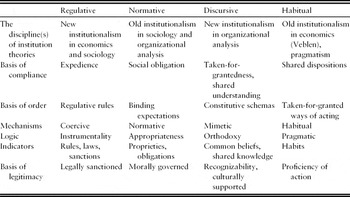
In Table 1 are the main postulates of different institution theories. In the this section, I will not go into the table's every detail, but instead I will focus on those differences between institutional theories that have a bearing on my main argument.

The regulative view concentrates mainly on legally sanctioned and other quite formal rules. These are seen to coerce individuals to behave in line with institutional ends because it is instrumentally rational for actors to do so (mainly due to fear of sanctions). Normative theorists argue that instrumental rationality is usually not applicable whenever moral issues enter the picture – and in the cases of institutions such issues always do enter in. These institutional norms weigh on actors as moral obligations that have to be fulfilled. Discursive theorists, however, propose that even moral obligations are mainly cultural schemas. Therefore, they emphasize the nature of institutions as knowledge schemas that are common beliefs about the nature of social roles and action situations. It is an inherent property of the human psyche to form routines whenever these beliefs are taken as the orthodox conception of the social world. Hence, actors tend to do as they believe others do (this is the mimetic aspect) and as they think has always been done.
Pragmatists would argue that one should not overdo the ‘thinking aspect’ in action; that is, even humans do not often think about what they are doing. Instead, they act on the basis of shared dispositions and reflect on their action if need be. Thus, rules are not necessary for the existence of institutions. It is the proficiency of habituated action in more or less stable environments that is important in understanding the reproduction of institutions. Furthermore, there is no deep divide between acting and thinking because a part of the thinking process is in responding sensorimotorally to different objects, whether in images only or also in overt actions. However, invoking the habitual dimension should not act as a catch-all term that ends inquiry (cf. Perraton and Tarrant, Reference Perraton and Tarrant2007). Habits can and should be studied, for example, through routines (Wood et al., Reference Wood, Quinn and Kashy2002) or by taking metaphorical thought into account (cf. Lakoff and Johnson, Reference Lakoff and Johnson1999).
From a pragmatist/Veblenian point of view, it can be maintained that institutions also have regulative, normative, and discursive aspects besides their habitual nature. Nevertheless, these other aspects are present to varying degrees and they tend to become habitual as well. One can, for example, have discursive notions that are habitual. In any case, it is useful to take into account the strengths of other institutionalisms. However, the habitual perspective is more comprehensive in its scope. This is because institutions are always based on habitual dispositions, whereas institutions sometimes can do without the regulative, normative, and discursive aspects. For example, in many Western societies institutional arrangements that are related to gender are nowadays mainly habitual (of course, gender also has a biological basis).Footnote 9 For the most part, these arrangements are not regulated by laws. It is not proper, either, to label some professions unsuitable for women on moral grounds. Nevertheless, there are taken-for-granted discursive scripts related to gender roles, and there are certainly habitual ways of doing things that are difficult to call into question. In practice, all institutional aspects are usually present and often in varying degrees. However, I am arguing that the presuppositions of other institutionalisms should be reconciled with habitual institutionalism (and not the other way around). The remainder of my article is devoted to this task, but this attempt can only be preliminary, owing to the vastness of the area that should be covered.Footnote 10
This reconciliation starts with treating the regulative institution theories’ view of calculative rationality, not as the paradigm case of rationality, but rather as its special, though empirically frequent, instance. After Parsons, sociologists have been willing to admit that calculative rationality characterizes economic conduct and is therefore a natural presupposition for economics. However, rational choice is not even the paradigmatic form of economic conduct, but rather its special case that is caused by the crises of action situations in which habitual action confronts obstacles due to the changes in the environment of action. Even in such situations, action is still based on habitual dispositions because habits make conscious deliberation possible. Moreover, deliberation is not exhausted by calculating utilities based on stable preferences; values, norms, and beliefs have to be taken into account. Furthermore, institutions cannot be theorized exclusively from the perspective of rational choice, since stable, co-operative relations do not develop out of purely egocentric calculations (cf. Beckert, Reference Beckert2002).
Atomistic views of society downplay the fact that actors are fundamentally social in their make-up, that is they take the attitudes of others toward themselves (see Mead, Reference Mead and Morris1934: 156; cf. Fontana et al., Reference Fontana, Tilman and Roe1992). Methodological individualism can be acceptable as a methodological postulate if it only aims at highlighting the importance of individual action. There is no reason to turn this postulate it into an ontological view according to which only individuals exist in society. Thus, one should not forget the social context of action but, in addition, it is useful to take notice of pragmatism's action theory, which constitutes a viable alternative to rational choice theories (cf. Beckert, Reference Beckert2003: 770). The latter have focused on discrete acts and their motives at the expense of the continuity of action. Instead, attention should be paid to the way in which motives relate to the ongoing action process of the individual, to his or her habits and to the larger institutional context. Having said this, one can admit that institutions also have such regulative aspects that affect action via different explicit rules, laws, and sanctions.
Normatively oriented theoreticians often argue that successfully internalized institutions do not need sanctions to back them up. Well and good, but values and norms are not independent of the meanings and the interpretations attached to them, that is independent of action processes. Value orientations are related to particular social contexts and to the projects that actors happen to be pursuing. These projects need not always be conscious, which means that knowledge is not the final word on the theme of meaning. The classical pragmatist emphasis on habitual action enables us to get rid of residual categories related to ‘tacit knowledge.’ Conscious deliberation regulates ongoing habitual conduct in problem situations but habits need not originally have an interpretation in consciousness. Furthermore, habits are not just dead routines since they are the very foundation on which reflection and consciousness are built on. Thus, the bodily and non-conscious aspects of action can be theorized more consistently in habitual institutionalism than in different social constructionisms, for example. It seems likely that most cognitive processes are not conscious – and this is not due to forgetfulness or ‘repression’. To state the matter differently, all meaning should not be reduced to knowledge – and this is why the actor is not transparent to himself.