1. Introduction
Tatian was ‘the Syrian’ to the Greeks and ‘the Greek’ to the Syrians.Footnote 1 The Oration’s defence of barbarian wisdom and demonstration of Greek learning represent its author as an authority in both worlds. Born in Assyria, Tatian studied in Rome and then, some time after Justin's death, returned to his native country. There his gospel, the so-called Diatessaron, achieved canonical status.Footnote 2
We do not know where or when Tatian wrote his gospel and the question of its original language neatly divides our sub-field. To consider a few leading lights, William Petersen and Jan Joosten argue for a Syriac origin while Ulrich Schmid and Matthew Crawford maintain that Tatian composed in Greek.Footnote 3 Unfortunately, much of this battle has been waged on methodologically dubious ground.
For the last century, students of Tatian's gospel have toiled under a paradigm now defunct. The hypothesis of an Old Latin Diatessaron that could furnish medieval harmonies with Tatianic readings set scholars scouring High German, Middle Dutch and other vernacular sources for parallels to early Syriac gospel readings.Footnote 4 The arguments of Daniel Plooij and William Petersen in favour of a Syriac origin are founded on these far-flung thirteenth- and fourteenth-century sources.Footnote 5 This inter-millennial, pan-Mediterranean parallelomania was brought to a halt by Ulrich Schmid. In a series of mutually corroborative studies, Schmid demonstrated that the vernacular harmonies are dependent for their Tatianic content on the thoroughly Vulgatised text tradition of Codex Fuldensis.Footnote 6 The supposed Diatessaronic readings found therein were just so many apophenies.
Apart from studies dependent on such vernacular witnesses, most of the composition language debate has concerned a tiny Greek fragment found at Dura Europos. Long supposed to be the only surviving piece of Tatian's Diatessaron, Dura Parchment 24 has been marshalled in support of both Greek and Syriac priority.Footnote 7 I have argued elsewhere that the Dura fragment is not a witness to Tatian's work.Footnote 8 In any case, the evidence furnished by these fifteen partially preserved lines has hardly generated consensus.
We must reach back to the likes of Theodor Zahn and Adolf Harnack for treatments of the issue derived only from Diatessaronic sources we still recognise as such.Footnote 9 However, these scholars laboured before (Ps.-)Ephrem's Commentary – our most important source for Tatian's gospel – had been recovered in Syriac.Footnote 10 New data, improved methods, and an old controversy cry out for fresh analysis.
Similarly, the relative priority of the Diatessaron and the Old Syriac gospels is a matter yet unresolved. Recent treatments of the issue argue in opposite directions.Footnote 11 These questions are interrelated and the resolution of either would provide the critic with a badly needed methodological control. In our current state, scholars should be wary of taking either position as given.
Such puzzles are not solved with a single piece. Nevertheless, a unique arrangement of the evidence at Luke 19.4 favours one solution over another.Footnote 12 The data ad locum are best explained by the supposition that Tatian composed his gospel in Greek and this circulated in the east before the Syriac ‘Separated Gospels’.Footnote 13
2. Sycamore: Text and Translation
In Luke 19.4, Zacchaeus climbs up in a ‘sycamore tree’. Probably the Ficus sycomorus is envisioned here but, as noted below, this occasioned some confusion in antiquity. Six spellings of ‘sycamore’ are extant in Greek manuscripts at Luke 19.4. Since I am not interested in determining Luke's initial text, these variants concern us only as two groups: the omicron-spelling and the omega-spelling. The singular readings found in Codex Alexandrinus (A) and Leicestrensis (69) are unattested in Greek literature and can be dismissed as nonsense scribal errors.
Omicron Spellings
(1) συκομοραιαν EC F H M Rvid S V Y Γ Λ Ψ Ω
(2) συκομορεαν א B L Δ
Omega Spellings
(3) συκομωραιαν W E* Y G K U Π f 13
(4) συκομωρεαν D Q Θ
Singular Readings
(5) συκωμοραιαν A
(6) σιμοραιαν 69
The Latin, Coptic and Syriac offer three different approaches to translating the term. The Old Latin, Jerome's Vulgate and the Bohairic simply transliterate the Greek, producing arborem sycamorum and ⲥⲩⲕⲟⲙⲟⲣⲉⲁ respectively.Footnote 14 The Sahidic instead offers the equivalent ⲛⲟⲩϩⲉ or reads ⲃⲱ ⲛ̄ⲕⲛ̄ⲧⲉ, meaning ‘fig-tree’ (συκή).Footnote 15 The Syriac gospels adopt yet another translation technique.
3. Tasteless Fig(-Tree): The Syriac Gospel Tradition
The Syriac gospels survive in three recensions: Old Syriac, Peshitta and Harklean. Curiously, none of these opts for  as the Christian Palestinian Aramaic does in Luke 19.4 and the Peshitta uses for שקמה throughout the Hebrew Bible (e.g. Isa 9.10; Amos 7.14). Rather, all three Old Syriac gospel manuscripts, the Peshitta and the Harklean together read
 , i.e. ‘dull’ or ‘tasteless fig(-tree)’.Footnote 16 The same translation is attested by Ephrem of Nisibis (Fid. 25.14) and Jacob of Sarug.Footnote 17 Although the Greek συκόμ(ο/ω)ρ- (along with συκάμινος) is itself probably derived from the Semitic שקמה, the Syriac ‘tasteless fig-tree’ is transparently an attempt at etymology.Footnote 18 The translator has identified συκ- with συκῆ = ‘fig-tree’ and μωρ- with μωρός = ‘dull, foolish’. As Tjitze Baarda has already noted, this etymological translation requires the omega-spelling.Footnote 19
Gregory of Nazianzus and Cyril of Alexandria are the only patristic commentators to attest the omega-spelling at Luke 19.4. While Gregory mentions the episode only in passing (Or. 39.9), Cyril offers the following interpretation:
And [Zacchaeus] was small in stature, not only bodily but also spiritually; and he was not otherwise able to see [Jesus], except being raised up from the ground. And he ascended upon the sycamore (συκομωραίαν) which Christ was about to pass by. The word contains a riddle. For someone is not otherwise able to see Christ and to believe in him unless he be lifted up on the sycamore (συκομωραίαν), making foolish (μωράνας) the parts upon the earth: fornication, immorality, and the rest. Christ, it says, was about to pass by the sycamore (συκομωραίας), for travelling according to the conduct of the law – which is the fig-tree (συκῆν) – he chose the foolish things (μωρά) of the world – which is the cross and death. And all who take up his cross and follow in the conduct of Christ will be saved, accomplishing the law wisely. This person is a fig-tree (συκῆ) not producing figs (σῦκα) but foolish things (μῶρα), for the secret works of the faithful ones appear as foolish things (μωρία) to the Jews … (Commentary on Luke 72)Footnote 20
Like many patristic commentators, Cyril seems to have imagined Zacchaeus ascending a συκῆ – probably the Ficus carica.Footnote 21 More interesting for our purposes, one of only two commentators to attest the omega-spelling at Luke 19.4 also saw μωρός = ‘dull, foolish’ in συκομωραίαν.Footnote 22
Applied to food, μωρός connotes insipidity (LSJ i.4). In the gospels, for instance, μωραίνω applied to salt means ‘to become tasteless’ (Matt 5.13/Luke 14.34). The translator's use of  , rather than
 (cf. Peshitta Matt 7.26), suggests this ‘tasteless’ interpretation of μωρός.Footnote 23 A corresponding etymological analysis of ‘sycamore’ is also attested in Greek authorities. Strabo (Geogr. 17.2.4) and Pedanius Dioscorides (De materia medica 1.127) indicate that the name referred to the fruit's ‘dishonourable’ (ἄτιμον) or ‘unpalatable’ (ἄστομον) taste.Footnote 24
The critical editions of both Strabo and Dioscorides, however, print not the implied omega-spelling but the omicron. If the modern editors are correct, we should probably imagine these ancient authors reporting a popular etymology derived from a familiar word's phonology while writing the term according to its ‘standard’ spelling.Footnote 25 Unlike Strabo (but like Cyril), our Syriac translators encountered an unfamiliar word in writing.Footnote 26 There is, however, good reason to question the editors’ preference for the omicron-spelling here.
Preliminarily, the omicron is the predominant spelling throughout Greek literature. The Thesaurus Linguae Graecae proffers 111 results for the omicron-spelling but only six for the omega.Footnote 27 We should expect scribes to correct the text towards this standard spelling – as did the corrector of Codex Basilensis (E07) at Luke 19.4.Footnote 28
Of the four significant manuscripts extant for this portion of Strabo's Geographica, only a correction in a single manuscript (Marcianus gr. xi 6) evinces συκόμορον, the omicron-spelling.Footnote 29 On the other hand, two manuscripts give the omega-spelling (Athous Vatop. 655; Vaticanus gr. 482).Footnote 30 The final manuscript (Parisinus gr. 1393) and the first hand of the corrected Marcianus gr. xi 6 read συκώμορον – probably a scribal corruption of the omega-spelling.Footnote 31 On both internal and external grounds, the omega-spelling should be preferred for Strabo.Footnote 32
Likewise, Dioscorides’ text tradition is not univocal.Footnote 33 The fourth-century Oribasius quotes Dioscorides’ description of the sycamore verbatim. Instead of the omicron-spelling, however, Oribasius (without variation in his own manuscript tradition) attests the omega.Footnote 34 Although the divided external evidence for Dioscorides still favours the omicron-spelling, the same internal considerations adduced for Strabo favour the omega-spelling.Footnote 35 It is possible, therefore, that the omega-spelling and not the omicron belonged to the initial text of both authors.
Finally, ancient authorities associate the omicron-spelling with a different etymological analysis. Throughout his corpus, Galen consistently uses the omicron-spelling of sycamore.Footnote 36 In his On the Properties of Food, Galen gives the following etymology of the term:
μᾶλλον δ’ ἐν τῷ μεταξὺ μόρων τε καὶ σύκων αὐτὸν εἰκότως ἄν τις θείη. καί μοι δοκεῖ καὶ τοὔνομ’ ἐντεῦθεν αὐτῷ κεῖσθαι.
Indeed, one might reasonably place it between berries (μόρων) and figs (σύκων). And it seems to me that this name is given to it from this.Footnote 37
Thus, Galen explains that the name συκόμορον (omicron-spelling) is due to the fruit's resemblance to both the συκῆ (Ficus carica) and μόρoν. The latter term is used to describe the berry-like fruit of several different plants.Footnote 38 Galen himself typically uses μόρoν to refer to the fruit of the συκάμινος, his name for the Morus nigra (De alimentorum facultatibus libri 2.11).Footnote 39
After this, Galen rejects the etymology associated with the omega-spelling:
γελοῖοι γάρ, ὅσοι διὰ τοῦτό φασιν ὠνομάσθαι τὸν καρπὸν τοῦτον συκόμορα, διότι σύκοις ἔοικε μωροῖς.
Therefore, they are ridiculous who say that this is why this fruit was named ‘sycamore’, namely because it resembles tasteless/foolish (μωροῖς) fig-trees. (De alimentorum facultatibus libri 2.35)Footnote 40
Galen, who consistently reflects the omicron-spelling, considers absurd the etymology associated with the omega-spelling. For this Greek physician, συκόμορον apparently meant ‘fig-berry’ not ‘fig-tasteless’.
In sum, Cyril of Alexandria's use of the omega-spelling associates it with the ‘tasteless’ or ‘foolish’ etymology while Galen's discussion of the omicron-spelling associates it with ‘berries’. It follows that between the second and the seventh centuries, three Syriac translators rendered συκομωρ- with  = ‘tasteless fig(-tree)’. The entire Syriac gospel tradition, therefore, offers a single, distinctive translation that supports the omega-spelling against the omicron.
4. Deaf Fig(-Tree): (Ps.-)Ephrem's Commentary
The gospel commentary attributed to Ephrem is the ‘premier witness’ to Tatian's text.Footnote 41 This composite work survives in two recensions.Footnote 42 One is attested in the aforementioned Syriac manuscript (Chester Beatty 709) and the other in two Armenian copies.Footnote 43 Wherever extant, both must be consulted. At Luke 19.4, this most important witness to the Syriac Diatessaron gives a different name to the publican's perch.
Although in the initial citation (Ps.-)Ephrem refers to Zacchaeus’ perch only as a  /թզենի = ‘fig(-tree)’, the commentator proceeds with the following interpretation:
Therefore, Zacchaeus left behind the just law. And he climbed, in a symbol, a deaf fig-tree ( /ի խուլ թզենի) – a symbol of his blocked hearing (
 /խլացեալ լսելեացն նորա). And the symbol of his salvation was signified by his ascent. He left the depth below. And he climbed into the air in the middle to examine the exalted divinity. Then our Lord quickly brought him down from the deaf fig-tree (
 /ի խուլ թզենւոյ), and, in the symbol, from his behaviour, so that he would not remain in deafness (
 /ի խլութեան անդ). (15.21)Footnote 44
The Armenian խուլ թզենի = ‘deaf fig(-tree)’ differs from the vulgate ժանտաթզենի in agreement with the Syriac  = ‘deaf fig(-tree)’.Footnote 45 In both recensions of the commentary, the distinctive term
 /խուլ = ‘deaf’ is the stimulus for a couple lines of somewhat forced exegesis. ‘Forced’ because, in the text cited by the commentator, the tree rather than the earth is deaf. The commentator's initial interpretation of a salvific ascent would suggest the opposite. Alongside its repetition and treatment as self-evident, the phrase's awkward fit with the commentator's initial interpretation suggests that the operative term
 /խուլ = ‘deaf’ belonged to the commentator's Syriac Vorlage. This most important witness to Tatian's text, therefore, diverged from the rest of the Syriac tradition in reading
 = ‘deaf fig(-tree)’, not
 = ‘tasteless fig-tree’.Footnote 46
The significance of  = ‘deaf fig(-tree)’ is less clear. In biblical literature,
 is the equivalent of κωφός (e.g. Peshitta Matt 9.32; Mark 7.37) and the cognate חרשׁ (e.g. Peshitta Pss 42.18; 38.13). The phrase is not, therefore, an obvious etymological translation. Nor, of course, is it a transliteration. Here Baarda offers another key insight: the lexicographer Bar Bahlul glosses
 with
 = ‘deaf fig(-tree)s’.Footnote 47 The entry reads:

 [Syriac] According to [Ḥenanishoʿ] Bar Sero[shway] and Sergius [of Reshʿayna], Deaf Fig(-tree). [Arabic)]The unripe fig, the fig that does not mature.Footnote 48
The Syriac lemma is a transliteration of the Greek ὄλυνθος/ὄλονθος. This had a variety of fig-related uses in antiquity – including the connotation of prematurity.Footnote 49 For our purposes, it is sufficient that Bar Bahlul glosses the term as ‘deaf fig(-tree)s’ and defines it as an ‘unripe fig’. Whatever the sense of ὄλονθος in other speech communities, Bar Bahlul understood ‘deaf fig(-tree)s’ as a gloss for premature figs.Footnote 50
5. Unripe Fig(-Tree): Arabic Diatessaron
Our knowledge of the Arabic Diatessaron is comparatively elementary. It seems to have been translated in the ninth century from a Vulgatised Syriac exemplar.Footnote 51 Eight manuscripts survive from the twelfth to nineteenth centuries, but still we want for a critical edition.Footnote 52 At Luke 19.4, the Arabic Diatessaron does not give the expected جمّيزة = ‘sycamore’ or render  = ‘tasteless’ with a form of تفه as in Matt 5.13/Luke 14.34 at Arabic Diatessaron 25 or حمق in some of the Arabic gospels.Footnote 53 Rather, Marmardji's edition prints تينة فجّة = ‘unripe fig(-tree)’.Footnote 54
This is a sensible translation of  = ‘deaf fig(-tree)’ as Bar Bahlul understood the term. Alternative explanations introduce new difficulties: the Arabic's term for ‘unripe’, which agrees with (Ps.-)Ephrem as Bar Bahlul understandood
 = ‘deaf fig(-tree)’, is not a rendering of the Peshitta's
 = ‘tasteless’. The Arabic تينة corresponds to (Ps.-)Ephrem's
 but has no corresponding element in Ishoʿdad's
 (discussed below). Likewise, the Arabic is singular with (Ps.-)Ephrem rather than plural with Ishoʿdad. The simplest explanation is that the Arabic Diatessaron's تينة فجّة = ‘unripe fig(-tree)’ is a translation of
 = ‘deaf fig(-tree)’ as found in (Ps.-)Ephrem's Syriac Vorlage.
6. Unripe Fruits: Ishoʿdad, Bar Bahlul and Bar Salibi
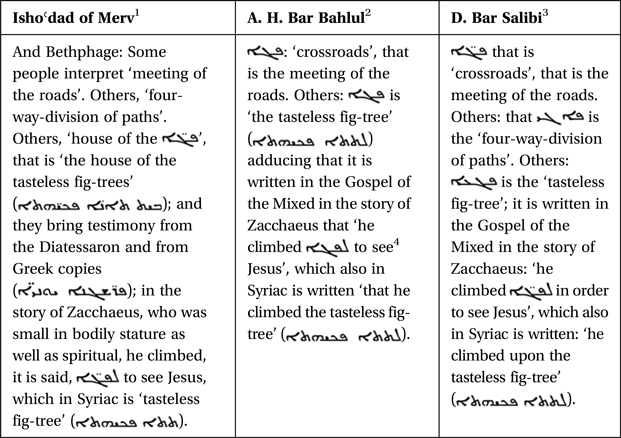
(Ps.-)Ephrem's Commentary and the Arabic Diatessaron are not our only witnesses to Tatian's text at Luke 19.4. Three additional Syriac authors contrast Tatian's gospel with the rest of the Syriac tradition at precisely this point of variation (Table 1).Footnote 55
Testimonia to  in Tatian's Diatessaron

1 My translation of the text from M. D. Gibson, ed., The Commentaries of Isho'dad of Merv, vol. ii (Horae Semiticae 6; Cambridge: Cambridge University Press, 1911) 134–5.
2 Text from Hassan bar Bahlul, Lexicon Syriacum, vol. ii (ed. R. Duval; Paris: Leroux, 1901) 1486.
3 Text from A. Vaschalde, Dionysii Bar Salibi Commentarii in Evangelia, vol. ii (CSCO 95 (Syr 47); Leuven: Imprimerie Orientaliste, 1953) 2. Latin translation in A. Vaschalde, Dionysii Bar Salibi Commentarii in Evangelia: interpretatus est, vol. ii (CSCO 98 (Syr 49); Leuven: Imprimerie Orientaliste, 1953) 1.
4 The text reads  but I translate the emendation
 .
These authors ascribe  to Tatian's gospel at Luke 19.4. The sense of this term is not difficult to ascertain: Bar Ali and Bar Bahlul, the ninth- and tenth-century lexicographers, give similar glosses for
 . Bar Ali reads, ‘The unripe that has no taste, unripe, and did not mature.’Footnote 56 Bar Bahlul, before giving the Syriac definitions presented above, reads, ‘The unripe that did not ripen, did not mature’ and ‘[Syriac] According to [Henanishoʿ] Bar Sero[shway] [Arabic] Henna Blossom.’Footnote 57 Likewise, Eliya of Nisibis defines פגא as ‘unripe [fruit]’.Footnote 58 Marcus Jastrow glosses the Aramaic cognate פגה as ‘hard, underdeveloped berry, fig, date’ and his examples suggest prematurity (e.g. b. Sanh. 107a). Finally, the Arabic cognate فِجّ means unripe or immature. Although its purported occurrence in Tatian's version of Luke 19.4 suggested to these commentators that
 referred to Zacchaeus’ sycamore, our sources for the term's conventional use indicate that it picked out premature fruit, including that of the fig-tree.
The use of the plural  in Ishoʿdad and Bar Salibi will prove instructive. Surely they did not envision Zacchaeus ascending multiple trees. Rather,
 refers to the fruit itself. Tatian, according to these authors, depicted Zacchaeus climbing into the ‘unripe fruits.’
These three testimonia are genetically related but the shape of their stemma is debatable. Dionysius Bar Salibi, the latest of the three, agrees with Ishoʿdad against Bar Bahlul on the plural of  and in situating the testimony in a comment on Matt 21.1. Bar Salibi's first set of glosses, however, agree with Bar Bahlul against Ishoʿdad. Furthermore, Bar Salibi and Bar Bahlul both attribute the reading to the ‘Mixed Gospel’ rather than the Diatessaron (as in Ishoʿdad).Footnote 59 This pattern of alternating alignment can be explained if Bar Salibi is an independent witness to an earlier tradition or if he meticulously conflated Ishoʿdad and Bar Bahlul. Since it is unclear what would motivate the latter, the former seems more likely.Footnote 60 Alas, Bar Salibi provides no information not attested in an earlier author and my argument does not depend on either judgement.
Ḥasan Bar Bahlul, a tenth-century lexicographer, cites Tatian's gospel not in a comment on Matthew (as in Ishoʿdad and Bar Salibi) but in a lexical entry for  .Footnote 61 Bar Bahlul often cites his authorities by name and Ishoʿdad never appears among them.Footnote 62 Rather, both authors attribute the Diatessaronic tradition to ‘others.’ Furthermore, Bar Bahlul elsewhere evinces independent access to traditions about Tatian's gospel.Footnote 63 Bar Bahlul is probably, therefore, an independent witness to a common (lost) source for the
 tradition – as indeed suggested by our consideration of Bar Salibi.
Most of the differences between Ishoʿdad's testimony and Bar Bahlul's are relatively insignificant. First, Ishoʿdad gives  in the plural while Bar Bahlul uses the singular. Since the singular stood atop the entry in Bar Bahlul's lexicon and the Syriac plural is marked here only by a syāmē, Ishoʿdad's plural (supported by Bar Salibi) is probably the earlier form. Second, Ishoʿdad refers to Tatian's gospel according to the Greek name
 while Bar Bahlul (supported by Bar Salibi) uses the Syriac title
 = ‘The Mixed Gospel’. Finally, Bar Bahlul omits Ishoʿdad's claim that ‘Greek copies’ corroborate Tatian's use of
 . This line is perplexing, and it is easy to imagine Bar Bahlul dropping it from his lexicon (as did Bar Salibi). We will return to consider one interpretive implication of Bar Bahlul's probable independence from Ishoʿdad, but first we must treat our oldest and most informative witness to this tradition.
Ishoʿdad of Merv was a ninth-century bishop of Ḥdatta and the author of commentaries on the Old and New Testaments. He introduces Tatian's gospel at the beginning of his commentary on Mark by rehearsing Eusebius’ account of its origin and identifying the Diatessaron as the object of Ephrem's commentary.Footnote 64 Throughout his corpus, Ishoʿdad cites the Diatessaron six additional times as a source for variant gospel readings.Footnote 65 Among these we discover our etymology for ‘Bethphage’ containing a testimony about Tatian's text at Luke 19.4 (see Table 1). The following excerpt is especially relevant:
Others, ‘house of the  ’, that is ‘the house of the tasteless fig-trees’ (
 ); and they bring testimony from the Diatessaron and from Greek copies (
 ); in the story of Zacchaeus, who was small in bodily stature as well as spiritual, he climbed, it is said,
 to see Jesus, which in Syriac is ‘tasteless fig-tree’ (
 ).Footnote 66
Thus Ishoʿdad apparently contradicts (Ps.-)Ephrem on the text of the Syriac Diatessaron. Tatian's gospel, according to Ishoʿdad, read  instead of
 = ‘deaf fig(-tree)’ in the Zacchaeus pericope.Footnote 67 This is, of course, not a fatal objection to the credibility of either Tatianic witness. Rendel Harris and Tjitze Baarda acknowledge the contradiction and make conjectures concerning the evolution of Tatian's text.Footnote 68 However, an interpretation that reconciles (Ps.-)Ephrem with Ishoʿdad would be heuristically preferable. I offer one below.
Curiously, Ishoʿdad reports that ‘others’ have cited the Diatessaron and ‘Greek copies’ ( ) in support of one and the same Syriac reading. Are these ‘Greek copies’ manuscripts of Tatian's gospel or manuscripts of Luke? That Ishoʿdad frequently cites variant readings from the Greek text of the gospels but does not elsewhere use the language of ‘copies’ (
 ) might favour the first interpretation – but we should leave this unresolved.Footnote 69 How, in either case, could any ‘Greek copies’ possibly attest the Syriac term
 ?Footnote 70 Ishoʿdad's testimony demands a diachronic explanation.
A simple solution to both problems is that  reflects a Syriac commentator's ad hoc translation of a Greek text. The term
 , ex hypothesi, never stood in a Syriac Diatessaron but was, rather, some earlier commentator's gloss for a Greek noun in Tatian's gospel and some copies (of either the Diatessaron or Luke). Therefrom Ishoʿdad, Bar Bahlul and Bar Salibi derived their common testimony. Indeed, (Ps.-)Ephrem's Commentary provides a neat analogy. In five places, the Ephremic commentator presents a reading from ‘the Greek’ in Syriac. This also, according to Crawford, probably refers to a Greek Diatessaron.Footnote 71 Such a reconstruction accounts for the attribution of a Syriac word to ‘Greek copies’. Likewise, it explains Ishoʿdad's ascription of this tradition to ‘others’. Most importantly, it erases the conflict between our two witnesses to the Syriac Diatessaron.
Finally, if Ishoʿdad, Bar Bahlul and Bar Salibi are indeed copying independently from a common source, the shared contrast of  with ‘the Syriac’ belongs to that earlier commentator. This means that the Syriac source, working from a Greek text of Tatian, elected to use the Syriac
 and pointedly contrast this with
 = ‘tasteless fig-tree’, despite believing them to be synonymous. What would inspire a commentator conscious of the conventional translation (
 ) and believing the words to be synonymous to select a different term? Since the omicron- versus omega-spelling is the only variation in the Greek tradition of Luke and ‘tasteless fig-tree’ is an etymological translation of the omega-spelling, we might infer that the omicron-spelling lay before Ishoʿdad's source. The unknown commentator, ex hypothesi, selected
 precisely to contrast the Greek's omicron-spelling with the conventional omega-spelling. As I argue below, there are yet stronger reasons to identify
 (and also
 ) with the omicron-spelling.
7. The Text of Tatian's Gospel
(Ps.-)Ephrem's and Ishoʿdad's ostensibly contradictory testimonia to Tatian's gospel have an underlying unity. Both  and
 refer to premature fruit – including that of the fig-tree. Two translators, therefore, independently opted not to use
 with the Old Testament Peshitta or
 with the Syriac gospel tradition. Rather, they selected two roughly synonymous terms to refer to Zacchaeus’ perch. How do we explain this remarkable coincidence?
First, as noted above, the omicron-reading suggested μόρoν to ancient readers. That is, in συκόμορ- readers saw ‘fig-berry’. This, I propose, accounts for the use of  in the plural. Ishoʿdad's
 = ‘unripe fruits’ refers specifically to fruit, not a tree. The berry is, of course, fruit and, in attempting to render the omicron-spelling etymologically into Syriac, Ishoʿdad's source selected a fruit word.
What, however, of the prematurity implied by both terms? None of the etymological analyses considered above explicitly associates either spelling of ‘sycamore’ with prematurity. There is, however, evidence of such an association in antiquity. Significantly, this appears in one of only two surviving Greek texts that use μόρoν to refer to the fruit of the συκομορ- (as opposed to the συκαμίνος). A botanical lexicon attributed to Galen glosses ξάνθης σπέρμα = ‘seed of the pale [sycamore]’ as ἄωρα μόρα συκομορέας = ‘unripe berries of the sycamore’.Footnote 72 There is, unfortunately, no further elaboration. Instead of modifying καρπός (cf. Luke 13.7), the lexicographer referred to the unripe (ἄωρα) fruit of the sycamore as μόρα. The association is intuitive: similar to berries, the unripe fruit of the fig and sycamore are small and round. At least for this ancient botanist, μόρα applied to συκομορ- suggested prematurity!
Three considerations, therefore, support attributing the omicron-spelling to Tatian's gospel. First, Ishoʿdad's source elected to use  despite familiarity with the conventional translation. Second,
 refers specifically to fruit as suggested by μόρoν. Finally, both
 and
 signify prematurity. This too is suggested by μόρoν. It follows that two Syriac translators worked from a Greek text of Tatian that differed from the textual base of the Syriac gospel tradition.
8. The Original Language of Tatian's Gospel
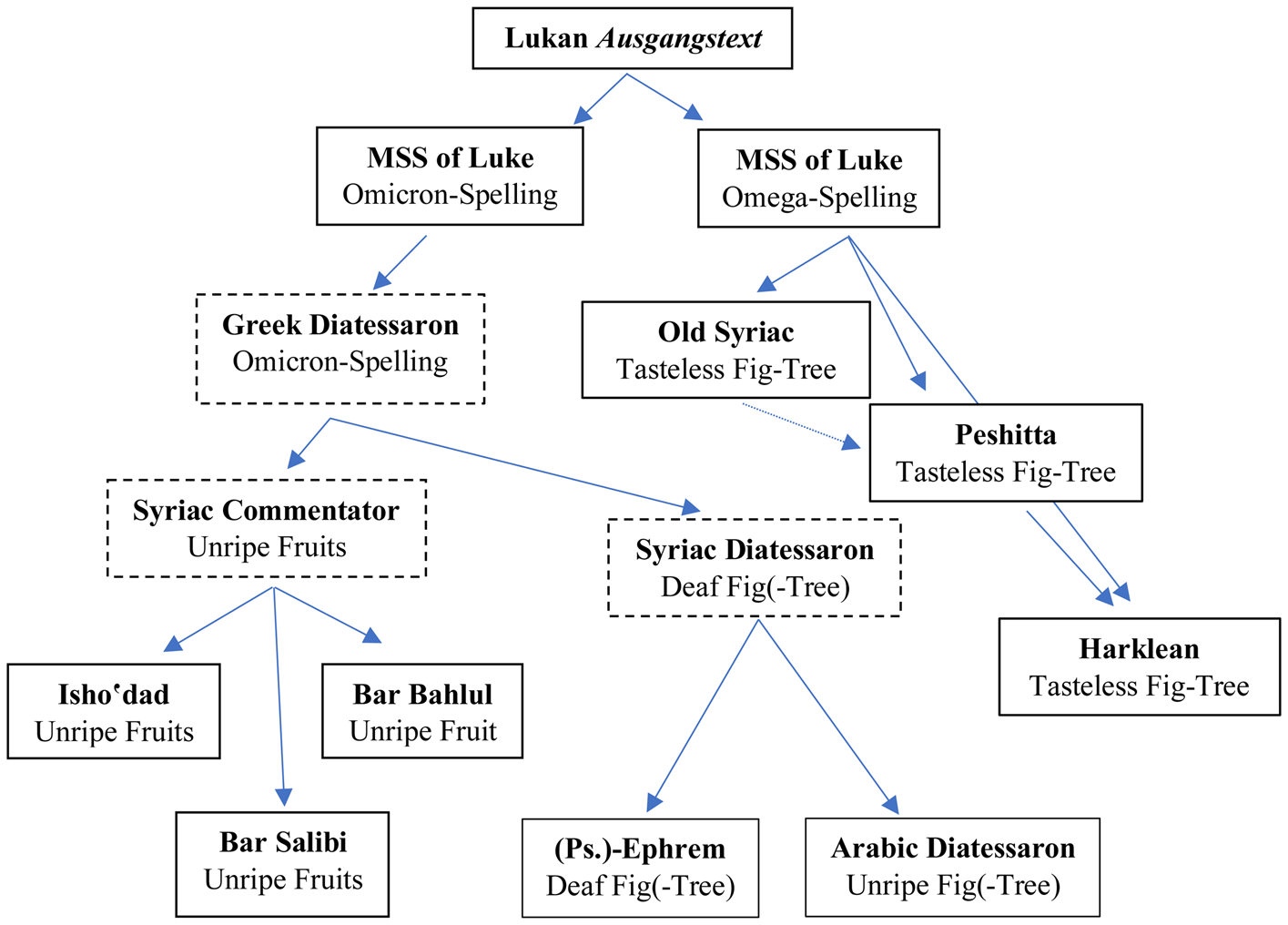
The omicron-spelling of sycamore is probably the least interesting textual variant ever attributed to Tatian's gospel. The unique arrangement of witnesses to this supremely unremarkable reading, however, supports one solution to the sub-discipline's most intransigent crux. A local stemma for the Syriac of Luke 19.4 will aid in summarising the results of the preceding investigation and clarify its consequences for our understanding of Tatian's gospel (Fig. 1).
Stemma for Syriac Translations of Sycamore

First, if Ishoʿdad's Diatessaronic testimony should be explained as an ad hoc translation, we need not attribute  to the Syriac Diatessaron. These contradictory testimonia to Luke 19.4, therefore, do not suggest that the Ephremic commentator, the Arabic translator and Ishoʿdad each used different editions of the gospel. Rather, the Syriac Diatessaron appears to have read
 as attested by (Ps.-)Ephrem and translated تينة فجّة in the Arabic Diatessaron.
Second, this reconstruction favours the chronological priority of Tatian's gospel to the Old Syriac gospels. If the Old Syriac furnished Tatian with the raw material for his harmony, we should expect  = ‘tasteless fig-tree’ in Tatian's text. Since the Syriac Diatessaron reflects a Greek variant reading other than that supported by the entire Syriac gospel tradition, the Syriac Diatessaron must have had independent recourse to textual minutia in the Greek.Footnote 73 On the uncontroversial supposition of some literary relationship between Tatian's gospel and the Old Syriac, Luke 19.4 supports Tatianic priority. Furthermore, Greek as the language of Tatian's composition (argued below) supports the posteriority of the Old Syriac gospels.
Third, the two Syriac terms attributed to the Diatessaron reflect a single and distinctive Greek reading. This suggests that the same Greek text of Tatian's gospel circulated long enough to reach two Syriac translators independently. The enduring circulation of Tatian in Greek is itself a novel result. For instance, it lends credence to Crawford's aforementioned proposal that Ephrem's ‘Greek’ referred to a Greek edition of Tatian's gospel.Footnote 74 It may likewise account for Theodore Bar Koni's ascription of the Diatessaron to  = ‘Tatian the Greek’ (Liber scholiorum, Siirt Recension 8.39).Footnote 75 Bar Koni is the first Syriac author to mention Tatian and, although he knows of Tatian's ‘Mesopotamian’ provenance (Liber scholiorum Memra, Siirt Recension 11.39), calls him ‘the Greek’.Footnote 76 Since there is no evidence that any work of Tatian other than the Diatessaron ever circulated in the Syriac-speaking east, the enduring circulation of Tatian's gospel in the Greek language might account for this curious appellation.
Fourth, this reconstruction supports an original Greek for Tatian's Diatessaron. My stemma – assuming a Greek original – presents the most parsimonious reconstruction. Alternative genealogies introduce certain difficulties: if Tatian composed in Syriac we must suppose that a subsequent Greek translation of Tatian's Syriac recreated the omicron-spelling against the local (as evinced by the Syriac gospel tradition) omega-spelling of sycamore. Moreover, this secondary Greek translation of Tatian would then need to reach another Syriac translator who was ignorant of Tatian's original Syriac rendering.
More plausibly, Tatian composed in Greek and it was in this form that his gospel circulated widely enough to reach both Latin Fulda and Syriac Edessa. On this supposition, the Syriac need not be retro-translated into the omicron-spelling. Furthermore, the ignorance of our secondary Syriac translator is more easily understood if the Greek, not the Syriac, was the more prominent form of Tatian's gospel.
Reconstructing the transmission of a text so poorly preserved is discouraging work. There is much we will probably never know about Tatian's gospel. Yet minutiae so apparently insignificant as an omicron instead of an omega can offer unexpected insights. Parallel cases will be needed to bolster my arguments, but the omicron-spelling is one more piece in the Tatianic puzzle.
 = ‘wounded fig-tree’ and then contrasts its fruit not with
 = ‘flavourful/reasonable’ as in On Faith 25.14 but with
 = ‘eloquent’ (4.41–2). This is more clearly the opposite of
 = ‘deaf/mute’ than
 = ‘tasteless/foolish’. E. Beck, ed., Des heiligen Ephraem des Syrers Hymen de Nativitate (Epiphania) (CSCO Scriptores Syri 186/82; Leuven: Imprimerie Orientaliste L. Durbecq, 1959) 29.
 is used for μωραίνω at Matt 5.13/Luke 14.34 and ἄναλον γένηται at Mark 9.50.
 , suggests that the Syriac translators were unfamiliar with the Greek term. This is corroborated by Ephrem's identification of
 with the fig-trees in Matt 21.18 (Faith 25.14) and Mark 11 (Virginity 35.2). By contrast, Strabo and Dioscorides describe distinctive features of the Ficus sycomorus.
 refers to an unfruiting tree (13.48). Presumably, Sahdona uses the adjective
 = ‘deaf/mute’ to connote lack of productivity. A. de Halleux, ed., Martyrius (Sahdona) oeuvres spirtuelles, vol.

 = ‘Separated Gospels’ as opposed to its omission by ‘the Evangelist’. Bar Bahlul, Lexicon Syriacum,
 = ‘fig-tree’ in his comment on Luke 19. Gibson, Commentaries of Ishoʿdad of Merv,
 is a transliteration of φηγός = ‘oak’ but gave up on explaining this element of Ishoʿdad's testimony. Baarda, ‘The “Foolish” or “Deaf” Fig-Tree’, 175. This is not supported in any Greek (or versional) witness to Luke. Additionally, it makes Ishoʿdad's initial gloss
 = ‘tasteless fig-trees’ for
 incomprehensible.