Introduction
Due to dissolution of the geology department that maintained the paleontology collection at Allegheny College in Meadville, Crawford County, Pennsylvania, in 2023, a sandstone slab (Fig. 1.1, 1.2) with three specimens of the echinoid Hyattechinus pentagonus Jackson, Reference Jackson1912, including the holotype (CM 62984, Fig. 1.3) and two paratypes (CM 62985, Fig. 1.4; CM 62986, Fig. 1.5) have been transferred to the Section of Invertebrate Paleontology, Carnegie Museum of Natural History, Pittsburgh, Pennsylvania. Also transferred was a second slab of similar lithology containing additional Hyattechinus specimens (not figured in this work). All these specimens consist of natural external molds of the aboral (upper) surfaces. We have taken this opportunity to refigure the holotype slab with new photographs (Fig. 1) and discuss the geologic setting in which they occur.
Slab of fine-grained sandstone with natural molds of the type specimens of Hyattechinus pentagonus Jackson, Reference Jackson1912 from the “Drake Well Formation,” Meadville, Crawford County, Pennsylvania: (1) front and (2) back of the slab containing (3) the holotype, CM 62984, (4) a nearly complete specimen, paratype, CM 62985, and (5) a partial specimen, paratype, CM 62986. Exact collecting locality and stratigraphic level of the specimen within the formation are unknown. The back side of the slab (2) shows Jackson’s original handwritten specimen label that reads, “Alleghany [sic] College, Meadville Penn Lepidechinus sp. nov. Waverly Group. Meadville Penn This not only is a new species but is most interesting in its characters of interambulacra & periproct. Very very choice. R.T. Jackson, July 1905.” Notice that the name “Lepidechinus sp. nov.” is crossed out and “Hyattechinus pentagonus sp. nov.” is printed beside it.

Jackson designated the most complete of the three specimens (Fig 1.3) on the first slab as the holotype of H. pentagonus in his description and figure captions (Jackson, Reference Jackson1912, p. 295–296, pl. 24, fig. 1). The other two specimens on this slab (Fig. 1.4, 1.5) were designated as paratypes in the caption for Jackson’s pl. 24, figs. 2, 3 where the word “Paratypes” appears to have been added almost as an afterthought. Nowhere else in Jackson (Reference Jackson1912) are they described as types of any kind. The holotype slab represents the only known type specimens in the Allegheny College paleontology collection (L.B. Whitenack, personal communication, 2024). None of the specimens on these slabs received a catalog, accession, or specimen number while in the Allegheny College collection.
In describing the species, Jackson stated that it was “the most remarkedly pentagonal of any known regular sea-urchin” (Jackson, Reference Jackson1912, p. 296). Robert S. Breed, Professor of Biology at Allegheny College from 1902 to 1913 (Conn, Reference Conn1956), loaned the slab with the holotype to Jackson for study and provided two additional specimens that Jackson reposited at the Harvard Museum of Comparative Zoology and designated as paratypes. One specimen is a natural external mold of the aboral surface (previously MCZ 3107; Jackson, Reference Jackson1912, pl. 24, fig. 4, pl. 25, figs. 1, 2), and the other is an external mold of the oral surface (previously MCZ 3108; Jackson, Reference Jackson1912, pl. 19, fig. 8). These paratypes were subsequently recatalogued and are identified as MCZ:IP:101916 and MCZ:IP:101917, respectively (GBIF.org, 2024).
Materials
Repositories and institutional abbreviations
The specimens included in this note are reposited in these institutions: Carnegie Museum of Natural History Section of Invertebrate Paleontology (CM), Pittsburgh, Pennsylvania, USA; Harvard Museum of Comparative Zoology Department of Invertebrate Paleontology (MCZ:IP), Boston, Massachusetts, USA.
Geological setting
Locality information
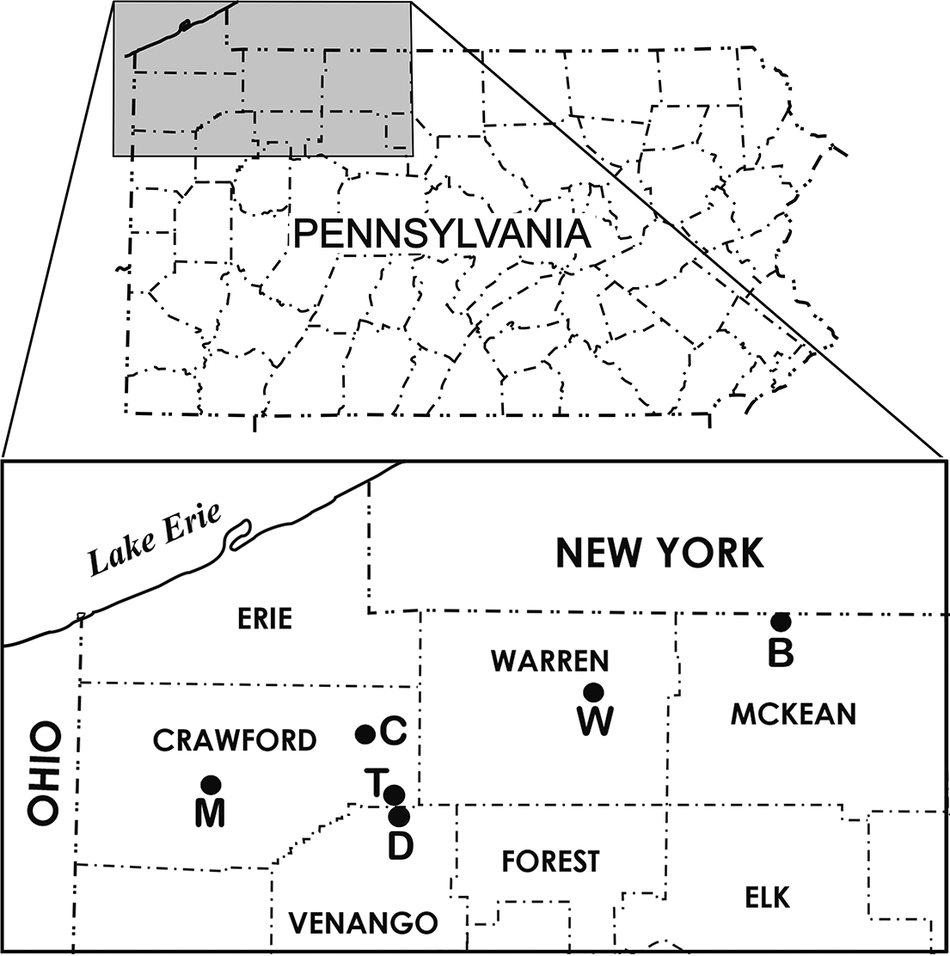
Professor Breed either neglected to give Jackson the exact location(s) where the specimens were collected or was unaware of their precise locations because they were collected by other parties. It is also possible that Jackson decided not to divulge the locations to keep them proprietary. The only published information on the stratigraphy and locality was “Waverly Group, Lower Carboniferous, Meadville, Pennsylvania” (Jackson, Reference Jackson1912, p. 296). Meadville, the county seat of Crawford County, Pennsylvania, is situated in the northwestern part of the state. Figure 2 shows the location of Crawford County in Pennsylvania and the locations of Meadville and other counties and towns mentioned below.
Map of Pennsylvania counties with an enlarged portion showing the locations (black circles) mentioned in the text and in Fig. 4. B = Bradford; C = Centerville; D = Drake Well Park; M = Meadville; T = Titusville; W = Warren.

Stratigraphy
Although there was previously minimal information available on the stratigraphy and locality for H. pentagonus, recent work on the Famennian–lower Carboniferous boundary section in northwestern Pennsylvania (Baird et al., Reference Baird, Jeffry, Gryta, McKenzie, Over, Pulawski, Sullivan and Harper2009a, Reference Baird, Over, Sullivan, McKenzie, Schwab and Dvorakb, Reference Baird, McKenzie, Harper, Sullivan, Deakin and Lash2013, Reference Baird, Harper, Over, Hannibal, McKenzie, Tesmer, Ver Straeten, Over and Woodrow2023) has provided a more complete understanding of these important aspects. This includes a thorough discussion of the “Drake Well Formation,” the formation that appears to be the primary, if not the sole, stratigraphic unit in which H. pentagonus can be found.
Harper (Reference Harper, Harper and Fleeger1998, p. 67) proposed the name “Drake Well Formation” as a provisional unit based on lithology to replace Caster’s (Reference Caster1934) “Kushequa Member,” which was based solely on fossil zonation (the “Kushequa” in the type locality in McKean County, Pennsylvania, is lithologically indistinguishable from the underlying Riceville Formation according to Baird et al., Reference Baird, Jeffry, Gryta, McKenzie, Over, Pulawski, Sullivan and Harper2009a). The unit was named for the historic Drake Well at Drake Well Museum and Park in Venango County, Pennsylvania, about 1.6 km southeast of Titusville, Crawford County (Fig. 2). It was described from a single outcrop (the type section) and from subsurface geophysical data obtained from two gamma-ray log transects through northwestern Pennsylvania. The type section occurs in a railroad cut along the Oil City and Titusville Railroad at the Drake Well Station within the park grounds. The outcrop consists of about 4 m of sandstone with a few thin interbedded dark gray shales and fissile siltstones, underlain by about 3 m of darker colored mudrocks. The entire formation is about 18 m thick in the vicinity of the Drake Well, but much of it is covered by debris and vegetation.
Baird et al. (Reference Baird, Harper, Over, Hannibal, McKenzie, Tesmer, Ver Straeten, Over and Woodrow2023) described the lithology of the “Drake Well Formation” as alternating siltstones, sandstones, and gray shales with coquinitic beds and lenses. In the Meadville area, two provisional members are recognized, the “Cora Clark Park Member” and the “Bennyhoof Shale Member” (Fig. 3; Baird et al., Reference Baird, Harper, Over, Hannibal, McKenzie, Tesmer, Ver Straeten, Over and Woodrow2023). Neither of these members has been recognized outside of central Crawford County. The formation overlies the Riceville Formation across much of northwestern Pennsylvania and is overlain by the Tidioute Shale across eastern Crawford, northern Venango, Forest, and Elk and parts of Warren and McKean counties; it is overlain by the Cussewago Sandstone in central Crawford and southern Erie counties (Fig. 4).
Generalized stratigraphic section from the upper beds of the Riceville Formation to the lower part of the Cussewago Sandstone in the Meadville area, modified from Baird et al. (Reference Baird, Jeffry, Gryta, McKenzie, Over, Pulawski, Sullivan and Harper2009a, fig. 4). The section was created from composite profiles of outcrops a few miles north of Meadville. Notice the prominent discontinuities separating the “Drake Well Formation” from adjacent strata.

East to west correlation of Upper Devonian (in part) and lowermost Mississippian (L.M.) stratigraphy from northeastern Ohio through northwestern Pennsylvania with inferred gaps based on ammonoid, conodont, and palynomorph biostratigraphy. Conodont zones (on the left side of the diagram) are included for reference. Relative positions of the Ohio–Pennsylvania boundary (OH/PA) and key cities at the top of the figure provide longitude context for localities referred to in the text. Simplified from Baird et al. (Reference Baird, Harper, Over, Hannibal, McKenzie, Tesmer, Ver Straeten, Over and Woodrow2023, text-fig. 4).

Recognition of the “Drake Well Formation” by Baird et al. (Reference Baird, Jeffry, Gryta, McKenzie, Over, Pulawski, Sullivan and Harper2009a, Reference Baird, Over, Sullivan, McKenzie, Schwab and Dvorakb; Reference Baird, McKenzie, Harper, Sullivan, Deakin and Lash2013; Reference Baird, Harper, Over, Hannibal, McKenzie, Tesmer, Ver Straeten, Over and Woodrow2023) in outcrops around Meadville extended the unit westward from its type locality to the Meadville area, a distance of about 40 km. In discussing the “Drake Well Formation” in the Meadville area (Fig. 3), Baird et al. (Reference Baird, Jeffry, Gryta, McKenzie, Over, Pulawski, Sullivan and Harper2009a, p. 22) described, “fully articulated echinoids in this interval at a number of Meadville-area localities. Both Hyattechinus pentagonus and Hyattechinus rarispinus [Jackson, Reference Jackson1912] have been found in the lowest 1.5 meter interval of this unit … Hyattechinus pentagonus usually occurs in clusters on bedding surfaces; many of the great Hyattechinus clusters in university and museum displays are probably from this interval.” As a result, Thompson and Ewin (Reference Thompson and Ewin2019, p. 808) considered the “Drake Well Formation” with its abundance of well-preserved Hyattechinus spp. to be part of a widespread late Famennian Lagerstätte that occurred along the southern margin of Laurussia and possibly along the margin of the Rheic Ocean.
Conodonts recovered from the lower beds of the “Drake Well Formation” include Bispathodus aculeatus aculeatus (Branson and Mehl, Reference Branson and Mehl1934) and Polygnathus communis communis (Branson and Mehl, Reference Branson and Mehl1934), implying that the formation correlates to the aculeatus Zone (upper Famennian, the so-called “Strunian Stage” of some authors; see Fig. 4). Baird et al. (Reference Baird, Harper, Over, Hannibal, McKenzie, Tesmer, Ver Straeten, Over and Woodrow2023) also documented Bispathodus aculeatus aculeatus, Bispathodus aculeatus anteposicornis (Scott, Reference Scott1961), Bispathodus stabilis (Branson and Mehl, Reference Branson and Mehl1934), and “Icriodus” raymondi Sandberg and Ziegler, Reference Sandberg and Ziegler1979 from the upper part of the “Drake Well Formation” near Centerville, Crawford County (Fig. 2), which they considered indicative of the same zonal interval (Baird et al., Reference Baird, Jeffry, Gryta, McKenzie, Over, Pulawski, Sullivan and Harper2009a, Reference Baird, Over, Sullivan, McKenzie, Schwab and Dvorakb; Reference Baird, Harper, Over, Hannibal, McKenzie, Tesmer, Ver Straeten, Over and Woodrow2023). Documentation of Bispathodus aculeatus anteposicornis (Scott, Reference Scott1961) from a portion of the “Drake Well Formation”-equivalent Knapp Formation (Oliver et al., Reference Oliver, de Witt, Dennison, Hoskins, Huddle and Oswald1967; Fig. 4) similarly suggests that this unit is within the aculeatus Zone or a higher zonal level (Baird et al., Reference Baird, Jeffry, Gryta, McKenzie, Over, Pulawski, Sullivan and Harper2009a, Reference Baird, Over, Sullivan, McKenzie, Schwab and Dvorakb). These data indicate that the “Drake Well Formation” is the eastern equivalent of the Cleveland Shale Member of the Ohio Shale in Ohio (Fig. 4), a black shale facies marking a period of anoxia during the global Dasberg extinction event.
An interesting locality that preserves Hyattechinus fossils occurs in the valley of Dick Run, a small stream that runs through Cora Clark Park in the southeastern corner of Meadville. This municipal park is the type locality for the “Cora Clark Park Member” (Fig. 3). It is probable that the specimens Professor Breed provided to Jackson were collected here or at one or more similar localities where streams have dissected the predominantly Lower Mississippian Meadville area succession into latest Devonian deposits. Baird et al. (Reference Baird, Jeffry, Gryta, McKenzie, Over, Pulawski, Sullivan and Harper2009a, Reference Baird, Over, Sullivan, McKenzie, Schwab and Dvorakb; Reference Baird, McKenzie, Harper, Sullivan, Deakin and Lash2013; Reference Baird, Harper, Over, Hannibal, McKenzie, Tesmer, Ver Straeten, Over and Woodrow2023) documented several localities around Meadville in addition to the Cora Clark Park locality.
Conclusions
This note documents the completed transfer of these specimens (as of November 2024) under CM accession number 39283. They have now been assigned original CM catalog numbers: holotype, CM 62984 (Fig. 1.3); paratype, CM 62985 (Fig. 1.4); and paratype, CM 62986 (Fig. 1.5). The subsidiary slab containing molds of H. pentagonus has been assigned CM 63480.
Researchers who would like to access these specimens may contact the Section of Invertebrate Paleontology, Carnegie Museum of Natural History via the online collections access form: https://carnegiemnh.org/research/ip-contact.
Acknowledgments
We thank L.B. Whitenack, Professor of Biology, for her care of the paleontological collection at Allegheny College and for reaching out to the Carnegie Museum regarding these specimens of H. pentagonus. Thank you to J. Cundiff, Curatorial Assistant of the Department of Invertebrate Paleontology, Harvard University Museum of Comparative Zoology, for information regarding the paratype specimens. We gratefully acknowledge G.C. Baird, whose work on the uppermost Devonian/Lower Mississippian stratigraphy of northwestern Pennsylvania provided the basis of our stratigraphy subsection. We also thank him for permission to use revised versions of his illustrations. We thank the editors and reviewers at the Journal of Paleontology (JOP) for their incisive and helpful comments, especially R. Mooi for alerting us to the paper by Thompson and Ewin. In particular, we appreciate the encouragement given by JOP editor J. Calede at the beginning of our manuscript drafting process. Finally, we extend our heartfelt thanks to A.D. Kollar, former Carnegie Museum of Natural History, Section of Invertebrate Paleontology Collection Manager until his passing in April 2024, for facilitating the specimen transfer. We thank him most of all for nearly 45 years of his dedicated care of the collection.
Competing interests
The authors declare none.
Data availability statement
Data corresponding to these specimens are available by contacting the Invertebrate Paleontology Section, Carnegie Museum of Natural History via the online collections access form: <https://carnegiemnh.org/research/ip-contact>