1 Introduction
Recent research into syntactic dialectology in Old English (Kroch & Taylor Reference Kroch, Taylor, Kemenade and Vincent1997; Ogura Reference Ogura1999; Hogg Reference Hogg, Curzan and Emmons2004, Reference Hogg, Kemenade and Los2006a; Ingham Reference Ingham2006) shows that linguistic variation has existed in English from the earliest times of the language. However, even a cursory glance at the literature on historical dialectology reveals that it is the Middle English period which has most often been addressed by linguists. The fact that research has focused almost exclusively on this period should perhaps come as no surprise. Strang hailed Middle English as ‘par excellence, the dialectal phase of English’ (Reference Strang1970: 224), and for Milroy it was the period that ‘exhibited the greatest diversity in written language of any period before or since’ (Reference Milroy and Blake1992: 156). Indeed, for Milroy ‘the label “Middle English” does not refer to a coherent entity, but to a complex series of divergent, rapidly changing and intertwining varieties retrospectively seen as transitional between “Old English” and “Modern English”’ (Reference Milroy and Blake1992: 157).
Reference books dealing with the history of the English language (Milroy Reference Milroy and Blake1992: 156; Fennel Reference Fennel2001: 108–9; Hogg Reference Hogg, Hogg and Denison2006b: chapter 7) tend to agree that this diversity was less noticeable in both Old and Early Modern English. In Old English, this was due to the scarcity of available material and to the dominance of West Saxon, spoken in the southern part of England (with the exception of the Southeast, which had its own Kentish dialect), with West Saxon becoming the dialectal variety used in most prose texts extant today.Footnote 2 Despite the fact that the Old English language is – or has been considered – very limited and extremely homogeneous, especially in terms of dialect,Footnote 3 some evidence of other dialects exists, in a small number of documents listed by Toon (Reference Toon1992: 427). As for Early Modern English, most written evidence adopts the ‘standard’ variety of the London area, leaving us once again with a relatively homogeneous set of historical data. Thus Middle English stands out in historical dialectology as the period of the English language for which the most comparable texts remain at our disposal.
In spite of the scant research on Old English dialectology, it is generally acknowledged that there must have been dialectal variation from the very beginning, bearing in mind that from the fifth century onwards the island was populated by five different nations. And, indeed, the few available studies here confirm this. Toon (Reference Toon1992: 429–33), for example, has highlighted significant differences between the northern dialectal area (comprising Northumbrian and Mercian dialects) and the southern area (including West Saxon and Kentish). In this North−South divide, northern dialects are generally considered the linguistically more innovative ones, with more resistance to the incorporation of new forms observed in the South. It is generally assumed that innovation in these northern dialects stems from the eighth- and ninth-century Scandinavian invasions, while the southern dialects continue their own linguistic traditions, a point made by Milroy, who is tempted to ‘suggest that a history of relatively strong contacts with Danes and (to a lesser extent) Normans may be implicated here, and that traditional forms survived where these contacts were less strong’ (Milroy Reference Milroy and Blake1992: 181).
Those few studies available have observed dialectal differences at the levels of orthography, phonology and lexis. Grammar, and especially syntax, has remained almost wholly overlooked until recently, with little research carried out into syntactic dialectal variation. The reasons for this are firstly, that there are few texts in prose to base research on, and secondly, that the available data consist principally of Latin-based originals, which have generally not been considered entirely satisfactory for the study of syntax. In spite of these data-related problems, the aim of the present study is to assess whether the limited dialectological evidence for Old English allows us to argue in favour of different geographic variants from a syntactic perspective. In particular, I will pay attention to processes of relativization, as regards both the paradigm of relativizers and the position adopted by the relative clause within the main clause.
Following Milroy's suggestion, we might assume that in a situation of language contact there would be grammatical changes,Footnote 4 and that syntax, though neglected in the linguistic literature, would nevertheless have an important role to play in dialectal variation. Southern dialects, in particular West Saxon, were affected by external influences only later in their development, and thus show greater allegiance to their own traditions in the Old English period than their northern counterparts. In terms of the distribution of relativizers in West Saxon, Mitchell (Reference Mitchell1985: §2165) and Fischer et al. (Reference Fischer, Kemenade, Koopman and Wurff2000: 59), among many others, note the clear preference for the invariable relativizer þe (equivalent to PDE that) over the pronominal relativizers, both simple (se/seo/þat) and compound (seþe/seoþe/þatþe) (equivalent to PDE who/which), or the almost nonexistent relativizer zero (equivalent to PDE zero). As regards the position adopted by the relative clause, West Saxon shows a clear tendency against embedding (Carkeet Reference Carkeet1976; O'Neil Reference O'Neil1976). Therefore, assuming that northern dialects are different from southern ones, I would expect a different distribution of relativizers and differences in the position adopted by the relative clause with respect to West Saxon in those texts belonging to dialects which may have been influenced by language contact, that is, Northumbrian and Mercian.
The article is organized as follows. A description of the corpus (section 2) is followed by a brief revision of what little research has been done on syntactic dialectology in Old English, in particular on word order and negation (section 3). The following section illustrates the variation of relativizers, and the position that the relative clause has with respect to the main clause in the texts under analysis. Finally, concluding remarks are offered (section 5).
2 Description of the corpus
As noted above, the evidence illustrating the different dialects of Old English is very patchy, especially in the case of non-West Saxon dialects (see Hogg Reference Hogg, Hogg and Denison2006b: 355). However, a small number of such documents are included in the Helsinki Corpus of English Texts: Diachronic and Dialectal, and these have been used to obtain the data for the present study. In order to minimize internal variation and to avoid possible bias in the sample, the corpus has been kept as homogeneous as possible in terms of register, date and size. Thus, from the Helsinki Corpus we have selected excerpts of a comparable number of words from three prose biblical texts, all dating from the same period (950–1050). These are the Lindisfarne Gospels, classified as a Northumbrian text; the Rushworth Gospels, the part classified as a Mercian text; and, finally, the West Saxon Gospels, classified as West Saxon.Footnote 5 In the three cases only the fragments included in the Helsinki Corpus have been analysed. All of them are Latin-based originals, the former two glosses and the latter a translation.
Although Latin-based texts are generally not used in the study of syntactic variation, since they may rely too heavily on the original and hence reflect no variation of the language under study, in the case of Old English, excluding these texts would drastically reduce the available material.
Examples (3) and (4) below demonstrate that there are indeed differences in the selection of relativizers irrespective of the original.Footnote 6
The Lindisfarne Gospels were written in about the year 700, but not until the late tenth century did the English version appear, in Northumbrian dialect, adapted by Aldred of Chester-le-Street, a town close to Durham (for more information see Hogg Reference Hogg, Kemenade and Los2006a). This text is of greatest relevance here, since it is the most valuable evidence of the Northumbrian dialect of Old English.
The Rushworth Gospels are divided into two parts: the first comprises the Gospel of St Matthew (the section included in the Helsinki Corpus, and therefore the part analysed for the present research), part of the Gospel of St Mark and part of the Gospel of St John. The English version was made in Lichfield by a scribe named Farman, by the late tenth century, using spelling which has been classified as Mercian.Footnote 7
Finally, the West Saxon Gospels were ascribed to different priests, amongst them Ælfric of Eynsham. The English version of this text dates from the late tenth century and follows the orthographic conventions of West Saxon.
Hence my corpus contains texts representing three of the four traditionally recognized major Old English dialectal areas (Toon Reference Toon1992: 414–28; Hogg Reference Hogg, Kemenade and Los2006a), which distribute as follows:
(i) Northumbrian, spoken to the north of the river Humber;
(ii) Mercian, spoken in the area between the rivers Thames and Humber;
(iii) Kentish, spoken in the south-eastern area (Kent and part of Hampshire);
(iv) West Saxon, spoken in the rest of the southern area.
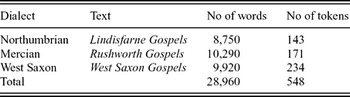
In total, the corpus contains ca. 29,000 words and has rendered 548 examples of relative clauses, as set out in table 1.
Description of the corpusFootnote 8

3 Dialectal variation in Old English syntax
Most studies of Old English language pay exclusive attention to West Saxon. Indeed, other dialects have seldom been studied. Nevertheless, some distinctive features characterizing the different dialects have been recognized. These features are mainly concerned with orthography, phonology and lexis, with most available regional indicators pertaining to one of these three. Far fewer regional indicators have thus far been identified in the fields of morphology and, especially, of syntax. To the best of my knowledge, the only corpus studies conducted to date on historical dialectology at the level of syntax concern word-order patterns and negative concord in Old English. The findings of these studies will be discussed in the following paragraphs.
With respect to word-order patterns, there is no agreement as to the unmarked word order in Old English, as noted by Denison (Reference Denison1993: 28) when he states that ‘whether Old English should be labelled SVO or SOV is far less clear’.Footnote 9 Kroch & Taylor (Reference Kroch, Taylor, Kemenade and Vincent1997) observe variation in Old English word orders and conclude that the most conservative dialects – southern dialects – show a variant of the IP-V2Footnote 10 type (like modern Yiddish and Icelandic), since movement of the finite verb to the second position of the clause is observed both in main and subordinate clauses. In the North, however, the verb-second constraint is of the CP-V2Footnote 11 type (also known as ‘the northern V2 grammar’), as in modern mainland Scandinavian, German and Dutch, in the sense that movement of the finite verb to the second position of the clause is only allowed in main clauses. Kroch and Taylor hypothesize that such a difference in the implementation of the verb-second constraint arises as a consequence of contact-induced simplification in the verbal agreement paradigm of the northern dialect.
As to the negative concord constraint, there is agreement that Old English was a negative concord language (see, for instance, Fischer et al. Reference Fischer, Kemenade, Koopman and Wurff2000: 54). Ingham (Reference Ingham2006), however, demonstrates that Old English texts provide clear evidence of a dialectal split in how negative concord was syntactically conveyed. He shows that West Saxon texts exhibit a marked preference for symmetrical use of the negative particle of Old English ne in clauses containing a negative indefinite (i.e. symmetry in negative concord) (example (1), from Ingham Reference Ingham2006: 241), as opposed to non-West Saxon texts, which indicate a clear preference for the asymmetric type of negative concord (Ingham Reference Ingham2006: 245) (example (2), from Ingham Reference Ingham2006: 241).
(1)

(2)

Regarding relativization, the available literature is not very illuminating in terms of dialects, and most information is based on descriptions of West Saxon. Therefore, my intention in the corpus analysis here is twofold. Firstly, I aim to analyse the differences among the selected texts concerning the choice of relativizers and the position that the relative clause occupies with respect to the main clause. Additionally, I aim to observe whether the existing differences between the Latin and Old English versions of the Gospels in the codification of relativization (see examples (3) and (4)) can be attributed to the fact that they belong to different dialects.
(3)
‘But the hour comes and now is, when the true adorers shall adore the Father in spirit and in truth. For sure the Father also seeks those who adore him.’
(Latin version: Sed venit hora et nunc est quando veri adoratores adorabunt Patrem in spiritu et veritate nam et Pater tales quaerit qui adorent eum.)
[Q O3 XX NEWT WSNEW 4:23]Footnote 12(4)
‘From you shall truly go the captain, who shall rule my people Israel.’
(Latin version: ex te enim exiet dux qui reget populum meum Israhel)
[Q O3 XX NEWT RUSHW 2: 6]
In examples (3) and (4) the same Latin relativizer (the pronominal qui) is conveyed by a different relativization strategy in the Old English version. In (3), from the West Saxon Gospels, the alternative chosen is the invariable relativizer þe (like PDE that). By contrast, example (4), from the Rushworth Gospels, chooses the pronominal compound seþe (equivalent to PDE who). The differences between these two examples suggest that Latin-based texts are syntactically more diverse than is usually supposed and that they therefore appear to be a valid resource for the study of syntactic variation in early English. Actually, relative clauses in Latin are always introduced by a pronominal relativizer (qui/quae/quod) and they immediately follow the NP antecedent they modify. As will be demonstrated in sections 4.2 and 5.2, the texts under analysis in this study contain relative clauses introduced by up to four different relativizers and they may adopt up to three different positions within the main clause.
4 Relativizers in Old English
4.1 Description
Three main relativization strategies have been available throughout the history of the English language,Footnote 13 which allows us to establish a formal distinction between the following types of relative clauses in Present-day English:
– Wh-relatives (illustrating the pronominal relativization strategy), introduced by a form of the paradigm of the pronominal relativizers, as in:
(5) The person [RC with whom I usually go to exotic countries] is a box of surprises.
– That relatives (illustrating the invariable relativization strategy), introduced by an invariable complementizer:
(6) The class [RC that I have enjoyed most] was about relative clauses in early English.
– Zero or unintroduced relatives (illustrating the gap relativization strategy):
(7) The song [RC Ø I was thinking about] suddenly started to play on my favourite station.
The same three relativization strategies were present in Old English (Traugott Reference Traugott1992: 224–8; Fischer et al. Reference Fischer, Kemenade, Koopman and Wurff2000: 58–61):
a. Pronominal relativization strategy: represented by a simple (se) or a compound (seþe) relativizer, agreeing in number and gender with the antecedent they refer to and in case with the syntactic function they realize in the relative clause. This relativization strategy is illustrated in examples (8) and (9):
(8)
(9)
The relative pronoun appears at the front of the relative clause irrespective of its syntactic function (subject in (8) and complement of a pied-piped preposition in (9)). It agrees in gender and number with its antecedent, and its case depends on the syntactic function it realizes in the relative clause. Example (8) is an example of a relative clause introduced by a compound pronominal relativizer (þa þe) in the nominative form and (9) of a simple pronominal relativizer (ðæm), declined as dative.
b. Invariable relativization strategy: represented by þe and þat relative clauses, as the following examples illustrate respectively:
(10)
(11)
In both (10) and (11) the relativizer þe and þætte are invariable.Footnote 15 There is neither case nor gender agreement with the antecedent they refer to, namely, the pronominal element æghwilc þara ‘any of those’ in (10) and the singular masculine noun se hælend ‘the healer’ in (11).
Invariable þe is the unmarked invariable relativizer of Old English. From late Old English onwards, þat begins to be used as an invariable relativizer and supplants þe during the Middle English period.
c. Gap relativization strategy: represented by zero relative clauses, as in (12):
(12)
Relativizer zero existed in Old English, but relative clauses similar to (12) were very uncommon, as we shall see in the corpus analysis in section 4.2. In most cases the relativized item functions as subject.
4.2 Distribution
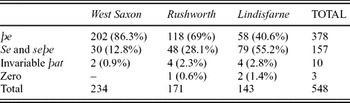
Table 2 contains the overall distribution of relativizers in my Old English sample according to text. The pronominal relativizers se and seþe have been grouped together, whereas the invariable relativizers þe and þat have been kept separate. The reason is that pronominal relativizers – both simple and compound – were functionally alike and distributed with similar frequencies throughout the Old English period; however, invariable þe was far more frequent in Old English than þat, which has been considered a late innovation and was finally consolidated as an invariable relativizer in Middle English.
Distribution of relativizers

Invariable þe is clearly favoured in the language of the West Saxon Gospels (86.3%). It also became the relativizer of choice in the Rushworth Gospels (69%), although it is considerably less frequent than in the previous ones. A very different situation prevailed in the Lindisfarne Gospels where the invariable þe, although present, was much less frequently used (40.6%). This situation deserves special attention because, as noted in section 1, invariable þe has been described as by far the most favoured relativizer in (West Saxon) Old English.
Regarding the pronominal relativizers (se and seþe), table 2 shows that although they are the second most frequent relativizers in the West Saxon (12.8%) and Rushworth Gospels (28.1%), they are much less frequently used than the invariable relativizer, especially in the former. Surprisingly, then, they become the clear favourite relativization strategy in the Lindisfarne Gospels (55.2%).
Finally, invariable relativizer þat is infrequent in all of the analysed dialects, with slightly greater occurrence in the Lindisfarne (2.8%) and Rushworth Gospels (2.3%). Does this mean that þat was becoming preferred as an invariable relativizer over þe and that this preference started from the northern dialects and spread towards the South? The number of examples is too low to draw any definite conclusions, but it is perhaps worth mentioning that in a recent study carried out on dialectal variation of relativizers in early Middle English (Suárez-Gómez Reference Suárez-Gómez, Gotti, Dossena and Dury2008), it is observed that invariable þat began to supplant þe from the Midlands southwards. No texts from the North were included in that particular study because they were not available in the data from the Helsinki Corpus, though it is very likely that the substitution started from the North, bearing in mind that most linguistic innovations in the early history of the English language were first documented in the northern area.
As for the relativizer zero, the only information that can be retrieved from table 2 is that it is very infrequent, and scarcely used at all in any of the three analysed dialects.
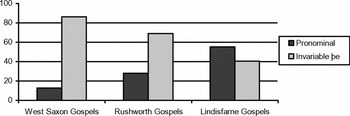
Figure 1 above depicts more clearly the tendencies seen in table 2. Only the two most frequent relativization strategies have been included. Relativizer zero and invariable þat have been excluded because they are underrepresented.
Distribution of relativizers (%)

In sum, what figure 1 nicely illustrates is the lower frequency of invariable þe in the Rushworth Gospels and, especially, in the Lindisfarne Gospels; the higher frequency of pronominal relativizers in the Rushworth Gospels and, most significantly, in the Lindisfarne Gospels; and finally, how the Lindisfarne Gospels differ from the Rushworth Gospels and, even more so, from the West Saxon Gospels.
5 Position of the relative clause
5.1 Description
Another important aspect of variation in Old English relative clauses is the position that the relative clause occupies with respect to the main clause. By position we refer to the linear order shown by the NP antecedent and the relative clause.
In Present-day English, relative clauses are postnominal and tend to immediately follow the antecedent they modify, irrespective of the function this realizes in the main clause. Therefore, if the antecedent functions as subject, the relative clause will most likely be embedded, as in (13), whereas if the antecedent functions as direct object, the relative clause will not be embedded, as in (14).
(13) The house [RC that I rent] has amazing views.
(14) I rent a house [RC that has amazing views].Footnote 17
In earlier English, and especially in Old and early Middle English (O'Neil Reference O'Neil1976), constructions such as (13) were available, but rarer than in Present-day English.
There seems to be broad agreement that Old English syntax was characteristically paratactic, and that subordinate structures arose after the reinterpretation and subsequent reanalysis of originally paratactic structures, especially relative clauses. In fact, a number of strategies were available in Old English to avoid embedded relative clauses within the main clause (O'Neil Reference O'Neil1976; Carkeet Reference Carkeet1976; Hopper & Traugott Reference Hopper and Traugott2003: chapter 7; Suárez-Gómez Reference Suárez-Gómez2006a, Reference Suárez-Gómez, Sintes, Palomo and Garrido2006b). The most relevant strategies are the extraposition of the relative clause towards the end of the main clause, or, following Carkeet (Reference Carkeet1976: 45), the moving of the relative clause to the front by a rule of copying the antecedent. Through this strategy, the antecedent (normally the subject) and the relative clause are topicalized and referred to again by means of a copy pronoun (cases of left-dislocation), so that the subject is not separated from the main verb, as illustrated by example (17) below.
A threefold classification regarding the position of the relative clause in Old English has been proposed in different studies, distinguishing between embedded or intraposed, left-dislocated and extraposed relative clauses (O'Neil Reference O'Neil1976; Hopper & Traugott Reference Hopper and Traugott2003: chapter 7; Suárez-Gómez Reference Suárez-Gómez2006a: 39–42). This classification has been adopted in the present study, although it has been simplified into two categories, as summarized below:
• Embedded or intraposed relative clauses, in which the relative clause and the antecedent follow each other, and the relative clause is embedded within the main clause, as in (15):
(15)
Examples such as (15) resemble subject relative clauses of Present-day English (see example (13)), where the tendency is to embed the subordinate clause. The antecedent ða ‘those’ and the invariable relativizer ðe are adjacent, and the relative clause ðe gecosted weron from gastum unclænum ‘who were troubled by unclean spirits’ is intraposed within the main clause.
• Non-intraposed relative clauses. This category comprises relative clauses of two types:
(i) extraposed relative clauses: the relative clause is separated from the antecedent it refers to and placed at the end of the main clause,Footnote 18 as the following example illustrates:
(16)
In this example the relativizer þe and the antecedent it refers to, œlcne ðara ‘any of those’, are separated by extraposing the relative clause þe of ðyson wœtere dringð ‘who drinks of this water’ towards the end of the main clause;
(ii) left-dislocated relative clauses: the relative clause is displaced to the front of the main clause, together with the antecedent it refers to. The antecedent is then repeated in the main clause, as below in (17):
(17)
In example (17), the relative clause þe þær asende wæron ‘who were sent there’ is moved to the front of the main clause together with the antecedent þa ‘those’. This antecedent is then referred to by the third-person pronoun þa (‘copy-pronoun’) which functions as the subject of the main clause.
Extraposed and left-dislocated relative clauses have been subsumed here under the same label because both of them are syntactic alternatives which prevent the intraposition of the subordinate clause. Although syntactically different, from a functional point of view they serve the same purpose.
5.2 Distribution
In order to analyse the position that the relative clause occupies with respect to the main clause, many examples had to be excluded from the analysis, leaving only those which could potentially show variation in position. In fact, in most of the remaining examples, the relativized item is the subject, as with ða in example (15) above, or a topicalized complement, as with þam in example (18) below.
(18)
Examples such as (11) and (12) also had to be excluded. Although the antecedent of example (12) functions as subject, it resorts to Subject−Verb inversion so as not to separate the antecedent from the relativized item (mon and Ø), thus avoiding embedding. In Subject−Verb inversion, however, there are some exceptional cases in which position is still relevant, as in examples (19) and (20), the first being a clear case of intraposition and the second one of extraposition:
(19)
(20)
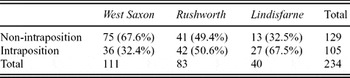
In instances similar to (11), also excluded from the data, the antecedent functioning as subject complement appears in final position in the main clause, leaving no alternative position for the relative clause. Similarly, most examples in which the antecedent functions as complement (direct object, indirect object, prepositional object, etc.) had to be excluded – with the exception of examples such as (21) below – because the complement tends to be located in the final position of the clause, leaving no chance of variability. The exclusion of such examples explains the reduced number of tokens in table 3 in comparison with tables 1 and 2.
(21)
Example (21) is relevant to the study of the position of the relative clause because the verb onbyrigde ‘tasted’, used as a transitive verb, appears in final position; its complement (the DO þœs wines ‘the wine’) precedes it, and this complement is modified by a relative clause which is extraposed (separated from its antecedent).
Distribution of relative clause position

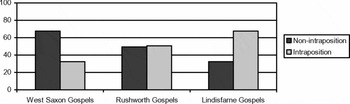
The overall results of our analysis concerning the position occupied by the relative clause in terms of dialects in Old English are laid out in table 3 above. The results here distinguish the three different texts very clearly. The West Saxon Gospels show that intraposition – theoretically the favoured syntax in a paratactic language such as Old English – is retained as the second most preferred alternative (32.4%). At the opposite extreme, the Lindisfarne Gospels seem to have adopted intraposition as the favoured pattern for relative clauses (67.5%). In between these, the Rushworth Gospels show no preference for any of the structural variations.
Figure 2 illustrates these findings more clearly. It shows the two syntactic positions of relative clauses in the three sources under analysis.
Relative clause position (%)

Relative clauses in the West Saxon Gospels show a clear preference for non-intraposition and in the Lindisfarne Gospels for intraposition. A different situation is represented by the Rushworth Gospels, where non-intraposed constructions are almost as frequent as intraposed ones. Intraposition, then, becomes more and more frequently used as we move northwards. The question of whether these results reflect merely a scribal stylistic preference or a definite dialectal difference in Old English, though, is left to be determined. However, at least one study on dialectal variation in Middle English (Suárez-Gómez Reference Suárez-Gómez, Gotti, Dossena and Dury2008) reveals that intraposition is, indeed, more frequent in the Midlands than in the southern (both West and Kent) dialects. This seems to give weight to the tentative claim that the results set out in table 3 are due to dialectal variation, rather than to scribal whim; although this preliminary conclusion needs to be confirmed with further research and analysis of additional texts.
To summarize, the West Saxon Gospels display a clear preference for non-intraposed constructions (which comprises both extraposed and left-dislocated) over intraposed ones. By contrast, the Lindisfarne Gospels show a strong preference for intraposition over non-intraposition. The Rushworth Gospels show no preference for any position. What is relevant in this text is the higher rate of intraposition and lower rate of non-intraposition in comparison with the West Saxon Gospels. The higher rate of intraposition in the Lindisfarne and Rushworth Gospels is of great significance.
It has been frequently proposed in the literature that variation in position – in relative clauses in particular – is related to varying degrees of syntactic complexity (Dekeyser Reference Dekeyser1989: 387; Rohdenburg Reference Rohdenburg1996: 191; Hawkins Reference Hawkins, Rohdenburg and Mondorf2003). It has also been demonstrated that the position of the relative clause is also influenced (but not determined) by other factors, the most relevant of which being the degree of explicitness of the relativizer, the type of relative clause, whether restrictive or nonrestrictive (Suárez-Gómez Reference Suárez-Gómez2006a: 125–9), as well as the length of the relative clause (see Wasow Reference Wasow1997 for weight influence on the position of constituents). In fact, non-intraposed relative clauses are favoured if they are nonrestrictive, long and introduced by a pronominal relativizer, whereas intraposed relative clauses are favoured if they are restrictive, short and introduced by an invariable relativizer. This correlation is mostly based on analyses of West Saxon texts, but judging from the results of tables 2 and 3 it does not work in the same way in the texts under analysis in the present study. If this were the case, we would expect a higher incidence of non-intraposition (than intraposition) in the Lindisfarne Gospels. Whether this is to be attributed to a scribal preference or the influence of Latin needs to be confirmed through the analysis of additional texts classified as Northumbrian.Footnote 20 Nevertheless, what is extremely relevant for the present article is that variation in the position adopted by the relative clause in Old English (non-intraposed vs intraposed constructions) is more closely related to the spread of intraposition observed in the evolution of the English language before the rigidification of word order (Suárez-Gómez Reference Suárez-Gómez2006a: 88–90), a process which seems to have started from the North and moved progressively southwards.Footnote 21
6 Conclusion
In the present study I have analysed the distribution of relativizers and the position that the relative clause occupies with respect to the main clause in order to ascertain whether the North–South divide attested in Old English for some levels of analysis, such as spelling, phonology and lexis, also holds true for syntax.
The studies of Kroch & Taylor (Reference Kroch, Taylor, Kemenade and Vincent1997) and Ingham (Reference Ingham2006) were taken as point of departure, given that they affirm that there is indeed dialectal variation in Old English syntax. My study here illustrates these claims with the study of the distribution of relativizers and the position adopted by the relative clause within the main clause, although further research and an increase of the database is necessary to validate the results obtained in this work. Analyses of three versions of the Gospels from the late Old English period show that, regarding the paradigm of relativizers, the traditional invariable þe is by far the most frequent relativizer in the West Saxon Gospels and Rushworth Gospels, representative of the West Saxon and Mercian dialects respectively, but not in the Lindisfarne Gospels, representative of the Northumbrian variety. The innovative invariable þat, infrequent in all three texts, appears to gain prominence, and indeed preference, over the traditional and archaic þe in the Northumbrian dialect, although the limited number of examples prevents us from reaching any definite conclusion. As regards the paradigm of the pronominal relativizers, they are only frequent in the Lindisfarne Gospels, which differ from the West Saxon Gospels, where pronominal relativizers are less frequently used.
Regarding the position occupied by the relative clause, it has been observed that intraposition, the less-preferred structural technique of Old English, becomes the preferred form in the northern dialects, especially in the Lindisfarne Gospels, even in the Old English period. By contrast, the West Saxon Gospels avoid the use of embedded structures, favouring nonembedding (both extraposition and also left-dislocation) instead.
The analysis of the distribution of relativizers and the position adopted by the relative clause with respect to the main clause provides evidence of variation in late Old English, in accord with evidence from analyses of other linguistic areas, such as orthography and phonology, lexis and the recent studies of syntax. Therefore, although the findings here may also reflect the mere capriciousness of individual scribes, they seem to constitute evidence of significant geographical variation, indicating in particular that northern dialects – and especially Northumbrian – are linguistically different from West Saxon.
The Rushworth Gospels, an illustration of Mercian, seem to behave as an in-between text with respect to the other two texts under analysis here. The Rushworth Gospels resemble the West Saxon Gospels in the distribution of relativizers (prevalence of invariable relativizers) but approximate to the Lindisfarne Gospels in the higher frequency of pronominal relativizers. Regarding the position occupied by the relative clause, the Rushworth Gospels resemble the Lindisfarne Gospels in the increase of intraposition, but tend towards the language of the West Saxon Gospels in the still high frequency of non-intraposition.
Finally, we might also conclude from the present study that Latin-based texts – commonly excluded from the analysis of syntax – have provided useful data on variation in the expression of relativization across different texts of Old English. Considering the scarcity of material in this area, these texts might reasonably be regarded as valuable source material for the further study of Old English.