Major congenital heart defects are common, with an estimated occurrence rate of 1 in 110 infants.Reference Botto, Correa and Erickson 1 Advances in surgical technique and peri-operative management have moved the most serious cyanotic heart lesions from universally fatal to an approximate survival of 80–90% through surgical palliation.Reference Hirsch, Devanay, Ohye and Bove 2 Despite these advances, this population continues to be burdened by significant morbidity, compounded by early growth failure. This is especially evident in patients receiving neonatal palliation with a systemic-to-pulmonary shunt for congenital cyanotic heart disease.Reference Kelleher, Laussen, Teixeira-Pinto and Duggan 3 Poor growth in patients with single-ventricle circulation has been well documented.Reference Williams, Zak and Ravishankar 4
Poor weight gain or growth failure is defined when the weight is below the 5th percentile, the weight-for-age z-score is <−2.0, or when the charted weight has crossed two major percentiles or z-scores. The aetiology of growth failure in congenital heart disease patients has been proposed to be inadequate caloric intake related to the increased energy expenditure in the hyper-metabolic state of the congenital heart disease.Reference Lees, Bristow, Griswold and Olmsted 5 , Reference Menon and Poskitt 6 The primary concern for these patients is the effect of this period of poor growth while having shunt-dependent physiology.Reference Williams, Zak and Ravishankar 4 Healthy infants are expected to gain between 20 and 30 grams per day for the first 6 months of life.Reference Behrman 7 These expectations are based on keeping the infant on his or her percentile curve. Infants with cyanotic congenital heart disease usually miss this phase of rapid growth. Poor weight gain in infancy in the congenital heart disease population has been associated with increased mortality and morbidity, including worse neurodevelopmental outcomes.Reference Rudolf and Logan 8 – Reference Dykman, Casey, Ackerman and McPherson 10
Several studies have evaluated infants with single-ventricle physiology following palliative neonatal shunt placement.Reference Williams, Zak and Ravishankar 4 , Reference Medoff-Cooper, Naim, Torowicz and Mott 11 , Reference Anderson, Beekman and Eghtesady 12 However, the growth trajectory in patients receiving a palliative shunt and progressing to two-ventricle repair is not as well understood.Reference Anderson, Marino and Irving 13 Furthermore, the role of primary outpatient cardiologists in monitoring and adjusting feeding schedules for shunted infants has not been described. The purpose of the study was threefold: (1) to compare the growth trajectory of palliated infants with single-ventricle versus two-ventricle cyanotic heart disease; (2) to examine the practices of clinic paediatric cardiologists at a single institution for feeding adjustments during outpatient visits comparing weight-for-age z-scores at surgical shunt takedown; and (3) to understand how patient- and procedure-related factors impact growth.
Materials and methods
We reviewed the course of neonates receiving modified systemic-to-pulmonary artery shunts (Blalock–Taussig or Sano Shunt) with ultimate single-ventricle palliation or two-ventricle repair at Children's Healthcare of Atlanta between January, 2002 and December, 2009. This study was approved by the Children's Healthcare of Atlanta Institutional Review Board. Study data were collected from the hospital medical records, the Sibley Heart Center outpatient charts, and surgical and cardiac catheterisation databases.
Patients were included if they received the shunt within 14 days of life and survived to surgical shunt takedown. In addition, patients must have had at least one outpatient appointment within the first 90 days of life, but before surgical shunt takedown. Patients with known genetic syndromes were included in the final analysis for population completeness. Patients were excluded if they were born at <36 weeks’ gestation and age >2 years at the time of surgical shunt takedown.
Demographic data were collected including gender, self-identified race, gestational age, and primary cardiac diagnosis. For analysis, patients were compared by the surgical takedown procedure: single-ventricle palliation versus two-ventricle repair. Single-ventricle circulation was defined as patients receiving a superior cavopulmonary anastomosis as the shunt takedown operation. Two-ventricle circulation was defined as patients receiving two-ventricle repairs as the shunt takedown operation. Neonatal peri-operative information was collected including surgical palliation performed – Norwood, modified Blalock–Taussig or Sano Shunt, or shunt with pulmonary artery banding. In addition, primary payer – public or private – was determined for each patient during neonatal admission.
Outpatient charts were reviewed for each patient meeting inclusion criteria. Institutional protocol for high-risk patients provides for weekly clinic visits with the primary cardiologist for the first 4 weeks after initial discharge and biweekly thereafter. In addition, information on the route of nutrition and caloric density of formula was collected. For each clinic visit, the cardiologists’ notes were reviewed to determine the number of changes made to the diet during the visit – including increase/decrease in the caloric concentration of formula, placement of nasogastric tube, referral to gastroenterology or otolaryngology clinics, and admission to hospital for poor weight gain. The Sibley Heart Center has 36 paediatric cardiologists, who have outpatient clinic responsibilities. We did not include changes in the volume of feeds as a diet change as we were unable to separate normal feed advancement with a true change in diet. The use of breast milk in the outpatient setting was noted and categorised by no use, stopped use, and continued use. “Stopped use” refers to patients who at early clinic visits were on breast milk or fortified pumped breast milk and discontinued use before shunt takedown. “Continued use” refers to the patients who were on breast milk at all visits. In addition, route of nutrition was categorised by the route of nutrition at first clinic visit. Patients were fed either solely by mouth, or with a nasogastric tube, or a gastrostomy tube.
Institutional protocol for patients with a systemic-to-pulmonary artery shunt includes a cardiac catheterisation between 3 and 5 months of age. The catheterisation data before surgical shunt takedown were collected, including aortic oxygen saturation and weight at the time of the procedure. This information was only available for 124 of the 133 patients and serves to demonstrate the growth trend, not the primary end point. Where possible, a later post-shunt weight, between 1 and 6 years of age, was obtained – available for 127 of the 133 patients.
Patients were classified as having a genetic disorder based on confirmatory genetic testing. In addition, patients were compared on the basis of their proximity to a major medical centre. Patients were divided by postal code. Patients with an Atlanta metropolitan postal code, defined by the United States Census Bureau, 14 were compared with patients outside the Atlanta metropolitan area.
Anthropometric measures of absolute weight and calculated weight-for-age z-score were obtained at the time of shunt placement, first outpatient clinic visit, cardiac catheterisation, shunt takedown, and post-shunt follow-up. The first outpatient clinic visit was within 7 days of hospital discharge. The weight-for-age z-score was calculated using the World Health Organization's Anthro Software (version 3.2.2, January, 2011 15 ). The World Health Organization reference standards include a z-score of “0”, which refers to the 50th percentile. Each whole number refers to one standard deviation farther from the 50th percentile. A z-score of −2 is equivalent to the third percentile. We defined change in weight-for-age z-score as the difference from first clinic visit or shunt takedown minus a previous value noted in the text or table. A box plot graph was created to demonstrate the movement of the weight-for-age z-score at neonatal surgery, first clinic visit, cardiac catheterisation, surgical shunt takedown, and post-shunt follow-up.
Data were reported as mean ± standard deviation or median and range, as appropriate. Univariate analysis was performed using Fisher's Exact test and Student's t-test. Multivariate analysis was performed using stepwise logistic regression. Analysis was performed using Microsoft Excel (Microsoft Corporation, Redmond, Washington, United States of America) and with STATA 6.0 (Texas A&M University, College Station, Texas, United States of America). Significance was determined at a p-value of <0.05. All probability values are two sided, and confidence intervals are 95%.
Results
Patient population
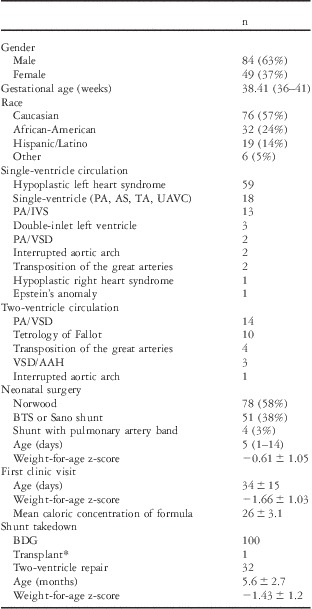
The characteristics of the 133 patients included in the study are shown in Table 1. The study group had various forms of complex congenital heart disease that necessitated neonatal surgical intervention. The mean gestational age was 38.4 (36–41) weeks. Self-reported races were documented in the surgical database with 57% Caucasian, 24% African-American, 14% Hispanic or Latino descent, and 5% classified as other. Genetic disorders represented include: 22q11 deletion in four patients, Trisomy 21 in one patient, Cat Eye in one patient, Klinefelter's syndrome in one patient, Sickle Cell disease in one patient, and Cystic Fibrosis in one patient. The median number of outpatient visits monitored was 5 (1 to 9 visits) during the first 90 days of life and with a median of 0 (0 to 4) adjustments to the feeds. There was a median of 0 (0 to 7) hospital admissions, excluding emergency department-only visits, while the shunt was in place.
Patient characteristics.

AAH = anoplastic aortic arch; AS = aortic stenosis; BDG = bidirectional Glenn palliation; BTS = Blalock–Taussig Shunt; IVS = intact ventricular septum; PA = pulmonary atresia; TA = tricuspid atresia; UAVC = unbalanced atrioventricular canal; VSD = ventricular septal defect
*Norwood recipient and included in the single-ventricle patient group
Single-ventricle circulation versus two-ventricle circulation
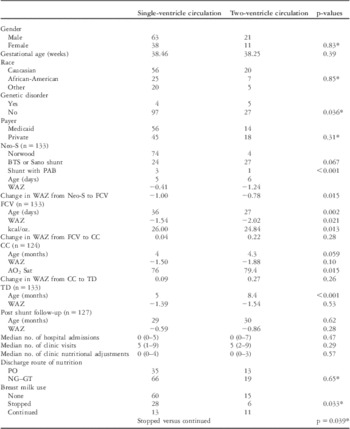
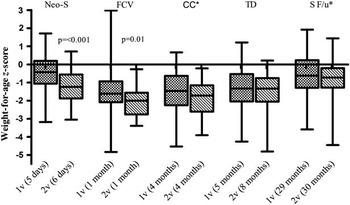
The study group was divided into two groups defined by the physiology achieved after surgical shunt takedown. The single-ventricle circulation group and the two-ventricle circulation group are compared in Table 2. Figure 1 depicts the changes in the weight-for-age z-score at several shunt-related points. With a statistically insignificant difference in age at neonatal surgery, single-ventricle patients had a higher weight-for-age z-score at neonatal surgery than two-ventricle patients (−0.4 ± 1.0 compared with −1.2 ± 0.9, respectively, p < 0.001), but the single-ventricle group showed a significantly greater change in the weight-for-age z-score from surgery to the first clinic visit (−1.1 ± 0.7 compared with −0.8 ± 0.7, respectively, p = 0.02). After the first clinic visit, the weight-for-age z-score was not significantly different between single-ventricle and two-ventricle patients.
Single-ventricle circulation versus two-ventricle circulation.

AO2 Sat = aortic oxygen saturation; BTS = Blalock–Taussig shunt; CC = cardiac catheterisation; FCV = first clinic visit; kcal/oz. = kilocalorie per ounce feed; Neo-S = neonatal surgery; NG–GT = nasogastric tube–gastrostomy tube; PAB = pulmonary artery banding; PO = by mouth only; TD = surgical shunt takedown; WAZ = weight-for-age z-score
Analysis by t-test unless noted
*Analysis by Fisher's exact test
Weight-for-age z-score for single-ventricle and two-ventricle patients. *CC (n = 124), SF/u (n=127). Neo-S, FCV, and TD are the endpoints with entire group represented (n=133). 1v and 2v groups were not significantly different at CC, TD, and S F/u. 1v = single ventricle; 2v = two ventricle; Neo-S = neonatal surgery; FCV = first clinic visits; CC = cardiac catheterisation; TD = shunt takedown; S F/u = post-shunt follow-up.

Independent variables
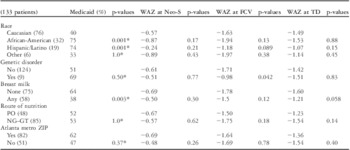
Table 3 demonstrates the univariate analysis of other characteristics and their implications on weight gain. The African-American group, Hispanic/Latino group, and other groups were compared with the Caucasian group at all time points of the study. There was no statistically significant difference in any of the groups compared with the Caucasian group in weight-for-age z-score. The African-American group and the Hispanic/Latino groups demonstrated a significantly higher percentage of public payer (Medicaid) patients compared with the Caucasian group, but still demonstrated no difference in the weight-for-age z-score.
Independent variables.

FCV = first clinic visit; Neo-S = neonatal surgery; NG–GT = nasogastric tube–gastrostomy tube; PO = by mouth only; TD = surgical shunt takedown; WAZ = weight-for-age z-score
Analysis by t-test unless noted
Analysis of race, compared with Caucasian population
*Analysis by Fisher's exact test
A total of nine patients were categorised as having a genetic disorder in which growth failure has been described – 124 without documented disorder. This percentage is lower than Children's Healthcare of Atlanta's congenital cardiac surgery population and likely reflects the effect of the inclusion criteria. At the time of neonatal surgery, the weight-for-age z-score was not different between those with and without genetic disorders. The patients without genetic disorders dropped more significantly in change of weight-for-age z-score than those with genetic disorders from neonatal surgery to first clinic visit (−1.09 ± 0.7 compared with −0.47 ± 1.1, p = 0.01). From the first clinic visit to surgical shunt takedown, patients without genetic disorders had a positive change in the change of weight-for-age z-score, whereas patients with genetic disorders had a negative change in the change of weight-for-age z-score (0.29 ± 0.9 compared with −0.52 ± 1.4, respectively, p = 0.02) to a point the groups were not statistically different at shunt takedown (−1.42 ± 1.2 versus −1.51 ± 1.4, respectively, p = 0.8).
In this study, the use of breast milk was not shown to improve the weight-for-age z-score compared with the formula exclusive group. The group that had at least some use of breast milk had a lower percentage of Medicaid as the payer than exclusive formula fed patients (p = 0.003). No difference was noted in the weight-for-age z-score in patients who were discharged with exclusive feeding by mouth compared with patients who were fed at least partially utilising a nasogastric tube or gastrostomy tube. Analysis was based on the route of nutrition at discharge from this initial hospitalisation. Further comparisons of groups taking feeds solely by mouth, with the use of a nasogastric tube, and the use of a gastrostomy tube did not reveal statistical differences in the weight-for-age z-scores at the discrete time points reviewed. The group living within the Atlanta metro area had no difference in weight-for-age z-score compared with patients living outside the metro area.
Multivariate analysis
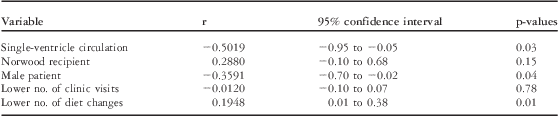
Table 4 demonstrates the results of the multivariate regression analysis for the primary outcome variable poor growth, defined as the change in the weight-for-age z-score from first clinic visit to shunt takedown. Single-ventricle circulation and male gender were associated with poor growth (p = 0.03 and p = 0.04, respectively). In addition, patients receiving a lower number of diet changes in the outpatient clinics by primary cardiologists were associated with poor growth (p = 0.009). The model adjusted for the total number of outpatient visits.
Risk factors for poor growth.

Discussion
Both single- and two-ventricle patients manifest significantly low weight-for-age z-score in early infancy. However, the two groups appear to have different growth trajectories. The poor weight gain occurred in spite of the near universal use of high-calorie feeds. This study demonstrated that recognition and intervention of poor weight gain by the cardiologist impacts weight gain trajectories.
The weight-for-age z-score for single-ventricle patients receiving a systemic-to-pulmonary artery shunt has been described as about one standard deviation below normal at the time of neonatal discharge, with no improvement by shunt takedown.Reference Williams, Zak and Ravishankar 4 , Reference Medoff-Cooper, Naim, Torowicz and Mott 11 , Reference Anderson, Beekman and Eghtesady 12 One study demonstrated that poor post-operative growth may occur in infants receiving early primary repair with two-ventricle physiology.Reference Anderson, Marino and Irving 13 To our knowledge, shunted patients who proceed to two-ventricle repair have not been compared with the palliated single-ventricle patients. In addition, caloric density of feeds and the nutritional management in the outpatient setting of these patients have received limited discussion.
In our study, poor weight gain was demonstrated despite the use of higher caloric density feeds. At first clinic visit, single-ventricle patients were on average on a higher caloric feed (26 kilocalorie per ounce) than two-ventricle patients (25 kilocalorie per ounce; p = 0.013), even though the single-ventricle patients’ weight-for-age z-score is a half of a standard deviation better. We are not sure why this may be. One might speculate that there is now recognition that single-ventricle patients are at risk of growth failure, whereas this is less well recognised in the shunt-dependent two-ventricle population. Interestingly, patients receiving feeds entirely by mouth demonstrated similar weight-for-age z-score to patients receiving at least some nutrition from a nasogastric tube or gastrostomy tube. The entire cohort makes no progress in improving the weight-for-age z-score from the first clinic visit to shunt takedown.
Despite equivalent age and gestation, the two-ventricle population has a significantly lower weight-for-age z-score than the single-ventricle patients at neonatal surgery. To our knowledge, this finding has not been described. The two-ventricle group was burdened with a higher percentage of patients with genetic disorders known to be associated with poor weight gain. Interestingly, although a genetic disorder was associated with a higher weight-for-age z-score at first outpatient visit, this group had a negative growth trajectory to shunt takedown. The group without a genetic disorder had a positive growth trajectory and at shunt takedown was statistically similar to the group with a genetic disorder. The significant drop in the weight-for-age z-score for single- and two-ventricle patients occurs from neonatal surgery to first outpatient visit, suggesting inadequate nutrition or a hyper-metabolic state immediately after surgery. Single-ventricle patients were not able to go to their first clinic visit until an average of 9 days later than two-ventricle patients; this difference directly correlates with increased length of stay in the hospital. Studies have identified patient characteristics and factors during hospital stay, which impact growth to discharge and were not further evaluated in this study.Reference Anderson, Beekman and Eghtesady 12 , Reference Medoff-Cooper, Irving and Marino 16 Notably, two-ventricle patients demonstrated higher aortic oxygen saturation at cardiac catheterisation than single-ventricle patients with statistically similar weight-for-age z-score.
The role of the primary cardiologist in optimising nutrition is gaining increasing attention. There is now an emphasis on the medical home for complex patients, such as those with cyanotic congenital heart disease. As such, cardiologists often assume responsibility for optimising nutrition. Importantly, our multivariate analysis revealed that patients receiving fewer number of diet adjustments by primary outpatient cardiologists were associated with poor weight gain. The argument could be made that those were the patients in need of the most intervention. However, this study has demonstrated that the group as a whole is about 1.5 standard deviations below normal at the time of surgical shunt takedown. This finding underscores the critical role of the primary cardiologist in optimising weight gain. Interestingly, some centres have explored dedicated nutritionists for this population, sometimes in the setting of a multi-disciplinary high-risk congenital heart disease clinic. One recent study did demonstrate the fact that the inclusion of a nutritionist may improve outcome.Reference Randall, Steury, Cross and Martin 17 Although that model is attractive, it may not be practical for high-risk cyanotic infants who receive routine follow-up outside of tertiary care centres.
It has been suggested that low weight-for-age z-scores might be reflective of aggressive diuretic use.Reference Kelleher, Laussen, Teixeira-Pinto and Duggan 3 Others have suggested that poor weight gain in the critically ill child is in proportion to energy expenditure and should be calculated for each child.Reference Botran, Lopez-Herce and Mencia 18 Other hypothesised mechanisms include disease complexity leading to longer intra-operative times associated with higher morbidity and mortality.Reference Medoff-Cooper, Irving and Marino 16 Although these mechanisms may be contributory, current work with premature infants indicates that growth failure is linked to inadequate nutrition, both caloric and protein.Reference Ziegler 19 Growth failure does not have trivial outcomes. Growth failure has been connected with neurodevelopmental impairment, including impaired executive functions, lower school achievements, and attention deficits.Reference Black, Dubowitz, Krishnakumar and Starr 9 , Reference Dykman, Casey, Ackerman and McPherson 10 , Reference Ehrenkranz, Dusick, Vohr, Wright, Wrage and Poole 20 , Reference Kar, Rao and Chandramouli 21 Work with extremely low birth weight infants has shown that in the first week of life for each 10 kilocalorie per kilogram increase in energy intake there was a 4.6 point increase in the Mental Developmental Index at 18 months, as well as a 8.2 point increase with each 1.0 gram per kilogram increase of protein.Reference Stephens, Walden and Gargus 22 Although this population is not a direct correlate, these findings should encourage cardiologists to facilitate the best growth possible for the shunted patient.
Other investigators have suggested that non-Caucasian race may be a predictor of poor growth; our population does not demonstrate this predictor.Reference Anderson, Beekman and Eghtesady 12 Although our African-American and Hispanic/Latino groups are burdened with a higher percentage of Medicaid patients than the Caucasian group (p = 0.001 and p = 0.001, respectively), there was no difference in weight change or weight-for-age z-scores at discrete points. Medicaid payer or urban versus rural residences was not associated with poor weight gain.
Our study has several limitations. Our results include only infants who survived to surgical shunt takedown. Importantly, infants with a gestational age <36 weeks were excluded. The retrospective nature of the study did not allow standardisation of anthropometric measurements. An important limitation of this study was the inability to document the total volume consumed by the infants. Parental recollection of feeding quantity was variable, and furthermore clinical documentation limited the study to caloric concentration at each visit. In addition, amount of breastfeeding and inclusion of solids as a supplement were inconsistently recorded. As a retrospective review of the primary cardiologists’ records and admitting hospital records, important interventions to improve weight gain with the primary care physician or possibly the gastroenterologist were not available. However, this effect is thought to be minimal as patients are a part of the high-risk congenital heart disease protocol and followed up principally by a primary cardiologist while the shunt is in place.
In summary, this study demonstrated a significant drop in the weight-for-age z-score from neonatal surgery to first outpatient visit, suggesting that these patients may receive inadequate nutrition. Poor weight gain was demonstrated in the outpatient clinic in the setting of high-caloric feeds. The poorest performers received the least number of outpatient changes to their diet. This finding underscores the critical role of the primary cardiologist in optimising weight gain through adjustments in nutrition as a part of a multi-disciplinary team caring for these complex patients.