1. Introduction
Boundary sediments of the Bashkirian and Moscovian stages are widely developed in the Volga region; they are laid mainly with carbonate rocks and, less frequently, with terrigenous-carbonate rocks. Determination of the Bashkirian–Moscovian boundary in the Volga region is one of the disputed issues in carboniferous stratigraphy of this region. Conodonts, which were first detected there by professor of Kazan University V.G. Khalymbadzha (Gubareva et al. Reference Gubareva, Khalymbadzha, Igonin and Klenina1995), are used to resolve this issue. Alekseev et al. (Reference Alekseev, Barskov and Kononova1994) examined Middle Carboniferous sediments of the Melekess-1 borehole and found a maximum congruence between the conodont complex of the upper part of the Bashkirian stage and the lower part of the Moscovian stage. Detailed exploration of conodonts within the Bashkirian–Moscovian boundary in the Volga region has recently been undertaken.
2. Materials and methods
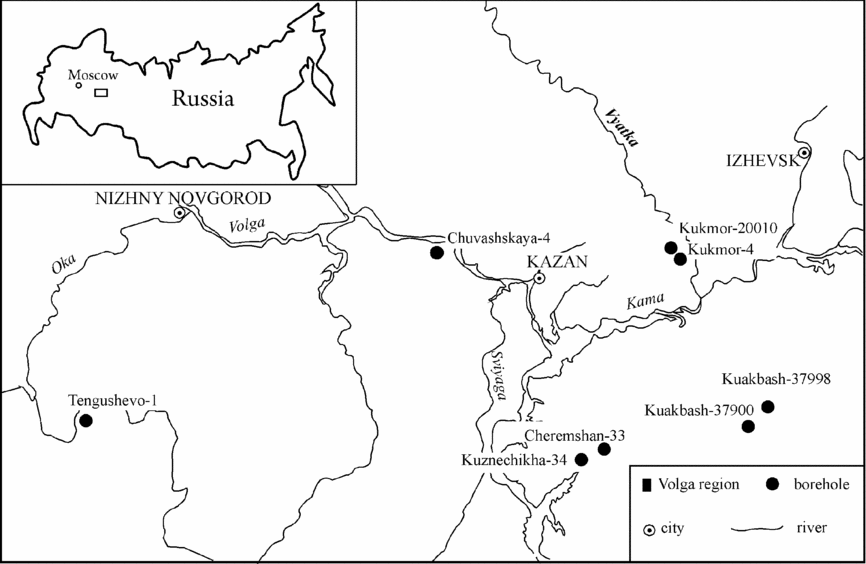
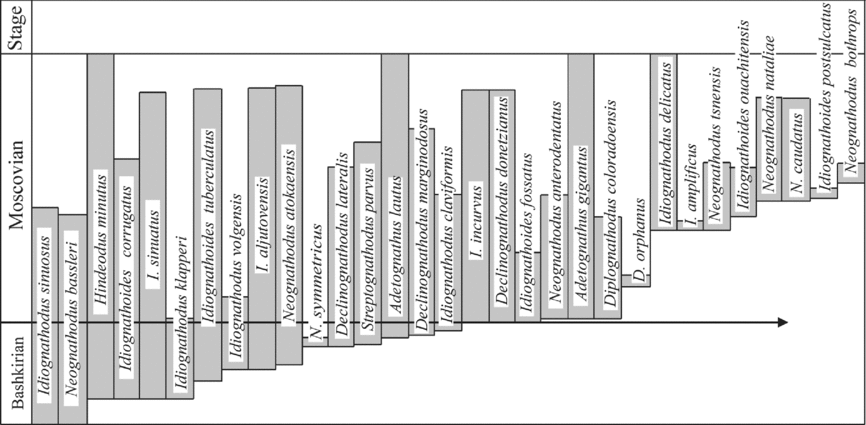
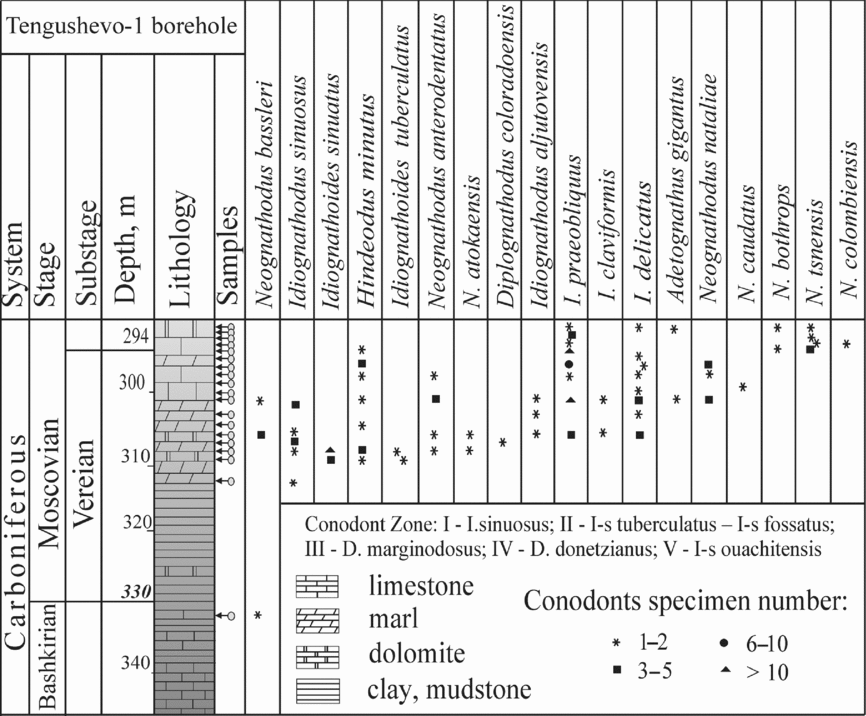
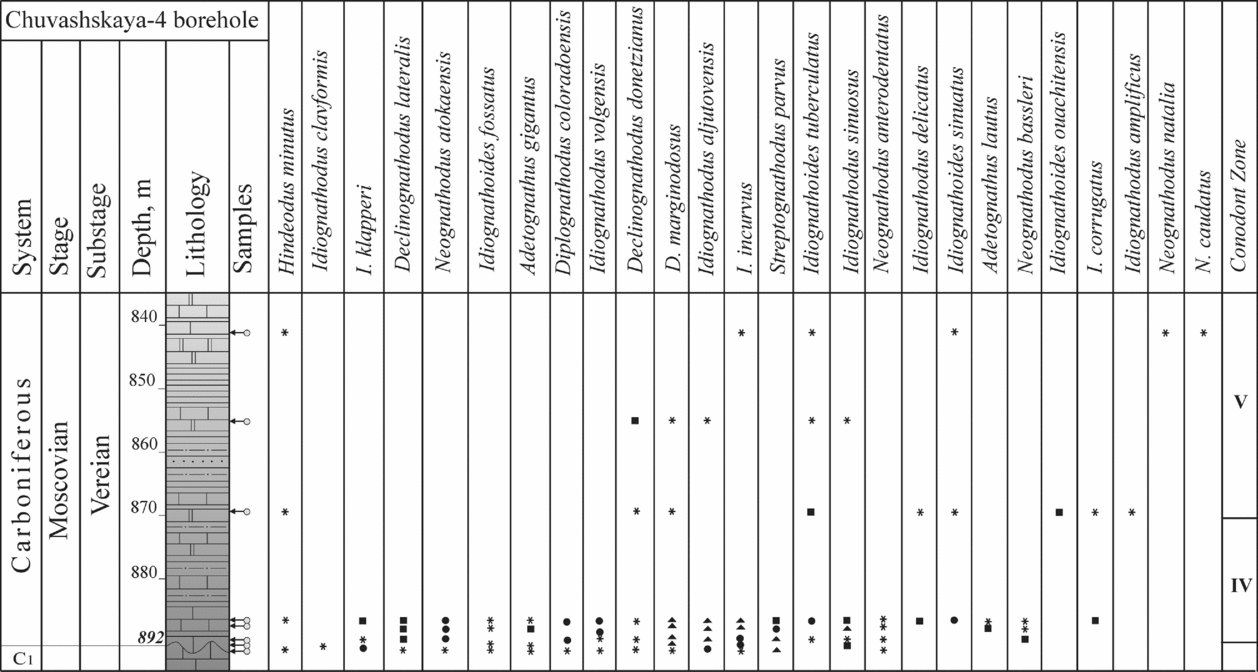
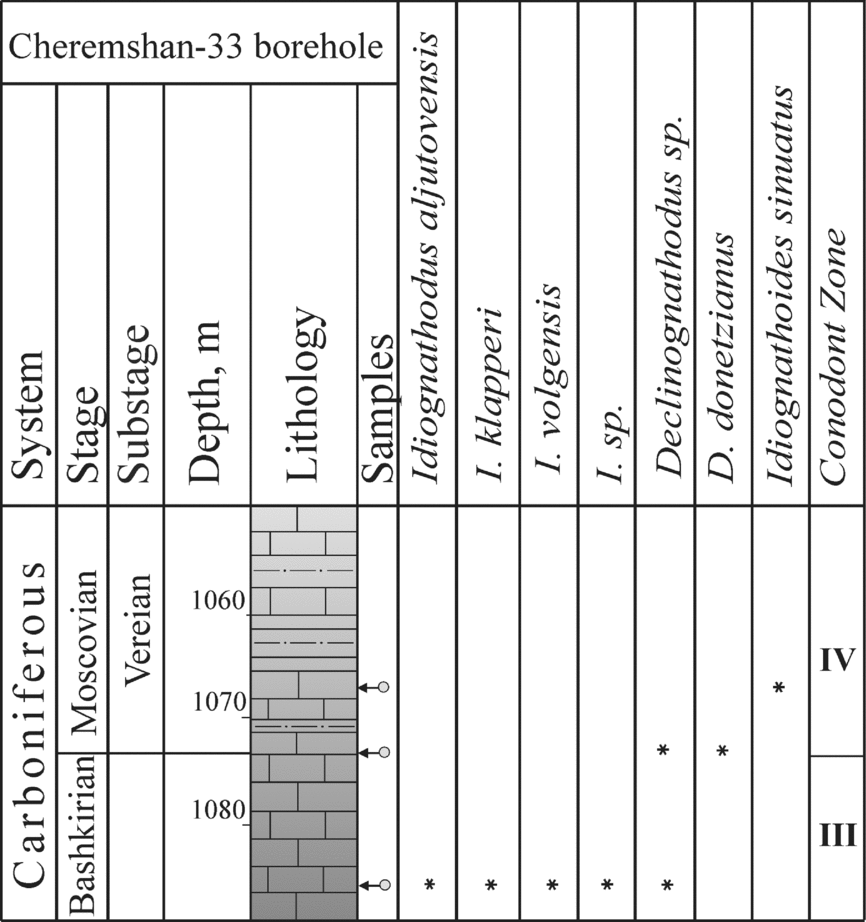
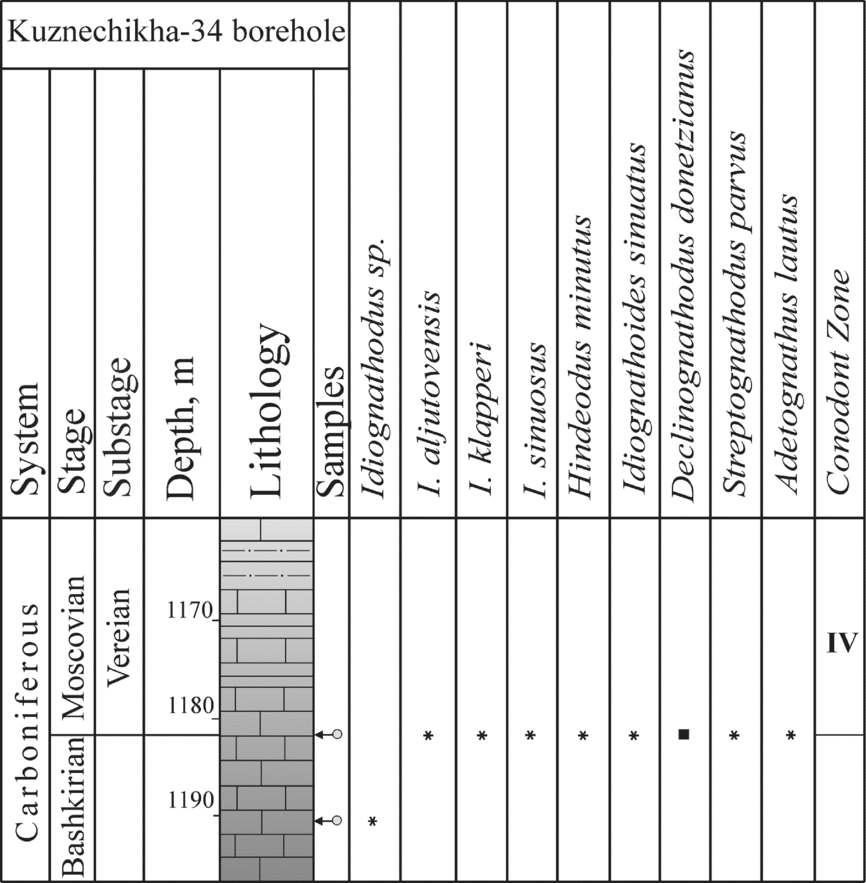
Conodonts were examined in open-pit mines of 8 boreholes (Fig. 1), located on Tokmovian arch (Tengushevo-1 and Chuvashskaya-4 boreholes), north Tatar arch (Kukmor-4 and Kukmor-20010 boreholes), south Tatar arch (Kuakbash-37900 and Kuakbash-37998 boreholes) and in the Melekess depression (Kuznechikha-34 and Cheremshan-33 boreholes). The obtained collection includes about 1200 samples comprising 31 species related to 8 genera (Fig. 2). Photographs of the conodonts were taken in the Laboratory of Scanning Electronic Microscopy of the Interdisciplinary Center of Analytical Microscopy of Kazan University using the Merlin device of CARL ZEISS Company.
Location of the boreholes, Volga region, Russia.

Distribution of the conodonts in the Upper Bashkirian and Lower Moscovian strata in the Volga region.

3. Biostratigraphy and conodont zonation
Conodonts are distributed unevenly in Bashkirian and Moscovian deposits of the Volga region; the largest distributions are concentrated in the upper part of the Bashkirian and the lower part of the Moscovian stages. This allowed detailed examination of conodont distribution within the boundary interval.
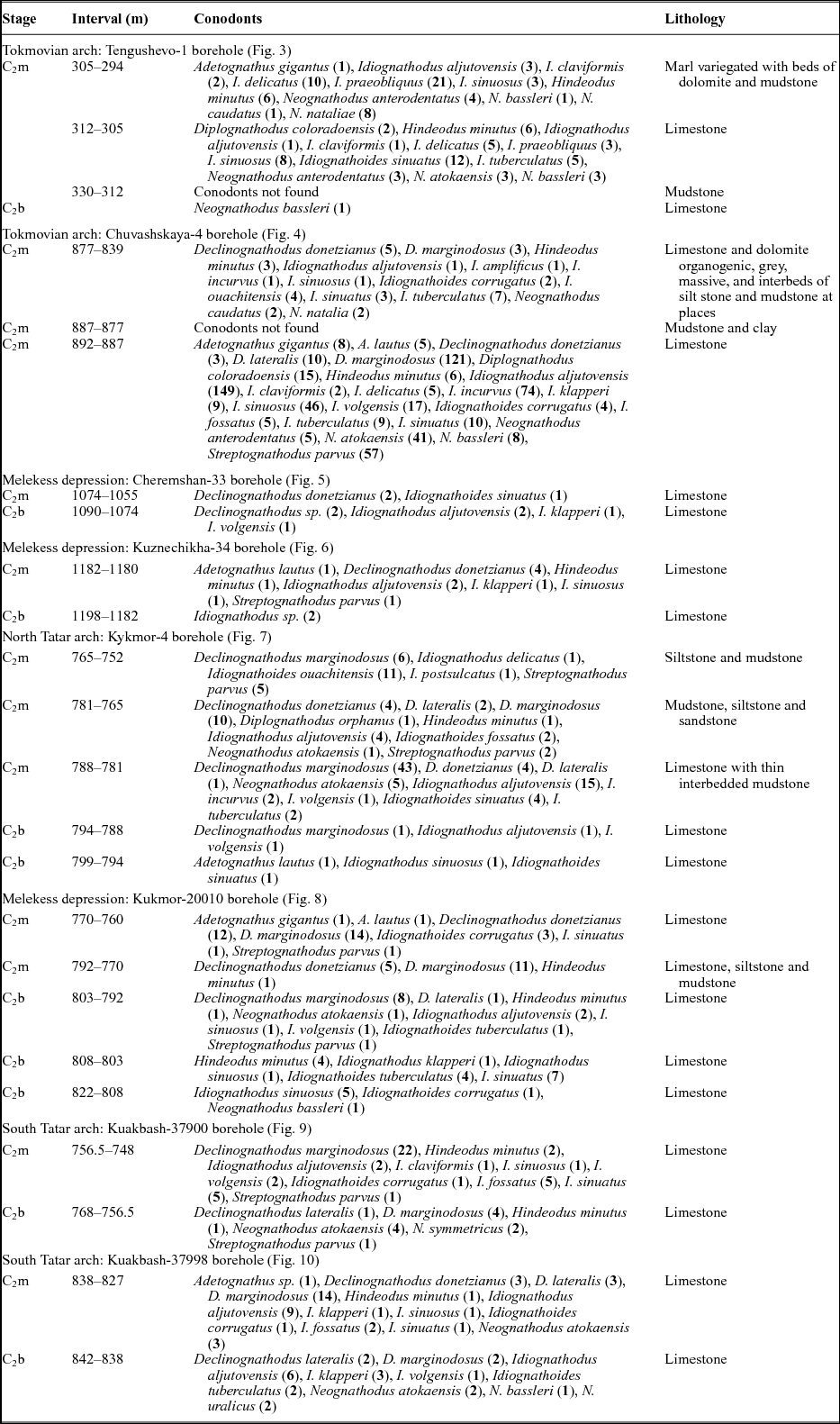
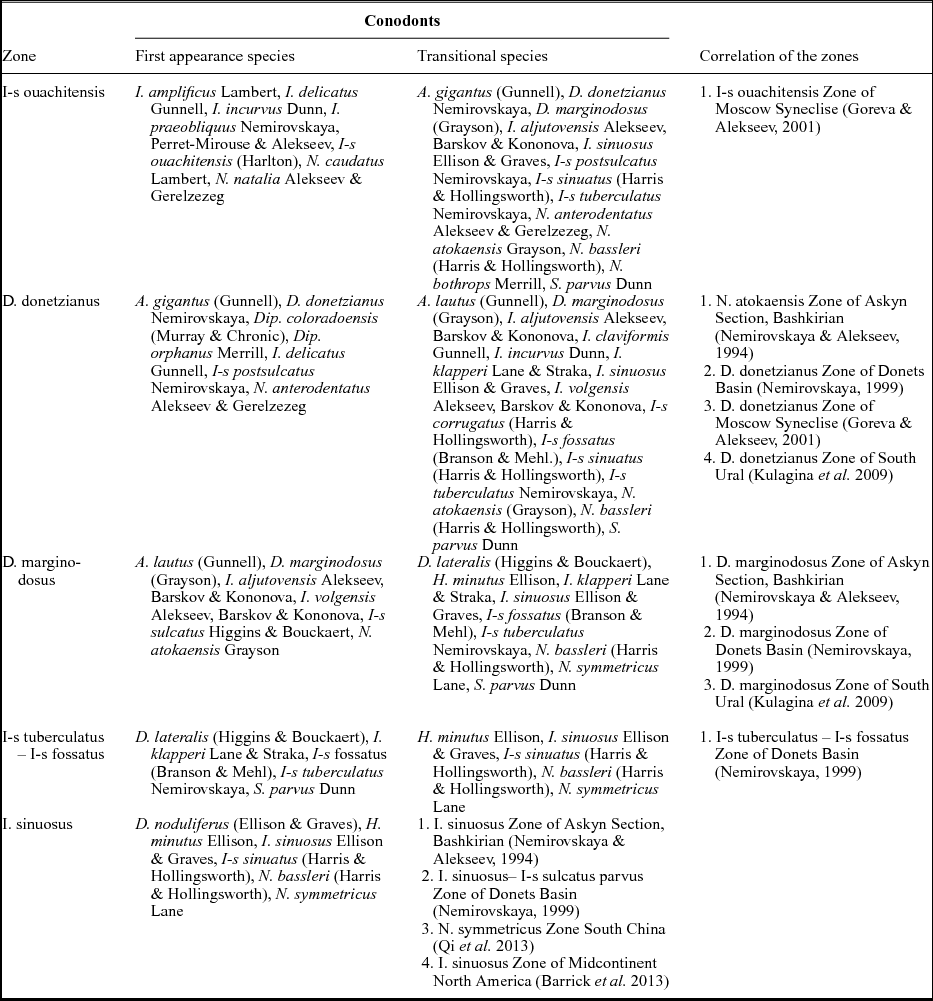
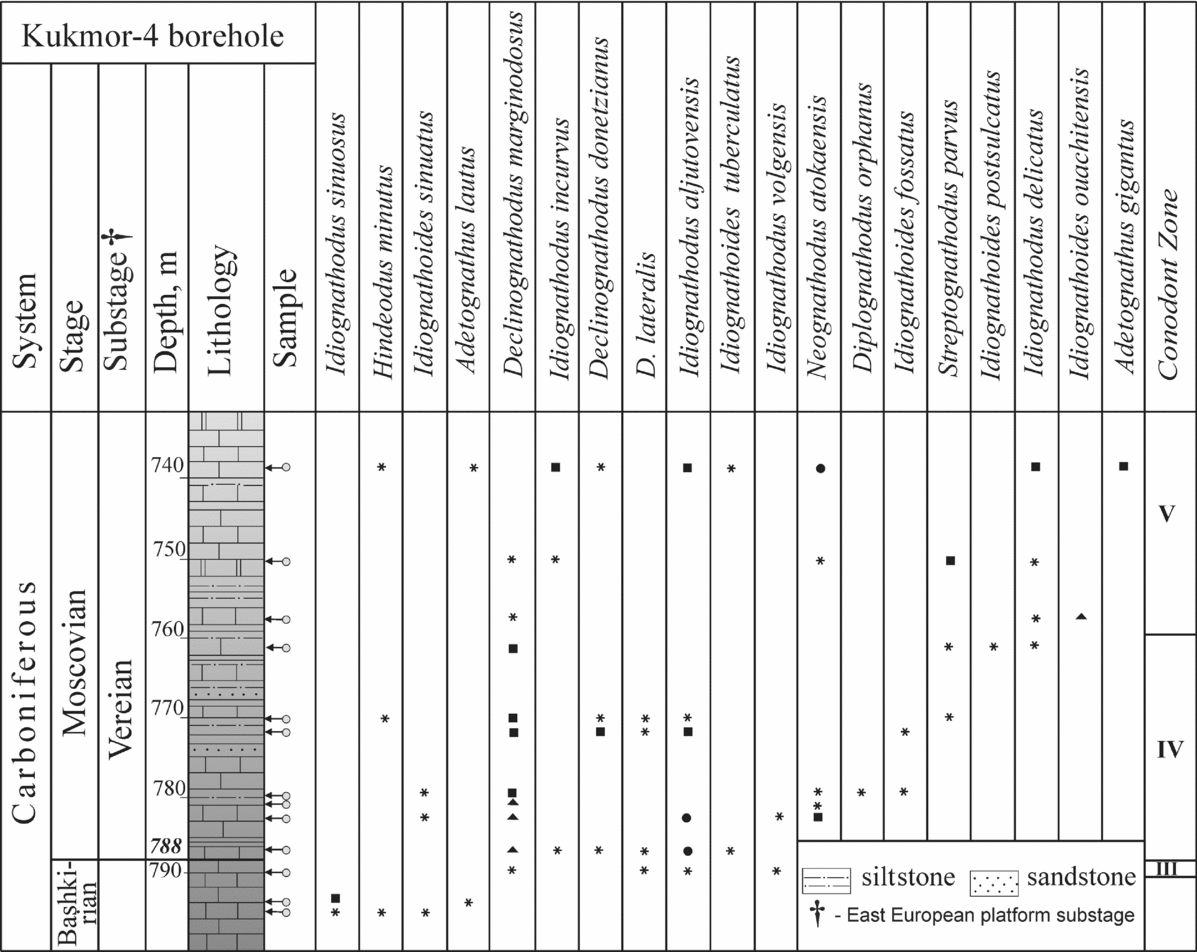
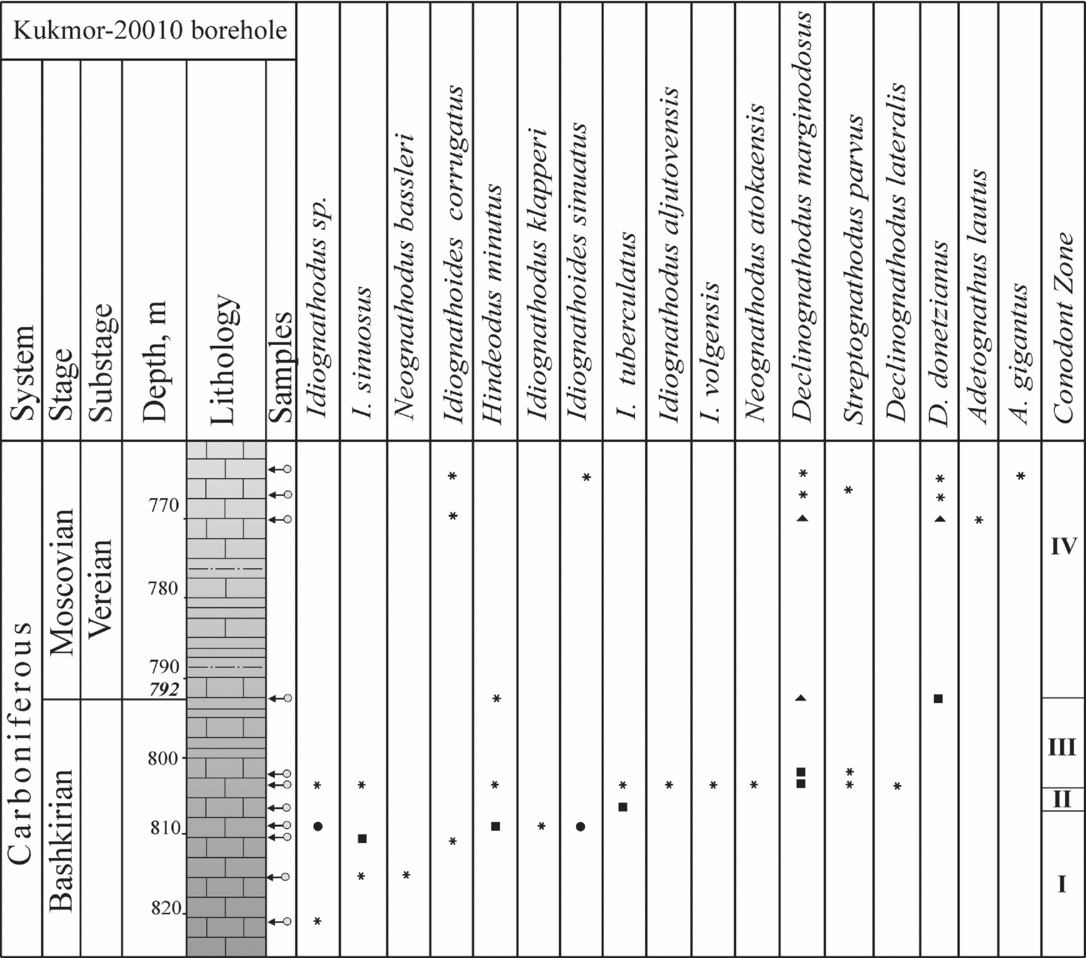
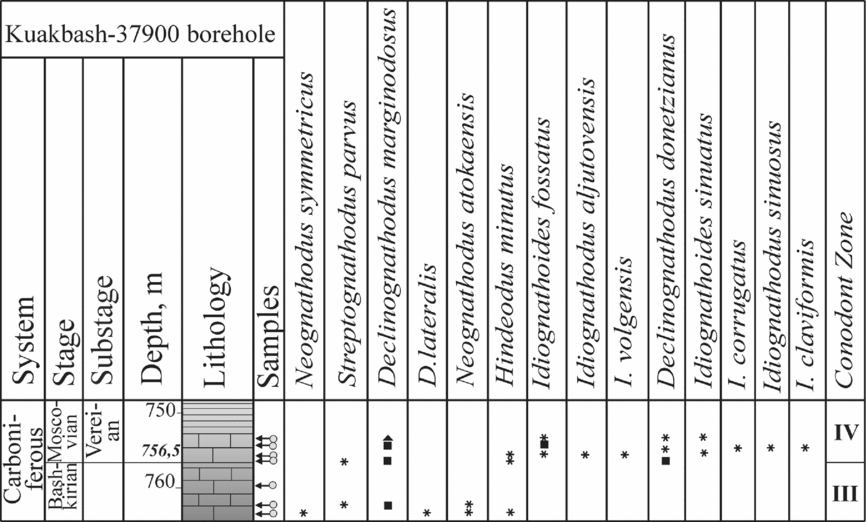
During biostratigraphic analysis of conodonts, most of the focus was on the exact species since this is a candidate for the role of biomarker of the Bashkirian–Moscovian boundary: Declinognathodus donetzianus Nemirovskaya; Diplognathodus ellesmerensis Bender; Idiognathoides postsulcatus Nemirovskaya (Yuping et al. Reference Yuping, Xiangdong and Lambert2010); and Streptognathodus expansus (Igo & Koike) (Qi et al. Reference Qi, Hu, Wang and Lin2013). Brief lithological characteristics of the open-pit mines and composition of the conodont complexes is given in Table 1 (Figs 3–10). Conodont zones are listed in Table 2. Lower boundaries of the zones are based upon the occurrence of zonal species; only the lower boundary of the Idiognathodus sinuosus Zone could not be determined due to washed sediments in the lower part of the Bashkirian stage in the Volga region.
Distribution of conodonts in boreholes

Conodont Zones of Volga region (A – Adetognathus, H – Hindeodus, D. – Declinognathodus, Dip. – Diplognathodus, I. – Idiognathodus, I-s – Idiognathoides, N. – Neognathodus, S. – Streptognathodus)

Distribution of the conodonts in the Upper Bashkirian and Lower Moscovian strata of the Tengushevo-1 borehole.

Distribution of the conodonts in the Lower Moscovian strata of the Tchuvashskaya-4 borehole.

Distribution of the conodonts in the Upper Bashkirian and Lower Moscovian strata of the Tcheremshan-33 borehole.

Distribution of the conodonts in the Upper Bashkirian and Lower Moscovian strata of the Kuznechiha-34 borehole.

Distribution of the conodonts in the Upper Bashkirian and Lower Moscovian strata of the Kukmor-4 borehole.

Distribution of the conodonts in the Upper Bashkirian and Lower Moscovian strata of the Kukmor-20010 borehole.

Distribution of the conodonts in the Upper Bashkirian and Lower Moscovian strata of the Kuakbash-37900 borehole.

Distribution of the conodonts in the Upper Bashkirian and Lower Moscovian strata of the Kuakbash-37998 borehole.

4. Discussion and conclusion
Quantitative domination of Declinognathodus and Idiognathoides is typical for Bashkirian and Moscovian stages of conodont development in the Volga region; other genera occur less frequently. Rare species of Diplognathodus first occur in the lower part of the Moscow layer. Specific composition of genera Idiognathodus, Idiognathoides, Neognathodus and Streptognathodus of the end of the Bashkirian and the beginning of the Moscovian centuries are very close. Species of all the above-mentioned genera, offered as markers of the lower boundary of the Moscovian stage, are either not detected in the Volga region at all (e.g. Diplognathodus ellesmerensis Bender and Streptognathodus expansus (Igo & Koike)) or else only detected rarely (e.g. Idiognathoides postsulcatus Nemirovskaya in the upper part of Idiognathoides ouachitensis Zone of Kukmor-4 borehole).
The genus Declinognathodus has the biggest stratigraphic potential among conodonts of the Bashkirian–Moscovian interval. There are two key points in its development. First of all, species Declinognathodus marginodosus (Grayson) dominates in the lower part of Moscovian stage in most of the explored boreholes (up to 30–60% of total conodont number). This event within Acme Zone rank may be used for local correlation of open-pit mines (Sungatullina, Reference Sungatullina2012, p. 53). Secondly, the species Declinognathodus donetzianus Nemirovskaya occurs in the Volga region at the base of the Moscovian stage; its first occurrence at the beginning of the Moscovian age was also detected in other regions. It is detected in the lower part of the Moscovian stage in south Ural (Basu section) (Kulagina et al. Reference Kulagina, Pazukhin, Davydov, Puchkov, Kulagina, Nicolaeva and Kochetova2009), Donbass (Nemirovskaya, Reference Nemirovskaya1999), Appalachian Basin (Work et al. Reference Work, Mason and Boardman2012) and Moscow Syneclise (Goreva et al. Reference Goreva, Alekseev, Alekseev and Schik2001).
We performed detailed analyses of time variations of Declinognathodus morphological characteristics and built a single phylogenetic sequence of species at the Bashkirian–Moscovian boundary. The occurrence of the species in chronological order is as follows.
Declinognathodus lateralis (Higgins & Bouckaert) appears in the second half of the Bashkirian age. It has a short carina, which is pressed to the outer parapet and continues to the posterior end. At the end of the Bashkirian century a new species of Declinognathodus marginodosus (Grayson) appears, the front part of the outer parapet of which is totally separated. At the beginning of the Moscovian age, the outer part of the basal cavity of Declinognathodus widens and additional nodes appear on its surface. This process occurs in two related species simultaneously: Declinognathodus marginodosus (Grayson) and D. lateralis (Higgins & Bouckaert). In the first case, isolation of the front part of the outer parapet occurs at first, and then nodes appear on it (Figs 11a, 12, 13, 14a, 15a). In the second case, nodes on the external surface of the basal cavity appear first, and only after that does the parapet front part separate (Figs 11b, 14b, 15b). In both cases the process completes with the forming of nodes on the external surface of the basal cavity, and the species Declinognathodus donetzianus Nemirovskaya appears. This morphogenesis, affecting a small sector of the conodont surface, shows itself as a short-period (at the beginning of the Moscovian age) and simultaneous event (within a significant territory of the Volga region). Declinognathodus donetzianus Nemirovskaya is therefore a good biomarker of the Bashkirian–Moscovian boundary in the Volga region (Fig. 16); its global potential is also huge.
Lineage changes of conodonts Declinognathodus across the Bashkirian–Moscovian boundary in the Kukmor-20010 borehole: (a) the front part of the outer parapet separates and then the tubercles are formed; (b) the tubercles are formed and then the front part of the outer parapet separates.

Lineage changes of conodonts Declinognathodus across the Bashkirian–Moscovian boundary in Kuakbash-37900 borehole (the front part of the outer parapet separates and then the tubercles are formed).

Lineage changes of conodonts Declinognathodus across the Bashkirian–Moscovian boundary in Kukmor-4 borehole (the tubercles are formed and then the front part of the outer parapet separates).

Lineage changes of conodonts Declinognathodus across the Bashkirian–Moscovian boundary in Tchuvashskaya-4 borehole: (a) the front part of the outer parapet separates and then the tubercles are formed; (b) the tubercles are formed and then the front part of the outer parapet separates).

Process of additional basal tubercles forming on the surface of the cavity: (a) Declinognathodus marginodosus (Grayson) in D. donetzianus Nemirovskaya; (b) D. lateralis (Higgins & Bouckaert) in D. donetzianus Nemirovskaya.

Bashkirian–Moscovian boundary from the studied boreholes and its correction in Volga region.

Examples of occurrences of separate morphological characteristics within various species of conodonts were frequently detected in boundary intervals and a number of other stratigraphic subdivisions, for example the formation of asymmetrically located furrow at the beginning of the Gzelian age and the formation of nodular lobe at the beginning of the Asselian age of conodonts of genus Streptognathodus (Chernykh, Reference Chernykh2006, Reference Chernykh2009, Reference Chernykh2010). Such peculiar but precise measurements of geological time in the form of separate leading characteristics, fixing crucial moments of geological history on Earth, serve as reliable instruments of correlation.
5. Systematic Palaeontology
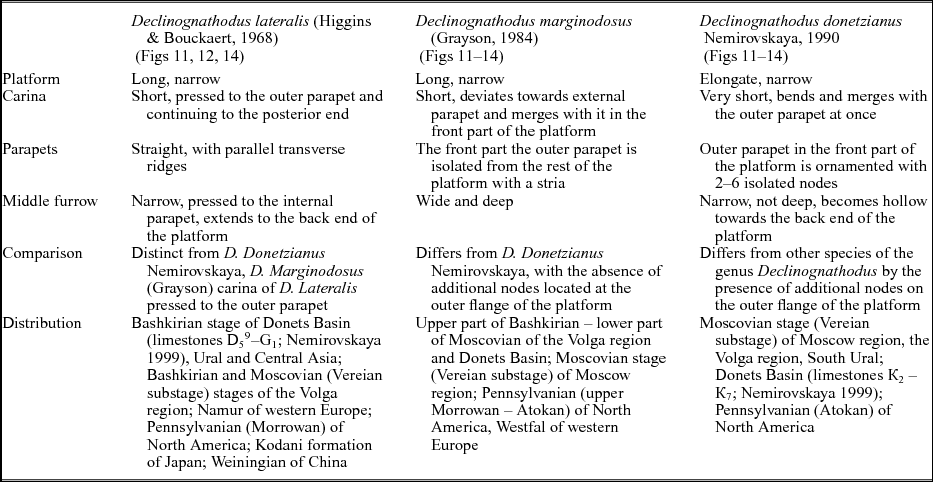
Table 3 describes the systematic palaeontology of Declinognathodus lateralis (Higgins & Bouckaert, Reference Higgins and Bouckaert1968), Declinognathodus marginodosus (Grayson, Reference Grayson1984) and Declinognathodus donetzianus Nemirovskaya, Reference Nemirovskaya1990.
Description of conodonts of genus Declinognathodus from the Volga region.

Acknowledgements
Thank you to Yu N. Osin, A. A. Trifonov and V. V. Vorobyov for help in photographing conodonts using the electronic scanning microscope. This work was subsidized by the Russian Government to support the Program of Competitive Growth of Kazan Federal University among world-class academic centers and universities.