

Advances in research on implementing research-based practices for educating students with and without disabilities have generated a strong knowledge base that can underpin efforts to make classrooms and schools more inclusive (Australian Research Alliance for Children and Youth [ARACY], 2013; Foreman & Arthur-Kelly, Reference Foreman and Arthur-Kelly2014; Grima-Farrell, Bain, & McDonagh, Reference Grima-Farrell, Bain and McDonagh2011). However, despite these significant advances, there remains a substantial gap between what has been proven to work in classrooms for students with and without disabilities and the extent to which it has been successfully implemented and sustained to enhance student success.
This paper presents an overview of the well-articulated research-to-practice (RTP) gap. It also presents an overview of a comparative case study that sought to identify the factors that contributed to the RTP gap and introduces the RTP model to raise awareness of ways to effectively implement and sustain the use of validated teaching approaches to maximise student engagement and success.
This complex RTP gap is a common concern across a range of disciplines and has been discussed at length by educational researchers (Grima-Farrell, Reference Grima-Farrell2017; Korthagen, Reference Korthagen2010 Olswang & Prelock, Reference Olswang and Prelock2015) and classroom teachers alike. National and global education directives continue to advocate for the sustained use of research-based practices to enhance student outcomes. Yet according to Bridgeland and Orszag (Reference Bridgeland and Orszag2013), approximately only $1 in every $1,000 spent by the US federal government on educational interventions and programs is supported by research. Our global, national, state, and school-based inability to close the RTP gap has had an ongoing adverse effect on the progress of inclusion in schools and our ability to effectively and efficiently respond to the needs of all students (Grima-Farrell, Reference Grima-Farrell2017; Korthagen, Reference Korthagen2010; Olswang & Prelock, Reference Olswang and Prelock2015).
Calls to support and empower teachers with the skills and knowledge of how to use research-based practices to enhance inclusive classrooms exist (ARACY, 2013; Grima-Farrell et al., Reference Grima-Farrell, Bain and McDonagh2011). Directives such as US legislation (Every Student Succeeds Act, 2015; No Child Left Behind Act, 2001; Individuals with Disabilities Education Improvement Act, 2004), Australian legislation, including the Disability Standards for Education 2005 (Commonwealth of Australia, 2005), and the United Nations international convention, Salamanca Statement (UNESCO, 1994), have encouraged access to the general curriculum for all students, including those with disabilities.
Theoretical Framework of Inclusion
Responding to the individual needs of all students within busy and complex classrooms is demanding and has had a significant impact on teacher preparation approaches internationally (Darling-Hammond, Reference Darling-Hammond2005; Forlin, Reference Forlin2010; Grima-Farrell et al., Reference Grima-Farrell, Bain and McDonagh2011). Teachers spend a great deal of time and effort striving to engage students and respond to their diverse personalities, strengths, and needs.
Previous work by researchers has provided insights into how various contexts shape learning and development to assist teachers as they strive to maximise student engagement and potential. Bronfenbrenner's theory of social context for development, the bioecological model of human development, can be linked to student growth and notions of inclusion as it highlights how social and cultural contexts shape learning and development (Bronfenbrenner & Ceci, Reference Bronfenbrenner and Ceci1994). Individual students are at the core of Bronfenbrenner's bioecological model of human development, and teaching should be student-centred and occur within least restrictive environments. After all, it is the right of all individuals to be included in naturally occurring settings and activities with their siblings and neighbourhood peers (Foreman & Arthur-Kelly, Reference Foreman and Arthur-Kelly2014). This is driven by the philosophy of inclusion to educate each child, to the maximum extent appropriate, in the school and classroom he or she attends. As a result, educators are required to respond to the diversity of student needs using practices and approaches that have been proven to be beneficial to students with and without disabilities. Research-based practices are designed to assist teachers in these sometimes challenging endeavours. The time to celebrate the collective expertise and commitment of both teachers and researchers in reducing these RTP challenges and progress with a new wave of optimism in successfully sustaining the use of research to support educational practice is now.
The Context: Research-to-Practice Gap
Much has been said about the RTP gap in education and exploring this body of knowledge is foundational to forging the pathway forward in reducing this gap. A review of the literature about the RTP gap over the last 40 years reveals that there have been few empirical studies that focus on the factors impacting upon research becoming practice in inclusive education settings (ARACY, 2013; Grima-Farrell, Reference Grima-Farrell2017; Grima-Farrell et al., Reference Grima-Farrell, Bain and McDonagh2011). Research indicates that some teaching practices that have little to no effect on student outcomes, particularly of students with disabilities, continue to be implemented in schools (Carter, Stephenson, & Strnadová, Reference Carter, Stephenson and Strnadová2011; Cook & Schirmer, Reference Cook and Schirmer2003).
A strong body of research evidence exists in support of programs and interventions that cater for student diversity and efforts to strengthen inclusive school and classroom cultures. Examples of these interventions include curriculum-based measurement (CBM) of reading, which has developed at a rapid rate over the past decade (Grima-Farrell, Reference Grima-Farrell2014, Reference Grima-Farrell2017; Madelaine & Wheldall, Reference Madelaine and Wheldall2004; Stecker, Fuchs, & Fuchs, Reference Stecker, Fuchs and Fuchs2005). Strong evidence for the technical characteristics, validity, and positive effects of CBM for reading has been produced. Other validated teaching strategies for inclusive settings include mathematical instructional techniques, peer mediation, cognitive strategies, direct instruction, and cooperative learning strategies (Earles-Vollrath, Reference Earles-Vollrath2012; Martens et al., Reference Martens, Eckert, Begeny, Lewandowski, DiGennaro, Montarello and Fiese2007; McGrath & Noble, Reference McGrath and Noble2010).
Despite the solid research base supporting the overwhelming research benefits of CBM, direct instruction, cooperative learning techniques, peer tutoring, and other research-based intervention techniques, the implementation of these strategies to enhance the outcomes of students with disabilities has varied considerably. Many studies have highlighted the advantages of these interventions with a wide range of students (Earles-Vollrath, Reference Earles-Vollrath2012; Grima-Farrell, Reference Grima-Farrell2014; Madelaine & Wheldall, Reference Madelaine and Wheldall2004; Stecker, Fuchs, & Fuchs, Reference Stecker, Fuchs and Fuchs2005). However, there is a limited body of research available that provides evidence that these validated interventions are extensively employed and sustained by teachers working with students with disabilities in school settings (Forlin, Kawai, & Higuchi, Reference Forlin, Kawai and Higuchi2015; Greenstein, Reference Greenstein2014; Grima-Farrell et al., Reference Grima-Farrell, Bain and McDonagh2011). Educational policy frameworks encourage the widespread implementation of these strategies, but their articulation in practice has remained an immense challenge (Black-Hawkins & Florian, Reference Black-Hawkins and Florian2012; Hattie, Reference Hattie2009; Korthagen, Reference Korthagen2010; Kurniawati, De Boer, Minnaert, & Mangunsong, Reference Kurniawati, De Boer, Minnaert and Mangunsong2014; Schulz, Reference Schulz, Peterson, Baker and McGaw2010).
The translation of RTP is a multifaceted process involving change at several school and system levels. Forlin (Reference Forlin2007, Reference Forlin2010) states that for inclusive education to become a reality, teachers need to be sufficiently trained and willing to support this reform (Black-Hawkins & Florian, Reference Black-Hawkins and Florian2012; Darling-Hammond, Reference Darling-Hammond2011; Forlin et al., Reference Forlin, Kawai and Higuchi2015). The relevance of including ideas from critical pedagogy within research and practice in inclusive education has been recommended as a useful tool for dealing with such issues (Greenstein, Reference Greenstein2014).
Many teacher-training resources exist for the purpose of sustaining and scaling RTP efforts. Some of these training experiences include professional development events led by school systems or consultants as well as university preservice and graduate teacher education programs. Teacher education has been presented throughout the literature as a key source of educational change in RTP (ARACY, 2013; Black-Hawkins & Florian, Reference Black-Hawkins and Florian2012; Darling-Hammond, Reference Darling-Hammond2006; Forlin et al., Reference Forlin, Kawai and Higuchi2015; Kurniawati et al., Reference Kurniawati, De Boer, Minnaert and Mangunsong2014).
Raising teacher awareness of the factors that have supported the implementation and sustainment of research-based strategies can provide them with a greater understanding of ways to use research to cater for the needs of all students in mainstream settings. This approach to inclusive education represents a whole-school responsibility that strives to align special education with general education in a way that effectively and efficiently imparts quality education to all students, including those with disabilities (Grima-Farrell et al., Reference Grima-Farrell, Bain and McDonagh2011).
Given the well-articulated need to bridge the RTP gap that supports national and global education directives and advances the meaningful engagement and success of all students, a longitudinal comparative case study was conducted. Through this 3-year study Grima-Farrell (Reference Grima-Farrell2017) sought to identify the factors that contributed to the research being successfully implemented and sustained in mainstream classroom and school environments.
The Application Method: Research-to-Practice Study
This section provides an overview of a longitudinal multiple case study methodology (Yin, Reference Yin2003) that builds on RTP knowledge to promote a greater comprehension of the factors that both enable and interfere with the successful translation of RTP in education. An ex post facto causal-comparative research design was employed to study the RTP cases (Miles & Huberman, Reference Miles and Huberman1994). Six cases of different research-based applications across diverse educational settings were examined.
Participants
Six teachers from a special education division of a nongovernment school system participated in this study. These teachers were also students enrolled in a Master of Education (Inclusive Education) program at an Australian regional university. Participants ranged from kindergarten teachers to a high school special education teacher. All participants shared the same graduate teacher experience and were expected to devise and implement a research-based project specific to the needs of their setting. All 10 graduates from the cohort were asked to participate in this study and six accepted the offer.
All participants were female and their ages ranged from 40 to 54. They were experienced teachers who had taught at an average of four schools. They all held the role of special education teacher at the setting where their project was implemented. All six had completed two university degrees prior to participating in this project. Five of the six projects were conducted in primary or elementary schools with student enrolments ranging from 350 to 600. One project took place in a high school where approximately 1,200 female students were enrolled.
Methodology
Through this causal-comparative case study the author investigated the implementation of six applied interventions in mainstream school settings. These unique cases involved the identification and implementation of an approach that had the potential to directly address student and teacher needs within a selected classroom, grade, or whole-school application. The participant-selected research-based interventions were varied; however, they were united in their literacy focus. The cases provided accounts of a range of trajectories in terms of the effectiveness, sustainability, and scalability of research-based practice in classroom environments. The author utilised case study research design to gain a depth of literature-based knowledge and teacher voice and expertise to provide an overview of the developmental process critical to the positive progression in reducing the RTP gap. The study was granted formal ethical approval by the university's human research ethics committee and the participants provided their informed written consent. This research specifically sought to answer the overarching research question: What are the factors and the relationships between them that influenced the translation of RTP in inclusive education settings?
Three phases of the study
An ex post facto causal-comparative research design that comprised three distinct phases was employed. Through the first phase of the research, the exploration phase, the author explored and applied the existing literature on RTP as a framework to investigate six diverse cases. Reports were also sought from six teachers on the factors that contributed to the success or failure of the research projects they were implementing in their classrooms. During this initial phase the data were collected prior to teachers being introduced to the information derived from the literature.
The second phase of this study was the explanation phase. During this phase all six teacher participants completed the 75-point RTP survey using a numerical (1–5) Likert scale. This required them to rate the impact of the 75 individual literature-based factors that affected the success or failure of their implemented projects. They all also participated in a semistructured interview based on the RTP knowledge gained from the analysis of five bodies of literature. These five areas are research-to-practice literature (RTP), professional development (PD), teacher education (TE), comprehensive school reform (CSR), and the concerns-based adoption model (CBAM). Written responses to open-ended questions about other RTP factors that significantly contributed to the status of their projects at various stages of implementation were collected from all participants. This included the explanation of factors that contributed to both the success and difficulty in sustaining and scaling research-based innovation.
The third and final data collection stage, the expansion phase, consisted of a focus group discussion. All participants were invited and all attended the focus group. This opportunity expanded upon RTP knowledge through validating and building upon assertions that were made in the two previous phases about ways to enhance the use of effective educational practices that address the diverse needs of students.
Data Analysis
The data collected through the three phases were analysed using thematic analysis and triangulation approaches. The review of literature, collected in phase one, was used to guide the development of the data collection tools that were used as a framework for collecting multiple sources of data from six individual participants. By reflecting on key RTP findings from relevant literature, the parameters by which data were to be interpreted were defined. Such an approach to data analysis is referred to by Yin (Reference Yin2003) as a dominant mode of analytical analysis titled theoretical propositions. Other processes of analysis involved the triangulation of data and methods to interpret the information shared by participants. Categorisation of data to extrapolate themes and provide possible explanations was also employed to the depth of knowledge (Miles & Huberman, Reference Miles and Huberman1994; Yin, Reference Yin1994). These processes were applied to the survey, interview transcripts, and focus group responses.
Findings
The accumulated knowledge gained through this research responded to the overarching research question that sought to identify the factors and the relationships between them that influenced the translation of RTP in inclusive education settings. Through examining the factors that contributed to the sustainment of four RTP cases and extinction of two cases over a 3-year period, across different school settings, it became evident that it was the complexities, consistencies, and differences in the interrelationships among the RTP factors that were critical to research being sustained in classrooms. A major finding was that no participants were able to isolate RTP factors in their explanations of the experiences at their settings. Participants described and compared ways in which the same RTP factors worked together to strengthen the status of four projects while those same RTP factors worked against each other to reduce the status of two cases.
The four successful cases demonstrated how the connections among and across factors continued to positively affect the status of their projects. A significant connection that resonated across all cases was the importance of well-aligned and successfully maintained relationships among school leaders and staff working toward mutually aligned goals. In each of these four cases, all stakeholders worked collaboratively to address student needs. All four projects became part of their whole-school plans and were successfully scaled within their schools. The participants who coordinated the two cases that became extinct also confirmed the importance of these factors. Each experienced significant difficulties maintaining their projects when connections among these RTP factors began to deteriorate. Instead of factors working together to create a harmonious and reinforcing progression, as they did in the other four cases, their connections became fractured, reducing the gains originally identified within these cases.
The findings highlight that all teacher participants reinforced the importance of the relationships among the same RTP factors (which were aligned differently to respond to the needs of the individual school settings) rather than a list of factors as being critical to reducing the RTP gap (Grima-Farrell, Reference Grima-Farrell2017). The same factors that contributed to research being sustained in practice were the same factors that contributed to the extinction of others. It was the alignment and relationship between these same 16 factors that positively or negatively impacted on the success of research-based projects in school-based applications.
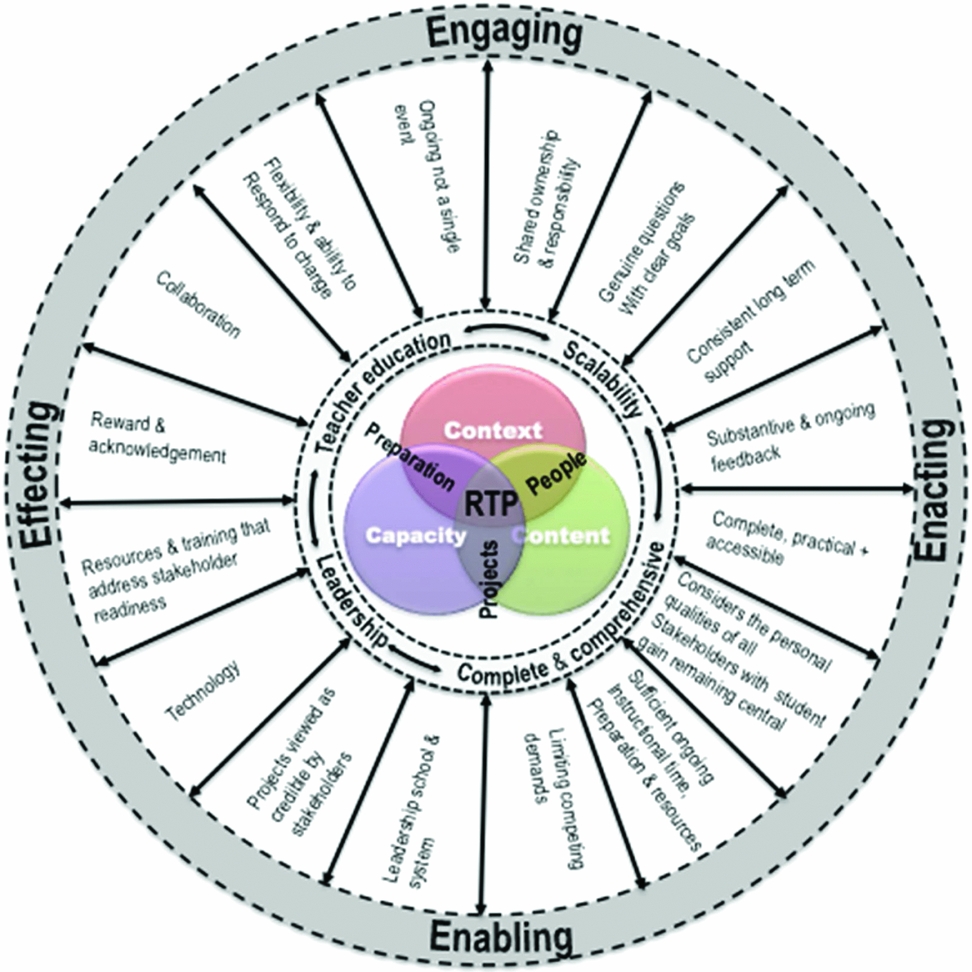
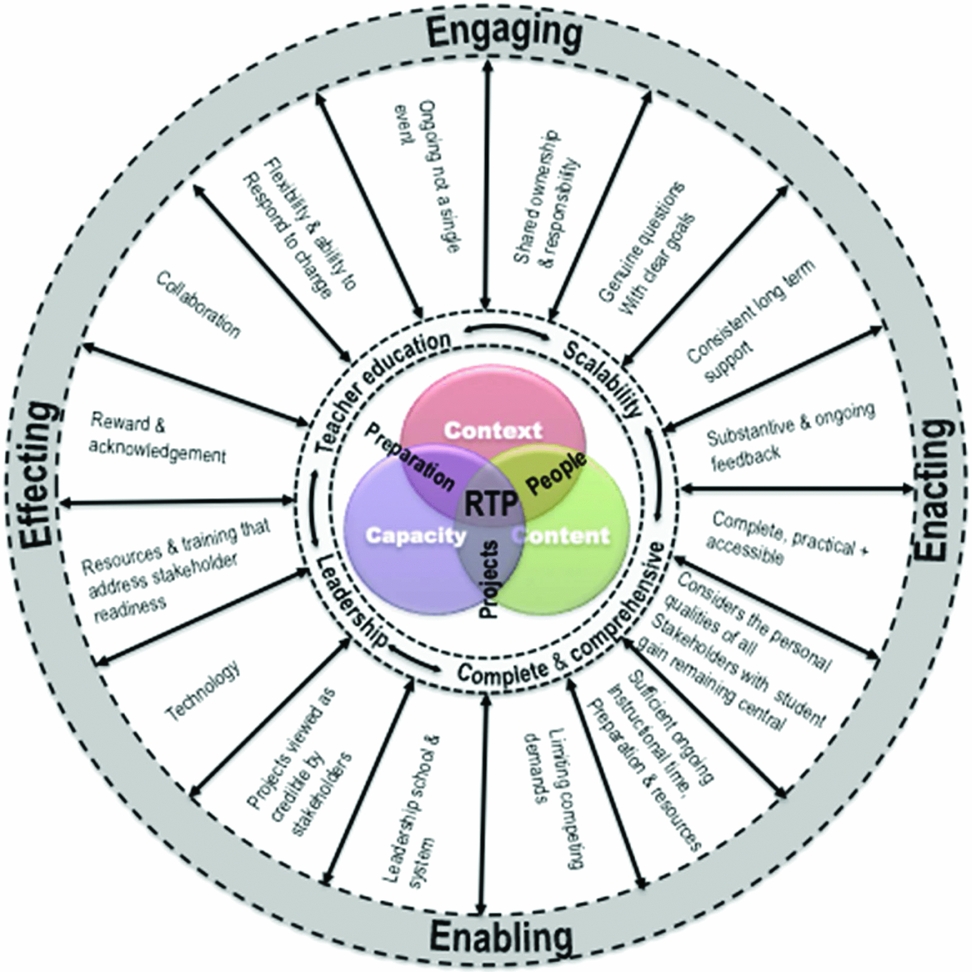
Presenting this collective knowledge of the complexities and consistencies across the factors and key contributors to the sustained successful implementation of research-based practices in classroom settings was challenging. The following section introduces an RTP model (see Figure 1) that provides a visual metaphor for teachers and research. It strives to raise awareness of the key ingredients to implementing and sustaining the use of research-based programs to address the needs of all students by promoting that the whole is greater than the sum of all its parts.
The Research-to-Practice Model: A Framework for Implementing and Sustaining Research-Based Practices. Reprinted with permission from Figure 9.1, What Matters in a Research to Practice Cycle? Teachers as Researchers (p. 247), by C. Grima-Farrell, Reference Grima-Farrell2017, Singapore: Springer.
This conceptual and responsive framework serves to move us beyond simply imparting knowledge, to inspiring growth and transformation through the enhancement of a deep multifaceted understanding of the components essential to sustaining the use of research in classrooms to respond to the needs of students with and without disabilities.
The Solution: Research-to-Practice Model
One of the most common and serious mistakes made by . . . leaders of a change process is to presume that once an innovation has been introduced and initial training has been completed the intended users (teachers) will put the innovation into practice. (Hord, Rutherford, Huling-Austin, & Hall, Reference Hord, Rutherford, Huling-Austin and Hall1987, p. v)
The RTP model is a visual metaphor created to succinctly summarise and define the themes in the relationships described by experienced teachers as they worked to address the needs of students in their classrooms. The conceptual RTP model provides an interactive approach that may be adapted to inform multiple applications rather than a sequenced set or list of RTP factors. It has the potential to be used as a tool that can both guide and show the interactions that should be considered when using research-based practices to enhance student engagement and success.
The RTP model was created and conceptualised as the most efficient way of summarising, integrating, and communicating the complexity of making research ‘stick’ in diverse classrooms. The RTP model (see Figure 1) is presented in a hub-and-spoke configuration to provide a framework for implementing and sustaining research-based practices. It is a schema for understanding findings from both the literature and authentic school-based cases. The model comprises three main sections: the outer circle, the inner circle, and the spokes. It is bound by the elements presented in the outer circle, which, like a tyre, represents the interface between a wheel and the ground. The outer circle comprises four verbs representing the actions required to give practical application to the model. The four verbs were selected to characterise the key features of implementation efforts. For example, RTP efforts need to be engaging through the enactment of harmonious and balanced relationships among RTP factors (spokes) so that they are able to move through an effective cycle of application to address the requirements of varied implementation settings. For RTP efforts to gain traction in a school, they need to engage multiple stakeholders to increase their capacity, skills, and knowledge in enabling students to benefit from research-based knowledge by enacting with integrity in areas including long-term support, well-aligned system and policy goals, and shared ownership and responsibility.
The specific RTP factors derived from the literature and cases are represented as spokes in the model. Each can exert an influence on the project's status. If one spoke weakens, fails, and collapses, additional pressure will be placed on the other spokes. If additional spokes fail, excessive pressure will fall onto those spokes that remain and the wheel is more likely to collapse. The hub represents the interactive core or central point of the wheel that coordinates the interaction among the content, context, and capacity of RTP efforts.
The inner circle includes an interactive hub (the centre of the model) representing the dynamic interaction and intersection of the broader yet vital components: the content of the project, the capacity of stakeholders, and the unique contextual variables of school settings. Elements of these components were originally derived from RTP literature and further validated in the case studies. The analysis of the data collected through this study validated the key big picture components within the inner and outer circle as areas that should be considered when designing realistic and effective RTP projects. The spokes that connect the inner and outer circles represent the specific factors that constitute the scope and diversity of things to be considered in RTP efforts. The spokes that symbolise the more specific 16 RTP factors were consistent across cases that were scaled beyond their initial implementation setting and those that became extinct; however, differing alignments can exist. The hub and spokes give structure to the model.
The RTP model is proposed as a planning tool for teachers, school leaders, and education systems. It aims to raise awareness of the essential connections between key RTP factors and the people implementing the initiatives, the projects themselves, and the preparation required if valuable research initiatives are to be successfully sustained in practice to support teachers in their use of validated resources to respond to the needs of students with and without disabilities.
The merger of research- and practice-based knowledge, derived through the culmination of this work, highlights how teaching and research fundamentally depend on the involvement of one another for maximum benefit. The RTP model strives to provide teachers with a framework that validates the key ingredients essential to maximising the use of research-based practices to respond to diverse student needs. It can serve as a planning tool and navigation instrument that presents the moving parts critical to balancing research and practice knowledge as teachers navigate the realities of classroom and school life. Prior to implementing research-based practices, teachers can use the model to ensure all identified key components are present. They can also use it to enhance the sustained use of research-based practices in their classrooms by using it to track the presence of factors and to raise awareness of the responsive relationships between them. The use of the RTP model as an analysis tool may also highlight key factors that are missing from RTP efforts. This knowledge could raise awareness of the potential areas that need to be addressed to enhance the success of their selected research-based practices to improve student success.
Conclusion
This article provides an overview of a conceptual framework of key considerations essential to successfully implementing and sustaining validated practices to support teachers in addressing the needs of individual students within our school systems. It is embedded in a philosophy that aims to connect students and teachers through research-based practices that effectively address their strengths and needs and seeks to maximise students’ potential to flourish as individuals and classroom members (Grima-Farrell, Reference Grima-Farrell2017). It encourages inclusion through the collaboration of multiple stakeholders, including educators, researchers, community leaders, students, parents, and policymakers. It strives to encourage discussions on how to advance the use of research to enhance inclusive practices and how good practice within authentic and changing 21st century classrooms can inform research. It disproves any notions of teachers being perceived as objects of research or reform, and instead supports the notion that teachers are change agents who are pivotal to inclusive education and the successful outcomes of students with disabilities.