Background
Recent disasters have illustrated the need for preparedness and response capability within the health care workforce.Reference Courtney, Toner and Waldhorn 1 - 4 To address this need, health care organizations, and their respective public and private sector response partners, have come together in networks known as health care coalitions (HCCs).Reference Rambhia, Waldhorn, Selck, Mehta, Franco and Toner 5 Health care coalitions vary in the scope of services they provide, 6 and some, but not all, focus on promoting disaster resilience within their communities. While all HCCs leverage their collective size and resources to influence the cost, quality, and access to health care services in a particular community or region, 6 , 7 disaster preparedness-focused HCCs specifically seek to prepare for, and respond to, mass-casualty and catastrophic events in their community; they are often comprised of hospitals, public health departments, emergency management agencies, and other health care entities.Reference Courtney, Toner and Waldhorn 1
Historically, health care preparedness coalitions have been sustained primarily through the allocation of federal funding. Federal programs to support collaboration and resource sharing within localities include: (1) the Department of Homeland Security-funded (Washington DC, USA) Metropolitan Medical Response System (MMRS), now part of the State Homeland Security Program, which was first funded in 1996; and (2) the Urban Areas Security Initiative, which began in 2003. In 2002, the Department of Health and Human Services (HHS; Washington DC, USA) began funding the National Bioterrorism Hospital Preparedness Program under the Health Resources and Services Administration (Rockville, Maryland USA), and in 2006, this program became the Hospital Preparedness Program (HPP) that is now administered by the Office of the Assistant Secretary for Preparedness and Response (ASPR; Washington DC, USA). Also in 2002, the Public Health Emergency Preparedness Program (PHEP) was funded under the Centers for Disease Control and Prevention (CDC; Atlanta, Georgia USA). In 2004, the CDC additionally funded the City Readiness Initiative, which has grown to include 72 high-risk metropolitan statistical areas.Reference Pines, Pilkington and Seabury 8
Generally speaking, federal funding for preparedness programs has declined over the last decade.Reference Pines, Pilkington and Seabury 8 In the face of decreasing federal support, coalitions have developed creative solutions to long-term sustainability,Reference Pines, Pilkington and Seabury 8 and many have become increasingly reliant on in-kind and monetary contributions from the private sector.Reference Hanfling 9 Whereas many coalitions began as partnerships among hospitals, increased understanding of the interconnectedness of the health system, evolving grant guidance and accreditation requirements,Reference Rambhia, Waldhorn, Selck, Mehta, Franco and Toner 5 and ongoing pressure toward non-grant-funded methods of sustainability have incentivized greater diversification of partners. In a recent survey, just 12% of interviewed coalitions included only hospitals. Additional stakeholders frequently included public health agencies, Emergency Medical Services (EMS), and emergency management offices, while primary care providers, physician's practices, and state medical societies played a role in a smaller subset of HCCs.Reference Rambhia, Waldhorn, Selck, Mehta, Franco and Toner 5 As coalitions evolve to include more partners, non-hospital-affiliated health care providers, police, firefighters, coroners, and school systems may be added.Reference Carrier, Yee, Cross and Samuel 2
Health care coalitions have demonstrated the capacity to increase a community's health resilience in all phases of a disaster;Reference Toner, Waldhorn and Franco 10 so, gaining additional insight into how America's most successful HCCs operate may be instrumental in increasing national health security in other parts of the country. Prior studies have noted a need for more data regarding HCCs,Reference Rambhia, Waldhorn, Selck, Mehta, Franco and Toner 5 , Reference Lathan 11 but there is a paucity of literature focused specifically on the HCC structure and how it has improved the resilience of local health care systems to disasters. The overarching goal of this qualitative study was to learn from the experiences of leaders of well-developed HCCs to describe the structure and history of the HCCs sampled, the perceived added value of HCCs to the communities in which they reside, commonly encountered challenges to increasing health care preparedness capability, and “promising practices” to be shared with more nascent coalitions. The study was intended to be exploratory and to drive hypothesis generation for future data collection on this topic. A companion publication from the authors focuses on the development of human capital through the HCC structure, and it will be published separately.Reference Walsh, Craddock, Strauss-Riggs, Schor and Gulley 12
Methods
Identification of Subjects
The source population of HCCs was limited to those whose primary mission is to foster and promote health care system preparedness for disasters, and did not include coalitions that may address preparedness, but whose mission is broader in scope. A purposive sampling strategy was used to preferentially target well-developed and active HCCs, as they would assumedly be positioned better to share comprehensive histories with the research team due to lengthier institutional knowledge. The study sample size was limited to no more than nine research subjects, as pursuant to the requirements set forth by the Paperwork Reduction Act. 13
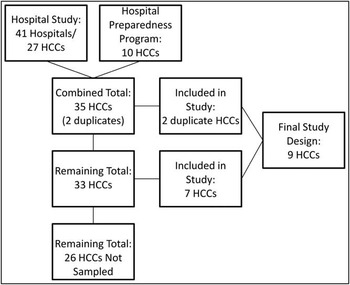
Figure 1 illustrates the 3-stage methodology that was used to identify well-established, preparedness-focused HCCs using the best available data. First, data were extracted from a hospital-based coalition studyReference Rambhia, Waldhorn, Selck, Mehta, Franco and Toner 5 that scored coalition member hospitals on 14 possible characteristics that indicated various attributes of preparedness. To establish a high benchmark for inclusion, hospitals with a score of either 13 or 14 were considered for inclusion in this study. In this manner, a total of 41 hospitals were identified. Each of the 41 hospitals were then linked to their respective coalitions. Coalitions without an online presence or accessible contact information were then excluded, resulting in 27 eligible HCCs from this data source.
Study Sample Selection Methodology. Abbreviation: HCC, health care coalition.

Second, data provided by the ASPR were used to identify “mature” coalitions from among those funded by the HPP. A subset of questions from an existing program evaluation survey was adapted to create search parameters focused on coalition longevity, capacity for education and training, and overall coalition performance. Using these search criteria, a total of 10 HCCs were identified from among the HPP grantees.
The two lists were reconciled, yielding a combined total of 35 unique health care preparedness coalitions. Two coalitions were identified in both datasets and were therefore included as interview sites for this study. The remaining seven coalitions were chosen from among the 33 remaining coalitions using convenience sampling, though efforts were made to select coalitions from urban, suburban, and rural locations, as well as from different parts of the country.
The final study design included nine coalitions, located in the states of California, Colorado, Massachusetts, Michigan, Minnesota, Kansas, Kentucky, Texas, and Washington (USA). Due to confidentiality agreements under the Institutional Review Board approval, individual HCCs will not be named, and instead, they will be identified by the state in which they exist.
Survey Instrument and Data Collection
A semi-structured interview guide was used to conduct face-to-face interviews with the coalition leadership in each of the nine HCCs. Institutional Review Board approval was obtained from the Uniformed Services University of the Health Sciences Office of Research (Rockville, Maryland USA), under protocol #381802-5.
Major topical areas covered in the interview guide included: the establishment and history of the coalition; strengths and weaknesses of the HCC structure; specific challenges encountered in improving health care systems preparedness capabilities; and “promising practices” to be shared with other coalition leaders. Questions regarding hospital- and public-health-preparedness capabilities were derived from HPP and PHEP grant materials, and input on the questionnaire was sought and obtained from the ASPR National Health Care Preparedness Programs. The final survey was also pilot tested with a local HCC leader who was not a respondent in this study. Additional questions regarding perceived disaster-health education and training needs, education and training barriers, and opportunities and advantages for additional disaster-health education and training through HCCs were also included in the guide, but are reported elsewhere.Reference Walsh, Craddock, Strauss-Riggs, Schor and Gulley 12
Data Analysis
The audio recordings were transcribed by an online transcription service, and transcripts were analyzed qualitatively using QSR NVivo 10 qualitative analysis software (QSR International Pty Ltd; Doncaster, Victoria, Australia). Three research personnel independently coded each interview, and a standard of 80% intercoder agreementReference Miles and Huberman 14 was followed. The methodology for thematic analysis was influenced by grounded theory,Reference Phillips 15 but because interviews were conducted with predetermined questions, predetermined theme areas were covered in every interview. A structured approach to coding was utilized,Reference Phillips 15 and a list of codes was determined prior to the analysis. Codes were then analyzed by hand to uncover and establish themes and trends from among the research sites. Both anticipated and emergent themes were considered, and findings are presented here according to the guidelines for communicating descriptive, qualitative analyses.Reference Knafl and Howard 16
Findings
Health care coalition leaders were very forthcoming, and were enthusiastic to share both positive and negative experiences. Substantial amounts of data were collected regarding: the establishment and structure of HCCs, the perceived contribution of health care preparedness coalitions to the resilience of local communities, the challenges that have been encountered in the course of establishing and sustaining coalitions, and promising practices to be shared with others.
History, Membership, and Leadership
The terrorist attacks of September 11, 2001 (USA) were the initial motivating events for the establishment of each of the coalitions surveyed. While one coalition was established prior to 9/11, the attacks spurred more motivated and widespread interest and involvement, and membership attendance became more robust in the years following.
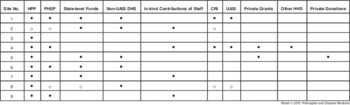
Today, most of the surveyed coalitions receive funding from multiple sources, including federal, state, and private grants and donations (Table 1). Many of the coalitions also employ staff sharing, in which member organizations donate staff time to assist in the coordination and execution of coalition-level activities and tasks.
Funding Sources of the Interviewed HCCs

Abbreviations: HCC, health care coalition; Hospital Preparedness Program (HPP); Public Health Emergency Preparedness (PHEP); Dept. of Homeland Security (DHS); City Readiness Initiative (CRI); Urban Areas Security Initiative (UASI); Health and Human Services (HHS).
•HCC receives funds from this source.
♦HCC partners, but not the HCC itself, receive funds from this source.
While many of the coalitions began as hospital-centric partnerships, the largest coalitions now have hundreds of individual institutions represented. Most coalitions cover very large, multi-county regions and incorporate multiple hospitals, EMS agencies, health departments, emergency management offices, and fire and police jurisdictions. In addition, the most developed coalitions actively involve long-term care facilities, freestanding clinics, local universities, public schools, medical societies, and military installations. Partnerships with the private sector are increasing as well.
Value of Health Care Coalitions
The most commonly shared value-add of HCCs was community and regional partnership building. Coalitions provide a forum for like-minded professionals with varying backgrounds to come together and plan for the mitigation of poor health outcomes in a disaster. Because coalitions are not “owned” by any one entity, they provide an impartial forum for building capacity throughout the health care system. This partnership building has: enabled interoperability among agencies and organizations involved in planning, response, and recovery; promoted the sharing of resources and information; and improved communication among agencies and with the general public.
We started out with two separate systems, and public health was doing all these things, and there really was not an integration with [the first responder] system that already existed. And so [the coalition is] trying to bridge that gap now.
[CITY] Public Health has a hazmat response crew. Well, so does the fire department. And then there's the Civil Support Team who could respond to larger events. If they all showed up at the same white powder situation, they needed to know [each other], because each comes from a different background: fire, military, public health. So they started communicating [through the coalition]… Now they know each other.
Coalitions also allow for education and training opportunities in disaster-cycle services to be shared with professions or segments of the population that may not have access or funding, but who would be expected to play a role in disasters. Emergency Medical Services was frequently cited as an example.
No one looks out for EMS. So hospitals may get funding through ASPR, right? They're regulated by [the Joint Commission], so [the Joint Commission] will tell them they have to do some things. You know, fire gets money through [the Federal Emergency Management Agency], through the assistance of firefighter grants, or through Homeland Security grants. Almost no money is available, or no incentive is available to EMS to exercise, to upgrade their equipment. So we [the coalition] involve EMS.
Staff- and resource-sharing agreements among partner institutions in the coalitions allow preparedness funding to be more equitably shared across the entire health care system.
…Another positive for our coalition: [the HPP and MMRS coordinators both] sat at the table, so when HPP grant dollars either, A) came up short, or B) were restricted to the point of useless, MMRS's coordinator would thumb through their documents. And it was a wonderful way to share money, because we were touching the same people.
Furthermore, the coalition structure has incentivized the clinical health sector to engage regularly with emergency management, the private sector, and public health in ways that were largely unprecedented. 17 - 19 This has allowed a shared vision of community vulnerabilities and “false planning assumptions,” and has built a diverse pool of professionals to brainstorm solutions together.
When we first started doing the [coalition] stuff, some of these providers had no idea that there was another facility just down the street. Some of the long-term care-ers were thinking, okay, if something bad happens, I'm off-loading my patients to the hospital. [If you asked] that same hospital, what are you going to do with your patients? [They say] I'm going to off-load them to long-term care. So you have this vision of ambulances transporting patients, passing each other on the street. And so I think one of the biggest things we've been able to accomplish with [the coalition] is just getting these people [to] meet each other and learn what those false planning assumptions are.
Coalitions also support better communication with the public. In health care disasters, all organizations in the coalition provide a unified voice and are able to share a consistent message. They are able to show that they are working together for the benefit of the community, which ultimately improves public opinion. Additionally, the cumulative presence of so many organizations lends credibility and power when working with vendors to get what they need for preparedness activities.Reference Pines, Pilkington and Seabury 8
Surge Capacity
Another unique benefit of coalition building was the ability to increase capacity of the health care system, or to “surge.” All coalitions were involved actively in facility- and community-level surge exercises and used these as opportunities to identify additional areas for improvement of their surge plans. Many have used grant dollars over the years to stock up on supplies and equipment, and the majority of respondents are able to set up alternate care facilities with the resources they have. Furthermore, because many facilities are running at capacity every day, they are largely comfortable with the idea of shifting and transferring patients.
As a result, the most advanced coalitions no longer focus on the quantity of surge patients they can handle, but are rather working toward identifying which patients “truly break the system.” In other words, each new surge exercise introduces a patient type that is not often seen in the day-to-day operations of the health care system (eg, chemically contaminated patients, severe burn patients, or unaccompanied minors). Coalitions have also started to shift from diverting or moving patients from one hospital to increasing bed capacity within the facility the patient is already in. These augmented surge plans often include: the training and staffing of additional volunteers (eg, through Community Emergency Response Teams and Medical Reserve Corps); identifying the assets required for high-acuity patients to be transferred in and out of specialty-care centers; and how to sustain facility surge for an extended period of time.
It's a lot easier to serve the facility than try to build a facility. And it's a lot easier to move staff than it is patients.
To assist in surge capacity planning, bed tracking systems are also used consistently in the coalition hospitals. Some coalitions even use advanced bed tracking systems that allow specific matching of patients to beds based on gender, age, monitoring status, and psychiatric condition. Others have introduced bed tracking systems into nursing homes and long-term care facilities in their region.
Challenges for Health Care Coalitions
The following six topics were identified as challenges to health care system resilience and capacity building by at least half of the respondents: (1) staffing; (2) stakeholder engagement; (3) funding; (4) education and training; (5) jurisdictional restrictions and scope of practice; and (6) federal grant guidance. The topic of education and training is discussed in depth in a companion report by the authors,Reference Walsh, Craddock, Strauss-Riggs, Schor and Gulley 12 and therefore, it will not be discussed in this report.
Stakeholder Engagement—Stakeholder engagement was the most frequently cited challenge for HCCs. Because HCCs often have few full-time staff members, and because their attention is prioritized generally toward completion of the grant deliverables, little time is left over for recruiting, managing, and retaining coalition partners. As a result, tasks and responsibilities are often delegated out, leading to decentralization of leadership and frequent duplication of efforts among coalition partners.
Furthermore, gaining and sustaining buy-in from health care leadership, specifically hospital executives, and the private sector is a significant challenge.
So trying to convince our hospitals and our hospital administration, given all of the other burdens that they have to comply with now with the Affordable Care Act, trying to get them to be able to be willing to spend a lot of resources and time around preparing for something that has never happened; it's hard to get them to prioritize this in many cases. Some get it, some don't.
There were also issues of territorialism and instances in which members of the coalition and leaders in the community were “not playing nicely.” This was evident across sectors (eg, between emergency management and public health) as well as within sectors (eg, among competing hospitals).
Obviously, emergency management involvement and overall capability management is huge[ly necessary]. The emergency managers are supposed to be the go-to men and women to make sure that everything gets done, [but] they don't play well in the sandbox.
So, I think that there's a lot of strength in the coalition and it's a struggle because you have to work on consensus and you can't just strong arm people …And what has not worked [for us] is [managing] this conflict or territorialism around roles.
Member retention also was cited frequently as a challenge related to stakeholder engagement. Coalition leaders stated that because representation within coalitions is so diverse, it is often difficult to keep information, education and training, and activities relevant to all partners.
As the breadth of our partnership expands, the relevancy becomes more difficult to obtain on an individual basis. And so we just try to keep it mixed up and varied as much as possible, understanding that people will opt in or opt out to particular meetings as they find it relevant.
Staffing—Almost all of the respondents indicated that they did not have enough staff to perform all the activities needed to build and sustain a high-functioning HCC. Due to the ongoing refinement of grant requirements and simultaneous budget cuts, coalition workload has increased without a parallel increase in funding or the ability to hire staff. Furthermore, grant reporting requirements are often particularly burdensome for hospital partners, making it difficult for hospital leadership to support the coalition. As a result, coalition staff was often being “borrowed” from other organizations, leading to employees “wearing multiple hats,” and being “spread too thin.” Of the nine coalitions surveyed, one was run entirely on volunteer time and the donation of staff time by HCC member organizations; three had a single, full-time equivalent coordinator and the in-kind support of committee representatives; and the remaining five had additional paid staff, supported either full-time or part-time by grants or part-time through staff-sharing agreements.
All the hospitals are understaffed in emergency management. So all of the people that we work with as our partners within a facility are usually wearing about ten hats… It can be a barrier to making progress when those people aren't available to commit their time to our program.
So, looking at ways to sustain a coordinator or a coordinator and a half position [is a priority] because …. It's more than a full time job, to do it well. You're bringing everybody together. You're assisting with [Hazard Vulnerability Analyses] and there's just a lot of work to be done. You're system exercise planning, and plan writing and testing those plans. And when you can do it right, it's more than a full time job.
Funding—Funding was also among the top challenges identified by HCC leaders. Simply stated, “there is not enough.” Heath care coalitions are struggling continually to find resources for hiring and retaining staff, providing education and training opportunities and exercises, and finding and purchasing resources. Prioritization of spending is made difficult due to federal or state restrictions on grant spending, the need to meet grant deliverables, or the inability to achieve consensus on financial decisions. Additionally, some coalition leaders struggle to reconcile the disparate allocation of federal funds in their jurisdictions.
I can't spend any money for a program that's not supported by [Hazard Vulnerability Analyses or After Action Reports] that tells me that it was required. But for some reason, emergency management has been insulated from that perspective, and they're spending lots and lots of money.
Furthermore, coalitions fear that continuous cuts in funding may result in the loss of capacity that has already been attained by the coalition, and may prohibit the coalitions from maintaining the equilibrium necessary to sustain their developed capabilities.
If we do not receive federal funding, these communities will not exercise. I understand that your dollars are tight and you have to make hard decisions, but if we cut this… the state's not going to fund it, it's just going to stop happening… and we will lose our capabilities.
Rural Needs, Cross-border Partnerships, and Licensure—More than half of the respondents reported that differences in needs from urban to rural partners were a significant challenge in effectively leading their HCC and meeting grant requirements. Rural coalitions often feel isolated from their more urban in-state counterparts, and generally find greater value in exchanging information with rural coalitions from bordering states than with urban coalitions in their own state. This introduced the related challenge of cross-border licensure and the relative inability to utilize licensed professionals from other states in resource-sharing agreements. One-third of coalitions indicated that cross-border licensure is a major impediment to operating under altered standards of care.
There should be a national credential, if you submit to this, and you have been fingerprinted and the background check and keep your credentials up, you are immediately deployable anywhere in this region…. Borders hinder us from doing anything – not within our coalition, but as we think about helping across borders.
There's a need from the federal level for a better, more clear understanding and definition of the legal issues around response. An example is medical licensure. And nobody really still has a clear understanding around medical licensure from [our city] to [bordering state]. We're that close together, but if our nurses go to help, they can't be nurses. How can that process be simplified so that we know how to plan for it and address it?
Adding another layer of complexity, facilities in the same region may have different privileging processes, so that a provider in one medical system is unable to practice in another.
Well, [there are] two different issues. One really is just the legality of the licensure from across county lines, or state lines, or whatever. And then there's the facility credentialing … I may get to [our border states] and my home state license might be good, but [the receiving facility] still isn't going to let me in the door to practice until I go through their credentialing process.
Going beyond this is the issue of tribal sovereign nations within coalition regional boundaries, as well as foreign countries (Canada or Mexico) which may border the coalition's state lines.
Grant Requirements—Finally, there were instances in which the grant guidance and funding requirements hindered preparedness planning and activities. Coalition building requires many different capabilities, but coalitions can often only afford one full-time staff person. Further complicating the matter is that some of the grant deliverables go beyond the scope of the coalition, and touch state and jurisdictional policy beyond the coalition's control.
I think some of [the grant deliverables] were beyond the control of the coalition and probably need to be looked at. I think they're more of jurisdictional policies, maybe, or state policies. And I understand they put those broadly because – the coalition may be the entire state, and they have the ability to make state law and whatever changes to get that done. But when you're talking about big regions like [ours], where we don't have jurisdictional authority and we don't have the ability to pass legislation; it makes it difficult to get those things done.
In addition, many coalitions described a disconnect between the actual preparedness needs of the community and the stipulations required for grant funding. This was evident especially in rural areas, where many grant requirements must be altered or adapted to be more relevant to their needs.
You know, we'll work really hard to try to help [grant deliverables] match the needs [of the region]. [But] I had heard from rural public health that her job is comprised of 95% of the stuff that they don't need and 5% of the stuff that her jurisdiction does need. And so the emergency manager said, well, then don't take the money… But if they don't take the money and they don't do [the deliverables], then that position just goes away.
If you have a grant that says you shall do “blah, blah, blah,” and whatever that is has very little relevance to your partnering agencies, you have to be very cognizant about how you try to meet that deliverable. If you have to do it, let them know, I have to do it… maybe try to get the most value out of it … and make it as relevant as you can, but I really try to avoid wasting anybody's time.
Furthermore, differences in the construction and execution of grant requirements under the different federal programs often result in an inconsistent or unrealistic understanding of requirements and the inability to coordinate across federal grantees in the same region.
So [the state] was telling public health something that, in some cases, they have no authority to make happen, instead of bringing in an emergency manager and saying, is this even practical, because the people who are designing these deliverables have no concept of what an emergency manager is. And [that] strains the local jurisdiction's relationship.
Similarly, because other federal grant programs focused on preparedness may have pre-existed in the community, or currently coexist in the community, coalitions must take care to “not recreate the wheel” when establishing partnerships, agreements, and plans, because they may have already been done by other programs. While the recent HPP/PHEP program alignment has helped bring federal grantees together, it does not yet take into consideration the full range of federal preparedness grants, such as non-HHS federal grants.
We've learned a ton from [Department of Homeland Security grantees] and we've stepped on toes, as well. I personally have done it. Because here's my deliverable …So all right, I go do that thing, not realizing that that thing had already been done like ten years ago by somebody.…
Hospital Preparedness Program and Public Health Emergency Preparedness Program Alignment
By and large, the alignment of HPP and PHEP capabilities and grant structure has been well-received among coalition leaders, including among those that do not receive direct funding from either program.
The nice thing about the alignment of capabilities is that instead of each program trying to figure out what their training exercises are, it's kind of dawned on us that you can kill two birds with one stone in so many areas, and that wasn't really apparent to us before.
While some HHS-funded coalitions are still figuring out how to formalize the alignment, others have been doing it all along.
It's been overwhelming to try and work at the public health facilities and try to manage those also with the hospital capabilities.
We've always kind of worked very closely with our public health partners in that we've always taken whatever grant is out there. We've already been aligning all those things across, and making sure that whatever are the strictest guidelines; those are the ones that are met.
Coalitions that do not receive funding under the HPP or PHEP programs also have utilized the capabilities alignment to augment their understanding of requirements requested of their public health and medical partners.
So, now, we use Department of Homeland Security Core Capabilities. But, we have to look very closely at the public health and medical capabilities… depending on what we're after and what we're trying to accomplish. But, it's not the same. And, so, I'll bounce back and forth just because one [set of capabilities] tends to have more detail.
Promising Practices and Coalition-developed Solutions to Challenges
The interviewed coalitions were among the most developed in the country. As such, they were able to provide a multitude of potential solutions to the problems that they, and others, have faced. The following five “promising practices” can be utilized by more nascent coalitions, policy makers, and educators to address existing and emergent issues within a coalition.
Stakeholder Engagement—With funds decreasing, monetary incentives are no longer the primary driver for participation in a coalition; although, a handful of coalitions continue to use equipment reimbursements and education and training grants to gain and sustain buy-in. In the absence of plentiful financial incentives, coalitions are reliant increasingly upon meaningful and sustained no-cost engagement with partners. Many highlighted the importance of writing a multi-year charter or a strategic plan early in the process of building the coalition. This serves the dual function of establishing longevity and articulating the collectively identified goals of all involved stakeholders. Getting hospital leadership and other high-level decision makers to contribute to the strategic plan from the beginning was emphasized, as it builds ownership and accountability. Some coalitions have even developed materials to share with executive leadership to help describe the coalition purpose, function, and the potential return on investment for participating.
And when we bring a new hospital in, we have a welcome packet. So we go out and meet with the hospital [Chief Executive Officer], visit the chief nursing officer, whoever their emergency management coordinator is, anybody else that they want to bring in. And we basically have the packet that goes with us. And it's their binder and it gives them an overview of: here's the alphabet soup and this is what this all means, and this is how you get into here, and here's your request forms and all of that stuff.
The number and type of stakeholders invited to participate in the coalition was also identified as important. All coalitions suggested integrating many partners to have access to both medical and non-medical resources. When thinking about who to include, a number of coalitions used a thought exercise that imagined all the personnel and equipment necessary to support a mass-casualty incident. Such preparedness exercises also helped to identify any potential insufficiency or redundancy in response capability, or when the closest assets were across state lines.
So, we really started to transition away from just hospitals to including how we surge beyond hospitals and how do we include our partners. And the term “partners” became very broad at that point in time, and I think we're still trying to define what that means as you start to look at who really are your partners when you're looking at a large-scale mass-casualty event.
The MMRS was cited frequently as a model for engagement, and including current or former MMRS representatives in the coalition leadership team was a common strategy among coalitions.
The good thing about the MMRS grant was that it was, essentially, if you did it right, a planning grant. And it was about bringing everybody together, going over plans, establishing things as needed, revising old ones, exercising… So now that the Health and Human Services part is coming around saying we need health care coalitions, if you follow the MMRS guidelines, you actually end up with a health care coalition.
The private sector was also identified as valuable, as they can often supply expertise, equipment, and supplies in an emergency; they also have the ability and incentive to provide monetary and in-kind donations throughout the year.
We had a water main break and [department representative] goes down to the [emergency operations center] and people started calling – we need ice, we need water – he picks up the phone and calls [major national chain] and says, I'm the Health Department, can you get us some water? And they say, yeah. Well, it's, kind of strange, because the Water Company couldn't do it. They said, we can't help you right now. So [the chain] is big and they've got the distribution system down pat.
Other potential partners for coalition building included: local military installations; local, state, and/or regional emergency management; tribal nations; non-hospital-based specialty-care providers; local institutes of higher education; hospital owned, non-affiliated, and federally-funded clinics; Medical Reserve Corps (Rockville, Maryland USA); animal control and rescue; American Red Cross (Washington DC, USA); local offices for the Federal Bureau of Investigation (Washington DC, USA); airports; long-term care facilities; faith-based organizations; and state hospital associations.
Communicating Value and Purpose—Leaders agreed that maintaining focus on the underlying mission is essential, as is being open and transparent about short- and long-term goals. With so many partners and so many individual interests, the “big picture” can get lost.
[My best advice is to] make every effort to clearly communicate your mission objectives. One of the biggest criticisms that we receive is not being transparent on what we're trying to accomplish.
Most people are quite surprised, when we go to other places in the state, of how we can all sit in a room and we can actually talk to each other like civil individuals and actually get things done. Rule number one is your ego stays at the door because this is not about ego. This is about being prepared.
Furthermore, explaining how supporting the coalition's mission has the dual benefit of also supporting day-to-day operations can also be a strong motivator for partners, especially executives. Continuity of operations planning can be used as an example of the intersection between systems preparedness and the financial “bottom line.”
Where we started going was business resiliency, continuity of operations. Because without that, if we don't have our partners up and running to some level, …we've lost a critical piece. And there's double benefit to that, quite honestly. There's obviously the benefit as it stands in and of itself, but as a health care coalition, part of our long-term sustainability vision has to be somewhat independent of [grant] dollars. So unless we can clearly demonstrate value for participation and affecting [health care business’] bottom line, it's going to be very difficult to get them to pay-to-play…
Simplifying the Process—Leaders also strove to make participating in the coalition “painless” for members by streamlining practices, simplifying forms, and carrying the brunt of the workload for health care professionals that are already “wearing multiple hats.” While coalition meetings were held at regular intervals (monthly, bimonthly, or quarterly), frequency was minimized to the absolute essential number needed to keep people engaged over time; they were also held at a time of day that didn't conflict with regular work hours. It was stressed that meetings must be kept timely and relevant, and education opportunities should be offered at each gathering. If possible, remote meeting technology can also be used to support participation. Recorded meetings and presentations also enable members to watch or listen to archived materials on their own time.
Being able to use technology so that people don't have to leave their office to still participate … it's enormously improved the amount of input we get from the regional partners outside of [the] County. ….Which never replaces face to face, but they don't do face to face because [there are] not enough hours in the day.
When planning drills and exercises, in many cases, coalition leaders collaborated with other facilities with annual exercise requirements (eg, airports, Office of Veteran's Affairs (Washington DC, USA) facilities, fire departments, hospitals, and long-term care facilities) in order to reduce redundancy and “get more bang for your buck.” They also used these more “visual” activities as opportunities to get sectors, or people, that were not otherwise involved regularly in the HCC, but who would be likely to respond in an event, more excited about being involved on a regular basis.
Finally, most successful coalition leaders understood their roles as a resource rather than as an imposed demand on their existing or potential members. Each made very practical efforts to help members solve their planning issues and understand and alleviate their concerns.
I think [our biggest value is] having our board, our coalition; the volunteers in it and the staff that's able to support [hospitals] so that they're not carrying the entire burden. Hospital [Emergency Management Coordinators] have a lot to do… It's not a revenue-generating department at a hospital. And so, again, you have to make it as painless as possible, and they have to be able to see some kind of benefit for their return of investing those personnel into it.
Contractual Agreements versus Informal Connections—For many, contracts among partners were inhibitory to moving forward. More successful strategies for a formalized continued engagement were memorandum of understanding (MOU) and compact agreements. While such agreements were usually between the coalition and the participating partner organization, some coalition leaders also found it useful to assist mission-similar facilities within the coalition in drafting a resource-sharing agreement to: (1) facilitate transfer of staff and resources among themselves, and (2) identify pervasive needs among the facilities that the coalition may be able to fill. In one case, National Incident Management System training was used as an opportunity to talk about the local compact agreements and how to leverage staff and resources, if needed.
However, while formal agreements (such as MOUs and compact agreements) were often essential to the productivity of the coalition, nothing was emphasized more than the importance of informal and personal engagement with partners, leadership, and steering committees. Getting to know people personally was identified repeatedly as a best practice.
And a lot of those gaps were bridged in coffee shops, and people laugh at me when I say that, but just going and drinking coffee with the emergency manager and buying him a donut will make a big difference. I've always encouraged all my hospitals to invite those people in once a month just for coffee and donuts.
Incentivizing Participation—To better foster long-term sustainability, a handful of coalitions have moved toward a participation-driven reimbursement model that rewards members proportionately with their unique contributions to the coalition. For example, one coalition has derived a points system in which each member organization can “earn” points for participating in activities and providing certain deliverables. Funding reimbursements are allocated based on how many points have been attained.
So we get our funding and we take what we need to sustain [and meet our capabilities requirements]. Then [with the remaining] money, we go back to the hospitals and we look at what their participation has been in this coalition. Are they attending their meetings? Do they do their bed reports? Do they do their surveys that go out? Do they attend the symposium? Have they participated in the exercise? And each of those have point values to them. And so then the amount of money they get is based upon how many points they have. And the more that they participate, the more they're rewarded with funding.
Other coalitions encourage more sustainable practices by providing reimbursements for member-driven education and training. Rather than hiring outside trainers to provide a course, coalitions will pay for facility leaders to be trained in a train-the-trainer format, so they are available year after year to provide support at a one-time cost.
I would rather have a trainer in your hospital [than hire one each year] so that next year, you just do the training. If you always have to wait for funding – I mean, it's just not sustainable.
Ongoing Efforts to Address Challenges
As shown in the previous section, coalitions are working actively on solving their issues and reaching smart and sustainable solutions to maximize health care system preparedness. While they've come a long way in addressing many of the identified challenges, others will require investment and support from outside stakeholders (eg, in the case of funding, licensure, and grant requirements). Other challenges may be solvable within coalitions, but haven't fully been figured out yet. The following two examples are issues that were identified as challenges that may require coalition-to-coalition or state/federal support for effective resolution.
Long-term Sustainability—Long-term sustainability was at the forefront of each of the interviewee's minds. Ultimately, the majority of coalition leaders see the need to become completely independent financially from federal-level support, but few have truly figured out how to do so. The “pay-to-play” model, in which the coalition is supported financially by the contributions of its members, is becoming increasingly desirable, but few coalitions have implemented it successfully. As a result, most of the coalitions are looking for guidance on how to replicate these models in their jurisdictions.
But as a health care coalition, part of our long-term sustainability vision has to be somewhat independent of [federal grant] dollars. But most of us have never gone down that path of pay-to-play. We entice them to come to the table by offering them dollars, and it's just not an option anymore, and it will be less of an option.
Resource Sharing—Resource sharing among coalitions is currently inconsistent and ad hoc. Coalitions are frustrated with spending a lot of time devising solutions to problems that other coalitions have already encountered and solved. They see a lot of value in coming together at conferences and workshops, as these are opportunities to share ideas and learn from their colleagues. The concept of an online resource repository was also suggested by about half the participants as a potential solution to the resource sharing issue, but none felt they could implement the solution alone.
[There are] a lot of resources out there, but they're all in different places, so nobody knows where to look. Not everybody has access to the same systems, [so maybe someone should] do a clearinghouse kind of concept.
Discussion
While there is currently no consistent way to measure the impact of HCCs on community health care system capacity for providing disaster-cycle services, the information gathered in this research suggests a marked improvement in community-level health care systems preparedness over the last 10-15 years. The coalitions sampled were among the most robust in the nation, and had much to share regarding successful practices and overcoming obstacles. Value-adds of health care preparedness coalitions to community preparedness include: stronger and broader partnerships, improved interoperability and communication between health and non-health partners, the removal of “false planning assumptions,” maturation of the disaster-response workforce through easier access to education and training opportunities, and an increased capacity to surge the health care system.
This and previous studies suggest that strengthening HCCs and their underlying systems could lead to improved national resilience to disasters.Reference Hick, Hanfling and Burstein 3 , Reference Rambhia, Waldhorn, Selck, Mehta, Franco and Toner 5 , Reference Hanfling 9 , Reference Toner and Adalja 20 However, coalition leaders are faced with obstacles that may preclude optimal system functioning. First, the majority of existing coalitions are dependent largely on federal grant funds that are, for the most part, decreasing. There was a shared fear of “losing what has been gained,” and coalition leaders emphasized the need for continued federal and state support until other options could be identified and implemented. Existing grant requirements were also inhibitory to optimal functioning. And, while efforts are being made at the federal and local levels to align public health, medical, and emergency management systems to improve preparedness planning,Reference Carrier, Yee, Cross and Samuel 2 , Reference Ginter, Rucks and Duncan 21 this is not yet a reality in most regions.
Long-term sustainability of HCCs will require the support of many stakeholders. Most proximal to the coalitions are the leadership of health care agencies in their communities. However, many of the interviewed coalitions described a reticence on the part of health care executives to take part in, and fund, preparedness activities. Coalition leaders are looking for ways to “sell” the coalition concept, and the concept of preparedness in general, to executives that are not necessarily concerned with low-probability events, but rather with how investments in preparedness would affect their “bottom line.”Reference Barbera, Yeatts and Macintyre 22 Like other prevention programs, it can be difficult to quantify the return on investment of preparing for health care disasters; but, more research in this area is dually imperative, as the buy-in of these executives is critical to coalition functioning and the knowledge level of decision-making health care executives can influence health outcomes in a disaster.
Beyond the executives, coalitions are also challenged to include a diverse subset of health care partners who currently have little motivation or funding to focus on preparedness. Greater engagement in a wider variety of health care entities may be incentivized by proposed legislation from the Centers for Medicare and Medicaid Services (Baltimore, Maryland USA) that would require health care institutions receiving Medicare and Medicaid reimbursements to undertake certain preparedness actions, 23 but this rule has yet to come to fruition. Additionally, non-health care partners and the private sector may have a lot to contribute before, during, and after a disaster, but may have little knowledge, expertise, or experience in the area. While some coalitions have made progress toward better integrating these partners, others have yet to fully leverage this source of potential support.
A remaining challenge for optimal coalition functioning is cross-jurisdictional and cross-border engagement. Many of the interviewed coalitions shared borders with neighboring states, Canada or Mexico, or tribal sovereign nations. These coalitions unanimously expressed frustration over the difficulty in planning for staff- and resource-sharing across borders, as the current legal system and process of health care professional licensure and facility privileging do not support it. Rural partners were burdened particularly by this reality, since the nearest neighboring medical facility was often across state lines. There is a need for improved state- and national-level systems to better support licensing and credentialing in disasters.
Limitations
Due to the small study sample size, these findings may not be generalizable to all preparedness-focused HCCs. Additionally, because mature coalitions were sampled purposefully, the viewpoint and experience of more nascent coalitions are not represented. Furthermore, because HCC structure, funding requirements, and specific regional characteristics are unique and varied, the design of this study precludes robust cross-coalition comparisons within the sample.
While participants were very forthcoming in their responses to the interview questions, response bias is often inherent in self-report interviews. The researchers attempted to prevent such biases to the extent practicable by offering confidentiality and anonymity to the respondents, but the potential impacts of such biases on the data are difficult to measure.
Conclusion
This study was novel in its approach within the existing body of literature surrounding disaster preparedness-focused HCCs and can be used to inform future research that samples larger numbers of coalitions. To the research group's knowledge, little evaluative data exist to inform the improved structure and function of HCCs and to assess the added value of preparedness coalitions in communities. This study combined the best available data from existing sources and built upon it to advance knowledge and information gathering in an understudied topic. The research group hopes this adds to the other work being done in academic and federal spaces, all with the goal of advancing community health care preparedness through building and supporting HCCs.
Supplementary material
To view supplementary material for this article, please visit http://dx.doi.org/10.1017/S1049023X14001459