Introduction
For the 15.5 million people diagnosed annually with cancer, the decision burden regarding care and treatment can be associated with profound biological, psychological, social, and spiritual effects (Pecanac et al., Reference Pecanac, Kehler and Brasel2014; Kruser et al., Reference Kruser, Pecanac and Brasel2015). Leveraging patient supportive resources, including religious and spiritual (R&S) beliefs and practices, to incorporate into the treatment planning process may help to facilitate decision-making that is in line with patient preferences and values (Balogh et al., Reference Balogh, Ganz and Murphy2011). To this point, the American Society of Clinical Oncology has endorsed assessing and incorporating R&S needs into the oncological care of patients (Puchalski et al., Reference Puchalski, Sbrana and Ferrell2019). R&S can serve as a valuable inter- and intrapersonal resource for cancer patients and their family members, including providing hope, finding meaning in the cancer experience, improving cancer-related psychological adjustment, as well as enhancing quality of life (Koenig, Reference Koenig2012; Peteet and Balboni, Reference Peteet and Balboni2013; Cohen et al., Reference Cohen, Sawatzky and Russell2017). Additionally, R&S can influence treatment-related decisions, including engagement in complementary therapies, enrollment in clinical trials, transition to palliative or hospice care, and the decision to undergo cancer-directed surgery (Koenig, Reference Koenig2012; Peteet and Balboni, Reference Peteet and Balboni2013; Roland et al., Reference Roland, Rodriguez and Patterson2013). Unfortunately, despite recommendations and data to support the incorporation of R&S into the clinical care of cancer patients, R&S beliefs and practices of patients are often excluded or overlooked in the healthcare setting (Koenig, Reference Koenig2012; Puchalski, Reference Puchalski2012).
Surgery often plays a key role in the treatment of many patients with cancer. Perhaps more than other types of therapy, cancer-related surgery can be particularly stressful on patients. In particular, surgical therapy tends to be “higher stakes” relative to the risks (e.g., perioperative complications and mortality), as well as the benefits (e.g., “cure”) (Kim et al., Reference Kim, Winner and Page2015; Ejaz et al., Reference Ejaz, Kim and Winner2016; Winner et al., Reference Winner, Wilson and Yahanda2016; Palmer Kelly et al., Reference Palmer Kelly, Payne and Pawlik2019b). To date, however, the role and importance of R&S among patients during the perioperative period has not been defined. As such, the objective of the current study was to characterize patient preferences around the role of R&S during cancer treatment with a specific focus on cancer-directed surgery. Additionally, we sought to characterize which R&S resources patients most often seek during the perioperative period.
Methods
Survey instrument design and administration
A cross-sectional descriptive study using survey methodology to assess R&S practice using an investigator-created survey was employed. For the purposes of the current study, religion was defined as a belief and trust in God, a higher power, and/or a set of religious beliefs and/or practices. Spirituality was defined as the way people seek and express meaning and purpose in their lives, and the way people experience connectedness to the moment, to self, to others, to nature, and to the sacred/holy/divine (Puchalski, Reference Puchalski2001, Reference Puchalski2012; Koenig and Büssing, Reference Koenig and Büssing2010). The survey was reviewed by members of the Pastoral Care Department at the Ohio State University Comprehensive Cancer Center (OSUCCC-James), and changes were made based on their feedback.
Participants were recruited during a follow-up visit with their physician at the outpatient clinics at the OSUCCC-James or electronically through MyChart (the patient's electronic medical record) and ResearchMatch©, an online registry that matches potential participants with current research studies (Harris et al., Reference Harris, Scott and Lebo2012). Eligible patients were ≥18 years old, self-identified as English-proficient, diagnosed with a cancer for at least 4 months, and underwent a surgical procedure related to their cancer. The study was approved by the Ohio State University Wexner Medical Center Institutional Review Board (protocol # 2018C0108).
Variables and outcomes
Demographic variables collected included age, gender, relationship status, and level of education. Patient reported cancer-related information included type of cancer, type of treatment(s), and year of cancer diagnosis. R&Svariables were also collected including participant membership in an organized practice (e.g., Jewish, Catholic, and Agnostics), behaviors associated with R&S practice (e.g., frequency of prayer/meditation), and the importance of R&S. Patient R&S beliefs were organized into three broad categories: religious (including participants that indicated they were both religious and spiritual, herein referred to as “religious”), spiritual, but not religious (herein referred to as “spiritual”), and neither religious nor spiritual (herein referred to as “neither”). Patient preferences on R&S were assessed with investigator-derived questions. The survey included potential screening questions (e.g., would you like your faith to be part of your cancer treatment?). If the participant responded “yes” to the screening questions regarding the desire for R&S resources during an inpatient stay, branching logic revealed 3–5 additional Likert-style questions related to desired resources for patients across five-domains: (1) written (e.g., texts), (2) audio/visual (e.g., music), (3) physical (e.g., prayer rugs), (4) communal (e.g., group worship), and (5) relational (e.g., speak with a faith leader).
Data analysis
A cross-sectional descriptive design was used to explore the quantitative survey items. Descriptive statistics were reported as frequency (relative frequency: %) and mean (standard deviation: SD, Range) for categorical and continuous data, respectively. Pearson's chi-squared test was used to assess the association between R&S identity and demographics with participant desire to incorporate R&S beliefs and needs in cancer care. For analyses of categorical data, Cramer's V (ɸ) was also utilized to assess the strength of association between variables (ɸ < 0.20 = weak association, ɸ range: 0.21–0.60 = moderate/relatively strong, and ɸ range: 0.61–1.00 = strong/very strong) (Akoglu, Reference Akoglu2018). All statistical analyses were performed using SPSS v25. All tests were two-sided, and statistical significance was assessed at α < 0.05.
Results
Among 383 potential participants who indicated interest in participating in the survey, 65 patients (16.9%) were recruited from clinics or MyChart at the OSUCCC-James, whereas 318 (83.0%) patients were recruited through ResearchMatch©. Among individuals who expressed interest and opened the survey, 253 (66.1%) completed the survey. Seventeen participants were excluded from subsequent analyses (n = 3, did not agree to participate on the consent form; n = 9, did not complete any survey questions after consenting; n = 3, did not designate a cancer diagnosis; n = 2, did not confirm they underwent a surgical procedure).
Demographics
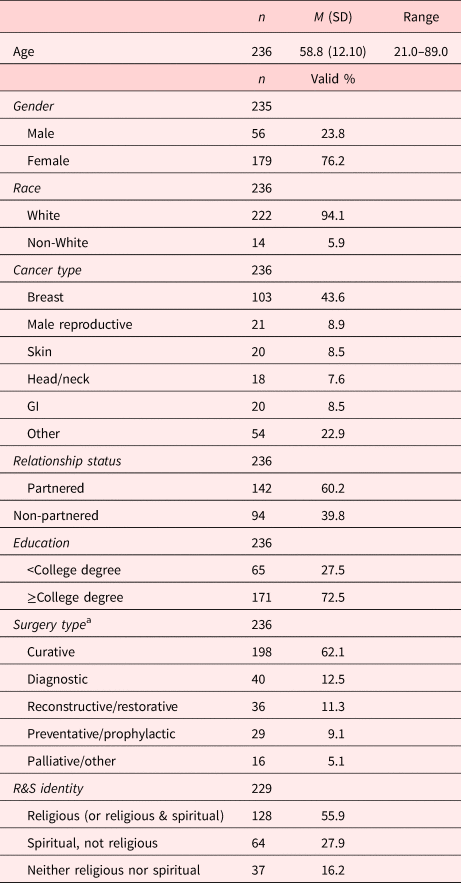
Among the 236 participants included in analytic cohort, average patient age was 58.8 years (SD = 12.1). The majority of individuals were female (n = 179, 75.8%), white/Caucasian (n = 222, 94.1%), had a significant other/spouse (n = 142, 60.2%), and had a bachelors or post-graduate degree (n = 171, 72.5%). The most common cancer diagnosis was breast cancer (n = 103, 43.2%); other diagnoses included male reproductive (n = 21, 8.9%), skin (n = 20, 8.5%) and head/neck (n = 18, 7.6%) and gastrointestinal (n = 20, 8.5%) cancer. Of note, the majority of respondents (n = 185, 78.4%) reported being cancer free at the time of survey completion; 14.0% (n = 33) of respondents reported having cancer at the time of the survey, while 7.2% (n = 17) reported being unsure. The majority of patients had a previous inpatient surgical procedure (n = 155, 65.7%), while a smaller number of patients had outpatient surgery (n = 81, 34.3%). Three-quarters of patients had only one surgical procedure (n = 177, 75.0%); a smaller number of patients had two (n = 41, 17.4%) or more (n = 18, 7.6%) procedures related to their cancer. Indications for surgical procedures included curative-intent resection (n = 198, 62.1%), diagnostic (n = 40, 12.5%), reconstructive/restorative (n = 36, 11.3%), and preventive/prophylactic surgery (n = 29, 9.1%).
With regard to R&S beliefs and practices, more than one-half (n = 128, 55.9%) of participants identified as being religious. A smaller subset identified as being spiritual (n = 64, 27.9%) or neither (n = 37, 16.2%) (Table 1). Approximately one-half (n = 117, 52.2%) of participants indicated that R&S was “very important” in their life, while 22.3% (n = 50) noted that R&S was “somewhat important;” 25.4% (n = 57) indicated R&S was “not too or not at all important.” The largest religious affiliation represented in the study cohort was Protestant (n = 43, 18.2%), followed by Catholic (n = 39, 16.5%), and nondenominational Christian (n = 31, 13.1%).
Demographic characteristics of the participants

R&S, religious and spiritual.
a Multiple response question.
Role of R&S during cancer care
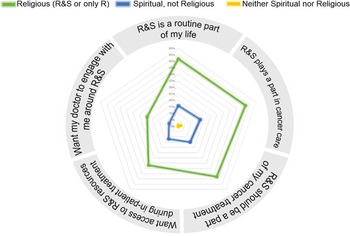
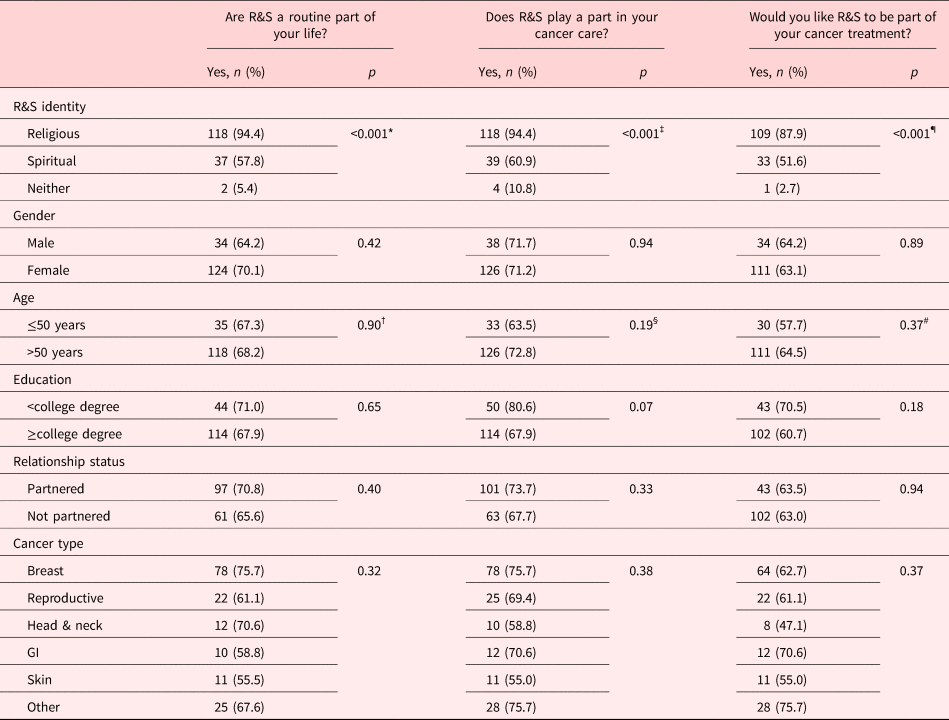
Many patients reported that R&S practices were a routine part of their life (n = 158/230, 68.7%) and that R&S played an important part of their cancer care (n = 164/230, 71.3%) (n = 6 missing response). Participants who identified as being religious were more likely than participants who identified as spiritual or neither to report R&S being a routine part of their life (94.4% vs. 57.8% vs. 5.4%, respectively; p < 0.001, ɸ = 0.71) (Table 2). In addition, participants who identified as being religious were overwhelming more likely to report wanting R&S to play a role in their cancer care (94.4% vs. 10.8%; p < 0.001, ɸ = 0.67); religious individuals were also vastly more likely to report wanting R&S to be a part of their cancer treatment vs. individuals who identified as neither religious or spiritual (87.9% vs. 2.7%; p < 0.001, ɸ = 0.65) (Figure 1). Specifically, individuals who reported that R&S was a routine part of their life were much more to identify as being religious vs. participants who identified as spiritual (75.2% vs. 23.6%). Of note, R&S preferences did not vary relative to sex, age, education level, relationship status, or cancer type (all p > 0.05). Patients with less than a college degree were more likely to report wanting R&S to be a part of their cancer care compared with patients who had a college degree or higher (80.6% vs. 67.9%, respectively; p = 0.07).
Comparison of R&S beliefs and preferences stratified by R&S identity.

Subgroup analyses for participant preferences on the role of R&S in cancer care (% represents row proportions)

GI, Gastrointestinal.
Due to missing data, the following symbols indicate the number of respondents: *157; †153; ‡161; §159; ¶159; #141.
Desired R&S resources in the perioperative period
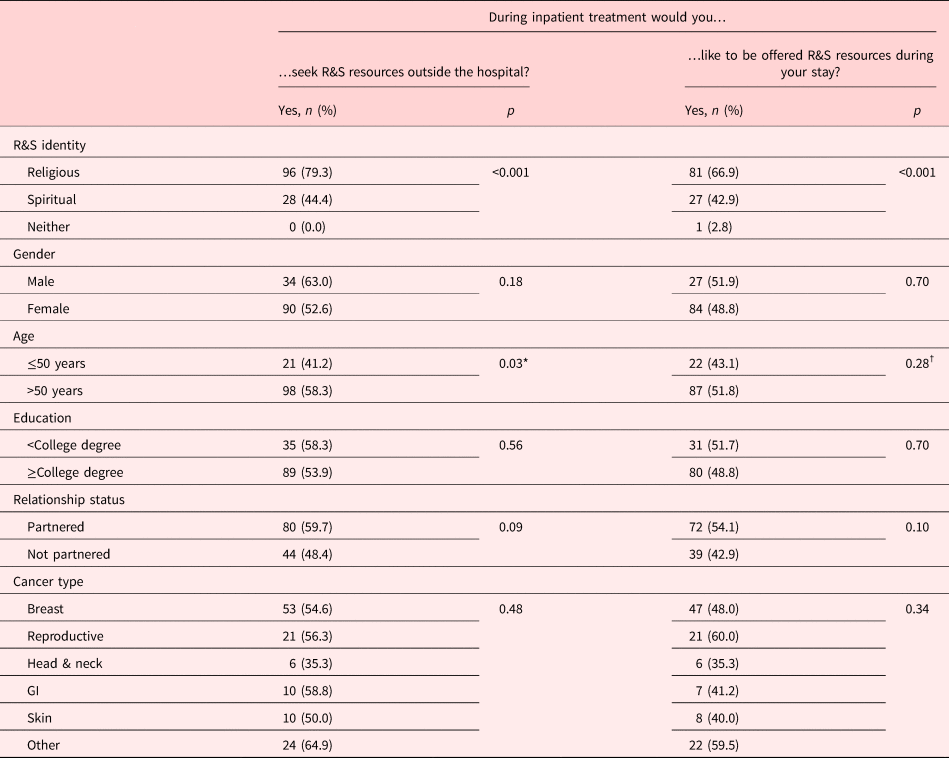
In assessing the analytic cohort, 124 individuals (55.1%) indicated a desire to seek R&S resources/support from individuals and communities outside the hospital, while 111 (49.6%) individuals reported that they wanted easier access to in-hospital R&S resources when admitted. Preferences for R&S resources varied by R&S identity. Specifically, 96 (79.3%) individuals who identified as religious indicated a desire to access R&S resources outside the hospital vs. 28 (44.4%) for individuals who identified as spiritual; no participant who identified neither reported wanting outpatient R&S resources (p < 0.001, ɸ = 0.59). Two-thirds (n = 81, 66.9%) of participants who identified as religious reported a desire to have greater access to R&S resources in the in-hospital setting compared with 42.9% (n = 27) who self-identified as spiritual, but not religious; only 2.8% (n = 1) individuals who self-reported as neither religious nor spiritual had any desire to have access to inpatient R&S resources (p < 0.001, ɸ = 0.46). Age was also associated with the likelihood of patients wanting R&S resources. Specifically, individuals ≥50 years of age more often reported wanting access to R&S resources compared with younger patients (58.3% vs. 41.2%, respectively; p = 0.03; ɸ = 0.15) (Table 3).
Subgroup analyses for participant desire for R&S resources during cancer treatment (% represents row proportions)

GI, Gastrointestinal.
Due to missing data, the following symbols indicate the number of respondents number of respondents: *119; †109.
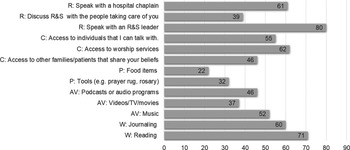
Among patients who desired R&S resources during their hospital stay, the ability to speak with an R&S leader from their faith practice (e.g., rabbi and priest) was most frequently indicated (72.1%). Other desired resources that individuals commonly identified included: access to R&S reading materials (e.g., holy texts) (64.0%), access to worship services for their R&S practice (55.9%), the opportunity to speak to a hospital chaplain (55.0%), and journaling materials (54.1%). Other physical R&S resources such as specific R&S food items (e.g., Kosher foods) (19.8%) and material objects needed to engage in R&S practices (e.g., prayer rug and rosary; 28.8%) were not as commonly identified (Figure 2). Of note, only 39 (35.1%) participants reported wanting an opportunity to talk directly about R&S with the healthcare team. While almost two-thirds (n = 145/229, 63.3%) of patients reported wanting R&S to be part of their cancer treatment in some way, the majority (n = 153/225, 68.0%) did not want their medical doctor to be the person engaging with them about R&S during treatment.
Details of needs of patients who would like R&S resources during their inpatient stay (n = 111).

Discussion
The Institute of Medicine describes patient-centered care as “providing care that is respectful of and responsive to individual patient preferences, needs, and values, and ensuring that patient values guide all clinical decisions” (Institute of Medicine, 2001). For many patients, this undoubtedly includes R&S beliefs and practices (Palmer Kelly et al., Reference Palmer Kelly, Agne and Pawlik2019a; Merath et al., Reference Merath, Kelly and Hyer2019). This facet of a patient's life is, however, often overlooked despite increased recognition of its importance from organizations such as the American Society of Clinical Oncology (Pargament et al., Reference Pargament, Koenig and Tarakeshwar2004; Puchalski et al., Reference Puchalski, Sbrana and Ferrell2019). The current study was important because we specifically examined R&S identity and R&S preferences using a cross-sectional survey. Of note, roughly 8 in 10 cancer patients self-identified as being religious or spiritual. Perhaps of even more interest was the finding that more than one-half of participants believed R&S played a role in their cancer care and should be incorporated into their treatment plan. While preferences for resources varied by R&S identity, patient demographic factors such as race or education had less impact. Importantly, roughly one-half of patients articulated a desire to be offered R&S resources during their cancer hospitalization. Of particular note, while many patients wanted R&S to be part of their cancer care, the majority of individuals did not want physician engaging in R&S during treatment. Rather, patients who desired R&S resources, largely wanted better access to R&S staff/clergy, as well as R&S materials such as sacred texts and worship materials. Collectively, the data suggest that R&S was important to many cancer patients and access to R&S should be incorporated into care services for cancer patients. Patient R&S preferences seem to be best addressed, however, by members of the multidisciplinary care team and chaplaincy services, rather than medical providers themselves.
Previous studies have attempted to characterize the role of R&S in the cancer continuum (Peteet and Balboni, Reference Peteet and Balboni2013; Sankhe et al., Reference Sankhe, Dalal and Agarwal2017; Merath et al., Reference Merath, Kelly and Hyer2019). These studies have largely focused on the influence of R&S among patients with chronic diseases or patients undergoing palliative care rather than patients undergoing cancer-directed surgery (Krupski et al., Reference Krupski, Kwan and Fink2006; Bernard et al., Reference Bernard, Strasser and Gamondi2017; Paredes and Pereira, Reference Paredes and Pereira2018). For example, among palliative patients, Bernard et al. (Reference Bernard, Strasser and Gamondi2017) noted that spiritual well-being and meaning in life were protective factors against psychological distress at the end of life. Additionally, spirituality has been associated with improved quality of life, and posttraumatic growth among patients with cancer (Krupski et al., Reference Krupski, Kwan and Fink2006; Paredes and Pereira, Reference Paredes and Pereira2018). In fact, R&S may not only be important as a means of support for the patient but also for caregivers. To this point, Lai et al. (Reference Lai, Luciani and Di Mario2018) reported that spirituality among caregivers predicted a higher amount of time dedicated to caregiving, as well as protection against emotional distress. In the current study, we noted that over one-half of participants indicated that R&S practices were a routine part of their life, that R&S played a part in their cancer care, and that they would like R&S to be a part of their cancer treatment. Collectively, these data strongly suggest that R&S is an important facet of many cancer patients' coping mechanisms for dealing with their diagnosis and treatment.
The current study sought to characterize R&S preferences (e.g., R&S is a routine part of life, R&S played a part in their cancer care, prefer R&S to be a part of cancer treatment) stratified by R&S identity and other demographic characteristics. Williams et al. (Reference Williams, Meltzer and Arora2011) evaluated the desire to have religious or spiritual concerns addressed among a cohort of internal medicine patients and noted that 41% of inpatients desired a discussion of R&S concerns while hospitalized. In a separate study involving patients with HIV/AIDS, Cotton et al. (Reference Cotton, Puchalski and Sherman2006) noted that 75% of patients reported that their illness strengthened their faith at least a little; in addition, many patients utilized religious tools as a means to cope with their illness. The current study builds on this previous work in that surgical patients who identified as religious or spiritual — with a high incidence of over 80% — were more likely to want R&S incorporated into their cancer care, including access to R&S resources vs. individuals who identified as neither. Of note, there were no differences in R&S preferences relative to patient demographic factors including sex, age, relationship status, or cancer type. As such, the data would suggest that addressing R&S within the clinical encounter may be important for many different types of patients and not just a specific subgroup.
Another interesting finding was that, while many patients want R&S services and resources available, two-thirds of individuals did not want their medical doctor to engage with them about R&S during treatment. Several authors have reported that R&S topics were infrequently discussed by physicians, and patient preferences on the extent and context in which a physician should engage in R&S discussions were very mixed (Best et al., Reference Best, Butow and Olver2015b, Reference Best, Butow and Olver2016). Rather, patients seemingly prefer to engage with their established R&S communities, including family members and friends, as a means to incorporate R&S in their cancer care (Merath et al., Reference Merath, Kelly and Hyer2019). The integration of family members and R&S community organizations into a patient's cancer care remains challenging. The provision of R&S resources after patients are admitted to the hospital may be more feasible, and nearly one-half of individuals noted a desire for such resources. Specifically, among individuals who identified as religious, a large number indicated that they would like access to R&S resources within the hospital during the perioperative period. Specifically, patients who desired R&S resources during their hospital stay most frequently indicated a desire to speak with an R&S leader, as well as have access to R&S reading materials. To date, R&S needs of cancer survivors have more often focused on external resources or less tangible needs (e.g., meaning-making vs. religious/spiritual texts) (Visser et al., Reference Visser, Garssen and Vingerhoets2010; Best et al., Reference Best, Aldridge and Butow2015a ). Meeting these patient R&S needs may be a means to improve patient satisfaction and quality of life, as increases in unmet spiritual needs have been associated with lower patient satisfaction scores and perception of quality of care (Astrow et al., Reference Astrow, Kwok and Sharma2016).
There are several limitations, some inherent to online survey methodology, which should be considered when interpreting the data. Participant recruitment involved a convenience sample, as individuals were asked to participate in the study based on meeting certain inclusion criteria; thus, volunteer bias was possible. Respondent bias was also possible, as participants had to be well enough to participate in the online survey (Reja et al., Reference Reja, Manfreda and Hlebec2003). Because recruitment largely occurred via online and in-person at the OSUCCC-James, the overrepresentation of participants from Ohio may have limited the generalizability of the results. Additionally, the cohort was relatively homogenous relative to certain demographic factors such as race and gender. In turn, studies to investigate R&S preferences among diverse populations with more under-represented minorities are warranted.
In conclusion, R&S beliefs and needs, including access to R&S resources, were prevalent among many patients undergoing surgical treatment for cancer. The desire for R&D resources was particularly strong among patients who identified with a specific religion or faith practice, and still was relatively common among patients who identified as spiritual, but not religious. Of note, most patients who desired that R&S be part of their cancer care wanted access to R&S personnel, as well as R&S materials rather than have medical providers be involved in R&S. Collectively, the data serve to emphasize that optimal patient-centered care should consider patient's R&S beliefs and their associated needs around the time of cancer-directed surgery.
Acknowledgments
The authors maintain full control of all primary data included in this article and will make it available for review if requested.
Funding
This research received no specific grant from any funding agency, commercial or not-for-profit sectors.
Conflict of interest
The authors declare no conflict of interest.