Introduction
One might eventually look back at June 2015 as a turning point for archaeologists dealing with the third millennium BC and the approximately 30 centuries thereafter. That month, two ancient DNA (aDNA) papers were published in the scientific journal Nature (Allentoft et al. Reference Allentoft, Sikora, Sjögren, Rasmussen, Rasmussen, Stenderup, Damgaard, Schroeder, Ahlström, Vinner, Malaspinas, Margaryan, Higham, Chivall, Lynnerup, Harvig, Baron, Della Casa, Dąbrowski, Duffy, Ebel, Epimakhov, Frei, Furmanek, Gralak, Gromov, Gronkiewicz, Grupe, Hajdu, Jarysz, Khartanovich, Khokhlov, Kiss, Kolář, Kriiska, Lasak, Longhi, McGlynn, Merkevicius, Merkyte, Metspalu, Mkrtchyan, Moiseyev, Paja, Pálfi, Pokutta, Pospieszny, Price, Saag, Sablin, Shishlina, Smrčka, Soenov, Szeverényi, Tóth, Trifanova, Varul, Vicze, Yepiskoposyan, Zhitenev, Orlando, Sicheritz-Pontén, Brunak, Nielsen, Kristiansen and Willerslev2015; Haak et al. Reference Haak, Lazaridis, Patterson, Rohland, Mallick, Llamas, Brandt, Nordenfelt, Harney, Stewardson, Fu, Mittnik, Bánffy, Economou, Francken, Friederich, Garrido Pena, Hallgren, Khartanovich, Khokhlov, Kunst, Kuznetsov, Meller, Mochalov, Moiseyev, Nicklisch, Pichler, Risch, Rojo Guerra, Roth, Szécsényi-Nagy, Wahl, Meyer, Krause, Brown, Anthony, Cooper, Alt and Reich2015), with far-reaching implications for our understanding of the later prehistory of Europe and Western Asia. Based partly on the results of two previous studies, published a little earlier (Brandt et al. Reference Brandt, Haak, Adler, Roth, Szécsényi-Nagy, Karimnia, Möller-Rieker, Meller, Ganslmeier, Friederich, Dresely, Nicklisch, Pickrell, Sirocko, Reich, Cooper and Alt2013; Lazaridis et al. Reference Lazaridis, Patterson, Mittnik, Renaud, Mallick, Kirsanow, Sudmant, Schraiber, Castellano, Lipson, Berger, Economou, Bollongino, Fu, Bos, Nordenfelt, Li, De Filippo, Prüfer, Sawyer, Posth, Haak, Hallgren, Fornander, Rohland, Delsate, Francken, Guinet, Wahl, Ayodo, Babiker, Bailliet, Balanovska, Balanovsky, Barrantes, Bedoya, Ben-Ami, Bene, Berrada, Bravi, Brisighelli, Busby, Cali, Churnosov, Cole, Corach, Damba, Van Driem, Dryomov, Dugoujon, Fedorova, Gallego Romero, Gubina, Hammer, Henn, Hervig, Hodoglugil, Jha, Karachanak-Yankova, Khusainova, Khusnutdinova, Kittles, Kivisild, Klitz, Kučinskas, Kushniarevich, Laredj, Litvinov, Loukidis, Mahley, Melegh, Metspalu, Molina, Mountain, Näkkäläjärvi, Nesheva, Nyambo, Osipova, Parik, Platonov, Posukh, Romano, Rothhammer, Rudan, Ruizbakiev, Sahakyan, Sajantila, Salas, Starikovskaya, Tarekegn, Toncheva, Turdikulova, Uktveryte, Utevska, Vasquez, Villena, Voevoda, Winkler, Yepiskoposyan, Zalloua, Zemunik, Cooper, Capelli, Thomas, Ruiz-Linares, Tishkoff, Singh, Thangaraj, Villems, Comas, Sukernik, Metspalu, Meyer, Eichler, Burger, Slatkin, Pääbo, Kelso, Reich and Krause2014), one can summarise their quintessence in five points:
-
1. The discovery of the third major group ancestral to all modern European populations, alongside the earlier ‘Western Hunter-Gatherers’ and ‘Early Neolithic Near Eastern farmers’. Importantly, this third component “is lower in southern Europe and higher in northern Europe”, where it is shared by more than 50 per cent of the current inhabitants of Norway, Lithuania and Estonia (Haak et al. Reference Haak, Lazaridis, Patterson, Rohland, Mallick, Llamas, Brandt, Nordenfelt, Harney, Stewardson, Fu, Mittnik, Bánffy, Economou, Francken, Friederich, Garrido Pena, Hallgren, Khartanovich, Khokhlov, Kunst, Kuznetsov, Meller, Mochalov, Moiseyev, Nicklisch, Pichler, Risch, Rojo Guerra, Roth, Szécsényi-Nagy, Wahl, Meyer, Krause, Brown, Anthony, Cooper, Alt and Reich2015: 210, fig. 3).
-
2. This third ancestral group derives from the Eurasian steppe belt and is linked to the westward movement of Yamnaya populations, dated to c. 3000 BC (stated by both articles).
-
3. Genetic transmission passed from steppe Yamnaya directly to the east/central/north European Corded Ware/Single Grave/Battle Axe Complex (henceforth CWC) in such a way that “Late Neolithic CWC people from eastern Germany traced 75 per cent of their ancestry to the Yamnaya” (Haak et al. Reference Haak, Lazaridis, Patterson, Rohland, Mallick, Llamas, Brandt, Nordenfelt, Harney, Stewardson, Fu, Mittnik, Bánffy, Economou, Francken, Friederich, Garrido Pena, Hallgren, Khartanovich, Khokhlov, Kunst, Kuznetsov, Meller, Mochalov, Moiseyev, Nicklisch, Pichler, Risch, Rojo Guerra, Roth, Szécsényi-Nagy, Wahl, Meyer, Krause, Brown, Anthony, Cooper, Alt and Reich2015: abstract).
-
4. Migrations are highlighted as an important driver for our understanding of the third millennium BC and prehistoric Europe as a whole, as “a highly dynamic period involving large-scale population migrations and replacements” (Allentoft et al. Reference Allentoft, Sikora, Sjögren, Rasmussen, Rasmussen, Stenderup, Damgaard, Schroeder, Ahlström, Vinner, Malaspinas, Margaryan, Higham, Chivall, Lynnerup, Harvig, Baron, Della Casa, Dąbrowski, Duffy, Ebel, Epimakhov, Frei, Furmanek, Gralak, Gromov, Gronkiewicz, Grupe, Hajdu, Jarysz, Khartanovich, Khokhlov, Kiss, Kolář, Kriiska, Lasak, Longhi, McGlynn, Merkevicius, Merkyte, Metspalu, Mkrtchyan, Moiseyev, Paja, Pálfi, Pokutta, Pospieszny, Price, Saag, Sablin, Shishlina, Smrčka, Soenov, Szeverényi, Tóth, Trifanova, Varul, Vicze, Yepiskoposyan, Zhitenev, Orlando, Sicheritz-Pontén, Brunak, Nielsen, Kristiansen and Willerslev2015: abstract).
-
5. Emphasis is placed on the link between these findings and the background and chronology of the spread of Indo-European languages (stated by both articles).
Several additional articles, published in the months thereafter and based partly on the same genetic data, supplement the picture. They demonstrate that:
-
• The plague (Yersinia pestis) is not only a disease of Late Antiquity and the medieval period, but a prehistoric disease to which humans succumbed as early as the third millennium BC (Rasmussen et al. Reference Rasmussen, Allentoft, Nielsen, Orlando, Sikora, Sjögren, Pedersen, Schubert, Van Dam, Kapel, Nielsen, Brunak, Avetisyan, Epimakhov, Khalyapin, Gnuni, Kriiska, Lasak, Metspalu, Moiseyev, Gromov, Pokutta, Saag, Varul, Yepiskoposyan, Sicheritz-Pontén, Foley, Mirazón Lahr, Nielsen, Kristiansen and Willerslev.2015), and, furthermore, it stems from the Eurasian steppes, being connected to the Yamnaya and CWC.
-
• Yamnaya steppe peoples have the highest ever calculated genetic selection for stature (Mathieson et al. Reference Mathieson, Lazaridis, Rohland, Mallick, Patterson, Alpaslan Roodenberg, Harney, Stewardson, Fernandes, Novak, Sirak, Gamba, Jones, Llamas, Dryomov, Pickrell, Arsuaga, Bermúdez De Castro, Carbonell, Gerritsen, Khokhlov, Kuznetsov, Lozano, Meller, Mochalov, Moiseyev, Rojo Guerra, Roodenberg, Vergès, Krause, Cooper, Alt, Brown, Anthony, Lalueza-Fox, Haak, Pinhasi and Reich2015), a biological property also positively confirmed in the bio-anthropological record of the fourth and third millennia BC (Rosenstock et al. Reference Rosenstock, Gross, Hujić, Scheibner, Kneisel, Dal Corso, Kirleis, Scholz, Taylor and Tiedtke2016).
-
• Yamnaya steppe peoples were fair-skinned but had dark eye colours (also confirmed in Allentoft et al. Reference Allentoft, Sikora, Sjögren, Rasmussen, Rasmussen, Stenderup, Damgaard, Schroeder, Ahlström, Vinner, Malaspinas, Margaryan, Higham, Chivall, Lynnerup, Harvig, Baron, Della Casa, Dąbrowski, Duffy, Ebel, Epimakhov, Frei, Furmanek, Gralak, Gromov, Gronkiewicz, Grupe, Hajdu, Jarysz, Khartanovich, Khokhlov, Kiss, Kolář, Kriiska, Lasak, Longhi, McGlynn, Merkevicius, Merkyte, Metspalu, Mkrtchyan, Moiseyev, Paja, Pálfi, Pokutta, Pospieszny, Price, Saag, Sablin, Shishlina, Smrčka, Soenov, Szeverényi, Tóth, Trifanova, Varul, Vicze, Yepiskoposyan, Zhitenev, Orlando, Sicheritz-Pontén, Brunak, Nielsen, Kristiansen and Willerslev2015); blue eyes were more common in the CWC, but, contrary to predictions, the lactase persistence mutation was not yet present.
-
• An aDNA study from Ireland—not the most central spot in the cultural triangle of ‘Yamnaya-CWC-Bell Beakers’—highlights the fundamental nature of changes in the third millennium BC; it presents proof of a profound genetic break at that time, such that burials dated after this threshold are much closer to the present Irish population (Cassidy et al. Reference Cassidy, Martiniano, Murphy, Teasdale, Mallory, Hartwell and Bradley2016).
-
• This is echoed by the findings of Poznik et al. (Reference Poznik, Xue, Mendez, Willems, Massaia, Wilson Sayres, Ayub, McCarthy, Narechania, Kashin, Chen, Banerjee, Rodriguez-Flores, Cerezo, Shao, Gymrek, Malhotra, Louzada, Desalle, Ritchie, Cerveira, Fitzgerald, Garrison, Marcketta, Mittelman, Romanovitch, Zhang, Zheng-Bradley, Abecasis, McCarroll, Flicek, Underhill, Coin, Zerbino, Yang, Lee, Clarke, Auton, Erlich, Handsaker, Bustamante and Tyler-Smith2016: abstract), showing “bursts of extreme expansion in male numbers” calculated for “4.8 and 5.5kya”, thus fitting nicely with previous views and giving a masculine spin to the character of events (see also Kristiansen et al. Reference Kristiansen, Allentoft, Iversen, Kroonen, Pospieszny, Price, Sjögren, Sikora, Rasmussen, Johannsen and Willerslev2017 in this issue).
These are indeed great results, assembled within a short span of time, and they will certainly not be the last of their kind. They have the potential to offer solutions to some of the most pertinent questions in later prehistory that have been disputed for decades. Leaving aside the purely genetic results, and those that archaeology alone cannot provide the answer to, several powerful archaeological statements are laid out to which one can agree as a prehistorian: yes, something came out of the Eurasian steppes, and we can track this westward movement of Yamnaya in the evidence; yes, there clearly is a link in burial practice between Yamnaya and CWC (Kristiansen et al. Reference Kristiansen, Allentoft, Iversen, Kroonen, Pospieszny, Price, Sjögren, Sikora, Rasmussen, Johannsen and Willerslev2017 in this issue), and probably also with Bell Beaker users (Harrison & Heyd Reference Harrison and Heyd2007; Heyd Reference Heyd, Furholt, Grossmann and Szmyt2016); and yes, these fundamental changes have a huge geographic reach, from the Altai to the Atlantic. On another level, everyone will also have to accept the existence of large-scale prehistoric migrations, the fact that they were a driving force of cultural change and that there was a link to the Indo-European languages, which in turn makes the late dispersal theory (Anthony & Ringe Reference Anthony and Ringe2015; Kristiansen et al. Reference Kristiansen, Allentoft, Iversen, Kroonen, Pospieszny, Price, Sjögren, Sikora, Rasmussen, Johannsen and Willerslev2017 in this issue) much more probable than the supposed connection with early farming. As another consequence, at a still higher level, culture-history and ethnic interpretations are back on the dinner table.
So, is it all that simple? If so, why have we archaeologists not seen these connections much earlier? Perhaps because the results are not beyond critique? Critique, for example, regarding the low numbers of Yamnaya and CWC aDNA hits, their regional constraints, the flawed selection of samples and other discrepancies:
-
1. The Haak et al. paper reports only seven sites from the Samara oblast in Russia, and one (Esperstedt) from Saxony-Anhalt in Germany. The Allentoft et al. paper draws on samples from only eleven sites (four Yamnaya, two Afanasievo and five CWC) dated to the first half of the third millennium BC, and of those, the Yamnaya sites are also only from a single Russian region (Kalmykia).
-
2. Three out of the four ‘Corded Ware’ graves from Esperstedt have such late radiocarbon dates (ESP11/I0104, feature 6216; ESP22/I0049, feature 6233; and ESP26/I0106, feature 6216, with dates of 2473–2348, 2454–2291 and 2454–2291 cal BC respectively) that they might have already experienced another aDNA admixture, namely that from incoming Bell Beaker users.
-
3. Five per cent of Yamnaya ancestry is assigned to the Iceman, although he lived 200±100 years earlier than the arrival of Yamnaya people in south-east Europe (Frînculeasa et al. Reference Frînculeasa, Preda and Heyd2015).
-
4. The problem of describing a complex archaeological situation within only 1500 words, making statements necessarily short and pronounced, and with a tendency to culture-historicism.
-
5. The more fundamental and dangerous problem of extrapolating the results from a handful of individual burials to whole ethnically interpreted populations.
Kossinna sends his greetings. . .
Gustaf Kossinna (1859–1931) is indeed the natural keyword here: the messages coming out of these high-flying scientific papers strongly remind any prehistorian of his ‘Siedlungsarchäologische Methode’, developed shortly before the First World War in the 1910s (Kossinna Reference Kossinna1911). Therein he proposes not only an ethnic identification for archaeological cultures, but he also equates artefact distribution boundaries with ethnicity and linguistic extent. Leaving aside the later political and ideological use and misuse of this method, it has rightly attracted criticism (e.g. Klejn Reference Klejn, Murray and Evans2006) in the simplicity of both its ethnic and cultural concepts. At the same time it is rigid in its application (unbedingt—‘unconditional’) and in its lack of proper definitions overall, being concurrently autochthonist and migrationist. Yet it would be too simple to ignore all aDNA results, to turn our backs on their messages, or to hide behind an anti-Kossinnian firewall. No doubt, the aDNA results force us to re-consider; to question our own evidence and the methodology we apply (Müller Reference Müller2013); and to re-focus our interpretations. Nevertheless, while we have known for decades about the special relationship between Yamnaya and CWC, it is obvious to anyone working on the third millennium BC that neither a one-to-one translation from Yamnaya to CWC, nor even the 75:25 ratio as claimed (Haak et al. Reference Haak, Lazaridis, Patterson, Rohland, Mallick, Llamas, Brandt, Nordenfelt, Harney, Stewardson, Fu, Mittnik, Bánffy, Economou, Francken, Friederich, Garrido Pena, Hallgren, Khartanovich, Khokhlov, Kunst, Kuznetsov, Meller, Mochalov, Moiseyev, Nicklisch, Pichler, Risch, Rojo Guerra, Roth, Szécsényi-Nagy, Wahl, Meyer, Krause, Brown, Anthony, Cooper, Alt and Reich2015: 211), fits the archaeological record. Three aspects in the archaeological-genetic relationship of Yamnaya to CWC can indeed only be explained away with great difficulty:
-
1. Yamnaya and CWC generally represent the inhabitants of different ecozones—steppe habitat vs forested temperate Europe—and there is not a single known burial of either group that transgresses this border.
-
2. The beginnings of Yamnaya and CWC show a chronological offset of some 200 years, c. 3050/3000 BC vs c. 2850/2800 BC (Włodarczak Reference Włodarczak2014; Frînculeasa et al. Reference Frînculeasa, Preda and Heyd2015).
-
3. While very similar at first glance, the burials, by far our most prolific source of both Yamnaya and CWC, are actually more different than identical in their fundamental regularities of ritual and equipment, and in material culture (Furholt Reference Furholt2014; Frînculeasa et al. Reference Frînculeasa, Preda and Heyd2015).
If it is so difficult to demonstrate archaeologically the smooth translation from Yamnaya to CWC, then there might perhaps be alternative or supplementary scenarios that fit the evidence. Starting points for such an approach do indeed exist and can be summarised in terms of time and scale.
2000 years of interaction (Figure 1)
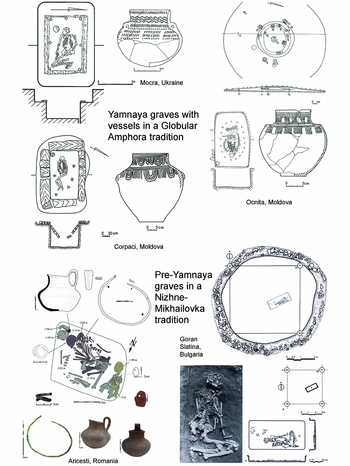
Instead of favouring one episode of genetic transmission from Yamnaya to CWC, and despite a handful of Yamnaya and/or Middle Dnieper/CWC graves along the steppe/forest-steppe border in Moldova and Ukraine having ‘mixed inventories’ of material culture (Telegin Reference Telegin2005; Włodarczak Reference Włodarczak2014), it is more convincing in terms of the archaeological realities to include interactions during previous centuries and to argue for a long-term and incremental relationship between steppe and temperate European populations, particularly as CWC is only partially contemporaneous with Yamnaya. Yet along the Rivers Prut, Dnester, the two Bugs, and the San, it is the Globular Amphora Culture that for two or three centuries exists in parallel with Yamnaya, with many mutual exchanges (Szmyt Reference Szmyt, Heyd, Kulcsár and Szeverényi2013). The role of the Globular Amphora Culture in the transmission is not emphasised; their peoples are not even mentioned in the aDNA papers. But throughout the fourth millennium BC, we see evidence both north and south of the Carpathian arc for close interrelationships between pre-Yamnaya societies of the steppe belt and ‘indigenous’ cultures or those whose ancestors were already in contact with steppe societies (Frînculeasa et al. Reference Frînculeasa, Preda and Heyd2015). Likewise, we find round barrows with individual burials in the Baalberge culture of eastern Germany from c. 3700 BC and early horse bones/skulls at the same period (at the site of Alsleben) and from the slightly later Salzmünde culture. Esperstedt, where the genotyped CWC graves were found is, incidentally, in the same region. There are also horse bones at fourth-millennium BC sites in the Czech Republic and Hungary. The interaction between the steppe and the south-east European ‘sown’ goes back as far as the fifth millennium BC, to the graves of the Suvorovo-Novodanilovka tradition, and probably inspired the adoption of steppe-related artefacts, such as stone horse-head sceptres, and common burial practises (Anthony & Ringe Reference Anthony and Ringe2015; Heyd Reference Heyd, Furholt, Grossmann and Szmyt2016).
Steppe links with temperate Europe prior to Corded Ware Complex; top) Yamnaya and Globular Amphora (after Szmyt Reference Szmyt, Heyd, Kulcsár and Szeverényi2013); bottom) pre-Yamnaya graves in Romania and Bulgaria (after Frînculeasa et al. Reference Frînculeasa, Preda and Heyd2015).

A Europe-wide horizon of change
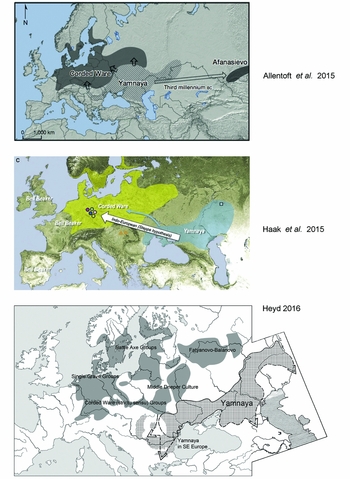
Again, instead of highlighting the few centuries of contact between Yamnaya and CWC, and transmission across a border zone between the two (Figure 2), it is more sensible archaeologically to consider the third millennium BC and Europe in their entireties. Consequently, the Bell Beakers of Europe's western half should definitely be included, as Beaker-related genetic components may also be present in the graves at Esperstedt. Recent radiocarbon dates for the Bell Beaker emergence on the Iberian Peninsula (c. 2800–2700 BC; Cardoso Reference Cardoso2014) are also very close to the earliest CWC dendrodates in eastern Switzerland of 2725 BC. This is in no way an accident, as Cassidy et al. (Reference Cassidy, Martiniano, Murphy, Teasdale, Mallory, Hartwell and Bradley2016) have demonstrated in their Irish study that we are dealing with more profound and far-reaching turbulences.
Various potential routes of transmission from Yamnaya to Corded Ware Complex.

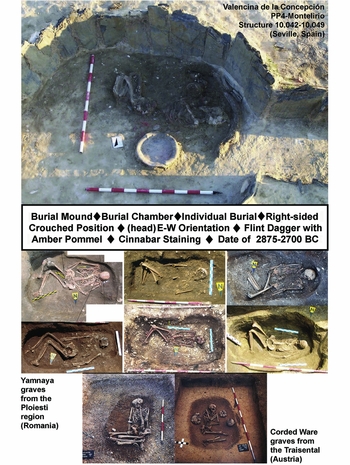
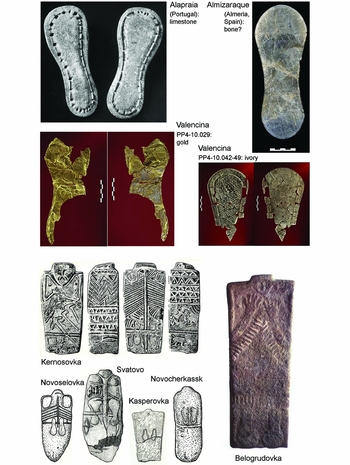
Something was changing dramatically at a Continental scale in the late fourth/early third millennium BC: the emergence of anthropomorphic stelae throughout Europe, including France and Iberia, is one indicator; the new flint and copper daggers and occasional hammer-axes in the west are a second; and the graves of men buried with such weapons—warriors—is a third (Harrison & Heyd Reference Harrison and Heyd2007; Heyd Reference Heyd, Furholt, Grossmann and Szmyt2016). Especially revealing is the recently discovered funerary complex—structure 10.042–10.049—of paramount status in the PP4-Montelirio sector of the ‘mega-site’ of Valencina de la Concepción, deep in the Iberian south (Seville; Garcia Sanjuán et al. Reference García Sanjuán, Vargas Jiménez, Hurtado Pérez, Ruiz Moreno and Cruz-Auñón Briones2013). Several features are strongly reminiscent of Yamnaya/CWC graves: the date of 2875–2700 cal BC; the large barrow with burial chamber; the individual male burial, crouched on his right-side, oriented east–west; the flint dagger, and staining with red cinnabar pigment (Figure 3). The upper part of the chamber and the immediate surroundings (PP4 10.029; 80m away) offer two other significant artefacts: a long, oval African ivory ‘plate’ and a decorated gold sheet, both in the form of ‘sandals’ (Murillo-Barroso et al. Reference Murillo Barroso, Costa Caramé, Díaz-Guardamino Uribe, García Sanjuán and Mora Molina2015: 588–89). Further such sandals, sandal soles or sandal-shaped idols, as they are also called, made of ivory, bone or limestone, are recorded from four other sites in southern Iberia. All are key sites of the Chalcolithic and are dated to the first half of the third millennium BC.
The burial at Valencina de la Concepción, PP4-Montelirio, structure 10.049, compared to Yamnaya/Corded Ware Complex graves in Romania and Austria (after Neugebauer Reference Neugebauer1987; García Sanjuán et al. Reference García Sanjuán, Vargas Jiménez, Hurtado Pérez, Ruiz Moreno and Cruz-Auñón Briones2013; Frînculeasa et al. Reference Frînculeasa, Preda and Heyd2015).

These are fascinating features/artefacts, but they would be of little wider significance if the contemporaneous European context did not have a really extraordinary parallel to offer: foot-print/shoe/sandal-formed engravings on Yamnaya/kurgan stelae from the Ukraine (Telegin & Mallory Reference Telegin and Mallory1994), carved and erected some 4500km away (Figure 4). Sandals are widely seen as symbolically loaded, with interpretations ranging from signs of status, power and property to concepts (in a burial context) of walking out of the tomb, towards the underworld in the case of sandal tips facing downwards (e.g. Mallory & Adams Reference Mallory and Adams1997). While we may only partly comprehend the symbolism, it is just one example of pan-European interconnectivity in the early third millennium BC, centuries before the Bell Beaker expansion around 2500 BC. This is what really matters, not the simple genetic transmission from Yamnaya to CWC.
Sandal/shoe representations from the Iberian Chalcolithic (top) and on Yamnaya stelae from Ukraine (bottom) (after Telegin & Mallory Reference Telegin and Mallory1994; Murillo Barroso et al. Reference Murillo Barroso, Costa Caramé, Díaz-Guardamino Uribe, García Sanjuán and Mora Molina2015 (with further Iberian references on ‘sandals’)).

Simple solutions to complex problems are never the best choice, even when favoured by politicians and the media. Kossinna also offered a simple solution to a complex prehistoric problem, and failed therein. Prehistoric archaeology has been aware of this for a century, and has responded by becoming more differentiated and nuanced, working anthropologically, scientifically and across disciplines (cf. Müller Reference Müller2013; Kristiansen Reference Kristiansen2014), and rejecting mono-causal explanations. The two aDNA papers in Nature, powerful and promising as they are for our future understanding, also offer rather straightforward messages, heavily pulled by culture-history and the equation of people with culture. This admittedly is due partly to the restrictions of the medium that conveys them (and despite the often relevant additional detail given as supplementary information, which is unfortunately not always given full consideration). While I have no doubt that both papers are essentially right, they do not reflect the complexity of the past. It is here that archaeology and archaeologists contributing to aDNA studies find their role; rather than simply handing over samples and advising on chronology, and instead of letting the geneticists determine the agenda and set the messages, we should teach them about complexity in past human actions and interactions. If accepted, this could be the beginning of a marriage made in heaven, with the blessing smile of Gustaf Kossinna, and no doubt Vere Gordon Childe, were they still alive, in a reconciliation of twentieth- and twenty-first-century approaches. For us as archaeologists, it could also be the starting point for the next level of a new archaeology.
Acknowledgements
The ideas expressed in this paper are to a large extent a response to presentations and discussions at the international conference ‘Linguistics, Archaeology & Genetics. Integrating new Evidence for the Origin and Spread of the Indo-European Languages’, held at the Max Planck Institute for the Science of Human History in Jena, Germany, in October 2015. I am grateful to Wolfgang Haak for having invited me to this exciting event. I am also indebted to Kristian Kristiansen and Karl-Göran Sjögren (both Göteborg), Marko Marila (Helsinki), David Reich (Harvard) and Piotr Włodarczak (Kraków) for their useful comments on an earlier draft, and to Henry Webber (Bristol) for having polished my text.