


Formal institutions of accountability are often weak in developing countries (Bardhan 2002). States in these countries often lack strong bureaucratic institutions for controlling corruption and making sure that lower level officials are doing their jobs. Democratic institutions such as elections that allow citizens to hold local officials accountable may be weak and unreliable or even nonexistent. Yet in these countries some local officials still perform better than others. Under these conditions, how do citizens make government officials organize and fund the public goods and services that they want and need?
This question is important for practical, political, and theoretical reasons. Practically speaking, people everywhere need their governments to provide roads, education, clean water, and other public goods and services that they have trouble producing on their own. The provision of these basic public goods and services matters deeply for the quality of people's lives everywhere. Politically, how effectively governments provide these goods and services has an enormous impact on their legitimacy. Many of the developing countries in Asia, Africa, and Latin America that struggle the most to provide basic public goods are also the countries struggling the most to build effective states and maintain regime stability.
This question is also important from a theoretical perspective. Existing explanations of governmental performance and variation in governmental public goods provision have focused primarily on the role of strong democratic and bureaucratic institutions. Theories of institutional design argue that the key to good government is providing formal democratic institutions and devolving power to local levels so that citizens can monitor and sanction officials effectively (e.g., Dahl 1971; O'Donnell 1996; Rose-Ackerman 2005; Seabright 1996). Theories of civil society and social capital argue that voluntary associations, interest groups, and associational activity can improve governmental performance in democratic systems (Boix and Posner 1998; Edwards and Foley 1998; Ehrenberg 1999; Putnam 1993). In consolidated democracies where formal institutions ensure the incorporation of citizen demands into the policymaking process, autonomous associations and interest groups can help citizens voice their demands more effectively. Other studies suggest that democratic institutions may not be necessary for good governmental public goods provision, but these arguments still rely on the existence of effective and coherent formal state institutions. Peter Evans (1995), for example, argues that developmental states differ from predatory states in two ways. First, developmental states generate bureaucracies with corporate coherence and strong bureaucratic institutions of internal accountability. Second, developmental states are “embedded” in the sense that the state forges informal connections with powerful business interests. Corporate solidarity enables the state to resist sliding into patron–client relationships with societal interests. Wai Fung Lam (1997) finds that irrigation governance in Taiwan is effective because strong community norms work in tandem with formal bureaucratic administration.
But what about governmental public goods provision in countries which lack strong democratic and bureaucratic institutions of accountability? Public goods provision is often much more of a problem, both practically and politically, in developing countries with nondemocratic or transitional systems. How do we account for variation in local governmental performance and public goods provision in these systems?
A MODEL OF INFORMAL GOVERNMENTAL ACCOUNTABILITY
Public goods provision is always associated with a collective action problem. Everyone has an incentive to free ride on the efforts of everyone else. Most models of public goods provision focus on the collective action problem. Alesina, Baqir, and Easterly (1999) argue that public goods provision is poorer in ethnically diverse areas because different ethnic groups have different preferences or tastes for particular public services, thus making any collective decision difficult. Elinor Ostrom (1990) finds that well-designed community social institutions can help overcome obstacles to collective action. Robert Putnam (1993, 2000) argues that dense social networks and norms of trust can make people more likely to cooperate with each other.
But these models do not explicitly address the additional problem associated with governmental public goods provision—the provision of public goods and services by the government—in systems with weak formal democratic and bureaucratic institutions: the problem of accountability. In these systems overcoming the collective action problem among citizens is not sufficient to guarantee that the government will provide public goods responsibly. Once public funds are in the hands of government officials, how can citizens make sure that officials use these funds to pave roads, build schools, and invest in local public projects? How can citizens have leverage over government officials in the absence of strong formal institutions?
I propose a model of informal governmental accountability. Even when formal governmental accountability is weak, local officials may still have a strong incentive to provide public goods when citizens award them moral standing for doing so. Like other types of prestige, moral standing is “the esteem, respect, or approval that is granted by an individual or a collectivity for performances or qualities they consider above the average” (Goode 1979, 7). In the case of moral standing, esteem or respect is granted for above-average performance of actions considered morally good. Those specific standards and actions vary. Moral standing can be a powerful incentive. It not only makes people feel good about themselves, but also it can translate into economic and social advancement. Local officials with higher moral standing may also find it easier to elicit citizen compliance with state policies. Moral standing can be an invaluable resource for accomplishing a variety of political, social, and economic objectives.
When are people more likely to reward officials with moral standing for providing public goods and services? First, citizens and officials must share a set of criteria for moral behavior. At minimum, these criteria include the principle that contributing to the good of the group deserves moral approval. Without this criterion, the group would not last very long. Second, opportunities must exist for publicizing behavior that meets these shared standards. The more citizens believe that officials really do share the group's obligations and standards and the more citizens know about whether officials actually behave according to these standards, the more likely they are to award officials moral standing. Like all forms of prestige, moral standing is dependent on the “verbal information disseminated in the community relating news and approval of an individual's activities” (Riches 1984, 235).
I argue that people are more likely to use moral standing to reward local officials for good public goods provision when there are local solidary groups—groups based on shared moral obligations as well as shared interests. To provide informal institutions that enable citizens to hold local officials accountable for public goods provision, solidary groups must have two particular structural characteristics. First, they must be encompassing, or open to everyone under the local government's jurisdiction. In localities with encompassing solidary groups, social boundaries overlap with political boundaries. Examples of encompassing solidary groups might include citizens' groups that monitor town planning decisions in the United States, parish churches in nineteenth-century England (Morris 2001), and village harambees or self-help organizations in Kenya (Miguel 1999). Second, solidary groups must be embedding in that they incorporate local officials into the group as members. Not all encompassing solidary groups are embedding. English parish churches are often embedding because local officials are likely to attend church services and identify as members of the congregation. In contrast citizen watchdog organizations in the United States, which are designed to monitor and challenge government, may encompass a particular town or municipality but are unlikely to embed officials into the group as members.
In localities with encompassing and embedding solidary groups, citizens and officials are more likely to share a common set of ethical standards and moral obligations. Members of clans, churches, fraternal organizations, and other solidary groups have strong obligations to the collective. In solidary groups members are judged according to the group's standards of what constitutes a good person and a good member. Members of church congregations thus feel compelled to contribute something when the donation basket is passed around. Members of clans are expected to and commended for siding with fellow members in disputes with outsiders. Group activities and dense social networks also provide ample opportunities for individual members to publicize their exemplary behavior. For moral standing to be conferred on an individual, both the individual's actions and acceptance of shared standards have to be “common knowledge” (Chwe 2003). Churches ask for volunteers to help with church activities immediately after services when the congregation is still assembled. In rural China lineage members are expected to attend group rituals of respect for shared ancestors. These collective gatherings help publicize who is deserving of moral standing in the community.
When the boundaries of a solidary group overlap with the administrative boundaries of the local government, embedded officials have a strong social obligation to contribute to the good of the group. Because in this case the group and the public are the same, officials in localities with encompassing and embedding solidary groups can earn moral standing for providing public goods (and suffer severe social sanctions for not doing so). Officials in localities with encompassing and embedding solidary groups thus have an extra incentive to provide public goods and services to their jurisdiction.
RESEARCH DESIGN
Contemporary rural China provides an ideal setting to examine the factors that affect the quality of local governance because of the tremendous variation in the performance of village governments.1
Although the central government officially refers to village governments as “self-governing organizations,” village governments are widely considered part of the state apparatus by higher level officials, village officials, and citizens themselves. Village governments collect state taxes, enforce state directives such as the birth control policy, and provide village public goods and services.
To study this problem, in 2001, I surveyed 316 villages and carried out a set of detailed case studies in rural China. After two months of preliminary research in seven different provinces across the country and eight months of in-depth fieldwork in one set of villages in the southern province of Fujian, I designed a survey to examine the impact of formal and informal institutions on village governmental public goods provision. The four provinces for the survey—Shanxi, Hebei, Jiangxi, and Fujian—were chosen to reflect differences in levels of economic development as well as regional differences between north and south China in terrain, institutional history, and social organization. Shanxi and Hebei are neighboring provinces in the north, but Shanxi is in the interior and less developed. Jiangxi and Fujian are neighboring provinces in the south, but Jiangxi is in the interior and less developed. Within each province, two counties were selected to vary in model county status for village democratic reforms (model counties employ more administrative resources and pressure to implement village democratic reforms) but to have similar economic and geographic characteristics. The original rationale for this selection strategy was to be able to use model county status as an instrument for identifying the impact of village democratic reforms which may be endogenous to the model, but in this paper, the implementation of village democratic reforms is included as a control rather than studied as the main variable of interest.
To conduct this survey, I visited each of the eight counties and presented references from Chinese academics and researchers to the county government. After obtaining permission to carry out research in the county, I selected eight townships through a random stratified sampling procedure (with stratification by official income per capita). A county official then accompanied me and my research team of Chinese university student enumerators to each of the townships where I then selected five villages in each township through a similar procedure (again with stratification by official income per capita). In townships with fewer than five villages, all the villages were surveyed. Townships with less than five villages account for the sample of 316 villages (as opposed to 320 villages). Each township government then contacted the village governments in their jurisdiction to notify them that a couple of students would be visiting them to do academic research. The combination of official approval from the local government and our obvious status as students helped secure the willing cooperation of our respondents. In each of the sampled villages, enumerators interviewed one or, in most cases, more than one village official in order to fill out village-level survey questionnaires about village conditions. In all cases, enumerators also used village documents to corroborate interviewee responses. Survey respondents showed a high level of frankness about even potentially sensitive topics such as economic indicators and the implementation of village democratic reforms. This level of comfort can be largely credited to the highly skilled administration of the survey by the student enumerators, most of whom had grown up in villages themselves and were pursuing degrees in agricultural economics, rural sociology, and related disciplines.2
When asked, for example, for the village's “official” income per capita and “real” income per capita, only 14%, in fact, reported the same figures. Village officials were also comfortable reporting interference—even by themselves personally—in the preelection process, even though such interference goes against official state regulations, as well as failure on their part to implement officially required procedures for voting and the operation of villagers' representative assemblies.
THE IMPORTANCE OF SOLIDARY GROUPS
Before we go on to the findings from analysis of the quantitative data, this section draws on data from in-depth case studies to illustrate how encompassing and embedding solidary groups, such as village temples and village-wide lineages, can provide incentives for local officials to provide public goods and services. When solidary groups are both encompassing and embedding, officials who provide public services to the local administrative unit (such as a ward, a town, or a village) are also fulfilling collective obligations to the solidary group. Complying with group norms of collective responsibility enables them to acquire moral standing among all their constituents since, in this case, local administrative boundaries coincide with social boundaries.
Imagine the mayor of a small town in the United States with only one church. Church suppers and picnics are a major part of the town's social life, and the church hall might in fact be the only place that people can rent for social gatherings. Even if not everyone goes to church regularly, everyone sees the church as representative of the town community. In this kind of small town, if the mayor does something exemplary like bringing down the crime rate by strengthening the police force, the minister might very well mention his good work in front of the congregation during his Sunday sermon. Getting commended by the minister during services can give the mayor a measure of moral and social standing in addition to whatever he might already possess as a public official or social elite. The mayor benefits personally from this increased standing. People stop him on the street to praise his work, storekeepers treat him with more deference, the bank is willing to give him a bigger mortgage, and his children receive more attention at school. Increased moral standing may also make his mayoral tasks easier to carry out. When he tries to implement a difficult state policy—a new requirement, for example, that students of a different ethnic group be bused into the town school—additional standing can help him elicit compliance from his constituents. Moral standing can make citizens more likely to trust that the mayor is right and defer to his judgment on whether the policy should be implemented. A local official with sufficient moral standing may also be more able to persuade leaders of the community solidary group to use their own moral authority to win over particularly stubborn opponents of the policy.
Solidary Groups in Rural China
Village Temples. In the Chinese context, an analogous example would be the case of West Gate, a village of about 3900 people in the coastal province of Fujian. Over five months in 2000 and 2001, I visited West Gate weekly to talk with villagers and observe village politics. West Gate's equivalent of our hypothetical town church is the village temple community council. The temple council organizes a multitude of religious and community activities for the village. As with temple groups in many other villages, West Gate's temple council evolved out of an informal group of villagers who decided, after the start of liberalization in the late 1970s, to try to rebuild village temples destroyed during the Cultural Revolution. Unlike larger, official Buddhist temples, these small village temples are a part of Chinese folk religion and house deities that people consider the guardians of their specific village. During festival holidays, village temples organize parades, opera performances, and other ritual festivities. Villagers have clear obligations to contribute to and participate in these activities because these collective activities represent group tributes to the village's guardian deities. Village residents are expected to make donations to help fund these activities. The names of donors and the amount they donated are posted publicly on the temple wall. Village temples are an important symbol of the village community. They provide strong institutions enforcing each member's responsibility to contribute to the collective good and numerous opportunities for publicizing whether members have fulfilled their responsibilities.
West Gate's 12 village officials—who, as with most village officials in China, come from within the village—try hard to be upstanding members of the village temple group. Party secretary Sun was one of the two top donors to a recent temple reconstruction project, having donated 2,000 yuan or about the same as the national annual per capita rural income. In 1996 when the district government directed all its villages to set up senior citizens' associations, West Gate's officials agreed to call the temple community council (which had been operating since the 1980s) the village senior citizens' association, thereby giving it an extra layer of legitimacy. Because the Communist Party discourages “superstitious” activities, village officials refrain from taking leadership positions in the temple, but as ordinary members of the temple group, they diligently fulfill their obligations to contribute to the good of the group.
These obligations make West Gate's officials very responsive to citizen demands for public goods and services. In exchange, the temple gives the village officials a good name or, as the temple council head notes, “half of the spotlight.” Council members also help officials mobilize villagers to attend meetings convened by the village government, convince villagers to give rights-of-way for the construction of a public drainage channel, and monitor the state ban on firecrackers during festivals.
The temple community council in West Gate has a positive effect on local governmental public goods provision because it is both encompassing and embedding. If it were not encompassing, officials would only be able to gain moral standing among some of the villagers. If it were not embedding, officials would not be able to gain any moral standing at all. The moral standing conferred by the temple community council gives an incentive for officials to provide public services, which formal state institutions do not provide.
The importance of having both structural characteristics becomes even clearer when we compare village temples to the other types of solidary groups most common in rural China—village churches and lineages.
Village Churches. The necessity of embedding local officials is clear if we compare temple groups like the one in West Gate to village churches. Extensive case study and interview data indicated that village temple groups typically embed village officials in their activities, but village churches do not. The state permits Catholic and Protestant churches, but in contrast to its tolerance of village folk temples, it considers churches to have high subversive potential and regulates them closely. Party members are thus prohibited from participating in church activities. Unlike village temples that developed indigenously, are inherently limited to the immediate locality overseen by the village guardian deity, and have a history of reinforcing the authority of the state,3
Local guardian deities are seen as officials in a celestial bureaucracy that mirrored the earthly imperial bureaucracy. Just as earthly government officials are assigned responsibility for a particular district or jurisdiction, officials in the celestial bureaucracy also take responsibility for a particular district or jurisdiction (Wolf 1974).
The example of South Bend, a village located in the northern province of Hebei, illustrates how village churches fail to have the same positive impact on village governmental public goods provision that village temples do. South Bend's church is easily the grandest building for miles. Mass is held daily when the state-authorized priest is in town and weekly when he is traveling around the county serving the eight other state-registered congregations. Just about everyone in the village identifies himself or herself as Christian, and at any given service about one-third of the village is in attendance. A church management committee of four male villagers appointed by the priest oversees the maintenance of the church building, materials for church activities and services, and donations from the congregation, which total about three thousand yuan per year (about $ 375, U.S.), an amount that exceeds the tax revenue the village government is able to extract.
The Party secretary of South Bend says that he believes in God but calls himself a bad disciple because he is a Party member and Party members are not allowed to believe in religion. He complains bitterly about his lack of authority among villagers whom he says do not trust him because he never goes to church. Instead, he says, the church management committee makes all the important decisions in the village. South Bend's village Party secretary is unable to benefit from the moral standing that the church can confer because the state does not allow him to participate as a member. Relative to the village officials in West Gate, South Bend's Party secretary has far less incentive to organize public projects. Village government funds are spent instead on the wages of village officials, and the village government does not fund or organize public services. Villagers do not listen to the village Party secretary, and there is a high level of tax evasion.
As we can see, South Bend's church does not have a positive impact on village governmental performance. It sets clear standards for exemplary behavior and the conferral of moral standing and offers opportunities for members to show that they follow these standards, but village officials cannot take advantage of these opportunities or participate in these institutions.
Although the church does not improve public goods provision by the village government, it does, however, itself provide some public goods for the village. In 1997 the church obtained a grant from the state Religious Affairs Bureau to replace the church's roof. This grant bypassed the village government and went directly to the church. The church diverted 20,000 yuan from this grant to buy concrete and organized villagers to volunteer their labor so the village's main road could be paved.
Encompassing solidary groups which are not embedding, like South Bend's village church, may be able to enforce norms of collective obligation among their members but cannot extend these norms to local officials. They may be able to organize collective projects themselves but are far less able to hold government officials responsible for organizing these projects. All other things being equal, the hypothetical small-town mayor who does not belong to the town church is unlikely to be commended by the pastor during services and thus has less of an incentive to provide public services than the small-town mayor who does belong to the town church. In fact, as we see in South Bend, members of encompassing solidary groups may actually hold officials in low regard precisely because they are not embedded in the group. One could argue that in democratic systems low regard for government officials can be healthy and motivate citizens to monitor officials more closely. In these systems closer monitoring can improve governmental performance because democratic institutions such as elections enable them to sanction officials who perform poorly. Thus encompassing groups that are not embedding may have a positive impact on local governance in democratic systems. But in places which lack democratic institutions, autonomous civil society groups or solidary groups that are not embedding have much less direct impact on governmental performance. Low regard of government officials may increase their monitoring, but without well-implemented elections or legal guarantees, citizens may not be able to remove or punish officials if they detect misconduct. These groups thus cannot provide informal institutions to hold officials accountable for providing public services—although they may be able to provide public services instead of the local government.
Lineage Groups. The third type of solidary group commonly found in rural China is based on lineage solidarity. Like village temple groups and village churches, lineage groups inculcate a sense of obligation to the group, but in this case obligation is based on concepts of family and shared patrilineal descent rather than on religious beliefs. Interviews with villagers and officials in all four provinces of the study indicated that like temples, lineage groups almost always embed village officials in their institutions. In contrast to churches, the Party is noncommittal about lineage activity. Village officials almost always take part in their lineage's activities. In fact, in places where lineage groups already exist, choosing not to participate would be like choosing to be disowned and ostracized.
Unlike temples and churches, which typically have boundaries co-extensive with local administrative boundaries, lineage groups vary widely in their scale and overlap with administrative boundaries. When a lineage group encompasses everyone in the village, and membership in the lineage means the same as membership in the village, lineages function in a way similar to temple groups. But when the social boundaries of lineage groups do not map onto the administrative boundaries of the village, villagers may be fragmented into subvillage groups. The members of a subvillage lineage also feel obligations to their group, but in this case, group obligations are narrower than public obligations to the village community. Subvillage lineage groups can confer moral standing on their group members, but this standing may only carry weight with the group members and not with the rest of the village. Village officials who are embedded in subvillage lineage groups may still try to organize projects, but these projects are likely to favor their group rather than benefit the village as a whole.
We can see how important it is for solidary groups to be encompassing by comparing the two cases of Li Settlement and Pan Settlement. Li Settlement, a village in the southern province of Jiangxi, has an active village-wide lineage group that exerts moral authority over the entire village. Village officials helped to renovate the village auditorium into a village-wide ancestral hall which contains a communal spirit tablet to represent the deceased elders of all the villagers rather than the many individual spirit tablets that ancestral halls usually house. Officials in Li Settlement demonstrate their commitment to the lineage and the village by participating in lineage rituals and organizing public projects. They choose to work out of their homes rather than use public funds to construct a government office building. To pave the main village road, officials used their personal connections with higher level officials to secure a bank loan of 90,000 yuan (about $ 11,000, U.S.). They then held a lineage banquet to solicit donations from lineage members, but only after they had built up their credibility and standing by showing that they themselves were willing to invest their reputations and resources to fulfill their obligations to the lineage. Village officials in Li Settlement feel proud of the work they have done for the village and seem to genuinely feel an obligation to work for the good of the community.
Pan Settlement, on the other hand, is a village in the northern province of Hebei which has three distinct subvillage lineage groups which they refer to as “gates.” According to local history, Pan Settlement was established by people who were forced by the imperial state during the Ming dynasty (1368–1644) to relocate to this area. The settlers divided the village into three groups—the east gate, the west gate, and the central gate. For decades, east gate villagers have been rivals with west gate villagers. Throughout the Maoist period, east gate villagers were dominant, and one of their members was the village Party secretary. In the 1990s, however, west gate villagers gained control of the village government, and now all three village officials are members of the west gate group. After failing to win back power in the 1997 elections, east gate villagers printed small white cards with the message “Oppose the village officials” and scattered them all over the village. East gate villagers accuse the village officials from the west gate of wining and dining guests, pocketing money from the sale of village land, and illegally favoring their fellow west gate villagers when renting out land and other public assets. Tensions between the subvillage groups have had a negative impact on village governance. Village officials cannot organize public projects on the same scale as neighboring villages. East gate villagers publicly berate the village officials from the west gate group for the birth control program even though they know it is actually the central government that sets the policy.
When officials are embedded in solidary groups which are not encompassing, such as Pan Settlement's west gate subvillage lineage group, they may still have strong incentives to contribute to the good of the group. In this case, however, the good of the group will not be synonymous with the public good, and any services provided by officials are likely to favor the particular group to which they belong.
The aforementioned case studies illustrate how encompassing and embedding solidary groups, such as village temples and village-wide lineages, can provide incentives for local officials to provide public goods and services. Solidary groups that are not encompassing and embedding, such as village churches and subvillage lineages, cannot provide the same incentives for governmental public goods provision, although they may use their solidarity and group norms to organize collective projects that do not involve the local government or benefit the village community as a whole. Are these patterns generalizable beyond a few cases? The next section analyzes survey data from 316 villages to answer this question.
DATA ANALYSIS AND MEASUREMENT
The main hypothesis of this article is: in places with weak formal institutions of accountability, localities with encompassing and embedding solidary groups are likely to have better local governmental public goods provision than localities without these groups, all other things being equal. This hypothesis does not exclude the possibility that under conditions of strong formal bureaucratic and/or democratic institutions, encompassing and embedding groups might also have a positive impact on local governmental public goods provision or that other kinds of groups might have a positive impact through other mechanisms. Nor does it exclude the possibility that other factors have an impact on governmental public goods provision, or that other factors or types of social groups may have a positive impact on nongovernmental public goods provision. This paper simply suggests that all other things being equal, solidary groups with these two structural characteristics have a positive impact on local governmental public goods provision.
Measuring the Dependent Variable
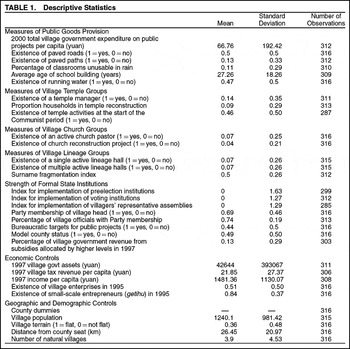
To measure local governmental public goods provision, the dependent variable, we look at both village government investment as well as objective measures of specific basic public goods—roads, school facilities, and running water infrastructure (see Table 1 for descriptive statistics). I chose these measures for three reasons. First, these measures are relevant and comparable across a wide variety of regions. Roads, primary school facilities, and water infrastructure are the public goods most often needed and demanded by villagers. Second, at the time of this study these public goods were usually the sole responsibility of the village government (unlike, e.g., electricity infrastructure which was usually funded and constructed in large part by county-level bureaus). Third, all of these measures reflect governmental public goods provision in relatively recent years. Although most solidary groups were started in the late 1970s and early 1980s, public goods such as paved roads and running water were not provided until much later in the reform period. As of 1985, for example, more than a third of China's villages were not connected to the road system at all, to say nothing of roads within the village (Benziger 1993).

A total of six measures for village governmental public goods provision are used: per capita village government expenditure on public projects in 2000, the existence of paved village roads; the existence of paved village paths, the proportion of village classrooms usable in rainy weather, the newness of the village school building (this measure was converted from the age of the school building so that a higher number indicates a newer building), and the existence of running water. Looking solely at any one of these indicators would not allow us to compare the performance of different village governments. If we looked only at the quality of school facilities as an indicator of village public goods provision, we would wrongly assume that a village government focusing investment on running water infrastructure was performing poorly. Using multiple indicators of governmental public goods provision acknowledges the fact that different places have different needs and preferences.
Measuring the Explanatory Variable
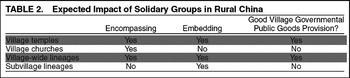
To demonstrate the plausibility of this hypothesis, the paper derives its observable implications for the four kinds of solidary groups most common in rural China: village temples, village churches, village-wide lineage groups, and subvillage lineage groups. Although the survey data do not provide direct measures of embeddedness, case study and interview data with villagers and officials from dozens of villages from both the four provinces in the survey and the three other provinces visited during preliminary fieldwork indicate that village temples and lineages are usually both embedding. In contrast, none of the interviewees had ever come across or heard of an embedding village community church. If the hypothesis is correct, we should then expect village temples and village-wide lineages to have positive effects on local governmental public goods provision. In contrast, village churches and subvillage lineages, which are not both encompassing and embedding, should not have these positive effects. Table 2 compares the structural characteristics of these four solidary groups and their expected impacts on local governmental public goods provision.

Two measures are used for village temple groups: the existence of a formal temple manager (a dichotomous variable) and the percentage of households participating in village temple reconstruction projects since the beginning of the reform period by donating money, materials, or labor. In some villages, temple activities are impromptu affairs organized informally by an ad hoc group of villagers. In other places, a temple manager, sometimes overseeing a temple council, organizes community activities. Temple reconstruction projects are one of the most common temple activities, and the percentage of households that can be mobilized to participate in these projects is a good measure of the group's authority. Fourteen percent of villages reported that they had a village temple manager. The average proportion of households participating in temple reconstruction across all villages in the sample (including the ones that did not have temples or engage in temple reconstruction) was 9%, but among the 58 villages reporting temple reconstruction projects, the average percentage of households participating was 58%.
Two dichotomous variables are used for village church groups: the existence of a state-approved Protestant minister or Catholic priest who organizes church services and activities and the existence of a church that has been renovated or rebuilt in the reform period. Seven percent of villages reported that they had a church with a priest organizing services and activities, and 4% reported that the church had organized a reconstruction project since decollectivization.
The clearest and most easily observed indication of organized lineage group activities is the existence of an ancestral hall with ancestor spirit tablets. These tablets are thought to contain the spirits of the deceased and are the focus of collective rituals on holidays. Fourteen percent of villages in the survey reported ancestral halls with spirit tablets. Village-wide lineage groups are measured by a dichotomous variable that is coded one when a village reported the existence of one and only one ancestral hall with spirit tablets. Subvillage groups are measured by a dichotomous variable that is coded one when the village reported multiple ancestral halls with spirit tablets. Using these measures, 7% of villages reported the existence of a village-wide lineage group, and another 7% reported the existence of multiple subvillage lineage groups.
Control Variables
To identify the effects of these solidary groups accurately, the analyses control for three sets of factors that may also have an effect on village public goods provision.
Geographic and Demographic Controls. The first set consists of geographic and demographic controls. Dummy variables for the eight counties from which the villages were randomly sampled are included. Distance from the county seat, village terrain, the number of natural villages (a proxy for spatial dispersion of village residents), and village population in 2000 were also included to control for variation in demand for specific public goods as well as variation in costs for comparable goods. Demand for public goods provision should be higher in villages with larger populations and in villages that are closer to urban areas. The cost of constructing roads, schools, and water infrastructure should be higher in villages that are located far from the county seat or in mountainous terrain. Running water infrastructure should also be more costly to construct in villages with multiple “natural villages” or scattered residential settlements.
Economic Controls. As the level of economic development rises, it seems reasonable to suppose that public goods and services will improve because more resources are available for investment in public goods or because demand for public goods increases. Economic factors controlling for variation in level of economic development and the amount of resources available to the village government are thus also included. These measures include 1997 village income per capita, 1997 village government assets, and 1997 village government tax revenue per capita. Economic data from 1997 are used instead of data from 2000, to avoid simultaneity bias. Demand for roads, schools, and infrastructure is also likely to increase with higher levels of industrial and commercial activity. The analysis thus also controls for the existence of village enterprises in 1995 and the existence of small-scale household enterprises (getihu) in 1995.
Democratic and Bureaucratic Institutions. The analyses also control for a third set of factors—formal institutions of accountability—which existing theories identify as central to governmental performance. To control for top-down institutions that enable higher level officials to supervise lower level officials, the analyses include measures of Party and bureaucratic institutional strength—a dummy variable for the elected village head's Party membership; the percentage of village officials who are members of the Party; and a dummy variable for villages where officials sign performance contracts including public project targets with higher level officials.
In addition to formal top-down institutions of accountability, the analyses also control for the effects of bottom-up democratic institutions. Since the late 1980s, grassroots democratic reforms have been implemented at the village level. These reforms entail direct elections for village officials and the establishment of deliberative villagers' representative assemblies. To control for the effects of these reforms, I include an index measuring the implementation of preelection procedures, an index of the implementation of voting procedures, and an index of the implementation of villagers' representative assemblies. For each of these three indices, principal components analysis was used to create an index out of a battery of survey questions (see Appendix A for details on the construction of these indices).
Estimation
I estimate the effects of different types of village solidary groups on village public goods provision using the following model:

In this model, is the public goods provision outcome measure, where k may denote village government investment, existence of paved roads, access to running water, or another provision outcome. Xi is a vector of socioeconomic, geographic, and institutional controls. SGi denotes a particular solidary group measure (which can either be the existence of a temple manager, the percentage of households engaged in temple reconstruction, the existence of a minister or priest who organizes church activities, the existence of a church reconstruction project, the existence of a single ancestral hall with spirit tablets, or the existence of multiple ancestral halls with spirit tablets), where i denotes a village. The hypothesis can be restated as H0:τk=0, jointly for all outcomes k. Rejecting this hypothesis means that the particular solidary group being measured has a significant effect on public goods provision outcomes.
For each solidary group measure, this analysis uses seemingly unrelated regression (SUR) which estimates a system of six equations (one equation for each of the six public goods provision outcomes) and allows the errors in different equations to be correlated (see Miguel 2004). Because each measure of public goods provision is regressed on the same set of explanatory variables, the coefficients and standard errors produced by SUR are identical to those produced by ordinary least squares regression (OLS). Using SUR to look simultaneously at multiple measures of village governmental public goods has a number of advantages over combining these measures into a single index of governmental public goods provision. In developing countries such as China where resources are scarce, citizens and officials often have to make difficult choices about how to spend public funds. Few villages are able to fund roads and school buildings and water infrastructure. Having a paved road often makes it less likely that a village will have running water. Thus, intercorrelations among the public goods provision measures are low, and the measures do not scale together. (A table of intercorrelations can be viewed online at [http://web.mit.edu/polisci/faculty/L.Tsai.html]. Using SUR to look simultaneously at multiple measures of village governmental public goods provision allows for the possibility that different places prioritize different goods. The SUR software routine produces the covariances between estimators from different equations which allows us to test joint hypotheses involving parameters in different equations (Wooldridge 2002).
This paper presents the results when missing data are multiply imputed using the EMis algorithm developed by King et al. (2001) although results of the analysis were similar regardless of whether missing data were deleted listwise or multiply imputed. This paper presents the results when missing data are multiply imputed for several reasons. First, listwise deletion generally resulted in larger coefficient estimates and more statistically significant results. The paper thus presents the more conservative estimates produced when missing data are multiply imputed. But as we can see from the estimates presented in Tables 3 and 4, even the more conservative coefficient estimates produced when multiple imputation is used provide substantial support for the paper's main argument. Second, listwise deletion results in a large loss of information. We can see from Table 1 that missing data for any individual variable is less than 10%. But when listwise deletion is used, about one-quarter of the observations are deleted because of the large number of controls in the analysis. For each missing item, five values were imputed to create five completed datasets. All the variables used in the analysis were included in the imputation model to help predict the missing values. Imputed values were created from the imputation model in the same way that values are simulated from a regression. Higher uncertainty about the value of a missing cell is reflected in higher variation across the five imputed values.
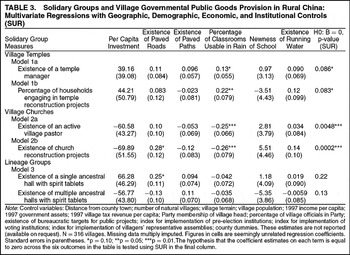
Table 3 presents the multivariate SUR estimates for the effects of different solidary groups on village governmental public goods provision when we control for geographic, demographic, economic, and institutional factors and missing data are multiply imputed using the process described above.4
Heteroskedasticity-robust standard errors are not reported because Stata and Clarify, a program for combining multiply imputed datasets for analysis, do not support seemingly unrelated regression with Huber robust standard errors. When listwise deletion is used, seemingly unrelated regression with robust standard errors generally results in similar standard errors.

As we can see, village temple groups have a substantial positive impact on village public goods provision. Model 1a in Table 3 shows that the estimated relationship between village public goods provision and village temple groups as measured by the existence of a temple manager is positive for all six public goods outcomes and statistically significantly different from zero for paths and classrooms. In addition, the estimated effect of a temple manager on roads and water, though not statistically significant, has relatively low levels of uncertainty. The magnitude of this positive effect is sizable for all of the outcomes except newness of school. Although the standard errors for the individual estimates are relatively large, we can be reasonably confident that temple managers do in fact have a positive effect on village governmental public goods provision in general because such effects exist for multiple measures of village governmental public goods provision. We can also reject the null hypothesis that the coefficient estimate on village temple manager jointly across public goods provision outcomes is equal to zero at a 90% confidence level (p-value = 0.086 as shown in the last column of the table). This finding is supported by the estimates in Model 1b in which village temple groups are measured by the percentage of households engaging in temple reconstruction, although these results are more mixed. The estimated effect of village temple groups as measured by temple reconstruction is positive for four of the public goods provision outcomes (investment, roads, classrooms, and running water) and statistically significant for classrooms. The estimated effect of temple groups is negative for two of the public goods provision outcomes (paths and newness of school building), but the levels of uncertainty about these estimates were quite high, especially for paths. Using SUR we can reject the hypothesis that the coefficient estimate on temple reconstruction is equal to zero jointly across all the public goods provision outcomes at a 90% confidence level (p-value = 0.083).5
The findings remain similar for a model regressing public goods provision outcomes on a temple groups index created through principal components analysis of the two measures of temple groups.
These results suggest that village temple groups, which are both encompassing and embedding, have a positive impact on village governmental public goods provision. But how do we know that both of these structural characteristics are necessary? We look next at the impact of village church groups that have only one of these characteristics—they are encompassing but not embedding. The results of Models 2a and 2b in Table 3 do not indicate that village churches have a positive impact on village governmental public goods provision.6
Again, the results are very similar for a model regressing public goods provision outcomes on an index for church groups created through principal components combining the two measures of church groups.
Including the control variables changes the sign of the coefficient estimates on two outcomes (paths and water) from positive to negative.
But perhaps being encompassing is not actually what is important. The positive effect of temple groups could simply be due to the fact that they are embedding, whereas churches are not. Or temple groups could be special not because of their structural characteristics but because of something about the content of their religious beliefs or the specific values they hold.
To examine these possibilities, we now turn to groups with a different basis for solidarity—lineage groups. In contrast to village temples that emphasize religious obligations to guardian deities who protect a particular geographical locale, lineage groups in rural China are based on a belief in shared ancestry and obligations due to kinship. Lineages tend to embed village officials, but not all of them encompass the entire village. Lineage group boundaries can be village-wide and overlap with village administrative boundaries, or they can be subvillage and fragment villagers into different lineage groups. If the structural hypothesis is correct—that is, both structural characteristics are necessary and the basis for solidarity does not matter—village-wide lineage groups that are both encompassing and embedding should have a positive impact on village public goods provision whereas subvillage lineage groups should not have a positive impact.
Model 3 in Table 3 estimates the impact of village-wide lineage groups and subvillage lineage groups on village public goods provision. SUR analysis suggests that village-wide lineage groups, like village temple groups, have a generally positive impact on village public goods provision. The standard errors on the individual coefficient estimates were relatively large, but the estimated effect was positive for five of the six public goods provision measures (investment, roads, paths, newness of school building, and water) and statistically significant for roads. In addition, the estimated effect of village-wide lineage groups on investment and paths, though not statistically significant, had comparatively low levels of uncertainty. Moreover, the magnitude of the estimated positive effects on investment, roads, and paths was relatively large. The estimated effect was negative for classrooms usable in rain, but the level of uncertainty for this estimate as very high and the magnitude of the effect was very small. Although the effect of village-wide lineage groups jointly across the six outcomes is not significant by conventional statistical standards, it remains substantively important (p-value = 0.22). An alternative SUR analysis with heteroskedasticity-robust standard errors and listwise deletion of missing data indicates that village-wide lineage groups have a statistically significant effect jointly across public goods outcomes at a 95% confidence level (p-value = 0.04).
Not surprisingly, subvillage lineage groups as measured by the existence of multiple ancestral halls with spirit tablets do not have a positive impact on village governmental public goods provision. The coefficient estimates on the existence of multiple ancestral halls was negative and statistically insignificant for all of the public goods provision except paths. Villagers frequently reported that leftover concrete from repairs and renovations to village ancestral halls was often used to pave adjacent footpaths, which may help to account for this relationship. The coefficient estimate on paths was positive and close to statistically significant, but the coefficient estimate on per capita government investment in public projects was negative. There was some uncertainty about the magnitude of this estimated effect on investment, but it seems reasonable to conclude that if subvillage lineage groups do have an effect on government investment in public projects, it is probably not a positive one. Thus, we can surmise that although subvillage lineage groups may have a positive impact on village paths, they do not have a positive impact on village governmental public goods provision.
In sum, results from seemingly unrelated regression analysis are consistent with the hypothesis that solidary groups that are both encompassing and embedding have a positive impact on village governmental public goods provision. Village temples and village-wide lineages—the two solidary groups in the Chinese context which are encompassing and embedding—both had a positive effect on government investment in public goods provision as well as the provision of actual public goods. Findings from bivariate SUR regression and logit models for the existence of paved roads, the existence of paved paths, and the existence of running water (dichotomous dependent variables) are not shown but are similar to the multivariate SUR estimates, and in many cases provide even stronger support for the hypothesis that localities with encompassing and embedding groups are likely to have better village governmental public goods provision than localities without these groups. (These results can be currently viewed online at [http://web.mit.edu/polisci/faculty/L.Tsai.html]).
But what if the existence of these groups is an effect of good public goods provision rather than a cause? To examine this possibility, I used two-stage least-squares instrumental variables (IV) estimation to estimate the impact of village temples and village-wide lineage groups. Two-stage least squares can potentially estimate the effect of an endogenous variable accurately if we can identify a variable that only affects governmental public goods provision through its effect on the solidary group in question. For village temples, I use the existence of temple activity before 1949 to instrument for the current existence of a temple manager. Because of the nearly complete eradication of community temples and collective temple activities and the radical social upheaval during the Maoist period (Madsen 1984; Ruf 1998), it is unlikely that a history of precommunist temple activity has influenced the current performance of village governments in any way except by making the current existence of temple groups more likely by providing a familiar template for newly organizing social groups. A history of precommunist temple activity would not be a valid instrument if there are unchanging village characteristics that produce both temple activity and public goods provision. To reduce this possibility, the analysis includes as many controls as possible for village characteristics. For village-wide lineage groups, a simple index of surname fragmentation was used to instrument for the current existence of village-wide lineage groups. In the Chinese context, surname patterns make a good instrument for the current existence of village-wide lineage groups because they were largely determined exogenously in the precommunist period by imperial land settlement policies and natural disasters. These patterns were then frozen during the Maoist period when the state instituted strict policies against internal migration (Solinger 1999). There is no guarantee that villages in which the vast majority of households share the same surname will definitely establish an active village-wide lineage group. But surname patterns and the existence of village-wide lineage groups are likely to be correlated because the possibility of a village-wide lineage groups requires that a village be dominated by one surname group.
Due to space constraints, the results from IV estimation are not shown here, but results from IV estimation also indicated that the estimated effects of village temples and village-wide lineage groups on village governmental public goods provision are positive. (These results can be viewed online at [http://web.mit.edu/polisci/faculty/L.Tsai.html].) In fact, the coefficient estimates produced by two-stage least squares were generally larger in magnitude than the estimates produced by seemingly unrelated regression. Hausman tests indicated, moreover, that instrumental variables estimation was not necessarily warranted, because the differences between the IV estimates and the OLS estimates (which are the same as SUR estimates in this case) were not different enough to suggest that OLS estimates were inconsistent and that village temples and village-wide lineage groups were endogenous.
So as we can see, even when we control for level of economic development, variation in bureaucratic and democratic institutions, and differences in the demand for particular goods or the cost of particular goods due to variation in location, geography and size, encompassing and embedding solidary groups have a significant positive effect on village governmental public goods provision.
To get a sense of the impact of encompassing and embedding groups in more concrete terms, we can compare the mean level or likelihood of different public goods in an average village with a temple manager to an average village without a temple manager (an average village being one where all the control variables are set at their means). The mean per capita investment in an average village with a temple manager was 99 yuan (about $12, U.S.), which was substantially higher than the mean per capita investment in an average village without a temple manager, 61 yuan. The uncertainty around these estimates was somewhat high, but the fact that the provision of actual road, school, and water facilities also increased in villages with temple managers gives us more confidence in the positive relationship estimated between village temple groups and village governmental public goods provision. The probability that the average village with a temple manager has a paved road, for example, was 59%, whereas the probability that the average village without a temple manager has a paved road drops to 49%. The probability of running water in the average village with a temple manager was 55% whereas the probability of running water in a village without a temple manager was 46%.
To get a substantive idea of the actual impact of village-wide lineage groups, we can also compare the mean level or likelihood of different public goods in an average village with a village-wide lineage group as indicated by a single functioning ancestral hall, an average village with multiple subvillage lineage groups, and an average village without any lineage groups at all. The mean per capita investment for an average village with a single functioning ancestral hall was 132 yuan (about $17, U.S.), double that of an average village without any ancestral halls, although the uncertainty around these estimates was somewhat high. The difference in the probability of paved roads, however, was far more certain. The probability of paved roads in an average village with a single functioning ancestral hall is 75%, whereas the probability in an average village without a single functioning ancestral hall is only 49%. Because their 95% confidence intervals do not overlap, we can be quite certain that villages with village-wide lineage groups perform differently than villages without these groups. The average village with a village-wide lineage group had a 49% probability of running water, whereas the average village with multiple subvillage lineage groups had a 47% probability.
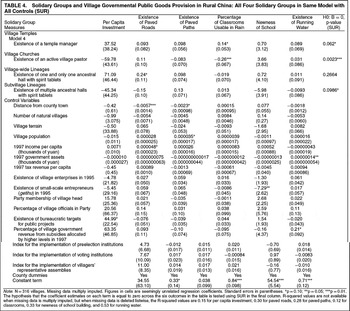
Data from the survey are consistent with the hypothesis that encompassing and embedding solidary groups (village temples and village-wide lineages) have a substantial positive effect on village governmental public goods provision. In contrast, solidary groups which do not have both of these structural characteristics (village churches and subvillage lineages) do not have a positive effect on local governmental public goods provision. These findings remain the same even when the effects of all four kinds of solidary groups are estimated in the same model. Model 4 in Table 4 includes all the control variables and measures for all four types of solidary groups. Even after controlling for the effects of churches and lineage groups, the estimated relationship among village temple groups as measured by the existence of a temple manager is positive for all the public goods provision measures and statistically significant for paths and classrooms. Although the estimated effect is not statistically significant for roads and water, uncertainty about these estimates are also relatively low. Similarly, the estimated relationship between village governmental public goods provision and village-wide lineage groups as measured by the existence of a single ancestral hall was positive for five out of six public goods provision outcomes and statistically significant for roads. Although the estimated effect is not statistically significant for investment and paths, uncertainty about these estimates was relatively low and the magnitude of the effects was relatively large. The estimated effect on classrooms was negative, but the uncertainty of this estimate was very high, and the magnitude of the effect was very small.

OTHER EXPLANATORY FACTORS
Contrary to what we might hope, local governments do not necessarily improve public goods and services a great deal as economic development and government resources increase. Resources matter but so does how they are used. We can see in Table 4 that the estimated relationship between village public goods provision and 1997 income per capita in Model 4 was positive for five outcomes (investment, roads, paths, school age, and water) and statistically significant for roads. The magnitude of this effect, however, was relatively small for investment and roads and very small for paths, newness of school, and water. When all other variables were held at their means, an increase from the 25th percentile to the 75th percentile in 1997 income per capita was only associated with a 6-yuan increase in investment, a 4% increase in the probability of paved roads, and a 2% increase in the probability of paved paths. The level of government assets also lacked an impact of any sizable magnitude on the six public goods provision outcomes. Higher tax revenue per capita was associated with less, not more, investment in village public projects and had little impact on any of the other public goods provision measures.
There was some indication, however, that more industrialization and a larger nonagricultural sector were associated with better public goods, although not with more village government investment in public projects. The estimated effect of the existence of village enterprises in 1995 was positive and statistically significant or close to significant for the probability of paved paths and running water. The estimated effect of the existence of small-scale entrepreneurs in 1995 was positive and statistically significant or close to significant for the probability of paved roads and paved paths.
Generally speaking, bureaucratic institutions of top-down control and democratic institutions did not seem to have sizable positive effects on village governmental public goods provision, although there was some evidence that villages that received more subsidies from higher levels were more likely to have better village governmental public goods provision. We can see in Table 4 that the estimated effect of subsidies from higher levels was positive and statistically significant or close to significant for investment, roads, and water. The estimated effect, however, on paths, classrooms, and school building was negative and close to statistically significant for paths and classrooms.
We can also see in Table 4 that neither of the two measures for formal Party institutions had any clear effect. Coefficient estimates on Party membership of village head and the percentage of village officials in the Party were statistically insignificant and generally small or modest in magnitude. Previous studies of bureaucratic performance contracts at the township level have found that contracts have a substantial impact on cadre behavior (Bernstein and Lu 2003; Edin 2003), but at the village level, we can see that bureaucratic performance contracts did not have a consistently positive effect on governmental public goods provision. Performance contracts had a positive impact on three of the public goods provision measures and a negative impact on the other three. The estimated positive effect on investment was statistically significant. These results suggest that performance contracts have a sizable impact on government investment in public projects but that this increase in investment is not accompanied by similarly large increases in the provision of actual public goods and services.
Why might performance contracts be correlated with higher government investment but not with better village public goods? One possible reason is that performance contracts rely on simple measures of village government performance such as investment without further monitoring whether village officials actually improve roads and schools when they increase spending. These findings also suggest that investment in education facilities may, at the same time, channel funds away from rural roads and water infrastructure. Other studies have found that top-down bureaucratic performance contracts may actually be counterproductive to local governance by encouraging investment in “vanity” public projects like new government office buildings or giving local officials excuses to raise local taxes (Bernstein and Lu 2003).
Contrary to what theories of democracy might predict, the estimated effects of the implementation of democratic institutions on village governmental public goods provision were very small and in general statistically insignificant. The estimated effect of the implementation of preelection institutions was only statistically significant for one outcome, the percentage of classrooms usable in rain, but the magnitude of this effect was very small. For an increase from the 25th percentile to the 75th percentile in terms of implementation of preelection institutions, the average percentage of classrooms usable in rain increased only 3%. The estimated effect of the implementation of voting procedures such as secret ballot and regulated proxy voting was statistically insignificant and of a very small magnitude for all six public goods provision outcomes. The estimated effect of the implementation of villagers' representative assemblies was also statistically insignificant for all six public goods provision outcomes, although the level of uncertainty was relatively low for investment, paths, and classrooms. The magnitude of these effects was small to modest. For an increase from the 25th percentile to the 75th percentile in terms of implementation of villagers' representative assemblies, the mean per capita investment in public projects increased 20 yuan, the mean probability of paved paths increased 3%, and the mean percentage of classrooms usable in rain increased 4%. Results remained similar when the implementation of democratic institutions were measured in different ways. There was still no indication that democratic institutions had a clear positive effect on village government investment and village governmental public goods provision when the provision measures were regressed on additive scores for the implementation of preelection institutions, voting institutions, and villagers' representative assemblies. Nor was there any indication that democratic institutions had a clear positive effect on village governmental public goods provision when the provision measures were regressed on a single additive score summing all of the dichotomous measures for preelection, voting, and villagers' representative assembly institutions.
Findings in the previous section suggested that solidary groups with certain structural characteristics could encourage local officials to provide public goods and services even without democracy. These findings suggest that the implementation of elections does not guarantee good governmental performance, especially when other democratic institutions are weak.8
Others have also discussed the differences between democracy and accountability (see, e.g., Przeworski et al. 1999).
These issues may also help account for the lack of a statistically significant or substantively important interaction term between the existence of an encompassing group (a dichotomous measure coded one when the village had at least one temple group, village church, or village-wide lineage; and zero otherwise) and an index of the implementation of village democratic reforms.
CONCLUSION
The results presented in this paper suggest that when formal institutions of accountability are weak, citizens can still make government officials organize and fund the public goods that they want and need when they have the right kind of social groups. Solidary groups that are structured so that they overlap and mesh with government structures can provide local government officials with important incentives to provide the public goods and services that citizens demand even when democratic or bureaucratic institutions do not work effectively. By participating in encompassing solidary groups and fulfilling obligations to work for the good of the group, local officials can earn access to the moral authority conferred by these groups, which can be invaluable for pursuing their personal interests and for carrying out state tasks. Solidary groups which are not both encompassing and embedding may still be able to mobilize their members and provide some public goods and services themselves—but they are less able to hold the government responsible for providing these goods and services.
What general lessons can we draw from the experience of rural China? First, economic development is not necessarily correlated with political or institutional development. Good governance may foster economic growth and industrialization, but it is not clear that the converse is true. The evolution of state institutions in different places (even in the same country) does not simply vary in the speed of change; they do not all follow the same trajectory of institutional development.
Second, we need to differentiate between different types of social groups and social capital and to theorize about how they are correlated with particular political and economic outcomes. What the “right” kind of social group is depends on what result we are interested in. This study shows that distinguishing between different types of social groups can reveal that groups with different structural characteristics have very different effects on governmental performance. It also suggests that we need to pay more attention to important interaction effects between social structures and state structures.
Third, the right kind of social group for governmental performance and public goods provision in authoritarian and transitional systems are not necessarily the ones that increase trust or are autonomous from the state. Without formal institutions that incorporate citizen participation in the policymaking process, it is not clear how much of an impact social organizations which help citizens voice their opinions and develop organizational skills can have. Under these conditions, solidary groups that incorporate agents of the state and offer moral standing as an incentive to contribute to the public good can provide informal institutions of accountability that substitute for formal ones.
In sum, solidary groups and informal institutions can be very beneficial to local governmental performance in transitional systems where formal institutions are weak. In democratic systems, explicit rules about how to change the rules give the system flexibility. In authoritarian and transitional systems, informality and informal institutions can provide this flexibility, sometimes at a lower cost to the state than the building of formal institutions to carry out the same functions. It may be that informal institutions can help stabilize states indefinitely, and what we think of as “transitional” systems are not really transitional at all.
But there may also be serious drawbacks to relying on solidary groups to provide informal institutions of accountability. This kind of informal system may also be difficult to “scale up” and may only work at local levels for towns and villages. In cities or at the national level, encompassing and embedding solidary groups may be both less relevant and less likely to exist. More importantly, this kind of informal system helps citizens obtain more public goods and services that they would otherwise get without this kind of informal system—but perhaps not as much as they would get if there was a system of formal accountability to make sure that higher levels of government also contributed resources and took responsibility for providing local public goods. By relieving pressure on the state in the short term, this kind of informal system may help to forestall reforms to the formal institutional system that would be more beneficial to both citizens and the state in the long term.
APPENDIX A
To measure the implementation of preelection institutions, the survey asked about interference by higher level township officials, the village Party organization, and incumbent village officials in the nomination of primary election candidates, the nomination of final candidates, and the selection of the election administration committee. For each of these nine questions, a dichotomous variable was created. Principal components analysis was then used to construct an index out of these nine items measuring the implementation of preelection institutions.
To measure the implementation of voting institutions, the survey asked the following seven questions: whether the results of elections were announced immediately after polls closed; whether there were more candidates than offices; whether ballots were counted publicly; whether secret ballot was used; whether candidates gave campaign speeches; whether proxy voting was regulated; and whether the ballot box was fixed in a designated polling place rather than brought around to each household, which increases the chances of fraud. Again, I used principal components analysis to create a index reflecting the implementation of voting procedures.
To measure the implementation of villagers' representative assemblies (VRAs), the survey asked whether the village had implemented the following seven institutions: competition for VRA seats, election through secret ballot, formal regulations on when the VRA was supposed to be convened, formal power of the VRA to recall the village head, formal power to inspect village expenditures; formal power to audit village accounts, and whether the VRA had vetoed a village government decision in the past year. Based on these seven measures, I constructed an index measuring VRA implementation using principal components analysis.
I am indebted to Elizabeth Perry, Grzegorz Ekiert, Robert Putnam, and Theda Skocpol for their invaluable advice and support at various stages of the project. Earlier versions of this paper benefited greatly from comments provided by Edward Young, Adam Berinsky, Melani Cammett, Andrea Campbell, Mary Gallagher, John Gerring, Frances Hagopian, David Laitin, Chappell Lawson, Devra Moehler, Daniel Posner, Susan Rose-Ackerman, James Scott, Tianjian Shi, participants of the World Bank Seminar Series on the Political Economy of Governance Reform, the China Research Seminar at Oxford University, the Democracy, Governance, and Identity Workshop at the University of Michigan, and six anonymous reviewers. Nathan Cisneros and William Tilden provided valuable editorial assistance.



Comments
No Comments have been published for this article.