This article builds on the debate about voters’ reactions to what parties say compared to what they do when in government. Research by Fernandez-Vazquez and Adams et al. finds that citizens do not significantly update their perceptions of parties’ issue positions in response to their policy statements, whereas Fortunato and Stevenson present research that citizens do respond to parties’ concrete actions – namely, their decisions to participate in a governing coalition – by updating their perceptions of parties’ policy positions.Footnote 1 In addition, Soroka and Wlezien find that citizens react to governing parties’ budgetary allocations – another form of concrete action – by thermostatically adjusting their own spending preferences.Footnote 2 This research suggests that voters react to governments’ deeds, not their words.
At the same time, issue ownership theory posits that parties use rhetoric to direct citizens’ attention toward issues the party ‘owns’, in the sense that it has developed a long-term reputation for competently handling these issues. In particular, the theory posits that mainstream left-wing parties – long-term advocates of the welfare state – enjoy positive reputations for administering government programs pertaining to public health, unemployment insurance, family assistance, old-age pensions and public housing, so that voters who prioritize these issues tend to support leftist parties because voters trust them to competently address these domains.Footnote 3 This implies that mainstream leftist parties benefit from emphasizing social welfare issues, because this emphasis increases the public salience of the issues these parties own.Footnote 4
To our knowledge, our study is the first to jointly consider how governing party support responds to governments’ rhetoric versus their concrete actions. We argue that because governing parties – unlike opposition parties – are in a position to enact policies, citizens prioritize governments’ deeds over their words, so that – contra issue ownership theory – governing parties’ support does not respond to their rhetorical issue emphases – we refer to this as the No Rhetorical Effects Hypothesis. We also review the conflicting arguments on how party support responds to governments’ concrete actions with respect to social welfare spending. We then present time-series, cross-sectional analyses of data on government support, government rhetoric (in executive speeches) and government spending (from Organisation for Economic Co-operation and Development (OECD) data) from Britain, Spain and the United States, which support our No Rhetorical Effects Hypothesis. However, our analyses identify strong negative effects of social welfare spending on government support, for both left- and right-wing governments.
Our findings pertain to governing parties’ electoral strategies and to mass–elite linkages. Our finding that leftist governments – in common with right-wing governments – are punished for social welfare spending pertains to the well-known ‘costs of governing’, that is, governments’ tendencies to lose public support over time.Footnote 5 Scholars have identified diverse factors that contribute to the costs of governing, including competence, performance in office, and real-world conditions pertaining to the economy or war.Footnote 6 To these considerations we add a new factor pertaining to left-wing governments: namely, that the budgeting strategy that optimizes leftist governments’ short-term support – which is to cut social welfare spending – is impractical in the long term. Not only do leftist governing elites plausibly sincerely support social welfare spending – so that cutting such spending depresses their policy-based utilitiesFootnote 7 – but in the long run governing parties that renege on their policy pledges may undermine their public credibility and alienate their core supporters.Footnote 8 In this sense, leftist governments may be ‘prisoners of their ideologies’,Footnote 9 in that the long-term imperative to faithfully act on their social welfare rhetoric undermines their short-term political support. This finding suggests yet another dilemma for social democratic parties in the twenty-first century as they confront strategic incentives to adapt their political messages and construct new electoral coalitions.Footnote 10
In future research we hope to extend our study to additional issue areas in which government action is not defined primarily in terms of spending levels – such as environmental and multicultural issues – and to issue areas ‘owned’ by the mainstream right, notably crime and defense. For now, our analyses of the social welfare issues associated with the mainstream left suggest that the mass public responds to governments’ actions, not their words.
HOW PUBLIC SUPPORT RESPONDS TO GOVERNMENTS’ POLICY RHETORIC AND THEIR ACTUAL BUDGET ALLOCATIONS: HYPOTHESES ON THE COSTS OF GOVERNING
The ‘cost of governing’ phenomenon,Footnote 11 whereby governing parties tend to lose support over time, has generated an extensive literature that has developed three well-known explanations. The ‘pendulum swing’ modelFootnote 12 argues that parties gain governing status in part due to short-term factors such as economic conditions, political crises and scandals, that propel these parties to positive electoral outcomes that help them capture the government, but because these forces recede over time (a form of regression to the mean), governing parties tend to lose popular support as time passes. A second model, known as the ‘unpopularity’ model, predicts that the more unpopular the government before elections, the more likely it is to be replaced at the next electionFootnote 13 and can be compared to the political business cycle.Footnote 14 A third model is expectation/disillusion theory,Footnote 15 that governments lose support because they fail to meet expectations they raised during the election campaign.
We extend the costs of governing literature to consider how government support jointly responds to what governments say, via their issue rhetoric, versus what they do in their budgetary allocations. We address this question in the context of social welfare issues, first because social welfare is the core competency of mainstream leftist parties, and secondly because – as discussed below – we have more reliable data on government spending (and rhetoric) in this domain than in domains associated with the right, such as crime and national defense. However, we compare the expected effects of social welfare rhetoric and spending on left- versus right-wing governments.
How Voters (Do Not) React to Government Speech: The No Rhetorical Effects Hypothesis
We first consider how citizens respond to governments’ policy rhetoric. To explore this question, issue ownership theory posits that parties compete by emphasizing the issue domains they ‘own’, in the sense that voters associate a focal party with particular issues they believe it can competently address.Footnote 16 In particular, the theory posits that mainstream, center-right parties – notably conservative and Christian Democratic parties – enjoy a reputation of competence on issues pertaining to crime, national defense and (arguably) immigration, whereas mainstream leftist parties – such as labor and social democratic parties – are known for managing social welfare domains including healthcare, public housing, family assistance, unemployment and old-age pensions.Footnote 17 Issue ownership theory implies that parties benefit when the issues they own increase in public salience, so that parties have electoral incentives to emphasize their core issues in order to direct voters’ attention to these domains. Indeed, empirical research by Hobolt et al. documents that political parties’ policy rhetoric influences citizens’ issue priorities,Footnote 18 and extensive research documents that political parties emphasize their core issues.Footnote 19
At the same time, alternative considerations cast doubt on whether political parties – especially governing parties – can cue public issue priorities via their rhetoric, independently of their actual policy outputs. Citizens plausibly discount government rhetoric versus governments’ actual deeds, because actions speak louder than words. In particular, citizens may reasonably treat governments’ budgetary allocations as ‘revealed preferences’ that disclose the government’s actual priorities, while dismissing government rhetoric as ‘cheap talk’ when it is not matched by action. In this regard, research by Epp et al. documents surprising inconsistencies between governing parties’ long-term rhetorical emphases and actual budgets, in particular that governing parties’ ideologies – left versus right – do not always predict their budgetary allocations, even in issue domains strongly associated with the left (such as social welfare spending) or the right (such as national defense).Footnote 20 Citizens who recognize this pattern may discount governing parties’ rhetoric even while they continue to weigh that of opposition parties, since opposition parties exert little influence on government policy and thus have no track record of recent actions. Consistent with this expectation, Fernandez-Vazquez and Somer-Topcu document that voters update their perceptions of opposition parties’ policy positions – but not governing parties’ positions – in response to parties’ policy rhetoric.Footnote 21
The second reason why voters may discount governments’ policy rhetoric is that opposition parties frequently undercut this rhetoric by publicly questioning its sincerity. At times this opposition strategy is retrospective, and involves highlighting government policies that do not match its promises. For instance in November 2010 – just six months after the May 2010 election that relegated the British Labour Party to opposition status – Labour leader Ed Miliband publicly attacked the Conservative Prime Minister David Cameron for destroying trust in government by leading ‘a government of broken promises’ with respect to its spending on child benefits and university tuition fees.Footnote 22 At other times the opposition prospectively charges that the government’s rhetoric is driven by political opportunism, not principle.Footnote 23 And of course voters may draw this cynical inference without prompting from opposition parties. In this regard, Fernandez-Vazquez documents that voters discount parties’ claims to have shifted toward publicly popular policy positions, because voters recognize that parties – regardless of their actual policy intentions – have electoral motivations to announce popular positions.Footnote 24
The considerations outlined above motivate our No Rhetorical Effects Hypothesis, that government support does not respond to the issues governments emphasize in their political rhetoric.
How Voters React to Government Spending: Conflicting Arguments and No Clear Prediction
In contrast to the prediction that voters discount government rhetoric, theoretical considerations offer conflicting predictions about the effects of government spending. In particular, there are arguments that voters will not respond to government spending, arguments that voters will reward increased social welfare spending, and alternative arguments that voters will punish increased welfare spending. The argument that citizens will not react to social welfare spending is that voters are ‘motivated reasoners’ whose partisan loyalties distort their perceptions of government spending to conform to their pre-existing policy preferences, that is, citizens who support (oppose) the government for other reasons perceive that government budgets match (diverge from) these supporters’ spending preferences, regardless of the facts. In this regard, Bartels shows that partisanship notably skewed American citizens’ retrospective perceptions of the Reagan administration’s budget allocations.Footnote 25 We note that the ‘perceptual screen’ that partisanship exerts on perceived government spending is part of a wider phenomenon, whereby partisanship also influences citizens’ perceptions of the economy.Footnote 26 And while one might expect political independents to form more impartial estimates of government spending levels, extensive research documents that non-aligned voters display lower levels of political interest and awareness than committed partisans,Footnote 27 so that the constituency best suited to impartially assess government spending is also the least likely to acquire this information.
Alternative arguments imply that citizens will respond to social welfare spending, but these arguments have conflicting implications about the direction of this effect – positive or negative – and some of them have conflicting implications for left- versus right-wing governments. With respect to considerations that apply to all governments, a reason to expect increased social welfare spending to enhance government support is that large public majorities in most Western democracies support social welfare programs; citizens who support increased social welfare spending substantially outnumber those who prefer reduced welfare spending.Footnote 28 Conversely, survey research also establishes that sizable majorities in Western democracies support cutting overall government spending.Footnote 29 These conflicting public preferences yield no clear prediction of how social welfare spending affects government support.
With respect to left-wing governments, an argument that increased social welfare spending enhances support is that such spending conforms to leftist parties’ long-term policy emphases on social welfare, thereby enhancing the leftist government’s image of credibility and reliability. Secondly, and related, Adams et al. document that while the public is not generally attentive to party policy behavior, parties’ core supporters do closely monitor their preferred party’s actions.Footnote 30 Since leftist parties’ core supporters tend to strongly support social welfare spending,Footnote 31 this implies that the segment of the public most likely to perceive that a left-wing government has increased social welfare spending is the constituency that most approves of this spending increase.
Conversely, alternative considerations imply that leftist governments are punished for increased social welfare spending. First, Soroka and Wlezien document that citizens respond ‘thermostatically’ to government spending by decreasing (increasing) their spending preferences in policy domains when the government spends more (less).Footnote 32 This implies that increased social welfare spending depresses citizens’ desire for additional welfare spending, which should depress public support for left-wing governing parties that have a reputation associated with the welfare state. Secondly, Adams argues that citizens perceive governments that spend more on social welfare to be more left wing, independently of the governments’ policy rhetoric.Footnote 33 This implies that increased welfare spending radicalizes leftist governments’ policy images; that is, it shifts the government’s image farther to the left, away from the moderate swing voters whose support is crucial for winning elections. Indeed, Ezrow demonstrates that leftist parties in Europe lose support as their Left–Right images radicalize.Footnote 34
With respect to right-wing governments, theoretical considerations again point in conflicting directions. First, because increasing social welfare spending clashes with right-wing parties’ long-term reputations, increased welfare spending may undermine right-wing governments’ public image of credibility and thereby depress their support. Secondly, Adams et al.’s finding that parties’ core supporters disproportionately monitor their preferred party’s actions,Footnote 35 referenced above, implies that the constituency most likely to perceive that a right-wing government has increased social welfare spending is the right-wing government’s core supporters, who will mostly disapprove of this policy. Conversely, to the extent that voters use social welfare spending to infer governing parties’ Left–Right ideologies,Footnote 36 increased welfare spending shifts governing parties’ policy images to the left, which for right-wing governing parties entails an image shift in the direction of centrist voters, thereby enhancing government support among this crucial electoral bloc.
In toto, we believe theoretical arguments cannot adjudicate the issue of how social welfare spending affects aggregate government support, because there are reasons to project that citizens will not react to government spending, other reasons to expect voters to reward increased social welfare spending and still other reasons to expect citizens to punish increased welfare spending. For this reason we turn to empirical analyses in order to parse out this issue, and to evaluate our No Rhetorical Effects Hypothesis, that governments’ social welfare rhetoric does not affect their support.
DATA, MEASUREMENT AND CASE SELECTION
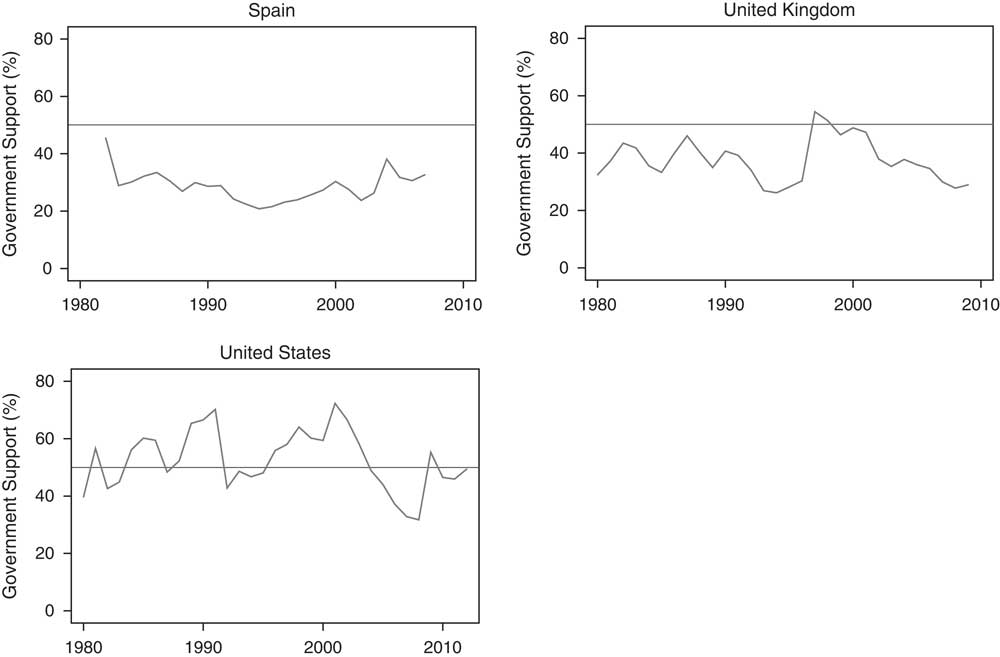
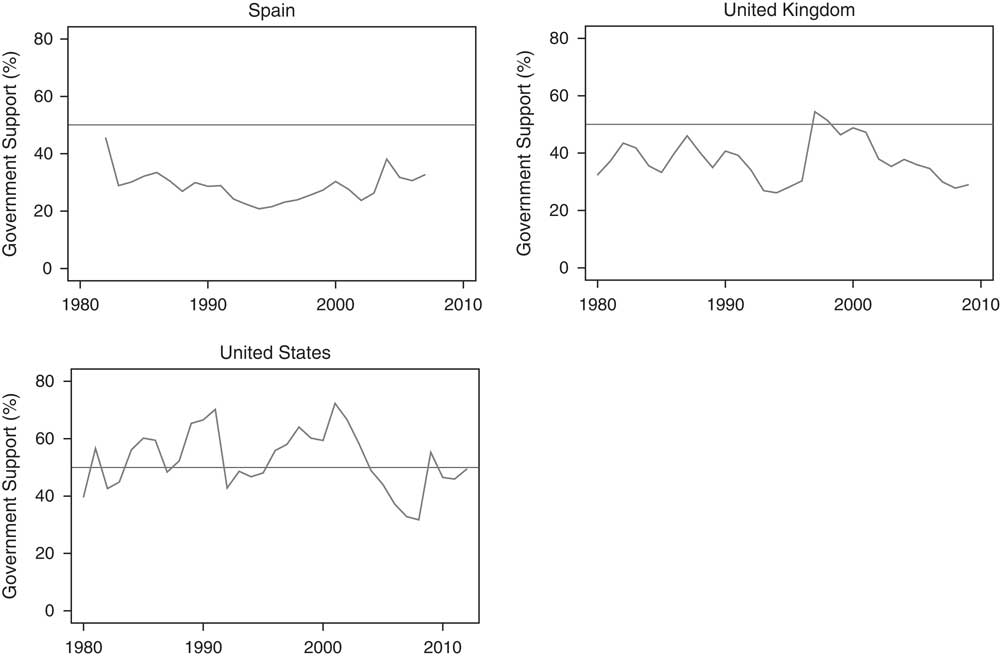
We analyze our research questions using time-series, cross-sectional data on government support, governments’ social welfare rhetoric, and their social welfare spending from three advanced democracies: Spain from 1982–2007, the UK from 1980–2009, and the United States from 1980–2012. (Below we discuss the practical and theoretical rationales for our choice of countries and time periods.) Our dependent variable is Government Support, measured using survey data on vote intentions for Spain and the UK, and presidential approval for the United States.Footnote 37 Such measures are widely used in studies on government support.Footnote 38 Unlike other measures of party support – such as citizens’ reported propensities to vote – that are more static over time and are based on pre-election surveys,Footnote 39 vote intentions are available at least on a yearly basis, allowing us to analyze government support dynamically. For Spain and Britain, government support in the current year is defined as the proportion of survey respondents over all respondents who expressed the intention to vote for the governing party (both countries featured single-party governments during the study period), averaged over all surveys conducted between the time of the current government’s executive speech (discussed below) and the previous year’s speech. For the United States, government support is the proportion of respondents who expressed approval of the president’s job performance, again averaged over all presidential approval polls conducted between the time of the president’s previous State of the Union speech and his current speech. Figure 1 displays the evolution of government support in Britain, Spain and the United States, according to these measures.
The evolution of government support in Britain, Spain and the United States Notes: the figures display the proportion of survey respondents who expressed the intention to vote for a governing party (in Britain and Spain) or who expressed approval of the president’s job performance (in the United States).
To measure governments’ social welfare rhetoric, we analyze data on executive speeches from the Comparative Agendas Project (CAP). CAP comparatively extends the Policy Agendas Project, which Jones and Baumgartner initiated in the United States.Footnote 40 CAP collects data on governments’ issue agendas in different venues (that is, party manifestos, executive speeches, parliamentary questions, bills, laws, expenditures and media coverage). Executive speeches are delivered annually by the head of state or head of government, and are formal statements that set out the government’s agenda for the year ahead.Footnote 41 Unlike other sources of party promises, such as election manifestos, executive speeches are available yearly and communicate the government’s general priorities as well as more specific measures that it plans to address. These speeches are costly signals that ‘create future potential costs for the government, if the priorities in the speech are not followed by policy outputs’.Footnote 42 Previous studies document the translation of governments’ policy agendas into legislative outputs in the United States and Britain, and comparative research documents that executive speeches reflect the issues that governing parties emphasize in other venues (such as party manifestos), suggesting that these speeches are reasonable proxies for the government’s more general rhetorical emphases.Footnote 43 Similar to the Comparative Manifestos Project’s codings of party manifestos,Footnote 44 the CAP coding scheme takes quasi-sentences in executive speeches as the unit of analysis, with each quasi-sentence assigned a single topic code. We focus on social welfare issues in four CAP major topics: Health (3), Labour and Employment (5), Welfare (13) and Housing (14). Specifically, our measure of government social welfare rhetoric in the current year, [Government Welfare Speech (t)], is the sum of the proportions of quasi-sentences in the executive speech that CAP codes into these categories.
We measure governments’ social welfare spending in the current year, [Government Welfare Spending (t)], as government spending as a percentage of GDP summed over four categories: Health, Active Labour Market Programs, Unemployment and Welfare, and Housing.Footnote 45 Government spending is widely used as an indicator of policy in the literature on how party ideology affects public spending and on policy responsiveness.Footnote 46 Below we report robustness checks using an alternative measure of government policy, the social welfare generosity index, which some scholars use instead of social welfare spending.
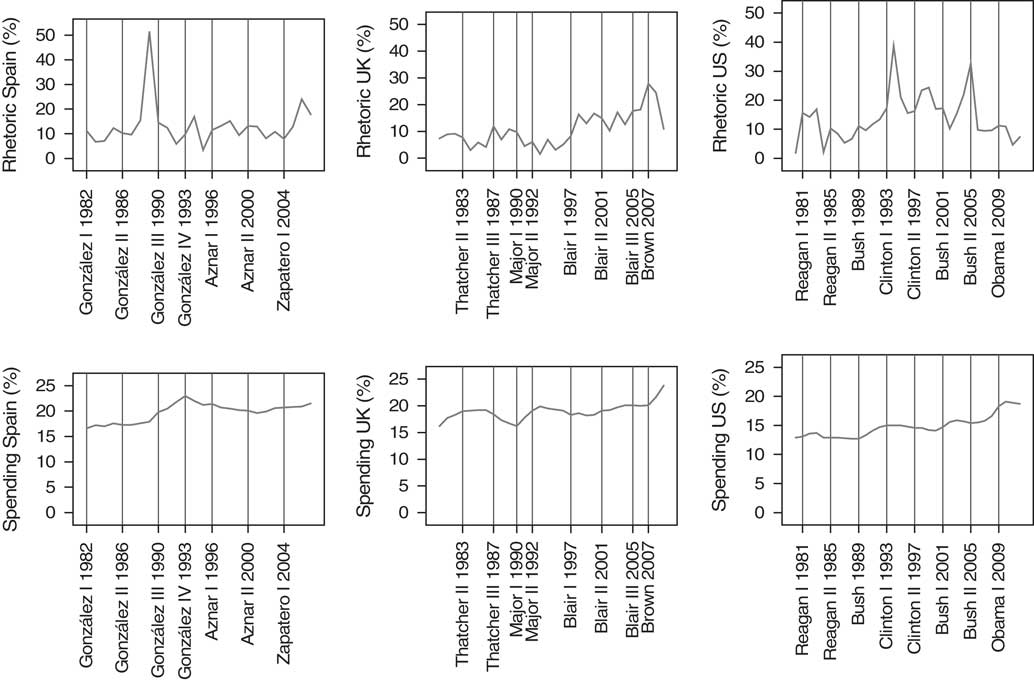
Figure 2 displays the evolution of government social welfare rhetoric and spending over time in Britain, Spain and the United States, where the horizontal axis denotes time and also lists the starting points of the different governments (presidential administrations) in each country, while the vertical axis displays the proportion of the executive speech or budget devoted to social welfare domains. First, note the much larger year-to-year fluctuations in governments’ social welfare rhetoric (as a proportion of their executive speeches) compared to their social welfare spending (as a proportion of GDP). This reflects the well-recognized pattern that government budgets tend to evolve incrementally,Footnote 47 whereas governments (and parties) have more flexibility to adjust their rhetoric.
The evolution of government social welfare rhetoric and spending in Britain, Spain and the United States Note: the figures in the top row display the government’s rhetorical social welfare emphases in their executive speeches (the vertical axis) over time (the horizontal axis), in Spain, Britain and the United States. The horizontal axis also labels the starting points of different governments (presidencies). The figures in the bottom row display yearly social welfare spending as a proportion of GDP.
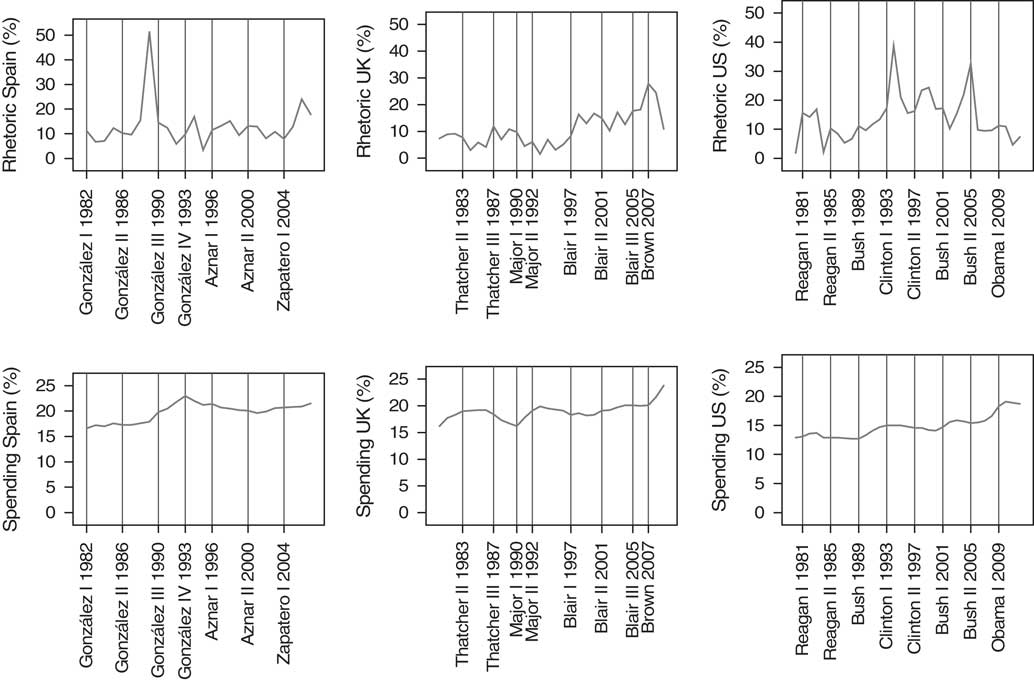
Secondly, the patterns generally support the expectation that leftist governments emphasize social welfare more strongly than right-wing governments. In Britain the Labour governments of Tony Blair and Gordon Brown displayed higher levels of both social welfare rhetoric and spending than Margaret Thatcher’s and John Major’s Conservative governments. And in the United States, Democratic President Bill Clinton’s administration emphasized social welfare rhetoric – and spent more on social welfare programs – than the Republican presidential administrations of Ronald Reagan, George H. Bush and George W. Bush, on average. However, consistent with Epp et al.’s finding that government ideology does not always predict behavior,Footnote 48 we see that George W. Bush rhetorically emphasized social welfare more than the Democrat Barak Obama, and that the Bush administration’s average social welfare spending nearly matched that of the Clinton administration. In Spain, the relationship between government ideology and social welfare emphasis is more complex, but displays similar patterns. In particular, the two sharp spikes in Spanish governments’ social welfare rhetoric occurred in 1989 and 2006, during the governments of the left-wing Socialist Worker’s Party under Prime Ministers Felipe González and José Luis Rodríguez Zapatero, as opposed to the governments of the center-right People’s Party under PM José María Aznar. Social welfare spending declined under the first right-wing Aznar government (1996–2000) compared to the final González government (1992–1996), and then increased again following the switch to the left-wing Zapatero government in 2004. Finally, note that because our Spanish data series ends in 2009 it does not cover the period of ‘austerity’ budgets, featuring sharp social welfare benefit cuts, that were introduced in Spain (as a condition for receiving international loans) in response to the dramatic contraction of the domestic economy that coincided with the worldwide economic recession. We return to this point in the conclusion.
Finally, in our analysis we will estimate – in addition to analyses of all governments – separate models on right- and left-wing governments, because the theoretical arguments outlined above suggest that the effects of social welfare emphasis on government support may depend on the government’s ideology. We consider the British Labour governments of Blair and Brown as left wing and the Conservative governments of Thatcher and Major as right wing; the administrations of US Democratic Presidents Bill Clinton and Barak Obama are coded as left wing, while the Republican administrations of Ronald Reagan, George H. Bush and George W. Bush are coded as right wing; the Spanish Socialist Worker’s Party governments of González and Zapatero are coded as left wing, while Aznar’s People’s Party government is coded as right wing.
Case Selection
We apply our analyses to Spain from 1982–2007, Britain from 1980–2009 and the United States from 1980–2012, because with the exception of Denmark, these are the only democracies for which the CAP codings of executive speeches are publicly available. Moreover, we cannot include Denmark in our analyses because we lack data on government support for the Danish Government over most of the period for which the CAP codings are available.Footnote 49 Secondly, the time periods of our analyses are those for which we have reliable data on these governments’ social welfare spending, from the OECD Social Expenditure Database. Theoretically, our three cases offer high levels of clarity about responsibility and electoral identifiability,Footnote 50 because Spain and Britain featured single-party governments across the study period,Footnote 51 while previous research has found that American citizens ascribe primary policy responsibility to the president’s party, even during periods of divided government.Footnote 52
MODEL SPECIFICATION
In our analyses we confront variation across countries and over time. A pure ordinary least squares approach is problematic for time-series cross-sectional models, because it assumes that errors have equal variance (homoskedasticity) and are independent over time (no serial correlation) and across units (no spatial correlation).Footnote 53 As modeling strategies are driven by methodological issues as well as theory, we first evaluate whether our data are stationary. Unit root testsFootnote 54 reveal that our dependent variable (Government Support) and one of our key independent variables (Social Welfare Spending) are non-stationary, and that we cannot reject the null hypothesis that all the panels contain a unit root. Treating these series as stationary could generate biased inferences. Since first-difference models often perform poorly and throw out long-run effects, scholars’ attention has recently moved to applications of error correction models (ECMs) to time-series data,Footnote 55 particularly in studies of dynamic representation.Footnote 56 Another reason why ECM models are appropriate for our data is that we plausibly encounter time dependencies. In fact, tests for autocorrelation reveal first-order autocorrelation for government support.Footnote 57
In addition to methodological issues, theoretical considerations also support the application of ECMs to our data. In particular, ECMs allow us to estimate both short-term effects, whereby government support responds to changes in government social welfare spending or rhetoric, and long-term effects whereby government support responds to (lagged) levels of social welfare spending or rhetoric. Since we have no a priori expectations about whether short- or long-term effects predominate in our analyses, we follow De Boef and Keele’s advice and analyze both types of effects.Footnote 58
Our model specifies over-time changes in government support as a function of the levels of (and changes in) the government’s social welfare rhetoric and spending. In the model, the dependent variable, [ΔGovt. Support (t)], is the difference between the government’s support in the current year and its support in the previous year: positive values on the dependent variable [ΔGovt. Support (t)] denote that the government’s support has increased over the past year. Our independent variables are: [Govt. Support (t−1)], which denotes the government’s support in the preceding year; [Govt. Welfare Speech (t−1)], which denotes the proportion of the previous year’s executive speech that pertained to social welfare domains; [ΔGovt. Welfare Speech (t)], which denotes the change in the government’s emphasis on social welfare in the current year’s executive speech compared to the previous year’s speech;Footnote 59 [Govt. Welfare Spending (t−1)], which denotes the level of social welfare spending in the previous year; and [ΔGovt. Welfare Spending (t)], which denotes the change in current welfare spending compared to welfare spending in the previous year.Footnote 60 We specify the following basic model to be estimated yearly over all the governments in our study, and then separately on all left-wing governments and then on all right-wing governments:
 $$\eqalignno{ \Delta govt.\,support\left( t \right)\, {\equals}\, & \alpha 0{\plus}\alpha _{1} \left[ {govt.\,support\left( {t{\minus}1} \right)} \right]{\plus}\beta _{1} \left[ {\Delta govt.\,welfare\,speech\left( t \right)} \right] \cr & {\plus}\beta _{2} \left[ {govt.\,welfare\,speech\left( {t{\minus}1} \right)} \right]{\plus}\beta _{3} \left[ {\Delta govt.\,welfare\,spending\left( t \right)} \right] \cr & {\plus}\beta _{4} \left[ {govt.\,welfare\,spending\left( {t{\minus}1} \right)} \right] $$
To evaluate the No Rhetorical Effects Hypothesis, that government support does not respond to social welfare rhetoric, the key coefficients are those on the [Govt. Welfare Speech (t−1)] and the [ΔGovt. Welfare Speech (t)] variables. A positive coefficient β1 on the [ΔGovt. Welfare Speech (t)] variable would denote that an increase in the government’s social welfare rhetoric in the current year – compared to the previous year – is associated with an increase in government support; that is, that government support responds to short-term changes in the government’s social welfare rhetoric. The coefficient β2 on the [Govt. Welfare Speech (t−1)] variable denotes the relationship between changes in the dependent variable Government Support and the proportion of the government’s lagged speech that pertained to social welfare. A positive coefficient would denote that the more the government rhetorically emphasized welfare domains during the previous time period, the more its support increased in the current time period – a long-term effect of the (lagged) level of social welfare rhetoric. Our No Rhetorical Effects Hypothesis implies that the coefficient estimates on the [ΔGovt. Welfare Speech (t)] and [Govt. Welfare Speech (t−1)] variables will be statistically insignificant.
The coefficients β3 and β4, on the [ΔGovt. Welfare Spending (t)] and [Govt. Welfare Spending (t−1)] variables, have substantive interpretations with respect to government spending that parallel the above discussion on government rhetoric. A positive coefficient β3 on the [ΔGovt. Welfare Spending (t)] variable denotes that increases in social welfare spending in the current year (compared to the previous year) are associated with increased government support, a short-term effect, while a positive coefficient β4 on the [Govt. Welfare Spending (t−1)] variable would denote that the more the government budgeted for social welfare during the previous time period, the higher its level of support in the current period. As discussed above, we have no clear expectations about how social welfare spending affects government support, since theoretical arguments point in conflicting directions.
Our specification also includes the government’s lagged support, [Govt. Support (t−1)], to control for the governing party’s long-term level of support, and to evaluate whether governments that were more popular in the previous time period tend to lose more support in the current time period.
Finally, in our empirical analyses we omit country-years in which a new government emerged with an ideology that differed from that of the previous government, such as Britain in 1997 when Tony Blair’s Labour government replaced John Major’s Conservative government. This is because in these years, the lagged and current levels of government rhetoric and spending pertain to different governments, so that the public plausibly does not hold the current government responsible for the previous government’s lagged behavior. We note, however, that we consider successive governments with the same prime minister (or president) to be the same: we include Britain in 2001 and 2005, the first years of Tony Blair’s second and third Labour governments, respectively, as well as all the years of the four successive González governments in Spain.Footnote 61
RESULTS
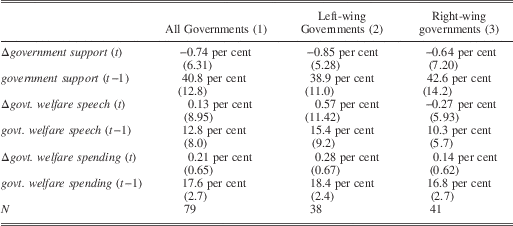
We first estimated the parameters of Equation 1 on the full set of seventy-nine government support changes in our dataset, and we then re-estimated these models separately on the thirty-eight support changes for left-wing governments, and then on the forty-one support changes for right-wing governments. Table 1 reports the means and standard deviations (in parentheses) of the observed values of the variables in our dataset, computed over all governments (Column 1), left-wing governments (Column 2) and right-wing governments (Column 3). The mean value of our dependent variable, [ΔGovernment Support (t)], is −0.74 per cent when averaged over all governments; that is, the governments in our study on average lost roughly three-quarters of 1 per cent of their support in the current year compared to the previous year, consistent with the well-known cost of governing discussed earlier. In addition, the percentages displayed in Columns 2–3 of Table 1 indicate that, as expected, left-wing governments devoted higher proportions of their executive speeches and budgets to social welfare domains than did right-wing governments: the mean value of the [Govt. Welfare Speech (t−1)] variable is 15.4 per cent for left-wing governments versus 10.3 per cent for right-wing governments, while the mean of the [Govt. Welfare Spending (t−1)] variable is 18.4 per cent for left-wing governments but 16.8 per cent for right-wing governments.
Descriptive Statistics: Dependent and Independent Variables

Note: the numbers in the table are the means of the variable values, while the numbers in parentheses are the standard deviations. The variable definitions are given in the text. The set of cases included in our analyses are Spain 1982–2007, Britain from 1980–2009 and the United States from 1980–2012.
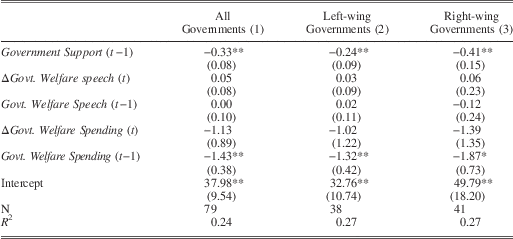
Table 2 reports our parameter estimates (with panel-corrected standard errors in parentheses)Footnote 62 for the model given by Equation 1 above, estimated over all governments (Column 1), over left-wing governments (Column 2) and over right-wing governments (Column 3), where the dependent variable, [ΔGovernment Support (t)], is the percentage change in the government’s support over the past year.
Analyses of How Social Welfare Rhetoric and Spending Affect Government Support

Note: panel-corrected standard errors in parentheses. For these analyses, the dependent variable, [ΔGovernment Support (t)], is the change in the government’s support in the current year compared to the previous year. The independent variables are defined in the text. ** p≤0.01, * p≤0.05, two-tailed tests
Before turning to effects pertaining to social welfare rhetoric and spending, note that the coefficient on the variable [Government Support (t−1)] is negative and significant in all three sets of analyses, while the coefficient on the intercept is positive and significant, which implies a ‘regression to the mean’ in government support; that is, when government support was unusually high (low) during the previous time period, then support tended to subsequently decline (increase) in the current period.Footnote 63 This pattern is found in various social settings and may reflect ceiling/floor effects or underlying dynamic processes.Footnote 64 The ceiling/floor effect is that aggregate government support is bounded by the values 0 per cent and 100 per cent, so that when lagged government support was unusually low (high), it has more room to grow (decline) in the current period. The dynamic process is that when a government’s lagged support was unusually low (high), this may reflect the effects of short-term factors such as political scandals or the government’s handling of crisis situations, which tend to recede over time.
We now consider the social welfare rhetoric and spending effects that interest us. If government support responds to social welfare rhetoric, we would expect significant coefficient estimates on either (or both) of the variables [ΔGovt. Welfare Speech (t)] and [Govt. Welfare Speech (t−1)]. However, the estimates on both variables are near zero and statistically insignificant in all three sets of analyses (those over all governments, over left-wing governments and over right-wing governments). These estimates support our No Rhetorical Effects Hypothesis that government support does not respond to governments’ social welfare rhetoric. Indeed, the coefficient estimates on these variables, in combination with their standard errors, imply that we can rule out – at conventional levels of statistical significance – the hypothesis that social welfare rhetoric exerts substantively significant effects on government support.
The coefficient estimate on the [Govt. Welfare Speech (t−1)] variable is exactly zero in the analyses that include all governments (see Column 1 of Table 2), and the 95 per cent confidence interval on this estimate is [−0.19, +0.19]. The value +0.19 would imply that, ceteris paribus, an 8 per cent increase in the lagged proportion of the government’s executive speech pertaining to social welfare domains (a one-standard deviation change in the observed values of this variable) increases the predicted value of the dependent variable, [ΔGovernment Support (t)], by only about 1.5 percentage points (that is, [8 per cent×0.19]=1.52 per cent). Conversely, the lower bound on the 95 per cent confidence interval for the [Govt. Welfare Speech (t−1)] coefficient, −0.19, would imply that an 8 per cent increase in the lagged proportion of the government’s social welfare speech depresses predicted government support by about 1.5 percentage points. Thus even if the true effects of social welfare rhetoric lie at one of the boundaries of the 95 per cent confidence interval on our parameter estimate, this rhetoric only modestly affects government support.Footnote 65
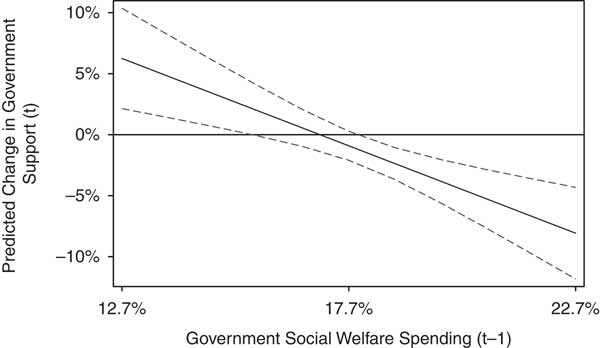
By contrast, our estimates imply that increased social welfare spending depresses government support, in that the coefficient estimate on the variable [Govt. Welfare Spending (t−1)] is negative and statistically significant, denoting that the higher the government’s lagged social welfare spending, the more government support declines in the current time period; that is, the public punishes governments for higher levels of social welfare spending. The coefficient estimate that includes all governments, −1.43 (p<0.01), implies that the difference between a lagged social welfare spending level of 17.6 per cent of GDP (the mean for the governments in our dataset) and a lagged social welfare spending of 20.3 per cent of GDP (one standard deviation above the mean) depresses expected government support by roughly 3.8 percentage points in the current time period, which is a substantively significant effect.Footnote 66 The parameters on the [Govt. Welfare Spending (t−1)] variable estimated over left-wing governments (−1.32, p<0.01) and right-wing governments (−1.87, p<0.05) are similar, suggesting that social welfare spending depresses support for both types of governments.Footnote 67
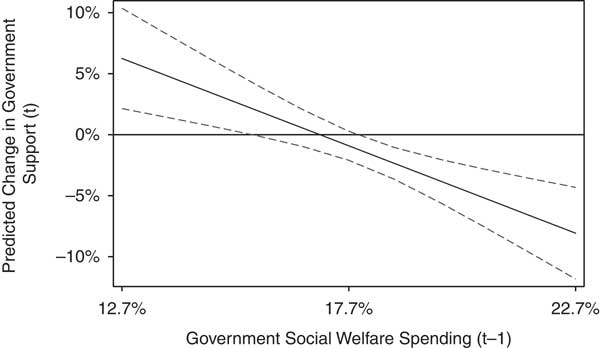
Figure 3 displays the effects of lagged government social welfare spending (the horizontal axis) on predicted changes in government support (the vertical axis), based on the coefficient estimates that include all governments (Column 1 in Table 2 above). The effects are displayed as a solid line with dashed 95 per cent confidence intervals, over the full range of values of the [Govt. Welfare Spending (t−1)] variable in our dataset. (These estimates are calculated while holding all other independent variables at their mean values.) The figure illustrates, first, that governing parties are projected to lose support in the current year – compared to the previous year – for levels of lagged social welfare spending above 17.1 per cent of GDP, and that this projected loss is statistically significant when lagged social welfare spending is above 18 per cent of GDP (which is at the 50th percentile of the values in our dataset) – projections that substantiate the well-known costs of governing effect. Secondly, the figure illustrates how higher lagged social welfare spending substantially exacerbates these projected vote losses, while lower levels of lagged spending mitigate these losses. Indeed, when lagged social welfare spending falls below 15.7 per cent of GDP, governments enjoy statistically significant projected vote gains.
Effects of lagged social welfare spending on government support changes Note: the figure displays the predicted effect of the [Government Welfare Spending (t−1)] variable on the [ΔGovernment Support (t)] variable, computed for the coefficient estimates reported in Column 1 of Table 2. The dashed lines denote 95 per cent confidence intervals.
Finally, we also estimate negative – albeit statistically insignificant – coefficients on the change in social welfare spending variable, [ΔGovt. Welfare Spending (t)], in all three sets of analyses (those on all governments, on left-wing governments, and on right-wing governments). These negative coefficients are consistent with our conclusion that voters punish governments for higher social welfare spending. That the coefficient estimates on the [ΔGovt. Welfare Spending (t)] variable are insignificant may reflect the modest variation in the values of the [ΔGovt. Welfare Spending (t)] variable in our dataset (see Table 1 above); governments’ social welfare spending changes are typically incremental, which inflates the standard errors on these parameter estimates.
Robustness Checks
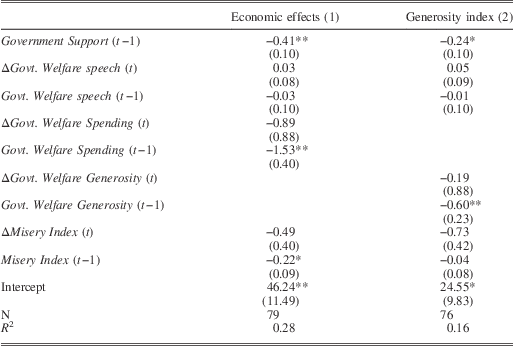
We estimated the parameters of additional models in order to assess the robustness of our findings.Footnote 68 First, we estimated the parameters of an economic effects model, which controls for national levels of unemployment and inflation by including a misery index that sums these two variables, along with the yearly change in this index.Footnote 69 An extensive literature documents that voters hold governing parties accountable for economic conditions,Footnote 70 particularly in single-party governments such as those in Britain and Spain during our study period,Footnote 71 so we expect that higher levels of unemployment and inflation – along with short-term increases in these factors – will depress government support. Column 1 in Table 3 reports our parameter estimates for the economic effects model, estimated over all governments, which continue to support our substantive conclusions. (We report the separate analyses on left- and right-wing governments, which support the same substantive conclusions, in Appendix Table S1.) Our estimates again support our No Rhetorical Effects Hypothesis: the parameter estimates on the [ΔGovt. Welfare Speech (t)] and [Govt. Welfare Speech (t−1)] variables are near zero and statistically insignificant. Our parameter estimates again imply that higher lagged social welfare spending depresses support: the estimate on the [Govt. Welfare Spending (t−1)] variable is negative and statistically significant (p<0.01). Furthermore, our parameter estimates on the misery index imply that the public punishes governments for increases in unemployment and inflation, since the estimate on the lagged misery index is negative and significant (−0.22, p<0.05).
Analyses of Government Support: Robustness Checks

Note: panel-corrected standard errors in parentheses. For these analyses, the dependent variable, [ΔGovernment Support (t)], was the change in the government’s support in the current year compared to the previous year. The independent variables are defined in the text. ** p≤0.01, * p≤0.05, two-tailed tests
Next, we analyzed a model that includes an alternative indicator of government social welfare policy, the social welfare generosity index, which measures the generosity of government social insurance benefits including unemployment insurance, sick pay insurance and public pensions.Footnote 72 The generosity index, which is widely used in comparative studies of social welfare policy,Footnote 73 is arguably a more relevant measure of government policy than the level of social welfare spending, since the latter is influenced by factors such as the unemployment rate and the population of pensioners, which can cause overall government spending to vary even if the underlying social welfare policies are stable. Column 2 in Table 3 reports our parameter estimates for the generosity index model, estimated over all governments, which continue to support our substantive conclusions.Footnote 74 (We report separate analyses on left- and right-wing governments in Appendix Table S2.) We again find support for the No Rhetorical Effects Hypothesis, because the parameter estimates on government speech are near zero and statistically insignificant. Our parameter estimates again substantiate that higher lagged levels of social welfare generosity depress support: the estimate on the [Govt. Welfare Generosity (t−1)] variable is negative and statistically significant (p<0.01).
Finally, we performed additional analyses to assess the robustness of our findings. First, we re-estimated our models while including controls designed to evaluate whether governing parties were punished when their social welfare spending did not match their (lagged) social welfare rhetoric. Secondly, we estimated models that included additional lags for government spending and speech. Thirdly, in response to previous research suggesting that government support varies based on the electoral cycle,Footnote 75 we included controls for the length of time until the next election. Fourthly, we estimated models that included separate controls for unemployment and inflation in order to parse out different effects of these economic variables. Finally, to investigate the possibility that causal processes differ across countries – in particular that there are differences in the US presidential system versus the British and Spanish parliamentary systems – we re-estimated our modes while omitting one country at a time from our analyses. These analyses, which we report in supplementary materials posted on our website, continue to support our substantive conclusions.
In toto, our results consistently suggest that voters punish governments for higher levels of social welfare spending, and that these effects are both statistically and substantively significant. This conclusion extends to separate analyses of left- and right-wing governments, and to analyses that control for economic conditions and for alternative measures of governments’ social welfare spending policies (as well as the additional robustness checks summarized above). We find no evidence that government support is affected by the government’s social welfare rhetoric, and indeed our analyses allow us to rule out – at conventional levels of statistical significance – the hypothesis that welfare rhetoric substantively affects levels of government support. The finding that the public does not respond to governing parties’ stated issue emphases extends Fernandez-Vazquez’s finding that citizens do not meaningfully update their perceptions of party ideologies in response to parties’ stated issue positions.Footnote 76
CONCLUSION AND DISCUSSION
The question of whether citizens evaluate governments based on their words or their deeds has normative and empirical implications. The normative question is whether citizens should prioritize political actors’ actions over their rhetoric. The empirical question is: Do citizens prioritize actors’ concrete behavior over their rhetoric? We address the latter question here, in the context of the mass public’s evaluations of the government’s social welfare rhetoric and spending. To our knowledge, ours is the first study to evaluate how citizens jointly respond to governments’ words and deeds.
We have presented theoretical arguments that the public will not respond to government rhetoric – the No Rhetorical Effects Hypothesis – first because citizens recognize that political actors are motivated to broadcast publicly appealing ‘cheap talk’ regardless of their true policy intentions, and secondly because in the case of governing parties (but not opposition parties), citizens can evaluate the government’s concrete actions, which speak louder than their words. However, with respect to the government actions we study here – namely social welfare spending – we believe theory provides limited guidance on how the public will respond (positively or negatively), because theoretical arguments point in conflicting directions. This issue is important because social welfare is a major component of government budgets in all Western democracies, and is a core competency domain of center-left political parties.
Our empirical analyses of governments’ social welfare rhetoric from Britain, Spain and the United States support our No Rhetorical Effects Hypothesis: we find no evidence that levels of government support respond to governments’ social welfare emphases, as broadcast in their executive speeches. Executive speeches are costly signals because governments face negative public reactions if they renege on the priorities they outline in this speech, so we might expect that if citizens weigh any government communication, it would be the executive speech. Moreover, previous research documents that executive speeches reflect the issues governments emphasize in other public venues.Footnote 77 Yet we find no relationship between the governments’ social welfare emphases in these speeches and their public support. Our findings on the (non)effects of governments’ issue emphases extend the research of Fernandez-Vazquez and Adams et al., who find that citizens do not meaningfully respond to parties’ stated issue positions.Footnote 78
Our empirical analyses also uncover – for both left- and right-wing governments – a consistent negative relationship between social welfare spending and government support. We find that public support declines when the government spent more on social welfare programs during the previous time period; that is, governments suffer a social welfare spending penalty. This finding implies a dilemma for mainstream labor and social democratic parties in government: these parties risk short-term losses in support if they raise social welfare spending, yet cutting welfare spending plausibly violates leftist politicians’ bedrock principles, and weakens their long-term relationships with their core supporters. In this regard, research by Karreth et al. documents that social democratic parties that pursued a ‘third way’ strategy of scaling back their emphasis on the welfare state (while embracing free-market economics) initially increased their support, but suffered longer-term reverses as their core supporters subsequently deserted them.Footnote 79 These findings are consistent with the effects we identify.
We believe our finding that the mass public evaluates governments based on their deeds, rather than their words, has positive implications for representative democracy. This voter decision rule appears to be normatively desirable, first because government actions arguably constitute ‘revealed preferences’ that speak louder than their words, and secondly because it implies that governments have a limited ability to distract citizens from unpopular policies via clever public rhetoric. Government accountability is arguably maximized when the public holds the government accountable for its actions. We find that in the social welfare domain, the public fulfills this desideratum.
Our study comes with caveats that also raise questions for future research. First, our failure to detect a relationship between governments’ social welfare rhetoric and public support does not prove that no such relationship exists: an absence of evidence does not constitute evidence of absence. In future research we plan to extend our empirical analyses to other countries and time periods as additional CAP executive speech codings are released. Such extensions may yet uncover positive evidence that the public responds to government rhetoric. At the same time, we have outlined theoretical arguments that cast doubt on whether citizens will respond to the government’s words, given that the public can alternatively react to the government’s concrete actions. Moreover, our analyses allow us to rule out, at conventional levels of statistical significance, the proposition that realistic changes in social welfare rhetoric exert substantively meaningful effects on government support.
Secondly, the lack of evidence that aggregate public support responds to governments’ social welfare rhetoric does not rule out individual-level effects. To the extent that some citizens respond positively – but others negatively – to social welfare rhetoric, these individual-level effects may roughly cancel each other out. In future research we plan to analyze whether citizens’ reactions to governments’ social welfare rhetoric/spending are mediated by individual traits such as citizens’ issue priorities, socio-demographic characteristics and policy beliefs. In particular, citizens holding leftist social welfare views plausibly react much more positively to pro-welfare rhetoric/spending than do those on the right. However, we believe our aggregate-level findings matter regardless of these individual-level processes, because governments are plausibly more concerned with how their behavior affects their aggregate support than with the breakdowns across different subconstituencies. Finally, as we noted in the introduction, we hope to extend our analyses to issues such as the environment, multiculturalism and European integration, where government action is not defined primarily in terms of spending levels, and also to the issue areas ‘owned’ by the mainstream right, notably crime and defense. We also hope to extend our study to other countries where government responsibility is less clear than in the cases of Britain, Spain and the United States as additional data on government speeches and popularity become available. Such analyses might also clarify the relationship between public support and governments’ social welfare/rhetoric across varieties of economic and social welfare regimes.
Thirdly, the countries and time periods we analyze do not include instances of the types of savage social welfare spending cuts that governments in Greece, Ireland, Portugal and – after our study period – Spain enacted in response to the eurozone economic crisis that began in 2008–2009. We have analyzed a set of countries (Britain, Spain and the United States) during periods of (mostly) ‘normal’ government budgets, when yearly changes in social welfare spending were typically incremental, and when national governments were not constrained to slash spending to conform to the terms of international financial assistance packages, as occurred in Greece, Ireland and (eventually) Spain. We make no claims that our findings extend to these types of extraordinary economic and political contexts. At the same time, we believe the collapse in domestic support for some European governments that slashed social welfare spending after 2009 does not contradict our conclusion that welfare spending cuts enhance government support, first because in several cases the government’s support collapsed before it slashed welfare spending but after the national economy contracted, suggesting that support collapsed largely due to the severe economic downturn, rather than government budgets. Secondly, as discussed above, the recent social welfare cuts in Greece, Portugal and elsewhere were qualitatively different to those we analyze in our study, not only in their severity but because these governments were perceived as acting under pressure from international creditors, which weakened these governments’ public images for independence and leadership ability.
Finally, our conclusion that support does not respond to government rhetoric does not necessarily imply that citizens similarly discount opposition party rhetoric. Whereas citizens may privilege the government’s deeds over its words, they may weigh the opposition’s rhetoric because they feel they have no practical alternative: opposition parties often have no meaningful influence on government policy outputs, so citizens may fall back on their words instead.
In this article we have analyzed how government support in Britain, Spain and the United States responds to the government’s social welfare rhetoric and social welfare spending. We find that government support is not meaningfully related to its rhetoric, but that governments that spend more on social welfare programs see their support decline, regardless of whether they are left or right leaning. This ‘social welfare spending penalty’ poses strategic problems for left-wing governing parties, whose long-term policy images – and linkages with core supporters – are tied to their associations with the welfare state.
Appendix
Government support
Spain: Vote intentions from CIS Barometer
United Kingdom: Vote intentions from WJFFP datasetFootnote 80
United States: Gallup US President Approval (‘Do you approve or disapprove of the way [the President] is handling his job as President?’) from the Policy Agendas Project website
Social welfare spending
OECD Social Expenditure Database
Social welfare generosity index
Data downloaded from the Comparative Welfare Entitlements Data Set 2, Version 2014‐03. Available from http://cwed2.org/ Footnote 81
Social welfare rhetoric
Spain: Executive speeches from the Spanish Policy Agendas Project (Chaqués Bonafont, et al. Reference Chaqués Bonafont, Palau and Muñoz Marquez2014)
United Kingdom: Executive speeches from the UK Policy Agendas ProjectFootnote 82
United States: Executive speeches from the Policy Agendas Project. The data used here were originally collected by Frank R. Baumgartner and Bryan D. Jones, with the support of National Science Foundation grant numbers SBR 9320922 and 0111611, and were distributed through the Department of Government at the University of Texas at Austin. Neither NSF nor the original collectors of the data bear any responsibility for the analysis reported here.
Economic indicators
Unemployment rate as percentage of civilian labor force (OECD)
Inflation as consumer prices as percentage change on the same period of the previous year (OECD)