Introduction
The alteration of the meat may be a consequence of microbe growth or of lipid and pigment oxidation and depends on multiple factors, the most noteworthy being the systems of conservation used and the level of antioxidants present in the meat. Lamb meat is progressively being presented to the consumer packed in modified atmospheres (MAP), usually composed of high proportions of carbon dioxide (30% to 20%) and oxygen (70% to 80%). The high proportions of carbon dioxide reduce the growth of meat-quality altering bacteria (Nissen et al., Reference Nissen, Sørheim and Dainty1996). In turn, the high proportion of oxygen enables improved oxygenation of meat pigments and favours the appearance of oxymyoglobin. This increase in oxymyoglobin enhances the red colouring of the meat, which is related to increased consumer acceptance (O'Grady et al., Reference O’Grady, Monahan, Burke and Allen2000). However, the high concentrations of oxygen favour oxidation processes, the main cause of the alteration of the meat conserved in MAP (Ordóñez, Reference Ordóñez1998). In addition, the Spanish system of production is characterised by fattening the animals up to low slaughter weights by feeding them with fodder, which produces meat with low concentrations of antioxidants. Thus, the use of MAP packing should consider the use of antioxidants. Among natural antioxidants, vitamin E, and within the isomers comprising the latter, α-tocopherol is biologically the most active antioxidant (Kamal-Eldin and Appelqvist, Reference Kamal-Eldin and Appelqvist1996). The increase in α-tocopherol concentration in meat can be achieved through vitamin E supplementation in the animals’ diet at higher levels than the nutritional requirements of ruminants proposed by the National Research Council (15 to 40 mg/kg feed) (NRC, 1985). However, vitamin E supplementation may entail substantial financial investment. Thus, it is important to put forward a concentration of α-tocopherol adequate enough to improve the conservation of lamb meat during MAP conservation. The objective of this study was to obtain lamb meat with increasing concentrations of α-tocopherol, through supplementation with vitamin E, and to establish the minimum concentration required for oxidation processes during MAP conservation to be efficiently reduced.
Material and methods
Experimental animals and dietary treatments
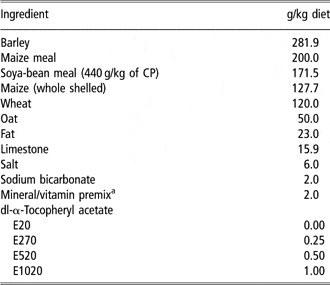
In order to achieve lamb meat with different concentrations of α-tocopherol, 36 male lambs of the Manchego breed were randomly assigned to four dietary treatments (nine lambs per treatment). The control group (E20) received a basal diet (Table 1), with the amount of vitamin E recommended by the National Research Council as minimum requirements, containing 20 mg vitamin E/kg feed. The vitamin E-supplemented groups received the basal diets plus either 250 (E270), 500 (E520) or 1000 (E1020) mg vitamin E/kg feed. Vitamin E (dl-α-tocopheryl acetate) was provided as a premix (Roche Vitamins Europe, Basle, Switzerland) and was included in the feed during the manufacturing process.
Composition of experimental diets (E20, E270, E520, E1020)

aVitamins and minerals provided per kg of diet: retinol 10 000 IU; cholecalciferol 3000 IU; α-tocopherol 20 mg; thiamine 1 mg; riboflavin 1 mg; Mn 30 mg; Zn 50 mg; I 0.5 mg; Fe 50 mg; Co 0.5 mg; Se 0.15 mg; Mg 25 mg; S 22 mg.
Nutritional value of the experimental diet as outlined in Lauzurica et al. (Reference Lauzurica, De la Fuente, Díaz, Álvarez, Pérez and Cañeque2005).
The lambs were housed in individual pens (1 m2). Feed, water and barley straw were offered ad libitum. The fattening period included from an initial weight of 13 kg to a slaughter weight of 26 kg. Animals were slaughtered at a local slaughterhouse. Carcasses were chilled for 24 h at 4°C and then Longissimus dorsi (LD) muscles were dissected from the left and right side of each carcass. Left LD was vacuum-packed in metallic pouches (PET/MET120 Sacoliva, Spain) of low O2 permeability (<1.5 cm3/m2 per 24 h O2 permeability) and frozen at −20°C until the concentration of α-tocopherol was measured. In every case, α-tocopherol analysis was performed within 2 weeks of freezing. The right LD was cut into three pieces and randomly distributed for 14, 21 or 28 days of storage. The pieces were packed in MAP in polyamide/polyethylene pouches (PA/PE 150 μm, Sacoliva, Spain) of low gas permeability (7 cm3/m2 per 24 h O2 at 4°C and 80% relative humidity (RH), 150 cm3/m2 per 24 h CO2 at 23°C and 75% RH) using a packing machine (EV-15-1-CD-SC Tecnotrip, Spain) and a mixture of 70% O2 and 30% CO2 (MAP) (EAP 20, Carburos Metalicos, Spain). All packages were stored in darkness at 4 ± 1°C.
Determination of α-tocopherol
α-Tocopherol concentration was determined in left LD. Samples were thawed and analysed in duplicate. α-Tocopherol was extracted according to the method of Liu et al. (Reference Liu, Scheller, Arp, Schaefer and Williams1996) with some of the modifications proposed by Cayuela et al. (Reference Cayuela, Garrido, Bañón and Ros2003) and quantified by high-performance liquid chromatography (HPLC). The HPLC system was composed of a model 114-M pump (Beckman Coulter, Spain), a manual injector, a System Gold® interface, a fluorescence detector FP1520 (Jasco, Spain), a Kromasil Silica 150 × 4.6 (5 μm) column KR100-5-150 (Symta, Spain) and a Kromasil Silica guard column (10 μm) KR100-10-10C5 (Symta, Spain). The eluting solvent was isooctane–tetrahydrofuran (90 : 10), at a flow rate of 1 ml/min. Detection was achieved at λem 297 nm and λex 321 nm. α-Tocopherol isomer was quantified, and the dl-α-tocopherol standard was used for calibration (Sigma-Aldrich Chemical, Madrid, Spain). Results were expressed as mg α-tocopherol/kg meat.
Determination of metmyoglobin proportion and lipid oxidation
At 14, 21 and 28 days of MAP storage, pouches were opened and metmyoglobin proportion and lipid oxidation were analysed.
The proportion of metmyoglobin (MetMb) of the pieces was measured at the surface as described by Krzywicki (Reference Krzywicki1979) with the Minolta CM-2600d spectrophotometer (Aquateknica, Spain). A D65 illuminant and a 10° standard observer were used. After metmyoglobin proportions were determined, samples were vacuum-packaged in metallic pouches (PET/MET120 Sacoliva, S.L, Barcelona, Spain) and frozen at −20°C until lipid oxidation analysis. In every case, lipid oxidation analysis was performed within 2 weeks of freezing. Lipid oxidation was assessed by thiobarbituric reactive substances (TBARS) using the 2-thiobarbituric acid method of Maraschiello et al. (Reference Maraschiello, Sarraga and García Regueiro1999). The malonaldehyde acid (MDA) standard, obtained from hydrolysis of the compound 1,1,3,3-tetraethoxypropane (Sigma-Aldrich Chemical), was used for calibration. Duplicate samples were used and the results were expressed in mg of MDA/kg meat.
Statistical analysis
All statistical analyses were performed using the SAS statistical software (Version 8.01) (SAS, 1996).
Pearson correlation coefficients between vitamin E supplementation and α-tocopherol concentration were calculated using the correlation procedure (PROC CORR).
A two-slope broken-line regression analysis (Robbins, Reference Robbins1986) was performed to estimate an inflection point for the dietary vitamin E supplementation and α-tocopherol concentration using the non-linear regression procedure (PROC NLIN). A two-slope broken-line model consists of two straight lines with an increasing or decreasing non-zero slope. Their point of inflection or intersection is the breakpoint. The lines are fitted by the method of fewest squares. The general model is

where L is the ordinate and B the abscissa of the inflection in the curve. U is the slope of the line for X < B, and V is the slope of the line at X > B. Thus, (B − X) is zero for values of X greater than B, and (X − B) is zero for values of X less than B. The dietary vitamin E supplementation (B) at which the breakpoint is achieved is estimated as the level of optimum efficiency of the concentration of α-tocopherol in meat.
Moreover, Pearson correlation coefficients and two-slope broken-line regression analyses were performed in order to estimate the breakpoints where the concentration of α-tocopherol in meat is most efficient at delaying lipid and pigment oxidation.
Results and discussion
Fattening period
The fattening period lasted an average of 37 ± 1.5 days, from an initial weight of 13.2 ± 0.5 kg to a slaughter weight of 26.2 ± 0.3 kg. The average total feed intake per animal did not differ between treatments and it was 31.2 ± 1.5 kg. Total vitamin E consumption averaged 0.6 ± 0.2 g, 8.5 ± 0.9 g, 16.4 ± 1.2 g and 31.6 ± 1.9 g α-tocopherol for E20, E270, E520 and E1020, respectively.
Dietary vitamin E supplementation and α-tocopherol concentration
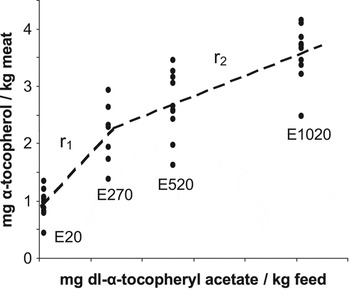
Supplementation of the diet with vitamin E increased the concentration of α-tocopherol in the meat (P < 0.001). Thus, average concentrations of 0.95 ± 0.10 mg α-tocopherol/kg meat in E20, 2.17 ± 0.13 mg/kg in E270, 2.68 ± 0.12 mg/kg in E520 and 3.56 ± 0.10 mg/kg in E1020 were obtained, encompassing a range of 0.46 to 4.14 mg α-tocopherol/kg meat (Figure 1).
Broken-line regression analysis to describe the response of α-tocopherol concentration in left Longissimus dorsi (y) to dietary vitamin E supplementation (x) (E20, E270, E520 and E1020). Broken-line model: r 1: y = 0.85 + 0.0049 × if × < breakpoint; r 2: y = 1.75 + 0.0018 × if × > breakpoint; breakpoint = 287.1 mg dl-α-tocopheryl acetate/kg feed that corresponded with 2.26 mg α-tocopherol/kg meat (R 2 = 0.970; RSD = 0.481).

The increase of α-tocopherol concentration in tissues occurring with dietary supplementation had been reported in previous studies on lambs (Wulf et al., Reference Wulf, Morgan, Sanders, Tatum, Smith and Williams1995; Guidera et al., Reference Guidera, Kerry, Buckley, Lynch and Morrissey1997; Strohecker et al., Reference Strohecker, Faustman, Furr, Hoagland and Williams1997; Lopez Bote et al., Reference Lopez Bote, Daza, Soares and Berges2001). One of the factors influencing the amount of concentration of α-tocopherol through supplementation is supplementation time. In general, the greater the amount of vitamin E fed and/or the longer the supplementation match up with, the higher the meat concentration of α-tocopherol (Arnold et al., Reference Arnold, Scheller, Arp, Williams and Schaefer1993). Thus, allowance must be made for the fact that the traditional system of lamb production in Spain reduces the fattening periods to slaughter weights close to 26 kg in order to obtain lightweight carcasses. The results of this study show that even short supplementation periods of 37 days make it possible to increase the amount of α-tocopherol concentration in the meat through dietary supplementation with the levels studied.
The correlation coefficient between dietary supplementation with vitamin E and the concentration of α-tocopherol in meat had a value of 0.861 (P < 0.001). The increase in α-tocopherol concentration is more marked up to a certain level of dietary vitamin E supplementation (breakpoint), the point at which a change of slope occurs and the increases in concentration are reduced with each unit of increase in supplementation (Figure 1). The breakpoint corresponds to the breakpoint between two straight lines (r 1 and r 2), which indicate the existing slopes. Through broken-line regression analysis the two-slope broken-line model and the breakpoint were obtained. The breakpoint was 287 mg vitamin E/kg feed (P < 0.001), which is very close to the E270 level of supplementation. This supplementation allowed a concentration of 2.26 mg α-tocopherol/kg meat. From the economic point of view, the profitable thing to do would be to supplement up to the levels that show the maximum efficiency in deposition, in this case, up to 287 mg vitamin E/kg feed. This indicates that the concentration of 2.26 mg α-tocopherol/kg meat would be the maximum concentration obtained most efficiently. Broken-line regression analysis has been used satisfactorily to estimate the requirements of nutrients in some species such as lysine in pigs (Coma et al., Reference Coma, Carrion and Zimmerman1995), isoleucine in pigs (Robbins et al., Reference Robbins, Saxton and Southern2006) and vitamin E in fish (Shiau and Shiau, Reference Shiau and Shiau2001; Lin and Shiau, Reference Lin and Shiau2005). The only reference found concerning the application of broken-line regression analysis to determine the optimum dietary supplementation of vitamin E in lambs was in Lopez Bote et al. (Reference Lopez Bote, Daza, Soares and Berges2001). These authors reported 524 mg vitamin E/kg feed as the target vitamin E level to optimise α-tocopherol concentration in lamb, corresponding to a meat concentration of 5.2 mg α-tocopherol/kg meat. Concentrations estimated from this study are higher than our results. However, α-tocopherol concentrations in non-supplemented animals (2 mg α-tocopherol/kg meat) were higher than ours (0.95 mg α-tocopherol/kg meat). The discrepancy between the two results and the lack of more bibliographical data in this regard indicate the need to extend the study in order to establish a recommended level of vitamin E supplementation to efficiently increase α-tocopherol concentration in lamb.
Pigment and lipid oxidation
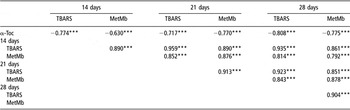
High correlation coefficients between the concentration of α-tocopherol and the values of MetMb or TBARS at 14, 21 and 28 days of conservation were found (Table 2).
Coefficients of correlation between the concentration of α-tocopherol and the oxidative stability measured as TBARS and MetMb at 14, 21 and 28 days in MAP storage

α-Toc = concentration of α-tocopherol (mg/kg meat); TBARS = thiobarbituric reactive substances (mg MDA/kg meat); MetMb = proportion of metmyoglobin; MAP = modified atmospheres.
***P < 0.001.
In both cases and for the three conservation times, the sign of the correlation coefficients was negative, which shows that increases in concentration of α-tocopherol were related to lower values of MetMb and TBARS in the meat after its storage. Previous studies have shown that lipid and pigment oxidations are promoted in meat packed in a high-oxygen MAP. Kerry et al. (Reference Kerry, O’Sullivan, Buckley, Lynch and Morrissey2000) reported higher TBARS values and metmyoglobin proportions for meat storage in high-oxygen MAPs compared with other aerobically refrigerated atmospheres. When vitamin E is supplemented above normal recommendations, a reduction in lipid and pigment oxidation during storage has been observed. Lopez Bote et al. (Reference Lopez Bote, Daza, Soares and Berges2001) reported that, for meat under aerobically refrigerated conditions of darkness for a period of 9 days, the TBARS value was 3.1, 2.3, 1.3 or 0.5 mg MDA/kg meat for lambs with 2.0, 3.6, 5.2 or 6.9 mg α-tocopherol/kg meat, respectively. Gatellier et al. (Reference Gatellier, Hamelin, Durand and Renerre2001) reported in beef that lipid oxidation was significantly lower in the vitamin E-enriched meat (5.8 mg α-tocopherol/kg meat) compared to control (3.9 mg α-tocopherol/kg meat) after 13 days of MAP storage.
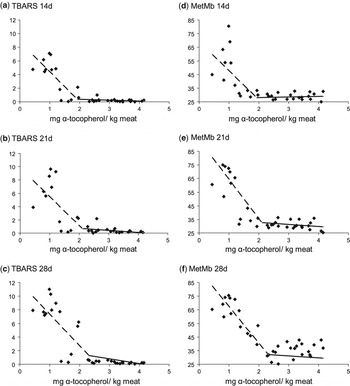
If we represent the values of TBARS and of MetMb at each conservation time in relation to the concentration of α-tocopherol (Figure 2), it may be observed that, in all cases, there is a concentration of α-tocopherol (breakpoint) above which the reduction of the values of TBARS and MetMb is less accentuated.
TBARS (mg malonaldehyde acid/kg meat) and MetMb (%) values in the meat conserved in modified atmospheres, according to concentration of α-tocopherol and broken-line models (see Table 3).

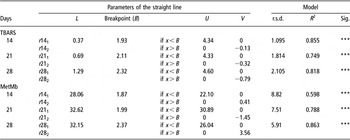
Through broken-line regression analysis, the two-slope broken-line model was obtained for each storage time and for each parameter. Figure 2 shows the broken-line models and Table 3 shows the values of the breakpoints (B) and of the parameters studied corresponding to these breakpoints (L). Lipid oxidation was reduced efficiently at TBARS values of 0.37 mg MDA/kg meat with concentrations of up to 1.93 mg α-tocopherol/kg meat for meat conserved for 14 days (Figure 2a), at values of 0.9 mg MDA/kg meat with concentrations of up to 2.11 mg α-tocopherol/kg meat during 21 days (Figure 2b) and values of 1.29 mg MDA/kg meat with concentrations of up to 2.32 mg α-tocopherol/kg meat during 28 days (Figure 2c). Pigment oxidation was efficiently reduced to proportions of 28.06% MetMb with concentrations of up to 1.87 mg α-tocopherol/kg meat during 14 days of conservation (Figure 2d), at proportions of 32.62% with concentrations of up to 1.99 mg α-tocopherol/kg meat during 21 days (Figure 2e), and at proportions of 32.15% with concentrations up to 2.37 mg α-tocopherol/kg meat during 28 days (Figure 2f). Thus, the value of the breakpoint for TBARS and for MetMb at 14 and 21 days was less than the concentration calculated previously as the maximum concentration, which would be obtained efficiently (2.26 mg α-tocopherol/kg meat) with the levels of supplementation used in this study. Only regarding conservation during 28 days did the value of the breakpoint slightly exceed this concentration, reaching values of 2.37 and 2.32 mg α-tocopherol/kg meat for TBARS and MetMb, respectively. It was observed that the effectiveness of protection against lipid and pigment oxidation was very similar and this is demonstrated by the high correlation coefficients obtained between both parameters at each conservation time studied (Table 2). Lee et al. (Reference Lee, Kannan, Eega, Kouakou and Getz2008), when compared TBARS ant MetMb between lambs and goats finishing under identical dietary regime, observed that no differences in lipid oxidation levels were correlated with no differences in MetMb.
Parameters of the broken-line models for TBARS and MetMb in MAP conserved meat, according to concentration of α-tocopherol

TBARS = thiobarbituric reactive substances (mg MDA/kg meat); MetMb = metmyoglobin (%); MAP = modified atmospheres; Broken-line model = y = L + U (B − x) + V (x − B); L = Ordered from the breakpoint of the slope (TBARS or MetMb value); B (breakpoint) = Abscissa of the breakpoint of the slope (mg α-tocopherol/kg meat); U = Slope previous to the breakpoint of the slope; r.s.d. = residual standard deviation; R 2 = Determination coefficient; Sig. = Significance of the model.
***P < 0.001.
TBARS are used as a marker for development of rancid off-flavors in meat. Greene and Cumuze (Reference Greene and Cumuze1982) related lipid oxidation in beef meat, quantified through TBARS values, to the appearance of rancid flavours in the meat through sensorial evaluation by inexperienced panellists, and they established that, up to values of 2 mg MDA/kg meat, this meat was accepted. In our study, values of 8 to 12 mg MDA/kg meat were observed at 14, 21 and 28 days in the samples with least concentration of α-tocopherol, while the TBARS values that corresponded to the breakpoints at each conservation time (Figures 2a–c) did not exceed the value of 1.29 mg MDA/kg meat. Thus, the concentrations of α-tocopherol at the breakpoints were shown to be efficient regarding reducing lipid oxidation and maintaining the meat within the values proposed by Greene and Cumuze (Reference Greene and Cumuze1982) as acceptable to the consumer for up to 28 days of MAP conservation. When trained sensory panels were used (Lanari et al., Reference Lanari, Schaefer and Scheller1995), the borderline level for detection of off-flavour in pork was 0.5 mg MDA/kg meat. In this case, only breakpoint at 14 days of storage was under this limit for trained panellists.
Greene et al. (Reference Greene, Hsin and Zipser1971) reported that consumers use colour as an indicator of meat freshness and will make a no-purchase decision when brown metmyoglobin reaches 40%, as a change in redness is directly related to the oxidation of myoglobin to metmyoglobin. In our study, although values of 75% to 85% of MetMb were observed at 14, 21 and 28 days in the samples with lower concentrations of α-tocopherol, the values of MetMb that corresponded to the breakpoints in each conservation time (Figures 2d–f) did not exceed the value of 33%. Therefore, the concentrations of α-tocopherol at the breakpoints were shown to be efficient in terms of reducing pigment oxidisation and keeping the meat within the values proposed by Greene et al. (Reference Greene, Hsin and Zipser1971) as acceptable to the consumer. Therefore, according to our results, Berruga et al. (Reference Berruga, Vergara and Gallego2005) studied acceptability of colour on lamb meat packaged on 80% CO2/20% O2 with sensory evaluation and concluded that 92%, 84% and 78% of packs considered acceptable at 14, 21 and 28 days of storage, respectively.
Our results show that the target α-tocopherol concentration in lamb for optimum improvement against lipid and pigment oxidation during 14, 21 and 28 days of storage in high-oxygen atmospheres was in the range 1.87 to 2.37 mg/kg meat. Faustman et al. (Reference Faustman, Cassens, Schaefer, Buege and Scheller1989) and Arnold et al. (Reference Arnold, Scheller, Arp, Williams and Schaefer1993) reported that the target α-tocopherol concentration in beef meat for optimum protection against lipid and pigment oxidation during 7 days of aerobically refrigerated storage was approximately in the range 3.0 to 3.5 mg/kg meat. Lopez Bote et al. (Reference Lopez Bote, Daza, Soares and Berges2001) reported in lamb that the optimum α-tocopherol concentration for improved lipid and colour stability during 9 days of aerobically refrigerated storage would be in the range 5.3 to 5.6 mg/kg meat. Concentrations estimated from this study are higher than our results but the oxidation processes occur more intensely in oxygen-enriched atmospheres (Berruga et al., Reference Berruga, Vergara and Gallego2005); thus, lower concentrations of α-tocopherol may display a greater effect in these types of atmosphere. Liu et al. (Reference Liu, Scheller, Arp, Schaefer and Williams1996) pointed out that it is only advantageous to feed the minimum amount of vitamin E required to produce a consistent, economically detectable improvement in meat quality. Thus, it may not make economic sense to exceed the concentration of α-tocopherol amounting to 2.26 mg/kg meat, calculated as the proportion obtained efficiently with a supplementation level of 287 mg vitamin E/kg feed, as this is very close to the breakpoints obtained for TBARS and MetMb at 14, 21 and 28 days of conservation.
Conclusions
Conservation of lamb meat with a low concentration of α-tocopherol in oxygen-enriched atmospheres leads to high TBARS, giving the meat a rancid appearance, and MetMb values, which causes uncharacteristic colouring, and consequently the meat is rejected by the consumer. The increase in the concentration of α-tocopherol in the meat can be obtained through vitamin E supplementation in the diet. Concentrations of α-tocopherol in the range 1.87 to 2.37 mg/kg meat were shown to be effective regarding the reduction of lipid and pigment oxidation during long periods of conservation.
Acknowledgements
This study was supported by the Spanish Ministerio de Ciencia y Tecnología, Programa Nacional de Alimentación, Project CAL02-03-C2-2.