1. Introduction
In accordance with the Sanitary and Phytosanitary (SPS) Agreement (1995), each country has the right to take the SPS measures necessary to ensure the protection of plant, animal, and human life or health from biological or chemical contamination induced by trade, provided that such measures do not constitute a means of arbitrary discrimination between trade partners or a disguised restriction on international trade. In the specific case of the trade of fresh produce, for example, members can specify the number of chemical molecules allowed within their territory, the maximum residue limits (MRLs) tolerated, the quarantine organisms (QOs) from which they wish to protect themselves and the technical measures with which trading partners must comply to ensure the safety of the goods shipped.
As the number of these regulations has constantly increased since the mid-1990sFootnote 1 and adoption costsFootnote 2 can be significant for exporters, the majority of economic research on this topic has tried to evaluate the impact of SPS measures on trade flows (Beghin and Bureau, Reference Beghin and Bureau2002; Marette and Beghin, Reference Marette and Beghin2010; Swinnen and Vandemoortele, Reference Swinnen and Vandemoortele2011). While this particular question has understandably attracted the attention of many international trade economists, we suggest that the authors in question have often forgotten or neglected to analyze the economic dimensions of the explanatory variable itself (the regulatory measures), perhaps because of the implicit assumption that a standard is ultimately nothing more than a series of words stipulating conditions, thereby making them easy to modify when necessary such that they are the best standards that an economic agent can rationally expect (Alchian, Reference Alchian1950; Alchian and Demsetz, Reference Alchian and Demsetz1973; North and Thomas, Reference North and Thomas1973).
We do not agree with this definition of a standard. Echoing North (Reference North1990), we know that producing or modifying a standard involves high fixed costs as well as transaction costs. Such costs are significant and, together with the learning effects and coordination effects, provide powerful incentives for institutional stability while often making change impossible (Donnelly, Reference Donnelly, Hogan, Dolan and Donnelly2009). Consequently, there is no guarantee that the standard applied is the best available norm. Ultimately, trade flows are more dependent on the efficiency of the market that produces standards than on any one particular standard.
When we apply such reasoning to SPS measures, other empirical and theoretical issues become relevant such as the cost of negotiating an SPS measure, whether or not negotiating or renegotiatingFootnote 3 an SPS measure entails transaction costs and the level of market efficiency in such conditions. In the following pages, we endeavor to show that negotiating or renegotiating an SPS bilateral protocol is not without cost. Negotiation or renegotiation costs may sometimes be so high that it is ultimately preferable for an exporting country to continue using the existing standard, despite its higher adoption costs (‘maladaptation cost’: Williamson, Reference Williamson1985, Reference Williamson1993), rather than try to modify it. The institutional economic literature on ‘path dependence’ (David, Reference David1994; North, Reference North1990) includes numerous factual examples demonstrating the impact of past regulatory choices on the present (Hansen and Hansen, Reference Hansen and Hansen2007; Poelmans and Taylor, Reference Poelmans and Taylor2019). This helps us to analyze these types of situation.
The aim of this paper is to draw on this path-dependence literature in order to shed light on a specific pest risk management standard: the ‘USDA in-transit cold treatment protocol’Footnote 4.
Like other national in-transit cold treatment protocols, the north-American protocol specifies all the technical conditions that an exporting country must comply with to introduce a given type of fresh produce (deciduous, stone, and citrus fruits, etc.) onto US soil. These conditions include the nature of the targeted quarantine pest, temperature/days pairings, the number and position of thermal sensors (atmospheric or within the pulp of the fruit), the type of container, and specific equipment required.
As we will point out in the following pages, the ‘USDA in-transit cold treatment protocol’ is by far the most commonly adopted bilateral protocol in international trade, despite the absence of any international legal obligation for other countries to adopt it. Potentially less costly and equally effective alternatives to ‘in-transit cold treatment’, such as ‘cold storage before shipping’, exist, but are not widely adopted.
In order to understand the predominance of the USDA protocol in the international trade of fresh produce as well as the reasons for which alternative means of providing the same level of efficiency do not emerge spontaneously or are not more widespread, we focus on the specific case of French apple exports. This particular case study is of interest in many respects.
First, apples rank just after bananas (FAOstat) in global trading volumes. Second, apple exporting countries are often contaminated by the Mediterranean fruit fly (MFF) and therefore do not comply with legislation in MFF-free importing countries in South Asia and the Americas, where demand for apples has witnessed rapid growth. This is the case in France, which ranks among the seven main apple exporting countries in the world. Third, as MFF are sensitive to cold temperatures, the use of cold treatment is usually recommended or imposed through bilateral protocols in order to eradicate MFF when these are deemed to be quarantine pests in the importing country. Fourth, apples are a rare example of fresh fruit that can be kept in cold storage for a long time – up to 1 year in ultra-low-oxygen cold rooms – without any significant impact on their organoleptic properties. As we will see below, this characteristic (of natural resistance to cold temperatures) provides exporting countries with the possibility of designing a pest risk management system which differs from the ‘cold treatment in transit’, such as conventional cold storage before leaving the exporting country. Finally, conventional cold storage has been adopted by certain countries such as China when importing from France, thus proving the existence of an efficient alternative to the USDA in-transit cold treatment protocol. As we will see in Sections 3 and 4, while the cold treatment protocol imposed on French exporters by importing countries is more often than not the USDA protocol, the existence of an alternative contributes to making institutional path dependence analysis relevant.
In the first part of this paper, we will describe the theoretical framework which serves as a background to our work. As stated above, we will use the contributions of neo-institutionalist economists (Coase, Reference Coase1937; North, Reference North1990; Williamson, Reference Williamson1985), and in particular contributions relating to path dependence (Arthur, Reference Arthur1984; David, Reference David1985; North, Reference North1990) and international trade (Dür et al., Reference Dür, Baccini and Elsig2014; Lavallée, Reference Lavallée2006; Rodrik et al., Reference Rodrik, Subramanian and Trebbi2004; Vidigal, Reference Vidigal2017). In the second part, we will retrace the history of the emergence of cold treatment, and more particularly in-transit cold treatment, as a pest risk management standard. We will show that, in the absence of an international standard in this field, the US public norm has become a reference in world trade. We will then use the case study of French apple exports to describe the proposed alternative practice, its potential strengths, and the associated constraints, particularly those which are institutional in nature preventing its dissemination at the international level. We will then present our conclusion.
2. Theoretical framework
2.1 General elements on institutional path dependence
In 1985, David (Reference David1985) published a paper on the history and economics of the QWERTY standard, the most widely used keyboard layout. In this article, which would strongly influence subsequent literature in the field of evolutionary economics addressing technological innovation, David explained how a given technology – the QWERTY keyboard layout – was able to emerge in the world of mechanical typewriters and persist until today's electronic computer keyboards, despite the proven existence of more ergonomic alternativesFootnote 5 (DVORAK keyboard layout) requiring no additional production costs. In arguing his point, David drew inspiration from W.B. Arthur's theoretical work on increasing adoption returns in the complex technologies sector (Arthur, Reference Arthur1984, Reference Arthur1989, Reference Arthur1990).
Arthur pointed out how positive feedback economics (PFE) significantly differs from conventional economics (CE) in the selection process of technologies. First, PFE is based on the assumption that adoption results from increasing returns, while in CE, it results from diminishing returns, leading to the best solution being retained once the less efficient alternatives have been discarded. Second, PFE fits well with modern, complex, knowledge-intensive technologies that ‘often display increasing returns to adoption in that the more they are adopted, the more experience is gained with them, and the more they are improved’. This is not the case of CE, which mostly deals with ‘standard’ technologies. Third, the positive feedback process generated by former technologies creates a ‘lock-in situation’ where neither the predictability nor the allocative efficiency of the market outcome can be guaranteed, while the diminishing returns of CE always ensure the predictability of the final equilibrium. Finally, the PFE selection process is not as deterministic as that of CE, as it often results from insignificant variables – ‘historical small events’ – lending an initial advantage to the adoption of a particular technology, although it is not necessarily the most efficient in the long run.
Adopted by authors from different backgrounds (Krugman, Reference Krugman1994; Pierson, Reference Pierson2000; Pomeranz and Topik, Reference Pomeranz and Topik1999Footnote 6), these ideas also attracted the attention of neo-institutionalist economists such as Williamson (Reference Williamson1993), who worked on the concept of ‘path dependence remediability’, or North (Reference North1990), who transposed the concepts of ‘path dependence’ and ‘lock-in situation’ to the institutional field.
To use North's terminology (Reference North1990), institutions are the rules of the game commonly accepted by the players (organizations). The fundamental role of these rules, and the cornerstone of their credibility/enforceability, is to reduce the complexity of the world in which the game is played by reducing both the scope of possible choices and the degree of uncertainty associated with that scope.
Very generally speaking, a market emerges because it is ‘framed’ by and ‘based on’ rules (formal or informal, legal or cultural) which limit the field of action as well as the modalities of the player's actions by making the agent's behavior moderately predictable, the development of impersonal trade possible, and the division of labor profitable (North, Reference North2005). In this respect, North's theory (new-institutional economics) is not very far removed from the conclusions of economic sociology (Muniesa et al., Reference Muniesa, Millo and Callon2007; Granovetter, Reference Granovetter1985; Le Velly, Reference Le Velly2012).
Echoing Arthur, North (Reference North1990) considers that both institutions and technologies are characterized by increasing returns to adoption and the same self-reinforcing mechanisms including large start-up and fixed costs, learning effects, coordination effects, and adaptive expectations (Donnelly, Reference Donnelly, Hogan, Dolan and Donnelly2009). Institutions would therefore behave in a pretty similar way to complex technologies, with no guarantee that the rules adopted by a society are the fairest (in terms of social justice) or the most efficient (in terms of economic development); moreover, once established, institutions are difficult to modify or substitute.
North goes beyond these path-dependence similarities by extending Arthur's original concept, in particular introducing elements of Transaction Cost Theory (TCT) such as opportunistic behavior, limited rationality of economical agents, weak enforceability, and positive transaction costsFootnote 7.
First, institutions are the product of social interactions between groups (organizations) who compete with each other in order to defend their particular interests through an opportunistic approach. Consequently, there is no guarantee that a given society develops and selects rules that allow it to maximize social well-being rather than the economic benefits of a particular group.
Second, while it is true that institutions can be modified continuously over time, North points out that institutional changes can only be incremental and bounded due to the limited rationality of economic agents.
Third, for rules to be efficient, they need to be accompanied by effective enforcement mechanisms. In the absence of these mechanisms, good rules can produce bad games or bad choices, just as bad rules would.
Finally, there is no guarantee that ‘sub-optimal’ rules will be superseded in the long-run by better rules (as argued by Alchian, Reference Alchian1950; Alchian and Demsetz, Reference Alchian and Demsetz1973; North and Thomas, Reference North and Thomas1973). The shift toward more desirable rules for players will come to a halt when it appears too costly from a transactional point of view. With regard to this, it is clear that North (Reference North1990) combines Arthur's speculations with the ‘Coase theorem’ (Coase, Reference Coase and C1960). He concludes that, in the presence of increasing adoption returns, i.e. the increased probability of preferring a given institutional framework because it was previously preferred by others, and positive transaction costs, which reflect incomplete and uncertain markets, the selected institutions ultimately become incontestable, greatly influencing society's present and future economic returns. This is the so-called ‘institutional path dependence’ effect and ‘lock-in’ situation.
The path dependence literature, both evolutionist and institutionalist, has naturally been subject to criticism, notably with regard to what can legitimately be defined as a lock-in dependent situation. Most critics consider that Arthur's path dependence concept has been stretched considerably, becoming the unduly dominant explanation of institutional change. While Liebowitz and Margolis (Reference Liebowitz and Margolis1990, Reference Liebowitz and Margolis1995, Reference Liebowitz and Margolis2012) strongly criticize David's works, arguing that lock-in situations are not as frequent as ‘new positive feedback’ economists claim, Williamson (Reference Williamson1993) – who introduced the remediability principle as an equivalent to the efficiency principle – limited the number of lock-in situations to those that are ‘irremediable’. In the same vein, Rixen and Viola (Reference Rixen and Viola2015) point out that North contributes to this concept-stretching by claiming that limited incremental changes in institutions occurring in a path-dependent situation may lead to continually different outcomes, thus weakening Arthur's initial concept predicting a unique outcome once the path is taken.
These criticisms, of course, reduce the scope of the path dependence analysis, but also help discriminate situations that can legitimately be analyzed in this manner. As North (Reference North1990: 98) himself states, ‘Path dependence is a way to narrow conceptually the choice set and link decision-making through time. It is not a story of inevitability in which the past neatly predicts the future’.
2.2 Institutional path dependence in international trade
Echoing North (Reference North1990), but without discussing the variables that explain increasing returns to adoption, we suggest that the international market, and in particular that of fresh agricultural products, is governed by institutional devices (international institutions) that are not always capable of negotiating optimal rules or of quickly renegotiating existing rules when better solutions are available. This situation, that we can qualify as ‘institutional lock-in’, would be exacerbated by the presence of significant transaction costs linked to negotiation and renegotiation activities and generated by (i) the slowness of the production process for international standards, (ii) the limited universality of international standards, and (iii) their low level of enforceability.
With regard to the first point, a simple glance at the number of voters and the voting procedure used by the main international trade organization (unanimous vote, WTO) is sufficient to explain the long decision-making times. In the case of the IPPO (International Plant Protection Organization), for example, the average time required to develop an ISPM (International Standard for Phytosanitary Measures) is about 10 years. The slowness of the standards production process results from the extensive negotiations necessary to agree on common rules. It is also a sign of the existence of high transaction costs specific to the voting method adopted. This does not mean, however, that transaction costs (related to bilateral negotiations) would be lower in the absence of international institutions. Quite the contrary. We simply mean that international institutions do not have the capacity to make these costs disappear, despite emerging in order to reduce the transaction costs associated with negotiating common standards (Keohane, Reference Keohane1982).
In the case of global trade in fresh agricultural produce, the difficulty in producing a universal international rule results from the local nature of the phytosanitary problems observed. Despite the universalist vocation of international trade institutionsFootnote 8, global trade in this type of product is strongly influenced by the existence of variable geographical phytosanitary risks, i.e. specific to the geo-climatic origins of the exporter/importer pairs and the product/QO pairs. The heterogeneity of the situations prevents the emergence of universal standards (Castonguay, Reference Castonguay2005) and confines international institutions to the production of ‘general rules’. In this respect, the two main international agreements on sanitary risk management in plants (SPS agreement, IPPC) grant each member country the right to set the phytosanitary standards it deems most appropriateFootnote 9, thus facilitating the expression of countries' particular interests in bilateral negotiations and generating even higher transaction costs.
With regard to the weak enforceability of international standards as a source of further transaction costs, two scales of analysis can be used: the first international and the second bilateral.
In the first case, an international market is considered to be a trading area essentially governed by common rules and international organizations (this is the image we have of the WTO and the DSB, e.g.). At this level, the literature tries to establish whether or not international control bodies have the necessary authority to enforce (as a last resort) the standards stipulated in international agreements. Vidigal (Reference Vidigal2017) points out that, despite their slowness, multilateral dispute settlement systems have been used more extensively than bilateral adjudications (under the FTA), because of the ‘multilateral enforcement pressure that is integral to WTO adjudication’. Contrary to this, Berkowitz et al. (Reference Berkowitz, Moenius and Pistor2004) believe that multilateral dispute settlement systems would be too slow and lack power. This would explain the importance of national authorities, the tendency for private commercial agents to include clauses in their commercial contracts specifying which national jurisdiction applies, the tangible methods for dispute settlement and the relevant international court of arbitration (Casella, Reference Casella1996), as well as the persistence over time of many outstanding international commercial disputes.
When international trade is considered to be simply the sum of bilateral relations, it is the ‘border effect’ – understood here to be the gap between national jurisdictions (Turrini and Van Ypersele, Reference Turrini and Van Ypersele2002), their quality (Rodrik et al., Reference Rodrik, Subramanian and Trebbi2004), and their legal guarantees (Anderson and Marcouiller, Reference Anderson and Marcouiller2002) – which would be the most immediate cause of weak enforceability of contracts and therefore of reduced trade. As we recalled in the previous paragraph, the nature of quarantine problems is such that standards are, more often than not, set unilaterally or bilaterally. This leads to disputes which could not only be more numerous but also less easy to resolve, given the absence of any multilateral pressure.
Finally, all these elements (the slowness of the public standards production system as well as their low level of universality and enforceability) indicate not only the presence of high transaction costs linked to the negotiation of standards, but also the lack of a guarantee that regulations will emerge or persist solely because of their efficiency in optimizing trade costs (David and Zeitlin, Reference David and Zeitlin1998).
Based on these avenues of reflection, we focus on two aspects of the so-called ‘cold treatment’ standard. On the one hand, we show that, in the absence of a common international standard, the definition of the practice of ‘cold treatment’ falls to the individual countries and that among the possible definitions, the American one has become the international reference. On the other hand, we illustrate that ‘cold treatment’ (according to the US definition) is almost systematically carried out ‘in transit’, not only for practical reasons but also because this inspires greater confidence in the importing country, while there is also a lack of alternatives. In accordance with the neo-institutional theoretical framework employed, we suggest that the absence of alternatives cannot be explained by specific economic or technical disadvantages, but rather by the existence of an ‘institutional path dependence’ situation that prevents their emergence – in other words a situation in which the cost of maladjustment (Williamson, Reference Williamson1985) generated by existing rules is exceeded by the cost of their renegotiation.
3. ‘Cold treatment’: history of a path-dependent device
As mentioned above, in ‘path dependence’ literature, ‘technical or institutional lock-in’ situations emerge when several conditions are observed. These include the existence of competing alternative techniques or standards; the possibility, under the assumption of increasing adoption returns (Arthur, Reference Arthur1984; David, Reference David1985), of identifying the ‘accidents of history’, meaning random accidents along the way that allowed one of the existing devices (technical or standard) to emerge at the expense of others; and transaction costs (North, Reference North1990) that are sufficiently high that it no longer seems viable to leave the chosen path, despite the existence of more effective alternatives.
The case of ‘cold treatment’, particularly in-transit, would not appear to be an exception to this rule. In this section, we try to describe all the conditions that have made the USDA-APHIS T107-a standard a ‘de facto’ international reference, i.e. because of its ability to achieve a consensus among market operators and be adopted by a significant number of countries outside the USA.
3.1 The ‘cold treatment’ standards market
At present, no international ‘cold treatment standard’ has been developed at a multilateral level. The reasons for this were presented in the previous section. First heterogeneity of the geo-climatic and phytosanitary conditions underpinning the international trade of fresh produce prevents the emergence of such a universal standard. Second, the WTO and IPPC both recognize that each member has the right to define their own SPS protection system (SPS Agreement, 1995), which is most often done unilaterally or bilaterally. Consequently, the only institutional scale at which cold treatment standards can possibly be developed is the national level, and only then through bilateral trade protocols.
At this level, we realize that different versions of the so-called ‘cold treatment standard’ coexist for a single product. These versions differ in scope and compete with each other in terms of their ability to attract/retain users, thereby guaranteeing the potentially competitive nature of the market. For example, while in Jordan cold treatment is to be carried out exclusively ‘in transit’ for a period of 40 days at a temperature of 1 °C, Sri Lanka offers a choice between cold treatment before shipping or in transit and between four different temperature/time frame pairs (Table 1, infra).
‘Cold treatment’ standards for the Ceratitis Capitata/apple pair and for main exporting countries (excluding the USA)

a USDA APHIS T107-a before 2002 (0°/10d or 0.55°/11d or 1.1°/12d or 1.67°/14d or 2.22°/16d).
b NIMP 28 Ceratitis (citrus) (2°/16d or 3°/20d).
c USDA APHIS T107-a 2002 (1.1°/14d or 1.67°/16d or 2.22°/18d).
3.2 The emergence of ‘USDA-APHIS in-transit cold treatment’: an American history
Despite the variety of operational definitions that we have highlighted above and the right of each country to define its own standard, careful examination of cold treatment standards currently imposed by importing countries on a panel of leading apple exporting countries (Table 1) leads us to qualify the USDA-APHIS standard (and in particular the T107-a protocolFootnote 10) as predominant. As such, it is relatively common for countries outside the USA to require French, South African, or Australian exporters, for example, to comply with the US cold treatment standard or with conditions very similar to itFootnote 11. In the case of France, five out of 15 destinations requiring specific phytosanitary treatments for the control of Ceratitis Capitata demand compliance with the USDA-APHIS T107-a standard, while for South-Africa, four of 12 listed destinations require the USDA-APHIS standard, with the same proportion (one-third) observed in the Australian case. In light of the limited data available for Italy with regard to the apple/MFF pair (only one bilateral protocol signed, namely with the USA), we focus on a similar product: kiwis. The result is very similar as USDA-APHIS 107-a still appears to be predominant, especially if we limit our study to Asian countries only.
In accordance with the theoretical framework used above and the assumption of increasing adoption returns, we explain the current predominant position of the USDA/APHIS standard compared to other international standards by the ‘historical accidents’ that gave it an initial advantage.
The appearance of Ceratitis Capitata in Perth (Australia) in 1895 (Bonizzoni et al., Reference Bonizzoni, Guglielmino, Smallridge, Gomulski, Malacrida and Gasperi2004), followed by the infestation of Hawaii in 1907 due to its trade relations with Australia (Vargas et al., Reference Vargas, Peck, McQuate, Jackson, Stark and Armstrong2001), as well as the crises in Florida in 1929, Texas in 1966, and finally in California in 1975Footnote 12 are, in our opinion, the ‘accidents of history’ that drove the USA to become the first country – from the end of the 19th century onwards – to experiment with and use cold air as a preventive phytosanitary measure against the Mediterranean fly in the context of a burgeoning fresh fruit trade (Wilcox and Hunn, Reference Wilcox and Hunn1914).
In a document published in 1952, Richardson noted that in response to the waves of Mediterranean fly contamination mentioned above, the ‘first large-scale commercial use of “cold treatment” (in cold storage) was observed in Florida in 1928’.The first ‘in-transit cold treatment’ protocol was subsequently approved in 1937 for products arriving in New York (notably grapes). The note written by Richardson is all the more pertinent because it already specified the conditions for validating ‘in-transit cold treatment’: the use of atmospheric and fruit-pulp sensors to ensure compliance with the treatment time and temperature instructions, as well as details on the number of probes required per compartmentFootnote 13.
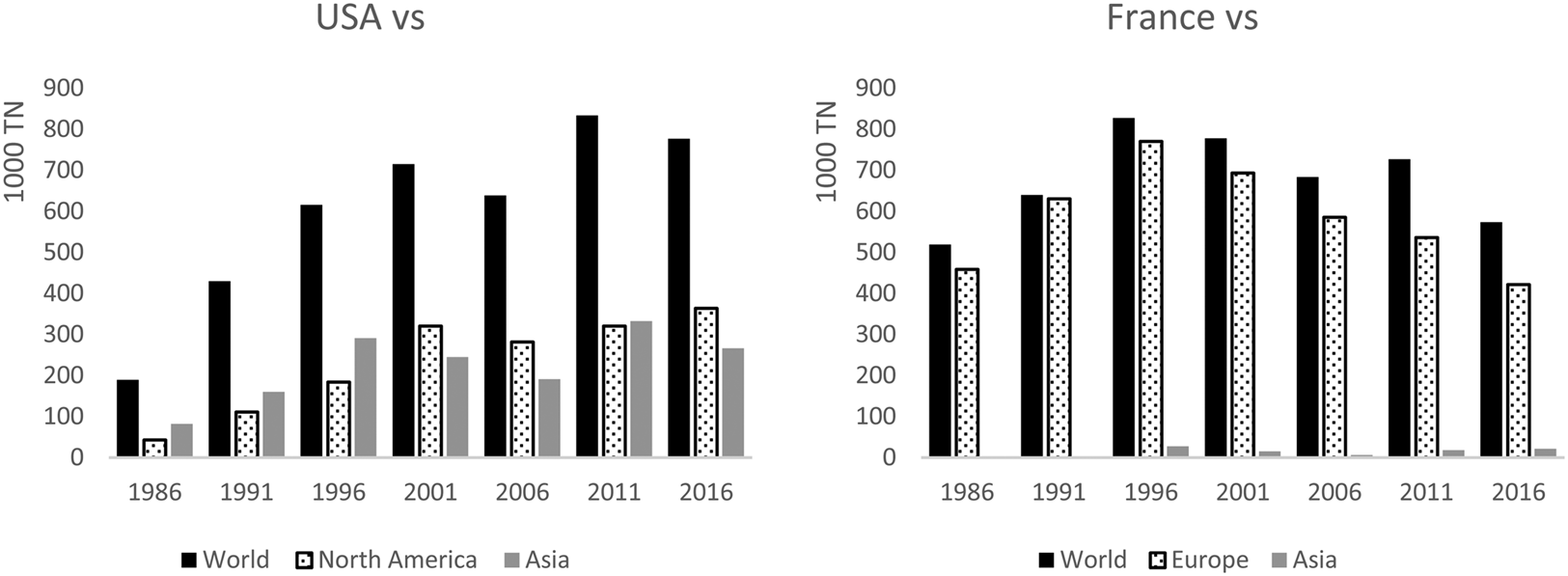
The repeated Mediterranean fly contamination crises in the USA during the 20th century pushed the American authorities to develop different methods of controlling Ceratitis Capitata at an early stage and to make ‘cold treatment’ both a tool for domestic management of quarantine risks (with regard to products imported from contaminated territories or countries) and a way to reach pest-free markets. With regard to this second point, it is important to understand the link with the USA's position in the 20th century international apple trade. Unlike in Europe (France and Italy), North American exports have always been geographically diversified and oriented toward countries with stringent phytosanitary constraints. The figure below (Figure 1) shows that while 40% of American apple exports were shipped to Asian countries (susceptible to MFF) during the 1980sFootnote 14, 90% of French apple exports were shipped to northern European countries (primarily concerned by health quality issues: MRL).
USA versus France: total exports and by regions (1986–2016).

It can therefore be assumed that the USA was very quickly required to negotiate bilateral protocols incorporating ‘cold treatment’ and therefore to have its expertise in this field recognized, long before the more recent arrival of European products.
3.3 Increasing adoption returns: when the USDA/APHIS standard became the ‘system’
While the prior presence of American apples in countries with stringent phytosanitary constraints makes it possible to explain the initial advantage acquired by the USDA/APHIS standard since the middle of the 20th century, more recent additional elements suggest a self-reinforcing effect of the standard, an effect that the literature explains by the presence of increasing returns to adoption (Arthur, Reference Arthur1984; David, Reference David1985; North, Reference North1990). Here, we provide some examples involving micro to macro scales.
The USDA-APHIS certifies incoming vessels and containers, as well as the recording equipment (thermal probes) used to certify ‘in-transit cold treatment’ (CPHST databaseFootnote 15). The aim for the American phytosanitary authority is above all to ensure that imports comply with the conditions described by the national cold treatment standard. Although this certification is in theory an instrument for controlling only incoming flows (imports), we suggest that approved vessels, containers, or other technical facilities function as vectors for the spread of the USDA-APHIS standard throughout the world. For example, since 2018, the ocean carrier company APL has ensured all its trading partners (not only the USA) that its ‘in-transit cold treatment’ operations (SMARTcool®) are carried out in USDA-APHIS-certified containers, regardless of the final destinationFootnote 16. Such a guarantee can be analyzed both as a means for APL to break even on initial USDA-standard adoption costs (start-up costs), and as proof of the existence of ‘the coordination effect’ between the American standard and international private agents' investments.
Another example of coordination effects can be seen in the fact that several international companies manufacturing thermal probes (such as Comark, Carrier, or Senmatic) promote their USDA-compatible probes, simply calling them ‘USDA probes’. It is not beyond the realms of belief that these companies use USDA-APHIS accreditation to increase their international credibility while at the same time promoting the adoption of the USDA-APHIS standard.
In a similar way, we point out the recent emergence of insurance systems or ‘remote control’ systems for ‘in-transit cold treatment’ proposed by the main international shipping companiesFootnote 17. While these systems may, on the one hand, increase confidence in the reliability of cold treatment operations carried out in transit, they can also be seen as a specific investment choice made by shipping companies as a consequence of the growing importance of this particular practice for the international trade of fresh produce.
The impact of the USDA-APHIS standard on international relationships can also be assessed at the institutional level. Bilateral trade protocols recently signed by Italy, South Africa, or Australia, for example, with Asian countries (China, Thailand, India, Indonesia, or Iran among others) explicitly state that cold treatment must be carried out ‘in-transit’ and exclusively in USDA-APHIS-approved vessels or containers or using USDA-APHIS-certified probes. This is an additional step beyond simply requiring the respect of temperature/day pairings.
One final example is that in April 2018, after several years of consultation, the IPPO approved the ISPM 42 on ‘requirements for the use of temperature treatments as a phytosanitary measure’. This international standard specifies certain requirements to ensure that cold treatment is successful. We learn that ‘cold treatment’ begins when the required temperature is reached ‘at the heart of the fruit’, that this temperature can only be recorded by thermal sensors placed ‘at the heart of the fruit’ and that the minimum number of fruit-pulp sensors to be used is three. While this international standard does not provide a complete definition of how cold treatment is supposed to be achieved, it does specify how the temperature is to be measured. With the emergence of this new IPPO standard, we can point out that the ISPM 42 is a relatively faithful reproduction of the current USDA-APHIS standardFootnote 18 and is very similar to the ‘cold treatment’ protocol introduced in the USA 80 years earlier as described by Richardson (Reference Richardson1952).
4. ‘Lock-in situation’ and disposal costs: a case study of French apple exporters
In the previous section, we documented evidence illustrating how the USDA-APHIS T107-a standard is predominant in the international apple trade and deduced what might have been the historical causes underpinning this. In this section, we examine a particular case study – that of French apple exports – to show how expensive it is to avoid the practice of ‘cold treatment’ as established by the American standard, despite the existence of an alternative practice which is potentially both more effective and less expensive.
4.1 The French apple export sector: a sector in the process of restructuring, sensitive to phytosanitary constraints
While French fresh apple exports have been moderately constant since the 1960s, their relative market share (in relation to production) has increased significantly and the number of destinations has expanded significantly. In the 1980s, French exports accounted for about 20% of domestic production and for one-third in 2015 (Faostat). At the end of the 1990s, European countries, and in particular those in the North, absorbed almost all French apple exports (93%). More recently (2013), the same region absorbed only 73% of exports with the remainder now shipped to North Africa (for the most part Algeria) and the Middle East (Saudi Arabia and the United Arab Emirates).
In this context of significant change, it must be noted that the Asia and Americas region, which are dynamic in terms of consumption, remained marginal destinations for French exports (<1% of fresh apples exported in 2013), although this figure increased in 2015Footnote 19.
Recent works (DeMaria et al., Reference DeMaria, Lubello and Drogué2018) have highlighted that import bans and phytosanitary restrictions imposed by importing Asian countries help to explain the limited trade in this area. It should be noted that the risk of contamination by Ceratitis Capitata is the most frequently cited risk and that ‘cold treatment’ is systematically required by these countries: of the 15 countries requiring special treatments on apples originating in France, 14Footnote 20 require a specific ‘cold treatment’ for MFF (Exp@don database). It is therefore clear that the risk of contamination by Ceratitis Capitata is a major problem for French operators, and that ‘cold treatment’ is the main solution they are systematically forced to adopt.
According to information collected from French apple sector operators (ANPP, Interfel, Aneefel, cooperativesFootnote 21), almost all apples exported to countries requiring cold treatment receive ‘in-transit cold treatment’ in refrigerated containers equipped with thermal sensors. Still based on the information provided by these operators, the cost of this operation varies (depending on the shipping company employed), but is about €1,100/container.
This extra cost, equivalent on average to 5% of the value of the exported goods, reduces the overall competitiveness of the exporting sector, causing the industry (ANEFEL, INTERFEL, ANPP) to claimFootnote 22 that the current practice of ‘cold storage’ would be equivalent to ‘cold treatment’ in terms of its ability to limit the risk of contamination by Ceratitis Capitata, as ‘cold storage’ is generally carried out at temperatures compatible with those required by the main cold treatment protocols (between 0° and 2.5 °C) and for a much longer period of time (from one to several months). Proof of the reliability of ‘cold storage’ as a phytosanitary risk management tool is provided by the Franco-Chinese protocol, the oldest bilateral protocol signed by France (in 2000). This protocol specifies the temperature/day pair to be respected, but does not demand the use of fruit-core probes or in-transit treatment.
4.2 ‘In-transit cold treatment’ versus ‘cold storage before shipping’: technical, economic, and transactional differences
In addition to historical accidents, the predominant position of ‘in-transit cold treatment’ in the international trade of fresh fruit can also be explained by a number of advantages. Perhaps the most striking of these is that two operations (transport and treatment) can be carried out at the same time. This time-saving factor overshadows two other advantages: first, the fact that the treatment is carried out on the open sea limits any form of ex-post contamination of the fruit; and second, adopting a just-in-time approach makes it possible to react as effectively as possible to market prices, particularly at the beginning of the season, whereas cold storage before shipping (in warehouses) would delay the departure of the vessel by several weeks, potentially affecting the exporters' scope for bargaining.
However, apart from this short delay which makes in-transit cold treatment of freshly harvested fruit a major asset for negotiating better-selling prices, ‘cold storage before shipping’ has equally attractive advantages for fruit that can be kept cold for a long time (this is the case for apples but not strawberries, e.g.). Technical advantages include the fact that a cold storage warehouse is designed to generate cold, whereas a refrigerated container can only maintain a given temperature (Foulquier, Reference Foulquier2007). In a cold storage warehouse, it is therefore not only possible to reach the temperature imposed by bilateral protocols (as precooling is already performed there), but also to maintain it for several months, if necessary; this is impossible in a container. Furthermore, ‘insect-proof’ certified cold storage and packaging stations reduce the risk of re-contamination, similar to the isolation conditions of a shipping container.
The financial benefits of cold storage are also significant. First, ‘cold storage before shipping’ not only saves the extra cost of ‘in-transit cold treatment’ but, since most French cold rooms usually operate at temperatures compatible with those required by importing countries (between 0.5 and 2.5 °C), no additional operating costs would be incurred. Second, as ‘cold storage before shipping’ is centralized and constantly controllable, it allows the exporter to react quickly in the event of a treatment failure. In this respect, while a treatment failure implies a loss of time (the need to start the treatment protocol again from scratch, which is possible in a cold storage center), it does not require the destruction of the goods or their redirection to a less profitable market (which usually happens with in-transit cold treatment failures since containers are not designed to generate cold). Finally, as a larger volume of apples can be processed in a cold room than in a container, economies of scale and organizational economies can be enjoyed. To illustrate this, let us take the example of inspections. In the case of in-transit cold treatment, each container is subject to a pre-departure inspection by a national phytosanitary authority which certifies the correct launch of the cold treatment protocol. In the case of ‘cold storage before shipping’, it is the cold room (which is equivalent to several containers) that is inspected in order to certify the end of the treatment.
While it is reasonable to think that ‘cold storage before shipping’ has undeniable advantages, the experience of international trade tells a different story, and this can be traced back to the differing nature of the two practices. It should be recalled that ‘cold treatment’, as defined by the USDA-APHIS standard, entails both an obligation of result and of means. It involves an obligation of result because all importing countries requiring France to apply ‘cold treatment’ implement inspections on arrival (source: Exp@don France-AgriMer), while it entails an obligation of means because, as we have seen above, ‘cold treatment’ implies compliance with three conditions: a given ‘fruit-core’ temperature, a precise duration, and the use of specific recording instruments. It is with regard to this last point – thermal probes – along with transactional constraints that the difference between cold storage and cold treatment emerges.
A cold storage room is generally designed to generate cold and to maintain the so-called ‘commercially cold’ temperatures (between 0.5 and 2.5 °C). This can be qualified as a generic asset insofar as there is no specific equipment to carry out particular operations: in other words, it is designed in such a way as to maintain a precise environmental temperature within the room as a whole and not only at particular points in the room. In contrast, ‘cold treatment’ as commonly practiced requires dedicated cold roomsFootnote 23, i.e. with specific equipment as described by Transaction Costs Theory (Williamson, Reference Williamson1985). This specific equipment comprises mobile thermal probes and, more precisely, probes used to record the evolution of the ‘fruit-core’ temperature.
4.3 Non-market constraints
4.3.1 The ‘scientific evidence approach’ and its limitations
There are two ways of dealing with this issue. The first would be to make the necessary investment to transform conventional cold rooms into dedicated cold rooms (e.g. in accordance with USDA-APHIS guidelines). This investment is costly and profitable only for the practice of cold treatment (hence the notion of specific asset borrowed from Transaction Costs Theory). This solution would also represent a further step toward the dominance of American practice.
The second approach would be to provide proof that, under certain conditions, ‘cold storage’ in a conventional cold room can achieve the same results as ‘cold treatment’. The issue here is to ‘produce sufficient scientific evidence’Footnote 24 that would legitimize this claim, and to this end, it is necessary to request and obtain a status of ‘technical equivalence’, change ISPM 42, and possibly amend the bilateral trade protocols.
This ‘scientific evidence approach’ nevertheless displays two major limitations.
The first relates to the origin of the scientific evidence: each importing country involved in a negotiation would be entitled to demand that the exporting country produces its own scientific results in the field. In practice, evidence cannot be borrowed from other countries that have already carried out testsFootnote 25 and each exporting country would therefore have to carry out the test; the underlying reason for this is the heterogeneity of the geo-climatic, physical, and/or varietal conditions in which the tests are carried out. This could potentially result in the production of scientific evidence becoming redundant and very costly.
Laboratory experiments recently conducted in France by the CTIFL (Vincent Mathieu-Hurtiger, forthcoming) meet this requirement of originality of proof. The CTIFL has tested the hypothesis that precooled apples stored at a temperature equal to or lower than 2.22 °C in French conventional cold rooms for a period of at least 18 days (in accordance with the USDA-APHIS standard) do not show any trace of Ceratitis Capitata (regardless of the QO's development stage).
The second limitation concerns the specifications of the experimental protocol. To clarify this point, it should be recalled that Japan, as well as New Zealand and Australia, require exporting countries to test QOs on a minimum number of specimens (30,000 for the Mediterranean fly) to achieve probity thresholds of 9 (Follett and Hennessey, Reference Follett and Hennessey2007; Sproul, Reference Sproul1976). In the same vein, it should be recalled that, in 2002, the USDA-APHIS tightened the T107-a cold treatment program, following observation of the low probity of the temperature/day pairs previously requested (USDA-APHIS, 2002).
All these unilateral constraints relating to the means of producing scientific evidence have the potential effect of multiplying the cost of producing such evidence by the number of countries with which negotiations would be undertaken.
However, a breakthrough was made in 2016 when the Technical Panel on Phytosanitary Treatment (TPPT) concluded on ‘the absence of scientific evidence supporting the idea that populations of Ceratitis Capitata, originating from remote geographical regions, would react differently to cold’ Footnote 26. The TPPT qualifies this conclusion as a major step forward in the process of harmonizing ‘cold treatment’ techniques. Despite this, no ISPMs have since been produced on this subject by the IPPC, and no country seems to have used this argument in recent negotiations.
4.3.2 The ‘negotiation approach’ and its limits
Despite the technical and economic advantages that can be associated with the use of ‘cold storage’ as an alternative technique for managing the risk of contamination by Ceratitis, and the emergence of scientific studies conducted to demonstrate the effectiveness of controlled cold storage, international recognition of this alternative is not on the agenda. In our opinion, the explanation lies in the nature of the institutional structures governing the international market for fresh agricultural products, and it is immaterial whether we analyze the international market by adopting an international or bilateral perspective.
In the first case, the institutional itinerary that must be followed for a risk management technique to be recognized as equivalent to an existing one is potentially long. It is carried out through the technical equivalence and/or harmonization commissions of internationally recognized bodies: in the case of plant products, this is in the IPPC, and in particular the TPPT, where discussions take place in working groups which have only an advisory value based on the technical/scientific elements provided by interested parties. Apart from the length of the procedure and the purely consultative nature of the work of these panels however, the positive effect of international recognition of technical equivalence does not ensure that the new technique will certainly be taken into account by both old and new trading partners.
This brings us back to our second scenario: the route through bilateral negotiations. This is an obligatory step which is long (10 years on averageFootnote 27), which must be reiterated for each country and which involves several entities including trade operators (who are pressing for the opening of new countries), diplomatic networks (who represent a country's political and commercial interests), networks of experts (who participate in country risk analysis), as well as ministerial representatives who proceed with the ratification of agreements and protocols. The institutional transaction cost of setting up and operating such a system is therefore far from negligible.
5. Conclusions
In an increasingly globalized world in which goods, services, and people move across national borders at an ever increasing pace, the WTO, through the SPS Agreement (1995), recognizes that each of its ‘Members [has] the right to take the measures necessary for the protection of human, animal or plant life or health’ (art 2.1), from trade-induced risks.
In the international trade of fresh agricultural products, one of the most important threats to be considered is that trade may become a vector for quarantine infestations. In accordance with the SPS Agreement, importing countries free from a specific quarantine pest can therefore demand – either unilaterally or through bilaterally negotiated phytosanitary agreements (bilateral trade protocols) – that fresh products originating in infested countries be subject to specific phytosanitary restrictions.
For apple exports originating in countries home to the MFF, one of the most widely adopted phytosanitary restrictions is cold treatment, in particular because of its quality of thermic treatment (as opposed to chemical or radioactive treatments).
In the case of French apple exports, particularly toward fly-sensitive countries, cold treatment is systematically carried out ‘in-transit’, i.e. during shipping in specially-equipped containers. This particular treatment method generates an additional cost of around €1,100/container compared to a shipment without treatment.
In this paper, we have tried to understand the reasons underpinning the emergence, success, and persistence over time of this specific phytosanitary risk management method, notably in light of its significant cost and the existence of other, cheaper methods of applying cold treatment, in particular the use of ‘cold storage’ in the cold rooms of fruit stations (in accordance with the Franco-Chinese protocol).
We believe that experiments carried out by the CTIFL on cold storage (Hurtiger, forthcoming), as well as the analysis of some French apple stations, show that technical and economic advantages, generally associated with the practice of ‘in-transit cold treatment’, can equally well be obtained by the alternative and cheaper practice of ‘cold storage’. This result does not justify the predominant position of ‘in-transit cold treatment’ in the international apple trade. To explain the lack of development of alternative practices which are just as beneficial as in-transit cold treatment practices from an economic point of view, other arguments of an institutional nature must be called on. By using the theoretical framework of new institutional economics (Section 2), we have determined this specific case to be an example of ‘institutional path dependence’. In accordance with the specific literature, we have described the random accidents that led to the emergence of a predominant standard as well as more recent additional elements suggesting a self-reinforcing effect of the standard.
In this respect, as we have seen in Section 3, the practice of ‘in-transit cold treatment’ emerged in the USA at the beginning of the 20th century in response to a major phytosanitary crisis affecting the domestic fresh fruit trade (Hawaii versus other federal states). Also in Section 3, we showed that adoption of the USDA-Aphis T107-a standard by many partner countries, particularly in Asia, is not only limited to the adoption of a simple temperature/days correspondence table, but is also reinforced by the development of an imposed set of equipment and human skills certified by the United States Phytosanitary Authority and dedicated to the maintenance of the standard. Such a standard-dedicated device also contributes to path dependency.
In this context, any attempt to change the predominant standard faces strong institutional limitations generating significant transaction costs.
In light of this, we focused (Section 4) on two major obstacles that exporting countries encounter in an international institutional environment when trying to negotiate (bilaterally or multilaterally) changes in the governance of the fresh agricultural product trade, notably with regards to SPS constraints.
The first obstacle is the slow and cumbersome nature of multilateral negotiations in a field where the heterogeneity of bio-geo-climatic situations inevitably leads to bilateral negotiations. The second obstacle is the need to produce scientific proof, the conformity, and quality of which is always subject to the assessment of the importing country. Producing ‘tailor-made’ scientific proof dedicated to a particular importing country is costly not only in itself, but also because, as we have shown, country-specific knowledge cannot be freely applied to other importing countries, i.e. no benefits from economies of scale.
These two constraints generate costs which can be described as transaction costs. It is ultimately through these costs that we believe it is possible to explain the persistence of a potentially more costly risk management practice.
In light of the magnitude of these exit costs from path dependence, some exporting countries such as France continue to suffer from the maladaptation costs caused by the need to follow a predominant standard.