



Every step and every movement of the multitude… are made with equal blindness to the future; and nations stumble upon establishments, which are indeed the result of human action, but not the execution of any human design. Adam Ferguson (Reference Ferguson1767, An essay on the history of civil society, p. 227)
1. Adam Ferguson’s insight
Scottish enlightenment philosopher Adam Ferguson’s famous quotation, originally focused on political institutions, proposes that the astonishing complexity of human culture and society – from networks of manufacturing and trade, legal, and political systems to science, technology, language, and the arts – can arise through processes of spontaneous order rather than deliberate design (e.g., Hayek, Reference Hayek1945; Polanyi, Reference Polanyi1941; Sugden, Reference Sugden1989). Indeed, the complexity of cultural and social systems vastly exceeds the comprehension of any individual.
Ferguson does not propose that individual behavior is without design or purpose. Indeed, he stresses that it is purposeful human action that drives social change. But human purposes are typically short-term:
Mankind, in following the present sense of their minds, in striving to remove inconveniencies, or to gain apparent and contiguous advantages, arrive at ends which even their imagination could not anticipate… He who first said; “I will appropriate this field; I will leave it to my heirs;” did not perceive, that he was laying the foundation of civil laws and political establishments. He who first ranged himself under a leader, did not perceive, that he was setting the example of a permanent subordination, under the pretence of which, the rapacious were to seize his possessions, and the arrogant to lay claim to his service. (Ferguson, Reference Ferguson1767, pp. 221–222)
In this paper, we explore the consequences of pushing Ferguson’s perspective to something of an extreme, to provide a cognitively plausible foundation for the emergence of social rules and social complexity. The mind is perpetually attempting to solve immediate cognitive challenges, at the time-scale of seconds or below: understanding perceptual input, interpreting or generating movements, gestures, or speech. The same applies to jointly creating, adapting, and deploying social rules that will coordinate social interactions in real time, from turn-taking to coordinating who eats what, sits where, and so on (e.g., Goffman, Reference Goffman1983; Levinson, Reference Levinson, Enfield and Levinson2006; Sebanz, Bekkering, & Knoblich, Reference Sebanz, Bekkering and Knoblich2006).
Crucially, the solution to each momentary challenge sets precedents for how new challenges are addressed, through the thoughtful reuse, adaptation, and recombination of past solutions. Thus, each new cognitive challenge draws on precedents from past challenges and sets precedents for future challenges. Just as the intricacy of the common law arises from histories of past cases, not the decree of an all-seeing lawgiver, so the complexities of thought and society emerge unplanned from the cumulative results of successive past struggles to coordinate social behavior: a process that we call social tinkering.
But, as with Ferguson’s examples of property and subjugation, solutions to the social challenges of the moment can lead to far-reaching consequences. The immediate need to regulate social behavior may cumulatively generate moral and social norms, systems of legal rules, and political processes by which those rules can be adjusted; the human drive to communicate the message in the here-and-now may, in aggregate, generate the full complexity of human language; the perpetual need to account for, and record, specific transactions may over time generate systems of writing, mathematical notations, and the principles of arithmetic. And the adversarial nature of many human interactions can create innovation by other routes, as when one party finds and exploits a loophole in the law and the other tinkers with the law to close that loophole. In short, we aim to explain how overall cultural complexity arises from directed but highly local cognitive challenges, where people are aiming to solve the social coordination problem of the moment.
Section 2 outlines the four key elements of our thesis: that social tinkering creates (i) local and (ii) directed cultural change, allowing (iii) coordinated behavior organized into (iv) complex, interlocking systems that arise through spontaneous order. Building on this framework, Section 3 outlines six stages in the evolution of cultural complexity. Section 4 explores the surprisingly far-reaching implications of Ferguson’s perspective for contemporary theories of individual cognition. Finally, Section 5 explores how social tinkering extends and complements previous accounts of cultural evolution.
2. Cultural complexity from social tinkering, not human design
Our account has four elements: (i) cultural change is largely local: arising from a myriad of tiny modifications; (ii) cultural change primarily involves directed innovations, created by individuals and small groups in response to challenges of the moment; (iii) much cultural change involves creating rules to coordinate behavior between individuals, including norms, conventions, and natural language; (iv) these processes for enhancing coordination generate the multitude of complex, interlocking linguistic, social, and political systems through spontaneous order. These claims provide a bottom-up theory of the foundations of social complexity: complex social systems are not the product of any overall design but arise as the incidental by-product of many momentary and myopic human actions.Footnote 1 In this section, we discuss each point in turn.
2.1. Cultural evolution is local
Our notion of social tinkering builds on a celebrated paper by Jacob (Reference Jacob1977), which introduces the metaphor of biological evolution as a tinkerer:
The action of natural selection has often been compared to that of an engineer. This, however, does not seem to be a suitable comparison. First, because in contrast to what occurs in evolution, the engineer works according to a preconceived plan in that he foresees the product of his efforts. Second, because of the way the engineer works: to make a new product, he has at his disposal both material specially prepared to that end and machines designed solely for that task. Finally, because the object produced by the engineer… approach the level of perfection made possible by the technology of the time. In contrast, evolution is far from perfection. (Jacob, 1977, p. 1163).
Thus, biological change is like tinkering in that it operates gradually, by adjusting, recombining, and reorganizing existing components, following no grand plan. Biological complexity arises through the accumulation of local ad hoc adjustments. Each new round of adjustment, recombination, and reorganization provides the raw materials for the next (so that the biochemistry of life is largely conserved; the structure of single cells carries over to multicellular organisms; a leg is gradually repurposed as a flipper, and so on). Jacob stresses that the combination of local changes is highly contingent and can diverge in many different directions (yielding the familiar branching phylogenetic tree). To a limited degree, though, diverse historical processes may lead to similar outcomes, where the same function is carried out in a similar way: Jacob notes the striking convergent evolution of octopus and human eyes.
This perspective chimes with Ferguson’s observation concerning the local nature of cultural and institutional change, quoted above: that such change originates when people who are “striving to remove inconveniencies, or to gain apparent and contiguous advantages, arrive at ends which even their imagination could not anticipate.” The bottom-up character of the creation of cultural complexity is central to evolutionary approaches to culture of all kinds and to the present account. Indeed, we suggest that Ferguson’s view can be encapsulated by construing cultural evolution as a process of social tinkering.
Consider language. The local nature of linguistic change was noted by nineteenth-century German philologists, and the linguistic equivalent of a phylogenetic tree for Indo-European languages partly inspired Darwin’s thinking in biology (e.g., Christiansen & Chater, Reference Christiansen and Chater2022). For example, the bottom-up character of lexical change is illustrated by contemporary computational reconstructions of language change (Gray & Atkinson, Reference Gray and Atkinson2003). Indeed, a local account sees the elementary unit of change as operating on individual communicative interactions (Keller, Reference Keller1989, Reference Keller1994), from which the meaning or pronunciation of a word can change incrementally from one occasion to the next (Bybee, Reference Bybee2010).
The same pattern applies throughout human culture. Accordingly, human behavior operates primarily at the level of individual occasions – thus, styles of cookery are assumed to arise as processes of local variation from countless episodes of cooking; transitions in axe, spear, pottery, or canoe design are assumed to arise from gradual modifications over countless episodes of manufacturing and repair. Following Jacob’s tinkering metaphor, these changes are local adjustments, possibly repurposing existing (linguistic or material) components.
Jacob (1977, p. 1166) notes that, in biological evolution, “the interplay of local opportunities—physical, ecological, and constitutional—produces a net historical opportunity which in turn determines how genetic opportunities will be exploited.” Thus, organisms do not evolve independently, but in a changing biological and physical environment, where shifts in the behavior or morphology in one organism will shift the landscape of opportunities for others. The same applies in cultural evolution – change arises from adapting to the immediate challenge (e.g., stretching the meaning of an existing word to apply to a novel situation, or using a tool for a new, unanticipated purpose). Equally, the ethical, legal, and institutional rules governing society typically change by the processes of gradual modification, action, and reaction described in institutional economics (North, Reference North1990), rather than deliberate top-down design.
2.2. Cultural evolution is driven by directed innovation
We have suggested that Ferguson’s vision is that culture and institutions evolve by tinkering. But Jacob’s metaphor bears careful consideration. He notes that a human tinkerer, taking whatever elements lie to hand, might repurpose a bicycle wheel to build a roulette table (Jacob, 1977, p. 1164). This is prototypical of cultural evolution – the tinkerer sees an opportunity for reusing existing components in a new way.
But here, cultural and biological tinkering operate very differently: in biological natural selection, the creation of new variants is undirected; blind variation is followed by directed selection. But human tinkerers are anything but undirected: seeing that a bicycle wheel might be placed flat, with its axle aligned with the turret of the roulette table, requires ingenuity.Footnote 2 The tinkerer’s progress would be infinitesimally slow if she generated random actions. Real tinkerers are improvisers – conjuring something workable from whatever parts lie to hand. That is, the creation of variation is not random but, rather, a process of directed innovation with the current purpose in mind; it operates far faster than undirected biological evolution.
Consider Dawkins’ (Reference Dawkins1986) image of Darwinian biological evolution as a blind watchmaker, where variations are generated randomly and “good” solutions are preferred through the process of selection. But cultural evolution is the product of a sighted watchmaker, intelligently choosing the variations, adjustments, recombinations, or existing solutions to solve the problem of the moment. Selectional forces will still operate, and cumulative tinkering will lead in unanticipated directions. The ingenuity of individual thought and action is what allows cultural evolution, whether in technology, law, science, language, or the arts, to proceed so quickly.
Thus, in Ferguson’s example, a person laying claim to a field and attempting to pass it to their children is engaged in intelligent, planned action – and may build fences, make maps, document the justification for their claim and their intentions for the future (and neighbors may respond with opposing claims). But while focused on purely immediate goals, Ferguson points out, this person may incidentally create precedents, norms, and perhaps ultimately laws, which (along with innumerable other locally intelligent precedents) will shape land and property rights for future generations. Immediate purposeful and intelligent individual action is the driving force behind the bottom-up emergence of cultural forms, which are themselves unplanned. This is Ferguson’s insight: that cultural practices can be “the result of human action, but not the execution of any human design.” Footnote 3
The directed nature of tinkering is crucial: clever improvisations to address the challenges of the moment allow people to innovate solutions to communicative and practical problems, and to direct the selection of past solutions to new problems. The history of technological and medical innovation, whether for steam engines, silicon chips, or vaccines, is a process of fairly myopic and zigzagging innovations, where past insights and technologies are often reused in unexpected ways. Progress can sometimes arise through serendipity, but exploiting such discoveries requires long periods of tinkering (e.g., the lengthy process from Fleming’s fortuitous observation that mold contamination inhibits Staphylococcus bacteria in 1928 to the therapeutic use of penicillin in the 1940s by Florey and Chain). At each stage, the selection of ideas to work on is intelligently and insightfully directed; a random, non-directed process of invention would be hopelessly slow and ineffective.
The same pattern applies across cultural evolution more broadly. People intelligently, but myopically, tinker with solutions to address their immediate challenges; but this tinkering leads cumulatively to long-term impacts (new theories, technologies, laws, political systems, notations, or indeed languages) undreamt of by the individuals concerned.Footnote 4
A well-known, but particularly striking, example of social tinkering is the creation of Nicaraguan Sign Language (NSL; Kegl et al., Reference Kegl and DeGraff1999; see Christiansen & Chater, Reference Christiansen and Chater2022, for discussion) over just a few generations, through interactions by deaf children. NSL emerged after deaf children from around Nicaragua were brought together in the late 1970s/early 1980s at two schools in Managua to teach them spoken Spanish and lipreading. The teaching of Spanish failed; instead, the children began to communicate using signs, initially based on the idiosyncratic gestural systems – so-called homesigns (Hill, Lillo-Martin, & Wood, Reference Hill, Lillo-Martin and Wood2018) – that each child used at home to communicate with their hearing family members. Gradually, as the children tinkered with this somewhat haphazard combination of signs, NSL evolved into a full-blown language with morphology and syntax. Originally ambiguous signs gradually became conventionalized over several generations of children entering the schools (Pyers & Senghas, Reference Pyers and Senghas2020). Thus, NSL emerged as a product of these children’s repeated directed tinkering, driven merely by momentary communicative goals.
The claim that cultural evolution involves directed, rather than blind, tinkering seems both intuitively natural, and also fits with historical accounts of technological, scientific, legal, or political change,Footnote 5 as well as the post-behaviorist conception of the mind as engaged in intelligent and creative thought, action, and innovation, rather than, say, as driven purely by associative principles (see, e.g., Miller, Galanter, & Pribram,Reference Miller, Galanter and Pribram1960). Similarly, in anthropology, many influential theorists have stressed the importance of human agency in actively reshaping cultural forms (e.g., Malinowski,Reference Malinowski1944; Sahlins, Reference Sahlins1981; Steward, Reference Steward1955; White, Reference White1949). Curiously, though, as we’ll see later, many more recent, and highly influential, theories of cultural evolution assume the opposite: that cultural, like biological, evolution is driven entirely (Blackmore, Reference Blackmore1999; Campbell, Reference Campbell1960; Cavelli-Sforza & Feldman, Reference Cavalli-Sforza and Feldman1981; Dawkins, Reference Dawkins1976) or primarily (Boyd & Richerson, Reference Boyd and Richerson1985; Henrich, 2016; Mesoudi, Whiten, & Laland, Reference Mesoudi, Whiten and Laland2006) by selection over options created by random variation. Few theories of cultural evolution focus on the process of tinkering as directed innovation: the deliberate and creative modification and/or recombination of existing elements to address the purposes of the moment.
2.3. Cultural evolution involves coordination
Humans are, of course, profoundly social creatures: most of our thoughts and behaviors are highly interdependent on the thoughts and behaviors of other people, with whom we must coordinate. Thus, a major focus of human cognition is learning the norms and conventions that guide interactions both with specific other people, and which operate more broadly in the groups in which we live – rules which we must continually adjust, generalize, and recombine to deal with the challenges of the moment.
Momentary social interactions with others thus throw up a continual stream of coordination challenges, which need to be solved jointly (Clark, Reference Clark1996). Suppose person A drops a book and person B picks it up and hands it back to them. For this to work smoothly, both parties have to form a joint plan in which A waits to receive the object (perhaps based on B being closer, or stronger); B bends down, picks it up, and hands it to A; the timing of B letting go and A grasping the object is synchronized in time and space. For an interaction to be harmonious, both parties need to have the same understanding of the relevant norms and conventions, and the roles and responsibilities involved in this joint plan. For example, if the book is old and valuable, the joint plan will specify that it is handled delicately (and B will be responsible for any damage caused by grabbing it roughly or with inky hands); if, on the other hand, A clearly wants to deposit a trashy paperback into a recycling bin, B might more appropriately help recycle the book, rather than handing it back to A; and so on.
Various cognitive mechanisms have been proposed to facilitate ad hoc, moment-by-moment coordination in social interactions (Bratman, Reference Bratman1992; Gilbert, Reference Gilbert1990; Searle, Reference Searle, Cohen, Morgan and Pollack1990; Sebanz & Knoblich, Reference Sebanz and Knoblich2009). Concepts such as thinking in the “we-mode” (Tuomela, Reference Tuomela and Schmitt2003), team-reasoning (Sugden, Reference Sugden1993), shared intentionality (Tomasello et al., Reference Tomasello, Carpenter, Call, Behne and Moll2005), and virtual bargaining (Chater, Zeitoun, & Melkonyan, Reference Chater, Zeitoun and Melkonyan2022; Misyak & Chater, Reference Misyak and Chater2014) suggest that individuals can infer how they and others should contribute to a joint endeavor by jointly reasoning about what “we” should do in a given interaction.
But what matters here is that the joint solutions to endless novel challenges of joint action will generate a supply of innovations concerning social rules.Footnote 6 This is distinctively social tinkering: the creation and entrenchment of shared precedents, rules, and conventions, which cumulatively compose the complex interplay of linguistic, ethical, legal, religious, economic, and political systems that allow humans to coordinate our interactions with each other in remarkably complex ways.
The contrast between social tinkering and what we might call individual tinkering is crucial. Yet, while much classic work in anthropology and sociology has focused on active joint construction of systems of norms and conventions through social interaction (Berger & Luckmann, Reference Berger and Luckmann1966; Douglas, Reference Douglas1966; Geertz, Reference Geertz1973; Goffman, Reference Goffman1983), individual tinkering has been the primary focus of recent work on cultural evolution (e.g., Blackmore Reference Blackmore1999; Boyd & Richerson, Reference Boyd and Richerson2005; Claidière, Scott-Phillips, & Sperber, Reference Claidière, Scott-Phillips and Sperber2014; Mesoudi, Whiten & Laland, Reference Mesoudi, Whiten and Laland2006; Simonton, Reference Simonton1999). Individual tinkering is the process by which individuals learn, cumulatively, within and between individuals to understand and gain control of the natural world (including technology, hunting, agriculture, and so on).Footnote 7 The immediate effectiveness of a particular tool, hunting technique, or agricultural innovation depends on how well it fits the individual’s purposes and the environment in which it is deployed, and is only indirectly affected by the strategies of its neighbors.Footnote 8 But social tinkering concerns the coordination of behavior – and coordination only works if the participants in an interaction follow the same norms or rules. A communicative or social convention, agreement or institution is only effective if it is shared by the relevant participants in an interaction. Without this shared understanding, a new word, norm, or convention is no more use than the proverbial first and only telephone. Thus, the use of shells as currency is only effective if shared across trading partners; norms establishing private property only work if respected by the community at large; politeness norms can smooth social interactions only if largely agreed by all parties; and so on.
The idea that the means of coordination can evolve through cultural evolution goes back at least to David Hume (Reference Hume1739/2000). Indeed, Hume emphasizes that means of coordination (e.g., conventions) can arise unplanned
…Two men, who pull the oars of a boat, do it by an agreement or convention, tho’ they have never given promises to each other. Nor is the rule concerning the stability of possession the less deriv’d from human conventions, that it arises gradually, and acquires force by a slow progression, and by our repeated experience of the inconveniences of transgressing it. (Treatise of Human Nature, Book III, Part II, Sect. 2, paragraph 11)
The number and complexity of these shared social patterns is very great and must be mastered afresh by each generation of children. Indeed, this process of “enculturation” is arguably at least as challenging as the problem of mastering purely individual behaviors, such as perceptuo-motor skills (Tomasello, Reference Tomasello2019). And as we have stressed, social tinkering requires joint understanding. To take an everyday example, in a game of Pictionary a player may innovate a new and simplified way to draw a house, and this may be picked up, reused, and adapted in later games. But while created by an individual, this communicative innovation only works if jointly understood by everyone in the interaction – otherwise, the communicative innovation will fail. Thus, social tinkering can only “march” at the pace at which social innovations are assimilated by the relevant community.
2.4. Spontaneous order in cultural systems arises through successive processes of mutual adjustment, competition, and recombination
Social tinkering is piecemeal. Yet, as in Jacob’s discussion of tinkering in biology, it can cumulatively lead not merely to individual innovations, but to the emergence of interlocking cultural systems of great complexity: languages, moral norms, customs, religious and artistic traditions, laws, forms of social and political organization at many scales, and economic institutions and principles including money, trade, division of labor, firms, unions, systems of corporate or national regulation and governance.
None of these arises through deliberate design. Rather, they emerge from the cumulative result of individual human action: to recall Ferguson’s words, “in striving to remove inconveniences, or to gain apparent and contiguous advantages, [people] arrive at ends which even their imagination could not anticipate…” In the terminology of modern social science, social tinkering can lead to the emergence of unplanned, spontaneous order (e.g., Hayek, Reference Hayek1945; Polanyi, Reference Polanyi1941; Sugden, Reference Sugden1989).
The parallel with non-social tinkering with technology is helpful: we continually adjust, repurpose, and recombine existing elements to solve the engineering challenge of the moment; and in doing so, we add to the stock of elements that can be used, in unanticipated ways, to solve future challenges. In the technological case, the cumulative and largely unanticipated result of such tinkering can generate machines, computers, and software of a complexity far beyond the grasp of any single person; and these both create, and are shaped by, new and often fast-changing economic and technological ecosystems. Consider how Tim Berners-Lee’s creation of the first website brought together existing technologies (the internet, hypertext, etc.), motivated by an “act of desperation” (Berners-Lee & Fischetti, Reference Berners-Lee and Fischetti1999) to solve the immediate problem of helping CERN computer systems to work together. Berners-Lee’s tinkering required great ingenuity (and was by no means a product of random variation), but was just a single, though crucial, step in the cumulative creation (through processes of spontaneous order rather than far-sighted design) of the vast ecosystem of the contemporary World Wide Web (Johnson, Reference Johnson2001; Van Schewick, Reference Van Schewick2010).
Social tinkering operates in the same way, but over the often implicit, flexible, and open-ended norms and conventions that govern human interactions; and processes of spontaneous order, rather than deliberate design, generate rich patterns including languages, religions, legal and financial systems, and political institutions. As noted above, the complex communication system of Nicaraguan sign language illustrates how the accumulation and interaction of ad hoc conventions required to solve the communicative challenge of the moment have combined to create an elaborate system with a phonology (handshapes and movement rules), morphology, and syntax comparable to other natural languages – all within a few generations. Similarly, we suggest, repeated interactions can create norms, customs, conventions, notations, diagrams, currency, finance, and can support the intricately structured ecologies of organizations (firms, regulators, governments, judicial and political systems) that comprise the modern state. Each of these arises, we suggest, through successive incremental adjustments to, and adaptations of, prior arrangements; the goal of such changes is to solve the problem of the moment. But, as in biology and technology, social innovations are continually repurposed and recombined in unexpected ways (Roe, Reference Roe1996).
Spontaneous order arises throughout nature: from the formation of hexagonal or other patterns of convection currents in heated fluids (Cross & Hohenberg, Reference Cross and Hohenberg1993), to the formation of galaxies (Binney & Tremaine, Reference Binney and Tremaine2008) and crystals (including snowflakes, Libbrecht, Reference Libbrecht2005), to the molecular “self-assembly” of the double-helix of DNA (Whiteside & Boncheva, Reference Whitesides and Boncheva2002), the self-organization of neural circuits through patterns of local activity during development (Katz & Shatz, Reference Katz and Shatz1996), the intricate collective behavior of social insects (Camazine et al., Reference Camazine, Deneubourg, Franks, Sneyd, Theraulaz and Bonabeau2001), and many more. In all these cases, an accumulation of local interactions leads to unanticipated global patterns, without the need for a blueprint or plan.
Adam Ferguson’s insight is that such spontaneous global patterns arise even when individual local adjustments are locally intelligent and purposeful. Indeed, intelligent social tinkering can dramatically speed up the creation of global order. No one planned natural language – but the drive to optimize communicative efficacy in the moment generates and reuses communicative innovations in ways that rapidly create rich and complex communicative systems (e.g., Chater & Christiansen, Reference Chater, Christiansen, Lappin and Bernardy2022; Keller, Reference Keller1994). No one planned the modern market economy, yet individual innovations to turn an immediate profit can, under some conditions at least, lead to rapid economic advances (e.g., North, Reference North1990). No one planned the ethical and legal codes by which we live – but these arise through processes of innovation, adaptation, recombination, contestation, and continual adjustment, to close loopholes and resolve the current challenges (e.g., Ostrom, Reference Ostrom1990). Social change would surely be incomparably slower if people could only generate candidate linguistic, economic, or ethical/legal changes at random, and had to rely on selectional processes alone. Indeed, we would argue that this is a key reason why cultural evolution tend to be orders-of-magnitude more rapid than biological evolution.
Three caveats are in order. First, there are, of course, complex interactions between social and technological tinkering, so that neither can be considered in isolation. Technological changes create new social challenges (e.g., printing, photography, digitization, sampling, and AI create successive legal puzzles about ownership and copyright, Rose, Reference Rose1993; Samuelson, Reference Samuelson2023); and social changes create the impetus for new technological challenges (e.g., the intricacies of the modern financial system has co-evolved with the creation of computers, the web, block-chain, and so on). Yet distinguishing between the shaping of the social rules by which we live and the technological tools we have at our disposal is theoretically crucial (we explore this point further below). Second, social tinkering can sometimes look beyond immediate objectives – people can draw up and partially implement blueprints for global change (e.g., consider the creation of the UN institutions after WW2); and they can debate the principles governing the World Wide Web (Van Schewick, Reference Van Schewick2010). But while visionary political thinkers, religious leaders, or moral philosophers can be crucial in setting out plans that can profoundly influence the future, such attempts have very limited scope, typically building incrementally on what has gone before (e.g., regimenting and clarifying rules of social etiquette, linguistic usage, legal procedures, and so on), and often lead to unanticipated outcomes (as so often seen in the law – e.g., the prohibition of alcohol leading to a growth in organized crime in the U.S., Okrent, Reference Okrent2010). Thirdly, as with biological tinkering, there is no expectation that spontaneous order through social tinkering leads inexorably to “progress” in any sense. After all, spontaneous processes include the emergence of criminal networks, corruption, disinformation, and more, and the social rules that coordinate behavior can both strengthen and corrode society.
But Ferguson’s insight remains: the emergence of the vastly complex cultural and social structures in which we live is a product of largely myopic, but intelligent, social tinkering: they are the cumulative results of myriad human actions, with no overarching human designFootnote 9 (for a summary and illustrations of the social tinkering perspective, see Table 1).
Four features of cultural evolution through social tinkering

Table 1 Long description
A table with six rows and five columns comparing the evolution of cultural structures through social tinkering across different domains. The columns are labeled Local, Directed (Shaped by human intention to solve local challenges), Coordinating (Enables social alignment), and Spontaneous emergence of complex systems. The rows are labeled Natural language, Writing, Invention of money, Law, Political institutions, and The modern corporation. Each cell describes the evolution and impact of the respective domain.
3. Stages of cultural complexity
How does directed, but myopic, tinkering to solve the problems of the moment lead to the accumulation of cultural complexity? We distinguish between six overlapping and interacting stages, each of which allows the emergence of qualitatively distinct behaviors. As with parallel discussions of the major transitions in evolution (Maynard Smith & Szathmary, Reference Maynard Smith and Szathmary1997), while the ordering is strict (i.e., Stage n + 1 cannot be reached before Stage n), it is an open question whether some stages may in practice arise roughly simultaneously.Footnote 10 We now consider each stage in turn (see Figure 1).
The six stages of tinkering resulting in cultural complexity.

3.1. Stage 1: Non-social tinkering
This stage, of purely non-social tinkering over the lifetime of an individual organism, is the predominant type of learning in the vast majority of biological species. Such organisms are like Jacob’s tinkerers, alone in their workshops, living in a world without systems of social norms, including, crucially, the norms governing language (as these are, we assume, products of social tinkering). These lone tinkerers can try out various recombinations and variations of existing equipment to produce something of use. But there will be no cumulative cultural progress – new innovations will die with each individual tinkerer and need to be rediscovered. Individually learned perceptuo-motor skills of many kinds largely fall into this category. Across species, learning skills, e.g., to walk, fly, hunt, locate food, and so on, will involve continual tinkering with sequences of actions (rather than objects in the workshop) to make them more effective. In some cases and species, important skilled behaviors will be based on genetically encoded information (e.g., nest-building), and the role of tinkering will be a matter of specific implementation and fine-tuning.Footnote 11
3.2. Stage 2: Copying and tinkering with non-social behavior
Here, the tinkerers are no longer working independently; each tinkerer can observe and learn from the behavior of others. Stage 2 learning allows successful innovations to spread and become established in a population, so that tinkering drives change throughout a population, not just within an individual. The processes by which such innovations may spread are varied, e.g., depending on whether one agent copies the visible action of another, their goals, or both (see Hurley & Chater, Reference Hurley and Chater2005). But the key is that (i) successful new innovations can be maintained in the population, rather than continually needing to be rediscovered afresh; (ii) new innovations build on prior innovations, raising the possibility of cumulative culture (the ratchet effect, Tomasello, Kruger, & Ratner, Reference Tomasello, Kruger and Ratner1993). Stage 2 learning occurs in many species, from the cultural transmission of songs in songbirds (Catchpole & Slater, Reference Catchpole and Slater2003) and whales (Noad et al., Reference Noad, Cato, Bryden, Jenner and Jenner2000), to the transmission of tool-use and food-processing skills in chimpanzees (Whiten et al., Reference Whiten, Goodall, McGrew, Nishida, Reynolds, Sugiyama, Tutin, Wrangham and Boesch1999).
The copying and tinkering of individual behavior are, though, generally assumed to be especially prevalent and sophisticated in humans (Hurley & Chater, Reference Hurley and Chater2005). Many theories of cultural evolution in humans are focused on Stage 2: whether considering the rich range of cognitive mechanisms that enable transmission (e.g., ranging from imitation to actively teaching skills by demonstration) or how innovations spread across populations (possibly interacting with genetic changes, Boyd & Richerson, Reference Boyd and Richerson1985; Henrich, Reference Henrich2015). Typical targets for such copying processes include making and using stone tools, using fire, and methods for finding, preparing, and cooking food. While such processes often involve “social” learning (people are learning from others), the content of what is learned is a non-social skill that can be acquired and applied by a single individual.
3.3. Stage 3: Social tinkering: Copying and tinkering with the rules of social behavior
Social tinkering is, primarily, tinkering not over individual actions, but over interactions between people. For example, in fairness norms in food sharing, one party attempting to take more than their share may be countered by hostility and retribution from another; the next food-sharing interaction may thereby be more equitable – the behavior of the “greedy” party will be moderated, until mutual consent is reached. Social tinkering is, like all tinkering, purposeful but myopic. But purposeful tinkering operates not at the level of the individual but the dyad (or larger group). In some cases, where people can jointly conceive of a way of adjusting their interaction that would be mutually acceptable, they may jump directly to that solution (possibly by successfully imagining the agreed outcome, e.g., Misyak & Chater, Reference Misyak and Chater2014; Chater et al., Reference Chater, Zeitoun and Melkonyan2022); or they may approach the solution incrementally, where attempts to impose a particular solution by one party may be countered by objections and punishments from others.
The norms that emerge from any given interaction provide potential precedents for similar future interactions – so that rather than having to determine how to share each meal afresh, standard patterns of sharing will be established. Thus, entrenched precedents gradually create rule-like patterns. Although focusing on an immediate problem, an interaction may nonetheless shape future interactions, and indeed, establish general norms which may be adopted by other pairs of agents (for example, through overlapping pairs or through observation). Thus, the resulting fairness norms are the result of human action but not human design.
3.4. Stage 4: Social tinkering to create communicative conventions
While social tinkering does not require linguistic communication, as illustrated by our previous food-sharing example, language makes it vastly easier to develop more complex social interactions. Communication will be crucial in the flexible coordination and division of labor of all kinds, e.g., whether hunting, preparing food, making tools, or building shelter, and in flexibly dividing up rewards from that labor.
Communication will be especially important in helping to generalize and reshape existing social rules (at Stage 3). Suppose that two individuals have reached a general agreement of equal food sharing. But such an agreement needs to be modified continuously to the circumstances of the moment. Perhaps one person would like to forgo their share today (perhaps they are nauseous) but claim more tomorrow; or one person needs to replenish the energy expended in hunting or needs more to give to a relative whose hunting has failed. Or perhaps the pair have different preferences between meat and berries, so that an equal division of both is not optimal. In these cases, an unequal share of food may be warranted and indeed mutually beneficial, but communication is required to establish and justify this exception, without causing conflict.
How can a system of communication (ultimately, a language) emerge? As we have argued elsewhere (Christiansen & Chater, Reference Christiansen and Chater2022), a clue comes from what happens when people who do have a language are required to communicate without it – as in the creative ad hoc gestures, facial expressions (and sometimes noises) that people generate in the game of charades (in which people playfully pantomime the title of a movie or a book). Continuing our example, the person hoping to claim the majority of the food might refer to the effort they have expended, by pantomiming their contribution (e.g., acting out a long chase, exhaustion, etc.), and then indicating an uneven division, perhaps by miming a division of the carcass. The other party might accept the division – or push back by miming their own contribution; miming an equal division; or using any number of possible communicative strategies. To communicate, and ultimately to agree, both people must create a common understanding of these gestures. And future food-sharing episodes will likely invoke both these past momentary conventions and generalize them to the new situations (perhaps this time the other person did the chasing; the contributions were equal; or one provided a crucial tool or weapon). More intricate communicative conventions will be required to coordinate roles and responsibilities in more complex joint activities, to divide tasks between group members, convey private information to others, and so on. In all these cases, just as in charades, successful communication for the purposes of the moment is the goal. Success requires that both parties jointly agree (at least roughly) what is meant by each mimed proposal; and, to settle on an agreement, they need also to agree on what is fair.
Gestures created to solve a momentary challenge can be repurposed to address future challenges. This happens when the two people play charades multiple times: a novel gesture is reused, simplified, and adapted to a new context. This type of phenomenon was observed in the emergence of conventionalized signs in Nicaraguan Sign Language. Pyers and Senghas (Reference Pyers and Senghas2020) document how the sign for “horse” varied considerably among the first generation of children, with one child pretending to hold the reins and moving them up and down; another depicting a person riding a horse by spreading the middle and index fingers on one hand and straddling them over the other hand (held flat), followed by gestures indicating holding a rein and slapping the horse’s haunches; a third student also used the depiction of a person atop the horse but followed it with a gesture suggesting a swaying tale. By the third generation, “horse” had been conventionalized into a single sign: the sign showing a human straddling a horse. Again, purposive action to solve the problem of the moment (here, a communicative challenge) can rapidly create communicative resources that will be valuable for later interactions.
Over time, such communicative actions can become increasingly conventionalized and rule-like (as attested in the phenomenon of grammaticalization in language change; Hopper & Traugott, Reference Hopper and Traugott2003), eventually resulting, through processes of spontaneous order, in a full-fledged linguistic system, rich in complexity (see Chater & Christiansen, Reference Chater, Christiansen, Lappin and Bernardy2022; Christiansen & Chater, Reference Christiansen and Chater2022, for extensive discussion). Thus, we envisage the evolution of language not as a generalization of animal signaling (e.g., Girard-Buttoz et al., Reference Girard-Buttoz, Neumann, Bortolato, Zaccarella, Friederici, Wittig and Crockford2025) or ape Machiavellian intelligence (Byrne & Whiten, Reference Byrne and Whiten1988), but as emerging through the crucible of joint action for the purpose of social tinkering. In this way, Stage 3 provides not only the foundation but also the motivation for Stage 4, providing a possible explanation for why only humans have language: language is needed for the further development of social tinkering. This generates a co-evolutionary virtuous cycle between Stages 3 and 4: simple social tinkering provides the basis and impetus for the emergence of simple linguistic communication that, in turn, feeds back to allow for more complex social tinkering, which promotes more complex linguistic abilities, and so on, leading to the enormous cultural and linguistic complexity created by modern humans.
3.5. Stage 5: Language-mediated social tinkering over representations
Language can radically reshape the momentary interactions between people in various important ways. For example, the decision about how food should be shared becomes a matter of debate, in which each party can make demands, express outrage, provide justifications, and so on. And the relevance of past experience (e.g., of previous food-sharing bargains) can now be explicitly articulated: e.g., “but last time, we did this,” “now it’s my turn,” etc. And such debates will themselves rapidly develop into arguments over linguistically formulated proposals about acceptable rules of behavior; and debate over the justification of specific rules may generate discussion about which past precedents are relevant, which already-agreed cultural rules are applicable to the present case, and so on.
The shift from informal norms to explicitly agreed-upon social rules provides a helpful illustration. In informal interactions between people, past experience may suggest how new situations should be handled. For example, we may all agree that it is generally not appropriate to take a pet Chihuahua to one’s job interview. But in other contexts (e.g., shops, hair salons), people’s intuitions, expectations, or interests may clash, and linguistic debate may be engaged: people may formulate and agree linguistically articulated rules of behavior (“no dogs”), which may be extended (“no pets”), and challenged or perhaps modified (“no dogs except guide dogs” or “all dogs must be on a leash”). We therefore have a new process of social tinkering: one that operates not directly over momentary human interactions, but which operates over linguistically formulated representations of cultural rules.
The shift from tinkering over unspoken customs to tinkering over linguistically formulated rules is ubiquitous and of fundamental importance (Bowles & Gintis, Reference Bowles and Gintis2011; Searle, Reference Searle1995). Everyday conversation is frequently focused on tinkering over representations of behavior, e.g., what aspects of other people’s behavior are, or are not, laudable or acceptable and why (Dunbar, Reference Dunbar2004). And we continually probe and negotiate what is “appropriate” through formulating and debating conjectures about what is (or is not) fair, just, moral, cool, or prudent behavior in ourselves and others, and why. Moreover, in numerous spheres of life, from sharing food or other resources, to sports and games, to systems of reward and punishment, or procedures for dispute resolution, there is often a continual drive towards systematization (Berger & Luckman, Reference Berger and Luckmann1966) – to clarify gray areas, reduce the need for continual renegotiation, and to rapidly enculturate “new joiners” to the “way we do things around here” (whether children learning the norms of their culture, or adults joining a new social group).
The advent of writing has further supercharged this process of social tinkering over cultural rules (Clanchy, Reference Clanchy2012; Goody, Reference Goody1986; North, Reference North1990): societies, companies, and all manner of other organizations can now develop explicit handbooks; ad hoc informal alliances can become codified in contracts and treaties; consensus-based systems of enforcing norms can transmute into legal statutes, textbooks, and judicial processes, and generate the so-called secondary rules about how legitimate rules are recognized, how they can be adjudicated and changed, and by whom, that are crucial to the functioning of a system of rules or regulations (Hart, Reference Hart1961). Moreover, the ability explicitly to represent the rules by which we live in language makes these rules much easier to propagate, enforce, challenge, and justify (Crawford & Ostrom, Reference Crawford and Ostrom1995). Previously, informal norms can be crystallized into rule-books, laws, religious precepts, contracts, and constitutions: the written form is publicly verifiable and therefore less open to challenge.
Moreover, processes of justification and challenge can lead to ever more abstract representations: of rights, responsibilities, personal virtues, principles of fairness, values and indeed the entire realms of political philosophy and ethics, and the gradual construction of ever-more complex social and political institutions (Boltanski & Thévenot, Reference Boltanski and Thévenot2006; Henrich, 2016; North, Reference North1990; Richerson & Christiansen, Reference Richerson and Christiansen2013). Importantly, though, these processes of social tinkering operating on explicit representations are, as ever, directed but typically myopic. Recall Ferguson’s quote, “He who first said; ‘I will appropriate this field; I will leave it to my heirs;’ did not perceive, that he was laying the foundation of civil laws and political establishments.” The point applies quite generally – people hammer out the codification of agreements primarily to resolve the dispute of the moment. The resulting accumulation of these agreements, with their endless interactions and ramifications, leads to the vast system of contracts, precedents, and statutes that comprise a modern state. This complexity is thus a product of human action but not human design.
3.6. Stage 6: The language-mediated enhancement of non-social tinkering
We’ve seen that the ability to tinker with representations expressed in language (and, by extension, expressed using specialized formalisms, diagrams, etc.) allows, in turn, a radical enrichment of our collective ability to tinker with the non-social world. Tinkering by interacting directly with the world can be augmented with tinkering with shared mathematical principles, scientific theories, biological taxonomies, data sets, experimental protocols, statistical procedures, and more. The shared, social nature of these representations is crucial: science and mathematics are public creations – open to inspection, revision, adjustment, or defense (see, e.g., Lakatos, Reference Lakatos1976; Merton, Reference Merton1973; Popper, Reference Popper1959), which can be taught to, and reshaped by, each subsequent generation. The creation of the public realm of science and technology has, of course, spectacularly increased the power with which humans can tinker with the non-social environment. It is the ability to create shared social conventions through social tinkering that allows the collaborative activity of continually tinkering with formalisms, theories, experimental designs, and so on, which underpins technological change. Thus, social tinkering allows humans to rapidly ratchet up non-social tinkering (Tennie, Call, & Tomasello, Reference Tennie, Call and Tomasello2009).
Tinkering with publicly available representations of knowledge is, like other tinkering, local, directed, and supports coordination with others. Scientists and mathematicians adjust their thinking one step at a time (whether adjusting a formula, reinterpreting an observation, finding an analogy, or proposing and evaluating a new principle, axiom, or notational convention); their adjustments are paradigm examples of directed, deliberative thought, being generated through experience and intelligent reflection rather than random variation; and this process of tinkering is also open to public inspection, adjustment, and critique. Moreover, to some degree, processes of spontaneous order arise here too: the complex interdependencies between scientific and mathematical claims mean that theories are not designed according to a blueprint in the mind of their originators. Rather, theories emerge through mutual interactions and dependencies between claims, many such relations being very non-obvious. The process of theory construction is typically highly distributed across individuals (with different knowledge and reasoning expertise), and usually involves iteration, refinement, reformulation, and adjustment, before the theory reaches even a partially stable form. In retrospect, mathematical systems can be axiomatized, and precise scientific laws can sometimes be formulated, with retrospective inevitability. But as the history of science illustrates, the crystalline structure of, say, arithmetic (including the long-puzzling notion of zero), predicate calculus, the axioms of probability, or the laws of thermodynamics emerges only after centuries of overlapping, confused intuitions, and often contradictory analysis and observations from the scientific community (Hacking, Reference Hacking1975; Kline, Reference Kline1972; Kneale and Kneale, Reference Kneale and Kneale1962; Lieb & Yngvason, Reference Lieb and Yngvason1999).
Theories of cultural evolution often focus on Stages 1 and 2: tinkering with the natural world and learning from the tinkering of others. But language and other public representations have been crucial to our control of the natural world throughout human history: as a medium of recording and teaching experiences and insights, from oral traditions in non-literate cultures to the vast, mostly digital, libraries of today. Thus, language crucially supports the accumulation of scientific and technological insight – a process enhanced by deliberate teaching and enculturation within a particular knowledge community (Merton, Reference Merton1973). But just as important, it provides public representations on which collective, intelligent, if myopic, tinkering can occur, honing, extending, recombining, and sometimes abandoning scientific ideas: the process that is the engine of scientific and technological progress.
3.7. The importance of stages
While theorizing about cumulative innovation frequently focuses on trial and error learning (Stage 1) and copying (Stage 2), according to the social tinkering viewpoint, the ability to create conventions (Stage 3) including language (Stage 4) and more specialized types of representation (Stages 5 and 6) is crucial to speeding the process of innovation – because tinkering can occur not just on individual actions, but on publicly accessible representations, including setting down observations and experimental data, fixing mathematical and diagrammatic conventions, creating taxonomies, proofs, theoretical claims, and more. The public nature of these representations allows intelligent tinkering, critiques of tinkering, and ripostes to those critiques; and hence to the cumulative aggregation of knowledge and technical expertise that allows a mastery of the world far greater than could be achieved by selecting over actions. At each step towards such mastery, progress is directed (to solving the problem of the moment) but myopic.
These observations raise important questions for hominin evolution. For example, while Stages 3 and 4 are conceptually distinct, do they co-occur in practice? That is, once humans can create social conventions to coordinate their actions, does this lead immediately to the creation of communicative conventions and the rapid collective invention of language? How does the social tinkering of representations governing human interaction (whether norms, agreements, stories, rituals, or religious beliefs, Stage 5), and the application to mastery of the natural world (Stage 6) operate through the oral tradition? How far has the ability to accumulate such knowledge been changed by the invention of writing and the spread of literacy? Is substantial cultural accumulation, even at Stages 1 and 2, even possible except with support from the ability to represent and modify public codifications of rules and knowledge (Stages 4–6)? Perhaps tellingly, non-human animals with limited abilities to coordinate their behavior and form communicative conventions seem to accumulate culture, but to a much more limited degree (Henrich & Tennie, Reference Henrich, Tennie, Muller, Wrangham and Pilbeam2017; Tennie et al., Reference Tennie, Call and Tomasello2009).
4. Why social tinkering matters for theories of individual cognition
The interplay of the six stages outlined above generates societies of immense complexity: human societies have languages, moral codes, religious norms, laws, political systems, technologies, and much more. For individuals to succeed in such societies, they must learn to work within these complex cultural systems, rather than simply confronting the challenge of survival in the natural world directly. Indeed, as we’ve noted, the process of “enculturation,” of learning to play an effective part in one’s culture, is a large part of the process of cognitive and social development.
This is perhaps fairly uncontroversial. What is less obvious, however, is that seeing culture as arising from the stages of individual and social tinkering has far-reaching implications for understanding many aspects of cognition. We have argued that social tinkering has fueled the cultural complexity evident in all human communities, from hunter-gatherers to industrialized societies. But this explanation of cultural complexity requires us to rethink key aspects of human development. First, the problem of learning to be part of a culture, and hence to coordinate with others (Stages 3–6), is very different, as we shall see, from directly learning to master the natural world (Stages 1 and 2). Second, learning skills (relevant at Stages 1–4) is fundamentally different from acquiring explicit knowledge encoded in language (relevant only at Stages 5 and 6). We explore the implications of these points in turn.
4.1. Human development in light of social tinkering: Learning to coordinate
Learning to navigate the natural world is crucial for most, if not all, multicellular species, to locate food, find shelter, attract mates, and avoid predators. Animals that live together in groups, however, must additionally learn how to negotiate their social environment. Among these, humans stand out by leveraging social tinkering to evolve a high degree of cultural complexity, which requires a uniquely long period of enculturation and socialization compared to other social species. As a consequence, human cultural evolution has come to depend on two different types of learningFootnote 12 : learning to manipulate the natural world through individual tinkering and from the non-social tinkering of others (Stages 1 and 2); and learning about the social world and the cultural patterns (including culturally constructed scientific theories and technology) that are the products of social tinkering (Stages 3–6).
At first blush, learning about the socio-cultural world might seem just as difficult as learning about the natural world. Indeed, the social sciences often model cultures as defining a complex series of interlocking games, with elaborate systems of rules, conventions, and norms, and the rules of such games may themselves be open-ended and open to challenge and negotiation. Learning such conventions might seem a little different from learning the “laws of nature.” Crucially, though, the problem of learning cultural rules is fundamentally different from learning to predict and control the natural world, because the goal is to align not with an external reality but to coordinate with other people – and this vastly simplifies the learning problem.
In its simplest form, the problem of coordination can be construed as a so-called Schelling game (Schelling, Reference Schelling1960), in which two people have to align with each other on some choice or decision, such as choosing the same location and time to meet in New York City tomorrow, or choose the same date, color, or number, and so on. Schelling observed that people are often astonishingly good at coordinating in such games, even when the space of possibilities is vast, and hence random guessing would be very unlikely to succeed. Thus, people attempting to coordinate on a location in New York tomorrow tend to focus on salient locations (Time Square, Grand Central Station, the Empire State Building) and times (e.g., midday), rather than choosing arbitrary locations and times. Aligning on such focal points vastly reduces the range of options to be considered. Similarly, as Clark (Reference Clark1996) points out, the creation of momentary communicative conventions (e.g., mutually agreeing the reference of “that guy” in look at that guy! when looking at a sea of cyclists, one of whom is wearing a dinosaur costume) is a Schelling game: and the fact that people can typically agree on what is salient in a scene (given their similar perceptual systems, background knowledge and so on) greatly simplifies the problem of agreeing on a referent.
The same point applies to extrapolating from a shared history of previous momentary interactions to coordinating on new cases. The classic “problem of induction” in the philosophy of science (Goodman, Reference Goodman1955; Hume, 1748/Reference Hume2000) and its variants in machine learning (Wolpert, Reference Wolpert1996) highlight the vast space of logically possible extrapolations from past experience. But in a coordination game, people need only align with each other, vastly pruning the search space to one or a few focal points that seem natural or salient to the human cognitive system. This means that, to the extent that humans share the same cognitive system (and cultural history), a “salient” solution is likely to be the right solution, because of our shared notion of salience. For example, in some contexts (e.g., a lecture room), it may seem “obvious” that if, on one occasion, we sat in particular seats, then when we return, we will resume the same seats; in other contexts (e.g., where we are sitting at a restaurant where just one seat has a delightful sea view, see e.g., Chater et al., Reference Chater, Zeitoun and Melkonyan2022), it may seem “mutually obvious” that we should alternate. So the vast range of logically possible extrapolations from one of a few cases is immediately vastly reduced to those that are cognitively and socially natural. More generally, the problem of extrapolating from past precedents is hugely simplified to the degree that people have the same intuitions about what “makes sense.”
From this point of view, enculturation involves joining in with games that have long been in progress – and following norms and conventions that have been implicitly agreed upon through prior interactions, perhaps over many generations. The challenge of learning a culture may be very considerable – but the space of possible rules is nonetheless greatly reduced to the extent that new learners share cognitive mechanisms with the people whose momentary interactions gradually established those rules. Crucially, new learners are following in the footsteps of past learners (Chater & Christiansen, Reference Chater and Christiansen2010) – and to the extent that generations of learners share a common cognitive system, the quirks and biases of the learner will be just the right quirks and biases, because the rules to be learned have been shaped by past generations with those very same quirks and biases. That is, cultural rules are like Schelling’s focal points, shaped around the human cognitive apparatus over generations of cultural evolution. Hence, new learners will find the resulting rules particularly natural – because they share that very same cognitive apparatus. This hugely simplifies the problem of enculturation. The culture has been adapted, through long histories of social tinkering, to align with the learning and processing biases of the human mind.
We have so far focused on Schelling games, in which people must learn to do the same thing as each other. But in general, of course, the cultural “games” we play can take many forms: people may need to choose opposite and complementary actions (“I push, you pull”), divide labor to achieve complex tasks, form organizational hierarchies, and work in line with roles and responsibilities of great complexity. Yet while the space of logically possible sets of rules is vast, the subspace of cognitively natural rules will be far smaller – and the fact that the rules have arisen through processes of social tinkering by human agents automatically ensures that the current rules in a culture will be within that subspace. As societies have become ever more complex, the amount of learning needed to assimilate the accumulated products of social tinkering has increased, with some of it taking place in educational settings (which also provides the basis for more sophisticated non-social tinkering in Stage 6). Nonetheless, such enculturation will in general be relatively easy because the culture has been adapted across generations to fit the biases of past learners.Footnote 13
4.2. Skills vs knowledge
We’ve seen that the fact that culture is created piecemeal by direct social tinkering has profound implications for the ease with which culture can be learned: learning to align with other people is inherently far easier than learning how to predict and control the natural world. But there is a second way in which the present framework has profound implications for theories of individual cognition: through clarifying the relationship between culturally acquired skills in a domain and the explicit representation of knowledge of that domain.
According to our account, the patterns arising in language, moral rules, laws, and so on, arise as accumulations of momentary solutions to immediate social challenges, in which people need to communicate or coordinate their behavior (Stages 3 and 4 in the evolution of cultural complexity). But only at Stages 5 and 6 do people begin to represent these patterns: to enunciate, debate, and modify putative linguistic rules, social and moral codes, or religious and scientific doctrines. Accordingly, patterns of behavior arise bottom-up; and only later do explicit linguistic representations provide a partial codification, clarification, and tidying-up of these already established patterns of behavior.
To illustrate, consider the case of human language. From the viewpoint of social tinkering, language acquisition is a kind of skill learning (Chater & Christiansen, Reference Chater and Christiansen2018) where children are trying to improve their ability to coordinate linguistically with others in their community. Dictionaries and grammar books are post hoc creations that partially codify the complex interlocking and often conflicting patterns that emerge from continual use of language to solve the communicative challenges of the moment (Christiansen & Chater, Reference Christiansen and Chater2022). Recent work in construction grammar, in particular, sees individual linguistic constructions as basic building blocks of language, and abstract grammars (as described in linguistic theory) as theoretical constructs (Croft, Reference Croft2001). Thus, language acquisition does not challenge children to learn grammar; instead, they must learn to select and deploy the right linguistic constructions needed in particular communicative exchanges. And although this task is non-trivial, it is solvable because children are following in the footsteps of prior generations of language learners just like themselves. The various parts of language that seem natural for a child to use in the moment have been honed as linguistic focal points by previous learners with the same biases.
This language-as-skill perspective contrasts with the more traditional approach that sees language learning as acquiring knowledge of the particular grammar of the child’s native language (e.g., Pinker, Reference Pinker1994; Yang, Reference Yang2006). This language-as-knowledge viewpoint essentially treats the child as a “mini-linguist” doing a kind of Stage-6-level individual tinkering over linguistic patterns, to reveal abstract knowledge of grammar. However, this presents the child with an exceedingly difficult learning problem (one that still vexes highly educated linguists). Consequently, language acquisition is, therefore, often thought to require some sort of innate language-specific constraints, mechanisms, or knowledge common to all languages (e.g., Chomsky, Reference Chomsky1965; Lasnik & Lidz, Reference Lasnik, Lidz and Roberts2017; Pinker, Reference Pinker1994). Yet, the existence of such a “universal grammar” is difficult to justify on evolutionary grounds (e.g., Chater, Reali, & Christiansen, Reference Chater, Reali and Christiansen2009; Christiansen & Chater, Reference Christiansen and Chater2008; De Boer et al., Reference De Boer, Thompson, Ravignani and Boeckx2020; Evans & Levinson, Reference Evans and Levinson2009). But, perhaps more importantly, such a built-in universal grammar is unnecessary when viewing language as a product of social tinkering. Just as children don’t need a theory of the interplay of relevant gyroscopic forces to ride a bicycle, they don’t need knowledge of abstract grammar to use languageFootnote 14 – instead, repeated practice is key to both.
The language-as-skill perspective does not imply, though, that children are “blank slates” for language acquisition. Indeed, we have argued elsewhere that language is subject to a number of domain-general biological constraints deriving from our brains, bodies, and the communicative functions of language (Christiansen & Chater, Reference Christiansen and Chater2008, Reference Christiansen and Chater2016, Reference Christiansen and Chater2022). To quote Bates (Reference Bates, Bizzi, Calissano and Volterra1999), “[l]anguage is a new machine built out of old parts,” to which we add that it’s a machine built to solve the communicative challenges of the moment while inheriting the biological constraints from its “old parts.” What we are questioning is the necessity of domain-specific constraints on language, like universal grammar, to explain how children acquire language.
The language-as-knowledge viewpoint has inspired parallel styles of explanation for other kinds of human behaviors purported to involve innate domain-specific knowledge and/or cognitive mechanisms, including moral behavior (Hauser, Reference Hauser2006; Mikhail, Reference Mikhail2007), theory of mind and folk psychology (Gopnik & Meltzoff, Reference Gopnik and Meltzoff1997; Gopnik & Wellman, Reference Gopnik and Wellman1992, Reference Gopnik and Wellman2012), and music (McDermott & Hauser, Reference McDermott and Hauser2005; Mehr et al., Reference Mehr, Krasnow, Bryant and Hagen2021). As with language, we suggest that these behaviors are more appropriately viewed as skills, developed through experience, in the context of in-the-moment social tinkering.
Consider the suggestion that humans have an innate domain-specific universal moral grammar (e.g., Hauser, Reference Hauser2006; Mikhail, Reference Mikhail2007, Reference Mikhail, Doris and Vargas2022; Rawls, Reference Rawls1971) analogous to a purported universal grammar for language. The analogy is motivated by evidence suggesting that some moral prohibitions (e.g., against murder) appear culturally universal, that most languages incorporate moral-related terms (such as permissible and forbidden), and that children learn these moral codes relatively early. Universal moral grammar has been challenged on other grounds (e.g., Dupoux & Jacob, Reference Dupoux and Jacob2007; Rorty, Reference Rorty2006); but from a social tinkering perspective, the observed cross-cultural and cross-linguistic similarities are, respectively, social and linguistic focal points that have emerged as repeated solutions from myriads of momentary interactions dealing with similar social challenges. And, as with language, such focal points will be natural for children to learn and use because they have been shaped by previous generations with the same domain-general constraints, living in similar communities. Of course, over historical time, ethical theories and legal principles have been established to help codify, clarify, and organize precedents from prior histories of social interaction (Stage 5) – though such codification will always only be partial (Hart, Reference Hart1961).
Another knowledge-based approach to human cognition is exemplified by the influential theory-theory approach to cognitive development (e.g., Gopnik & Meltzoff, Reference Gopnik and Meltzoff1997; Gopnik & Wellman, Reference Gopnik and Wellman1992), which sees the child as having innate domain-specific theories about the psychological, biological, and physical world, which are revised using standard scientific methods. That is, the child is viewed as a scientist engaged in hypothesis-testing given the available evidence – indeed, formal science is seen as a natural outgrowth of such universal learning capacities (Gopnik, Reference Gopnik, Antony and Hornstein2003; for updated formulations, see Gopnik, Reference Gopnik2011, Gopnik & Wellman, Reference Gopnik and Wellman2012). More recent work within this approach has explored how life-long cultural learning might lead to less flexibility in this hypothesis-testing process across development (Gopnik et al., Reference Gopnik, O’Grady, Lucas, Griffiths, Wente, Bridgers and Dahl2017). By contrast, the social tinkering perspective construes cognitive development as skill learning, in which children are active participants, not theorists. Children are neither mini-linguists nor mini-scientists. Cognitive development does not require learning abstract representations of the social or natural worlds (i.e., Stage 5 and 6 tinkering) but learning to skillfully interact with the social and physical world in real time.
The idea of built-in domain-specific knowledge also figures centrally in many accounts of human behavior in evolutionary psychology (Barkow, Cosmides, & Tooby, Reference Barkow, Cosmides and Tooby1992; Buss, Reference Buss1995). Evolutionary psychologists typically assume that the human mind is composed of distinct functionally encapsulated psychological mechanisms (or modules, Fodor, Reference Fodor1983), adapted to life among ancestral hunter-gatherers (Cosmides, Tooby, & Barkow, Reference Cosmides, Tooby, Barkow, Barkow, Cosmides and Tooby1992; Tooby & Cosmides, Reference Tooby, Cosmides and Buss2015). One challenge for this proposal is that natural selection has no foresight and cannot anticipate the generalizations or abstractions required to deal with the huge variety of complex cultures and societies in historical times. In biology, adaptations are made to the specifics of the local environment of the relevant species, as famously illustrated by the beak adaptations of Darwin’s finches for different types of foods on the Galápagos Islands. Consider, for example, a presumed domain-specific adaptation for cheater detection, proposed as part of an innate system dedicated to reasoning about social exchange (e.g., Cosmides, Reference Cosmides1989; Cosmides & Tooby, Reference Cosmides, Tooby and Buss2015; Cosmides et al., Reference Cosmides, Tooby, Fiddick and Bryant2005). But if humans had indeed evolved such a module, it would be adapted for detecting cheaters among our hunter-gatherer ancestors and only be able to generalize to reasoning about social exchanges today through abstraction and generalization using a great deal of world knowledge. But this goes against the closed, domain-specific nature of the proposed evolved modules and associated trigger-style learning (cf. Buss, Reference Buss2020; Tooby & Cosmides, Reference Tooby, Cosmides and Buss2015). This would suggest that an ancient cheater detection module would not be triggered by highly stylized verbal reasoning problems, such as the Wason card selection task, used as evidence for cheater detection (Cosmides, Reference Cosmides1989). Of course, humans care a lot about fairness and pay close attention to social contract violations. But, from a social tinkering perspective, such concerns are themselves cumulative cultural constructions: the result of myriads of past exchanges, each solving the social challenges of the moment.
Humans have, of course, been subject to natural selection – and increasing cultural complexity will reshape those selectional forces, possibly generating a virtuous cycle: a more complex culture (including language) strengthens the biological selection pressures for the large brains required to master and thrive in that culture; and large brains drive the intelligent (if myopic) directed innovations which further complexify the culture (Christiansen & Chater, Reference Christiansen and Chater2022; see also Deacon, Reference Deacon1997; Henrich, 2016). Accordingly, we should expect a general selection pressure for increasingly sophisticated social tinkering to deal with a fast-changing culture, rather than evolved domain-specific cognitive mechanisms for fixed challenges.
An interesting implication of this virtuous cycle perspective is that, given the conserved order of neurogenesis, increases in brain size in the hominin lineage would disproportionately lead to larger frontal lobes (Finlay, Darlington, & Nicastro, Reference Finlay, Darlington and Nicastro2001), which in turn would allow for increased self-control (Shilton et al., Reference Shilton, Breski, Dor and Jablonka2020). This provides an explanation for the putative increasing “friendliness” and associated traits in human evolution, as a byproduct of selection for larger brains to deal with ever-increasing demands from social tinkering. Moreover, the complex systems of mutually beneficial social rules will, as with formal legal systems, themselves promote pro-sociality (and tendencies to punish or ostracize rule-breakers). Thus, selection for greater mastery of these systems (through greater brain size and cognitive sophistication) will lead to more pro-social behavior and less tolerance of violations of social norms. More broadly, the ability to engage in pro-social interactions with unrelated group members need not depend on specific biological adaptations (as proposed by the self-domestication hypothesis, e.g., Benítez-Burraco, Ferretti, & Progovac, Reference Benítez-Burraco, Ferretti and Progovac2021; Leach, Reference Leach2003; Wrangham, Reference Wrangham2018).Footnote 15
5. Why social tinkering matters for theories of cultural evolution
We have argued that social tinkering is central to cultural evolution: the inordinately complex systems of languages, notations, conventions, norms, regulations, rules, and organizational structures that govern society have emerged through the accumulation of local adjustments, recombinations, and innovations which aim to solve the problems of the moment. These adjustments – to communicate a specific message, forge or enforce a particular agreement, close a legal loophole, simplify a notation, protect a specific resource, and so on – are directed by human intelligence. But their cumulative result is not: cultural complexity arises from largely unanticipated and undesigned processes of spontaneous order.
How does this viewpoint link with other theories of cultural evolution? Rather than contradicting other approaches, we suggest that it complements and extends a variety of existing viewpoints. Let us consider the four key elements of the social tinkering account in turn, before briefly concluding.
5.1. Social tinkering is local
The first element, the local nature of cultural change, is relatively uncontroversial. It does, of course, contrast with the once popular “heroic individual” perspective of the 19th Century historian Thomas Carlyle (Reference Carlyle1841), in which great leaps are presumed to be made by a few visionaries, interspersed with periods of stasis.Footnote 16 Moreover, it is clear that discontinuous, large-scale changes in social rules can derive from familiar historical and political forces, from revolutions and invasions, to the imposition of top-down control by centralized democratic states, authoritarian governments or religious authorities, which can reshape or obliterate bottom-up traditions arising from local tinkering (Acemoglu & Robinson, Reference Acemoglu and Robinson2012; Scott, Reference Scott1998; Skocpol, Reference Skocpol1979).Footnote 17 Thus, the social tinkering account is not intended as a comprehensive theory of history; rather it focuses on aspects of cultural complexity that arise through the accumulation of (typically modest) local adjustments. In this regard, it is in line with most recent theorizing about cultural evolution (e.g., Boyd & Richerson, Reference Boyd and Richerson1985; Centola, Reference Centola2010; Christiansen & Chater, Reference Christiansen and Chater2008; Chudek et al., Reference Chudek, Heller, Birch and Henrich2012; Henrich & McElreath, Reference Henrich and McElreath2003; Mesoudi, Reference Mesoudi2021; Singh, Reference Singhin press; Sperber, Reference Sperber1996).
There will, however, be substantial constraints on which local adjustments are natural or indeed possible. Taking the example of language, as we noted above, the cultural evolution of language is constrained by the biological properties of the various neural mechanisms that subserve it. Thus, the nature of the vocal tract and auditory system will shape what is possible as a local adjustment in phonetics or phonology. Likewise, the mental representation of linguistic regularities will determine what constitutes a local change in syntax and semantics. Different cognitive theories will have distinct predictions concerning the nature of the “similarity space” in which local changes operate in cultural evolution. For example, from the perspective of construction grammar, local changes involve piecewise modifications to individual constructions and corresponding adjustments to analogous structures (Goldberg, Reference Goldberg1995, Reference Goldberg2006). By contrast, within a principles and parameters account of grammatical representation, a local change might instead correspond to the adjustment of a single parameter – for example, changing “head direction” (Baker, Reference Baker2001; Chomsky, Reference Chomsky1981). Connectionist networks provide yet another model of local, analogical change; they have been used to explore historical changes in morphological systems, suggesting that gradual, learning-based changes in network weights can give rise to systematic shifts in structure over time (Hare & Elman, Reference Hare and Elman1995; for more recent work on phonology, see Beguš, Reference Beguš2022). Thus, observations of the nature of such local changes in cultural evolution provide an indirect, but potentially powerful, method for distinguishing between cognitive theories, and cognitive theories will play a key role in explaining cultural and linguistic evolution (Bybee, Reference Bybee2010; Croft, Reference Croft2000; Hopper & Traugott, Reference Hopper and Traugott2003). Moreover, cognitive and historical explanations of cultural patterns need not stand in opposition (see Beguš, Reference Beguš2022): cognitive constraints shape the similarity space in which local change operates (Christiansen & Chater, Reference Christiansen and Chater2008, Reference Christiansen and Chater2016).
5.2. Social tinkering is directed innovation
The second element of the account – the focus on directed innovation, rather than selection – contrasts with the emphasis of many diverse perspectives on cultural evolution. Adam Ferguson focused on human action (intelligently solving the problem of the moment), not human design as the origin of social complexity. By contrast, as we’ve noted (see also Mesoudi, Reference Mesoudi2021), many modern theories of cultural evolution take their inspiration from theories of biological evolution, where variation is random, and selection is the driving force. This has led even those theorists who allow that the generation of cultural variants is intentional, rather than random, to downplay the importance of deliberate innovation. But we suggest that non-random, intelligent generation of candidate actions is important even at Stage 1, individual learning. Indeed, even supposedly “associative” learning, in both humans and non-human animals, seems better understood as process of deliberative problem solving (e.g., Mitchell, De Houwer, & Lovibond, Reference Mitchell, De Houwer and Lovibond2009; Rescorla, Reference Rescorla1988); and of course modern cognitive and social science typically sees human behavior as intelligent and purpose-driven (e.g., Becker, Reference Becker1976; Lieder & Griffiths, Reference Lieder and Griffiths2020; Simon, Reference Simon1955).
Accounts of cultural evolution with a strongly selectionist focus include Campbell (Reference Campbell1960), whose work laid the foundation for evolutionary epistemology, and gene-culture coevolution models (e.g., Boyd & Richerson, Reference Boyd and Richerson1985, Reference Boyd and Richerson2005). A separate tradition focuses on the selection and transmission of “memes” (Blackmore, Reference Blackmore1999; Dawkins, Reference Dawkins1976; Dennett, Reference Dennett1996). Mesoudi (Reference Mesoudi2011) synthesizes and empirically tests these approaches, emphasizing how cultural traits evolve through processes akin to natural selection.
But recall that, while biological complexity arises slowly through the random variation and selection of a “blind watchmaker,” cultural evolution with directed innovation can rapidly combine the insights and innovations of “sighted watchmakers.” Candidate solutions to immediate problems can be generated using the full power of human intelligence, and solutions can be rapidly tested, adapted, generalized, and recombined (see, e.g., Popper, Reference Popper1972, Reference Popper and Pollard1984). When the solution space is vast (which is typical in real-world problems), random variation will be hopelessly slow. Indeed, recent agent-based modeling and large-scale behavioral experimentation suggest that human semantic memory – knowledge of generalizable associations between words and the typical function and properties of the objects/events they refer to – may facilitate the creation of directed innovations; without relevant semantic knowledge, the generation of new solutions is much less effective and largely random (Yaman, Tian, & Lindström, Reference Yaman, Tian and Lindström2025).
Nonetheless, proponents of “epidemiological” models of how ideas or behaviors spread typically do not focus on directed innovation, but on how ideas or behaviors are reproduced: e.g., that people preferentially copy those who are close in their social network, are perceived to be similar to them, or to have high social status; and that copying is influenced by how easily information is learned and reproduced (e.g., Boyd & Richerson, Reference Boyd and Richerson1985; Centola, Reference Centola2010; Chudek et al., Reference Chudek, Heller, Birch and Henrich2012; Henrich & McElreath, Reference Henrich and McElreath2003; Mesoudi, Reference Mesoudi2011). Cognition is seen primarily as a passive filter (through biases in attention, memory and reasoning) which make some ideas more “contagious” than others, leading to stable “cognitive attractors,” such as religious beliefs, which are particularly easy to remember and communicate (Boyer, Reference Boyer1994, Reference Boyer2001; Sperber, Reference Sperber1985, Reference Sperber1996; Sperber and Hirschfield, Reference Sperber and Hirschfeld2004). Note, though, that many of these theorists allow that the process of selection may itself be directed: that behaviors and ideas are in part transmitted (or not) based on an intelligent assessment of whether those behaviors will succeed, or whether ideas are useful or justified. That is, they allow that the process of cultural selection (unlike natural selection) is shaped by directed thought (Singh, Reference Singhin press, calls this “subjective selection”).
While epidemiological perspectives may primarily explain the spread of taboos, urban myths, lexical items, tunes, and much more, it is the active engagement of intelligence to directed innovation and selection that allows the rapid accumulation of cultural complexity. It is this intelligent innovation that allows new languages to be invented within a few generations (e.g., Nicaraguan Sign Language; Kegl et al., Reference Kegl and DeGraff1999); and underpins technology, science, mathematics and the arts (supported, of course, by the existence of effective ways of disseminating, storing, propagating and critiquing information, and by educational and research institutions, means of mobilizing required capital and labor, and so on; Mokyr, Reference Mokyr2016). To the extent that cultural change is suffused with what Ferguson would see as intelligent “human action,” the role of blind Darwinian forces is reduced.
5.3. Social tinkering creates joint plans and conventions
The third element, that social tinkering involves the joint negotiation and adjustment of agreements to coordinate behavior, marks a further crucial distinction with many theoretical accounts of cultural evolution. These often see norms and conventions as fundamentally individual behaviors (e.g., akin to habits), which are established by conferring some advantage to the individual that adopts them. But social tinkering works very differently (this is the crucial jump between Stages 2 and 3 above). Norms and conventions are mutually advantageous when they help coordinate behavior (see Bicchieri, Reference Bicchieri2006; Lewis, Reference Lewis1969). And the starting point for social tinkering is joint action – i.e., where two or more people coordinate their actions by a joint plan in hunting, tool making, turn-taking, division of labor, sharing, etc., in ways that are mutually beneficial (Tomasello et al., Reference Tomasello, Carpenter, Call, Behne and Moll2005). Thus the problem of cultural evolution is not how individuals can form effective habits or learn new skills (e.g., by learning from direct experience, or by copying others); rather it is how dyads and groups of people can collectively learn to create joint plans; and, through the entrenchment of precedents, how their behavior can come to be governed by stable cultural norms. This process involves directed joint reasoning and planning: people are highly sensitive to clues about prevailing expectations and norms, and social interaction is a continual process of negotiation to help coordinate behavior, as sociologists and sociolinguists have long stressed (e.g., Garfinkel, Reference Garfinkel1967; Goffman, Reference Goffman1980; Sacks, Schegloff, & Jefferson, Reference Sacks, Schegloff and Jefferson1974).
By contrast, theories of the cultural evolution of conventions, including communicative conventions, often adopt a more restricted model of human behavior: the framework of evolutionary game theory (Gintis, Reference Gintis2009; Lewis, Reference Lewis1969; Skyrms, Reference Skyrms1996). This framework encompasses a wide variety of models. In some cases, agents possess hard-wired and heritable social behaviors (potentially subject to random variation), with biological selection of those behaviors being influenced by the payoffs that agents earn when interacting with others. These interactions are often stylized as repeated games – such as the Prisoner’s Dilemma, Stag Hunt, or Coordination Games – with fixed payoffs and rules (Maynard Smith, Reference Maynard Smith1982). In addition, strategies that yield higher payoffs spread over time through imitation or differential reproduction, capturing an evolutionary dynamic similar to natural selection (e.g., Boyd & Richerson, Reference Boyd and Richerson1985). Other models see agents as possessing reinforcement learning algorithms that differentially select behaviors that have yielded successful outcomes in past interactions (Roth & Erev, Reference Roth and Erev1995; Macy & Flache, Reference Macy and Flache2002). The hope is that these individual-level learning mechanisms may, under certain conditions, give rise to emergent population-level regularities that resemble stable conventions – such conventions being equilibria in “repeated games” (Binmore, Reference Binmore1994, Reference Binmore1998; Gintis, Reference Gintis2003; Young, Reference Young1998).
Evolutionary game theory approaches, of whatever type, assume that conventions arise from random variation and selection of the independent actions of individual agents. But this purely backward-looking approach makes convergence on good conventions difficult and slow, and populations will often converge on inefficient conventions, where they converge at all. Indeed, explaining how this approach can work in general is a formidable challenge, especially when moving beyond stylized contexts where, for example, a very simple game is repeated precisely across a homogeneous population of agents.
Cultural transmission approaches, too, downplay collaborative, coordinated interaction and focus on changes in individual-level cultural traits across time. For example, although the dual-inheritance theory framework (e.g., Boyd and Richerson, Reference Boyd and Richerson1985) aims to understand how social learning through interaction between individuals might affect cultural evolution (with potential feedback on genetic evolution), models concentrate on individual-level social factors, such as prestige and conformity biases (Henrich & McElreath, Reference Henrich, McElreath, Dunbar and Barrett2007) rather than collaborative interaction. Similarly, agent-based approaches to modeling cultural evolution – involving simulated agents interacting with each other, often within structured social networks – typically incorporate little or no coordination or collaboration. Instead, what is modeled is how the distribution of individual traits (such as specific beliefs) may change across time as a consequence of psychological biases and/or social network structure (e.g., Schaller & Muthukrishna, Reference Schaller and Muthukrishna2021). Even in many studies of cultural transmission in language evolution, there is no actual communicative interaction; rather, what is modeled is how individuals’ representations of language change across generations of learners (e.g., Arnon & Kirby, Reference Arnon and Kirby2024; Kirby, Dowman, & Griffiths, Reference Kirby, Dowman and Griffiths2007 – but see e.g., Fay et al., Reference Fay, Garrod, Roberts and Swoboda2010; Kirby et al., Reference Kirby, Tamariz, Cornish and Smith2015, for exceptions). Thus, while previous accounts of cultural transmission have yielded considerable insights, they do not incorporate the kind of bottom-up collaborative coordination that is central to our account.
Indeed, perhaps significantly, non-human animals notably do not develop flexible conventions to guide their interactions (e.g., Boyd & Richerson, Reference Boyd and Richerson2005; Sterelny, Reference Sterelny2003). Indeed, specifically social tinkering may be uniquely human. In particular, Tomasello (Reference Tomasello2022) highlights how joint attention is central to how humans coordinate their actions through joint goals and plans, and entrench conventions to guide future behavior. Moreover, the flexibility and richness of human reasoning may be important in enabling this social tinkering (Sterelny, Reference Sterelny2012; Tomasello, Reference Tomasello2014, Reference Tomasello2022); indeed, humans may possess a distinctive “interaction engine” (Levinson, Reference Levinson, Enfield and Levinson2006, Reference Levinson2025) underpinning the speed and sophistication of human social and communicative interchange. More broadly, according to the social tinkering viewpoint, people intelligently (and rapidly) create and modify the most promising joint agreements, whether these agreements are generated through team-reasoning (Bacharach, Reference Bacharach2006, Sugden, Reference Sugden1993), virtual bargaining (Chater et al., Reference Chater, Zeitoun and Melkonyan2022; Misyak & Chater, Reference Misyak and Chater2014), or Kantian universalization (Levine et al., Reference Levine, Kleiman-Weiner, Schulz, Tenenbaum and Cushman2020). The improvised construction of new conventions (just as when human inventors tinker with gadgets) involves, and perhaps even requires, the full power and creativity of human intelligence. And the specific characteristics of human cognition will affect which joint plans and conventions people create, thus directing the flow of cultural evolution.
5.4. Social tinkering sees cultural systems as emerging through spontaneous order
Theories of cultural evolution often focus on how beliefs, behaviors, and conventions change in isolation over time, guided by variation and selection. But culture is organized into systems of moral and legal codes, political and economic structures, religious traditions, rituals, folk and scientific theories, and mathematical systems; and these interlock, interact, and compete in complex ways. Social tinkering emphasizes the processes of spontaneous order through which intelligently directed local interactions generate large-scale cultural patterns.
Accordingly, the individual history of a particular cultural unit (a word, a tool, a particular religious ritual, a concept, or belief) is shaped not in isolation, but in a dynamic interaction with the system(s) of which they are a part. The simplest way this can occur is through the gradual entrenchment of a pattern of similar cases (whether for past-tense morphology, word order, use of a particular musical scale, or harmonic or rhythmic pattern, or the emergence of moral and legal rules). But within-system constraints go beyond simple entrenchment of similar cases. For example, in many domains, the constraint of consistency is very powerful. In mathematics, minor tweaks to axioms or definitions will often lead to inconsistency, and hence to an unviable mathematical system. Sometimes, equally modest changes generate entirely new mathematical systems – famously, modifying Euclid’s fifth postulate allowed the creation of Riemannian geometry, later underpinning general relativity (Greenberg, Reference Greenberg1974). Indeed, it seems appropriate to see non-Euclidean geometry as emerging through a process of spontaneous order – an order revealed (but not designed) by Riemann, Lobachevsky, and others (Kline, Reference Kline1972). Similarly, modest local changes in scientific theories (Kuhn, Reference Kuhn1962), religious or political orders (Fukayama, Reference Fukuyama2011; Scott, Reference Scott1998), or financial systems (Kindleberger & Aliber, Reference Kindleberger and Aliber2011) sometimes also turn out to have revolutionary consequences.
Similar constraints shape how existing ideas generalize to new cases, whether by adjustment, recombination, or analogy: thus, laws of thermodynamics initially developed to understand steam engines can be intelligently repurposed and extended to chemical reactions, climate modeling, electrical engineering, and the physical cost of computation (Atkins, Reference Atkins2010; Landauer, Reference Landauer1961).
Equally, functional pressures on an entire “system” can drive change, so that gradual local change can sometimes lead to further consequential changes. Examples from language include chains of vowel shifts (Labov, Reference Labov1994), word-order changes (Hahn & Xu, Reference Hahn and Xu2022), or the gradual replacement of case endings by rigid word order, as in the transition from Old to Middle English (Fischer et al., Reference Fischer, van Kemenade, Koopman and van der Wurff2000). Similar functional pressures operate in organizational structures and legal systems, from the increasing need for increasing codification and bureaucracy governing human interactions as societies become more complex (Weber, 1978/Reference Weber1922), to the intelligent recombination and generalization of existing laws to handle the stream of legal puzzles thrown up by new technologies (Lessig, Reference Lessig2001; Samuelson, Reference Samuelson2023).
Adversarial interactions provide further sources of rapid change. Most obviously, in debate (Mercier & Sperber, Reference Mercier and Sperber2017), whether in law (Fuller, Reference Fuller1964), politics (Dewey, Reference Dewey1927), science (Popper, Reference Popper1959), or mathematics (Lakatos, Reference Lakatos1976), claims and theories come under continual attack and are continually modified in their defense. The endless process of finding and fixing systemic “bugs” continues indefinitely (e.g., Dennett, Reference Dennett2013).
Existing theories of cultural evolution recognize the interdependence and systemic relations between cultural elements (e.g., theorists describe “cultural attractors” (Sperber, Reference Sperber1996), “super-attractors” (Singh, Reference Singhin press), “memeplexes” (Blackmore, Reference Blackmore1999), and mutually reinforcing systems of cultural elements (Boyd & Richerson, Reference Boyd and Richerson2005)). A distinctive contribution of the social tinkering viewpoint is that, while the system itself arises without deliberate design, the constraints that generate this order come from the continual and active operation of human intelligence. To adapt Neurath’s (Reference Neurath1983/1932) vision of knowledge as a ship perpetually reconstructed while at sea, the social tinkering viewpoint is that social systems are maintained and changed through the active and continual renegotiation of our shared social rules, repurposing whatever materials are currently to hand, and focusing on the immediate challenge of keeping the “ship” afloat.
5.5. Cultural evolution through social tinkering
The concept of social tinkering described here is, of course, itself a product tinkering, drawing on a long intellectual lineage that stretches from David Hume (Reference Hume1739/2000) and Adam Ferguson (Reference Ferguson1767) through Michael Polanyi (Reference Polanyi1941), Friedrich Hayek (Reference Hayek1945), to Thomas Schelling (Reference Schelling1960), David Lewis (Reference Lewis1969), Eleanor Ostrom (Reference Ostrom1990), and to contemporary authors including Robert Sugden (Reference Sugden1989), Herbert Clark (Reference Clark1996), and Michael Tomasello (Reference Tomasello2014), among many others. We hope that the framework provides a foundation for explaining historical patterns of cultural and linguistic change, and for elucidating how complex rules and institutions arise in societies of all kinds. We also believe that the approach opens up exciting new possibilities for modeling cultural evolution, going beyond traditional models in which agents merely filter and transmit “cultural units.” With the advent of generative AI, we can envisage computer simulations involving networks of intelligent and innovative AI agents, who actively adjust their actions and conventions to achieve the individual and collective goals of the moment (Chater, Reference Chater2023; Tomasello, Reference Tomasello2025). This raises the intriguing scientific possibility of simulating the emergence of linguistic and cultural structures through AI “social tinkering” (Perez et al., Reference Perez, Léger, Ovando-Tellez, Foulon, Dussauld, Oudeyer and Moulin-Frier2024). Moreover, if AI agents can play a role in non-social and social tinkering, it is possible that the future social tinkering of human societies may increasingly be shaped not just by human minds, but by the innovations of intelligent artificial agents.
Acknowledgments
None.
Financial support
NC was partially supported by the European Union/UKRI under Horizon Europe Programme Grant Agreement no. 101120763 – TANGO; ESRC UKRI/NSF – Grant Ref: ES/Z504397/1; and Advanced Research and Invention Agency (ARIA) Collaboration Agreement SCNI-PR01-P16. Views and opinions expressed are however those of the author(s) only and do not necessarily reflect those of the European Union or the European Health and Digital Executive Agency (HaDEA). Neither the European Union nor the granting authority can be held responsible for them. MHC was partially supported by the United States–Israel Binational Science Foundation Grant 2022082; and by the Danish National Research Foundation grant DNRF193 to the Center for Contemporary Cultures of Text. For the purpose of open access, the authors have applied a Creative Commons Attribution (CC-BY) license to any Author Accepted Manuscript version arising from this submission.
Competing interests
None.
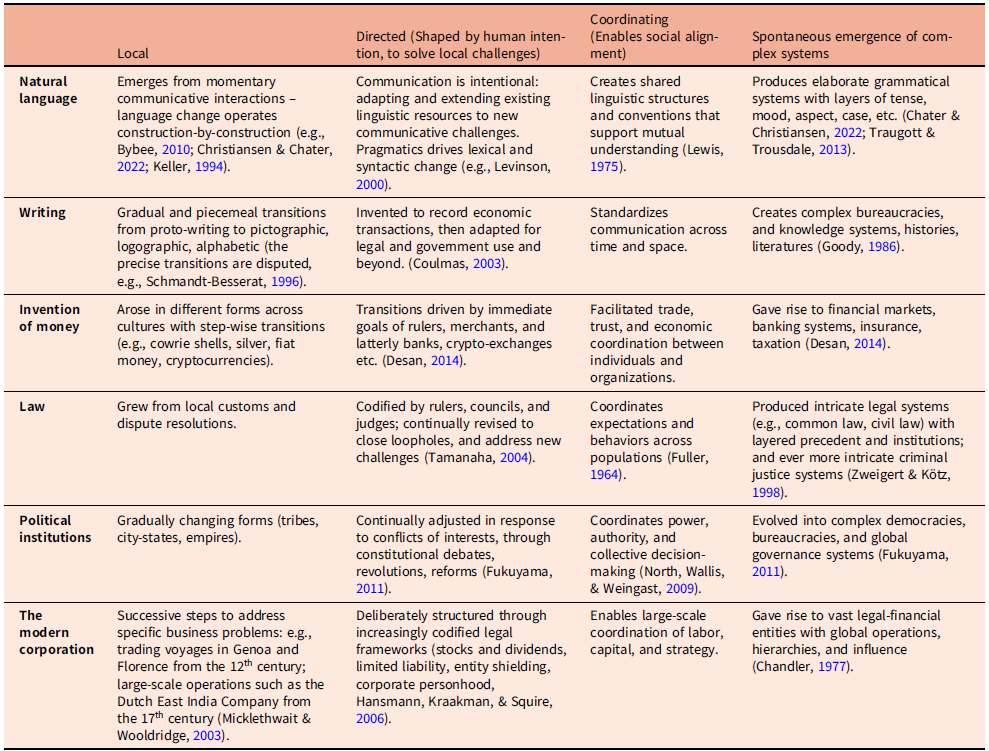
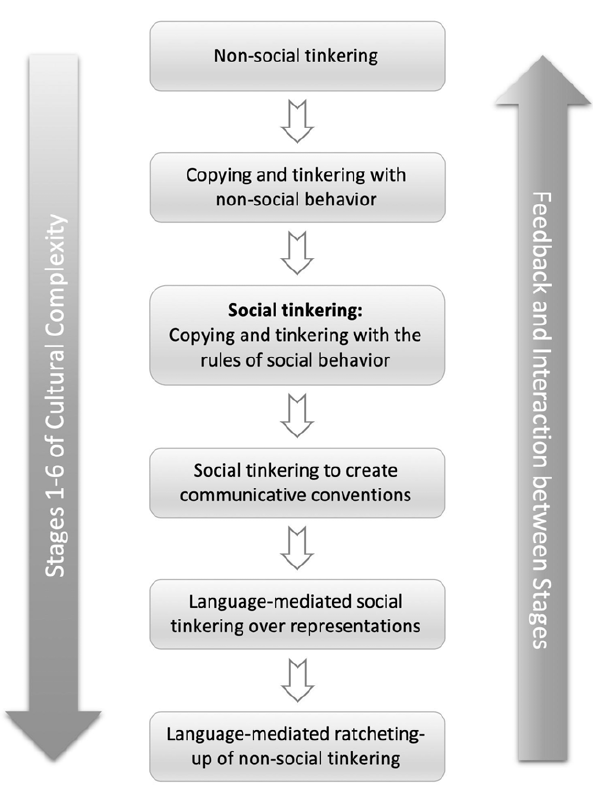



Target article
Social tinkering: The social foundations of cultural complexity
Related commentaries (25)
A lobbying theory of cultural evolution: Rhetoric, expediency, and self-interest promote inequality in the prescriptive grammar of complex institutions
Before social tinkering: Self‑organisation and collective social niches as foundations of cultural complexity
Beyond nearsighted and directed: Varied sources of cultural change
Beyond social tinkering: Toward a mechanistic and multilevel theory of cultural complexity
Cognitive practices and the transformation of the social tinkerer
Cooperative goals must be selected by groups before tinkering begins
Cultural complexity is multifaceted: Variations in social tinkering
From coordination to normativity in social tinkering
Gradual is not always so gradual
Normative commitments constrain the scope of cultural tinkering
Now we see the violence inherent in the tinkering
Sequence representation and cultural systems are necessary for cumulative culture
Social tinkering as a complex dynamical system
Social tinkering generates complexity, but also system-scale fragility and collective delusions
Social tinkering in designed environments
Social tinkering is not motivationally myopic
Social tinkering is real, but is it enough?
Stage fright: Why cultural evolution is diversification, not progression
The arts as engines of social tinkering: Variation generation, safe experimentation, and cognitive training
The cognitive scaffolding of tinkering: Directed innovation and strategic social transmission
The dark side of the sighted watchmaker: How retrospective tinkering builds cultural traps
The role of know-how copying in and beyond social tinkering
Tinkering beyond the present: The importance of future thinking for cultural complexity
Tinkering toward what? On the absence of fitness goals in cultural evolution
Tinkering with reflection and normativity: An action-based model for the emergence of complex social systems
Author response
Tinkering with social tinkering