



Congenital heart anomalies are the most common birth defects, with an estimated incidence of 1 in 110 live births in the United States of America. Reference Reller, Strickland, Riehle-Colarusso, Mahle and Correa1 Many of these anomalies require surgical or interventional management, and as a result, the number of adults living with adult congenital heart disease (CHD) is increasing. These patients are at an increased risk of developing cardiovascular disease, including arrhythmias, heart failure, and stroke. There was an observed heterogeneity in the prevalence of obstructive sleep apnoea, which ranged from 9 to 38 % and was higher among men. Reference Senaratna, Perret and Lodge2 It grew with age, reaching 90% in some old male groups and 78% in elderly female groups, middle-aged and older adults, overweight and obese individuals, and those with certain medical conditions, such as hypertension and diabetes. Reference Senaratna, Perret and Lodge2 Despite its high prevalence, the impact of obstructive sleep apnoea on in-hospital morbidity and mortality in young adults with adult CHD remains understudied. The pathophysiology of obstructive sleep apnoea in adult CHD is complex and multifactorial, involving anatomical abnormalities, altered ventilatory control, and endothelial dysfunction, which can exacerbate the underlying cardiovascular disease burden. Previous studies have mainly focused on the prevalence and risk factors of cardiovascular disease in adult CHD, with conflicting results regarding the association with adverse outcomes. Therefore, there is a need for large-scale studies to investigate the relationship between cardiovascular disease and cardiovascular outcomes in young adult CHD patients.
In this study, we aimed to assess the prevalence and impact of obstructive sleep apnoea on all-cause mortality, dysrhythmia, stroke, and resource utilisation in young adult CHD patients using the National Inpatient Sample 2019, a nationally representative database of inpatient hospitalisations in the United States of America. We also aimed to compare the demographic and clinical characteristics of adult CHD patients with and without obstructive sleep apnoea and identify potential risk factors for adverse outcomes. The findings from this study could help inform clinical practice and guide future research on the management of obstructive sleep apnoea in young adult CHD patients. Additionally, these findings can help inform future research and policy decisions related to the management of obstructive sleep apnoea in adult CHD patients.
Methods
The NIS databases of the Healthcare Cost and Utilization Project, sponsored by the Agency for Healthcare Research and Quality, were used to identify young adults (18–44 years) with adult CHD and obstructive sleep apnoea between January 2019 and December 2019. The National Inpatient Sample is the largest publicly accessible all-payer inpatient healthcare dataset in the United States of America, comprising data from more than 40 states and representing approximately 20% of all United States of America hospitals. We used the International Classification of Diseases, Tenth Revision, Clinical Modification (ICD-10-CM) codes to identify patients with adult CHD and obstructive sleep apnoea. Patients with adult CHD were identified by the presence of relevant ICD-10-CM codes (Q20-Q28, Q30-Q34) in the primary or secondary diagnosis fields. Patients with obstructive sleep apnoea were identified by the presence of ICD-10-CM code G47.33 in any of the secondary diagnosis fields. We excluded patients with missing data on age, sex, and race.
We used a propensity-matching approach to create two cohorts: the obstructive sleep apnoea cohort and the non-obstructive sleep apnoea cohort. The cohorts were matched in a 1:1 ratio based on age, sex, and race. We compared the two cohorts with respect to all-cause mortality, dysrhythmia, and stroke. Multivariable regression analyses were performed to control for relevant comorbidities, including traditional cardiovascular disease risk factors (e.g., hypertension, hyperlipidaemia, and diabetes), chronic obstructive pulmonary disease, hypothyroidism, and prior venous thromboembolism. We also compared the two cohorts with respect to resource utilisation measures, including length of stay, disposition at discharge, and total hospital charges.
Descriptive statistics were used to summarise the demographic and clinical characteristics of the study population. Continuous variables were reported as means ± standard deviations or medians (interquartile ranges), as appropriate. Categorical variables were reported as frequencies and percentages. Chi-square tests were used to compare categorical variables between the two cohorts, and Wilcoxon rank-sum tests were used to compare continuous variables between the two cohorts. Multivariable logistic regression analyses were used to assess the association between obstructive sleep apnoea and dysrhythmia, stroke, and all-cause mortality while controlling for relevant confounders. The results were reported as adjusted odds ratios with 95% confidence intervals. All analyses were conducted using IBM SPSS Statistics version 25.0 (IBM Corp., Armonk, NY, USA) with the incorporation of weighted data and complex survey modules. Categorical measures were analysed using the Pearson chi-square test, while the Mann–Whitney U-test was used for continuous variables. A p-value of < 0.05 was considered statistically significant, and due to the privacy guidelines of the Healthcare Cost and Utilization Project, cell sizes less than 11 were not reported.
Results
A total of 41,950 young adult CHD admissions were identified in the 2019 National Inpatient Sample, of which 6.3% (n = 2630) had obstructive sleep apnoea. After propensity matching, the obstructive sleep apnoea+ (n = 2590) and obstructive sleep apnoea− (n = 2590) cohorts were compared. Both cohorts had a comparable median age of 35 years and were predominantly male (63.1% versus 62.5%).
The demographic and clinical characteristics of the two cohorts are shown in Table 1. The obstructive sleep apnoea+ cohort had a higher proportion of patients with hypertension (complicated and uncomplicated), diabetes with and without chronic complications, hyperlipidaemia, obesity, chronic obstructive pulmonary disease, alcohol and drug abuse, hypothyroidism, arthropathies, and prior venous thromboembolism than the obstructive sleep apnoea− cohort. There was a higher proportion of patients with a median household income in the lowest quartile for patient ZIP code in the obstructive sleep apnoea+ cohort than the obstructive sleep apnoea− cohort. Importantly, the obstructive sleep apnoea+ cohort had a higher prevalence of traditional cardiovascular disease risk factors, such as chronic obstructive pulmonary disease, hypothyroidism, and prior venous thromboembolism, than the obstructive sleep apnoea− cohort.
Baseline characteristics, and comorbidities of hospitalisations in ACHD patients with vs. without OSA, 2019: 1:1 propensity-score matched analysis

ACHD = adult congenital heart disease; OSA = obstructive sleep apnea; VTE = venous thromboembolism.
P < 0.05 indicates statistical significance.
The adjusted odds ratio (aOR) for dysrhythmia was significantly higher in the obstructive sleep apnoea+ cohort (aOR 2.99, 95% CI 2.13–4.19, p < 0.001) than the obstructive sleep apnoea− cohort. However, there was no significant difference in the risk of all-cause mortality (adjusted OR 1.66, 95% CI 0.51–5.44, p = 0.421) or stroke between the two cohorts in the multivariable analysis controlled for relevant comorbidities (Table 2). In terms of patient disposition, there was a significant difference between the two cohorts (p < 0.001). The obstructive sleep apnoea+ cohort had a lower proportion of routine discharges and higher proportions of transfers to short-term facilities and home healthcare. The median length of stay was significantly longer in the obstructive sleep apnoea+ cohort (7 days) than the obstructive sleep apnoea− cohort (7 days) (p < 0.001). The median total charges were also significantly higher in the obstructive sleep apnoea+ cohort ($130,379) than the obstructive sleep apnoea− cohort ($124,093) (p < 0.001).
In-hospital outcomes of hospitalisations in ACHD patients with vs. without OSA, 2019: 1:1 propensity-score matched analysis
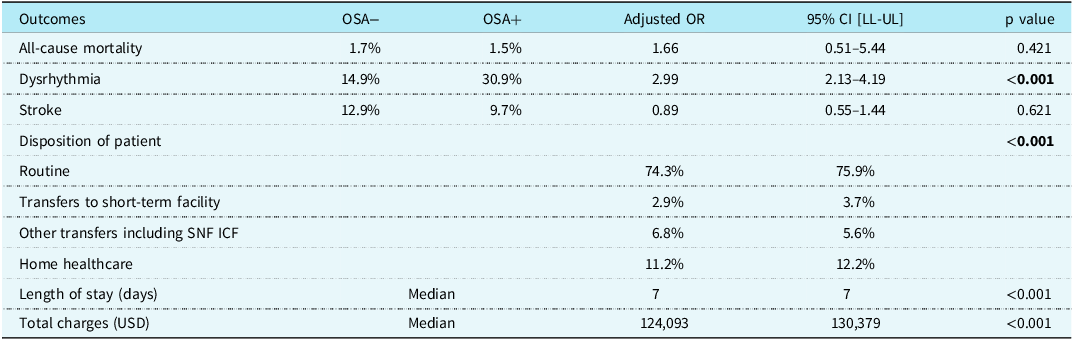
SNF = Skilled Nursing Facility; ICF = Intermediate Care Facility. P < 0.05 indicates statistical significance. Multivariable regression models were adjusted for baseline demographics, hospital level characteristics, and relevant cardiac and extra cardiac comorbidities: Age, sex, race, median household income national quartile for patient ZIP code, primary expected payer, elective versus non-elective admission, bed size of hospital, location/teaching status of hospital, region of hospital, acquired immune deficiency syndrome, alcohol abuse, arthropathies, metastatic cancer, solid tumor without metastasis, malignant, depression, hypertension, complicated, hypertension, uncomplicated, hyperlipidaemia, obesity, peripheral vascular disease, prior MI, prior PCI/CABG, drug abuse, chronic pulmonary disease, hypothyroidism, other thyroid disorders, prior TIA/Stroke, and prior VTE.
Discussion
Our study provides valuable insights into the prevalence and impact of obstructive sleep apnoea on cardiovascular disease outcomes in young adults with adult CHD. We found that obstructive sleep apnoea is a common comorbidity among young adult CHD patients, with a prevalence of 6.3%. This finding is consistent with previous studies that have reported a high prevalence of obstructive sleep apnoea in adult CHD. Reference Drake, Ginde and Cohen4 The presence of traditional cardiovascular disease risk factors, such as chronic obstructive pulmonary disease, hypothyroidism, and prior venous thromboembolism, was more frequent in adult CHD patients with obstructive sleep apnoea compared to those without obstructive sleep apnoea, highlighting the need for screening for these comorbidities in this population. A higher proportion of them were males compared to females. Research studies have repeatedly and consistently confirmed that obstructive sleep apnoea is more typical in men than women. Reference Park, Ramar and Olson3,Reference Drake, Ginde and Cohen4 The male-to-female ratio is estimated to be between 3:1 and 5:1 in the general population and between 8:1 and 10:1 in some clinical populations. Reference Young5,Reference Quintana-Gallego, Carmon-Bernal and Capote6
Our study also revealed a nearly threefold increased risk of dysrhythmia in adult CHD patients with obstructive sleep apnoea compared to those without obstructive sleep apnoea. This finding is in line with previous studies that have reported an association between obstructive sleep apnoea and cardiac arrhythmias. Reference Guilleminault, Connolly and Winkle7 The underlying mechanisms for this association remain unclear, but several factors, including vagal stimulation, sympathetic activation, intermittent hypoxia, sleep deprivation, and systemic inflammation, have been proposed. Reference Hersi8 Obstructive sleep apnoea-related hypoxaemia and hypercapnia may also contribute to the development of cardiac arrhythmias. Reference Hersi8
Despite the increased risk of dysrhythmia, our study did not find any significant impact of obstructive sleep apnoea on all-cause mortality and stroke in young adult CHD patients after controlling for relevant comorbidities. This finding is consistent with some previous studies that have reported no association between obstructive sleep apnoea and mortality or stroke in patients with adult CHD. However, other studies have reported conflicting results, with some showing an increased risk of mortality and stroke in adult CHD patients with obstructive sleep apnoea. Reference Giang, Fedchenko, Dellborg, Eriksson and Mandalenakis9,Reference Labarca, Dreyse and Salas10 The differences in study populations, sample size, and methods used to control confounding factors may account for these discrepancies.
When looking for a correlation with race, our study showed that more whites with adult CHD had obstructive sleep apnoea compared to other races such as blacks, Asians, Pacific Islanders, and native Americans. However, available literature suggests that obstructive sleep apnoea is more common among African Americans, Hispanics, and Pacific Islanders. This may be due to differences in anatomical features, such as airway size and shape, as well as differences in lifestyle factors such as obesity and smoking. Reference Redline, Tishler, Hans, Tosteson, Strohl and Spry11,Reference Patel and Hu12 Similarly, adult CHD can also vary in prevalence and severity among different racial and ethnic groups. Cardiovascular disease is another risk factor for obstructive sleep apnoea in adult CHD patients. A study by Somers et al. has shown that obstructive sleep apnoea is associated with an increased risk of hypertension, cardiovascular disease, stroke, and other cardiovascular disease complications. Reference Somers, White and Amin13 Our study also suggested that cardiovascular risk factors such as complicated hypertension, diabetes mellitus, and hyperlipidaemia were also predominantly present in the cohort with obstructive sleep apnoea. Hypothyroidism was also found to be associated with obstructive sleep apnoea. Our study also found that there was a significant association between obstructive sleep apnoea in adult CHD patients with alcohol abuse and drug abuse. Obstructive sleep apnoea is often underdiagnosed, and sleep disordered breathing is prevalent in a wider population, including adult men and women. Reference Young, Palta, Dempsey, Skatrud, Weber and Badr14 It is a common notion that obstructive sleep apnoea is associated with the elderly population and the overweight population, but the adult normal weight population is often overlooked. A study by Harada et al. showed a high prevalence of sleep apnoea in adult patients with CHD. A high prevalence of sleep apnoea may be associated with its unique haemodynamics. Reference Young, Palta, Dempsey, Skatrud, Weber and Badr14 A study by Tom Carlisle and team suggested the key finding that overnight, neck circumference increased, indicating fluid shift due to pressure changes, and this was accompanied by an overnight rise in pharyngeal collapsibility measured during sleep and a decrease in pharyngeal diameter. Reference Carlisle, Ward, Atalla, Cowie, Simonds and Morrell15 These factors causing haemodynamic changes are more prone in patients with adult CHD and thus suggest a connecting link between adult CHD and obstructive sleep apnoea.
In addition to the impact on clinical outcomes, our study also highlighted the economic burden associated with obstructive sleep apnoea in young adult CHD patients. We found that adult CHD patients with obstructive sleep apnoea had higher transfers to short-term facilities, prolonged stays, and higher charges than those without obstructive sleep apnoea. These findings are consistent with previous studies that have reported higher healthcare utilisation and costs in patients with obstructive sleep apnoea. The increased healthcare utilisation and cost associated with obstructive sleep apnoea underscore the need for effective screening, diagnosis, and treatment of this comorbidity in young adult CHD patients.
Our study analysed several important factors predisposing to obstructive sleep apnoea and outcome of adult CHD patients who developed obstructive sleep apnoea, but the study has several limitations that need to be considered. First, the study relied on administrative data, which may be subject to coding errors and inaccuracies. Second, the study is limited to in-hospital outcomes, and long-term outcomes could not be evaluated. The NIS data are inpatient administrative data that relies on ICD-10 codes for disease classification. The study could not analyse subtypes of adult CHD because of the limitations of secondary data analysis. Third, the study design is observational, and causality cannot be established. Fourth, the study is limited to young adults with adult CHD, and the findings may not be generalisable to other age groups or populations.
Conclusions
In conclusion, our study highlights the high burden of traditional cardiovascular disease comorbidities and the increased risk of dysrhythmia associated with obstructive sleep apnoea in young adults with adult CHD. The economic burden associated with obstructive sleep apnoea underscores the need for effective screening, diagnosis, and treatment of this comorbidity in young adult CHD patients. Early detection and treatment of obstructive sleep apnoea in this subset of the population is essential for improving clinical outcomes and quality of life. An important aspect of this step would also be to understand the complexity of the underlying heart disease and its interactions with obstructive sleep apnoea and other comorbidities. Further studies are needed to elucidate the mechanisms underlying the association between obstructive sleep apnoea and dysrhythmia and to evaluate the long-term outcomes associated with obstructive sleep apnoea in adult CHD patients. These findings may have important implications for the management and follow-up of young adults with adult CHD and obstructive sleep apnoea.
Acknowledgements
None.
Author contribution
Ankit Vyas and Rupak Desai equally contributed to this work.
Financial support
None.
Competing interests
None.



