Milk proteins are rich sources of bioactive peptides such as angiotensin I-converting enzyme (ACE)-inhibitory, opioid, immune-stimulating, antimicrobial, and cholesterol-lowering peptides (Meisel, Reference Meisel1997). Peptides that inhibit ACE (a peptidyl-dipeptide hydrolase) have been isolated extensively from bovine casein hydrolysate and whey proteins (Maruyama & Suzuki, Reference Maruyama and Suzuki1982; Kohmura et al. Reference Kohmura, Nio and Ariyoshi1990; Yamamoto et al. Reference Yamamoto, Akino and Takano1994; Nakamura et al. Reference Nakamura, Yamamoto, Sakai, Okubo, Yamazaki and Takano1995; Maeno et al. Reference Maeno, Yamamoto and Takano1996; Mullally et al. Reference Mullally, Meisel and Fitz Gerald1997). This enzyme has been associated with the renin-angiotensin system that regulates peripheral blood pressure through converting the decapeptide angiotensin I to a potent vasoconstrictor angiotensin II (an octapeptide). It also inactivates the vasodilator nonapeptide bradykinin, and encephalin (Mullally et al. Reference Mullally, Meisel and Fitz Gerald1997). Therefore, inhibition of ACE is regarded as a medical approach to reduce blood pressure.
Enzyme-modified cheese (EMC) is produced by enzymatic hydrolysis of cheese curd to enhance its flavour. EMC is added into foods at levels of 0·1–2·0% to provide dairy or cheesy notes and reduce the requirement for aged cheese in food formulations (Moskowitz & Noelck, Reference Moskowitz and Noelck1986). For EMC production, cheese curd is traditionally digested by a combination of proteolytic and lipolytic enzymes. The procedure may, however, result in hydrolysis and inactivation of the lipolytic enzyme(s) by accompanying proteolytic counterpart(s). Therefore, a multi-stage process initiated by proteolysis, mediated by heat treatment and finished by lipolysis has been developed (Kilcawley et al. Reference Kilcawley, Wilkinson and Fox2006). Release of free fatty acids upon lipolysis contributes considerably to the flavour development in EMC (Noronha et al. Reference Noronha, Cronin, O'Riordan and O'Sullivan2008). It has been recommended to employ peptidases in EMC preparation in order to negate bitterness development that arises from the use of broad specificity proteases (Azarnia et al. Reference Azarnia, Lee, Yaylayan and Kilcawley2010). Proteolysis/peptidolysis could also release bioactive peptides from parent protein sequences. Haileselassie et al. (Reference Haileselassie, Lee and Gibbs1999) used aminopeptidase enzymes in combination with a commercial protease to obtain an EMC with ACE-inhibitory property. Thereafter, Tonouchi et al. (Reference Tonouchi, Suzuki, Uccida and Oda2008) isolated two β-casein-derived ACE-inhibitory and antihypertensive peptides from the cheese curd digested by a mixed preparation of proteolytic/peptidolytic enzymes including Flavourzyme (EC. 3·4·11·1). Flavourzyme is an enzyme obtained from Aspergillus oryzae and shows both endoprotease and exopeptidase activities (Madadlou et al. Reference Madadlou, Iacopino, Sheehan, Emam-Djomeh and Mousavi2010; Feng et al. Reference Feng, Qiao, Zou, Huang, Kang and Zhou2014). Although a few reports were available about bioactive EMC, it was of interest for the authors to carry out a systemic and more comprehensive study on the optimisation of bioactive EMC preparation procedure.
EMC paste can be dried (Kilcawley et al. Reference Kilcawley, Wilkinson and Fox2000) to extend the shelf life and for simpler transport. Cheese powder is mainly used in dips, dressings, biscuits, and chips and directly as flavouring on hot dishes like spaghetti and soups (Písecký, Reference Písecký2005). Spray drying is very commonly used in food and flavour industries to produce dry products (Reineccius, Reference Reineccius2004) due to its low cost and availability of equipment (Aghbashlo et al. Reference Aghbashlo, Mobli, Madadlou and Rafiee2013). The first objective of the present study was optimisation of the digestion process of Iranian white cheese curd for obtaining as much ACE-inhibitory peptides as possible EMC paste. Response surface method (RSM) was exploited for process optimisation. For this purpose, Flavourzyme concentration, and hydrolysis temperature and time were considered as independent variables. Subsequently, a spray drying process was optimised to dry the EMC which underwent an elementary characterisation.
Materials and methods
Materials
Full fat milk (12·2% dry matter, 3·3% protein, 3·4% fat, and pH 6·89) was obtained from the dairy pilot plant of the University of Tehran, and used for cheese curd preparation. ACE from rabbit lung, hippuric acid, ethyl acetate, hippuryl-histidyl-leucine (Hip-His-Leu, substrate for ACE) and boric acid were procured from Sigma-Aldrich (Dorset, UK). Flavourzyme 1000 l and Palatase 20 000 l (EC 3·1·1·3) were gifts from Novozymes (Bagsværd, Denmark). Bulk set culture (DM 230 LYO 1000 l, Danlac Canada Inc., Alberta, Canada) containing Lactococcus lactis subsp. cremoris and Lactococcus lactis subsp. lactis was used as starter. Meito Microbial Rennet (Meito Sangyo Co. Ltd., Tokyo, Japan), a mixture of coagulants produced by the fungi Rhizomucor pusillus and Rhizomucor miehei were used as milk coagulant. All other chemicals were purchased from Merck (Darmstadt, Germany).
Cheese curd making procedure
Iranian white cheese curd was produced according to the method by Madadlou et al. (Reference Madadlou, Khosroshahi, Mousavi and Djome2006) with some modifications. Fresh raw milk (5 kg) was batch pasteurised at 64 °C for 30 min in a stainless steel container placed in a water bath, cooled to 37 °C and supplemented with 1·5% starter culture. The milk was held at 37 °C for approximately 60 min for starter maturation before rennet addition. The curd was cut crossways in cubes when firm (after approximately 30 min) and allowed to settle for 3–5 min and then gently agitated for 10 min. Subsequently, the curds were pressed for 1 h (20 kg weights/30 kg final curd) and then mixed to a homogenous mixture for EMC preparation using a house mixer.
Chemical analysis of cheese
The pH of milk and cheese curd samples was measured using a digital pH-meter (microprocessor pH meter, model pH 537 WTW, Germany). Total solids of milk were determined by drying 8–11 g of milk at 100 °C for 5 h (Madadlou et al. Reference Madadlou, Khosroshahi, Mousavi and Djome2006). Cheese was analysed for moisture content by vacuum-oven and for ash content by dry ash method (AOAC, 1997). The fat content of milk and cheese samples was determined by the Gerber method (James, Reference James1995). Their total protein contents were determined by measuring total nitrogen using the Kjeldahl method (AOAC, 1997) and converting it to protein content by multiplying by 6·38. All chemical measurements were done in triplicate.
Experimental design and statistical analysis of EMC production and drying
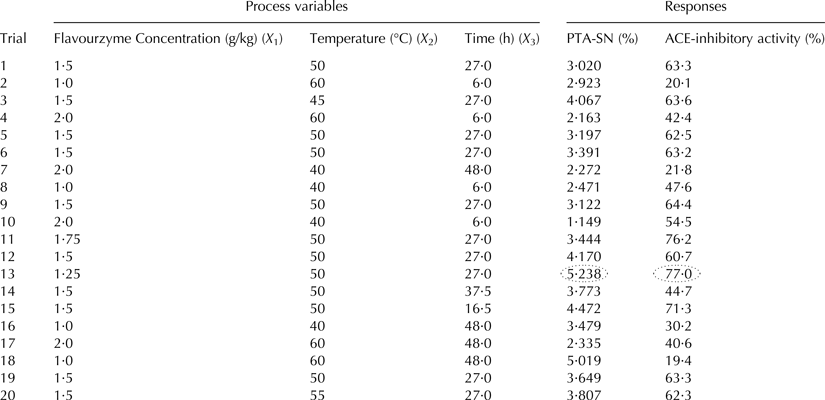
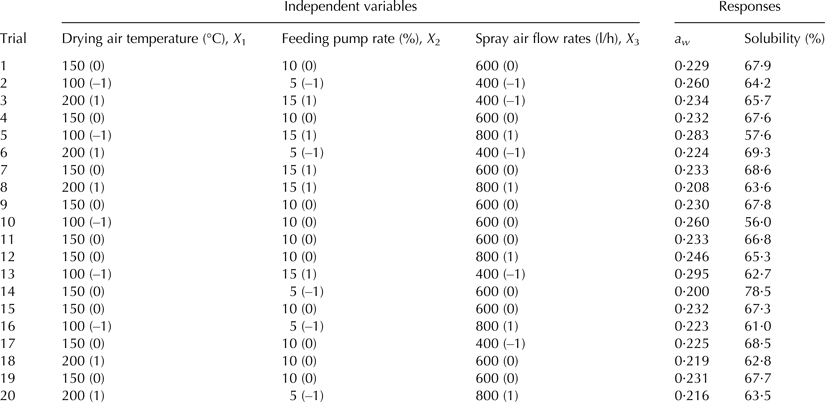
An inscribed 5-level-3-factor central composite design (CCD) with 8 cube points, 6 centre points in cubes, 6 axial points and 0 centre point in axial was designed for the EMC preparation stage and a 3-factor face-centered CCD with 8 cube points, 6 centre points in cubes, 6 axial points and 0 centre point in axial was designed for the EMC drying stage by Minitab software (version 14, Minitab Inc., PA, USA). These designations generated 20 trials at each stage. It is noteworthy that the face-centered CCD requires carrying out the experiments at only three levels for each variable which makes the design simpler to perform. Flavourzyme concentration (1–2 g/kg), incubation temperature (40–60 °C) and incubation time (6–48 h) were independent variables of EMC preparation process based on literature survey (Kilcawley et al. Reference Kilcawley, Wilkinson and Fox1998) and authors experience (Amighi et al. Reference Amighi, Emam-Djomeh and Madadlou2013). The EMC's ACE-inhibitory activity was the measured response. After model verification for the ACE-inhibitory EMC paste production, the sample with the strongest inhibitory activity was spray-dried to powder. The inlet drying air temperature (100–200 °C), feeding pump power (5–15%), and spraying air flow rate (400–800 l/h) were selected as independent variables of EMC paste drying. The responses measured were solubility and water activity (a w) of powder. Tables 1 and 2 give the coded values corresponding to the natural values of each independent variable and central composite design of experiments.
Central composite rotatable design with experimental values of response variables for ACE-inhibitory EMC

Central composite design with experimental values of response variables for ACE-inhibitory EMC powder
The response function (Y), which includes linear, quadratic, and interactive components, was fitted to the experimental data. In this study a second-order polynomial equation was used because of curvature in the system. A generally fitted second-order model is as follows:
 $$Y = {\rm \beta}_{0} \!+\! \sum\nolimits_{i = 1}^{k} {{\rm \beta}_{i}} X_{i} + \sum\nolimits_{i = 1}^{k} {{\rm \beta}_{ii}} X^{2}\,_{i} +\! \sum {\sum\nolimits_{i \lt j} {{\rm \beta}_{ij} X_{i} X_{\,j} + {\rm \varepsilon}}} $$
where Y represents the generated response; β0, βi, βii, and βij are constant and regression coefficients of the model; X i and X j are independent variables; k is number of levels; and ε represents the error or noise observed in the response y.
The significance of values in the polynomial model was judged statistically by analysis of variance (ANOVA) at a probability (P) of 0·05. SPSS statistical software version 17·0 for windows (SPSS Inc., Chicago, IL, USA) was applied to analyse the data. Student's t-test at 5% significance level was employed to examine the significant differences amongst means.
Optimum proteolysis-peptidolysis condition and spray-drying of EMC paste were determined using a desirability function method (Derringer & Suich, Reference Derringer and Suich1980):
 $$D\, = \,(d_1 ^{r{\rm 1}} \times {\rm} d_{\rm 2} ^{r{\rm 2}} \times {\rm} d_{\rm 3} ^{r{\rm 3}} \times \ldots \times {\rm} d_n ^{rn} )^{{\rm 1}/} \Sigma _i r$$
where d i is the desirability index (d i = 0 least desirable; d i = 1 most desirable) and r i is the relative importance of each response. The aim of optimisation at the stage of EMC preparation was achieving the highest ACE-inhibitory whilst that of EMC drying was the lowest a w value and greatest degree of solubility. Accordingly, desirability indices of 0·933, 0·937 and 0·892 were acquired for ACE-inhibitory, a w and the degree of solubility, respectively. The importance of the two responses sought at the EMC drying stage was considered equal.
EMC production process and analyses
EMC production
Before preparation of EMC, all utensils were autoclaved at 121 °C for 15 min. Cheese curd (31·95% dry matter, 15·6% fat, 3·7% ash, 14% protein, and pH value 6·82) was used for EMC production. Pieces of fresh cheese curd (65 g) were blended with 32·8 ml distilled water, 1 g di-sodium hydrogen phosphate, 0·5 g tri-sodium phosphate, 0·5 g tri-sodium citrate and 0·2 g potassium sorbate to a homogeneous paste using a glass stirrer. The slurry was heated at 80 °C for 20 min, then cooled to 50 °C and stored at –18 °C until required. Flavourzyme was added to the cheese slurry at several concentrations, and incubated for the predetermined time intervals at fixed temperatures while shaken at 200 rpm. Proteolysis was stopped by heating the cheese slurry at 80 °C for 20 min. The optimum hydrolysis condition was determined based on the maximum ACE-inhibitory achieved. Subsequently slurry with the highest ACE-inhibitory was further hydrolysed by the lipolytic enzyme Palatase (3 g/kg) by incubation at 34 °C for 16 h followed by heating at 80 °C for 20 min to inactivate the enzyme. The EMC paste was cooled to 50 °C and stored at –18 °C until analysed.
Proteolysis assessment
Proteolysis was monitored by measuring the percentage of 5% phosphotungstic acid-soluble nitrogen (PTA–SN) (Stadhouders, Reference Stadhouders1960; Kuchroo & Fox, Reference Kuchroo and Fox1982). Nitrogen was determined by the macro-Kjeldahl method. For determination of PTA-SN, 10 ml water soluble extract (WSE) of EMC paste was added to a mixture of 7 m sulphuric acid (3·95 m) and 3 ml phosphotungstic acid (330 g/l). The resultant mixture was equilibrated overnight at 4 °C and filtered through Whatman No. 42 filter paper (Tavaria et al. Reference Tavaria, Franco, Carballo and Malacta2003). For WSE preparation, 20 g EMC paste was centrifuged at 3000 g for 30 min at 4 °C and supernatant was filtered through Whatman filter paper No. 42 (Kuchroo & Fox, Reference Kuchroo and Fox1982). The WSE of spray-dried powder for ACE-inhibitory measurement was obtained by rehydration of powder for 1 h at 40 °C and subsequent centrifugation-filtration steps.
ACE-inhibitory measurement
The ACE-inhibitory activity of WSE was measured according to the methods of Cushman & Cheung (Reference Cushman and Cheung1971) modified by Hernandez-Ledesma et al. (Reference Hernandez-Ledesma, Recio, Ramos and Amigo2002) and Madadlou et al. (Reference Madadlou, Sheehan, Emam-Djomeh and Mousavi2011). The method is based on the liberation of hippuric acid from Hip–His–Leu catalysed by ACE. First, 225 µl borate solution (100 mm, pH 8·3) containing 5 mM Hip-His-Leu and 300 mm NaCl was incubated with 25 µl WSE (4% protein content) at 37 °C for 5 min. Then 50 µl ACE solution (4 mU/ml) was added and incubation continued for other 30 min. The reaction was stopped by adding 50 µl 1 m HCl. The ACE-produced hippuric acid was extracted with 900 µl ethyl acetate and, after removal of ethyl acetate by evaporation at 95 °C for 15 min hippuric acid was redissolved in distilled water and measured spectrophotometrically at 228 nm. A control was prepared by substituting WSE of samples with that of cheese curd in the assay. Samples activity was calculated according to the following equation:
 $${\rm ACE} - {\rm inhibitory \,(\% )} = \left[ {\displaystyle{{HA_{{\rm control}} - HA_{{\rm sample}}} \over {HA_{{\rm control}}}}} \right] \times 100$$
EMC drying process
A Mini Spray Dryer (BUCHI, B-191, Laboratory-Techniques Ltd, Flawil, Switzerland) with a concurrent air flow was used for spray drying. The dryer was equipped with a two-fluid internal mixing nozzles (0·7 mm diameter). The drying air was circulated through the chamber by the aspirator motor. The amount of heated drying air could be increased up to 35 m3/h or decreased by regulating the aspirator speed. The heated air temperature could be set on the control panel up to 220 °C. The outlet drying air temperature was monitored on the control panel by PT 100 thermocouple. The feeding pump power regulated the inlet mass of EMC paste into the chamber and could be set up to 100% on the device. The spraying air flow rate is the amount of compressed air needed to disperse the solution, emulsion or suspension and it could be set on the device up to 800 l/h and corresponding air pressure up to 8 kPa. Before each experiment, the dryer was run with distilled water for 10 min in order to achieve the desirable steady-state conditions. EMC was dried at various inlet drying air temperatures (100–200 °C), feeding pump powers (5–15%) and spraying air flows (400–800 l/h). The gathered powder was weighed and stored in airtight glass vessels till analyses.
EMC powder analyses
Powder solubility and a w
EMC powder solubility was measured according to the Eastman & Moore (Reference Eastman and Moore1984), with some modifications. For this purpose, 0·5 g powder was hydrated with 50 ml distilled water and vortexed strongly for 5 min followed by centrifugation at 7500 g for 10 min. The obtained supernatant was dried at 105 °C for 5 h. EMC powder solubility was calculated by weight difference (Eastman & Moore, Reference Eastman and Moore1984; Cono-Chauca et al. Reference Cono-Chauca, Stringheta, Sardagna and Cal-Vidal2004).
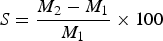 $$S = \displaystyle{{M_2 - M_1} \over {M_1}} \times 100$$
where S, M 1 and M 2 are the solubility of powder, weight of empty container and weight of container with sample after removing from oven, respectively. The a w of EMC powder was measured using a water activity-meter (Novasina, Switzerland) with ±0·001 sensitivity at 20 °C. All analyses were performed in triplicate.
Glass transition temperature of EMC powder
Glass transition temperature (Tg) of EMC powder was measured according to Grabowski et al. (Reference Grabowski, Truong and Daubert2006) with some modifications. A differential scanning calorimeter (DSC Pyris 6, Perkin Elmer Co. USA) equipped with Pyris thermal analysis station with Infinity PRO software (version 4.2·64) was calibrated using mercury. Approximately 2 mg sample was prepared in aluminium pans. The heating programme increased sample temperature in an atmosphere of nitrogen gas from –20 to 200 °C at 10 °C/min. An empty pan was used as a reference. The glass transition midpoint value was calculated as the average of the onset and end points values and is reported as the glass transition temperature (Shrestha et al. Reference Shrestha, Ua-arak, Adhikari, Howes and Bhandari2007).
Results and discussion
EMC preparation procedure
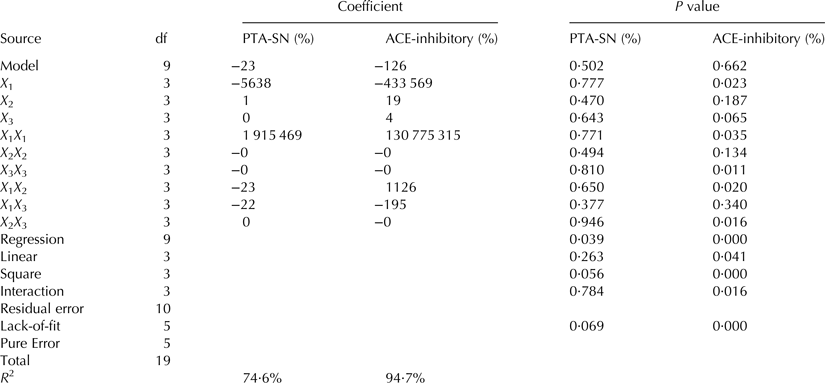
The values of the responses of interest for each trial are given in Table 1. Maximum ACE-inhibitory (77·0%) was obtained by Flavourzyme concentration of 1·25 g/kg, incubation temperature of 50 °C, and incubation time of 27 h. This hydrolysis condition also yielded highest PTA-SN content in EMC (Table 1). PTA-SN indicates secondary proteolysis and is comprised of amino acids and small peptides (Feeney et al. Reference Feeney, Guinee and Fox2002). Based on the statistical analysis of data (Table 3) the following equation was obtained which is an empirical relationship between the ACE-inhibitory activity of EMC and the independent variables studied:
 $$\eqalign{Y = & -{\rm 126}-{\rm 433569}X_1 + {\rm 19}X_2 + {\rm 4}X_3 + {\rm 130775315}X_{\rm 1} ^{\rm 2} \cr & + {\rm 1126}X_{\rm 1} X_{\rm 2} -{\rm 195}X_{\rm 1} X_{\rm 3}}$$
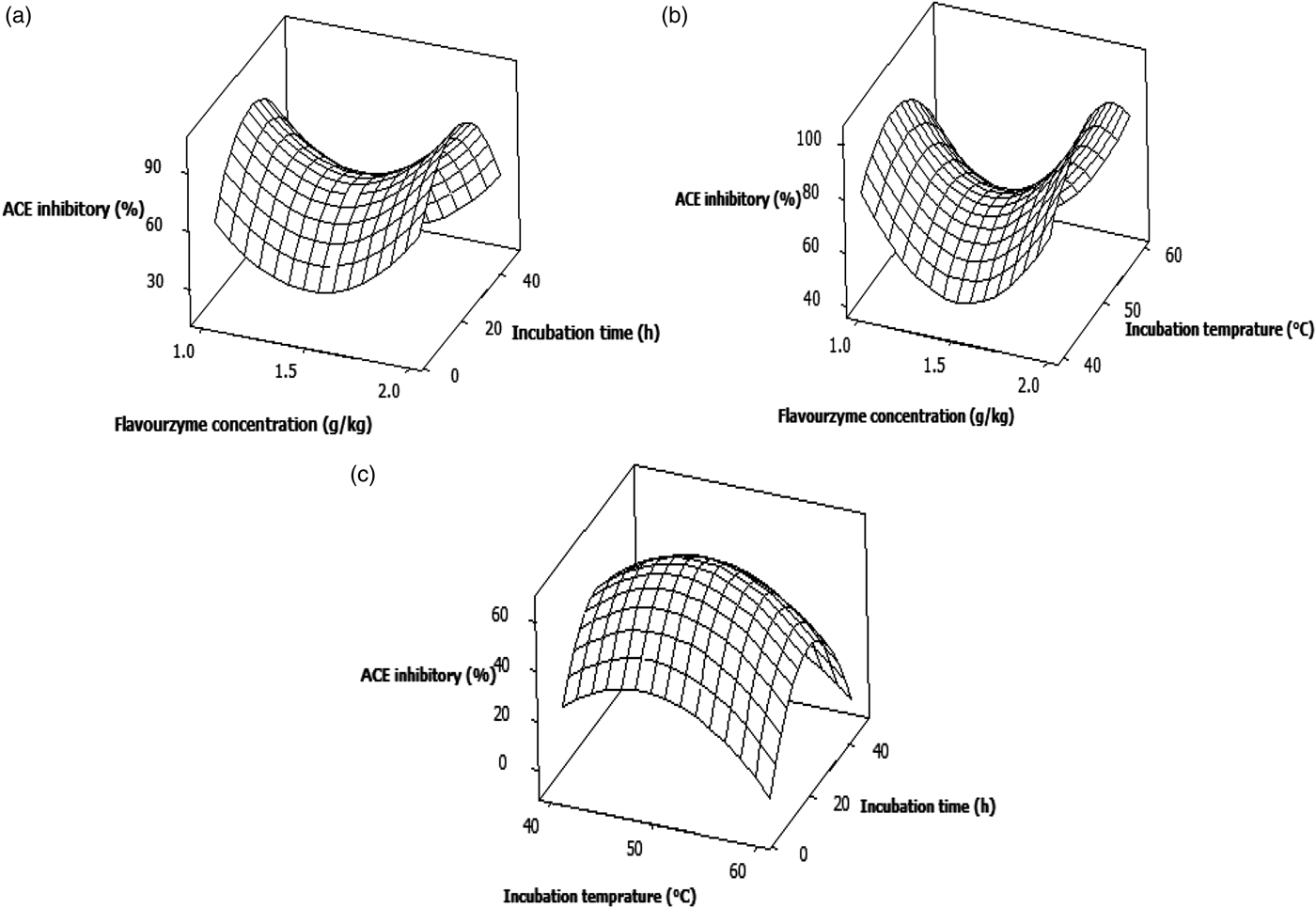
where Y is the ACE-inhibitory activity and X 1, X 2, and X 3 are the coded values of the variables. The smaller the magnitude of P value, the more significant the corresponding term (Bayraktar, Reference Bayraktar2001). Thus, the ACE-inhibitory of EMC was dependent on proteolytic-peptidolytic enzyme (Flavourzyme) concentration (variable X 1), and independent of the linear term of hydrolysis temperature (variable X 2) and its quadratic coefficient (Table 3). The quadratic coefficients of Flavourzyme concentration and incubation time (X 12, X 32, respectively) and their interactions with hydrolysis temperature (X 1X 2 and X 2X 3) showed statistical significance. The significant effect of the interaction of variables suggests that peptide generation in EMC was a multi-variable dependent process and it is possible to optimise the ACE-inhibitory property of EMC through controlled proteolysis. The linear term of Flavourzyme concentration (X 1), second order term of incubation time (X 32) and hydrolysis temperature–time interaction (X 2X 3) had negative effects on ACE-inhibitory (i.e. ACE-inhibitory decreases); whilst second order term of Flavourzyme concentration (X 12) and Flavourzyme concentration–hydrolysis time interaction (X 1X 3) had positive effects. The negative effect of the linear term of Flavourzyme concentration on ACE-inhibitory is represented in response surface plots (Fig. 1) which highlights the relationship between variables and the response. It is observed that ACE-inhibitory of EMC decreased as Flavourzyme concentration increased to a definite value after which further increase in Flavourzyme concentration increased the ACE-inhibitory activity. The latter trend is related to the positive influence of quadratic coefficient of Flavourzyme concentration.
Surface plots for EMC ACE-inhibitory as function of: (a) Flavourzyme concentration (X 1) and incubation temperature (X 2), (b) Flavourzyme concentration (X 1) and incubation time (X 3), (c) incubation temperature (X 2) and incubation time (X 3).
ANOVA table showing the variables as linear, quadratic, and interaction terms on each EMC preparation response variable and coefficients for the prediction models
P value <0·05 is significant at α = 0·05.
Lack of fit is not significant at P value >0·05.
The R 2 value of ACE-inhibitory regression model indicates that a great fraction (94·7%) of variation in the ACE-inhibitory property of EMC could be explained and was affected by the independent variables. The R 2 value of PTA-SN content regression model was however low and this response was not influenced by the variables (Table 3). It is argued that proteins were digested rapidly to PTA-soluble fractions during the first hours of proteolytic-peptidolytic hydrolysis and therefore this parameter was not influenced by the variables in the ranges employed.
The criteria applied for graphical optimisation included maximum ACE-inhibitory activity. Accordingly, optimum hydrolysis conditions were established as 1 g/kg, 48·3 °C and 25·3 h for Flavourzyme concentration, incubation temperature and incubation time, respectively. Subsequently, an EMC paste sample was prepared in triplicate by following the predicated optimum condition and analysed for ACE-inhibitory activity. Results of one sample t-test of experimental and predicted value, as reported in Table 4 highlighted insignificant differences between experimental and predicated results.
Experimental and predicted result for ACE-inhibitory activity of the EMC prepared at optimum condition
EMC drying procedure
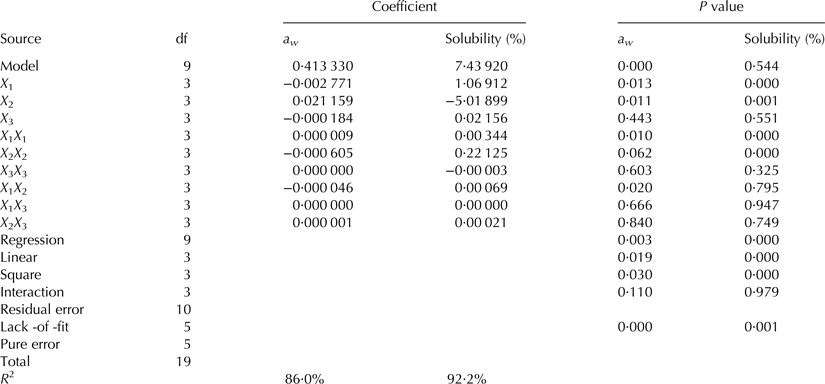
An EMC paste sample was prepared by employing the optimum condition found in the previous section and fed into spray dryer at various conditions. Spray-dried powder was collected and analysed for a w and the degree of solubility. It is generally accepted that at a w values lower than 0·25 food powders are stable during conventional storage (Kumar & Mishra, Reference Kumar and Mishra2004). Drying by inlet air temperature of 150 °C, feed flow rate of 5% and air flow rate of 600 l/h yielded an EMC powder with the lowest a w i.e. 0·20. The powder produced in that condition was also the most soluble amongst all treatments (Table 2). ANOVA (Table 5) revealed that a w was influenced significantly (P < 0·05) by the linear effect of inlet drying air temperature and feed flow rate, as well as by the quadratic effect of drying air temperature and its interaction with feed flow rate. The linear term of inlet drying air temperature had an inverse relation with water activity, which is attributed to the enhanced moisture removal from atomised droplets of paste during drying.
ANOVA table showing the variables as linear, quadratic, and interaction terms on each EMC powder response variable and coefficients for the prediction models
X 1 = drying air temperature, X 2 = feeding pump power (feed flow rate), X 3 = Spraying air flow rate.
P value <0·05 is significant at α = 0·05.
Lack of fit is not significant at P value >0·05.
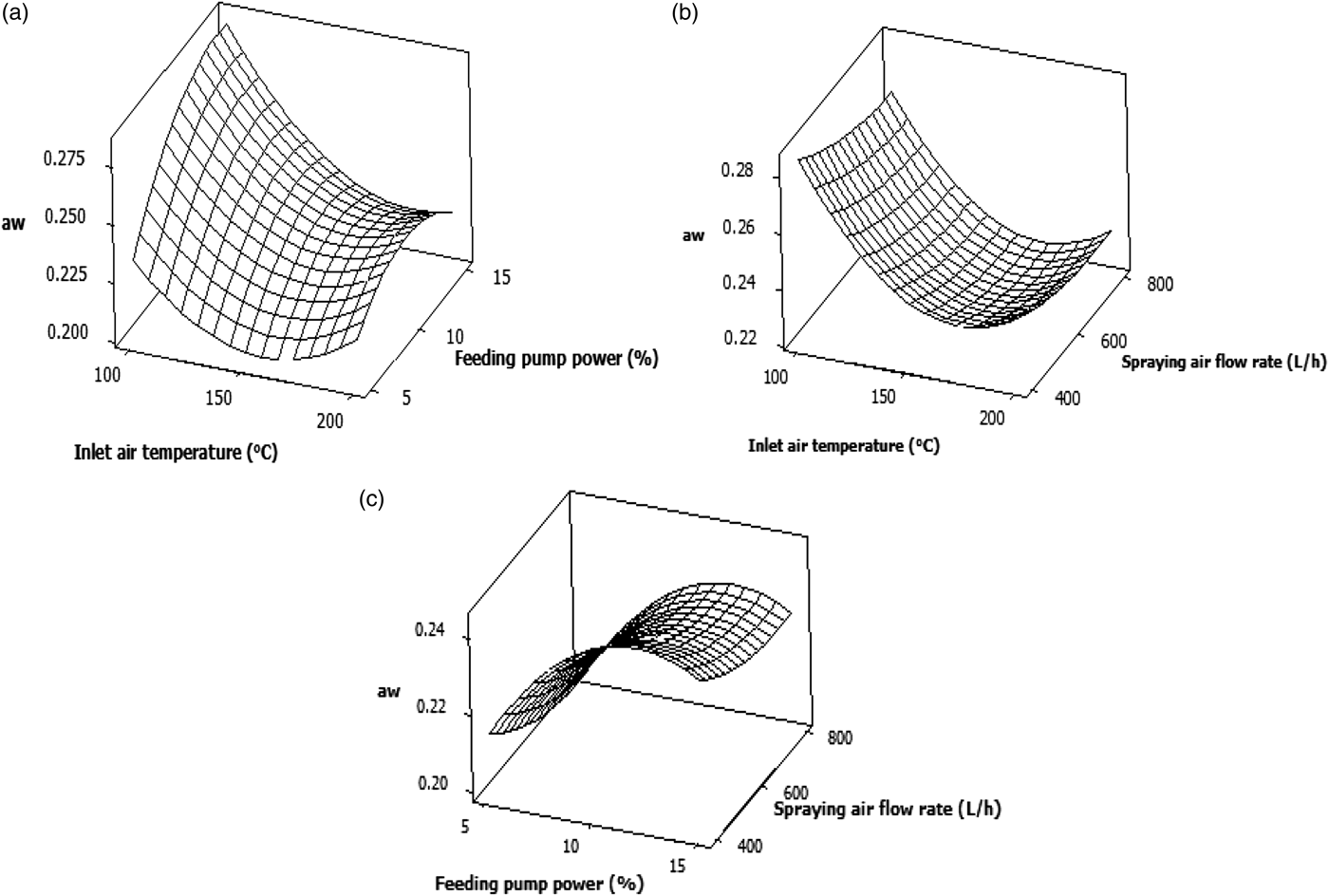
It is observed in surface plots (Fig. 2) that higher inlet drying air temperatures and feed flow rates decreased and increased the water activity of powder, respectively. The R 2 value of the regression model for a w of ACE-inhibitory EMC powder was 86% (Table 5), which is sufficiently accurate for prediction purposes.
Surface plots for EMC powder a w as function of: (a) inlet drying air temperature (X 1) and feed flow rate (X 2), (b) inlet drying air temperature (X 1) and spraying air flow rate (X 3), (c) feed flow rate (X 2) and spraying air flow rate (X 3).
Most powdered foods are intended for rehydration instantly and disperse/dissolve easily without lumps (Hogekamp & Schubert, Reference Hogekamp and Schubert2003). The degree of solubility degree of the EMC powders varied greatly from a minimum of 56·0% to a maximum of 78·5%. The maximum powder solubility was obtained by spray drying at an inlet air temperature of 150 °C, feed flow rate of 5% feeding pump power, and spraying air flow rate of 600 l/h (Table 2). Results of ANOVA (Table 5) indicate that solubility was dependent on linear terms of X 1 (inlet drying air temperature), and X 2 (feed flow rate). Also, the quadratic coefficients of X 1 and X 2 and were independent from variable X 3 (spraying air flow rate). It is also evident that interaction between all pairs of variables did not influence the powder solubility (P > 0·05), whilst X 1 coefficient indicates that higher inlet drying air temperatures increased the powder solubility significantly. In general, higher inlet drying air temperatures cause severe denaturation of proteins and hence adversely affect solubility (Al-khatani & Hassan, Reference Al-khatani and Hassan1990). However, the EMC paste was composed mostly of short and medium chain peptides rather than proteins. Peptides do not possess highly ordered secondary and tertiary structures and, therefore, did not undergo heat denaturation. The increased solubility of EMC powder with increasing inlet drying air temperatures is related to the lower moisture content of powders dried at higher temperatures. Goula & Adamopoulos (Reference Goula and Adamopoulos2005a) stated that powder solubility is influenced by the moisture content and operational parameters of the dryer; the lower the moisture content, the more soluble the powder becomes. Lower humidity of the drying air at higher temperatures increases the drying rate and results in rapid case hardening, which in turn decreases particle adhesion. Therefore, powder particles absorb water quicker upon the subsequent hydration. In accordance to the results obtained in the present study, Nurnazihah (Reference Nurnazihah2009) reported that solubility and dissolution of spray-dried pineapple juice powder increased with increase in inlet drying air temperature.
Three EMC powders dried by different drying air temperatures (100, 150 and 200 °C) with identical feeding pump rates of 10% and spray air flow rates of 600 l/h were subjected to DSC analysis. Stability of dairy powders was closely associated with the physical state of its constituents; powders containing amorphous materials such as lactose may undergo physical changes including adhesion, sintering and shattering. During cheese curd production lactose is eliminated by transfer to the whey or utilised by lactic acid bacteria thus leaving a curd matrix dominated by casein proteins. DSC thermograms (Fig. 3) show that the EMC powder dried with the hottest air (200 °C) had a lower glass transition temperature. It is postulated that higher dehydration rates of atomised EMC droplets (at 200 °C-air) prevented peptide molecules from organising in an orderly fashion. Therefore, the particles transitioned to a rubbery state at a lower temperature than their more organised counterparts formed at the drying airs with lower temperatures.
DSC themograms for EMC powder produced at drying air temperatures of 100 °C with feeding pump power 10% and drying air flow rate 600 l/h (a), 150 °C with feeding pump power 10% and drying air flow rate 600 l/h (b) and 200 °C (c) with feeding pump power 10% and drying air flow rate 600 l/hwith feeding pump power 10% and drying air flow rate 600 l/h.
Conclusion
ACE-inhibitory peptide generation in EMC is a multi-variable dependent process and therefore controlled management of hydrolysis variables can be used to optimise the bioactive property of finished product. It was found that proteolysis-peptidolysis progresses rapidly, leading to the release of high number of peptides in a short time with low levels of Flavourzyme concentration. However, not all of these peptides contribute to the ACE-inhibitory property of the EMC hydrolysate. Spray drying in different conditions may result in EMC powder with statistically identical water activity, allowing the selection of the condition that consumes less energy. DSC analysis revealed different glass transition behaviour for EMC powder from that expected for foods with intact protein.