INTRODUCTION
Frugivorous bats are important seed dispersers in both tropical and subtropical rain forests (Charles-Dominique Reference CHARLES-DOMINIQUE1991, Fleming Reference FLEMING, Estrada and Fleming1986, Reference FLEMING1988; Heithaus Reference HEITHAUS and Kunz1982, Medellín & Gaona Reference MEDELLÍN and GAONA1999, Thomas Reference THOMAS1991) and play a vital role in the maintenance of forest ecosystems (Fleming & Sosa Reference FLEMING and SOSA1994, Galetti & Morellato Reference GALETTI and MORELLATO1994). As the only group of mammals capable of active flight, frugivorous bats are among the most effective seed dispersers over large distances (Hall Reference HALL and Strahan1983, Start Reference START1974) and can promote seed interchange between different forest patches and the re-vegetation of large open areas (Mickleburgh & Carroll Reference MICKLEBURGH, CARROLL, Olney, Mace and Feistner1994, Boon & Corlett Reference BOON and CORLETT1989).
Despite the importance of frugivorous bats in seed dispersal, researchers have tended to focus on identifying differences in feeding behaviour and foraging patterns (Banack Reference BANACK1998, Bhat Reference BHAT1994, Cox et al. Reference COX, ELMQVIST, PIERSON and RAINEY1991, Fleming & Heithaus Reference FLEMING and HEITHAUS1981, Lobo et al. Reference LOBO, QUESADA and STONER2005, Martén-Rodríguez et al. Reference MARTÉN-RODRÍGUEZ, ALMARALES-CASTRO and FENSTER2009, Tang et al. Reference TANG, SHENG, MA, CAO, PARSONS, MA and ZHANG2007, Reference TANG, CAO, SHENG, MA, WALSH and ZHANG2008). This is unfortunate because frugivorous bats have the ability to disperse seeds away from their natural predators and fungal pathogens which commonly occur at higher densities close to parent trees (Liu et al. Reference LIU, PLATT and BORG2004, Traveset Reference TRAVESET1998). Seed dispersal can also help increase the likelihood of seed germination and survival by reducing competition (Howe Reference HOWE and Murray1986, Janzen Reference JANZEN1971, Reference JANZEN, Futuyma and Slatkin1983) and allowing seeds to colonize new habitats.
In Xishuangbanna Tropical Botanical Garden (XTBG), Yunnan Province, South-West China, two frugivorous bat species, Rousettus leschenaulti (Desmarest, 1820) and Cynopterus sphinx (Vahl, 1797) are common and widespread. Both species of bat consume a variety of wild fruits and have been identified as potential seed dispersers (Tang et al. Reference TANG, SHENG, CAO, LIANG and ZHANG2005). Observational studies have shown that both R. leschenaulti and C. sphinx feed on the fruit of Syzygium oblatum (Roxb.) Cowan, a species of tree that occurs at low densities across Xishuangbanna (< 1 tree ha−1) and produces fruit that contains a single seed (approximately 10 mm in diameter; Tang Reference TANG2007) from July to August. Neither species of bat consumes the fruit on the parent tree, instead choosing to fly to feeding roosts where they consume the flesh of the fruit before letting the seed fall to the ground (Tang Reference TANG2007).
Information on the importance of R. leschenaulti and C. sphinx as seed dispersers is limited. Here we aim to investigate the role of R. leschenaulti and C. sphinx in dispersing S. oblatum seeds and how this influences the levels of germination success and survival in different habitats. We predict that by removing seeds from the parent trees and dispersing them over a wide area, R. leschenaulti and C. sphinx will reduce the level of seed predation and lower the competition for resources between seeds which will result in an increase in the number of seeds being able to germinate and persist in new habitats.
METHODS
This study was carried out between 2005 and 2006 in a protected area of rain forest in XTBG (21°55′N, 101°16′E). The vegetation of the XTBG consists of tropical rain-forest trees, dominated by Pometia tomentosa and Terminalia myriocarpa with an average canopy height of 30 m (Zhang & Cao Reference ZHANG and CAO1995).
After an extensive survey of the study site three isolated S. oblatum trees (with more than 500 m between them) were identified and marked to a 10-figure grid location. A 500-m radius was chosen because radio-tracking has previously identified that this is the maximum distance R. leschenaulti and C. sphinx will fly while carrying fruit (unpubl. data). Mist-nets (10 × 2.5 m) were erected over five nights around each of the trees to confirm the species of bat consuming the fruit. Mist-nets were checked every 30 min between 19h00 and 00h00. Bats were released immediately after capture. On nights when mist nets were not used, fruit bat foraging behaviour was observed at the three S. oblatum trees during the peak fruiting period using three observers per tree equipped with night vision equipment (NV28, China).
We choose one bough in the central canopy of each tree and marked the stalk of each fruit with red string. The boughs were checked every day so that the following information could be recorded: position of fruit on the tree, date of ripening (as indicated by a colour change from green to yellow-green) and duration of fruit on the tree. Monitoring continued until all of the marked fruit had fallen to the ground or been removed. To determine the presence of any frugivorous animals feeding on the fruit of S. oblatum during the day, the three parent trees were monitored over 3 days between 06h00 and 19h00.
Identification of feeding roosts
Bat feeding roosts were identified by searching the area within a 500-m radius of each parent tree every morning throughout the course of the study. This was performed by walking a set of concentric circles spaced 20 m apart that radiated out from the parent tree. Feeding roosts were easily distinguishable by the presence of fresh seeds on the ground that had been dropped by the bats during the previous night. Once a feeding roost was located a plastic screen housed within a wire mesh was erected 1 m above the ground in order to catch discarded seeds and prevent granivorous mammals from consuming the seeds before their collection.
Seed germination
Germination trials were carried out to determine the viability of seeds dropped by bats in three different habitats: (1) under the canopy of the parent tree, (2) under fruit bat feeding-roost trees (Alstonia scholaris) and (3) in a forest gap. Three plots (0.5 × 0.5 m) were established in every habitat with 20 seeds used in every plot. Iron cages lined with wire mesh (0.5 × 0.5 × 0.5 m) were used to enclose the plots and prevent granivorous mammals from consuming the seeds or any new seeds entering the cage. The number of seeds to germinate was recorded daily until there was no further germination for over 1 mo.
Germination trials were also carried out to determine the viability of S. oblatum seeds that had been dropped at feeding roosts (after having the fleshy pulp of the fruit removed) compared with seeds still within ripe pieces of fruit. Trials were carried out in flowerpots (diameter 35 cm, height 35 cm) in sandy soil (3:1) that had been sterilized (160 °C, 12 h). A total of 25 seeds without pulp and 25 ripe fruits containing a seed were placed in flowerpots with each treatment replicated three times.
Statistical analysis
All statistical analyses were performed with SPSS 16.0 (Chicago, IL). One-sample Kolmogorov–Smirnov tests were used to determine whether data were normally distributed. One-way analysis of variance (ANOVA) was used to determine the peak feeding activity and to detect differences in final germination percentages among treatments. Post hoc Tukey tests were used to detect differences between treatments. Germination percentages were arcsine-square-root transformed before analysis. Survival analysis (Kaplan–Meier method) was employed to analyse the data from seed germination experiments. Log-rank (Mantel–Cox) tests were used to detect differences among treatments. Differences were considered significant at P = 0.05. Summary statistics presented in the text are mean ± SE.
RESULTS
Ripening of fruit
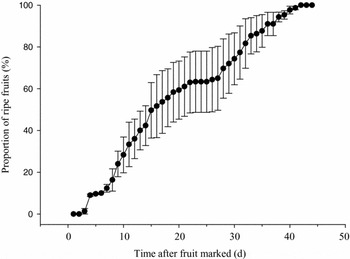
Monitoring of the S. oblatum trees showed that the marked fruit did not ripen simultaneously and was instead staggered throughout the monitoring period (Figure 1). Over half of the fruit on each parent tree was seen to fall to the ground and was not carried away by the bats (65.5% ± 7.45%, N = 3). Observations showed that strong winds and unsuccessful attempts to acquire fruit by R. leschenaulti and C. sphinx were the two main reasons for fruit dropping to the ground.
Ripening curves for marked fruits on three Syzygium oblatum parent trees between 27 June and 10 August 2006. The numbers of fruits on the three monitored trees were 39, 89 and 126, respectively.

Feeding behaviour and consumption of fruit
Over five nights a total of 46 R. leschenaulti and 25 C. sphinx were caught attempting to forage on the fruit of S. oblatum. Both species were observed to forage on the fruit from approximately 30 min after sunset (20h00). Observations confirmed that neither species of bat stayed at the foraging site after acquiring an item of fruit. Seeds were dropped beneath feeding roosts after the fleshy pulp of the fruit was consumed. This behaviour was consistent among all individuals. There was no significant difference in the number of foraging bouts through the night (F = 0.833, df = 7, 29, P > 0.05), although the number of foraging bouts was observed to be higher between 20h30 to 21h00.
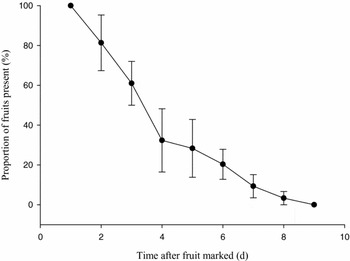
All marked fruit on the observed trees was either taken away by a bat or had fallen to the ground by 7–9 d of the start of monitoring (Figure 2). No other animals were seen feeding on the fruit. The majority of marked fruit that had not fallen to the ground were consumed by the bats within 3 d of becoming ripe.
Disappearance curves for marked ripe fruits from one bough of each Syzygium oblatum parent tree from 12 July to 29 July 2005. The numbers of fruit marked were 11, 24 and 31 for the three parent trees, respectively.

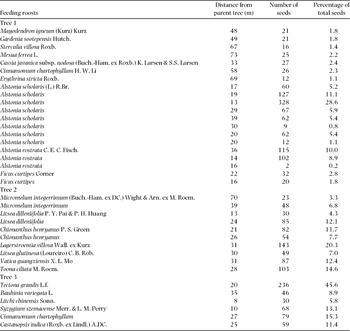
Identification of feeding roosts
A total of 36 feeding roosts consisting of 22 species of tree were found around the three parent trees. Alstonia scholaris, Chionanthus henryanus, Lagerstroemia villosa and Tectona grandis were found to be the most common trees used (Appendix 1). Both species of bat appeared to select trees that had dense crowns and horizontal branches. Although other tree species were found in the forest at much higher densities, e.g. Anthocephalus chinensis (1.33 individuals ha−1) and Albizia lucidior (0.67 indiv. ha−1), they were not used.
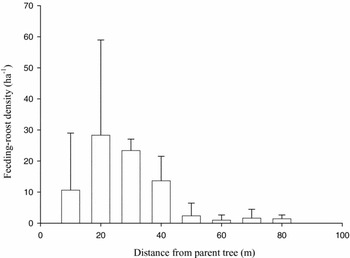
Feeding roosts with the highest density of dropped seeds beneath them were found to be 21.3 ± 5.2 m from the parent trees (Figure 3), which accounted for 31.5% ± 7.4% of the seeds identified that came from these trees. The maximum distance of a feeding roost from the parent tree was 73 m.
Feeding roost density of fruit bats in relation to distance from three Syzygium oblatum parent trees in Xishuangbanna Tropical Botanical Garden, Yunnan province, South China.

Seed germination
Survival analysis revealed that there was no significant difference in the time taken for seed germination between the three treatment types (under parent tree (33 ± 2.1 d), in forest gap (30 ± 1.5 d), under feeding roost (36 ± 1.8 d)) (Log rank, χ2 = 4.3, df = 2, P > 0.05). There was however a significant difference in the final percentage of seeds found to germinate between the three treatment types (under parent tree (78.3% ± 1.67%), forest gap (91.7% ± 4.41%), under feeding roost (86.7% ± 1.67%)) (one-way ANOVA, F2, 6 = 5.44, P < 0.05). Further analysis showed that the final germination percentage of seeds was significantly higher in the forest gap when compared with the seeds beneath the parent tree (Tukey's test, P < 0.05).
Comparison of median cumulative germination times found no significant different between seeds without fruit pulp (31 ± 2.0 d) and seeds still within fruit (32 ± 2.3 d) (Log rank, χ2 = 0.06, df = 1, P > 0.05). There was also no significant difference between the final germination percentages of S. oblatum seeds between treatments (seed without fruit pulp: 88.0% ± 2.31%; seed still within fruit: 92.0% ± 6.11%) (Tukey's test, P > 0.05).
DISCUSSION
Seed dispersal plays an important role in the successful propagation of rain-forest trees (Corlett Reference CORLETT1998, Galindo-González et al. Reference GALINDO-GONZÁLEZ, GUEVARA and SOSA2000) and can promote diversity within forests by distributing seeds away from parent trees and preventing monocultures from occurring (Clark & Clark Reference CLARK and CLARK1984, Connell Reference CONNELL, den Boer and Gradwell1971, Howe Reference HOWE and Murray1986, Janzen Reference JANZEN1970).
In this study we found that R. leschenaulti and C. sphinx were the two primary seed dispersers of S. oblatum. Feeding roosts were found to be concentrated 10–40 m from the parent trees with the bats being able to disperse seeds up to 73 m. Unsurprisingly, the concentration of feeding roosts also corresponded to the distance where the highest density of S. oblatum seeds were found on the ground (21.3 m). We found no signs that either species of bat used the parent tree as a feeding roost, instead selecting tree species that occurred at lower densities compared with others in the forest as their feeding roost. This supports previous work by Tang et al. (Reference TANG, CAO, SHENG, MA, WALSH and ZHANG2008) and suggests that tree architecture may be an important factor in feeding-roost selection. The tree species used most often, e.g. Alstonia scholaris, Alstonia rostrata and Ficus curtipes, all have horizontal boughs with a dense drooping umbrella-like crown of leaves offering cover for protection from predators while feeding.
Unlike other species of rain-forest tree such as Ficus septica and F. variegata, whose seeds are ingested by C. sphinx (Shilton et al. Reference SHILTON, ALTRINGHAM, COMPTON and WHITTAKER1999), we have shown that the seeds of S. oblatum do not have to be ingested in order to germinate. We have also shown that S. oblatum seeds do not have to be removed from the fruit by the bats to successfully germinate. This is important because survival analysis showed that the final germination percentage of seeds was significantly higher in the forest gap than beneath the parent tree. As the only way S. oblatum seeds would be dispersed by R. leschenaulti and C. sphinx into forest gaps is by whole items of fruit being dropped during flight (personal observation) it is crucial that the seeds are able to germinate while still within the fruit.
Seed dispersal is often necessary for rain-forest trees because seed predators and pathogens occur at higher densities close to parent trees because they are attracted to the high number of seeds that occur there. In general, seed density will decrease with increasing distance away from the parent tree (Augspurger & Hogan Reference AUGSPURGER and HOGAN1983, Ganeshaiah & Uma Shaanker Reference GANESHAIAH and UMA SHAANKER1991, Morse & Schmitt Reference MORSE and SCHMITT1985, Sinha & Davidar Reference SINHA and DAVIDAR1992), indicating that seeds that fall within close proximity of their parent tree will have a higher mortality compared with seeds that have dispersed to low-density areas where predation is reduced.
By moving seeds away from parent trees frugivorous animals have the ability to reduce seed density to a level that fails to elicit a response from seed predators (Howe Reference HOWE and Murray1986, Willson Reference WILLSON and Fenner1992). In this study, because both R. leschenaulti and C. sphinx drop the seeds below their feeding roosts, secondary sites of high seed abundance will be created, but considering over half of the items of fruit fell beneath the parent trees and 36 feeding roosts were identified, the seed abundance at these sites will still be lower compared with the parent trees. At what density seeds need to be in order to attract a high number of granivores is unknown and needs further investigation because the probability of S. oblatum seeds escaping post-dispersal predation could depend on a complex interplay between distance from parent trees, density and foraging behaviour of rodents in microhabitats where other animals are primary seed dispersers (Forget & Milleron Reference FORGET and MILLERON1991, Hallwachs Reference HALLWACHS, Estrada and Fleming1986, Janzen Reference JANZEN1971, Schupp Reference SCHUPP1990, Sork Reference SORK1987, Vander Wall Reference VANDER WALL1990). The occasional loss of fruit by bats in flight between parent tree and feeding roost is especially important because it will create low concentrations of seeds (reducing predation risk) and potentially disperse seeds into new habitats such as forest gaps where the likelihood of successful germination is higher than beneath the parent tree.
Overall we have shown that these two species of bat are important in the seed dispersal of S. oblatum and that seeds have a higher likelihood of success in germinating when they are found in forest gaps. Further work needs to be carried out to determine whether the level of seed predation beneath feeding roosts is comparable with that of the seed predation beneath parent trees.
ACKNOWLEDGEMENTS
This study was funded by the National Natural Science Foundation of China (30800119), Doctoral Fund of Ministry of Education of China (200802001011), Academic backbone program for Youth scholar of Northeast Normal University (120401044) and the Laboratory for Tropical Rain Forest Ecosystem Research and Management (TRERM), Xishuangbanna Tropical Botanical Garden, Chinese Academy of Sciences. We thank the directors of the protected area in XTBG for permission to work in the forest and the staff for their hospitality and support.
Feeding roosts and the seed numbers dispersed by fruit bats to corresponding roosts around three Syzygium oblatum parent trees. Percentages are based on total seed samples collected (n = 1146).