Introduction
As we approach the American Political Science Association's Centennial
Celebration and reflect upon the history of the discipline, perhaps
nothing has changed the face of political science more than the growing
numbers of women in the profession. The entry of women into the field of
political science, however, was not always welcomed. Gender
discrimination posed barriers to women's academic career advancement.
Even into the late 1980s, subtle discrimination perpetuated what
researchers described as a “chilly climate” for women faculty. Through a
commitment to gender equity by the APSA, the Women's Caucus, regional
associations, and political science departments, significant progress
has been made in the last decade. This progress, however, has been
measured only from the perspective of department chairs through surveys
regarding issues of recruitment and retention of women. The limited
information that department chairs have been able and/or willing to
provide has frustrated our attempts to clearly measure the status of
women in the profession. This study, made possible by a Centennial
Research Grant from the American Political Science Association and a
supplemental grant from the Southern Political Science Association, adds
the direct perspective of women faculty in order to understand fully the
scope of the barriers that remain.
Background
Since the late 1980s, the Southern Political Science Association (SPSA)
has monitored the progress of women in political science by regularly
administering surveys to political science department chairs in the
region. Three surveys have been conducted, the first two reported
limited progress towards gender equity in the profession, noting in
particular the underrepresentation of women at the top of the profession
(see Stetson et al. 1990, and Guy 1992). More recently, the 2000 survey of
department chairs reported significant progress in increasing the
representation of women at all ranks, but especially at Ph.D. granting
institutions where the number of women in tenured positions at the rank
of associate and full professor doubled since the previous survey (see
van Assendelft et al. 2001). In 1990,
women held only 5.8% of full professor positions and in 2000 they
constituted 11.2% of full professors.
While women have made considerable progress towards gender equity in the
profession, many of the recommendations made by the Committee on the
Status of Women (CSW) over the past decade have not been enacted. The
2000 survey of department chairs indicated that issues of recruitment
remain salient. Few departments formally and/or actively recruit women
applicants. As many as a third of department chairs are unaware of their
college's or university's policies regarding maternity leave or
childcare. Few schools offer family friendly policies. There was also a
notable absence of formalized mentoring and only limited research
support for junior faculty members. These results prompted the CSW to
strongly recommend a follow-up survey of women faculty—rather than
department chairs—to gain the direct perspective of women on the issues
raised in previous surveys.
With funding from the APSA and SPSA, in January of 2002 the CSW sent
surveys to 878 female faculty members in political science departments
in the South. After sending two waves of surveys and follow-up
postcards, a total of 168 usable responses were returned, yielding a
response rate of 19.1%. After adjusting for the number of surveys
returned to sender and by removing retired faculty, graduate students,
and women outside of political science departments from the denominator
(n = 85), our adjusted response rate is 21.1%.1
The project was funded by a Centennial Research Grant
from the American Political Science Association and a
supplemental grant from the Southern Political Science
Association. Mailing labels for female faculty were obtained
from the American Political Science Association. A total of 878
women were surveyed in Florida, Georgia, South Carolina, North
Carolina, Virginia, Maryland, West Virginia, Kentucky,
Tennessee, Alabama, Mississippi, Louisiana, Texas, Arkansas, the
District of Columbia, and Delaware. Surveys were mailed in
January of 2002, with a cover letter by Mary Ellen Guy, 2002
SPSA President. A second mailing of surveys was sent out in
March after addresses were cross-referenced in the 2002–2004
APSA Directory of Political Science Faculty. Follow-up
postcards were mailed in April and May. There was a total of 168
usable responses returned, yielding a response rate of 19.1%.
However, numerous surveys were returned to sender, or
invalidated by respondents who indicated that they were graduate
students, retired, or outside of political science, adjusting
the response rate to 21.1%.
Although the response rate
for the 2002 survey of female faculty is significantly lower than the
response rate for the 2000 survey of department chairs, a representative
sample of female faculty at all ranks responded.
In the 2002 survey of female faculty, a plurality of women are employed
at the assistant level (40%), with slightly fewer women at the associate
level (33%), and even fewer at the full professor rank (19%). The
remaining 7% are in other positions, primarily as instructors or in
visiting positions. These numbers are nearly identical to those reported
from our 2000 survey of department chairs where 44% of women were
employed at the assistant level, 35% at the associate level, and 21% at
the full professor level. The proportion of male and female faculty by
rank in the southern region is consistent with national trends. In the
southern region in 2000, women comprised 31.2% of assistant professors,
26.1% of associate professors, and 11.8% of full professors. The
2001–2002 APSA Survey of Departments reports that nationwide women hold
35.6% of positions at the assistant professor level, 26.3% at the
associate professor level, and 13.9% of positions at the full professor
level.
Our data are also representative in terms of the types of institutions
where women are employed. In the 2002 survey of female faculty,
respondents are fairly evenly spread across colleges and universities.
Approximately one-third (31.1%) are employed by colleges where a
Bachelor's degree is the highest degree offered, another 27.4% work in
master's programs, and the remainder (41.5%) are at Ph.D.-granting
institutions. The 2001–2002 APSA Survey of Departments indicates that
nationwide 30.1% of women are employed in B.A. political science
programs, 25.8% in master's programs, and 44.1% in Ph.D. programs.
The majority of women in our sample specialize and/or have teaching
responsibilities in American Politics (59%), nearly equal percentages
teach courses in International Relations and Comparative Politics (26%
and 29%, respectively), while the fewest women specialize in Political
Theory (16%). Seventy percent of female faculty members in the South
teach in one subfield of the discipline, 24% teach in two, and 3% teach
in more than two subfields. Women who teach at undergraduate colleges
are the most likely to teach in more than one subfield. In fact,
approximately 46% of women teaching at undergraduate colleges in the
South teach in at least two different subfields, while less than one
quarter (24%) of women in masters programs do so, and even fewer (15%)
women at Ph.D.-granting universities do so. For those faculty members
teaching in more than one subfield, the most common combination is
International Politics and Comparative Politics (nearly 50% of those
teaching in two subfields indicated these two subfields), while the
second most common combination is American Politics and Political Theory
(24%).
The purpose of our survey was to allow women faculty to share their
perspectives on the status of women in political science. The
questionnaire used in the 2000 survey of department chairs was adapted
to include numerous open-ended responses. We inquired about various
recruitment and retention issues and report the results of our survey
here.2
In selecting quotes for
inclusion here, we tried to be as representative of the entire
sample as possible. Indeed, many women gave their departments
and/or schools glowing report cards, others were far more
negative in their assessments, and many fell somewhere in
between.
The Findings: Perspectives of Female Faculty Members
Recruitment
To what extent are departments actively recruiting female candidates
for full-time faculty positions? What are women's perspectives
regarding the effictiveness of their department's efforts to recruit
female candidates? In our 2000 survey of department chairs, we found
that departments hired female faculty in nearly identical
percentages as the proportion of female graduate students in
political science (38%). Out of all of the departments in the South,
approximately a fourth of them had not hired a single female in the
past decade. A large majority (75%) of political science departments
have at least one fulltime female faculty member, though, and the
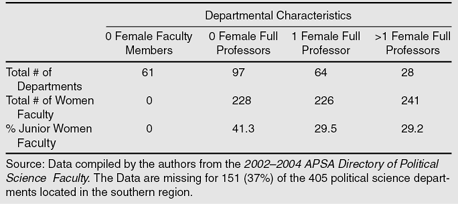
average political science department in the South has two women. As
Table 1 indicates, even though women
are fairly well distributed across colleges and universities in the
South, over 40% of the junior female faculty are in departments
where there are no female full professors. An additional 30% are in
departments with only one female full professor.
With such numbers in mind, does recruiting additional female
candidates seem to be a key priority for departments? Apparently
not, according to our data. Approximately one-third of the
departments reported having a policy to increase the numbers of
women on their faculty (35%), leaving two-thirds of the departments
without such a policy. According to our 2002 Survey of Female
Faculty, the impressions of female faculty are a bit different, as
fewer women indicated that their departments had any policy to
recruit female candidates (22.3%). When we look at those women who
have actually served on departmental search committees, an even
smaller percentage indicate that such a policy is in place (17.4%).
Further, one-third (33.3%) of female faculty said that their
departments lacked special resources to recruit women.
Our respondents report that departments, colleges, and universities
make various efforts to recruit women to the faculty ranging from
contacting graduate programs to encourage female applicants to apply
for positions, to advertising job openings in Women's Caucus
newsletters, to including women faculty on search committees. When
asked, however, “How would you evaluate your department's efforts to
recruit and hire women?” many women indicated that more needs to be
done to diversify their departments. “I am one of only four women in
the history of the department and the two who proceeded me left
dissatisfied. There's good reason to think my other remaining
colleague won't stay long. The department has serious problems with
recruitment in general, much less searching only women. The ‘powers
that be’ have traditionally been very conservative and not at all
favorable to aggressive AA/EO.” Another faculty woman writes. “I was
an affirmative action hire and I was treated by my colleagues as
such. I experienced considerable sexual harassment. Nonetheless, I
have endured.” Our data suggest that an important factor in
successfully recruiting and hiring women seems to be the presence of
other women faculty in the department. The following comment
demonstrates one woman's perception of this difference. “I recently
left a department where I was the only woman. The chair there was
very good at giving lip service to hiring more women. I am currently
in a program that is about half women—the difference in the
environment is NIGHT AND DAY” [original emphasis]. In general,
respondents from departments where women faculty hold senior rank
and/or administrative positions also note a positive impact on
diversity. “There is an impressive number of female faculty at all
levels of achievement that make [the school] an appealing workplace
for recruiting women.”
Tenure and Promotion
After women are hired, how do they progress toward tenure and
promotion? How do they evaluate their departments' efforts to tenure
and promote women? What steps do departments take in order to
maximize their faculty members' productiveness and progress? We
asked a variety of questions to get at this issue. First, we
inquired whether or not their departments have written standards for
tenure and promotion, and whether or not these standards were
explained during the hiring process. A majority of women responded
in the affirmative to both of these questions—60% say their
departments have written tenure and promotion standards, and
slightly fewer indicate that such standards were explained (56%).
More than three-quarters (77%) of the women indicated that they were
evaluated on a regular basis, and annual reviews were by far the
most common (85%). Thus, female faculty, for the most part, have a
sense of their department's tenure expectations, and receive fairly
regular evaluations to mark their progress toward tenure.
Many departments also appear to be implementing a variety of programs
and opportunities to assist faculty in their progress toward tenure
and/or promotion. One such way is by instituting some form of
mentoring programs for junior faculty. Nearly half (46%) of the
female faculty indicated that such a program was in place in their
department or university. Noticeably fewer women actually have
mentors (32%), but closer examination reveals that rank is inversely
associated with having a mentor. That is, assistant professors are
the most likely to have a mentor (nearly half do—48%), full
professors are the least likely to have a mentor (only 6% of these
women do), and associate professors fall in between (27%). Further,
the data suggest that mentoring programs make a difference. In fact,
women in colleges or universities with mentoring programs are more
than twice as likely to have mentors than those women employed at
institutions without such programs (47% vs. 20%). Our data indicate
that junior faculty are typically assigned a mentor by the chair of
their department or the dean of the college or school. Male and
female colleagues serve as mentors but our respondents remarked on
the relative lack of women in senior positions. “Several senior
colleagues have mentored me informally—all men, given the scarcity
of senior women.” The paucity of senior women in departments in the
South virtually necessitates that junior faculty will have male
mentors.
Turning to other programs, we found that more than three-quarters of
the women indicated that their institution provided some sort of
faculty development money (80%) and that a majority provide course
release time for junior faculty (57%). Course release time is more
common in the larger, Ph.D. granting departments while faculty
development money is fairly evenly distributed across the different
types of institutions.
We also asked women to give an assessment of their department's
efforts to tenure and promote women. Again the presence of women on
the faculty, especially in senior ranks, was perceived as increasing
the likelihood that a junior woman would be tenured and promoted
within the department. One woman who judged her department's efforts
as “good” reported, “We have three full professors who are women,
two assistants. This year we tenured a woman. Women are no more
likely to be denied promotion than men in my department.” Contrast
this assessment with that of a junior woman at another institution
with only one tenured woman faculty member in her department. “Not
great, to date. One very qualified woman has received tenure. She is
the only woman ever tenured in this department and had to appeal an
initial decision denying her tenure before she received it. It's
possible things have improved. The next tenure decision on female
faculty will arise when a colleague and I come up for tenure in five
years, unless a retirement or relocation results in a tenured hire.”
A female faculty member who described her department's record as
“excellent” shared the secret of their success: “Junior faculty are
reviewed and mentored informally and formally. Faculty development
funds are provided for travel to conferences. Grants are available
for research (although limited and competitive).”
Yet, for every success story there were failures reported that
require attention if political science departments are to tenure and
promote women faculty. A woman who labeled her department's efforts
as “horrible” writes, “I won tenure as the University Rank and
Tenure Committee overturned the Government Department. Before me,
three women left before coming up and are now tenured elsewhere. The
University is trying to take action to correct this policy,
especially as another woman faculty member has just resigned,
leaving only a single woman as full-time faculty.” Another woman
remarked, “This department thinks once a woman is hired, that is the
end of its job. Lots of glass ceilings and glass walls around here.”
Her perspective is shared by a colleague at another institution who
notes, “There are real problems here, lack of mentoring, higher
service loads, and women's greater attention to teaching all put
women junior faculty at a disadvantage. Of the three women (of seven
junior faculty) all of us are either looking to leave this
university or academia.” Sadly, these problems do not seem to end
with a tenure decision. A senior woman remarks that the chilly
climate in her department has deteriorated into what she labeled a
“toxic culture.” “My department opposed my promotion to associate
professor, but my chair advocated my case. My promotion to full was
not opposed. It's not the policies that obstructed me, it was the
male faculty. Policies can only advance an institution so far, if
the culture is toxic and if the motivation to deny women promotion
and tenure exists, women will suffer.”
Retention
What efforts do departments of political science in the South make to
retain their female faculty? Although our data are not longitudinal
in nature, we received a variety of responses about women's
impressions of their departments' abilities to retain women faculty.
For some respondents the environment within the department is as
important to retention as institutional resources. “The department's
efforts are excellent, given its position in a state university. The
intellectual atmosphere and support in the department are
outstanding. The obstacles to retention tend to be university-wide
(relatively low salary and benefits).” One faculty member remarks
that efforts to retain faculty have met with mixed results within
her department. “Our efforts are good, but have been only partially
successful. [The school] will match salary counter offers, but
cannot match the allure of better facilities, lower teaching loads,
and the prestige of larger departments, Ph.D. programs, etc. In my
case, I received a substantial offer from another institution. [The
school] met my demands for a pay increase, and promoted me to boot.”
At the other end of the spectrum a woman expressed a desire to
resign her position rather than remain at her institution. “Let us
say that I would give up tenure to get out of [the school]. It is
horrible for women.”
The 2000 survey of department chairs recommended that departments do
more to let female job candidates know about various family-friendly
benefits, especially recommending that chairs do more to familiarize
themselves with department and/or college policies in these areas
and to ensure women that the climate is friendly. In our 2002 survey
of female faculty, we found that written sexual harassment policies
are in effect virtually everywhere, with 98% of the respondents
indicating that their institutions had such a policy. How they were
informed about such a policy varied. The majority of women were
acquainted with their institution's sexual harassment policy during
faculty orientation. Many mentioned that the policy was included in
the faculty handbook or posted on the college or university web
site. A few women had attended faculty workshops where the details
of the sexual harassment policy were discussed, sometimes with legal
counsel present.
We also inquired about the existence of family leave policies and how
they might affect a faculty member's tenure clock. In the 2000
survey of department chairs, we reported that only “19.5% of
departments … have a formal maternity leave policy, 9.4% have an
informal policy, and 15.6% did not know one way or the other” (van Assendelft, et al. 2001: 336). Turning
to the female faculty themselves, a larger number (47.9%) reported
that their colleges and universities had a formal policy regarding
family leave, while a small minority of female faculty (10.3%) did
not know whether or not such a policy existed. Many women indicated
that the federal Family and Medical leave Act was the only family
leave policy in effect. “We abide by all federal laws. So we can
take up to 12 weeks of unpaid leave. Oh boy.” Another respondent
highlighted the discrepancy between the federal policy and a
semester calendar. “The FMLA is our only policy. Twelve weeks
without pay—our semesters are 16 weeks.” Some women were unclear
about the specific details of family leave policies at their own
institutions. One woman simply wrote, “I don't know—it [the family
leave policy] arrived after my child.” Although we did not inquire
about faculty members' marital status or whether or not they had
children there are some indications that women without children were
least informed (as many of the women wrote in the margins of the
survey that they would look into these policies when ready to start
a family). One woman candidly remarked, “I don't know because I'm
single and have no children.”
Many expressed the continued need for family friendly policies. “Our
University still seems stuck in the model of requiring women to plan
pregnancies for summer. An attempt was made to update the leave
policy, but male faculty seemed opposed to different treatment for
female faculty in any manner. Discussion of replacement funds and
paid leave had to be dropped. Sexism on this committee was an eye
opening experience.” Even those who think that sexism is not a
problem for women in political science departments, acknowledged
that family leave issues continue to be a concern. “As a woman, I'm
very tired of playing victim and avoid those circles on campus. I
believe this struggle for women as a special category is over.
Family leave remains the key issue for women as well as men.”
Can the tenure clock be stopped when junior faculty take family
leave? Approximately one-third of female faculty indicated that the
tenure clock could be stopped for family leave reasons, another
one-third said the tenure clock would not be stopped, and the
remaining women did not know the policy details or were employed at
institutions without formal leave policies. Of those women who knew
the details of stopping the tenure clock, the majority (58.8%) of
them indicated that one year was the norm. The next most common
response was that the tenure clock would be stopped for the length
of the leave, and a few additional women indicated that leave time
was negotiable (15.7%) or lasted for one semester (5.9%).
Finally, we asked about the presence of child-care facilities on
college and university campuses. About 40% of the women indicated
that their colleges had on-site childcare facilities, while another
28% responded that dependent care reimbursement accounts were
available. These facilities and options are important for women
faculty trying to balance career and family. “The most crucial issue
for many women is balancing work and children. My university has NO
maternity policy. This is unbelievable. Also has withdrawn financial
support for childcare center. Will turn over to for-profit = low
quality.”
Conclusion: Visions of Political Science in the New
Millennium
In the end, the women who took the time to respond to our survey and
provided us with thoughtful comments about their experiences as
political scientists appreciated the opportunity to have their say and
to be heard: “I think women still have a long way to go to achieve the
respect and salary levels that men enjoy. I do not think this is
intentional, but the fact is that a discrepancy exists. Thanks for
conducting this survey!”
We recognize that issues related to “campus climate” are difficult both
to quantify and resolve. As one woman writes, “As I see it the problem
is no longer in hiring women or even in getting them to complete a Ph.D.
Rather it is in keeping them up with the men offered tenure in terms of
salary, respect, rewards, awards, acknowledgment and power. Of all
these, my department is completely inadequate. Discrimination and
disrespect are now subtle, rarely written, often silent, and simply
consist of being ignored, excluded, buried but then used every time they
need a woman on a committee.”
Allowing the different voices of the women in our survey to be heard is
an important first step towards opening discussions about the
perceptions of gender equality in political science. In contrast with
previous surveys of department chairs, this survey allowed women to
share their own thoughts and perspectives about their status in
political science departments in the South. To those ends, we
consciously strove to reflect the diversity of experiences—both good and
bad. In doing so, we found that some women are quite content and feel
both valued and respected in their departments while other women report
far less positive experiences. To continue monitoring the status of
women in the profession, the CSW recommends future surveys of both male
and female faculty and graduate students, in addition to department
chairs.