Introduction
The title is the introduction. This paper describes a series of fabulous flower flies that are dedicated to a group of famous fly fanatics who worked for years together to build the Canadian National Collection (CNC) of Diptera into one of the world's great scientific institutions. In addition, they continued a trend of creating useful manuals for the understanding of the fly fauna of the Nearctic Region and set a standard for others to emulate.
In the beginning, which is considered to officially start with Systema Naturae (Linnaeus Reference Linnaeus1758), to identify the basic groups of organisms (genera) one had to sequentially read a series of diagnoses. Although in most cases, these diagnoses were arranged so that they functioned as keys, the first analytical keys, in the modern sense, were produced by the Austrians, and for flies (Diptera) that was Schiner (Reference Schiner1860–1864). His keys were extremely useful and lead the American dipterist, Samuel Williston, to copy the methodology at the generic level for the Nearctic Region (Williston Reference Williston1888). This lead to a subsequent series of “manuals” to Nearctic Diptera (Williston Reference Williston1896, Reference Williston1908; Curran Reference Curran1934; McAlpine et al. Reference McAlpine, Peterson, Shewell, Teskey, Vockeroth and Wood1981, Reference McAlpine, Peterson, Shewell, Teskey, Vockeroth and Wood1987; McAlpine and Wood Reference McAlpine and Wood1989). From this effort, other areas have followed suit, so we now have partial coverage of the Palaearctic Region (Papp and Darvas Reference Papp and Darvas1997–2000), complete coverage of MesoAmerica (Brown et al. Reference Brown, Borkent, Cumming, Wood, Woodley and Zumbado2009, Reference Brown, Borkent, Cumming, Wood, Woodley and Zumbado2010), and there are now plans for the Afrotropical Region (see Kirk-Spriggs and Mostovski Reference Kirk-Spriggs and Mostovski2010).
Materials and methods
The terminology used follows from Thompson (Reference Thompson1999), which was derived originally from the Manual of Nearctic Diptera (McAlpine Reference McAlpine1981) and is largely congruent with it.
For the species key, these follow ergonomic design standards (see Thompson Reference Thompson1999: 323) and provide minimal documentation about the species, their distribution and names (original publication). For type specimen information, the exact details of the label on the holotype is presented, the data for each label is given within parentheses (“…”) and each line is separated by double virgules (//) with appropriate annotations as necessary. In the material examined section, identical information from previous specimen(s) record is not repeated but replaced by ellipsis (…). An asterisk (*) in distribution statements means that specimens were examined from that locality, otherwise a citation is given to where the locality record was published.
Most of the species described here have been extracted from other revisions and monographs either in preparation or in press. Hence, only minimal information on them is provided here. Upon publication, the information about these new species will be transferred and available to all as species pages of the Encyclopedia of Life (www.eol.org). The species in the “Results” section are arranged alphabetically by species name.
Results
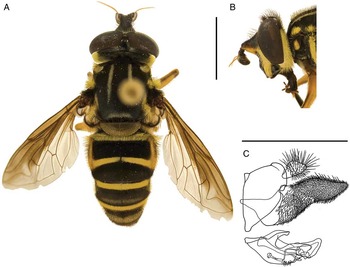
Blera chillcotti Thompson, sp. nov.
(Fig. 1)
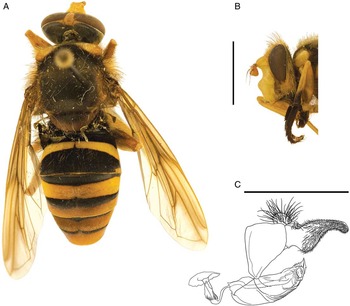
(A) Blera chillcotti sp. nov.: Habitus, dorsal, paratype male; (B) head, lateral; scale bar = 4 mm; (C) male genitalia, lateral, holotype, scale bar = 2 mm.

Description. Male. Head. Face, frontal and vertical triangles yellow; face golden pollinose, yellow pilose on paraface; gena yellow except for black fasciate macula on anterior margin ventrad to eye and reaching half-way to oral margin, shiny anteriorly, sparsely white pollinose posteriorly, yellow pilose; lunule yellow; frontal triangle yellow, yellow pollinose except shiny narrowly dorsad to lunule, bare; ventral triangle yellow pollinose and pilose; narrowly dichoptic, eyes separated by width of anterior ocellus; occiput yellow on ventral 1/3, black dorsally, very sparsely white pollinose on ventral 1/3, more densely white pollinose dorsally, yellow pilose; antenna orange, black pilose; arista brown on basal half, paler apically.
Thorax. Postpronotum yellow, sparsely white pollinose, yellow pilose; propleuron black, yellow pilose; scutum black except orange narrowly mesial to postpronotum, dorsad to wing and postalar callus, grayish pollinose, yellow pilose except with intermixed black pile on posterior half anterior to scutellum and on postalar callus; scutellum dark brownish orange except basomedially black area, mainly black pilose, with some yellow pile basally; meso- and metapleuron black except for large yellow macula on posterior anepisternum, very sparsely grayish pollinose, yellow pilose; spiracular fringes pale yellowish-white; halter brown with black capitulum; calypter white with ventral margin and fringe yellow, dorsal margin and fringe brown; plumula yellow. Legs: pro- and mesocoxa, trochanters and femora yellowish orange, yellow pilose except for some black pile intermixed posteriorly; protibia orange on basal 3/4, black apically, yellow pilose on pale area, black pilose apically; protarsus black, black pilose; mesotibia and tarsus yellow, yellow pilose; metacoxa black, gray pollinose, yellow pilose; metatrochanter black, yellow pilose; metafemur yellow basally and apically, black medially, yellow pilose except with thick black pile ventrally on apical 3/4; metatibia and tarsus yellow, yellow pilose. Wing: brownish on anterior half, except costal cell lighter, microtrichose except narrowly bare along anterior margin of cell CuP (Anal); cell R4 + 5 with petiole long, twice as long as humeral crossvein.
Abdomen. First tergum black, dull pollinose, black pilose except brownish-yellow pilose laterally; second tergum black except medial 1/4 yellow, yellow pilose except black pilose basolaterally; third tergum black except yellow medial 1/3 and apical margin, yellow pilose except black pilose on apical  ; fourth tergum yellow except narrowly black on basal margin and with narrow black fascia medially, black pilose except yellow pilose on lateral margins; first and second sterna black, sparsely gray pollinose, yellow pilose except for a few black pili intermixed on second sternum; third sternum black except narrow yellow apical margin, sparsely gray pollinose, yellow and black pilose; fourth sternum black except broad yellow apical margin, black pilose. Male genitalia yellow, yellow and black pilose.
Female. Similar except for normal sexual dimorphism and: frons shiny apicomedially, elsewhere golden pollinose, yellow pilose; sterna all with yellow apical margins; genitalia black; cercus brown.
Length. Body 16.1–17.5 mm; wing 11.8–13.0 mm.
Type material
Holotype. Male, pinned with the following labels: “27°58′N, 85°00′E//NEPAL, 11,100 ft//19 June 1967//Can. Nepal Exped.”; “J. Skevington//Specimen //19721”; and “Holotype//Blera//chillcotti//Thompson 2010” [orange, handwritten] (CNC). Paratypes. Same data as holotype, except 1.vi.1967 (1 ♂, United States National Museum of Natural History [USNM]), 25.vi.1967 (1 ♀, CNC).
Type locality. NEPAL. 27°58′N, 85°00′E, 11,100 ft.
Distribution. Nepal*.
Etymology. This species is named in honor of its collector and the original leader of the CNC Diptera Manual team, James Gordon Thomas Chillcott (Daly Reference Daly1967; McAlpine Reference McAlpine1967; Shewell Reference Shewell1967). In the summer of 1964 after the North American dipterists had reviewed the final proof of the forthcoming new Diptera catalog (Stone et al. Reference Stone, Sabrosky, Wirth, Foote and Coulson1965), Jim proposed to all that the next logical step was a revision of the then obsolete Curran manual to Nearctic Diptera (Curran Reference Curran1934). Unfortunately, before the project got launched Jim had a heart attack in the field (Nepal) and the project was forgotten until revived by Frank McAlpine.
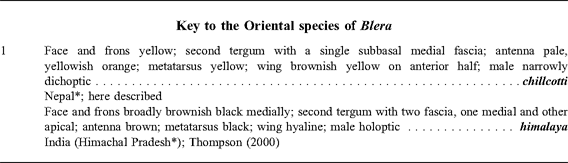
Remarks. In the last key (revision) of Blera Billberg (Barkalov and Mutin Reference Barkalov and Mutin1991), both Oriental species run to couplet 10/11, where they differ from all the following species by having broad continuous fasciate yellow abdominal maculae instead of circular or lunate separate maculae. The Oriental species are mimics of honey bees (Apis L.) (Hymenoptera: Apidae) or yellow jackets (Vespa L.) (Hymenoptera: Vespidae).
Sphiximorpha mcalpinei Thompson, sp. nov.
(Fig. 2)
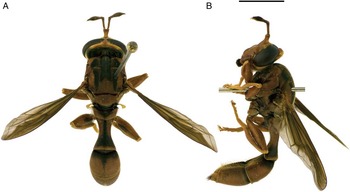
(A) Sphiximorpha mcalpinei sp. nov.: Habitus, dorsal, holotype male; (B) head, lateral; scale bar = 4.4 mm.

Description. Male. Head. Reddish orange except black medially and posteriorly on occiput; face about 1.25 as long as eye height, about 1/3 as wide as head, with parallel sides, shiny except for yellow and yellow pollinose submedial vitta, very short yellow pilose; gena shiny except for yellow pollinose vitta on anterior margin (vitta is between face and gena), yellow pilose; frontal prominence long, slight more than half (0.6) as long as scape, long as broad apically (dorsal view), shiny, bare; frontal triangle shiny, bare on anterior half, yellow pollinose and pilose posteriorly; vertical triangle shiny, yellow pilose; holoptic; eye contiguity about 1.5× as long as ocellar triangle; occiput shiny on ventral half, yellow pollinose dorsally, yellow pilose; antenna orange except basoflagellomere brownish black and arista white; scape and pedicel black pilose; antennal ratio (scape, pedicel, basoflagellomere, arista) 1:1:1:0.
Thorax. Postpronotum reddish orange, yellow pilose; proanepisternum reddish orange medially, black ventrally and posteriorly, pale pilose; proanepimeron orange; mesonotum orange except for broad brownish black medial vitta on anterior 2/3 and sublateral vitta, shiny except sparsely yellow pollinose on vittae, short pale pilose; postalar callus orange, yellow pilose; scutellum orange, yellow pilose; metanotum black; mesoanepisternum orange except narrow black on anteroventral margin of posterior convex portion, pale pilose; mesoanepimeron reddish orange except dorsal triangular portion blackish, pale pilose; mesokatepisternum black except orange dorsal 1/3, pale pilose; mesokatepimeron (barrette) orange; meron orange except black dorsad to metasternum and anterior to spiracle; metathoracic pleuron orange; mediotergum orange; metasternum yellow, yellow pilose; plumula absent; calypter white with yellowish fringe; halter yellow. Legs: Proxoca black except pale narrowly apically, yellow pilose; mesocoxa orange except narrowly black basally, yellow pilose; metacoxa orange, yellow pilose; proleg beyond coxa reddish orange except femur more brownish red, yellow pilose; mesoleg beyond coxa reddish orange except black on basoventral 1/3 of femur, yellow pilose; metaleg beyond coxa reddish orange except femur more brownish red, yellow pilose, with black spinose pile along whole ventral margin. Wing: bicolor, dark brown anteriorly, hyaline posteriorly, dark area extending posteriorly to cell CuP and vein R4 + 5; vein R4 + 5 slightly sinuate, with a long pur into cell R4 + 5; cell R4 + 5 with very short petiole, about 1/5 as long as humeral crossvein; microtrichose except alula bare.
Abdomen. First tergum reddish orange except narrowly black basomedially, yellow pilose; second tergum about 1.5× as broad apically as basally, minimal (medial) width about half as wide as apical width, with apical width about 3/4 as tergal length, black except broadly reddish orange basolaterally on basal 2/3 and narrowly on apex; third and fourth terga reddish orange except dark on basal 1/5, entirely short yellow pilose except longer on lateral margins; first sternum black, shiny, pale pilose; second sternum orange except for black triangular macula on apical third, shiny, pale pilose; third and fourth sterna black except orange margin, short appressed black pilose with longer yellow pile; eighth sternum triangular, yellow, yellow pilose except from some black pile apically; tergal ratio (first, second, third, fourth, eighth sternum, dorsal) 1:3.25:3.5:3.6:0.5.
Length. Body 19.3 mm; wing 12.5 mm.
Type material
Holotype. Male, pinned with the following labels: “24 mi. W. La Ciudad//Dgo. MEX. 7000′//July 17 1964//J. F. McAlpine” and “Holotype//Sphiximorpha//mcalpinei//Thompson 2010” [orange, handwritten] (CNC)”.
Type locality. MEXICO. Durango, La Cuidad (24°01′N, 104°46′W), 24 miles west of.
Distribution. Mexico (Durango*).
Etymology. This species is dedicated to its discoverer, James Frank McAlpine (1922–). Frank was critical to reviving the Manual project and seeing it through to completion. As a true son of Ireland, he with a twinkle in his eye, ensured that the unit was always a fun place in which to work.
Remarks.Sphiximorpha mcalpinei is very similar to Sphiximorpha loewii (Williston), but is clearly distinguished by the pale prescutellar macula and the shiny fourth abdominal tergum. Also, S. mcalpinei is a reddish orange species with black maculae, not a black species with yellow maculae.

Psilota shewelli Thompson, sp. nov.
(Fig. 3)
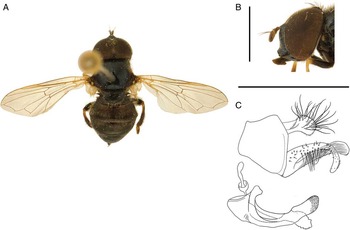
(A) Psilota shewelli sp. nov.: Habitus, dorsal, paratype male; (B) head, lateral; scale bar = 2 mm; (C) male genitalia, lateral, scale bar = 1 mm.

Description. Female. Head. Azure blue; face straight, with epistoma produced very slightly, shiny medially, white pollinose laterally, white pilose; gena shiny, white pilose; frons shiny except for large white pollinose lateral spots on ventral half, white pilose; vertex shiny, brown pilose; occiput white pollinose on ventral 3/4, shiny dorsally, white pilose. Antenna: elongate, slightly longer than face, mainly orange, brown pilose above and white pilose below; basoflagellomere elongate, about 2 and 3× as long as broad, brown except orange on ventral half on basal 3/4; arista orange, bare, as long as antenna. Eye short white pilose.
Thorax. Shiny azure blue, except narrowly reddish brown on postalar callus, short white pilose except for a few brownish pili above wings and on postalar callus; katepisternum completely pilose; calypter, plumula, and halter white; scutellum white pilose, with abundant white ventral fringe. Legs: coxae bluish black, sparsely white pollinose, white pilose; trochanters reddish brown, white pilose; femora bluish black except broadly orange apices of pro- and mesofemora, white pilose except black pilose on apices of metafemur; pro- and mesotibiae mainly orange, with a subapical brown fascia, white pilose on orange areas and brown pilose on dark areas; metatibia bluish black except orange basal 1/4, black pilose; pro- and mesotarsi orange with apical two tarsomeres brownish, black pilose; metatarsus brownish orange, black pilose. Wing: hyaline, with veins yellowish orange, microtrichose on apical 1/2, extensively bare on basal 1/2; first costal cell bare, basal 1/8 and along edge on basal 1/4 of second costal cell, cell R bare except microtrichose medially on apical 1/2, cell BM except with a few microtrichia medially on apex, narrowly on bases of cells R4 + 5 and DM, between branches of Rs to level of anterior crossvein, base of cell CuA1, basal 1/2 and anterior 1/2 of cell CuP, along both side of anal vein almost to tip of cell CuP, broadly in front of and behind Ax; alula broad, rounded apically, completely microtrichose; tegula brown, brownish orange pilose; basicosta yellow, orange pilose.
Abdomen: oval, azure blue, shiny, completely short white pilose.
Male. Similar to female, except as follows: frontal triangle shiny, narrowly white pollinose along margins, white pilose; holoptic; eye contiguity long, about 1.4× as long as frontal triangle; vertical triangle elongate, about twice as long as frontal triangle, densely white pollinose on anterior  , sparsely pollinose posteriorly, white pilose except black pilose on ocellar triangle; genitalia shiny, white pilose, as figured.
Length. Body 6.8–6.4 mm; wing 5.9–4.6 mm (based on only holotype and paratype male; other specimens are broken or missing their heads).
Type material
Holotype. Female, pinned and with the following labels: “NEPAL nr Birganj//Lothar 450 ft.//11 Sept. 67//Can. Nepal Exped.;” “Holotype//Psilota//shewelli//Thompson 2010” [orange, handwritten] (CNC). Paratypes. INDIA. Karnataka, Mudiger, 700 m, 8.iv.1975, K. Ghorpade A191 (1 ♂, USNM); Kerala, Trivandrum, Vellayani, x.2002, R. Krishnakamar (3 ♀, USNM).
Type locality. NEPAL. Lothar, near Birganj (27°01′N, 84°56′E), 450 ft. The place here called “Lothar” was not found in gazetteers except as the name of a river.
Distribution. Nepal*, India*.
Etymology. This species is named for Guy Eaden Shewell (1913–1996) (Becker and Vockeroth Reference Becker and Vockeroth1996; Arnaud Reference Arnaud2001; Adler et al. Reference Adler, Currie and Wood2004), the quiet member of the black fly team who worked for all. Arnaud (Reference Arnaud2001) provided a fine summary of Guy's work, but unfortunately short-changed him by seven genus-group (a total of 17) and four species-group names (a total of 74, for a complete listing of Guy's new names and taxa, see Systema Dipterorum at www.diptera.org).
Remarks.Psilota Meigen is easily recognized by its distinctive facial shape and as such no author has ever failed to recognize the group since Meigen (Reference Meigen1822) originally described the genus some 200 years ago. Psilota is the only flower fly group with a basal r-m crossvein, which has a nondimorphic face without a tubercle. Psilota has its greatest diversity in the Australian Region (16 species), with limited distribution in the Palaearctic (nine species) and Nearctic (three species) and is absent from the Neotropics and Afrotropics. Only three other species of Psilota have been described from the Oriental Region. P. shewelli represents the first species described from the Indian subcontinent. The specimens from India, Kerala, were reared. One has an attached empty puparium with the note, “ex pupa of weevil, Rhynchophorus ferrugineus.” This is probably an error and the larvae were living in the rot in the burrows of the weevil and were only indirectly associated with the pupa of the weevil. The maggots of Psilota have elongate rigid posterior respiratory process and are associated with liquid decaying matter. In the common European species, this is usually sap fluxes and sometime burrows of wood-boring beetles (Bartsch et al. Reference Bartsch, Binkiewicz, Klintbjer, Rådén and Nasibov2009). In the Orient, de Meijere found larvae associated with rotting materials in termite nests (Meijere Reference Meijere1933), which is also the habitat reported for Australian species (Hill Reference Hill1921). The New Zealand species (Miller Reference Miller1921) breeds in the “gum-fluid retained in the leaf-sheaths of” flax-bush, Phormium tenax J.R. Forst. & G. Forst. (Agavaceae).

Rhopalosyrphus teskeyi Thompson, sp. nov.
(Fig. 4)
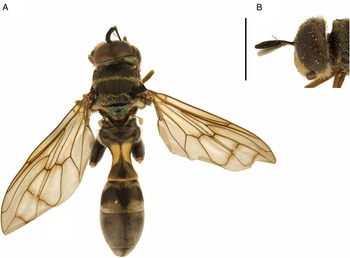
(A) Rhopalosyrphus teskeyi sp. nov.: Habitus, dorsal, paratype male; (B) head, lateral; scale bar = 2.5 mm.

Description. Male and female. Head. Face reddish to brownish black (except holotype broadly yellowish dorsolateral), always black medially, white pilose except for a few black pili ventrally; gena small, linear, white pilose; frons, and vertex black, white pilose; occiput reddish brown, white pollinose, and pilose on ventral 1/3, shiny dorsally; eye with a medial fasciate area of enlarged ommatidia; antenna about 1.5× as long as face, antennal ratio 5:1:10.
Thorax. Brownish black; pleuron white pilose; mesonotum punctate, very short appressed pilose, white pilose in males, more extensively black pilose medially in females; metasternum with short, appressed pile; calypter white, with brown margin and fringe; halter orange with brown capitulum. Wing: brown anteriorly, hyaline posteriorly, microtrichose except bare cell R and BM, anterobasal  of cell CuP and basomedially on alula. Legs: reddish brown except yellow basal 2/3 of metatibia, pale pilose except black pilose dorsomedially on pro- and mesotibiae and tarsi, with dense black spinose pile on ventrolateral 2/3 of metafemur, with ventromedial appressed black spinose pile on basal 2/3 of metatibia.
Abdomen. Black except third tergum yellow and second tergum reddish apically, mainly short appressed white pilose, except fourth tergum black pilose medially; first tergum short, as long as third; second tergum half as long as entire abdomen, constricted and cylindrical on apical 2/3, as wide as thorax basally; third tergum short, as long as first; fourth tergum oval, as long as second, forming with third a distinct club in ♂; fifth tergum elongate, about 1/2 as long as second, forming with third and fourth a distinct club in ♀.
Length. Body 15.8–14.6 mm; wing 8.8–8.6 mm; antenna 3.1–2.9 mm.
Type material
Holotype. Male, pinned with the following labels: “Argent. Salta//Rio Juramento, //60 km.S. Guemes//18.X.68. Pena;” & “Holotype//Rhopalosyrphus//teskeyi//Thompson 2010” [orange, handwritten] (CNC). Paratype. Paraguay, San Pedro, Corro-Rio Ypane, 5–9.xii.1983, Malaise Trap, M. Wasbauer (1 ♀, CDFA).
Type locality. ARGENTINA. Salta: Rio Juramento, General Martín Miguel de Güemes (24°40′S, 65°03′W), 60 km south of.
Distribution. Argentina*, Paraguay*.
Etymology. This species is named for Herbert Teskey (1928–1998) (see Vockeroth Reference Vockeroth1998). Herb described 29 new species and three new genera.
Remarks. The genus Rhopalosyrphus (Giglio-Tos) was recently revised (Weems et al. Reference Weems, Thompson, Rotheray and Deyrup2003). As noted in the key below, R. teskeyi appears related to Rhopalosyrphus australis, but distinct from it by the structure of the abdomen and wing microtrichia.

Parasyrphus vockerothi Thompson, sp. nov.
(see Vockeroth Reference Vockeroth1992: fig. 247)
Description. Male. Head. Black except face partially yellow; face broadly yellow laterally, with broad black oral margin and medial vitta, shiny except lightly white pollinose along eye margin, black pilose; gena shiny except lightly white pollinose along eye margin, black pilose; frontal lunule orange; frontal triangle shiny except narrowly black pollinose along eye margin, black pilose; vertical triangle black pilose; occiput gray pollinose and black pilose dorsally, becoming grayish-white pollinose and white pilose ventrally. Antenna: brownish orange except dark brown dorsoapical 2/3 of basoflagellomere, black pilose; basoflagellomere quadrate, about 1.5× as long as wide; arista brownish orange.
Thorax. Black except scutellum brownish yellow; postpronotum brownish-gray pollinose; mesonotum subshiny sublaterally, light brownish pollinose on medial 2/3, more grayish pollinose laterally, yellow and black pilose; scutellum grayish pollinose, black pilose; pleuron sparsely grayish pollinose, brownish-yellow pilose; halter, plumula, and calypter yellow. Wing: brownish hyaline, microtrichose. Legs: coxae and trochanters brownish black, black and yellow pilose; pro- and mesofemora brownish black on basal 1/3, orange apically, black pilose; pro- and mesotibiae orange, black pilose; pro- and mesotarsi brownish black, black pilose; metafemur black except brownish orange apex, black pilose; metatibia brownish orange on basal 1/3, black apically, black pilose; metatarsus black, black pilose.
Abdomen. First tergum black, yellow pilose laterally, black pilose medially; second tergum black with large orange oval macula on medial 1/3, with macula extending over lateral margin in at least 1/2 its width, dull pollinose on basal 2/3, shiny apically, black pilose except yellow pilose on macula; third and fourth terga black except for sinuate yellow medial fascia, shiny apically and laterally, elsewhere dull pollinose, black pilose except yellow pilose on pale areas; fifth tergum yellow basolaterally, black apicomedially, black pilose on black areas, yellow on pale areas, shiny; first sternum black except yellow apical margin, gray pollinose, yellow pilose; second, third, and fourth sterna shiny, yellow on basal 1/3 and apical margins, black medially, yellow pilose on pale areas, black pilose on dark areas. Genitalia black, black pilose.
Female. Similar to male except for normal sexual dimorphism and: frons shiny, except for gray pollinose along eye margin and in form of small mediolateral macula, with maculae broadly separated medially; pro- and mesofemora usually entirely pale orange; metafemur usually broadly yellow on basal 2/3.
Length. Body 7.8 mm; wing 7.2 mm (Holotype).
Type material
Holotype. Male, pinned specimen with dissected male genitalia attached in plastic microvial, with the following labels: “Beechgrove//Que. 16 V. 1962//45°39′, 76°9′//J.R. Vockeroth,” “CNC DIPTERA// 22640,” and “Holotype//Parasyrphus//vockerothi//Thompson 2010” [orange, handwritten] (CNC). Paratypes: with same data as holotype (3 ♂, USNM, CNC). BRITISH COLUMBIA: Sheep Lake, Robson, Central Kootenay L.D., 8.vii.1960, H.R. Foxlee (1 ♂ JS 22598, CNC); Cariboo Co., Bowron Lake, 4.vii.1947, J. Grant (1 ♂ JS 22596, CNC). MANITOBA: Stockton, 2 miles west of, 8.v.1958, J.F. McAlpine (1 ♂ JS 22618, CNC). ONTARIO: Simcoe Co., Orillia, 28.iv.1921, C.H. Curran (2 ♂ JS 22613–4, CNC); Hastings Co., Maynooth, 22.v.1970, D.M. Wood (1 ♂ JS22603, CNC); …, 6.v.1963, J.E.H. Martin (5 ♂ JS 22604–8, CNC); …, J.F. McAlpine, (1 ♂ JS 22609, CNC); Ottawa Division, Mer Bleu, 5 miles east of Ottawa, 7.vi.1966, D.D. Munroe (1 ♂ JS 22600, CNC); …, 15.vi.1966 (1 ♂ JS 2601, CNC; …, 19.vi.1966 (1 ♂ JS 22602, CNC); …, Ottawa, 4.v.1969, J.R. Vockeroth (1 ♂ JS 22610, CNC); …, Dirleton, 29.iv.1968, J.E.H. Martin (2 ♂ JS 22611–2, CNC); Algonquin Provincial Park, Mew Lake area, 13.v.1990, J.E. O'Hara (1♂ JS 22616, CNC); Algoma Co., Elliot Lake, 18 km east of, 11.v.1990, J.E. O'Hara (1 ♂ JS 22615, CNC); Sudbury District, Chapleau, 22.v.1990, M. Usui (1 ♂ JS 22617, CNC); Cochrane District, Lake Abitibi, Low Bush, 9.vi.1925, N.K. Bigelow (1 ♂ JS 22597, CNC; 1 ♀, USNM); …, 13.vi.1925, N.K. Bigelow (1 ♂ JS 22599, CNC). QUEBEC: Communaute-Urbaine-de-l'Outaouais, Aylmer, 13.v.1920, J. McDunnough (7 ♂ JS 22649–55, CNC; 2 ♂, USNM); …, 16.v.1924, C.H. Curran (4 ♂ JS 22656–59, CNC); …, Hull, 20.v.1923, C.H. Curran (3 ♂ JS 22660–62, CNC); …, 22.v.1923, C.H. Curran (♂ JS 22663, CNC); …, 24.v.1923, C.H. Curran (2 ♂ JS 22664–5, CNC); …, 26.v.1923, C.H . Curran (2 ♂ JS22666–7, CNC); Les Collines-des-L'Outaouais, Old Chelsea, 12.vi.1965, J.R. Vockeroth (♂ JS 22668, CNC); Tetreauval, 20.v.1923, C.H. Curran (1 ♂ JS 22669, CNC); Les Collines-de-l'Outaouais, Beechgrove, 10.v.1962, J.R. Vockeroth (4 ♂ JS 22633–6, CNC); …, 16.v.1962, J.R. Vockeroth (4 ♂ JS 22637–40, CNC); …, 3.v.1968, J.F. McAlpine (♂ JS 22641, CNC); Le Centre-de-la-Maurice, Lac Mondor, near Ste. Flore, 13.v.1951, E.G. Munroe (1 ♂ JS 2642, CNC); …, 16.v.1951, E.G. Munroe (3 ♂ JS 22643–5, CNC); …, 25.v.1951, E.G. Munroe (1 ♂ JS 22646, CNC); …, 27.v.1951, E.G. Munroe (1 ♂ JS 22647, CNC); …, 15.v.1951, E.G. Munroe (1 ♂ JS 22648, CNC); La Haute-Cote-Nord, Lac Mascanin, 19.vi.1929, W.J. Brown (1 ♂ JS 22670, CNC). LABRADOR: Goose Bay, 25.vi.1948 (1♂ JS 22631, CNC); … 10.v.1948, H.C. Friesen (1 ♂ JS 22632, CNC). NEW BRUNSWICK: Sunbury Co., Lincoln, 1.v.1968, I.W. Varty (1 ♂ JS 22622, CNC); York Co., Fredericton, 22.viii.1922 (1 ♂ JS 22619, CNC); …, 5.v.1922 (1 ♂ JS 22620, CNC); … 2.v.1960, R.C. Clark (1 ♂ 22621, CNC): Kent Co., Kouchibouguac National Park, 23.v.1977, J.D. Lafontaine (1 ♂ JS 22623, CNC). NOVA SCOTIA: Queens Co., Greenfield, 10–13.v.1968, D.M. Wood (4 ♂ JS 22625–28, CNC); Kings Co., Kentville, 23.v.1952, H.B Specht (2 ♂ JS 22629–30, CNC); …, Kentville, 30.v.1951 (1 ♂ JS 22630, CNC); …, Kentville, 15.vi.1914 (1 ♂, USNM); Colchester Co., Truro, 23.v.1914, C.B. Garrett (1 ♂ JS 22624, CNC). VERMONT: Laurel Lake, near Jacksonville, 20.v.1978 (1 ♂, USNM), 22.v.1978 (1 ♀, USNM), 25.v.1978 (1 ♂, 1 ♀, USNM), 27.v.1978 (1 ♂, 1 ♀, USNM), H.D. Pratt. NEW HAMPSHIRE: Grafton Co., Franconia, 18.vi.1973, B.J. & F.C. Thompson (1 ♂, 2 ♀, USNM) (no data beyond the state), A.T. Slosson (1 ♀, USNM); Franconia Notch, Rt. 3, 20–21.vi.1973, B.J. & F.C. Thompson (1 ♂, 7 ♀, USNM); Bethlehem, Rt. 3, 18.vi.1973, B.J. & F.C. Thompson (1 ♂, USNM); Passaconoway, 25.vi.1966, F.C. Thompson (1 ♀, USNM). Coos Co., Pittsburg, Moose Falls, 27–30.vi.1976, L.V. Knutson & F.C. Thompson (1 ♀, USNM); Connecticut Lakes, Rt. 3, 20–24.vi.1972, B.J. & F.C. Thompson (1 ♂, 6 ♀, USNM). MAINE: Orono, 16.vi.1978, on Viburnum cassanoides (1 ♀, USNM); Bar Harbor, 2.vi.1911 (1 ♀, USNM). MASSACHUSETTS: Wellesley, 19.v.1963, D. Meisner (1 ♀, USNM), 4.v.1963, D. Meisner (1 ♀, USNM); Weston, 22.vi.1963, F.C. Thompson (1 ♀, USNM); Amherst, 3.v.1963, F.C. Thompson (1 ♂, 1 ♀, USNM).
Type locality. CANADA. Quebec: Beechgrove, 45°39′N, 76°7′W.
Distribution. British Columbia* to Ontario* and Labrador*, south to Massachusetts*.
Etymology. This species is named for John Richard Vockeroth (1928–), North American's leading living dipterist, holder of the Charles Paul Alexander award of the North American Dipterists Society (see http://www.nadsdiptera.org/awardhome.htm). Dick is the only person who ever streaked in a Canadian government office, but Dick will be best remembered for his ability to see unique and informative characters to define and delineate generic groups. Some of these ideas were not published, but fortunately, Dick freely shared his knowledge to all. I am especially grateful because much that I know of flower flies derived directly from Dick's genius.
Remarks. Vockeroth (Reference Vockeroth1992) provided a key to the Nearctic species of Parasyrphus Matsumura, a brief description of this new species, and a figure of the male genitalia (Vockeroth Reference Vockeroth1992: fig. 247). He kindly left the species unnamed as he had expected me to name it after him in a timely manner. Unfortunately, my studies were delayed.
This species is johnsoni of Fluke (Reference Fluke1935) and others and is very similar to malinellus Collin (Reference Collin1952). The male genitalia of the two are the same. Parasyrphus vockerothi differs from malinellus in having the sterna shiny, with distinct black fasciae, and metafemur in the female broadly yellow on basal 2/3.
Lycopale woodi Thompson, sp. nov.
(Fig. 5)
(A) Lycopale woodi sp. nov.: Habitus, dorsal, paratype male; (B) head, lateral; scale bar = 3.5 mm; (C) male genitalia, lateral, holotype, scale bar = 2 mm.

Description. Male. Head. Face yellow with broad black medial vitta reaching frontal prominence but not antenna, yellow pilose and pollinose laterally, shiny and bare on medial vitta; gena black, shiny and bare anteriorly, yellow pilose and pollinose posteriorly; frontal prominence distinct, about 3/4 as high as eye width; frontal triangle black, shiny except very narrowly grayish-white pollinose along eye margin, black pilose; vertical triangle black, yellow pilose and pollinose anterior to ocellar triangle, shiny and black pilose posteriorly; eyes very narrowly dichoptic, separated by width of ommatidium; occiput black, densely golden pollinose and yellow pilose on ventral 2/3, becoming grayish-white pollinose and black pilose dorsally. Antenna: black except reddish orange on basoventral 1/3 of basoflagellomere and yellow arista; basoflagellomere oval, about equal in size to metathoracic spiracle, with small basoventral sensory pit on mesial surface; arista thick.
Thorax. Black except legs and scutellum; postpronotum yellowish-white pollinose, yellow pilose; scutum generally dull black pollinose and pilose, with notopleuron grayish-white pollinose and thick yellow pilose, with submedial grayish-white pollinose vitta ending anterior to but not reaching scutellum, with postalar callus on anterior 1/3 and adjacent scutum grayish-white pollinose and yellow pilose; pleuron dull grayish to black pollinose, only bright yellow pollinose on posterior anepisternum and dorsal katepisternum, yellow pilose except anepimeron extensively black pilose, with pile thicker on anepisternum; scutellum brownish yellow except narrowly black basally, black pilose except yellow pilose along base, without subscutellar fringe; plumula brown; calypter brownish orange except margin black. Wing: hyaline except light brown anteriorly, with brown extending to vein M on basal 1/2, to spurious vein medially and vein R4 + 5 apically; microtrichose except bare cell BM, cell D on basal 1/4, anterobasal 1/3 of cell CuP, anterobasal 1/2 of anal lobe and basomedially on alula. Legs: coxae black, yellowish-gray pollinose, yellow pilose; trochanters black, yellow pilose except short black pile intermixed on metatrochanter; pro- and mesofemora orange, yellow pilose except black dorsoapically on profemur and apicoventrally on mesofemur; metafemur orange except broadly black medial 1/3, yellow pilose except black pilose ventrally; protibia and tarsus black, black pilose; meso- and metatibiae and tarsi orange, yellow pilose except with some intermixed black pile on tarsi.
Abdomen. Black except second tergum narrowly yellow basolaterally; first tergum yellow pollinose and pilose; second tergum yellow pilose on basal 2/3 and laterally, black pilose apically, black pollinose except with narrow yellow pollinose oblique fascia which narrowly separated medially but broadly connected to lateral orange area and at mid length of tergum; third tergum yellow pilose on basal 1/2 and laterally, black pilose apically, black pollinose except with yellow pollinose fascia on basal 1/3 which separated from base and sides of tergum; fourth tergum similar to third except with apical 1/2 brownish-gray pollinose; sterna 1–3 shiny, yellow pilose; fourth sternum sparsely gray pollinose, yellow and black pilose; male genitalia (fig. 30) brownish-gray pollinose, yellow and black pilose.
Length. Body 15.2–10.2 mm (12.5 average of 5); wing 7.4–10.8 mm (9.1 average of 5).
Type material
Holotype. Male, pinned specimen with the following labels: “MEXICO, Hidalgo//km 170 Pachuca–Tampico, Tlalchinol//15 March 1986, F. Arias;” and “Holotype//Lycopale//woodi//Thompson 2010.=” [orange, handwritten] (UNAM). The holotype was dissected and has attached plastic microvial with the genitalia. Paratypes. MEXCIO: Chiapas, Huitepoc, 5 km west San Cristobal, 2750 m, 18.ix.1992, M. Wood (1 ♂, CNC); …, San Cristobal de las Casas, Huitepec, 16°45′05″N, 92°41′00″, 2300 m, 4.x.2009, P. Sagot (1 ♂, USNM), …, 16°45′15″N, 92°40′31″W, 5.i.2008, P. Sagot (1 ♀, ECOSUR). GUATEMALA: Zacapa: road to Plateau, north of San Lorenzo, trail beyond campsite, hill in Cloud Forest, 11.11561 N, 89.68412 W, 2,218 m, 17.xi.2007, B.D. Sutton, A.L. Norrbom, G.J. Steck & J. Monzoa (1 ♀, USNM).
Type locality. Mexico, Hidalgo, Tlanchinol, km 170 Pachuca–Tampico road, 20°59′N, 98°34′W
Distribution. Mexico (Hidalgo*, Chiapas*) to Guatemala*.
Etymology. This species is named after Donald Montgomery (simply “Monty” to all) Wood (1933–), Honorary Curator of Diptera at the Canadian National Collection, Ottawa, and specialist on black flies (Simuliidae), tachinids (Tachinidae), and Diptera phylogeny and male genitalia. To date, he has described 86 new species and three new genera, but knows of hundreds of more new Neotropical tachinids that wait on his time. As he is the “kid” of the group, I wish him many more years of productive research, so he can name those species.
Remarks.Habromyia Williston previously has been recognized as a broad concept (Thompson Reference Thompson1999, Reference Thompson1972; Thompson et al. Reference Thompson, Vockeroth and Sedman1976), but now I recognize this group as best being split into three genera (Lejops Róndani, Habromyia, and Lycopale) (Thompson et al. Reference Thompson, Rotheray and Zumbado2010; Thompson Reference Thompson2011b). Lejops is readily recognized by the shape and armature of the metaleg and contains only one Neotropical species (barbiellinii Ceresa, see Morales and Marinoni Reference Morales and Marinoni2008). Habromyia is restricted to the dark species with elongate abdomens and dark anterior margin of the wing, and contains three species (coeruleithorax Williston, flavifacies Shannon, and langi Curran). Lycopale contains the species with bright yellow tomentose pile on the thorax and abdomen. L. woodi is the northern most species and is readily recognized by its distinctive pattern of pale maculae and fasciae.

Acknowledgments
I thank Drs. J.R. Vockeroth and Jeffrey Skevington (Canadian National Collection, Agriculture and Agri-Food Canada (CNC), Ottawa); Philippe Sagot and Jorge L. León-Cortés (El Colegio de la Frontera Sur (ECOSUR), San Cristóbal de Las Casas), and Atilano Contreras Ramos (Instituto de Biologia, Universidad Nacional Autonoma de Mexico (UNAM), Mexico) for the loan of material in their care. I also thank Drs. Wayne N. Mathis and Joaquín (Ximo) Mengual (Smithsonian Institution, Washington) and Dr. Martin Hauser (California Department of Food and Agriculture, Sacramento) for their critical review of this manuscript; T. Litwak for preparing the illustrations of the male genitalia; and Joaquín (Ximo) Mengual for the other images and preparation of the final plates.