Kawasaki disease is a self-limiting systemic vasculitis of unknown aetiology that predominantly affects young children. It was first described in Japan in 1967.Reference Kawasaki 1 Although Japan has the highest incidence of Kawasaki disease, it has been described all over the world, with variable incidences being highest in Japan and other Asian countries. Reference Newburger, Takahashi and Gerber 2 – Reference Park, Han and Hong 6 The major long-term complication of Kawasaki disease is its effect on coronary arteries. The incidence of coronary artery aneurysms is high in untreated patients, being as high as 25% of cases.Reference Newburger, Takahashi and Gerber 2 Timely treatment with intravenous immunoglobulins decreases the incidence of coronary artery disease to less than 5%.Reference Newburger, Takahashi and Gerber 2 , Reference Durongpisitkul, Gururaj, Park and Martin 7 Although coronary artery aneurysms and subsequent myointimal proliferation and stenosis of the coronary artery at either end of the aneurysm remain a significant risk for myocardial infarction, spontaneous resolution of aneurysms is well described in up to 50% of patients.Reference Newburger, Takahashi and Gerber 2 , Reference Suzuki, Kamiya and Kuwahara 8
There are several case reports and case series of Kawasaki disease in the Middle Eastern countries;Reference Asadi-Pooya, Borzoee and Amoozgar 9 – Reference Al-Harbi 17 however, the true incidence in our part of the world is largely unknown. We report our experience in Kawasaki disease in Jordanian children from a single institution over 12-year period, with emphasis on demographic variables, clinical presentation, and short-intermediate coronary artery outcome.
Materials and methods
Medical records database of the Jordan University Hospital was searched for patients who were diagnosed with Kawasaki disease in the period from January, 1997 to April, 2010 using the computerised hospital coding system. All patients who met the diagnostic criteria for Kawasaki disease according to the American Heart AssociationReference Newburger, Takahashi and Gerber 2 were included in the study. Criteria for the diagnosis included fever for 5 or more days, in addition to four out of the following five clinical findings: polymorphic rash, non-purulent conjunctivitis, cervical lymph node enlargement, changes of the extremities, and changes in the oral mucosa. Patients who had less than four of these criteria were labelled as incomplete Kawasaki when all other diagnoses were excluded. In addition to the clinical data, echocardiographic reports, and images, cardiac catheterisation angiographic images, when applicable, were reviewed for every patient. Demographic data included age at diagnosis, gender, and season at diagnosis. Clinical data included symptoms at presentation, duration of fever before treatment with intravenous immunoglobulins, response to treatment, laboratory findings, echocardiographic findings, and angiographic findings when applicable. Treatment with intravenous immunoglobulins was considered late if given more than 10 days from the onset of fever. Echocardiographic assessment was done for all patients at the time of diagnosis, and at 2 and 8 weeks after the diagnosis. Subsequent assessments were done every 6–12 months.
Data are presented as mean (plus or minus standard deviation) or median (range) where appropriate. Statistical analysis was performed using Medcalc® version 10.0.2.0 statistical software. Categorical variables were analysed using chi square test, continuous variables were analysed using the non-parametric Mann–Whitney test, and linear and logistic regression analysis was used to determine risk factors for cardiac involvement. Statistical significance was present with p-value less than or equal to 0.05.
The study was approved by the institutional research committee.
Results
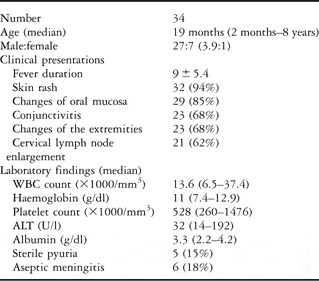
During the study period, the average number of patients admitted to the paediatric department was 2800 patients per year. A total of 34 patients were diagnosed with Kawasaki disease, making an incidence rate of 0.09% of all paediatric admissions. The median age was 19 months, ranging from 2 months to 8 years. Most children were boys, with a male to female ratio of 3.9:1. In all, 12 children (35%) were diagnosed during summer, 11 (32%) during spring, nine (27%) during winter, and only two (6%) during fall. Demographic and clinical data are summarised in Table 1. On chart review, 22 patients (65%) met the full criteria for diagnosis, with at least four of five clinical findings in addition to fever of 5 or more days. The 12 patients who were diagnosed with Kawasaki disease with only two or three clinical findings in addition to the fever were retrospectively diagnosed as incomplete Kawasaki. A thorough revision of the medical files of those patients showed that the diagnosis of Kawasaki disease was made after either a positive cardiac finding on echocardiogram (n = 7) or after exclusion of other possible diagnoses (n = 5). All patients had either elevated erythrocyte sedimentation rate or C-reactive protein at the time of presentation. There were six patients (18%) with aseptic meningitis.
Clinical data of patients with Kawasaki disease in Jordan.

ALT = alanine aminotransferase; WBC = white blood cell
Normal value 6–50 U/l
Cardiac involvement was found in 18 patients (53%). Of the 18 patients, 14 (41%) had changes of the coronary arteries – seven had aneurysms and seven had ectasia – and the other four patients had either isolated mild mitral regurgitation (n = 2) or pericardial effusion (n = 2). The detection of cardiac involvement was either based on the initial echocardiographic assessment (n = 14) or on 2-week echocardiographic evaluation (n = 4). Valvular regurgitation was found in a total of four (12%) patients; two had isolated mitral regurgitation, one patient had both a coronary aneurysm and mitral regurgitation, and another patient had coronary ectasia with both mitral and aortic regurgitation. Pericardial effusion was found in a total of four (12%) patients, two as isolated finding and two with coronary ectasia. Children with cardiac involvement were younger than children without cardiac involvement – mean age 1.6 (plus or minus 1.5 years) versus 3.4 years (plus or minus 2.4 years), respectively (p = 0.01). There was no difference in the rate of cardiac involvement between boys and girls (p = 0.86), nor between patients with complete and those with incomplete diagnostic criteria (50% versus 65%, p = 0.9).
Logistic regression analysis identified young age as the only predictor of development of cardiac involvement, with an odds ratio of 0.63 per year (95% confidence interval 0.41–0.95, p = 0.026).
Treatment and follow-up
All patients but one (97%) received at least one dose of intravenous immunoglobulins on the day of diagnosis of Kawasaki disease. The standard dose was 2 grams per kilogram over 12 hours. Owing to persistence of fever for more than 48 hours, six patients (18%) required more than one dose of intravenous immunoglobulins after the initial dose; one of these patients was given intravenous steroids after the third dose of intravenous immunoglobulins. Patients who developed cardiac involvement received intravenous immunoglobulins later than patients without cardiac involvement – mean 10.6 plus or minus 6 days, median 8.5 (4–25) versus mean 7.7 plus or minus 5 days, median 7.5 (4–23); however, this did not meet statistical significance (p = 0.2).
Once the diagnosis of Kawasaki disease was established, antipyretic medications were discontinued and 30 patients (90%) were started on high-dose aspirin (80–100 milligrams per kilogram per day). The other four patients were not having fever at the time of diagnosis. All patients were given anti-platelet dose of aspirin after fever subsided for 48 hours. Aspirin treatment was prescribed for all patients for 8 weeks. Patients who continued to have coronary aneurysms or ectasia were continued on aspirin beyond 8 weeks.
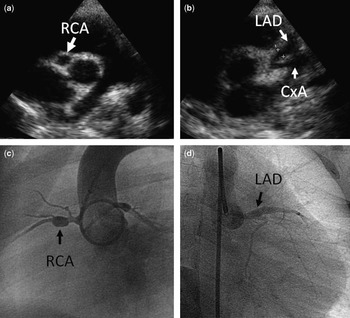
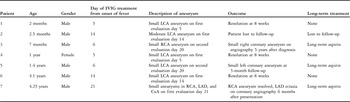
Of the seven patients (21%) with coronary aneurysms, five were detected on the initial evaluation and two on the subsequent 2-week evaluation. On subsequent follow-up evaluation, three aneurysms had resolved completely, one patient was lost to follow-up, two patients continued to have small aneurysms – one right coronary and one left coronary – and one patient had persistent dilatation of the left anterior descending coronary artery with resolution of the right coronary aneurysm (Fig 1). Demographic data and outcome for patients who developed coronary aneurysms are summarised in Table 2.
(a) and (b): Echocardiographic image of a small right coronary aneurysm (RCA), small left anterior descending artery (LAD), and circumflex artery (CxA) aneurysms in the same patient. (c): persistent small RCA aneurysm shown by aortography 18 months after presentation. (d): diffuse proximal LAD ectasia 6 months after presentation.

Clinical and outcome data of patients who developed coronary aneurysms.

CxA = circumflex artery; IVIG = intravenous immunoglobulin; LAD = left anterior descending artery; LCA = left coronary artery; RCA = right coronary artery
All other cardiac involvements have resolved completely on follow-up: four patients had valvular regurgitation – three mitral and one both mitral and aortic; valvular abnormality disappeared at the time of follow-up 8 weeks later and they continued to be free of valvular abnormalities at later follow-up. The four patients who had pericardial effusion had complete resolution – two at 8-week evaluation and two at 6-month evaluation.
Discussion
Kawasaki disease has been reported in almost every country around the world. The true incidence in most Middle Eastern countries is not known. This report is, to our knowledge, the largest series of Kawasaki disease in Jordan. It describes important demographic and clinical data about the disease in Jordan.
As described in numerous other reports, Kawasaki disease affects primarily young children, but it seems that it is far more common in boys than in girls with a ratio of almost 4 to 1, in contrast to the typical 1.5–2 to 1 ratio described in most other reports from other countries. Moreover, we found the disease was diagnosed throughout the year but most commonly during summer, which is similar to few other reportsReference Ma, Yu, Huang, Chen, Huang and Huang 5 but different from most reports describing peak incidence in winter.Reference Newburger, Takahashi and Gerber 2 , Reference Park, Han and Hong 6 This may have to do with regional differences in peak viral seasons, despite the fact that such viral aetiology of the disease is yet to be identified. Table 3 summarises some demographic variables and coronary complication rates of reported series of Kawasaki disease in the Middle Eastern countries.
Kawasaki disease reports in the Middle Eastern countries.

In addition to coronary artery disease, which is the major long-term morbidity of Kawasaki disease, we described a significant incidence of non-coronary cardiac involvement, namely valvular regurgitation, which occurred in 12% of cases. The affected valve was mitral valve, causing mitral regurgitation alone in three cases, and both mitral and aortic valve regurgitation in a 2-month-old female infant. Fortunately, this appears to be transient, as all the affected valves were normal with no regurgitation within a few months of follow-up. We believe that this valve involvement is secondary to inflammatory process involving the valve leaflets, which seems to resolve with the resolution of the systemic inflammatory process. This should be distinguished from valvular involvement of other inflammatory illnesses such as rheumatic fever, which typically results in long-term morbidity of valvular dysfunction.
Another non-coronary involvement was pericardial effusion, which also occurred in 12% of patients, with or without coronary involvement. This again seems to be mild, transient, and with no long-term effect.
The incidence of coronary aneurysms remains high, with seven patients (21%) developing aneurysms despite treatment with intravenous immunoglobulins. This high incidence may be partly explained by delayed recognition of the disease – four of the patients with aneurysms received intravenous immunoglobulins beyond the 10th day of fever – and may be due to the early development of aneurysms during the course of illness. In our series, most patients had aneurysms at the time of diagnosis, with a median duration of 10 days (5–21) of onset of fever.
One other important observation is that almost one-third of patients in our series were retrospectively labelled as incomplete Kawasaki, and they had the same incidence of cardiac involvement. In fact, seven of the 12 patients of incomplete Kawasaki were diagnosed after echocardiographic evaluation revealed cardiac involvement. This may indicate that our population is at a higher risk of cardiac involvement because of the difficulty in making the diagnosis owing to the lack of full diagnostic criteria, which will undoubtedly lead to delay in diagnosis and treatment.
Although we did not demonstrate that earlier treatment with intravenous immunoglobulins results in reduction of coronary morbidity, we still believe that this holds true because of the vast international evidence of its effect.Reference Newburger, Takahashi and Gerber 2 , Reference Durongpisitkul, Gururaj, Park and Martin 7 , Reference Abushaban, Salama, Uthaman, Kumar and Selvan 16 , Reference Oates-Whitehead, Baumer and Haines 18 Awareness of the presence of Kawasaki disease, with its characteristic features peculiar to our region, is indeed the main strategy against long-term morbidity in our children.
This study is limited by its retrospective nature and by the relatively small number of patients. Although there are certain trends in the age distribution, gender, and complications encountered, a larger series is needed to arrive at clear recommendations regarding management of Kawasaki disease in our area.
Conclusion
There is a relatively high incidence of coronary artery disease in Jordanian children with Kawasaki disease. Early recognition and management remain the most important measure to prevent the development of coronary artery disease.