In 1900, the Encyclopedia Britannica requested an original, previously unpublished portrait from Kaiser Wilhelm II for its forthcoming edition. The German emperor denied the request, instead advising the British publishers to find an existing photograph on the open market.Footnote 1 A few years later, when a Berlin-based association for hunting dogs needed a cover shot for its journal, the Kaiser gladly sat for the picture.Footnote 2 From a twenty-first-century perspective, Wilhelm's choice seems a bizarre case of misplaced priorities: the Kaiser took care to position himself among the hounds, but left his encyclopedia image in the hands of foreign publishers. Was this gaffe an example of what Wilhelm II's grandson, Louis Ferdinand, later criticized as the Kaiser's “deficient” sense of public relations, his feeling that “the imperial family stands high above the need to worry about publicity”? In England, mused the royal heir, “publicity is taken much more seriously”—after all, as early as the 1860s, Queen Victoria had courted public support by publishing her family portraits and private diaries.Footnote 3
Unlike Louis Ferdinand, historians today rank Wilhelm II alongside his grandmother Victoria as one of Europe's first media monarchs. They emphasize his obsession with his portrayal in mass newspapers and his proclivity to supply the media with headline-capturing sound bites—although they also concede that the Kaiser's press policies were uncoordinated, that his interest in newspaper reports was highly solipsistic, and that his blustering speeches often scandalized the German public.Footnote 4 Photo historians go even further and portray the Kaiser's interest in new media as unambiguously up to date. Over the course of his reign, Wilhelm II amassed a collection of 12,000 photographs, mostly of himself at state, military, and family gatherings, taken by court photographers who accompanied him on diplomatic travels, to military maneuvers, and on yachting and hunting trips.Footnote 5 The emperor also allowed filmmakers to set up cameras at official functions, so that, with 320 film clips to his name between 1895-1918, Wilhelm II was spliced into the “cinema of attractions” alongside other newsworthy spectacles.Footnote 6 Based on this evidence, scholars have concluded that Wilhelm II successfully used “photography as a PR-tool,” implying that he had a fine-tuned awareness of the media's potential to manipulate public opinion in subtle, even subliminal, ways.Footnote 7
But how accurate is this assessment, given Louis Ferdinand's criticism? Wilhelm II sought to be Wortführer (spokesperson for national ideals) and Volkserzieher (pedagogue of the nation), but did he also adopt modern marketing strategies to promote royalism?Footnote 8 Or was he merely transposing older forms of royal representation onto new visual media? After all, monarchs had long massaged their image for both an elite audience and the broader public through painting and sculpture, architecture and statuary, coinage and ceremonial. The ubiquity of Wilhelm II's image per se was not novel, even if it occurred in an age of mechanical reproduction: Frederick the Great's countenance was arguably better known than the Kaiser's, even among Wilhelm II's contemporaries. As Paul Seidel, conservator of the royal art collections, observed in 1897, “There is no likeness that lives deeper in the heart of the Prussian people than the image of ‘Old Fritz’; every child recognizes him at first glance.” Such instant recognition did not mean that Frederick the Great had been adept at promoting his popular image, though. To the contrary, the Prussian king had done little to encourage the distribution of his portrait and had in fact given up sitting for artists altogether after ascending the throne in 1740.Footnote 9 Instead, Frederick's image was immortalized in woodcuts and lithographs by numerous independent artists, Daniel Chodowiecki (1726-1801) and Adolph Menzel (1815-1905) foremost among them.Footnote 10
If Wilhelm II's media efforts were more in step with modern spin-doctoring, one would expect more advanced branding methods than those traditionally adopted by kings—all the more so as the Kaiser had numerous marketing models to follow. Advertising journals were first founded in the 1890s, advertising agencies around 1900. Fin-de-siècle trademark laws officially acknowledged the power of brand names to create consumer desire at a time when Germany already had 10,000 registered trademarks.Footnote 11 Ferdinand Avenarius's art journal, Der Kunstwart, ran regular articles on “How it's Done” (Wie's gemacht wird), exposing the self-advertising techniques used by cultural celebrities, while advertisers and psychologists such as Wilhelm Stern and Otto Lipmann, founders of Berlin's Institut für angewandte Psychologie in 1906, used behavioral studies, psychological experiments, and mass surveys to develop scientific market analysis.Footnote 12 On both sides of the Atlantic, Hugo Münsterberg, the German émigré and Harvard psychology professor, popularized ideas about the power of suggestion, people's susceptibility to illusion, and behavioral conditioning through propaganda, concepts he believed could help to integrate individuals into the state through “a conscious social program of symbol-building.” Münsterberg caught the Kaiser's eye in a different context: the emperor decorated the professor for the German-American academic exchange program he initiated.Footnote 13 Did Wilhelm II also borrow from Münsterberg's work in applied psychology?
The question is doubly significant because of what it reveals about German mindsets leading up to World War I. Thomas Kohut argued that Wilhelm II's grandiose but stern public image—his imperial brand—appealed to Germans' subconscious desire to be dominated, in the manner of Heinrich Mann's Untertan.Footnote 14 Otto May likewise asserted that the widespread consumption of postcards showing Wilhelm II in uniform is proof positive of Germans' fixation on authority figures (Verehrungsbedürfnis), confirming Germany as a society of subordinates marked by social militarism.Footnote 15 By reading the royal image at face value as evidence of subjects' passive acceptance of the monarchy's self-projection, however, such interpretations blocked out individual acts of appropriation and how they affected subjects' reception of the emperor's media image.Footnote 16 For indeed, the millions of postcard and photograph consumers who bought royal portraits placed their own stamp on what the images meant by how they used them once they purchased them.
The empire's photographic copyright legislation of 1876 and 1907, and the popular attempts to circumvent the law through piracy and photomontage, shed a unique light on these issues. Then as now, claims about copyright were overtly framed in financial terms, with opponents of copyright raising the alarm against business monopolies and extolling the social value of cheap editions, and critics of piracy invoking just compensation for authors, lambasting bootleggers for cheating consumers, and urging the need for economic incentives for inventors.Footnote 17 But copyright is never only about maximizing monetary profits. It is also about monitoring content, distribution, and end use—control that seems necessary to ensure that the artist and his/her work are not misrepresented, but receive the “right” kind of publicity.Footnote 18 Wilhelm II, too, was concerned about control as he used his photographic rights to regulate his image. Even so, changes in Wilhelmine copyright law recalibrated the Kaiser's power over his public persona, as new photographic techniques—snapshot technology, current events photos in newspapers, amateur cameras such as the Brownie—determined who could capture the emperor's portrait and thus whether the monarch belonged to the nation's cultural property (Kulturgut). Against this background, Wilhelm II had to wonder whether modifications to his image through piracy and photomontage represented a debasement of his person—a kind of brand dilution—or, more positively, secured his place in the creative evolution of a common, integrated culture, and whether it mattered that he had little say over the process.
This essay examines these topics in three parts. The first section assesses Wilhelm II's use of copyright law to manage his photographic image and concludes that the Kaiser was not especially modern in his publicity techniques. Instead, Wilhelm II mostly used his photographs to reinforce traditional social hierarchies and, rather than taking personal initiative to promote patriotism or populism, routinely displaced responsibility for the production and distribution of his image onto photographers and other private manufacturers.Footnote 19 The second section centers on photomontage, one of the practices that copyright legislation was meant to control. As artificially constructed pictures, the montages reveal which idealized images of royalty were most sought after on the open market, and how they compared to (and diverged from) the emperor's own, desired public profile. The third section enters the realm of everyday practices, setting the emperor's habits against those of photograph consumers and revealing that, in language and praxis, Wilhelm II and his subjects articulated very different attitudes toward the royal image. The autonomy of consumer demand in defining the emperor's public persona—similar to the cultural expectations citizens of other modern nations placed on their public figures—affirms that in media policy, too, Wilhelm II's personal regime was highly tenuous, and that the royal image was always in danger of slippage out of official control. It also suggests, as the conclusion argues, that the public's self-assertion in shaping the royal image made the Kaiser's traditional legitimacy inherently unstable and thwarted his attempts to re-charismatize the monarchy along authoritarian lines—a gap in symbolic communication between dynasty and public that contributed to the Hohenzollerns' rapid decline in support after World War I.
Piracy and Publicity
Mere months after ascending the throne in 1888, Wilhelm II was briefed by Otto Dambach, the legal scholar and president of the Photographische Sachverständigen Verein, on the dangers of photographic piracy to the royal image—dangers that Dambach traced back to the empire's outdated copyright laws.Footnote 20 When mass reproducible photography was first developed in the 1850s, it was classed among the mechanical arts, not the fine arts, according to long-standing aesthetic criteria: since the photographer merely reproduced existing objects, he was denied the subjective, artistic vision that defined fine art since the eighteenth century.Footnote 21 Disavowed as art, photographs were excluded from copyright protection until revisions to the law in 1876 partially rectified this situation. Inspired by the principle of free trade, the new law still treated photography as a mechanical art when the images were affixed to industrial products and consumer goods, and thus allowed manufacturers to reprint photographs freely and without permission on packaging and design. But the 1876 law also treated photographs as objets d'art when they were sold in their own right—for instance, when booksellers sold portraits of celebrities—and in such cases forbade their unauthorized reproduction.
Still, the new legislation seemed controversial at the time because it ran up against the peculiarities of German copyright traditions. The decentralized nature of the Holy Roman Empire and the German Confederation had bred profound differences and disunity in the German states' property laws, which in turn meant that the concept of “intellectual property” was less compellingly self-evident to German legal scholars than to those in Britain or France. Eschewing arguments based on ownership, Kant, Lessing, Goethe, and Herder all anchored their calls for copyright in the author's right to authenticity.Footnote 22 Kant in particular argued that unauthorized reprinting was an infraction against the author's identity—his right to speak in his own voice—as the pirate usurped his persona.Footnote 23 Abstract ideas might not be the property of any one individual, since such ideas could potentially be thought by every and anyone; however, their concrete expression in literary formulation and turn of phrase was unique to the individual author alone, and so should be protected.Footnote 24 With piracy tantamount to identity theft, authors' rights were subsumed under the broader concept of Persönlichkeitsrecht (the “right to one's person”), a legal term that also covered the right to privacy and to one's public image and reputation. This nuance is captured, in fact, in the German term for copyright—Urheberrecht—which emphasizes the rights of the artistic work's “creator” (Urheber) rather than the work's owner (in the understanding that the owner could, after all, merely be the work's publisher rather than its author).Footnote 25
The classification of photographers as Urheber remained problematic, though, as many legal analysts continued to argue that photographers did not produce art from their own creative minds and talent, but merely manipulated chemicals to reflect an existing reality.Footnote 26 To circumvent this ambiguity, the 1876 law supplemented the photographer's Persönlichkeitsrecht (his need to be protected from identity theft by pirates) with the Persönlichkeitsrecht of the individuals depicted in portrait photographs, that is, their right to their own image. To activate this second sense of Persönlichkeitsrecht, the law stipulated that whenever a portrait was taken, even in a photographer's studio, the right to the image belonged by default to the person who commissioned the photograph (the Besteller), with the assumption that the Besteller was usually coterminous with the sitter (or else was someone representing the sitter, as when a parent commissioned a child's photograph).Footnote 27 Piracy thus legally infringed on the Besteller's right to his image, meaning that, even if a Besteller chose to share the right of reproduction with the photographer, he or she still retained the primary right to prosecute unauthorized reproduction.
Ironically, the law's emphasis on the sitter's Persönlichkeitsrecht made it exceedingly easy to pirate the royal image. For instance, when Wilhelm II's predecessor Wilhelm I (1861-1888) had sat for photographs, he had usually granted the photographer joint right of reproduction to allow him to sell the picture on the market. Crucially, though, this joint right did not allow the photographer to initiate legal proceedings against copyright infringements, since the emperor as Besteller was considered the primary injured party under the law. Wilhelm I rarely went after bootleggers, however, even when they rephotographed official portraits and passed them off as originals, for fear that court trials would bring negative publicity to the monarchy. Unless the stolen images were transformed into overtly subversive pictures, the emperor let the pirates be. With the court photographers' hands tied, pirates came to count on Wilhelm I's benign neglect toward their swindles.Footnote 28
Otto Dambach now urged Wilhelm II to end this state of affairs on the grounds that it limited the number of high-quality royal portraits available to consumers. To offset their loss of profits through piracy, official vendors used their privileged status as court photographers to fix prices artificially high, placing authorized portraits out of reach for the broader public. Pirates, on the other hand, worked clandestinely and quickly, flooding the market with shoddy knockoffs. Arguing “in the interest of patriotism,” and on the assumption that the “widest possible distribution of [superior royal] images can only be desirable,” Dambach suggested an alternative: whenever Wilhelm II sat for a portrait, he should pass the joint right of reproduction not only to the acting court photographer, but also to a large number of reputable, third-party photographers, who could then sell decent copies at lower prices. To Dambach, this was a win-win situation: the original photographers would still command higher prices from well-heeled customers because of their cachet as court photographers, while the second-tier photographers' good but inexpensive reproductions would undercut (and stamp out) the bootleggers.Footnote 29
Dambach had reason to believe that his scheme would win the Kaiser's approval, as it echoed his policy of distributing royal photographs widely to Prussian schools. Under Wilhelm II's predecessors, schools had had to request royal portraits individually, and the merit of each petition had been judged using background checks of the faculties' political activities. Royal portraits had thus traditionally been used to reward teachers' good behavior, and not as a proactive tool to inspire loyalty to the crown in schoolchildren. It was only after Wilhelm I's death in March 1888 that his immediate successor and son, Friedrich III (March-June 1888), ordered the first state-sponsored distribution of Wilhelm I's portrait to 5,000 schools.Footnote 30 Even this, though, was more an act of commemoration than pedagogy: Friedrich III did not send his own portrait to the schools to encourage loyalism to himself, but that of his deceased father as a mark of reverence for the dead. Wilhelm II, in contrast, was finely aware of schools' potential to spread pro-monarchic propaganda and famously insisted that Prussian history lessons and physical education be added to the empire's curriculum to turn German youths into soldiers, patriots, and antisocialists.Footnote 31 Likewise, in 1889, Wilhelm II became the first Prussian king to send portraits of himself—as a living monarch—to schools en masse. With a total of 2,700 portraits, one school in every urban district (Stadtkreis) and five schools in every rural district (Landkreis) received a picture (Berlin, with its population of two million, was allocated five portraits). Schools that went empty-handed could purchase the same picture at a reduced price of eighteen marks fifty pfennigs.Footnote 32
While this broad-scatter distribution policy reflected Wilhelm II's interest in patriotic schooling, however, the emperor did not apply the same understanding to Dambach's petition and instead denied his request for a blanket authorization to extend partial copyright to second-tier photographers.Footnote 33 Although the Kaiser did not justify his decision to Dambach overtly, he seems to have been less concerned about disseminating his image in a populist manner (as Dambach urged him to do) and more anxious to restrict the dynastic image to its traditional, regal aura. In that spirit, when Wilhelm II discovered in 1890 that a public art gallery had commissioned a portrait of his deceased father, Friedrich III, without Wilhelm's prior knowledge, he stipulated (based on his Persönlichkeitsrecht) that all art institutions wishing to obtain Hohenzollern portraits or sculptures had to clear their intentions with him first so that he could monitor whether the end products were sufficiently regal.Footnote 34
In contrast to his generous school policy, Wilhelm's insistence that other public venues gain clearance to set up his portrait represents an early instance of his wariness of spreading his “brand recognition” too widely, lest his image suffer a loss of dignity. It also demonstrates, though, just how difficult it was for the Kaiser to maintain control of his public aura. When, in response to the new clearance stipulation, the Dürrenberg salt water spa requested permission in 1891 to purchase a bust of the emperor for its waiting room, Wilhelm had to revise his preapproval policy, limiting it to newly commissioned, original works of art and explicitly excluding all “reproductions and photographs of works of art.”Footnote 35 The prospect of having to approve all photographs or busts set up in the empire's pubs and post offices, let alone its public swimming baths, was simply too daunting: after all, the emperor's picture hung just about everywhere, “in the hotel room where you sleep, in the restaurant where you eat, in almost every shop window, in the picture galleries, in the churches, in the public buildings, and in every illustrated paper.”Footnote 36 The Kaiser had even less power over retailers who used his portrait to sell their wares. The empire's industrial laws, designed to foster free trade and competition, allowed advertisers to depict famous individuals, including the emperor, on their packaging without permission: rather than an infringement of Persönlichkeitsrecht, this was considered “industry's homage to the great man” (as long as the images were treated respectfully and did not conjure up unpleasant associations, of course).Footnote 37 And indeed, industrialists from cigarette makers to paper manufacturers capitalized on the Kaiser's aura by using his face to sell their products—one entrepreneur even displayed a telegram he had received from Wilhelm on his advertising posters, a misuse of royal favor the Kaiser tried to quash by sending the man a cease and desist order.Footnote 38
If Wilhelm II had little control over manufacturers' use of his portrait, he also—more surprisingly—had little interest in using his image to produce populist souvenirs. For instance, Wilhelm routinely denied requests for portraits from souvenir producers, even when their mementos were intended for soldiers and veterans.Footnote 39 Instead of sitting for photographs and transferring the copyright to the souvenir makers (as they hoped), Wilhelm II directed entrepreneurs to find existing photographs on the market and to work out the reproduction details with the respective photographers. In this way, Wilhelm used his court photographers as “gatekeepers” to keep memorabilia makers at bay. The Kaiser also relied on court photographers to distribute his image, further limiting his personal involvement in selling his portrait. While Wilhelm decided on the portraits' content (choosing his uniforms, props, and poses, for instance directly mimicking Louis XIV's iconography), he left the details of sale, format, and price to the respective photographers. Thus, when the court photographer J. C. Schaarwächter made inexpensive portraits of the royal family “available to the broader masses [breite Volksschichten],” this was at his discretion and not a decision handed down by the emperor.Footnote 40
In 1907, new copyright legislation further undermined Wilhelm II's ability to control his public image. In the new law, private citizens (as Besteller) retained control of their portraits as before, but when it came to “public men” (Personen der Zeitgeschichte), the right of reproduction was now automatically vested only in the photographer, and no longer in the person portrayed.Footnote 41 In other words, when Wilhelm II was photographed in public, on the street, or even during an authorized sitting in his palace, the photographer, not the emperor, had the exclusive right to reproduce the image. There were some exceptions to the photographers' rights, of course. The image could not be taken against the emperor's will in his private domain—although press photographers routinely worked around this restriction by waiting for the emperor to emerge from the palace gates. Also, the image could not be used disrespectfully—this was a general stipulation for all portraits of public figures, and Wilhelm's claim to respect was further bolstered by lèse-majesté laws.Footnote 42 These restrictions aside, though, the Kaiser was fair game once he stepped out in public: when a private citizen took snapshots of the emperor strolling on the Swinemünde beach in 1910, Wilhelm II directed his adjutants to confiscate the man's photographic plates, only to be told that they had no legal right to do so.Footnote 43
The 1907 law was overtly drafted in anticipation of the Berlin Convention of 1908, which was to extend the Berne Convention's copyright protections to photography.Footnote 44 The law's distinction between ordinary citizens and public figures was also made urgently necessary, however, by recent technological developments, for instance the exponential rise in piracy spurred by postcard production. As noted above, the 1876 law allowed for the free and unlicensed reproduction of photographs on all “works of industry,” including packaging and advertisements. This ruling applied as long as entrepreneurs used the images to sell other consumer goods, rather than selling the photographs themselves. Picture postcards were initially denied protection under the law because they, too, were designated works of industry: the postcard was viewed, just like writing paper, as a vehicle for written communication. The postcard-cum-stationery was thus the proper object of sale, while the photograph that adorned the postcard's front was merely a marketing device to sell the postcard. Pirates were able to exploit this loophole to their advantage, and throughout the 1890s, the courts had to rule against photographers who tried to sue for copyright infringement of their postcard images.Footnote 45 During those same years, improved, mechanized copying techniques made it possible to produce postcards in vast quantities. In 1897, more than 530 million postcards—costing only three pfennigs apiece—were sold in the German Empire.Footnote 46 In consequence, card collecting also became a “mass sport,” so that postcards could now be redefined as collectibles in their own right; and as the pictures on the postcards were reclassified as the proper object of sale, they were finally given the same legal safeguards as other photographs.Footnote 47 Still, to activate this protection effectively, photographers of celebrities needed the sole right of reproduction to initiate legal proceedings—a right afforded by the 1907 law's separate treatment of celebrities as public men.
The law's designation of public men was also intended to decriminalize modern journalistic practices. The old copyright law had penalized journalists who published photographs of public events without consent from all those present—not a great danger before the 1890s, since most newspaper illustrations still consisted of lithographs and other drawings (which did not require consent). At the fin de siècle, however, new technologies such as snapshot photography, dry plates, and lightweight cameras such as Eastman's Brownie allowed journalists to take spontaneous pictures of public events, while improved printing techniques made photographs a mainstay of mass circulation newspapers.Footnote 48 The time-consuming legal requirement to obtain consent for current events photographs now threatened to make news reporting virtually impossible—a threat disarmed when the 1907 law took the right of reproduction, and therefore the need for consent, away from public men. This change in law was not only a practical measure, but also a point of political idealism. As the prominent legal scholar Josef Kohler argued in 1903, the nation had a right “to form a clear mental image of the individuals who control the state or influence history,” adding that this was an important political development: “It is good and wise that the population has an interest in such things, and does not obtusely and apathetically let world events pass it by.”Footnote 49 In the eyes of its practitioners, the mass media fulfilled a democratizing role by opening avenues of communication between the public and its leaders, rather than cutting the latter off from popular view (as the arcana of absolutist monarchy, for instance, had done in the past).Footnote 50
Despite these corrections to the older legislation, the Kaiser and his advisors were dissatisfied with the new law, and especially the loss of control that the designation “public man” implied. Finding himself besieged now by paparazzi avante-la-lettre, the emperor had to seize upon alternate methods to keep intrusive photographers at a distance: he cordoned off official ceremonies and required press photographers to apply in advance for entrance tickets; he authorized police to use traffic ordinances to disperse cameramen at public events (camera tripods were blamed for blocking traffic); and he barred photographers from taking his picture at military maneuvers by invoking espionage laws.Footnote 51 Ad hoc though they were, these prevalent, rearguard efforts to prevent the dissemination of the royal image contradict the assumption that Wilhelm II was ever eager to have his picture taken.
All the same, these measures could only be applied to Wilhelm's appearances in public. But since, by law, the Kaiser remained a public man within his palace walls, he needed another way to protect his rights when sitting for official portraits: in 1908, he introduced a release form forcing court photographers to sign over their right of reproduction to him. Wilhelm II was urged to implement the release policy by his ministers, especially Kultusminister Ludwig Holle, on the grounds that the 1907 law did not allow for a suitable restriction of royal portraits: since the law gave court photographers the right of reproduction, it denied the emperor “sole disposal of particularly good photographs—to grant them as a sign of royal favor, for instance—or to limit their distribution to a small circle of especially closely connected individuals.”Footnote 52
Wilhelm II thus used the release form to reinstate some of the rights he had enjoyed under the older copyright law. At the same time, though, he also continued to deflect the requests of patriotic souvenir producers by claiming that the new law gave him no right to his own photographs—a disingenuous claim, since his release policy effectively circumvented this problem. When representatives from Noell & Lorenz lamented in 1910 that “it is very difficult to obtain good and characteristic drawings and portraits of His Majesty on the open market,” they voiced a common complaint. Still, Wilhelm II declined to provide them with an original photograph to use in modeling a bust intended for soldiers.Footnote 53 Similarly, the Kaiser rejected requests for original portraits from Freifrau von Liliencron, who planned to sell photographs of him in tropical uniform to colonial troops; from the Verein für das Deutschtum im Ausland, which hoped to produce postcards for German schools in foreign territories; and from the glass manufacturer C. Hey in August 1914, who sought to make paperweights with portraits of the German and Austrian emperors.Footnote 54 All were directed to purchase existing images and obtain reproduction rights from the respective court photographers.Footnote 55 In direct contrast, the Kaiser often used his release policy to support philanthropic causes. In 1910, he suspended Selle & Kuntze's right to a photograph they had taken of him and transferred it to the Verein für Wohlfahrtsmarken. In 1913, he gave the Kaiserin-Auguste-Viktoria-Haus a portrait to sell as a postcard, so that the institute, dedicated to reducing infant mortality, could benefit from the proceeds. In this case, far from claiming that the royal office had no right to hand out royal portraits (as he told patriotic souvenir producers), the emperor personally arranged to sit for a photograph and bestowed both the negatives and the exclusive right of reproduction on the institute's director. That same year, he granted a similar favor to a male choral society.Footnote 56
If Wilhelm II avoided souvenir producers because he found loyalist kitsch distasteful and potentially disrespectful, he was not alone among European monarchs. Queen Victoria and Emperor Franz Joseph equally frowned upon the patriotic excesses of the souvenir industry—the mugs, perfume bottles, cordial flasks, and soap packages bearing their faces.Footnote 57 Both Victoria and Franz Joseph also sought to preserve the dignity of their station by encouraging subjects to make philanthropic donations rather than investing in memorabilia at their jubilees. Philanthropy, not consumerism, was their preferred mode of patriotism, as it was for many German dynasts.Footnote 58 In 1908, though, Wilhelm II went a step further by setting philanthropy into direct conflict with patriotism, when he contemplated raising a tax on royal photographs in order to fund select charitable causes. The idea, initially suggested by the industrialist Georg W. Büxenstein, was vehemently discouraged by Wilhelm's advisors, who had to explain to the emperor that higher prices for royal portraits would work against the monarchy's political interests, since they would make it harder for “the common man” to “express his patriotic and pro-monarchic sentiments” by purchasing the objects.Footnote 59 Although forty years younger than his grandmother Victoria, and twenty-nine years Franz Joseph's junior as well, Wilhelm II's wariness of modern consumerism and the marketing it was based upon did not differ greatly from the previous generation's.
Wilhelm's reluctance to embrace his own commodification was tied to his desire to re-charismatize the monarchy by using archaic iconographic forms—an invocation (or reinvention) of a baroque, regal aura that also found expression in his imperial spectacles. Indeed, while the Kaiser's speeches at state festivities often had a colloquial tone that set him apart from his predecessors and made him seem modern, the content and form of the ceremonial was anything but populist. Just as he drew on Louis XIV's visual motifs for his state portraits, Wilhelm II based his state rituals on traditional imagery and actions, emphasizing regal distance, the divine right of kings, and medieval corporatist hierarchy, and sidelining the public to an acclamatory role, as spectators of monarchic leadership rather than active participants in the state.Footnote 60
To that same public, though, the spectacles meant something different, as royal events were increasingly experienced as exotic entertainment in the context of a “disenchanted” urban existence.Footnote 61 In reaction against the homogenization of mass industrialization and the perceived rootlessness of city life, many urbanites sought “real experiences” in public events that elicited emotional intensity. They attended royal galas with the same expectations they directed at other mass amusements: to provide “thrills and feelings of being alive.”Footnote 62 As Ludwig Marcuse, the philosopher and Nietzsche scholar, later recalled, the Berlin public experienced royal festivities not as subservient subjects but as a society “eager for drums and trumpets and romantic costumes; because the uniforms were not uniform, they were festive—only the business suit was boring and uniform.”Footnote 63 They were licensed to do so by mass-circulation newspapers, which reported on the festivities' dazzle and sheen in the knowledge that spectacles sell copy.
When it came to marketing royal photographs, the Kaiser's intentions diverged from popular expectations in very similar ways. Not only was he less involved in hawking his own image than is often assumed, but—his school policy aside—he was also eager to restrict his image to promote Byzantinism and a traditional regal aura, rather than aggressively selling his image to make himself widely popular. But of course, Wilhelm's photographic reticence was only possible because the market for patriotic souvenirs was strong even without his direct intervention, raising the question, again, what these images meant to consumers: whether photographs of the Kaiser in uniform reflected a militarized mentality, or whether such images were simply another form of entertainment, akin to the Kaiser's military parades that were experienced as “glittering spectacles” featuring the “glamour” of royalty—a question addressed in the next two sections.Footnote 64
Photomontage
Piracy involved the straightforward copying of official portraits, as bootleggers rephotographed, and thus multiplied, standard images of Wilhelm II in imperious poses. This was the easiest, cheapest form of reproduction, and it helps to account for the mass numbers of royal portraits in circulation. That such images sold well indicates that Germans did not reject Wilhelm's blustering style; still, it is possible to imagine that their consumption was not tantamount to an endorsement of the Kaiser's authoritarian spirit. In the context of a rising celebrity culture, photographs of the emperor were consumed like other celebrity collectibles, which situated famous men and women in a “theater of characterology” and turned them into “larger-than-life . . . stereotypes” that gave coherence and order to the modern world. In this “sociology of urban types,” the emperor was logically connected to his military uniform as a marker of his social significance, just as an actor might be depicted in costumes from his most famous roles.Footnote 65
While the rephotographing of existing images thus leaves open the question of audience response, photomontage more overtly supports the view that Wilhelmine attitudes to royalty were less fixated on authority than is sometimes assumed. These artificially constructed collages, which showed the royals, the Kaiser included, in scenarios different from his formal, martial portraits, were crafted by both authorized and illicit dealers, but, significantly, not by the monarchy itself.Footnote 66 As such, the montages helped to carve out the borders of the emperor's meaning as Kulturgut.
Before World War I, photographers routinely manipulated negatives to produce images that were desirable to consumers, but difficult to capture through regular means. From the earliest days of the carte-de-visite, court photographers enhanced their images' patriotic potential by drawing Iron Crosses onto carpeting and wallpaper, or painting princes onto photos of palace interiors if the lighting was too dim to take their picture in situ.Footnote 67 Such photographic retouching should not be written off as duping an unsuspecting public, though, since consumers were well acquainted with these techniques through their own studio visits.Footnote 68 Just as photographers gave their clients advice on clothing, lighting, and props, they also regularly erased wrinkles, narrowed waistlines, and whitened complexions to make ordinary sitters appear more attractive.Footnote 69 When court photographers also slimmed the empress's waist or lengthened Wilhelm II's mustache tips to baffling heights, their modifications were transparent to middle-class viewers.Footnote 70
Photomontage was as common as retouching, especially for group photographs hampered by ten-second-long exposure times.Footnote 71 By pasting together sharp, high-quality individual portraits, montages produced superior results, even if they sacrificed the authentic moment of togetherness.Footnote 72 Photographers likewise upgraded outdoor photographs by adding people and carriages onto street scenes when the actual moving objects had come out blurred. Indeed, some companies kept archives of stock figures and vehicles to add to negatives when necessary.Footnote 73 The difficulties of nighttime photography were overcome by coloring a daytime scene dark blue and pasting a full moon into the sky. The logical inconsistencies involved—that the shadows were out of line with the position of the moon—did not diminish their popularity, for as Der Kunstwart noted tartly, “picture postcards with a full moon—you must understand—are so poetic.”Footnote 74 While seeming “clumsy” to us, such prevalent and openly practiced techniques were not a sign of consumers' gullibility, but of their tacit acceptance of the technological limitations of the time, limitations that forced consumers to sacrifice authenticity for desired motifs.Footnote 75
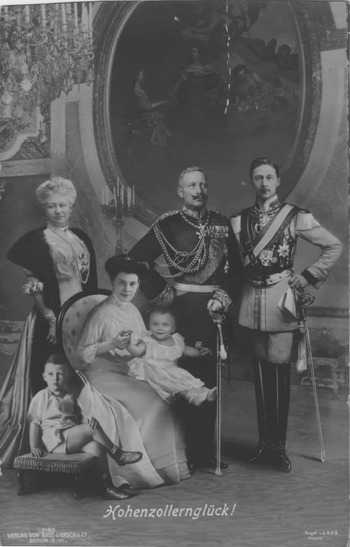
If montage was thus wish-fulfillment in the purest sense, fantasy images of royalty found expression in two main classes of photomontage: royal family portraits, and tourist postcards of Berlin. The best known among the family portraits are those that pasted together generations of royals, down to the youngest infants (Figure 1). Here, as with other group pictures, court photographers relied on montage rather than trusting to good fortune or royal patience to produce authentic snapshots in which everyone looked sufficiently regal. By embracing the entire extended family, the montages signaled the Hohenzollerns' reproductive vitality at a time when concerns about degeneration, demographic decline, and the dangers of princely inbreeding grew widespread.Footnote 76 Such collages also depicted a family intact in emotional terms. Royal couples were montaged together with their children to suggest bonds of affection, often falsely so: Wilhelm II traveled so extensively that he was rarely at home, and was remembered by his eldest son as distant and cold.Footnote 77
Hohenzollern Happiness! Hohenzollernglück! Photomontage postcard with Wilhelm II and Auguste Viktoria, the crown princely couple Wilhelm and Cecilie, and their two eldest sons Princes Wilhelm and Louis Ferdinand (ca. 1908–1909).

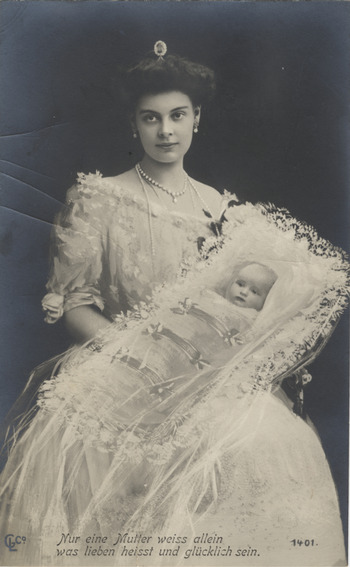
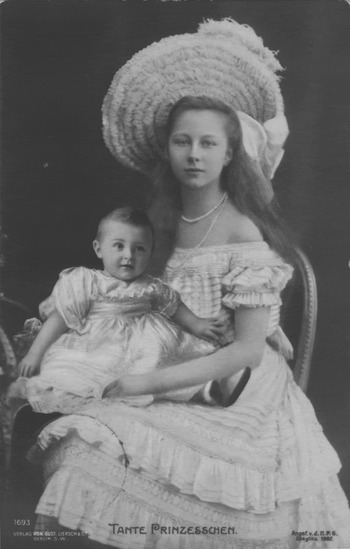
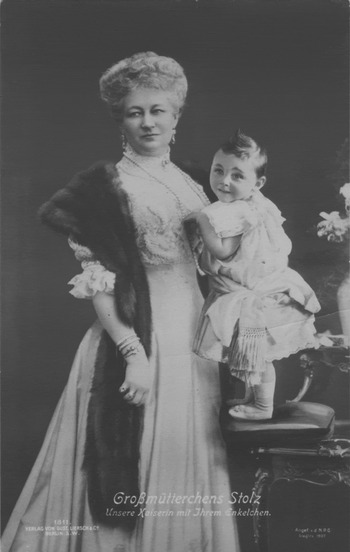
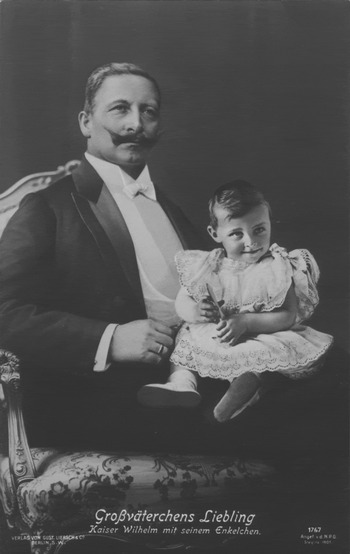
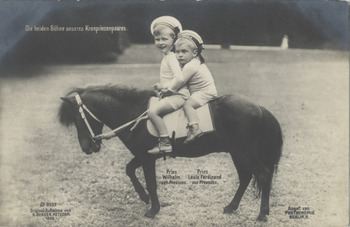
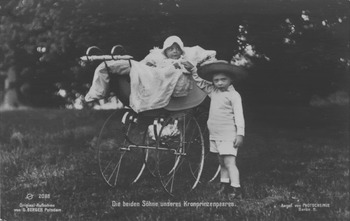
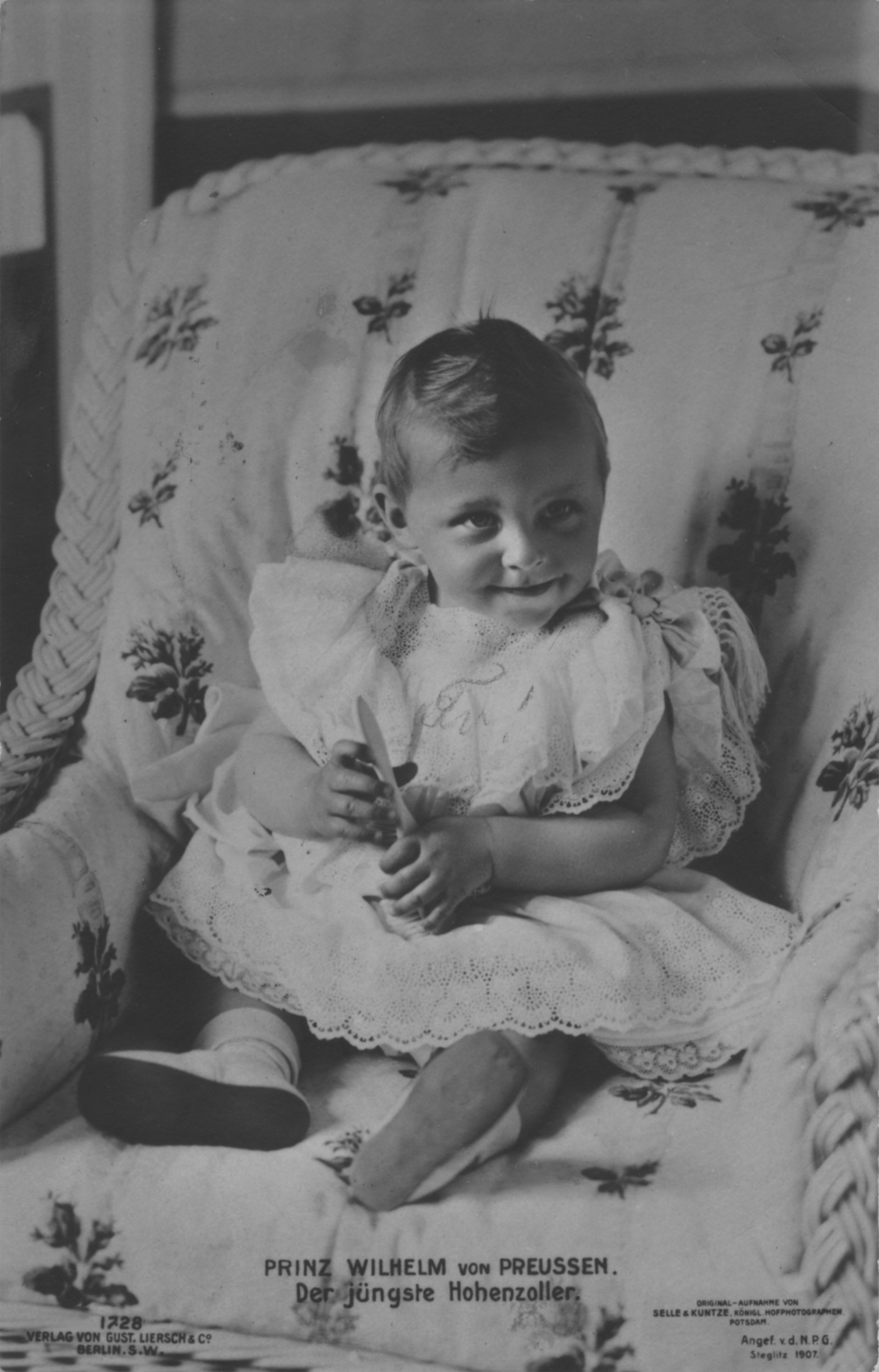
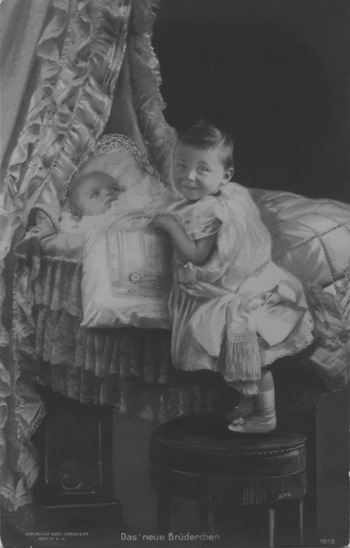
Similar in form to the dynastic portraits, but different in import, were montages depicting a single adult-infant dyad. Beginning with the birth of the crown prince's eldest son, Prince Wilhelm, in 1906, photographic publishing companies such as Gustav Liersch & Co. multiplied royal portraits by cutting and pasting existing images of Hohenzollern infants onto their elders' formal state portraits (Figures 2–5). Significantly, these collages were contemporaneous with “authentic” (i.e., unmodified) snapshots of those same imperial grandchildren (Figures 6 and 7). By 1906, snapshot technology was advanced enough for photographers to capture images of the children at play: swinging in trees, romping on the beach, sledding in winter, and often accompanied by pet goats, dogs, ponies, and other soft, young animals to heighten the sense of childhood innocence. These seemingly unmediated, intimate snapshots were taken first for the royal family's private use, and then sold to the public. Nonetheless, publishing companies felt compelled to make collages in addition to the snapshots, even if they had to rely on awkward juxtapositions to do so, for instance the disconcerting discrepancy between Wilhelm II's formal pose and baby Wilhelm's playful smile in Figure 5: the infant's smile was evidently intended for the photographer of the original picture (Figure 8) as he was performing tricks behind the camera. Still, the montages were successful enough to spur the production of further “action” images, with crude collages showing the crown princess helping the toddler take his first steps, the two-year-old Wilhelm peering into his younger brother Louis Ferdinand's crib (Figure 9—compare also to Figure 4); and the like.
“Only a mother knows what it means to love and be happy.” “Nur eine Mutter weiss allein was lieben heisst und glücklich sein.” Painted postcard of Crown Princess Cecilie with Prince Wilhelm (1906).

Auntie Princess. Tante Prinzesschen. Photomontage postcard of Princess Viktoria Luise with her nephew Prince Wilhelm (1907).

Granny's Pride—Our Empress with Her Little Grandson. Großmütterchens Stolz—Unsere Kaiserin mit Ihrem Enkelchen. Photomontage postcard of Empress Augusta Viktoria and Prince Wilhelm (1907).

Grandpa's Darling. Großväterchens Liebling. Photomontage postcard of Wilhelm II and Prince Wilhelm (1907).

The Two Sons of our Crown Princely Couple. Die beiden Söhne unseres Kronprinzenpaares. Snapshot postcard of Princes Wilhelm and Louis Ferdinand on a pony (1909).

The Two Sons of Our Crown Princely Couple. Die beiden Söhne unseres Kronprinzenpaares. Snapshot postcard of Princes Wilhelm and Louis Ferdinand, the latter in a pram (1908).

Prince Wilhelm of Prussia. The Youngest Hohenzoller. Prinz Wilhelm von Preussen. Der jüngste Hohenzoller. Postcard (un-retouched) of Prince Wilhelm (1907).

The New Little Brother. Das neue Brüderchen. Photomontage postcard of Prince Wilhelm standing at Prince Louis Ferdinand's crib (ca. 1908, combining images from 1907 and 1908).

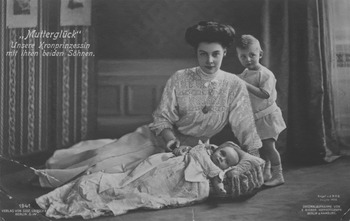
The contemporaneity of the snapshots with the montages indicates that technical problems did not prompt the latter's construction; rather, the snapshots, numerous though they were, did not satisfy public demand. Wilhelm II was so rarely photographed with his grandchildren in informal poses—he preferred dynastic group portraits—that it is readily understandable why Gustav Liersch & Co. would take the initiative to fill a gap in the market with images such as Figure 5. The more puzzling question is why the company also multiplied images of Crown Princess Cecilie with her small children, since snapshots of the princess and her children were widely available. Figures 10–14, for instance, show a series of snapshots and collages, all based on a single portrait session with the studio photographer Emil Bieber: the way the images were mixed and matched provides some clues about the meaning of the montages. In this set of postcards, Figures 10 and 11 constituted the original photographs; Figure 12 removed the crown princess to create a sharper focus on the infant Louis Ferdinand; and Figure 13 combined all three figures from Figures 10 and 11 to bring both children into the mother's orbit. On a first level, then, these modifications gave consumers greater choice, acknowledging that consumer desire was discriminating as well as both strong and strong-willed.
Our Crown Princess with her Youngest Little Son. Unsere Kronprinzessin mit ihrem jüngsten Söhnchen. Postcard (un-retouched) of Crown Princess Cecilie and Prince Louis Ferdinand (1908).

Our Crown Princess with her Eldest Son. Unsere Kronprinzessin mit ihrem ältesten Sohn. Postcard (un-retouched) of Crown Princess Cecilie and Prince Wilhelm (1908).

Prince Louis Ferdinand of Prussia. Youngest Son of our Crown Princely Couple. Prinz Louis Ferdinand von Preussen. Jüngster Sohn unseres Kronprinzenpaares. Retouched postcard of Prince Louis Ferdinand with Crown Princess Cecilie removed (1908).

“The Joys of Motherhood.” Our Crown Princess with her Two Sons. “Mutterglück.” Unsere Kronprinzessin mit ihren beiden Söhnen. Photomontage postcard of Crown Princess Cecilie and Princes Wilhelm and Louis Ferdinand (1908).

The postcard captions illuminate the montages' appeal even more suggestively. The more artificially constructed the image, the more sentimental its caption became; thus Figure 13 added the trope of mother love through the phrase “The Joys of Motherhood” (Mutterglück) to produce an emotional charge that went beyond the more sober references to genealogy in Figures 8 and 11. This same sentimentalization applied to the caption of Figure 14, which also borrowed the young Wilhelm from Figure 11. Here, “Brotherly Love” (Geschwisterliebe) directed viewers to the bonds of affection between royal offspring, in contrast to the realistic snapshot of the same children in Figure 7, simultaneously creating a bridge of commonality between dynasty and ordinary subjects. Through its caption and use of generic visual elements, such as the unspecified palace as backdrop, the collage created a genre scene, one that turned the royal grandchildren into emblems of the universal ideal of brotherly love. Had the postcard set the children in an identifiable palace interior, it would have distanced them from the viewer by showing the unbridgeable reality of social hierarchy; the collage's nonspecific palace structure, on the other hand, was indistinct enough not only to represent monarchy, but also to hint at other bourgeois appropriations of the palace metaphor, including the increasingly common application of the term “palace” to civic buildings such as courthouses and parliaments, private villas, and commercial warehouses such as the Crystal Palace.Footnote 78 In sum, the montage's genre qualities amplified the bonds of humanity between royal family and bourgeois family: in palace and cottage alike, the same domestic joys abounded.
Brotherly Love. Prince Wilhelm and Prince Louis Ferdinand of Prussia. Geschwisterliebe. Prinz Wilhelm und Prinz Louis Ferdinand von Preussen. Photomontage postcard of Princes Wilhelm and Louis Ferdinand, the latter in a pram (1908).

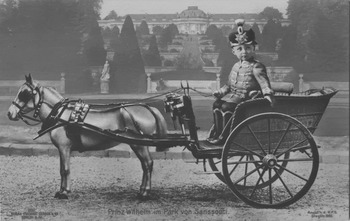
In other montaged portraits (Figures 3–5), the titles' diminutive tone inverted the relationship between adults and children, as Viktoria Luise became “Auntie Princess” (Tante Prinzesschen) and Auguste Viktoria was described with the words, “Granny's Pride—Our Empress with Her Little Grandson” (Großmütterchens Stolz—Unsere Kaiserin mit Ihrem Enkelchen). Even Wilhelm II was softened by the line “Grandpa's Darling” (Großväterchens Liebling). By framing the adults in terms of their relationship to the child, rather than foreshadowing the infant as a future adult, these montages performed the opposite function to the images showing royal children in the military or naval garb they would assume as grown-ups (Figure 15). While the latter militarized Hohenzollern childhood, “Grandpa's Darling” performed the reverse maneuver, bringing the autocratic, militaristic monarch down to a human level.
Prince Wilhelm in Sanssouci Park. Prinz Wilhelm im Park von Sanssouci. Photomontage postcard of Prince Wilhelm in uniform and a horse-drawn cart (ca. 1908).

The desire to domesticate the imperial image resonated within larger cultural trends, unmoored and independent from the monarchy and its concerns. Indeed, “cute, fetching pictures of children” were a staple of family photography, causing the portrait photographer Rudolf Dührkoop to despair in 1907 of their ubiquitous, “repulsive sentimentality.”Footnote 79 These images fed into the late nineteenth century's cult of childhood, which found expression not only in shifting pedagogical styles, but also in many other cultural products, from popular fiction laden with the bathetic emotions of endangered children—for instance the novel Uncle Tom's Cabin, a smash best seller in Germany—to the transformation of Christmas into a “children's fête” rather than a religious holy day.Footnote 80 Inside the home, lithographs, wallpaper, and other decorations showed children watched over by guardian angels, dancing with pixies and fairies, and in other motifs depicting “the unspoiled world of the little ones as seen from the wistful backward gaze of adults.”Footnote 81 The same themes were taken up by popular amusements, for instance in wax museum displays of mischievous boys climbing their neighbors' apple trees and toddlers romping with dachshunds, to name just two of Castan Panopticum's exhibits.Footnote 82
Such saccharine images were an element of what Dolf Sternberger defined as “genre” emotions: the heady feelings of “beauty, childlike innocence, scenes of vice, lushness, and lust, cold cruelty, poignant compassion, and pure goodness” that pervaded European culture in the nineteenth century.Footnote 83 Where such sentimentality was lacking, it had to be invented, and not only in Germany. Queen Victoria was routinely portrayed dandling small children on her lap, even though she personally disliked babies.Footnote 84 When Empress Elisabeth had herself photographed with her dogs but not her children, Austrian photographers, too, created montages to place her in her family circle.Footnote 85 Likewise, no matter how much Wilhelm II wanted to present himself in gloriously authoritarian terms, the empire's popular literature depicted him as a family man who treated his wife and sons at home “just as informally and candidly as in every good middle-class family,” gave his children pet names, and laughed so loudly as he played with them that their high spirits could be heard out on the city streets.Footnote 86 This blissful picture was not grounded in reality—according to his children, Wilhelm II rarely joined in their games “with unconstrained mirth or happy abandon”—but it spoke to a bourgeois audience schooled in the importance of family ties.Footnote 87
In Germany specifically, domestic sentimentality also functioned as an alibi for aggression, as a means to avoid full responsibility for the violence of the empire's unification. Middle-class Germans grasped at narratives of childlike innocence and vulnerability to make Bismarck's wars of “blood and iron” consistent with bourgeois values of cultivation, gentility, order, and self-restraint. The postcards' bizarre images of babies with deaths-head uniforms, or smiling infants playing with the eagle-eyed emperor, were thus neither propaganda imposed from above (as the montages demonstrate), nor a self-consciously disingenuous fig leaf for the empire's militarism. Instead, they served the psychological function of helping liberal Germans overcome the cognitive dissonance inherent in the empire's founding: the conflicting emotions of excitement at Bismarck's victories and the desire to see themselves as righteous and peace loving and the state as consistent with middle-class ideals.Footnote 88
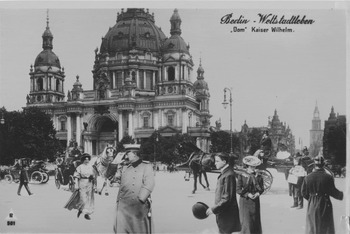
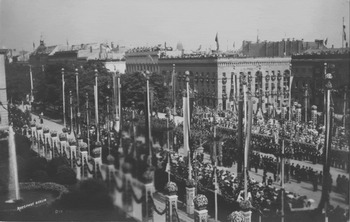
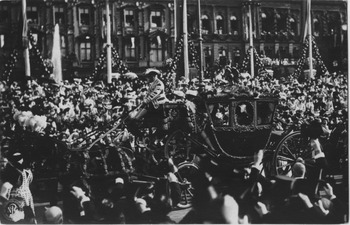
Also popular, if more solipsistic, were the tourist cards that placed cut-out images of the emperor onto the streets of Berlin (Figures 16–17). Above all, these montages differed from naturalistic photographs of royal parades by depicting the Kaiser without an entourage: unguarded (literally and figuratively) and approachable on the bustling city streets as an element of Berlin's Weltstadtleben (“Life in the Metropolis”).Footnote 89 Here, too, the montages were consciously designed to satisfy consumer desire by validating the tourist's participation in national life. As scholars suggest, late nineteenth-century tourism provided an antidote to the homogenization and routinization of modern life, with tourists seeking out cultural centers to demonstrate that they had made contact with things socially and culturally sublime.Footnote 90 Travelers purchased souvenirs, including postcards, to mark the authenticity of these experiences—to prove that they had “really been there.”Footnote 91 As Der Kunstwart observed in 1898, “Why does one send picture postcards? To show how the world looked when one saw it, right?”Footnote 92 If, however, the emperor was cordoned off behind a phalange of soldiers, as he was in realistic parade photographs, the illusion of contact was blocked. Instead, while authentic parade photographs were by necessity taken from the perspective of the atomized individual lost in the crowd (as in Figures 18–19), the collages allowed travelers to imagine themselves close to and relishing the attention of the emperor, thus foregrounding their involvement with the nation's social and political “center.”Footnote 93
Berlin—Life in the Metropolis. “Cathedral.” Kaiser Wilhelm. Berlin—Weltstadtleben. “Dom” Kaiser Wilhelm. Photomontage postcard showing Wilhelm II (central figure, saluting) in front of the Berlin Cathedral (date unknown).

Greetings from Berlin. Gruß aus Berlin. Photomontage postcard showing Wilhelm II (central figure) in front of the Berlin University (date unknown).

“Real photo postcard” of the wedding festivities of Cecilie of Mecklenburg-Schwerin and Crown Prince Wilhelm, on Unter den Linden (1905).

“Real photo postcard” showing the royal carriage at the wedding of Cecilie of Mecklenburg-Schwerin to Crown Prince Wilhelm (1905).

As the montages heightened the personal nature of what was in reality a mass tourist experience, they turned Wilhelm into a focal point for the tourist's self-referential significance. The Kaiser, in turn, was demoted to being a means to an end—the end of the tourist's emotional self-realization—and finally became metonymic for the authentically lived experience, summed up flippantly by Berliners in the popular saying, “Berlin jewesen, Kaiser jesehen” (“Been to Berlin, saw the Kaiser”).Footnote 94 In the process, Wilhelm ceased being an object of veneration, as when the 1905 guidebook Berlin und die Berliner featured ten pages of tips on Kaiser-spotting, but in a tongue-in-cheek manner that made it difficult to take the emperor seriously, or when newspapers gave instructions on when and where to go in Berlin (or Kiel or Munich) to see the emperor, treating him as simply another element of Germany's entertainment culture.Footnote 95
In sum, in the nineteenth century as today, critics of copyright legislation pointed to the socially constructed nature of creative production, stressing that all works of literature, art, and scientific discovery were based on the artists' or inventors' exposure to, and borrowings from, a common cultural and intellectual tradition. Accordingly, no work of art could be the “property” of a single individual, and the public must be regarded as “coauthors” of such joint enterprises.Footnote 96 The same argument can be made for Wilhelm II's public image, as consumers were instrumental in shaping its contours. Wider cultural tastes inspired photographers to create pictures of the monarchy that Wilhelm II himself did not promote, while consumers set the boundaries of the royal image as Kulturgut through their purchases, endorsing not only the Kaiser's preferred, grandiose posturing, but also more informal, personalized motifs. But consumption was not the only action consumers could practice. As individuals used the objects they purchased, they enunciated what the monarchy meant to them in their everyday lives.
Praxis: Photos as (Mis)Communication
For today's copyright holders, pirates are only part of the problem. End users represent another potential hazard, as they employ digital technologies to sample, distort, and disseminate images, both in tribute and in ridicule.Footnote 97 Although early twentieth-century technologies did not allow for the same widespread manipulations, Wilhelm II's desire to control his image was nonetheless challenged on an individual level by the way consumers used the photographs and postcards they purchased. While hanging a large-format, framed portrait of the Kaiser on one's parlor wall may well have been an act of admiration, other uses of the royal image were more quotidian and self-referential, and created a diversion away from the strictures of social hierarchy.
For instance, while Wilhelm's advisors assumed that people purchased royal photographs to express their patriotic loyalism, consumers were, in fact, more likely to use royal postcards to mark personal concerns, disconnected from the royal house.Footnote 98 These postcards functioned, as telephones would a generation later, to convey information quickly: to confirm appointments, travel plans, and train arrivals; to request funds and urgent advice; or to express birthday greetings, thank-you notes, promises of longer letters to come, and expressions of longing for future reunions. Even dignified dynastic portraits sported mundane messages on their reverse sides: “Should I bring cake to tea?” “The coffee filter broke—please buy a new one.” “The strawberries will be cooked into marmalade this afternoon!” Other royal postcards retailed a litany of human frailties: illnesses and doctors' visits; dangerous operations and long convalescences; dark hints of illegitimate births, abandoned lovers, broken friendships, and money troubles.Footnote 99
Then as today, many of the cards also sent tourist greetings, “wishing you were here” and telling tales of hiking trips and auto tours, bicycle rides and sledding parties, glorious sunsets and rained-out beach vacations. Strikingly, though, the senders did not feel obliged to refer to the high personages depicted on the cards' fronts. In this author's collection of fifty-six royal postcards, for instance, only six allude to royalty, and then primarily as entertainment or tourist attraction. One family marked their visit to the palace gardens in Berlin by picking up a postcard of the crown princess at a kiosk to send to friends. Another family went first to see the emperor on parade, then drank coffee at Berlin's fashionable Cafe Bauer—and reported both events with equal equanimity on their card. Nor were all such reports flattering to the dynasty: while one chronicled the glamour of a royal parade, remarking how “enchanting” the empress looked, another dismissed a similar procession as not worth attending.
This informal stance to authority is also evident in the way commoners used photographs and postcards to approach the sovereign. Subjects often conjured up personalized scenarios when they requested signed photographs from Wilhelm II: they desired the autographs not only as an inspiration to help them through difficult times, but because they were in love with him, wanted a travel souvenir if they had visited the same town as he, or simply because it would give them pleasure.Footnote 100 They envisioned hanging the pictures in the intimate spaces of their homes, as “the pearl of my salon,” as the “most beautiful and valuable adornment of my boudoir,” or as an addition to their celebrity autograph collections.Footnote 101 Finally, when it was announced in the international press that the Kaiser was himself an avid postcard collector, people from around the world sent him tourist cards. These missives, collected by the royal offices between 1905 and 1908, differed from ordinary letters to the emperor: while letters were reviewed by civil servants and often returned as inappropriate before they reached Wilhelm, these postcards were collected for their touristic images and postage stamps, regardless of who wrote them or what the cards said. As such, they offer a small but uncensored range of expression toward the emperor. Eighteen of the 187 postcards came from German subjects and were sharply divided between fawning admiration and jesting familiarity, the latter expressed in terms such as “Dear good Emperor! Come visit us in Brakel. Warmest regards” or “A jolly party sends His Majesty best wishes.”Footnote 102
Children played a special role in the personalization of the Kaiser's image. Their postcards to the emperor invariably adopted an unceremonious tone, as they sent him “a little greeting” (ein Grüßchen), or asked him to decree more school holidays or to send money for toys. Youthful writers showed a level of confidence—as one young sender remarked, “I am only fifteen years old, but surely that won't prevent Your Majesty from doing me a favor”—born of the sentimental images of monarchy promoted in the empire's anecdotal literature and, of course, by the imperial family postcards.Footnote 103 This familiarity courted a touristic response as well: schoolchildren were taught love for the dynasty not only through patriotic textbooks and the emperor's birthday celebrations, but also through songs such as the ubiquitous “The Emperor is a dear, sweet man, Berlin is where he stays, and if that weren't so far away, I'd visit him today.”Footnote 104 Adult memoirists later recalled their childhood encounters with the Kaiser-cum-tourist-attraction fondly, but with little reverence. In Berlin and the provinces alike, when the royal couple drove past in a carriage or automobile, these children stood and waved at the colorful fairy tale of kingship.Footnote 105 For some, he was “a plume of feathers and a car horn that electrified us,” to be “gaped at” as theater, but “not loved”; for others, he was an entertainment on par with exhibits of “wild natives,” trapeze artists, and hot-air balloons.Footnote 106 These children also voiced their disappointment when the imperial spectacle failed to live up to their expectations, for instance, when watching a royal parade in the February cold turned out to be “no fun at all,” or when Wilhelm II neglected to wear a crown or “even a helmet with plumes!,” as the young Golo Mann complained when he sighted the emperor in Munich in 1912.Footnote 107 What greater disappointment did these children feel as adults after 1918, when the Kaiser revealed himself to be neither majestic, nor entertaining, nor a “dear, sweet man,” let alone a capable military leader?
In contrast to such individualized uses of the royal portrait, the Kaiser tried to fix the proper meaning of his public image through his praxis of photograph bestowal, which emphasized regal exclusivity and social distance. It is not clear from the archives whether Wilhelm II had his adjutants respond to subjects' birthday greetings with unsigned royal postcards—Crown Princess Cecilie, for one, had such a policy. The files do show, however, that Wilhelm II reserved his autographed portraits for a very small circle of recipients, treating them as tokens of favor much as Frederick the Great bestowed bronze busts or Friedrich Wilhelm III gold snuff boxes.Footnote 108 As a result—and unlike some fellow princes—the Kaiser rejected most commoners' requests for autographs.Footnote 109 While even his predecessor, Wilhelm I, had been inclined to grant autographs to subjects with hard-luck stories or who otherwise touched his sentimental fancy, Wilhelm II was deaf to such overtures.Footnote 110 The Kaiser also declined to reward patriots professing “unwavering love for the fatherland,” although he did lend his portrait to veterans' associations to hang in their meeting halls, just as he did to Freemasons' lodges and male choral societies.Footnote 111
Instead, Wilhelm II mostly gave his signed photograph to government ministers, mayors of major cities, prominent judges, diplomats, professors, generals, bishops, famous artists, and other notables nominated by state officials to receive honors at important milestones in their careers (for twenty-five or fifty years of service, for instance).Footnote 112 On his travels, too, Wilhelm did not grant his photograph as a souvenir to all assembled at the stops along his route (as was the custom for the more generous Italian royal family), but only to specially favored, local honorees.Footnote 113 Occasionally, Wilhelm granted portraits to subjects who sent him pleasing gifts or were involved in his pet projects: steamship construction, wireless telegraphy, track and field competitions, male choral societies, and philanthropic works.Footnote 114 More commonly, the Kaiser used his portrait as a mark of respect for prominent millionaires, both domestic and foreign: Albert Ballin, James Simon, Carl Fürstenberg, Ferdinand Warburg, J. P. Morgan, and high-ranking diplomats and their families.Footnote 115 After 1918, when Wilhelm was sequestered in exile in Haus Doorn, the ex-Kaiser more routinely granted well-wishing commoners his autograph.Footnote 116 During his active rule, though, he kept a tight reign on who received a portrait from his hand, using photographs to foster traditional ties rather than as a broad-based tool to encourage loyalism.
Drawing a line of social distance was evidently the Kaiser's intention and not merely an oversight. Indeed, he was aware that his stern “photographic face” was a “very different expression to the charming friendly one [he] wore in private life.”Footnote 117 When speaking to the wife of a Danish envoy, he criticized his official photographs as inappropriate for close acquaintances: “I do not think this is handsome enough—I look so cross. And this one looks conceited, which I don't think I am. . . . In this one I look as if I had just ordered someone to be hanged.”Footnote 118 Still, in his official portraits, the Kaiser consciously chose this imperious attitude as the proper iconographic style for the German public. Nor did the few instances in which the Kaiser dropped his aloof stance translate into a change in his overall photographic policy. In 1906 and 1907, in an interview with the writer Ludwig Ganghofer and an official speech in Westphalia, both given in the context of the Eulenburg scandal, Wilhelm II expressed vulnerability and self-pity at being misunderstood by the public.Footnote 119 That moment of humble humanity passed quickly, though: that same year, he used his silver wedding anniversary to affirm that “my first and last thoughts belong to my armed forces and navy,” not to his family.Footnote 120 From there on, he went back to peppering his speeches with references to the divine right of kings, medieval vassalage and knighthood, and the Great Elector and Frederick the Great as his absolutist role models.Footnote 121 In the same way, although the emperor gave out greater numbers of autographed photographs after 1906, he did not widen the social circle of recipients, but simply gave more pictures to the same notables.Footnote 122 Nor did he soften his imperious poses in pictures sold on the domestic market. In sum, the Kaiser did not go out of his way to please the public, as public relations experts increasingly advised their political clientele to do.Footnote 123
Conclusion
Wilhelm II's resentment of the 1907 copyright law and of his status as public man; his stinginess in distributing royal photographs, using them to mark social distance, not populism; his coy lack of support for patriotic memorabilia producers and his reliance on others to distribute his image: all temper the Kaiser's reputation as a media monarch attuned to the “professional publicity techniques” of twentieth-century marketing.Footnote 124 To be sure, Wilhelm was concerned about his press reception because he wanted to feel popular, but he was also relatively naïve about how to win public sympathy.Footnote 125 Instead, his media policies were akin to his attempts to promote a personal regime in other technological matters: open-minded and interested, but highly idiosyncratic, erratic, and shy of any concerted, effective policy.Footnote 126
Moreover, the Kaiser's efforts to re-charismatize the monarchy leaned heavily on older conventions, for instance the baroque iconography he used in portraiture, architecture, and court culture, even if some of this pageantry was more invented than revived. While some of his speeches had an easy-going manner that seemed modern, in other public appearances he adopted the lilting, medieval cadence of the Minnesänger.Footnote 127 During his annual, all-male yachting trips to the Norwegian fjords, he took the personal initiative of publishing his shipboard sermons, given in his time-honored role as summus episcopus of the Evangelical State Church, but left reportage of the ship's daily life to select journalists.Footnote 128 The Kaiser also drew firmly on inherited aesthetic practices to advance his artistic projects. When he claimed that “the theater is also one of my weapons,” he saw himself working within a long tradition of princely patronage, in which the sovereign sought to raise public morals through drama (and to Wilhelm II, this specifically meant fighting modern realism with classical idealism). When he likewise insisted on the pedagogical mission of painting and sculpture in 1901, he defended the “tried and true methods” of Medieval and Renaissance royal benefactors in promoting “true art.”Footnote 129
This traditionalist understanding also conditioned the emperor's use of photography. Perhaps he hoped to resist a media culture that cut him down to human size—in any event, Wilhelm II did little to construct a populist image of himself for public consumption, and instead used modern media technology as a means to reinvigorate a premodern, regal aura.Footnote 130 Thus, when Walther Rathenau later described Wilhelm II's reign as tending toward an “electro-journalistic Caesaropapism,” he was right that Wilhelm II's emphasis on the divine right of kings and his self-appointed role as leader of European Christendom—his Caesaropapism—were broadcast through modern media, but they were traditional visions of rule nonetheless, with antecedents reaching back to antiquity, Byzantium, and the European Middle Ages.Footnote 131
Still, by using new forms of public media to archaicize the royal image, the Kaiser inadvertently opened up opportunities for journalists to reformulate that image. As Martin Kohlrausch noted in his perceptive studies of Wilhelm II's relationship to the press, it was the “logic of mass media” that produced the emperor as media star, as the technological requirements of mass circulation newspapers and early cinema—their need for distinctive figures and sound bites—made them seize on the Kaiser as a natural subject.Footnote 132 Journalists also created a domestic, intimate image of the emperor because they knew it would play to their paying audiences, just as photomontage makers crafted sentimental images they felt would sell well. In that sense, it might not have mattered that Wilhelm II had no modern public relations strategy: the end result—the “illusion of intimacy” and “personalization of politics”—was the same, even if it was crafted by the media rather than the monarchy.Footnote 133
And yet, the question of manipulation from above does become important when evaluating the German public's attitude to monarchy as a form of authority. If Wilhelm and his advisors were not as skilled at spin-doctoring as is sometimes assumed, then Germans' continuing loyalty to the dynasty cannot be written off as a supine response to the manipulations of a royal publicity machine. On the contrary, the public's participation in shaping the Kaiser's image to suit their tastes—through acts of consumption, photomontage, and the private use of royal images—reveals an autonomy of practice similar to what citizens were doing in other modern nations: subjecting their leaders, as celebrities, to their cultural expectations.
The public's active self-assertion, or Eigensinn, in shaping the royal image made the Kaiser's traditional legitimacy inherently unstable: if the media made Wilhelm II a star, his audience could also unmake him. Even before the war, the emperor's attempts to re-charismatize the monarchy rang hollow in the face of the multiple scandals that threatened his reign. After the war, he suffered further public humiliation through his inglorious flight into exile, which was widely interpreted as proof that he did not have the political talents or backbone to lead the nation.Footnote 134 The Kaiser's efforts to revitalize the monarchy's aura also failed, however, because of his ambivalent relationship to his public image. In the world of modern media, the monarchy's traditional Erbcharisma (hereditary charisma) stopped working its charm because subjects read the Kaiser's media images differently than he intended. While he meant for his uniformed photographs to elicit reverence and awe, subjects consumed him as a colorful spectacle, a form of entertainment, and a celebrity representing middle-class values—and they actively filled in the gaps that he left blank. Once they could no longer feel entertained by the Kaiser, in the context of war, defeat, and royal exile, Germans abandoned Wilhelm and the monarchy he represented for more seductive political actors.
All the same, the middle class's autonomy in handling the royal image did not keep them from sanctioning Wilhelm II's jingoistic Weltpolitik, although it did allow them to soften and justify that blustering diplomatic stance with (artificially constructed) images of gentle domesticity and sentimental civility. Far from absolving German culture from its responsibility for the aggressions leading to World War I, the German public's independence from royal manipulation confirms how easily an advanced, modern society with a socially confident, self-aware middle class can be drawn into diplomatic disasters against its rational, material interests. In a nutshell, the German middle class did not need to be fixated on authority, let alone be feudalized, to participate in the empire's military adventurism.