Family relationships can serve as both risk and protective factors for individual adjustment under varying conditions. Both social learning theory (Bandura, Reference Bandura1977) and bioecological models (Bronfenbrenner, Reference Bronfenbrenner1986) emphasise the associations between family relationships and individual development. Although youth spend increasing amounts of time with peers during adolescence, the influences of family relationships remain salient (Sheeber, Davis, Leve, Hops, & Tildesley, Reference Sheeber, Davis, Leve, Hops and Tildesley2007). For example, a study of US and Chinese adolescents found that negative family environments, characterised by low levels of warmth and high levels of conflict, were associated with adolescents’ depressive symptoms above and beyond peer relationship qualities (Greenberger, Chen, Tally, & Dong, Reference Greenberger, Chen, Tally and Dong2000). Although findings like this highlight the influence of family environments, to date, there has been a tendency to focus exclusively on parent-offspring relationships — mostly either as a general term referring to both parents or only on the part of mothers. According to family systems theory, families are composed of multiple interconnected subsystems (Cox & Paley, Reference Cox and Paley2003). It not only underscores the importance of distinguishing between mother-adolescent and father-adolescent relationships, but also the necessity of examining sibling relationships.
Given that most research on family relationships has been conducted with Western samples, it would be helpful to investigate the implications of family relationships for adolescents’ adjustment within the context of Chinese culture, which has a special emphasis on familism that shapes interpersonal relationships and social interactions. Traditionally, this cultural orientation is associated with a relationship hierarchy that situates family relationships at the top (Lam, Reference Lam1997). Therefore, even during adolescence, family members are highly involved in many aspects of youths’ lives, and strong ties are maintained within the family system (Lam, Reference Lam1997; Turner & Mo, Reference Turner and Mo1984). With the recognition of the central role family relationships play in Chinese adolescents’ lives, we investigated the associations between adolescents’ relationship qualities with mothers, fathers and siblings, and youths’ internalising symptoms and externalising behaviours. Studying multiple family subsystems simultaneously is important as it speaks to how families work together as integrated systems and provide important niches for the development of individual members (Cox & Paley, Reference Cox and Paley2003). Chinese families and their cultural uniqueness provide a great opportunity for us to better understand family systems theory and its applications: How does this theory apply to a special generation for whom a culture places great value on familism, but there is little expectation for sibling relationships?
Our work also recognises the multidimensionality of close relationships. Family relationships typically include feelings of closeness, intimacy, and affection that are concurrent with conflict, controversy, and disagreement. However, these positive and negative relational dimensions are seemingly independent, with only low or moderate correlations between relationship closeness and conflict, each making unique contributions to individual development (X. Zhang, Reference Zhang2013). Therefore, to understand the implications of family relationships for adolescents’ adjustment, it is critical to consider both relationship positivity (e.g., warmth, closeness, support) and negativity (e.g., conflict, hostility, aggression) across multiple family systems.
Parent-Adolescent Relationships and Adolescents’ Adjustment
The nature and quality of parent-adolescent relationships are critical for youths’ wellbeing. A body of work, for example, has demonstrated that positive parent-adolescent relationship qualities are negatively associated with adolescents’ internalising problems (Branje, Hale, Frijns, & Meeus, Reference Branje, Hale, Frijns and Meeus2010; Greenberger et al., Reference Greenberger, Chen, Tally and Dong2000); in contrast, parent-adolescent conflict is positively associated with depression and problem behaviors (Sagrestano, Paikoff, Holmbeck, & Fendrich, Reference Sagrestano, Paikoff, Holmbeck and Fendrich2003). Importantly, these findings are robust and extend across different cultural groups, including the Chinese (e.g., Dmitrieva, Chen, Greenberger, & Gil-Rivas, Reference Dmitrieva, Chen, Greenberger and Gil-Rivas2004; Greenberger et al., Reference Greenberger, Chen, Tally and Dong2000).
As discussed above, most research on the implications of parent-adolescent relationships for adolescents’ wellbeing and adjustment has focused on parents in general or on mothers exclusively. Less research has examined the influence of fathers, especially in the context of China, where the traditional gender roles advocate family divisions of labour in which men are in charge of ‘external’ affairs, while childcare is mostly women's responsibility. Partly due to this patriarchal ideology, along with the long-lasting influence of Confucianism, Chinese fathers and mothers usually have different parenting styles (Li & Lamb, Reference Li, Lamb, Shwalb, Shwalb and Lamb2013). A Chinese phrase, Yanfucimu — ‘strict father, kind mother’, describes a widely acknowledged family relationship pattern: Mothers are expected to be nurturing and affectionate, whereas fathers are expected to be strict disciplinarians and more emotionally distant. Considering gender roles are differently defined for males and females in families and there is an increasing pressure to conform to gender-typed role expectations during adolescence (Updegraff, Delgado, & Wheeler, Reference Updegraff, Delgado and Wheeler2009), at least among Western cultures, parents are likely to play quite different roles for same-gender offspring versus opposite-gender offspring. Nevertheless, the different yet complementary roles of fathers and mothers suggest that father-offspring and mother-offspring relationships may each be uniquely related to youths’ adjustment. Therefore, more research that includes both fathers and mothers is needed.
Consistent with this notion, research indicates that relationships with fathers are important for offspring's development. For example, in Western samples, paternal negativity was found to be associated with increased risk for adolescents’ internalising problems, whereas nurturing fathering behaviours were inversely related to adolescents’ depressive symptoms (Plunkett, Henry, Robinson, Behnke, & Falcon, Reference Plunkett, Henry, Robinson, Behnke and Falcon2007; Reeb & Conger, Reference Reeb and Conger2011; Sheeber et al., Reference Sheeber, Davis, Leve, Hops and Tildesley2007). Studies on Chinese adolescents have also highlighted the importance of father-youth relationships for adolescent mental health. Zhao (Reference Zhao2006) suggested that paternal warmth was inversely correlated with Chinese adolescents’ internalising problems. In contrast, paternal rejection, including the lack of warmth, was positively associated with behaviour problems and depression (Li & Lamb, Reference Li, Lamb, Shwalb, Shwalb and Lamb2013; Zou, Liu, & Zou, Reference Zou, Liu and Zou2007). Interestingly, most research on Chinese fathers has focused on the presence or absence of warmth, whereas little work has considered the role of father-youth conflict in shaping adolescent development.
Overall, despite evidence of the importance of parent-youth relationships, there are still relatively few studies that differentiate between mother-youth and father-youth relationships in their measures and examine their implications for adolescent development simultaneously (Choo & Shek, Reference Choo and Shek2013). As such, little is known about the unique contribution of each parent in predicting adolescents’ adjustment. The present study addresses this gap by examining Chinese adolescents’ relationships with both mothers and fathers across multiple relationship dimensions.
Sibling Relationships and Adolescents’ Adjustment
Studies in Western societies demonstrate that sibling relationships are uniquely related to child adjustment, above and beyond parent-offspring relationship qualities (Pike, Coldwell, & Dunn, Reference Pike, Coldwell and Dunn2005). For example, sibling negativity (e.g., conflict and aggression) is related to adolescents’ externalising problems such as delinquent behaviours, antisocial behaviours, and substance use (e.g., Bank, Burraston, & Snyder, Reference Bank, Burraston and Snyder2004; Buist, Deković, & Prinzie, Reference Buist, Deković and Prinzie2013; Solmeyer, McHale, & Crouter, Reference Solmeyer, McHale and Crouter2014; Whiteman, Solmeyer, & McHale, Reference Whiteman, Solmeyer and McHale2015). Sibling negativity has also been found to be a risk factor for internalising problems, including depressive symptoms, above and beyond the influence of parent-youth relationships (Buist et al., Reference Buist, Deković and Prinzie2013; Kim, McHale, Crouter, & Osgood, Reference Kim, McHale, Crouter and Osgood2007; Stocker, Burwell, & Briggs, Reference Stocker, Burwell and Briggs2002).
In addition to negativity, some work suggests that sibling positivity (e.g., intimacy, warmth, affection) also plays a crucial role in adolescents’ adjustment (Buist et al., Reference Buist, Deković and Prinzie2013; Pike et al., Reference Pike, Coldwell and Dunn2005). For example, sibling affection and support are inversely related to youths’ externalising behaviours (Branje, Van Lieshout, Van Aken, & Haselager, Reference Branje, Van Lieshout, Van Aken and Haselager2004; Padilla-Walker, Harper, & Jensen, Reference Padilla-Walker, Harper and Jensen2010) and internalising problems (Kim et al., Reference Kim, McHale, Crouter and Osgood2007). Positive sibling relationships can also indirectly affect adolescents’ mental health. In a longitudinal study, Yeh and Lempers (Reference Yeh and Lempers2004) found that adolescents who reported more positive sibling interactions were more likely to have better friendships and higher self-esteem, which in turn prevented loneliness and feelings of depression, and reduced the odds of exhibiting delinquent behaviour and substance abuse.
It is unknown, however, whether or not these associations generalise to other populations, particularly to China. In China, the presence of siblings is much more common than what is commonly believed. Although a one-child birth policy was implemented in 1979 in order to slow down the growth of Chinese population (B. Zhang, Reference Zhang2014), the implementation of this policy actually varied regionally (Hemminki, Long, Wu, & Klemetti, Reference Hemminki, Long, Wu and Klemetti2012). Implementation further depended on factors such as the parents’ occupation, their ethnic minority status, their own number of siblings, and the sex of the first child (Hesketh, Lu, & Xing, Reference Hesketh, Lu and Xing2005). Usually, locales would specify the conditions under which families were allowed to have multiple children and the spacing between births. For example, most rural areas permitted parents to have a second child four years after the birth of the first child if it had been a girl. Although national statistics have yet to establish the number of families that have more than one child across China, recent estimates reveal that siblings are common. In 2007, more than 70% of the Chinese population lived in areas where the policy, on average, allowed up to two children per couple (Baochang, Feng, Zhigang, & Erli, Reference Baochang, Feng, Zhigang and Erli2007). Additionally, in 2010, among the children born across the whole nation, 31% were second-born, and 5% were third-born (Population Census of China, 2010). Therefore, when considering the influence of family systems on Chinese adolescents’ adjustment, it is necessary and critical to study the entire system, including siblings.
Although rare, a few recent studies note the connections between Chinese youths’ relationships with parents and their siblings. For example, Chen (Reference Chen2018a) found that Chinese mothers’ parenting stress was indirectly linked to youth's sibling relationship qualities through maternal warmth. In a second study, Chen (Reference Chen2018b) discovered that mothers’ authoritarian control was positively linked to Chinese adolescent siblings’ conflicts, whereas maternal positive guidance was negatively related to conflict between siblings. Importantly, these studies demonstrate the connectedness of the parent-child and sibling subsystems among Chinese families. Yet, the implications of Chinese youth's sibling relationships for their adjustment is still unknown.
Importantly, when investigating the nature and implications of youth's sibling relationships, it is critical to examine structural qualities such as the gender composition of the sibling dyad and age-spacing as potential moderators (Yucel & Downey, Reference Yucel and Downey2015). For example, research with Western samples documents that same-gender siblings (especially sister-sister pairs) tend to have more intimate relationships as compared to mixed-gender siblings (e.g., Buist, Deković, Meeus, & van Aken, Reference Buist, Deković, Meeus and van Aken2002). Furthermore, among Western samples, siblings who are distal in age share more complementary roles (i.e., older siblings providing more support, supervision, and control for their younger sibling than vice versa), as opposed to egalitarian or reciprocal roles among siblings closer in age (e.g., Buhrmester & Furman, Reference Buhrmester and Furman1990; Dunn, Reference Dunn1983; Voorpostel, van der Lippe, Dykstra, & Flap, Reference Voorpostel, van der Lippe, Dykstra and Flap2007). Among Chinese families, it is especially critical to take the sibling age-spacing into consideration as Chinese siblings are spread more distally than their Western counterparts due to the policy restrictions.
The Current Study
With a growing concern about Chinese adolescents’ behavioural and mental health (Ye, Reference Ye2010), the goal of the current study was to examine the implications of multiple relationship qualities (i.e., positivity and conflict) across multiple family subsystems (i.e., mother-adolescent, father-adolescent, and sibling) for adolescents’ internalising (i.e., loneliness and depressive symptoms) and externalising problems in contemporary China. Advancing previous research, we examined positivity and conflict concurrently in the same model, while simultaneously considering relationships with mothers, fathers, and siblings as unique predictors of adolescents’ adjustment. We hypothesised that perceived conflict with both mothers and fathers would be positively related to youth maladjustment, whereas perceived positivity would be inversely related to youth maladjustment. We expected that the associations between parent-youth relationship and youths’ adjustment would be stronger for same-gender parent-offspring dyads (i.e., father-son and mother-daughter dyads) than for the opposite-gender parent-offspring dyads (i.e., father-daughter and mother-son dyads). Although rarely studied in Chinese families, on the basis of work in Western societies, we expected that sibling relationship qualities would uniquely predict adolescent adjustment above and beyond parent-adolescent relationships. Specifically, we hypothesised that perceived sibling conflict would be positively related to, and perceived sibling intimacy would be inversely related to, adolescents’ internalising and externalising problems respectively. Additionally, given the consideration of different gender-role expectations, we hypothesised that associations would be stronger for same-gender siblings than for mixed-gender siblings. Considering the structural differences in the spacing of births between siblings due to policy regulations, we also expected that siblings’ age-spacing would moderate the associations between sibling relationship qualities and outcomes. We hypothesised that associations would be stronger for sibling dyads closer in age than for those more disparate in age.
Method
Participants
Data for the current study came from a short-term longitudinal project studying Chinese adolescents’ psychological wellbeing and socio-emotional development. Participants came from Lanzhou, a representative industrial city in Gansu Province within the northwestern area of China. At the initial recruitment in 2013, participants were 7th graders (the starting grade of middle school) and 10th graders (the starting grade of high school) from four public secondary schools. Two additional waves (in 2014 and 2015) of data collection occurred at the same schools following the same cohorts. The current study used data from waves 2 and 3 because it was in those waves that measures of sibling relationships, which are central to the current study, were introduced. All of the students from participating schools were Chinese and 99% of them were Han Chinese, the predominant ethnic group in China. The overall school participation rate was 92% for wave 2 and 95% for wave 3, with different total numbers of students that were contacted each wave due to school transferring. Longitudinally, 84% of wave 2 participants also took part in wave 3.
Overall, 1,542 students participated in wave 2 data collection. For this study, we focused on youth with siblings (n = 741, 91% had only one sibling, 8.5% had two siblings). In order to further increase homogeneity, to be included in this study, participants had to share the same biological parents with siblings (n = 717), be non-twin siblings (n = 714), and currently live with their sibling as well as their biological parents (n = 567). We also excluded participants who reported on parent-youth relationships with people other than their biological parents (n = 20 for mother and n = 25 for father), those for whom we did not have sibling information (n = 58), and those whose age spacing with their sibling was greater than 168 months (i.e., over 14 years apart, n = 8). Given some overlap across the exclusion criteria, the sample included 540 adolescents in wave 2, out of which 460 participated in wave 3 data collection. On average, youth were 16.18 years old (SD = 1.83). There were 336 girls and 203 boys (1 missing value on gender). Among the sibling dyads, 222 were same-gender siblings and 316 were mixed-gender siblings (2 missing values on sibling gender composition); 328 focal children were first-borns (228 girls), 184 were second-borns (93 girls) and 12 were third-borns (6 girls; there were 16 missing values on birth order).
Paternal education was higher for students who participated in both waves 2 and 3 (M = 2.23) compared to those who left in wave 3 (M = 2.08, t = −2.75, p < .01); however, there were no differences between these groups in terms of maternal education, t = −.76, ns, family income, t = 1.31, ns, child gender, χ2 = 3.18, ns, or number of siblings, χ2 = 4.08, ns. At wave 2, 94% of the mothers and 95.9% of the fathers had completed secondary school, both higher than the province average (43.9%) in 2010; 5.8% of the mothers and 4.1% of the fathers had college degree, and 0.2% of the mothers had graduate school education, which are both lower than the province average of completing at least college education (7.5%) in 2010 (see China Statistical Yearbook, 2014). Among the fathers, 44.4% worked as freelancers or ran individual businesses, 22.6% worked as farmers or unskilled manual workers, 12.5% were skilled manual workers, 7.8% were routine employees or technicians, and 2.3% were professionals (e.g., doctor, lawyer). Due to the policy regulations regarding multiple offspring, no government employees ended up in our analytic sample. The average monthly family income for the final sample was 4,131.48 RMB (about $656), which is similar to the average income level of urban families in Gansu Province, but less than the average family income across China in 2010 (see China Statistical Yearbook, 2014).
Procedure
Informed consent as well as assent procedures and survey materials were approved by the Institutional Review Board of Purdue University. Measures that were originally developed in English but had not yet been used in Chinese populations, including sibling relationship qualities and problem behaviours, were translated into Chinese and back translated into English, and were reviewed by experienced professors and graduate students who were fluent in both English and Chinese to check item equivalence. School principals from the four participating schools sent letters to parents that included detailed information about the study, a consent form, and a demographic questionnaire. Following receipt of parental consent, adolescent assent was obtained in school, prior to data collection. Graduate students and undergraduate research assistants from local universities managed the data collection, which consisted of self-report surveys. Participants were compensated with school supplies such as notebooks and pens.
Measures
Demographics
Parents reported on their education as well as demographic information about their offspring, including children's gender, birth dates, and sibling status. Sibling age-spacing was calculated using the absolute value of the sibling age difference. Adolescents also reported their age, gender, and number of siblings. Although we used parent report of sibling status in our analyses, parent and child data regarding siblings were cross-checked for accuracy, with an agreement rate of 99%.
Parent-adolescent relationships
The Network of Relationships Inventory (NRI; Furman & Buhrmester, Reference Furman and Buhrmester2009) was used to examine adolescents’ intimacy, companionship, affection, and conflict with their mothers and fathers. Each of these qualities was assessed using a 5-point Likert-type scale (1 = never or rarely, 5 = very often). Example items included: ‘How much do you share your secrets and private feelings with this person?’ ‘How much free time do you spend with this person?’ ‘How much does this person like or love you?’ and ‘How much do you and this person argue with each other?’ There were three items within each subscale (intimacy, companionship, affection, and conflict). Because of the strong associations between the subscale of intimacy, companionship, and affection (rs ranged from .46–.68), we combined them into one composite variable — relationship positivity. Scores were averaged across the items, with higher scores denoting higher relationship positivity and conflict accordingly. The NRI has been used previously in China and strong psychometric properties have been reported (Jia et al., Reference Jia, Way, Ling, Yoshikawa, Chen, Hughes, Ke and Lu2009; Way & Chen, Reference Way and Chen2000). Descriptive statistics and Cronbach's alphas for all the measures are presented in Table 1.
Descriptive Statistics and Correlations Between Variables

Note: aAge was measured in years; bAge spacing was measured in months; cGender: 0 = female, 1 = male; dGender composition: 0 = same gender, 1 = mixed gender; eW2 = Wave 2; e W3 = Wave 3. fCorrelation between wave 2 and wave 3 measures.
*p < .05,. **p < .01, ***p < .001.
Sibling relationships
Sibling relationship intimacy and conflict were assessed using 13 items. Students were asked to respond to each item regarding their closest aged sibling on a 5-point Likert-type scale (1 = not at all, 5 = very much). Sibling intimacy was assessed with eight items (Blyth & Foster-Clark, Reference Blyth and Foster-Clark1987). Example items included ‘How much do you go to your sibling for advice or support?’ and ‘How much do you share your inner feelings or secrets with your brother/sister?’ Scores were averaged across the eight items, with higher scores denoting greater intimacy. Items tapping sibling conflict/antagonism were adapted from the NRI (Furman & Buhrmester, Reference Furman and Buhrmester2009). Examples of the items included ‘How much do you and your sibling disagree or quarrel?’ and ‘How much do you and your sibling get upset or mad at each other?’ Scores were averaged across the five items, with higher score indicated higher levels of sibling conflict.
Depressive symptoms
Depressive symptoms were assessed using the Center for Epidemiologic Studies Depression Scale – Revised (CESD-R; Radloff, Reference Radloff1977). This scale consists of 20 items that ask about participants’ feelings of depression, hopefulness, appetite loss, and sleeping problems (e.g., ‘I did not feel like eating; my appetite was poor’ and ‘I felt hopeful about the future’). Participants answered each item by choosing the number of days per week they experienced the symptoms as described, from 1 (1 day) to 4 (5–7 days). Several items were reverse coded and scores were averaged across the 20 items with higher scores indicating more depressive symptoms. Previous research has shown this measure is appropriate for use with Chinese samples (Lin, Reference Lin1989; Greenberger et al., Reference Greenberger, Chen, Tally and Dong2000).
Loneliness
Adolescents’ feelings of loneliness were measured using the UCLA Loneliness Scale (Russell, Peplau, & Ferjuson, Reference Russell, Peplau and Ferguson1978). This scale includes 10 items, such as ‘How often do you feel unhappy doing so many things alone?’ and ‘How often do you feel completely alone?’ Participants responded on a 4-point Likert scale (1 = never, 4 = always), and scores were averaged across the 10 items, with higher scores indexing greater loneliness. The UCLA Loneliness Scale is a widely accepted measure that has shown good reliability and validity across various populations, including Chinese samples (Page et al., Reference Page, Yanagishita, Suwanteerangkul, Zarco, Mei-Lee and Miao2006; Wang, Yuen, & Slaney, Reference Wang, Yuen and Slaney2008).
Problem behaviours
Adolescents’ problem behaviours were measured using a 17-item scale adapted from a self-reported measure that was developed for the National Youth Survey (Elliott & Ageton, Reference Elliott and Ageton1980; Elliott, Huizinga, & Ageton, Reference Elliott, Huizinga and Ageton1985). Changes were made to the original scales to better reflect the typical delinquent behaviours of Chinese adolescents. The 17 items tapped a variety of minor delinquent and problem behaviours (e.g., smoking tobacco, drinking alcohol, getting drunk, lying to parents, and fighting). Adolescents answered these items on a 7-point scale (0 = never, 1 = once or twice, 2 = once a month or less, 3 = 2 days a month, 4 = once or twice a week, 5 = three to five days a week, 6 = nearly every day) indicating the frequency of their participation in each behaviour. In the present study, we did not include the two items asking about drinking (but we kept the item of ‘getting drunk’) in our analyses because drinking alcohol is not a strict social taboo for adolescents in China; in fact, sometimes it is even encouraged at social occasions when elders are present. Therefore, scores were averaged across the remaining 15 items, with higher scores indicating more frequent risk-taking and problem behaviors.
Results
Descriptive Statistics and Correlations
Preliminary analyses explored the bivariate correlations among study variables (Table 1). Consistent with the hypotheses, both depressive symptoms and loneliness at wave 3 were positively associated with youths’ perceived conflict with fathers, mothers, and siblings at wave 2 (for depression, rs ranged from .16 to .23; for loneliness, rs ranged from .14 to .24), and they were negatively correlated with relationship positivity with fathers, mothers, and siblings (for depression, rs ranged from −.14 to −.18; for loneliness, rs ranged from −.15 to −.20). Problem behaviours were negatively correlated with relationship positivity with fathers (r = −.11) and siblings (r = −.16), and positively correlated with conflict with fathers (r = .16) and mothers (r = .14). Although the correlations were small to moderate in size, they provided preliminary support for our hypotheses regarding the implications of perceived family relationships for adolescents’ adjustment.
Family Relationship Qualities and Adolescents’ Adjustment
A path model (see Figure 1) was developed to further explore the associations between perceived father-youth, mother-youth, and sibling relationship qualities and adolescents’ internalising symptoms and externalising behaviours. Child age at wave 2 and parental education were included as control variables. Parental education, calculated as the mean of father and mother education, was used as a proxy measure of family socioeconomic status. Before the path model was constructed, paternal positivity, maternal positivity, paternal conflict, maternal conflict, sibling intimacy and sibling conflict were all centred to their means accordingly.
Path model examining the associations between father-youth, mother-youth and sibling relationship quality and adolescents’ internalising symptoms and externalising behaviours. W2 variables were assessed in wave 2 data collection; W3 variables were obtained from wave 3 data collection. Control variables included includes child age and parental education.

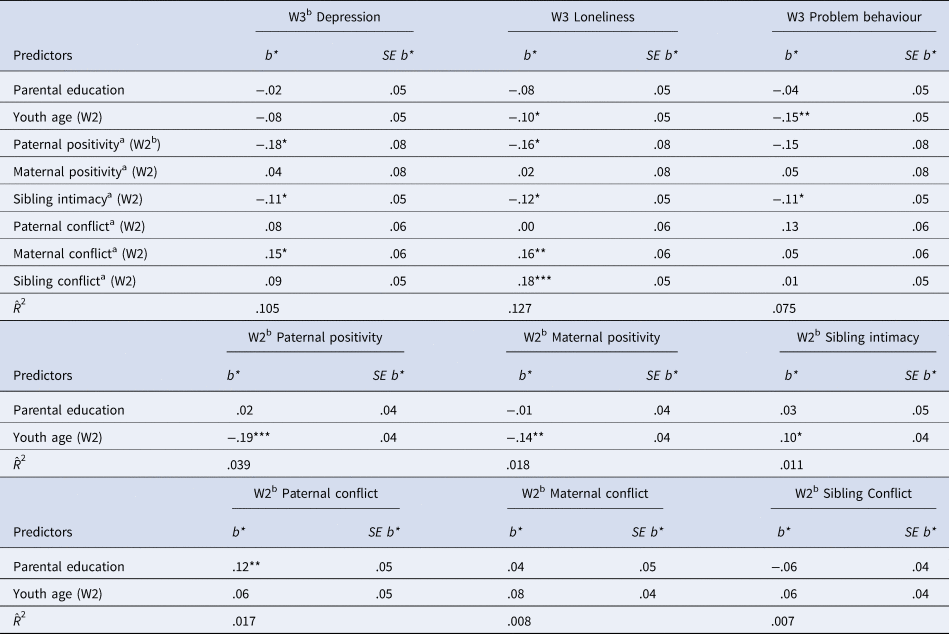
The path analysis was performed using Mplus v8.2 (64-bit; Muthén & Muthén, Reference Muthén and Muthén1998–2017). Maximum likelihood estimation with robust standard errors (MLR) was used to estimate the parameters and their standard errors. Missing data were handled using full information maximum likelihood (FIML), which retrieves as much information as possible from all available data, even when they contain missing values. Therefore, the path model was fitted to the entire analytic sample (n = 540). The model demonstrated good model-data fit, χ2(6) = 9.302, ns, RMSEA = .032, 95% CI [.000, .070], CFI = .997, SRMR .021. Results of the path coefficients estimates are presented in Table 2.
Summary Of Standardized Path Parameters (N = 540)

Note: a Predictors were mean centered before entering the model. b W2 = Wave 2; b W3 = Wave 3.
* p < .05. ** p < .01. *** p < .001.
Further, multigroup comparisons were conducted to test the hypothesised moderating effects of youths’ gender, sibling gender composition, and age-spacing of the sibling dyad. Given the consideration that siblings that are no more than three years apart are likely to share a common social environment at school, the age-spacing was dichotomised into ‘wide’ (more than 3 years apart, n = 363) and ‘narrow’ spacing (equal or less than 3 years apart, n = 157; 20 missing values on sibling age spacing) respectively. Using maximum likelihood estimation, we followed stepwise procedures to conduct multiple group analysis; the models were compared using likelihood ratio tests and the model with better fit was selected at each step. To begin, we allowed all model parameters to freely vary across groups to make sure the model was tenable in both groups simultaneously. This is the least constrained model, which set the baseline of model fit. Next, we constrained all path coefficients of focal interest to be equal across groups. In the current study, the focal parameters were the paths predicting wave 3 outcomes from wave 2 family relationship variables. We then conducted likelihood ratio tests to compare the first model (least constrained) with the second model (most constrained). If the model fit did not differ significantly, we concluded equal path coefficients across groups. If the likelihood ratio test suggested the constrained model had significantly worse fit with the data than the model that allowed all paths to freely vary, we proceeded by checking the modification indices and releasing the equal constraints on the path coefficients one at a time. Each time after we set a parameter to vary freely, we would conduct a likelihood ratio test to compare the model fit. We continued with this process until the point where there were no more equal constraints that could be meaningfully released and yield improvement on the model data fit. Finally, we concluded by testing all the parameters that were allowed to vary in the previous steps that differed between the groups. In the following sections, we only report the chi-square statistics obtained at the step when the corresponding parameter was set free.
Internalising symptoms
Taken together, youths’ family relationship qualities accounted for 11% of the variance in adolescents’ depressive symptoms one year later. As can be seen in Table 2, perceived father-youth positivity and perceived sibling intimacy were negatively related to adolescents’ subsequent reports of depressive symptoms; whereas perceived mother-youth conflict positively predicted later depressive symptomology. Results from the multiple group analysis, however, suggested that child gender moderated the effect of maternal conflict on depression, χ2(1) = 8.15, p < .01. As shown in Figure 2, for female adolescents, maternal conflict was positively associated with depressive symptoms (b = .102, SE = .035, p < .01). For male adolescents, however, maternal conflict was unrelated to youth's depressive symptoms (b = −.005, SE = .040, ns).
Association between maternal conflict at wave 2 and youth's depressive symptoms at wave 3 as a function of youth gender.

As for youths’ loneliness, the path model accounted for a 13% of the variance. While all other variables held constant, being older was inversely linked to loneliness. With respect to relationship qualities, perceived maternal conflict and sibling conflict were both positively related to loneliness one year later; whereas perceived father-youth positivity and sibling intimacy were negatively associated with later loneliness (Table 2). Multigroup comparisons, however, found that youth gender moderated the association between sibling intimacy and youths’ loneliness, χ2 (1) = 4.33, p < .05. As can be seen in Figure 3, for male adolescents, sibling intimacy was inversely associated with youths’ loneliness (b = −.147, SE = .05, p < .01). In contrast, for female adolescents, sibling intimacy was not predicative of youths’ loneliness (b = −.030, SE = .041, ns).
Association between sibling positivity at wave 2 and youth's loneliness at wave 3 as a function of youth gender.

Problem behaviours
For problem behaviours, the model accounted for 8% of the total variance. Older adolescents engaged in fewer problem behaviours, holding all else constant. Sibling intimacy was negatively linked to youths’ problem behaviours one year later. The multigroup comparison did not reveal any moderation effects of gender, sibling gender composition, or sibling age-spacing in terms of predicting youths’ problematic behaviours.
Discussion
Family relationships play important roles in shaping adolescents’ development. It has been well documented in previous research with Western samples that youth benefit from positive family environments, whereas adverse family environments serve as risk factors for their adjustment (e.g., Branje et al., Reference Branje, Hale, Frijns and Meeus2010; Greenberger et al., Reference Greenberger, Chen, Tally and Dong2000; Sagrestano et al., Reference Sagrestano, Paikoff, Holmbeck and Fendrich2003). In this study, we examined the implications of perceived family relationships for adolescents’ internalising and externalising problems in contemporary China. In particular, we investigated how youths’ perceived relationship positivity and negativity with mothers, fathers, and siblings were associated with their depressive symptoms, loneliness, and problem behaviours. To our knowledge, this study is the first to examine both relationship positivity and conflict across multiple family subsystems (including siblings) during adolescence in contemporary China.
By examining relationships with fathers and mothers in the same model, we were able to test the unique contribution of each parent in predicting youth outcomes. Our results showed that perceived relationship quality with fathers and mothers were both important factors in shaping adolescent development, although not contributing in the same way. Father-adolescent positivity (but not mother-adolescent positivity) was negatively linked to youths’ internalising problems. These findings are consistent with previous research on fathers (Li & Lamb, Reference Li, Lamb, Shwalb, Shwalb and Lamb2013; Plunkett et al., Reference Plunkett, Henry, Robinson, Behnke and Falcon2007; Reeb & Conger, Reference Reeb and Conger2011; Sheeber et al., Reference Sheeber, Davis, Leve, Hops and Tildesley2007; Zhao, Reference Zhao2006) and highlight the benefit of paternal warmth and intimacy. Theoretically, warm relationships with parents provide a context that enables adolescents to seek emotional, instrumental and informational support (Cohen, Reference Cohen2004; Franks, Campbell, & Shields, Reference Franks, Campbell and Shields1992; Umberson, Crosnoe, & Reczek, Reference Umberson, Crosnoe and Reczek2010). The social support that youth receive via family relationships is not only beneficial in terms of their development, but also can help buffer the negative influences of adversities and stress that might lead to risky behaviors (Umberson et al., Reference Umberson, Crosnoe and Reczek2010).
Importantly, mother-adolescent conflict (but not father-adolescent conflict) was positively associated with youths’ loneliness and depressive symptoms, the latter of which was apparent for adolescent females only. Problems in parent-offspring relationships have long been recognised as critical risk factors for the development of internalising and externalising problems among youth (e.g., Bond, Toumbourou, Thomas, Catalano, & Patton, Reference Bond, Toumbourou, Thomas, Catalano and Patton2005; Skeer, McCormick, Normand, Buka, & Gilman, Reference Skeer, McCormick, Normand, Buka and Gilman2009). For example, Skeer et al. (Reference Skeer, McCormick, Normand, Buka and Gilman2009) found children living in families with high levels of conflict were at increased risk for both externalising problems and substance use disorders during adolescence. Adolescents may learn negative behaviours during direct conflicts with their parents or through their observation of parents’ aggressive and hostile behaviours during interfamily conflict (Defoe et al., Reference Defoe, Keijsers, Hawk, Branje, Dubas, Buist and Meeus2013).
With that being said, why did we only find positivity (but not negativity) with fathers and negativity (but not positivity) with mothers were related to youths’ internalising problems? One possible explanation is that these findings are culturally specific. As discussed earlier, the traditional cultural norm of ‘strict father, kind mother’ leads to different role expectations of mothers and fathers. Mothers are viewed as the nurturing parent who is expected to interact with offspring in warm and affectionate manners. Fathers, in contrast, serve as the authority figures and exert control over other family members (Chen, Chen, Wang, & Liu, Reference Chen, Chen, Wang and Liu2002; Choo & Shek, Reference Choo and Shek2013). In fact, there is evidence that as children get older, Chinese fathers become stricter and less affectionate (Li & Lamb, Reference Li, Lamb, Shwalb, Shwalb and Lamb2013). Therefore, it is likely that Chinese adolescents expect warmer and more intimate relationships with mothers, and more emotionally distant relationships with fathers, who are usually stern. Incongruence with these preconceptions (e.g., greater warmth from fathers or greater conflict with mothers) may be especially salient as they fall beyond social expectations and potentially previous experiences. As such, it is possible that perceived father-youth positivity serves as a particularly salient source of social support to Chinese adolescents, which may be especially important for youths’ mental health with the many transitions that occur during adolescence. In contrast, considering the high expectation of positivity from mothers, ongoing conflictive relationships with mothers may become a major stressor that challenges adolescents’ coping capacities (Umberson et al., Reference Umberson, Crosnoe and Reczek2010). As such, high levels of conflict with mothers, coupled with unsuccessful coping, might eventually contribute to youths’ internalising symptoms (Sagrestano et al., Reference Sagrestano, Paikoff, Holmbeck and Fendrich2003). Further, these results are consistent with parenting research in Western samples documenting that psychological control is more strongly linked to adolescents’ internalising symptoms, whereas behavioural control is associated with externalising problems (Barber, Olsen, & Shagle, Reference Barber, Olsen and Shagle1994).
The current study also extends previous family research in China by highlighting the important role of sibling relationships during adolescence. Our results demonstrated that above and beyond parent-youth relationships, conflictual sibling relationships predicted higher levels of youths’ loneliness. In contrast, adolescents who had close relationships with siblings reported fewer depressive symptoms and fewer problem behaviours one year later. Sibling intimacy was also negatively linked to adolescents’ self-reported loneliness, but only for males. Given gender differences in the development and expression of intimacy during adolescence (e.g., McNelles & Connolly, Reference McNelles and Connolly1999), perhaps intimate relationships with siblings provides brothers with a source of companionship that is protective against loneliness. In general, these results are consistent with studies on adolescents in Western societies. Negative interactions between siblings are consistently linked to adolescents’ internalising and externalising problems (e.g., Bank et al., Reference Bank, Burraston and Snyder2004; Buist et al., Reference Buist, Deković and Prinzie2013; Whiteman et al., Reference Whiteman, Solmeyer and McHale2015). Conflictual interactions between siblings can put youth at risk for internalising problems by making them feel guilty and hopeless (Buist et al., Reference Buist, Deković and Prinzie2013), whereas positive and supportive sibling interactions can promote better mental health (Yeh & Lempers, Reference Yeh and Lempers2004). When adolescents experience high levels of conflict with siblings, they may feel bad and attribute the conflict to themselves; they also experience high levels of anxiety and fear that they would not be able to change such situations in the long run (Buist et al., Reference Buist, Deković and Prinzie2013).
Inconsistent with our hypotheses, neither sibling gender composition or age-spacing moderated the associations between sibling relationship qualities and adolescents’ adjustment. Although we think this needs further scrutiny in future studies, given the cultural emphasis of familism in China, it is possible that siblings function as social partners, playmates, attachment figures and social support resources regardless of their age difference. Nevertheless, our findings highlight the unique role played by siblings within Chinese families and speak to the importance of including siblings when examining family dynamics in China. Importantly, the official ending of one-child policy announced in 2015 holds great promise for future research endeavours on sibling relationships in China. In fact, future research can benefit from looking into more details about sibling dyads, such as type of siblings (e.g., full biological or half siblings), as these dimensions might matter in important ways when it comes to sibling influences (Yucel & Downey, Reference Yucel and Downey2015).
Overall, it is important that these finding be considered in the context of several study limitations. First, our study included adolescents’ self-reports of both their relationships and their (mal)adjustment. Although the self-reported relationship qualities tend to be better predictors of the individual development than parent reports, the associations reported could be inflated due to common method variance (Campbell & Fiske, Reference Campbell and Fiske1959). Future research should include multiple reporters or utilise observational methods in order to avoid the common method bias. Future work should also incorporate broader, family-level variables in addition to dyadic relationships. For example, family adversity or cohesion could moderate the associations between the dyad-level relationships and youths’ adjustment. Moreover, a pattern analytic approach (e.g., latent profile analysis and cluster analysis) could be used to examine whether and how different patterns of family relationships are linked to different youths’ adjustment.
Second, although our study found associations between family relationships and youths’ adjustment, it is important for future work to identify the underlying mechanisms that link family relationship qualities and adolescents’ mental health among Chinese adolescents. For example, does relationship positivity provide youth with greater social support, which in turn lowers the likelihood of maladjustment? Importantly, research on social support during adolescence suggests that siblings remain an important and malleable target for interventions (Bowles & Hattie, Reference Bowles and Hattie2015). Similar to Chen (Reference Chen2018a, Reference Chen2018b), research could also examine what parenting styles or specific parenting practices in Chinese families contribute to better parent-child and sibling relationships and, in turn, benefit youth mental health development.
Third, we should be cautious about generalising our conclusions, especially in terms of problem behaviours. Participants were recruited from college-track schools that aim to prepare students for higher education, which may make them less likely to engage in high levels of delinquent behaviours. Indeed, in this sample, youths’ internalising symptoms and externalising behaviours were stable over time, limiting our analyses to focus on individual differences at wave 3. Future research would benefit from sampling a more diverse population, with varying levels of risks, as well as assessing youth across a larger period of time permitting examination of how changes in Chinese adolescents’ family relationship qualities relate to changes in youths’ adjustment.
Fourth, because of our project design, we were unable to rule out the possibility that the target adolescent and reported sibling were both participants in our study. Given normative age-spacing of siblings in China, the probability was small, but the results might be influenced by potential interdependence of certain observations. Fifth, we used different scales to assess parent-youth relationship qualities and sibling relationship qualities. Although not a major concern, this limited our ability to compare the relative importance of each dimension across family subsystems.
Despite these limitations, the present study is one of the first studies that examined the implications of multiple relationship dimensions (i.e., positivity and negativity) across multiple family subsystems (i.e., fathers, mothers, and siblings) for Chinese adolescents’ mental health. As the prevalence of emotional and/or behavioural disorders among Chinese adolescents has been increasing with time (Ye, Reference Ye2010), there is an urgent need to investigate and identify effective interventions for this national problem. Our study suggests that it is critical to take the entire family system into consideration when addressing adolescents’ mental health. Despite the increasing salience of friends and peers in adolescents’ lives, families (including sibling relationships) remain critical points for intervention. Results from this study suggest that intervention efforts that seek to improve youths’ psychological and behavioural health would possibly benefit from getting fathers, mothers and siblings involved. Ultimately, by promoting intimate, warm and supportive family relationships with less occurrence of destructive conflict, the family-based interventions may be more efficacious than interventions targeting adolescents alone.
Author ORCIDs
Yi Feng, 0000-0002-3487-908X.
Financial support
This research received no specific grant from any funding agency, commercial or not-for-profit sectors.
Conflict of interest
None
Ethical standards
The authors assert that all procedures contributing to this work comply with the ethical standards of the relevant national and institutional committees on human experimentation and with the Helsinki Declaration of 1975, as revised in 2008.