INTRODUCTION
The United States has experienced a dramatic demographic change over the past decade, and that change continues at a remarkable rate. Most of the demographic changes have been attributed to increased Latino immigration to the United States. One region that has experienced an explosion in new immigrants, especially Latino immigrants, is the South. Durand et al. (Reference Durand, Massey and Charvet2000) indicate that the massive Latino immigration into the Deep South is no more than ten to fifteen years old. Most of these southern areas are what Suro and Singer (Reference Suro and Singer2002) refer to as “new Latino destinations.” These include cities and metropolitan areas such as Atlanta, GA; Charlotte, Greensboro-Winston Salem, and Raleigh-Durham, NC; Nashville and Memphis, TN; and Greenville, SC, among others. Between 1990 and 2000, each of these areas saw their Latino populations increase significantly—Memphis had the smallest percentage increase (265%, from 7546 to 27,520 Latinos), while Greensboro-Winston Salem experienced the largest percentage growth (809%, from 6844 to 62,210 Latinos).
The South, for the most part, has had no experience with Latino immigrant populations, and has few extant American Latino communities. Latinos, by and large, are an entirely new population to these areas. These new immigrants are coming into a region where social and political relations have been defined historically and, to a greater extent, continue to be defined racially. What effect is this demographic shift going to have on the structure of intergroup relations in the South, where the power dynamic is rooted in slavery and was solidified during Jim Crow, creating tensions that have historically been between Blacks and Whites? Would we expect southern Blacks to welcome these new residents as friendly neighbors or to view them with suspicion and see them as economic competitors? Is it possible that southern Blacks, based on the historical nature of race relations in the South and their historic position vis-à-vis Whites, will struggle to come to terms with the presence of a new minority group in need of incorporation into the social, economic, and political culture, rather than embracing them as equals? The history of immigrant groups in the United States suggests that there is bound to be a period of discontent as Latinos begin to rival southern Blacks, first in numbers and then in economic and political significance. This article examines perceptions of economic competition between established southern Blacks and the new Latino immigrants using data from a study of race and immigration in a southern location.
WHY LATINO IMMIGRATION INTO THE SOUTH?
Why the tremendous increase in Latino immigration to the South? Several reasons are posed in the immigration literature. First, globalization of the economy and new U.S. trade policies, such as NAFTA in 1994, resulted in the migration of labor and capital, thereby restructuring regional, national, and global economies. Older industries in the South, such as agriculture, steel, textiles, furniture, and clothing, were hurt by the new economy, which included foreign-owned auto plants; high-tech research and manufacturing; biomedical research; new food-processing plants for poultry, hogs, and seafood; and even the arrival of other foreign-owned businesses (Mohl Reference Mohl2003, p. 33; Kurotani Reference Kurotani, Peacock, Watson and Matthews2005). This shift in the southern economy, which required large numbers of unskilled and inexpensive labor, resulted in the region's economy outperforming all other regions of the country (Duchon and Murphy, Reference Duchon, Murphy, Murphy, Blanchard and Hill2001, p. 1). For example, Kandel and Parrado (Reference Kandel, Parrado and Arreola2004) found that the expanding poultry industry in the southeastern states created a need for unskilled workers. Faced with this expanded labor need, the poultry industry started to actively recruit immigrant workers from Mexico and Central America. In addition, other southern industries, such as meat processing, carpet manufacturing, oil refining, agriculture, and forestry also required large numbers of unskilled, low-wage workers, further increasing the demand for immigrant workers who were recruited primarily from Mexico (Torres Reference Torres2000).
Second, the push of the ongoing economic crisis in Mexico worked in tandem with the pull of economic changes in the South, creating an incentive for many legal as well as undocumented immigrants to migrate into the southern part of the United States (Massey et al., Reference Massey, Durand and Malone2002). The patterns of settlement have varied. Many Latino immigrants have settled in southern towns and rural areas, but large numbers have chosen urban areas as well. Those who settle in urban areas tend to be employed in nonunion, low-wage jobs, such as service work; cleaning hotels; working for other types of cleaning, construction, and landscaping companies; and building maintenance (Mohl Reference Mohl2003, p. 37, 41, 42; Ciscel et al., Reference Ciscel, Smith and Mendoza2003). Those who settle in rural areas tend to fill the low-skilled jobs in poultry, carpet, furniture, and meat and seafood processing industries, as well as agricultural jobs (Erwin Reference Erwin2003; Griffith Reference Griffith1993; Guthey Reference Guthey, Murphy, Blanchard and Hill2001; Hernández-León and Zúñiga, Reference Hernández-León and Zúñiga2000, Reference Hernández-León and Zúñiga2003, Reference Hernández-León, Zúñiga, Hernández-León and Zúñiga2005; Kandel and Parrado, Reference Kandel, Parrado and Arreola2004).
RACIAL THREAT AND COMPETITION THEORIES
It is possible that, as Latino immigration increases the numbers of Latinos in an area, Blacks will begin to feel threatened by the increasing presence of Latinos and begin to act accordingly. Most of the literature on political and economic threat focuses on the threat Whites perceive from Blacks, but the framework may be useful for examining relations among similarly situated racial minority groups. Blumer's (Reference Blumer and Lind1955, Reference Blumer1958) Group Position Model argues that feelings of competition and hostility emerge on the part of Whites (ingroup) as Whites begin to feel that Blacks (outgroup) are encroaching upon their status and position. Central to this model are the subjective feelings of where Whites feel they are vis-à-vis Blacks, with negative feelings and beliefs toward Blacks being central to Whites' reactions.
Oliver and Mendelberg (Reference Oliver and Mendelberg2000) suggest that White racial animosity increases as the percentage of Blacks in a given environment increases. They also suggest that White animosity toward Blacks is heightened by conditions of economic stress or status anxiety. Giles and Evans (Reference Giles and Evans1986) found that the greater the competition between Blacks and Whites, the stronger the sense of ingroup solidarity and hostility toward the outgroup. Giles and Buckner (Reference Giles and Buckner1993), in exploring what factors contributed to Whites voting for David Duke for governor in 1990, found that White voter mobilization for Duke was positively associated with the level of Black concentration among registered voters.
Bobo and Hutchings (Reference Bobo and Hutchings1996), using data gathered in Los Angeles, examined the Group Position Model in a multiracial setting. They found that the more that members of a racial group feel alienated or oppressed, the more likely they are to regard other racial groups as competitive threats to their own group's social position. They also found that Blacks and Latinos were most likely to perceive their relations with other minority groups in zero-sum terms. Moreover, the greater the social distance that Asians and Latinos perceive between themselves and Blacks, the more likely they are to see Blacks as competitors. Oliver and Wong (Reference Oliver and Wong2003) also examined attitudes of racial groups in multiracial settings, finding that, with the exception of Asians, people who live in neighborhoods where their group dominates tend to harbor greater negative stereotypes toward other racial minority groups. In other words, racial stereotypes increase as the percentage of one's own group in the neighborhood increases—the greater the perceived percentage of ingroup members within the neighborhood, the greater the sense of zero-sum competition with minority outgroups and the greater the perception of threats from immigration. Blacks and Latinos, who are the most racially isolated, harbor the most negative views toward other groups, but this pattern was not as pronounced among Blacks and Latinos residing in neighborhoods that are racially diverse.
Adding to the possibility that southern Blacks will perceive Latino immigrants as threats are the findings from the lone descriptive study of the context in which Latino immigrants and southern Blacks interact. Examining newspaper and interview accounts in several Georgia communities, Mohl (Reference Mohl2003, pp. 46–47) suggests that Latino immigrants in the South now fill jobs formerly held by Blacks, as employers appear to prefer Latino immigrants to Black American workers. Additionally, in many urban centers of the South, Latino immigrants are moving into predominantly Black neighborhoods. Job competition and unwelcome neighbors have contributed to Black resentment toward Latino immigrants, and the very real perception that Blacks are losing out to Latino immigrants. Moreover, while exact numbers of undocumented immigrants in the South are difficult to determine, the belief is that a sizeable portion of the new immigrants competing with Blacks for jobs are undocumented (Mohl Reference Mohl2003, p. 48).Footnote 2
While Mohl (Reference Mohl2003) identifies Latino immigrants as taking jobs from southern Blacks, the economics literature is mixed on the effects of immigration on Black earnings and the question of whether Latino immigrants are taking Black jobs nationally. Borjas (Reference Borjas1987, Reference Borjas1990), using 1980 data, found that in some instances immigrants tended to be substitutes for some labor-market groups, but they were also complements to others. Native-born White men appeared to be adversely affected by immigration, whereas native-born Black men gained slightly from increases in immigrant labor supply. On the other hand, Borjas did find that Mexican immigrants had a significantly negative, albeit small, effect in decreasing the earnings of both native-born White and Black men. In examining the effects of undocumented Mexican immigrants on the wages of other groups, Bean et al. (Reference Bean, Lowell and Taylor1988) found, also using 1980 data, no significant effect. Yet, they did find small negative effects of legal immigration on the wages of White and native-born minorities.
On the flip side, Stoll et al. (Reference Stoll, Melendez and Valenzuela2002) found that a large concentration of immigrants adversely affects the wages of lower-skilled Black men. Pastor and Marcelli (Reference Pastor and Marcelli2003), in one of the most recent studies using 2000 Census data, found that, as the proportion of undocumented Mexican immigrants increased, the wages of low-skilled Black men declined about 30%. Moreover, while the wages of low-skilled Black men declined, the wages of undocumented Mexican immigrants increased. Ong and Valenzuela (Reference Ong, Valenzuela, Waldinger and Bozorgmehr1996) found that Latino immigration to Los Angeles increased joblessness among low-skilled Black Americans with low levels of education, yet, at the same time, boosted the earnings of those with a job. In another study using 1990s data, Borjas (Reference Borjas, Hamermesh and Bean1998) found that the low-skilled Black native population loses out in competition with low-skilled immigrants. Moreover, he found that regardless of the skill set of immigrants, native Black per capita income decreases with increased immigration.
Waldinger (Reference Waldinger1997), in a study of hotels and restaurants in Los Angeles, found a strong employer preference for immigrants over African Americans (Ong and Valenzuela, Reference Ong, Valenzuela, Waldinger and Bozorgmehr1996). The situation was magnified when the immigrants were illegal, as employers believed that these individuals would work harder and were easy to exploit because they were concerned about being deported. In another study, using interview data from employers in Los Angeles collected in the 1990s, Waldinger (Reference Waldinger1997) identified a number of factors that worked against native-born Blacks and in favor of Latino immigrants in hiring. First, employers appear to operate within a hierarchy of ethnic preferences, with native Whites at the top, followed by immigrant Whites, immigrant Hispanics, and native Blacks at the bottom. Employers see Latino immigrants as more hardworking and willing to work long hours for less pay than are Black Americans. In addition, once Latino immigrants are hired, employers rely on their network with other immigrants to hire more. Using this network-hiring approach increases the probability that a work force will become predominantly immigrant within a short period of time. Waldinger noted that employers saw Blacks as being concerned with mobility and job advancement, while Latino immigrants were just happy to have a job.
Despite the lack of consensus in the economics literature on whether immigrants, in general, and Latino immigrants, in particular, are taking jobs from Blacks, the fact remains that Blacks may perceive the loss of jobs and deleterious economic effects from Latino immigrants. Based on racial threat and competition theory, along with the limited evidence that Latinos are taking jobs from southern Blacks, we pose the following hypotheses:
H1: Southern Black Americans will perceive Latino immigrants as threats to their own economic well-being, such that
H2: Southern Black Americans will be more opposed to immigration than their White counterparts.
RESEARCH SETTING
Durham, North Carolina, is the setting for this study. Unlike many southern cities, Durham evolved from a railroad station, Durham Station, into a city. As southern cities go, Durham is relatively new, having been incorporated in 1869, and thus is a “postbellum” city. As White Durham developed, a parallel Black community, Hayti, was developing just outside of “Durham proper” (Anderson Reference Anderson1990; Boyd Reference Boyd1925). Land in the Hayti district was recorded as being sold to Blacks around 1877. Many Blacks from Hayti worked in Durham's mills and tobacco factories, many of which were owned and controlled by Washington Duke, the tobacco tycoon.
Racial segregation policies were recorded as early as the 1870s, suggesting that Durham's racial history is similar to that of other southern cities. Several members of the White business community felt it necessary to cultivate relations with the Black community, as many of the industries relied on Black labor. These individuals also encouraged business development within the Black community and, in some instances, contributed money to these ventures. The development of a Black entrepreneurial class in Durham resulted in the founding of North Carolina Mutual and Provident Association (now North Carolina Mutual Insurance and Life Co.), the Durham Drug Company, the Merrick-Moore-Spaulding Land Company, Lincoln Hospital, Bankers Fire Insurance Company, and a host of other Black businesses. Boyd estimates that the value of Black property in Durham exceeded $4 million in 1923 (Boyd Reference Boyd1925, p. 284). Strong Black leadership in Durham and its connections to some of the major White leaders in Durham were important for maintaining peaceful relations between Blacks and Whites (Anderson Reference Anderson1990; Brown Reference Brown1997; Greene Reference Greene1996; Houck Reference Houck1941).
Yet Jim Crow laws governed the public space and social interaction of Blacks and Whites in the city and on the Durham railways, and the Dukes, despite their progressive ideas, endorsed and supported segregation. Blacks protested against these segregation laws as early as 1914. In 1922, the Colored Voters League encouraged Blacks to vote for quality candidates, regardless of partisan affiliation, and, in 1924, the National Negro Finance Corporation was founded to financially assist Black entrepreneurs. In 1927, the Durham Branch of the Negro Business League actively demanded equal citizenship rights for Blacks, and, in 1935, the Durham Committee on Negro Affairs was established to address the concerns of the Black community. The Durham Committee on Negro Affairs became a very powerful organization with tremendous influence on local Durham politics.Footnote 3
A successful Black middle class developed and grew substantially in the early and mid-twentieth century. Durham's Parrish Street business sector was dubbed the “Black Wall Street,” and the city was viewed by both Booker T. Washington and W. E. B. Du Bois as an example of Black economic success (Washington Reference Washington1911; Du Bois Reference Du Bois1912). The Black middle class is still present and active in the Durham community today. For example, the median Black family income in Durham in 2000 was $33,447. In addition, almost three-fourths (72.3%) of the Durham Black population aged twenty-five and over had finished high school. On the other hand, Black poverty is significant in Durham. Nearly one-quarter (22.1%) of the Durham Black population lived below the poverty level in 2000 (U.S. Bureau of the Census 2000).
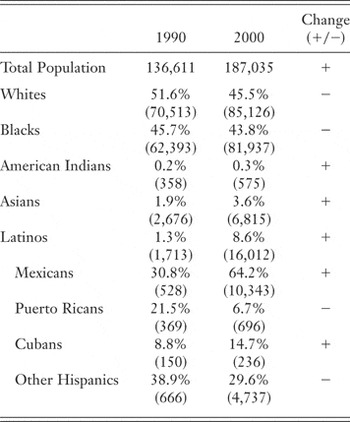
The city of Durham, like many southern locations, is undergoing demographic change. Table 1 shows the changes in the demographics of the city's population from 1990 to 2000. What is clear is that the number of Latinos residing in the city has risen dramatically. In 1990, Latinos were slightly more than 1% of the population, but by 2000, their percentage had reached 8.6%. For decades, Whites were the majority in Durham (51.6% in 1990), but the increasing Latino population, along with a smaller increase in the Asian population, has reduced the White proportion to the point where Blacks and Whites made up almost equal percentages of the population, 45.5% for Whites and 43.8% for Blacks in 2000.Footnote 4
1990 and 2000 Census Data for the City of Durham, North Carolina

Durham's Latino population derives from economically depressed countries (Mexico and Central America).Footnote 5 As such, many of the immigrants have low education levels, and most are unskilled workers. Only 52.4% of Latinos aged twenty-five and over in Durham have finished high school. Yet, Latino immigrants appear to be doing almost as well as Black Americans in terms of family income, with the median Latino family income ($30,439) being just $3008 below the median for Blacks in 2000. But more than one-fifth (21.2%) of Latino immigrants live below the poverty level. The low level of education and skills among Latinos means that many of them hold low-paying, unskilled jobs in Durham, with the consequence that Latino immigrants and low-skilled Blacks compete for the same jobs and social services.Footnote 6
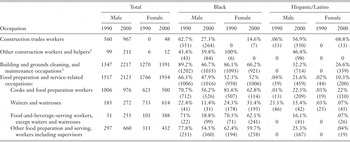
While data on specific job competition are limited, the data presented in Table 2 chart the shift from 1990 to 2000 in the absolute numbers of Blacks in selected low-skilled occupational categories. The percentage of Blacks in those categories may give us a sense of whether Latinos are displacing Blacks in some low-paying, unskilled job categories. In 1990, Black males were 62.7% of construction trade workers, while Latinos were less than 1%. By 2000, however, Black male workers had dropped to 27.3% and Latinos were now the majority, 56.9%, of the construction trade workers. Looking at female employment in this job category suggests that, as the construction trades have opened up to women, Latinas have done far better than Black women, accounting for 68.8% and 14.6% of the workers in that sector, respectively.
Race and Sex by Occupation for the Employed Civilian Population 16 Years and Over: Durham, North Carolina1

1 1990 data were retrieved from the 1990 Equal Employment Opportunity File ⟨http://censtats.census.gov/eeo/eeo.shtml⟩, a sample from the civilian labor force data collected in the 1990 Census. 2000 data were retrieved from Summary File 4 (SF 4)—Sample Data, Table Pct. 86. Sex by Occupation for the Employed Civilian Population 16 Years and Over.
2 Data sets: Summary File 4 (SF 4)—Sample Data, Pct 86. Sex by Occupation for the Employed Civilian Population 16 Years and Over. 1990 data include all construction trade workers except carpenters, electricians, painters, plumbers, and construction laborers.
3 1990 data include supervisors, building and cleaning, maids and housemen, janitors and cleaners, elevator operators, and pest control.
A similar pattern is present in Black male and female employment in building and grounds, cleaning, and maintenance occupations. In 1990, Black males and females were 89.2% and 86.1% of this category, and there were no Latino males and females employed in this category. By 2000, however, Black male and female employment had dropped to 46.7% and 66.2%, respectively, with Latino males and females rising to 32.2% and 26.6%, respectively. These numbers are especially astonishing in light of the fact that Blacks make up slightly more than 43% of Durham's population, while Latinos are just over 8%. It is possible that Blacks moved on to higher paying and more skilled jobs, but, while these data are by no means definitive on the question, they are suggestive of possible job competition.
In an effort to get a better handle on whether job competition is indeed present between Blacks and Latino immigrants, we calculated unemployment rates for the race and gender categories. The unemployment rates are calculated for the entire work force, not the specific job categories used above. In 1990, the overall Black unemployment rate stood at 7.67%, with the Black male rate at 8.12%, and the Black female rate at 7.29%. Interestingly, in the same year, the unemployment rate for Latinos was lower than it was for Blacks. The overall unemployment rate was 6.33%, with Latino male unemployment at 5.52% and Latino female employment at 7.69%.Footnote 7 By 2000, the overall Black unemployment rate had increased to 8.88%, with Black male unemployment at 9.25%, and Black female unemployment at 8.58%. Yet Latino unemployment had increased as well, reaching 7.72% overall, with Latino males at 7.20%, and Latino females at 9.35%.Footnote 8 Although the unemployment rates for Latinos increased, the absolute numbers of Latinos in Durham in the work force increased substantially from 980 in 1990 to 8559 in 2000, an increase of 773.3%. On the other hand, the number of Blacks in the work force only increased by 25.45%. Thus, in absolute terms, the size of the Latino population had increased substantially, with the majority of those individuals finding employment, while Blacks appear to have had more difficulty finding employment opportunities. Again, these data are also not definitive of job competition, but, coupled with the data in Table 2, they strongly suggest that Blacks and Latino immigrants are competing for jobs. At a minimum, Latino immigrants appear to be employed in higher proportions than are Blacks in Durham.
Impoverished Blacks and Latinos also share living environments. Increasingly, neighborhoods that were segregated as Black neighborhoods are becoming Black and Brown neighborhoods. (See Figure 1.) Some sections in the eastern part of Durham that used to be chiefly Black, with only a small percentage of Whites, now have a significant Latino component. These changing neighborhood demographics have the potential to create conflict and tension between Blacks and Latinos. Contact between these two groups, thus, suggests the beginning of a new era of race relations in Durham. Blacks who have had a history of contact with Whites in the city, and who have worked with or challenged the social order to advance the interests of the Black community, must now address issues that affect a totally new group of people with no historical roots in the city.
Distribution of Blacks, Whites, and Hispanics, in Durham, North Carolina, 2000

Why have we focused on Durham, North Carolina? First, North Carolina has the fastest growing Latino population in the country. It experienced an almost 500% increase in its Latino population, primarily immigrants from Mexico, skyrocketing from 76,726 in 1990 to 378,963 in 2000 (U.S. Bureau of the Census 1990, 2000). While the Greensboro-Winston Salem area has experienced the most growth since 1990, the Raleigh-Durham area has experienced a whopping 1180% increase since 1980, the largest of any North Carolina area (Suro and Singer, Reference Suro and Singer2002; see Table 1). Second, Durham, like other cities of the New South, has experienced a decline or exit of industries where Blacks have traditionally found work. As a result, a substantial portion of the Black population now works in the service industry, and Blacks and the new Latino immigrants find themselves competing for the same jobs. Finally, from a research and data-gathering perspective, Durham is of a manageable size.
DATA AND MEASURES
Our analyses in this article are based on the 2003 Durham Survey of Intergroup Relations (DSIR) (n = 500). The survey was conducted specifically for our project by the Center for Survey Research of the University of Virginia using a Computer-Aided Telephone Interviewing (CATI) system, employing random-digit dialing (RDD) and dialing of a directory-assisted Hispanic surname sample.Footnote 9 A randomly generated sample of phone numbers based on exchanges valid in the Durham, North Carolina, area was called. An oversample of numbers listed in the phone directory under a Hispanic surname was also called.Footnote 10 The survey was conducted from May 4 through June 22, 2003, and interviews were conducted in both English and Spanish (32% of the interviews were conducted in Spanish, as 95.8% of the Latino sample opted to be interviewed in Spanish).Footnote 11 A race/ethnicity quota was implemented to achieve a minimum of 150 Whites, 150 Blacks, and 150 Latinos; the remaining 50 respondents were not under this quota restriction and represented a number of racial/ethnic backgrounds. Interviews were completed with 500 residents of the city of Durham, for an overall response rate of 21.6%.Footnote 12 The sample of 500 consists of 160 Whites (32%), 151 Blacks (30%), 167 Latinos (34%), 6 Asians (1.2%), 12 who designated their race as other (2.4%), and 1 respondent (0.2%) who did not indicate a racial category.Footnote 13
To assess the quality of the sample, we compared the distribution of demographic characteristics in our study with the characteristics of the population in Durham as reported in the 2000 Census. Since the study was designed to oversample the Black and Latino populations, we did a detailed analysis of whether the sample was representative of each of our three main subpopulation samples, the results of which are not presented here.Footnote 14 In brief, overall, we find that our sample is reasonably representative of the three racial subpopulations under investigation, though the distribution of respondents is slightly older, better educated, and more often female than in the 2000 Census.
Our data also confirm what we had suspected—the Latino population in Durham is basically an immigrant population, primarily from Mexico. Of the 93% (n = 156) of Latino respondents who were born outside the United States, only about 19% were naturalized citizens. While Mexicans were the largest portion of the Latino sample (63%), Latinos from Central America were the next largest group (23%), followed by South Americans (5%), Puerto Ricans (4%), Spanish (2%), Cubans (1%), and other Latinos (2%).
Given that we are interested in Black attitudes, some of the analyses are performed using only the 151 Blacks in the sample. At other times, we use the entire sample, and in some analyses we use the Black (n = 151) and White (n = 160) samples separately. We use logit and ordered-logit analyses to test our hypotheses.
TESTING AND RESULTS
To test the hypothesis that Blacks in Durham perceive the sizeable growth of the Latino population as a threat to their economic well-being, we begin by using an ordered-logit model to examine responses to a question regarding how continued immigration would affect the economic opportunities of members of each respondent's racial group.Footnote 15 We use the following predictor variables: income measured in grouped categories ranging from $0 to over $100,000;Footnote 16contact with Latinos Footnote 17; the degree to which Black respondents held negative stereotypic views of Latinos (Black stereotypic views of Latinos is an index of three stereotype questions ranging in value from 3 to 15, with 3 = holding the least stereotypical views of Latinos, and 15 = holding the most);Footnote 18 the indicator of linked fate (those believing that what happens to other Blacks will have something to do with their lives);Footnote 19 and a dichotomous variable for race, where Blacks were coded as 1 and all other racial groups were coded as 0.
According to the results of our analysis (results not shown), Blacks were more likely than were non-Blacks to feel that continued immigration would lead to decreased economic opportunities for members of their racial group. Substantively, Blacks were approximately 29% more likely to feel that continued immigration would lead to “a lot less” economic opportunity for Blacks as a group than were non-Blacks to feel that increased immigration would lead to decreased economic opportunity for members of their racial groups.Footnote 20
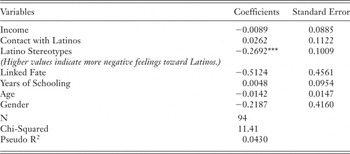
Based on the difference between Blacks' and non-Blacks' perceptions of how increased immigration would affect their racial groups' economic opportunities, we separated out the Black respondents and ran a separate ordered-logit model to examine the factors that predicted Blacks' responses to the effect of continued immigration on Black economic opportunities. The results (Table 3) demonstrate that the degree to which respondents held negative stereotypic views of Latinos was the only statistically significant predictor variable in this model.Footnote 21 According to our results, Blacks who hold more negative stereotypic views of Latinos are more likely to feel that continued immigration will lead to decreased economic opportunity for Blacks. Substantively, Blacks with high levels of negative stereotypic views of Latinos are about twice as likely as those with the mean level of negative Latino stereotypes to feel that increased immigration will lead to decreased economic opportunity for Blacks. Interestingly, income is not a statistically significant predictor of Blacks' perception of the economic effect of continued immigration, though it is a statistically significant predictor for non-Blacks.
Ordered-Logit Results for the Effect Continued Immigration will have on Blacks' Economic Opportunities (Black respondents only)

*** p < 0.01 (two-tailed test);
** p < 0.05 (two-tailed test);
* p < 0.10 (two-tailed test)
Note: The dependent variable is coded from 1 to 5, where 1 indicates feeling that R's racial group will have “a lot less” economic opportunity, and 5 indicates feeling that R's racial group will “probably have a lot more” economic opportunity if immigration continues at its present rate.
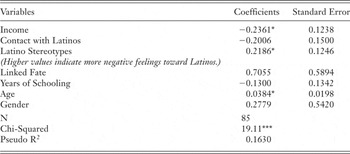
To explore perceived economic threat among Blacks in Durham further, we examined whether Blacks felt that they are losing jobs to Latinos.Footnote 22 Using a simple univariate analysis, we found that the Black respondents in our survey were nearly evenly split regarding whether or not Blacks were losing jobs to Latinos—about 47% agree with the statement that Hispanics are taking jobs from Blacks, while approximately 53% disagree. We then used a logit model to examine the factors that predict whether Blacks feel that they are losing jobs to Latinos. We used the same predictor variables as in previous analyses. The results of our analysis, shown in Table 4, indicate that income, age, and the degree to which respondents hold negative stereotypic views of Latinos all have a statistically significant relationship to whether or not Blacks feel that they are losing jobs to Latinos. Blacks with more negative stereotypic views of Latinos were more likely to feel that Latinos were taking jobs from Blacks, while Blacks with higher incomes were less likely to feel that Latinos were taking jobs from Blacks. Specifically, Blacks with high levels of negative stereotypic views of Latinos were twice as likely as were those with the mean level of negative Latino stereotypes to feel that Blacks were losing jobs to Latinos. Blacks with the mean household income were about 29% less likely than those who reported making $25,000 or less per year to feel that Latinos are taking jobs from Blacks. Also, older Blacks are slightly more likely to feel that Latinos are taking jobs from Blacks.
Logit Results for Whether Latinos are Taking Jobs from Blacks (Black respondents only)

*** p < 0.01 (two-tailed test);
** p < 0.05 (two-tailed test);
* p < 0.10 (two-tailed test)
Note:: The dependent variable is coded such that 0 indicates disagreement with the statement “Hispanics are taking jobs from Blacks,” and 1 indicates agreement with the statement.
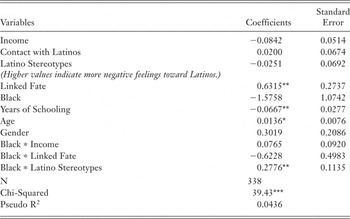
To test our hypothesis that southern Blacks are more opposed to immigration than are their White counterparts, we use the question that asked respondents how concerned they were about the rapid growth in the Latino population, making this the dependent variable in the analysis.Footnote 23 Fully three-fifths (61%) of Blacks felt “somewhat” concerned or concerned “a great deal” about the rapid growth in the Latino population, whereas only two-fifths (41%) of White respondents reported feeling this way. To test whether there was a statistically significant difference between White and Black attitudes on this issue and, if so, which factors contributed to that difference, we used the same predictor variables as in previous analyses. In addition, we included interactions between race and income, race and linked fate, and race and the stereotype measure as predictors to examine whether income, linked fate, and stereotypic views affected Blacks' concern about immigration differently than Whites'.
Our results, displayed in Table 5, indicate that linked fate, education, and age are all statistically significant. The direction of the coefficients implies that individuals with linked fate are more likely to be concerned about the rapid growth in the Latino population than are those without linked fate. Also, individuals with less education and those who are older appear to be more likely to be concerned about the rapid growth in the Latino population. Although we hypothesized that there would be a statistically significant difference between Blacks and Whites with regard to concern about immigration, our results do not show this. The interaction between race and stereotypic views, however, did achieve statistical significance, which implies that having high levels of negative stereotypic views of Latinos appears to matter in Blacks' attitudes toward the rapid growth in the Latino population, but it does not appear to matter for Whites.
Ordered-Logit Results for How Concerned Respondent is about Rapid Growth in Latino Population (Black and White Respondents)

*** p < 0.01 (two-tailed test);
** p < 0.05 (two-tailed test);
* p < 0.10 (two-tailed test)
Note: The dependent variable is coded from 0 to 4, where 0 indicates “not at all” concerned about rapid growth in the Latino population, and 4 indicates being concerned “a great deal.”
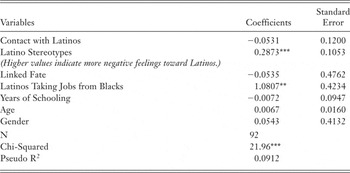
To examine this possibility, we ran separate ordered-logit models for Black and White respondents to examine how the predictor variables used in the preceding model (excluding race and the interaction terms) affected each group's attitudes (Table 6). We also added predictors for whether Whites and Blacks felt that they were losing jobs to Latinos. We dropped income in the model for Blacks because we added the indicator of whether Blacks felt they were losing jobs to Latinos, and income was statistically significantly related to the losing-job indicator in Table 4. Thus, including it in the model might interfere with the effect of the Latinos taking jobs from Blacks indicator. Interestingly, we found that two predictors, the extent to which they held stereotypic views of Latinos, and concern about Latinos taking jobs from Blacks, were significantly related to Black respondents' concern about the growth of the Latino population. Black respondents who embraced negative stereotypic views of Latinos were more likely to be concerned about growth in the Latino population than were those with the mean level. Substantively, Blacks with highly negative stereotypic views of Latinos were more than three times as likely as those with the mean level to feel concerned “a great deal” about the rapid growth in the Latino population. In addition, Black respondents who reported feeling that Latinos were taking jobs from Blacks were almost twice as likely as were Blacks who did not feel this way to be concerned about rapid growth in the Latino population.
Ordered-Logit Results for How Concerned Respondent is about Rapid Growth in Latino Population (Blacks Only)

*** p < 0.01 (two-tailed test);
** p < 0.05 (two-tailed test);
* p < 0.10 (two-tailed test)
Note: The dependent variable is coded from 0 to 4, where 0 indicates “not at all” concerned about rapid growth in the Latino population, and 4 indicates being concerned “a great deal.”
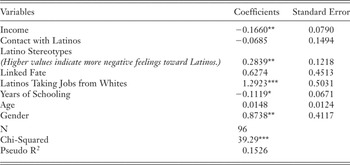
Income, stereotypic views, education, gender, and whether Whites felt that Latinos were taking jobs from Whites were all significantly related to White respondents' concern about the growth of the Latino population (Table 7). Contrary to our expectation, having highly negative stereotypic views predicted greater concern about Latino population growth among the White respondents as well, and the effect was even more pronounced than it was among Blacks. White respondents with the most negative stereotypic views of Latinos were over five times more likely than were those with the mean level to feel concerned “a great deal” about the rapid growth in the Latino population. Like Blacks, the effect of feelings that Latinos are taking jobs from Whites was significantly related to White feelings about the effects of immigration, though the effects were slightly more pronounced. White respondents who reported feeling that Latino immigrants were taking White jobs were just over three times more likely than were other Whites to be concerned about rapid Latino population growth. Lower-income Whites, those with less education, and women were also more likely to be concerned about Latino population growth.
Ordered-Logit Results for How Concerned Respondent is about Rapid Growth in Latino Population (Whites only)

*** p < 0.01 (two-tailed test);
** p < 0.05 (two-tailed test);
* p < 0.10 (two-tailed test)
Note: The dependent variable is coded from 0 to 4, where 0 indicates “not at all” concerned about rapid growth in the Latino population, and 4 indicates being concerned “a great deal.”
DISCUSSION
Overall, the results for our hypotheses are much as we predicted. Our first hypothesis was confirmed. In general, Blacks and non-Blacks in Durham perceive the potential economic threat from continued Latino immigration, but Blacks feel more threatened than do non-Blacks. Among Blacks, those that held negative stereotypes of Latinos were significantly more likely than were Blacks with fewer stereotypes to feel that continued immigration will lead to decreased economic opportunity for Blacks. Responses from open-ended questions on our survey are illustrative of some of the negative attitudes and stereotypes that some Black Durham residents have about Latino immigrants:
ʼn Latinos are lazy; they go to clubs and can't pay the power bill.
ʼn I don't fool with no Mexicans at all; want them to get back on the ship.
ʼn Hispanics should all swim home, don't know why they came to Durham.
ʼn Latinos are practically wiping out Black folk. On every corner, there are Mexicans with their whole family living in one apartment.
ʼn Blacks don't get as many opportunities as Latinos. They have twelve people living in one house. One even had a goat in the backyard, but Blacks still have a stigma attached.
Our second hypothesis was not confirmed in the way we had initially hypothesized. Blacks and Whites both appear to be concerned about the rapid growth in the Latino population. But the factors contributing to the concern appeared to be different for Blacks and Whites. The perception of economic threat was not the only significant factor in Blacks' concerns over Latino immigration. Holding negative stereotypes of Latinos was also a prominent contributor. Blacks with negative stereotypes of Latinos were more likely than were Blacks with fewer stereotypes to be concerned about the rapid growth in the Latino population.
The findings that are especially noteworthy are the results for Whites. Whereas a negative stereotype of Latinos, and Blacks losing jobs to Latinos were the only significant contributors to Black concerns about continued Latino immigration, five factors were significantly related to the feelings of White Durham residents on this issue. Lower-income Whites, Whites with negative stereotypes of Latinos, Whites who believed that Latinos were takings jobs from Whites, those with less education, and women were all the more concerned about the effects of continued immigration than were other Whites. In proportions, the majority of White Durham residents are not as concerned about the continued effects of Latino immigration as are Black Durham residents, but, for those Whites who are concerned, a number of factors distinguishes them from those who are not as concerned.
CONCLUSION
What do these results tell us about the future of Black and Latino relations in the South? We began this article hypothesizing that Blacks would perceive more of an economic threat from Latino immigrants than would Whites. We have answered some questions and raised others. Clearly, Blacks perceive more of an economic threat from Latinos than do Whites in Durham, North Carolina. Given the absence of class differences among Blacks on these issues, there are other factors contributing to Black concerns about Latino immigration beyond simply the threat of lost jobs. Something much more generalized in Black attitudes toward Latinos is at play here. We have not been able to identify all of the contributors, but it is clear that racial threat and economic competition theory are only a small part of the dynamic highlighted by our analyses. How Blacks in Durham perceive Latinos contributes significantly to whether they feel economically threatened or concerned about the effects of continued immigration.
Economic competition can and does result from direct group competition, but there is a less tangible and more subjective layer—an individual's affect toward another group. This affect is shaped by day-to-day social interactions among groups. Though they are literally neighbors, our previous work suggests that there is little social contact between Blacks and Latinos in Durham (McClain et al., Reference McClain, Carter, Soto, Lyle, Nunnally, Scotto, Kendrick, Grynaviski, Lackey and Cotton2006), and this, in turn, leads to a greater likelihood for the development of negative stereotypes. It is not an impossible scenario to imagine that the consequences of the negative attitudes of both Black and White Durham residents toward Latino immigrants could eventually result in an immigrant backlash similar to what is occurring in California and Arizona, and most recently in Georgia. Yet the perceptions of Latino immigration identified in this study raise concerns about the future of the South and how the various states might react to the changing demographics. If the conditions for changing these perceptions are not identified and promoted, a more generalized backlash might occur in the future.