Introduction
The period following weaning is usually characterized by low feed intake and poor weight gain (van Dijk et al., Reference Van Dijk, Everts, Nabuurs, Margry and Beynen2001) partly due to the sudden transition from a nutritious and readily digestible sow milk to dry feed. The poor performance associated with this period has been addressed by feeding diets containing high levels of crude protein (CP) supplemented with in-feed antibiotics as growth promoters. However, the recent ban of antibiotics usage in livestock diets in Europe as well as the ongoing interest to eliminate similar usage in North America and other parts of the world has led to the exploration of other nutritional and management strategies to reduce the incidence and severity of digestive problems associated with weaning.
It is well documented that dietary CP levels play an important role in the health status of weaned pigs (Gu and Li, Reference Gu and Li2004; Nyachoti et al., Reference Nyachoti, Omogbenigun, Rademacher and Blank2006; Wellock et al., Reference Wellock, Houdijk, Edwards and Kyriazakis2006a). High levels of dietary CP could increase the amount of substrate available for the proliferation of pathogenic bacteria that often colonize the pig’s gut after weaning and, therefore, may be a predisposing factor to post-weaning diarrhoea (Ball and Aherne, Reference Ball and Aherne1987; Nollet et al., Reference Nollet, Deprez, van Driessche and Muylle1999). Thus, low-CP, amino acid (AA)-supplemented diets may be used as part of the overall strategy for the nutritional management of the weaned pig. In fact, Le Bellego and Noblet (Reference Le Bellego and Noblet2002) reported that the performance of pigs (12 kg initial BW) fed low-CP, AA-supplemented diets was similar to that of pigs fed a high-CP diet. However, Nyachoti et al. (Reference Nyachoti, Omogbenigun, Rademacher and Blank2006) demonstrated that piglet (6.2 kg initial BW) performance may be impaired when dietary CP levels are reduced from 230 to 190 or 170 g/kg and suggested that essential AA, other than those normally added in the pure form (lysine, methionine, threonine and trptophan), especially isoleucine and valine, may limit the performance of pigs fed low-CP diets. A similar observation was made by Kerr et al. (Reference Kerr, Kidd, Cuaron, Bryant, Parr, Maxwell and Campbell2004) who reported that isoleucine requirements of pigs fed a low-protein diet was higher (0.68%) than the NRC (1998) value of 0.61%. Since deficiency of any essential AA may limit growth performance, we hypothesized that in addition to lysine, methionine, threonine and tryptophan, supplementation of isoleucine to a moderately reduced CP diet and isoleucine and valine to a low-CP diet on an ideal protein basis will improve the performance of piglets, especially those weaned at an early age. Therefore, the objectives of this study were: (1) to further determine the growth performance of piglets fed low-CP, AA-supplemented diets; (2) to determine whether isoleucine may limit the performance of piglets under a low-CP, AA-supplemented feeding programme; and (3) to further evaluate the potential benefits of low-CP diets on indicators of gut health.
Material and methods
All experimental protocols were reviewed and approved by the University of Manitoba Animal Care Committee (Protocol No. F05-024) and pigs were cared for according to the standard guidelines of the Canadian Council on Animal Care (1993).
Pigs and housing
A total of 96 crossbred Duroc × (Yorkshire × Landrace) piglets with an initial BW of 6.44 ± 0.14 kg and weaned at day 17 ± 2 were obtained from a commercial source. Pigs were weighed, balanced for BW and sex, and then assigned randomly to experimental treatments. Pigs were housed in groups of four (two barrows and two gilts) in plastic-covered, expanded metal floor pens (1.5 m × 1.16 m) equipped with a stainless-steel feeder and a low-pressure nipple drinker and were allowed to adapt to the new environment for 4 days before the inception of the experiment. During the adaptation period, pigs received a non-medicated adaptation diet formulated to contain 220 g/kg CP and 14.5 MJ/kg metabolizable energy and to meet or exceed requirements for other nutrients recommended by NRC (1998). Room temperature was maintained at 30°C during week 1 of the experiment and then reduced by 1.5°C over the subsequent weeks. Lights were on from 0700 to 2300. The experiment lasted 3 weeks.
Experimental diets and performance assessment
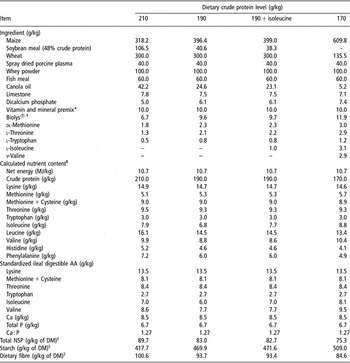
Four non-medicated diets based on maize, wheat and soybean meal were used in the current study (Table 1). Diets differed in CP content but were balanced for net energy (Degussa feed composition data) and standardized ileal digestible lysine, methionine + cysteine, threonine and tryptophan based on the ideal protein ratio (60, 62 and 20 for methionine + cysteine, threonine and tryptophan, respectively) suggested by Rademacher et al. (Reference Rademacher, Sauer and Jansman2000). The dietary treatments were as follows: (1) a high-protein, 210 g/kg CP control; (2) 190 g/kg CP, isoleucine deficient; (3) 190 g/kg CP supplemented with isoleucine up to the level in the 210 g/kg CP diet; and (4) 170 g/kg CP supplemented with isoleucine and valine according to the ideal protein ratio (60 and 70 for Ile and Val, respectively). Feed ingredients supplying CP and AA were analysed for CP and AA content and the analysed values used in diet formulation. The different dietary CP levels were achieved by using different combinations of corn, wheat and soybean meal and by replacing soybean meal with crystalline AA supplied by Evonik Industries (Hanau-Wolfang, Germany). All other nutrients were supplied in amounts meeting or exceeding the National Research Council (NRC, 1998) recommendations for a 6kg to 10kg pig.
Composition of experimental diets, as-fed basis

*Supplied the following per kg of diet: 8255 IU of vitamin A, 1000 IU of vitamin D3, 20 IU of vitamin E, 25 μg of vitamin B12, 1.5 mg of vitamin K, 30 mg of niacin, 781 mg of choline chloride, 7.5 mg of riboflavin, 200 μg of biotin, 4.5 mg of pyridoxine, 1 mg of folic acid; 4 mg of thiamine, 40 mg of Mn (as MnO), 130 mg of Zn (as ZnO), 130 mg of Fe (as FeSO4.H2O), 10 mg of Cu (as CuO), 0.30 mg of Se (as Na2SeO3), 0.6 mg of I (as Ca(IO3)2).
†Contains 50.7% L-Lysine
‡Based on analysed AA content in feed ingredients and digestibility coefficients reported by Rademacher et al. (Reference Rademacher, Sauer and Jansman2000) and Degussa feed composition data for NE, Ca and P.
§Based on the data reported by Bach Knudsen (Reference Bach Knudsen1997).
Pigs had unlimited access to feed and water throughout the experimental period and diets were fed in a mash form. Body weight and feed disappearance were monitored weekly to determine average daily gain (ADG), average daily feed intake (ADFI) and feed : gain ratio (FGR).
Faecal consistency scoring
Severity of post-weaning diarrhoea was assessed using the faecal consistency (FC) scoring system recently used by Nyachoti et al. (Reference Nyachoti, Omogbenigun, Rademacher and Blank2006). FC scoring (0, normal; 1, soft faeces; 2, mild diarrhoea; 3, severe diarrhoea) was performed on days 4, 5 and 11 of the experiment by 2 trained individuals with no prior knowledge of treatment allocation. The FC by the 2 scorers was averaged to determine each day’s value and the 3-day average was used to determine the overall FC score.
Tissue sampling and histological assessment
At the end of week 3, 1 pig representing the average BW of each pen (6 pigs/treatment) was held under general anaesthesia with isoflurane. Once a plane of surgical anaesthesia was attained, two 10-cm adjacent segments were obtained from the duodenum (5 cm away from the pyloric junction), jejunum (10 cm distal of ligament of Treitz) and ileum (10 cm proximal of ileo-caecal junction) for histological measurement and adherent bacterial count. Pigs were euthanized by an intra-cardiac injection of sodium pentobarbital (55 mg/kg BW; Bimeda-MTC Animal Health Inc., ON, Canada). The first segment obtained from each section of the small intestine (SI) was fixed in 10% buffered formalin for histological measurements. The second segment was cut open longitudinally along the anti-mesenteric attachment plane, rinsed with sterile ice-cold physiological saline (0.9% saline) to remove any debris, and then the mucosal tissue was scraped with a blunt sterile blade into a sterile tube, frozen immediately in liquid nitrogen, and stored at −80°C until cultured for adherent bacteria (14 days after sample collection). Following euthanasia, stomach, spleen, liver and the remaining parts of the SI were removed and weighed. All tissue samples were rinsed with ice-cold physiological saline (0.9% saline) and blotted dry with absorbent paper before the weight and the length (SI only) of the organs were determined. The stomach and SI were emptied of any digesta before being weighed.
The formalin-fixed segments were used for histological measurements as previously described (Owusu-Asiedu et al., Reference Owusu-Asiedu, Baidoo, Nyachoti and Marquardt2002). Briefly, six cross-sections were obtained from each formalin-fixed sample and processed for histological examination using the standard haematoxylin and eosin method. Villous height (VH) and crypt depth (CD) were measured on 10 intact, well-oriented villi per specimen using a Nikon YS100 compound light microscope equipped with a Sony DSP 3CCD colour video camera. Images were captured and processed using Northern Eclipse Image Processing Software version 6.0 (Empix Imaging, Inc., Mississauga, ON, Canada). The VH was measured from the tip of the villous to the crypt-villous junction and the depth of the crypt from the crypt-villous junction to the base.
Digesta characteristics and gut microbial population
Luminal content of caecum was collected into two separate sterile sample bags. One sample was snap frozen in liquid N and stored at −80°C until analysed for ammonia N and volatile fatty acid (VFA) and the other was placed on ice and used immediately for bacterial count. Ammonia N concentration in digesta samples was determined as reported by Nyachoti et al. (Reference Nyachoti, Omogbenigun, Rademacher and Blank2006) using the method described by Novozamsky et al. (Reference Novozamsky, van Eck, Ch. van Schouwenburg and Walinga1974). VFA concentration was determined using gas chromatography (Varian Chromatography Systems, Model Star 3400, Walnut Creek, CA, USA) according to the method described by Erwin et al. (Reference Erwin, Marco and Emery1961).
For bacterial count, 1 g sample of caecum luminal content was diluted in sterile peptone water (0.1%, 9 ml) and then serially diluted using sterile phosphate-buffered saline (pH 6.8). The diluted samples were analysed for aerobic and anaerobic sporeformers, Enterobactericeae, enterococci, Escherichia coli and total coliforms as described by Nyachoti et al. (Reference Nyachoti, Omogbenigun, Rademacher and Blank2006). Scraped mucosal samples (1 g each) were serially diluted as for the luminal samples and analysed for adherent total coliform and lactobacilli using violet red bile (35°C, 34 h) and deMan Rogosa Sharpe agar (30°C, 24–48 h), respectively.
Other chemical analyses
Ingredients and diets were ground through a 1-mm screen (Cyclotec 1093, Tecator, Hogana, Sweden) and then analysed for AA composition by Degussa AG as described by Nyachoti et al. (Reference Nyachoti, Omogbenigun, Rademacher and Blank2006).
Statistical analysis
Data were analysed using the GLM procedure of SAS (SAS Inst. Inc., Cary, NC, USA). The pen was considered the experimental unit for performance and FC score data while the individual piglet was used as the experimental unit for other response criteria. The effects of gender and dietary treatment and the interaction between gender and dietary treatment were included in the statistical model as sources of variation. There were no effects of gender and interaction between gender and treatment in all the analyses; therefore, only the effect of dietary treatment was included in the model for the final analysis. Treatment means were compared using Fisher’s protected least significant difference procedure. Association between ammonia N and FC or CD was determined with Pearson’s correlation coefficient. Statistical significance was accepted at P < 0.05 and P ⩽ 0.10 was accepted as a trend.
Results
General
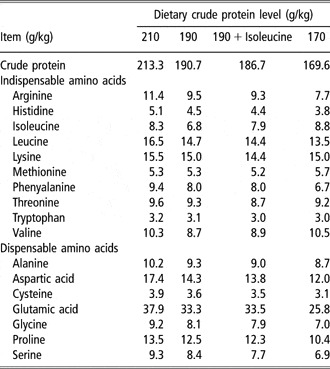
The analysed CP and AA contents in the experimental diets (Table 2) were similar to the calculated values derived from the analysed composition of individual feed ingredient (Table 3) except for CP and some AA in the 190 g/kg CP + isoleucine diet that were slightly lower than the calculated values.
Analysed crude protein and amino acid composition of experimental diets, as-fed basis

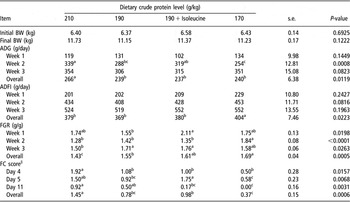
Performance of piglets fed different levels of dietary protein supplemented with amino acidsFootnote †,Footnote ‡

a,b,c Means within a row having a different superscript letter differ significantly (P < 0.05).
† Each value represents the mean of six pens.
‡ Abbreviations are: ADG=average daily gain, ADFI=average daily feed intake, FGR=feed : gain ratio, FC=fecal consistency.
§ 0=normal; 1=soft; 2=mild diarrhoea; 3=severe diarrhoea.
Performance
Growth performance of the piglets during the 3-week study period and FC score are shown in Table 3. Pigs fed the 210 g/kg CP diet had higher (P < 0.05) overall ADG and lower FGR compared with those fed the other diets. Overall ADFI of pigs fed the 170 g/kg CP diet was higher (P < 0.05) compared with other dietary treatments. Overall FC score of pigs fed the 210 g/kg CP diet was higher (P < 0.05) compared with other dietary treatments.
Organ weights and small intestinal morphology
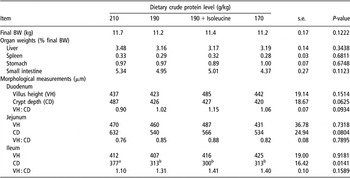
There were no effects of dietary treatment on organ weights except for a tendency for a reduction (P = 0.11) in empty SI weight (expressed as a percent of final BW) as the dietary CP level was reduced (Table 4). Pigs fed the 170 g/kg diet had lower (P = 0.02) SI weight than those fed the 210 g/kg CP diet. Piglets fed the 210 g/kg CP diet had deeper (P < 0.05) crypt in the ileum compared with those fed the other diets (Table 4). The CD tended to be deeper (P < 0.10) in the duodenum and jejunum of pigs fed the 210 g/kg CP diet compared with those fed the other diets.
Organ weights and small intestine morphology of piglets fed different levels of dietary protein supplemented with amino acidsFootnote †

a,b Means within a row having a different superscript letter differ significantly (P < 0.05).
† Each value represents the mean of six pigs.
Caecum luminal ammonia N and VFA concentration and gut microbial population
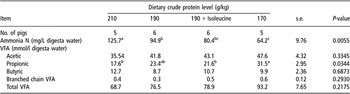
Effect of dietary treatment on caecum luminal ammonia N and VFA concentration is shown in Table 5. Pigs fed the 210 g/kg CP diet had a higher (P < 0.05) caecum luminal ammonia N concentration compared with those fed the other diets. Ammonia N correlated positively to the overall FS (R 2 = 0.47, P = 0.06) and jejunum CD (R 2 = 0.61, P = 0.01). There was no effect of diet on the VFA concentration except for pigs fed the 170 g/kg CP diet that had a higher (P < 0.05) propionic acid concentration than those fed the 190+isoleucine and the 210 g/kg CP diet.
Ammonia N and volatile fatty acid (VFA) concentration in the caecum of piglets fed different levels of dietary protein supplemented with amino acids†

a,b,c Means within a row having a different superscript letter differ significantly (P < 0.05).
There was no effect of diet on adherent jejunal and ileal and ceacal luminal microfloral count. Adherent ileal lactobacilli population averaged 4.6, 4.7, 5.1 and 4.3 log10 cfu/g (s.e. = 0.58) for the 210 g/kg CP; 190 g/kg CP, isoleucine deficient; 190 g/kg CP; and 170 g/kg CP diets, respectively. Adherent jejunal and ileal total coliforms were not detected at 102 cfu/g. The total coliforms count in the caecal luminal content averaged 5.31, 5.97, 5.37 and 5.31 log10 cfu/g (s.e. = 0.31) for the 210 g/kg CP; 190 g/kg CP, isoleucine deficient; 190 g/kg CP; and 170 g/kg CP diets, respectively.
Discussion
It was hypothesized in the current study that low-CP diets, supplemented with lysine, methionine, threonine, tryptophan, isoleucine and valine will support the performance of weaned pigs similar to those supported by a high-CP diet. Contrary to the hypothesis, overall performance of pigs fed the low-CP diets compared to those fed the high-CP diet was reduced. This observation is in agreement with the study of Pierce et al. (Reference Pierce, Callan, McCarthy and O’Doherty2007) and Wellock et al. (Reference Wellock, Fortomaris, Houdijk and Kyriazakis2006b), who also reported reduced ADG and increased FGR with a reduction in dietary CP level. The analysed composition of experimental diets used in the current study showed that the 190 g/kg CP+isoleucine diet was slightly lower in CP and some AA (lysine inclusive) than the formulated value. However, the 170 g/kg CP diet whose analysed CP and AA profiles were not different from the formulated values still performed poorly compared with the 210 g/kg CP control diet. Hence, it could be argued that the lower analysed AA value relative to the calculated value in the 190 g/kg CP+isoleucine diet was not solely responsible for the poor performance of pigs fed this diet. Poor performance of pigs fed the low-CP diets compared to those fed the high-CP diet despite supplementation with isoleucine and valine suggests that other AA and/or other nutrients may have been deficient. Also, the lack of difference between the performances of pigs fed the 190 g/kg CP diet with and without isoleucine supplementation shows that other AA apart from isoleucine may be limiting in a low-CP diet. However, it is possible that the lower levels of some AA determined in the 190 g/kg CP+isoleucine diet compared with the calculated values may have contributed to this observation. It has been suggested that supplementation of swine diets with some essential AA can make other essential AA limiting (Boisen et al., Reference Boisen, Hvelplund and Weisbjerg2000) and that an attempt to reduce the CP level in weaned pig diets could result in a deficiency of other indispensable AA apart from lysine, methionine+cysteine, threonine and tryptophan (Figueroa et al., Reference Figueroa, Lewis, Miller, Fischer, Gómez and Diedrichsen2002; Stein and Kil, Reference Stein and Kil2006). Since most indispensable AA are not commercially available, formulation of weaned pig diets to be moderately low in CP should be done carefully. A moderate reduction in dietary CP with appropriate dietary levels of all indispensable AA should support similar performance of weaned pigs as a high-CP diet but further studies will be required to develop such diets.
The performance of pigs in the current study is contrary to the findings of Le Bellego and Noblet (Reference Le Bellego and Noblet2002) who reported similar performance for the pigs (weaned on day 28; adapted to the housing and experimental conditions for 12 days; 12 kg BW) fed low- and high-CP diets. This discrepancy could be explained by differences in the weaning age and the age and BW at which dietary treatment were allotted to the pigs used in the two experiments. Pigs weaned at 4 weeks adapt to the environment and diet more quickly than those weaned at 2 weeks of age (Leibbrandt et al., Reference Leibbrandt, Ewan, Speer and Zimmerman1975). This observation suggests that weaning age plays an important role in maintaining the growth performance of weaned pigs under a low-CP, AA-supplemented feeding regimen. In addition, the essential AA requirements of the pigs used by Le Bellego and Noblet (Reference Le Bellego and Noblet2002) might have been lower, because they were heavier and older than those used in the current study, such that a reduction in dietary CP did not result in a deficiency of essential AA.
Although it has been suggested that low-CP diets supplemented with crystalline AA could be used as part of the overall strategy for reducing the incidence and severity of post-weaning diarrhoea in piglets, results from the literature have not consistently supported this opinion (Le Bellego and Noblet, Reference Le Bellego and Noblet2002; Nyachoti et al., Reference Nyachoti, Omogbenigun, Rademacher and Blank2006). The FC score was significantly reduced with the 170 and 190 g/kg CP diets compared with the 210 g/kg CP control diet, which is similar to the results of Wellock et al. (Reference Wellock, Fortomaris, Houdijk and Kyriazakis2006b). The discrepancies between studies on the effect dietary CP on FC score may be due to differences in the pig genotypes, weaning age, age and BW of pigs during the experimental period, diet composition and adaptation period. For example, pigs used in the Nyachoti et al. (Reference Nyachoti, Omogbenigun, Rademacher and Blank2006) study were adapted to a post-weaning diet for 7 days. Likewise, pigs used in Le Bellego and Noblet (Reference Le Bellego and Noblet2002) study were adapted to housing and experimental conditions for 12 days. These long adaptation periods compared with the 4 days used in the current experiment might have masked any dietary effects on FC scores.
It has been suggested that a severe reduction in dietary CP levels could result in poor gastrointestinal tract (GIT) growth and development (Nunez et al., Reference Nunez, Bueno, Ayudarte, Almendros, Rios, Suarez and Gil1996) and that excess dietary protein might increase visceral organ weight (Le Bellego and Noblet, Reference Le Bellego and Noblet2002). In the current study, the empty SI weight of pigs fed the 170 g/kg CP diet was about 21% lower than that of those fed the 210 g/kg CP diet. It does not appear that the low-CP diets supplemented with AA in the current study impaired GIT development because gut morphology was not impaired compared with the high-CP diet.
Pigs fed the 210 g/kg CP diet had or tended to have deeper crypts in all the sections of the SI evaluated compared with other dietary treatments. This finding is generally in agreement with Gu and Li (Reference Gu and Li2004) who reported a linear increase in CD in the jejunum, but not in the duodenum and ileum, with increase in dietary CP level. Crypt hypertrophy is an indication of insult to the gut, which could be in the form of pathogen colonization, feed antigen, or toxic microbial metabolic products (Li et al., Reference Li, Nelssen, Reddy, Blecha, Klemm, Giesting, Hancock, Allee and Goodband1991; Tang et al., Reference Tang, Laarveld, VanKessel, Hamilton, Estrada and Patient1999). High levels of soybean meal in weaned pigs’ diet have been implicated with alterations in gut architecture (Dunsford et al., Reference Dunsford, Knabe and Haensly1989; Li et al., Reference Li, Nelssen, Reddy, Blecha, Hancock, Allee, Goodband and Klemm1990). Soybean meal composition in the 210 g/kg CP diet was 10%, an amount that is lower than over 30% inclusion level that has been associated with hypersensitivity reaction in weaned pigs. In a study by Jiang et al. (Reference Jiang, Chang, Stoll, Fan, Arthington, Weaver, Campbell and Burrin2000), there were no differences in the CD, VD and crypt cell proliferation in weaned pigs (14-day old) fed diets based on 15% soybean meal and those fed 10% porcine plasma. As a result, the 10% inclusion level of soybean meal in the 210 g/kg CP diet is not expected to have contributed significantly to the deeper crypts observed in pigs fed this diet.
It was hypothesized in the current study that feeding weaned piglets a diet with a high-CP level could provide substrate for proliferation of pathogenic bacteria, and hence promote the production of toxic metabolic products. However, there was no effect of dietary treatment on the measured caecal microbial population, which is in agreement with the results of Nyachoti et al. (Reference Nyachoti, Omogbenigun, Rademacher and Blank2006), but contrary to that of Pierce et al. (Reference Pierce, Callan, McCarthy and O’Doherty2007) and Wellock et al. (Reference Wellock, Fortomaris, Houdijk and Kyriazakis2006b) who reported a lower faecal bifidobacteria and a higher faecal and colon coliform population, respectively, as the dietary CP level increased. It is also important to note that the different dietary CP levels in the current experiment were achieved by altering the ratios of maize, wheat and soybean meal in the diets and by replacing soybean meal with crystalline AA. As a result, the levels of dietary fibre, starch and nonstarch polysaccharide, which are known to affect microbial activities, in the experimental diets changed with differences in CP content (Table 1). Hence, the current results should be interpreted with caution. Furthermore, similar to the findings of Nyachoti et al. (Reference Nyachoti, Omogbenigun, Rademacher and Blank2006), ammonia N concentration in caecal digesta was higher in pigs fed the high-CP diet compared with those fed the low-CP diets. Not only could a high ammonia N concentration cause inefficient use of dietary energy by increasing the amount of maintenance energy required for its detoxification and excretion, but could also cause insult to gut structure and hence impair gut function (Lin and Visek, Reference Lin and Visek1991; Jensen, Reference Jensen1998). The results of the current experiment showed a positive correlation between ammonia N in the caecum digesta and faecal score or jejunal CD such that the pigs with the highest concentration of ammonia N in the caecum digesta also had the highest overall FC score and deepest crypt in the jejunum.
In conclusion, low-protein diets supplemented with lysine, methionine + cysteine, threonine, tryptophan, isoleucine and valine in the current study reduced crypt hypertrophy, ammonia N concentration and the performance of pigs over the 3-week period. Based on the results of the current experiment, the possible effect of isoleucine supplementation on the performance of weaned piglets is inconclusive and should be investigated further.
Acknowledgements
We gratefully appreciate Agri-Food Research and Development Initiative, Manitoba, Canada and Evonik Industries, Hanau-Wolfang, Germany for funding this project.