Number (Piazza et al. Reference Piazza, Izard, Pinel, Le and Dehaene2004) as well as time (Rao et al. Reference Rao, Mayer and Harrington2001) have been found to be represented in the intraparietal sulci (IPS). The mode of their representation – abstract or not abstract – is put into question by evidence uncovered by Cohen Kadosh & Walsh (CK&W). The authors define abstract representation as the insensitivity of neuronal populations coding numerical quantity to the notation in which the numerical quantity was presented. CK&W elegantly show in their careful scrutiny of existing studies that this property cannot be attributed to all representations of number. We suggest that their conclusion may be extended to representations of time.
We will refer to representations that are notation-specific as concrete representations. We will argue that primary neuronal representations of time (which we speculate may also be found in IPS) could be concrete. CK&W take as their measure of concreteness, the interaction of variations in behavioural data or neuronal activation with different numerical notations. We will show that comparable interactions are found in behavioural performance relating to notation- and modality-specific representations of time. First, we describe some studies that suggest that the representations of number we use to tell the time from clocks are concrete. Second, we will discuss studies that suggest that duration perception may also be concrete.
In a study of clock reading behaviour in children, Friedman and Laycock (Reference Friedman and Laycock1989) found an interaction effect. They asked 6- to 11-year-old children to detect the time displayed in pictures of analog and digital clocks. The success at reading the time from analog displays systematically varied with presented time, but this was not the case for digital displays. The independent variation in performance supports a view of representations of clock time as concrete.
Clock time also seems to be represented concretely in adults. Goolkasian and Park (Reference Goolkasian and Park1980) also found an interaction of notations with presented time. They asked subjects to compare clock times presented as words, with a second clock time presented either in analog or digital notation. There was an effect of the angular distance between the two times if the second stimulus was a clock face as compared to a digital display. This corroborates the finding by Friedman and Laycock (Reference Friedman and Laycock1989) in children and shows that concrete representations of clock time do not disappear during development.
Support for concrete representations of clock time also comes from repetition priming tasks. In a study by Meeuwissen et al. (Reference Meeuwissen, Roelofs and Levelt2004), participants had to name the time from analog clocks, followed by naming the time from a digital clock. Although there was no obvious repetition priming effect with respect to the hour, there was a facilitation present for naming the minutes. If subjects used an abstract representation to name the hour, we would expect to find a priming effect. The absence of such a priming effect suggests that the representations used in naming the hour are concrete. The authors interpreted this finding as evidence that we use different strategies to determine the hour, depending on whether we are using an analog clock or a digital display. Since determining the hour is the first stage in telling the time, we conclude that at this first stage, concrete representations of clock time are employed. Meeuwissen and colleagues showed that once the hour is known, determining the distance in minutes from the hour (e.g., 5 minutes before or after an hour) relies on the same operation for both display formats. This two-stage account of the processing of clock time is consistent with the model CK&W advance concerning the possibility of transformation of primary concrete numerical representations in parietal areas into a common format depending on task demands.
Representations of clock time seem to exert notation-dependent effects on behaviour. We propose that comparable interaction effects can also be found for duration perception, suggesting that the brain may represent temporal intervals concretely. Smith et al. (Reference Smith, Harper, Gittings and Abernethy2007) employed a duration bisection procedure to examine interval timing of two different temporal ranges, 100–500 msec and 1–5 sec, in patients with Parkinson's disease and healthy controls. The authors found a significant interaction between the temporal ranges and modality (visual vs. auditory). Both patients and controls overestimated visual short durations and underestimated visual long durations, but this effect was not observed in the case of auditory durations. This pattern in performance suggests that duration perception is modality-specific, hence concrete.
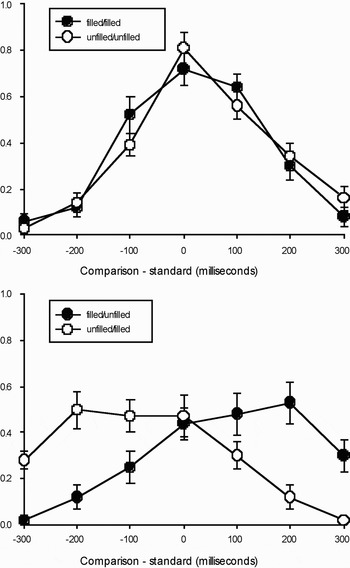
Further support for this conclusion comes from the following auditory duration judgment task (Wearden et al. Reference Wearden, Norton, Martin and Montford-Bebb2007). Participants were presented with a standard stimulus and a comparison stimulus consisting of filled or unfilled auditory durations, and they had to judge if the two stimuli had the same duration or different durations. There were four conditions, filled following unfilled (UF) durations, unfilled following filled (FU), filled following filled (FF), and unfilled following unfilled (UU) durations. The temporal generalisation gradients (i.e., functions plotting the proportion of “same duration” answers over duration differences between standard and comparison stimuli) showed slightly but significantly different shapes for FF trials compared to UU trials and markedly different shapes between FU and UF trials (see Fig. 1). These findings suggest that different notations of auditory stimuli can take distinct processing forms in the brain, providing additional support for the claim that durations are represented concretely.
Temporal generalisation gradients (mean proportion of “same duration” responses plotted against duration differences between standard and probe stimuli) for comparing filled and unfilled auditory durations. Upper panel: Comparison of filled durations (black circles) versus comparison of unfilled durations (white circles). Lower panel: Filled standards followed by unfilled probes (black circles) versus unfilled standards followed by filled probes (white circles). (Figure from Wearden et al. 2007.)

In conclusion, the reported evidence suggests that not only number, but also time can be represented concretely in the brain. This shared characteristic is in line with the idea of a general magnitude system, which codes time, space, and quantity (Walsh Reference Walsh2003). Both CK&W's and our evidence strongly suggest that a general magnitude system could code different forms of magnitude using concrete representations.
ACKNOWLEDGMENTS
The authors were supported by the Volkswagen Foundation (grant I/82 894). In addition, C. Falter was supported by a German Research Council (DFG) fellowship, V. Noreika by the Academy of Finland (project 8110957), J. Kiverstein by an AHRC grant (AH/E511139/1), and B. Mölder by an Estonian Science Foundation grant (ETF7163).