Until recently, the topic of charitable organizations seemed to have fallen in disgrace. Social scientists have given little attention to this sector of associational life. Instead, a great deal has been written on the issues of democratization through pressure groups or on the transformation of social movements into professional organizations while assessing the overall impact of development promoted by donors. Yet three signs point to the need for a better understanding of charitable organizations. First, new research studying Islamic activism through the lens of social-movement literature has offered innovative results.Footnote 1 Second, studies on the impact of aid during the second intifada have revealed that charitable organizations as well as Islamic organizations offered a significant amount of emergency support, sometimes competing with professional nongovernmental organizations (NGOs).Footnote 2 Finally, the fact that Hamas, also known for running a vast network of charitable organizations,Footnote 3 achieved such a significant political success in the 2005 municipal and 2006 legislative elections should invite social scientists to consider whether and how political momentum can also be obtained through activism in the charitable sector.
This article argues that in the last years there has been a nahᨍa, or reawakening, of charitable organizations, the origins and meanings of which need to be investigated. To do so, we hypothesize that the rebirth of the charitable sector is linked in part to a discourse that is in opposition to the parlance advanced by large Western donors and relayed by professional NGOs. Such contrasting discourses reflect profound changes and rifts within Palestinian social movements. In the past few years, conservative and religious discourses have gained the upper hand at the expense of the mobilization historically proposed by the secular left, whose leadership of late has been pushed to the margins of Palestinian politics.Footnote 4 This article discusses the modalities through which charitable organizations and socioreligious movements in the occupied Palestinian territories (OPTs) have gained social and political ground in the last decade—a process assisted by prolonged military confrontation and political stalemate in the region and accelerated by the discrediting of mainstream secular factions. We focus on health NGOs and assess the ways in which they frame their work, how they relate to their constituencies, and how their discourses can be read in relation to the massive aid disbursed for the OPTs.
To understand how the political economy of aid impacts the framing of socioreligious movements, we focus on the health organizations stemming from the mixed matrix of charitable organizations (which include some Islamic institutions and zakat [almsgiving] committees). We contrast their representation with that of another set of medical NGOs, namely those that arose as popular movements from the secular-left factions and that have developed into professional organizations. Although some health NGOs of the secular block have been successful in establishing large professional organizations,Footnote 5 have managed at times to check autocratic tendencies within the Palestinian National Authority (PNA), and have offered key ideas for the development of a national health plan,Footnote 6 they have become increasingly active only in central urban zones and ensnared with the priorities and modalities of intervention of large international donors.Footnote 7 As a result, some of these large NGOs (and some of their leaders) gradually lost touch with the aspirations of the population, and a rift emerged between the lay people and local elites.Footnote 8 In contrast, charitable organizations have played an important role in providing health services to peripheral zones and to underserviced populations,Footnote 9 albeit in a lower-key manner and generally unnoticed to the international donor community. If the Islamic NGOs, particularly active in the charitable sector, have gained so much influence politically in the last few years and if the charitable sector is expanding, it is because they have remained more faithful and closer to the poor. (Study of their discourseFootnote 10 will shed light on to what the links ought to be, from the population's perspective.)
If contemporary socioreligious movements (as embodied in the present case of religiously inspired health NGOs) promote successful discourses of common good that attract more popular support (and that eventually garner the organizations more popular support and legitimacy),Footnote 11 it is also because such discourses are in open (at times conscious) tension with modern liberal conceptions, such as civil-society promotion, good governance, and democracy, that are generally relayed by secular and more professionalized NGOs. Therefore, to understand the success of socioreligious movements in the OPTs and the nahḍa of charitable organizations (success defined by number of active organizations, type and quality of service provided, and political support for the sponsoring factions in the latest elections), we must grasp the political economy that alters and favors the work of these organizations, both secular and religious.
After a presentation of the methodology and the motives behind the Hebron case study selected here, a third section briefly outlines the evolution of the health sector and the changing context of international aid for Palestinian NGOs over the past fifteen years. A fourth section analyzes the discourses of various health organizations, with a focus on the Hebron district, a region with a high density of charitable organizations. The goal is to explore how health organizations discursively frame their work and to study their links to the local populations they serve. We present three models of social mobilization explained as a function of the relationship between health organizations and international donors.
METHODOLOGY AND THE HEBRON CASE STUDY
Studying civil society and the impact of aid is all too often done with a focus on professional or well-institutionalized NGOs, leaving aside smaller organizations such as charitable institutions. The material presented here is part of a larger research project to understand the perception of external aid by a wide variety of local civil-society actors in advocacy and health-service provision.Footnote 12 This paper covers health organizations only. As health is a very broad sector, we limit our focus to providers of primary health care (i.e., basic medical treatment that can be done at the community level without hospitalization), allowing us to include charitable and religious organizations. The interplay of health and activism is possible because health does not limit itself to mere physical well-being: health is multifaceted, providing an entry point into political activism and social work and revealing deeper moral codes of a community's functioning.Footnote 13 Studying how health actors frame their work is therefore an interesting way to divulge different political visions and unearth profound changes within a given society.
Two criteria guided our sampling. For a selection representative of the whole OPTs, we first identified which NGOs to interview from the northern half of the Gaza Strip (from Beit Hanoun to Gaza City) and from the southern half of the West Bank (from Hebron to Ramallah). Within this geography, we chose organizations by quota in order to have a nearly equal number of large, professional NGOs (eleven) active on the national level and smaller organizations (twelve) active only locally, with charitable organizations our target. Overall, we conducted interviews with twenty-three Palestinian health NGOs, between January 2003 and March 2004, using a semistructured questionnaire with open-ended questions. We gathered additional information about NGO activities from the organizations’ annual reports and printed material in English and Arabic.Footnote 14
We illustrate our findings through a case study of health organizations operating in Hebron, the most populated district of the West Bank (530,000 inhabitants). The city of Hebron (160,000), at the heart of one of the most vital industrial regions of the West Bank, is known for its political and social conservatism. Its rural hinterland is also heavily populated, with more than two-thirds of the district population (370,000) living outside the city. A key feature of the district is its very vibrant charitable sector: forty-eight of a total of 175 organizations based in Hebron are charitiesFootnote 15 (i.e., 28 percent of the region's NGOs, as opposed to 20 percent on average for the West Bank).Footnote 16
Its peripheral situation makes it an interesting case study to assess the differentiated impact of external aid, because donors tend to work mostly in and through urban centers, such as Ramallah and Jerusalem. There are actually very few health providers: to serve the population, the large, secular health NGOs operate only three permanent primary health-care centers, two in Hebron city and one in the rural zone of Idhna, to the west. The rest of the rural area is covered by small, charitable organizations based in villages or smaller cities. We adjusted our sample to target such charitable organizations offering basic medical treatment to a local constituency.
Ten organizations active in the Hebron district were interviewed for this study (six charitable and four professional). We made an effort to reach village-based organizations as well as a mix of charitable organizations and religious NGOs in addition to one local zakat committee. According to the most recent NGO directory (2006), new organizations have been created in the last four years, including charitable organizations. From thirty-three charitable organizations registered with the Union of Charitable Societies of Hebron in 1990, the number grew to forty-two in 2003 and forty-eight in 2006.Footnote 17 This increase offers the first evidence of a nahḍa in charitable organizations. The creation of new organizations indicates that the local population perceives their work as a necessity and supports them.
A BRIEF POLITICAL ECONOMY OF HEALTH NGOS
Over the past fifty years, there have been three main types of health providers in the OPTs. The first (and oldest) is the United Nations Relief and Works Agency for Palestine Refugees in the Near East, which has provided health and education to registered Palestinian refugees since its creation in the aftermath of the 1948 war. The second type of health actor is embodied by governmental services run by the PNA since 1994. The third type of health service comes from the nongovernmental sector, be it nonprofit or for profit (private treatment centers, labs, or hospitals). As our paper concerns competing models of social mobilization, we limit our study to the third sector.Footnote 18 Within it we look at two subsectors of health NGOs, namely, the professional and secular as opposed to the charitable and religious.
Health NGOs developed from competition among nationalist secular parties. Starting in the early 1970s, the main PLO factions created popular committees in the territories to promote political participation, to fight against Israeli policies of de-development, and to provide basic services to the population.Footnote 19 Israel did little to develop health infrastructures. In fact, under Israeli rule the number of government hospitals dropped from twenty in 1968 to fourteen by 1992, limiting the scope of services offered. Three of the six hospitals closed down were converted into a police station, a military base, and a prison.Footnote 20 In the late 1980s, while Israel was investing $306 per capita on the health of its citizens inside the 1949 Green Line, it was spending $30 per capita in the West Bank, an outlay that decreased to a mere $20 per person by 1991.Footnote 21 As a result, the so-called popular committees, divided by political party and professional activities, spread throughout the OPTs to organize basic health services for the local population.Footnote 22
With the advent of the PNA, many organizations closed down clinics, either because the PNA set up new infrastructure or diverted funding. Thus, the Union of Palestinian Medical Relief Committees, the health NGO linked until a few years ago to the Communist Party, had thirty-one primary health-care clinics in 1992, twenty-eight in 1995, and only twenty-five by the end of the decade.Footnote 23 The Union of Health Work Committees, originally linked to the Popular Front for the Liberation of Palestine, also shut down some of its clinics. The Union of Health Care Committees, originally affiliated with the Democratic Front for the Liberation of Palestine, cut back most drastically, closing fifteen clinics at the beginning of the Oslo years; their health operations shrank from thirty-two in 1992 to three in 1999.Footnote 24 Health organizations closely affiliated with Fatah merged with the nascent PNA, and many staff gained a job in the PNA administration or in the Palestinian Red Crescent Society, another health NGO that maintained strong ties with Fatah.Footnote 25 The scarcity of funding meant that the remaining secular NGOs had to scramble for money to survive, increasing both competition and the trend toward professionalization.Footnote 26
The other subsector of nongovernmental health under the lens here is charitable and religious organizations. Most charitable organizations tend to be affiliated with one of the four regional Unions of Charitable Societies (Nablus, Jerusalem, Hebron, and Gaza). They differ from the larger secular NGOs in that they are led by local notables (and therefore have a tendency toward paternalism). Many (and this is true only for the West Bank) were established under specific legislation, such as the Jordanian Law of Charitable Organizations Number 22 of 1955 (when Jordan was administering the West Bank).
Although most Islamic health organizations are charitable organizations (al-jam˓īyāt al-khayriyya), not all charitable associations are Islamic. Some are Christian and others secular (close to the Fatah movement). In all cases, however, they function conservatively and often work at the crossroads of various activities, offering health services alongside cultural events, for instance, or help for orphans or elderly people. Their approach is rooted in local needs and means. A last commonality between charitable and Islamic organizations is the rejection of Western discourse, to be discussed later.
For what distinguishes charitable from Islamic organizations, we look at the degree of inclusion of religious principles in their work ethos. Islamic organizations have their own subfields of organizations: some have a clear political project based on religious values, and some do not. The former can be described as “Islamist” organizations, whereas the latter correspond to the more neutral “Islamic” denomination.Footnote 27 Islamist NGOs do not aim only at gaining “political support, but [they are] also the result of a conscious policy to build up Islam as the basis for a sense of community to replace the sense of a nation shattered by the occupation.”Footnote 28
Another way to distinguish the charitable from Islamist NGOs is funding: Islamist NGOs apparently did not have serious financial difficulties during the early years of the second intifada and managed even to increase their work. On the contrary, charitable NGOs have suffered during the Oslo years from diminishing locally generated income and international support,Footnote 29 whether from the Gulf region, which might have preferred supporting Islamists, or from Western donors fearful of funding Islamists. Whereas the West tendsFootnote 30 to blur the lines between Islamic and Islamist, some within the international Arab donor community make the distinction and precisely orient funding on this basis.Footnote 31
The Islamist movement started creating its own service-provision organizations following the model of the Muslim Brothers in neighboring countries. This is the case with al-Mujamma˓ al-Islami (the Islamic Assembly), created in Gaza in 1973 under the leadership of Shaykh Ahmed Yassin,Footnote 32 who later founded Hamas in 1988. The model of service provision through voluntary popular participation (which originally emerged in the secular left) was emulated on a broader basis only later, from the end of the 1980s onward. Roy notes how Islamic NGOs providing services around health, education, or orphan care have contributed to the further rise of the Islamic movement because of the quality of their work—despite the crackdown on Hamas structures during the 1990s.Footnote 33
To return to the distinction between charitable and professional organizations, our database suggests that 21 percent of health organizations active in the OPTs (27 of 129) are charitable ones. They are rather small entities, dispersed throughout communities and in villages. They are less clearly structured: a recent study reports that most charitable NGOs are headed by a general assembly, whereas professional NGOs are managed by boards of trustees or administrative boards.Footnote 34 The study highlights that rural-based charitable organizations are “generally weaker in structure” than NGOs based in urban communities.Footnote 35
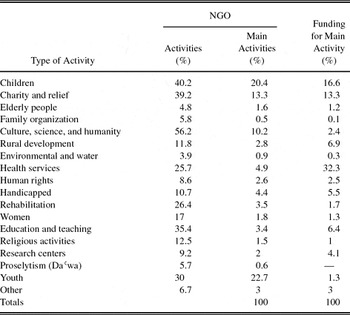
Charitable organizations also differ from the larger, professional NGOs in their roles and activities. Table 1 indicates the main field of activity, as reported by NGOs; the last column reports the percentage of funding dedicated to this main activity.Footnote 36
Field of activities and proportion of funding, as described by nongovernmental organizations (NGOs) in 2000

Note the contrast between the variety of activities and the main purpose of each NGO. Table 1 shows that although many NGOs work in certain areas (culture, education, charities, and youth), fewer define these fields as their main activities. By contrast, few organizations identify health as a main activity (4.9 percent), rural development (i.e., agriculture, 2.8 percent), education (3.4 percent), and research (2 percent), but these four sectors, host of most professional NGOs, absorb much more funding per NGO than the rest (almost half of the funding, respectively 32.3 percent, 6.9 percent, 6.4 percent and 4.1 percent).
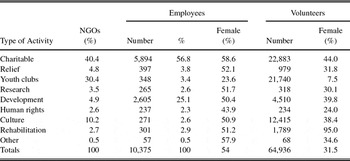
Table 2 identifies which sector employs most NGO workers, giving us an idea of the relative importance of each sector.Footnote 37 Again, the charitable sector stands out, not only in mere numbers of NGOs, but also because it employs more than half of those paid by NGOs. Table 1 highlights that youth activities are very popular but require little funding. This is also confirmed here, with only 3.4 percent of all employees being in this sector. Finally, the NGOs describing themselves as “developmental” (what we call “professional NGOs”) employ 25.1 percent of all employees, although they represent only 4.9 percent of all NGOs. This suggests that certain activities cost more than others; they are not only professionalized, but also have become an important source of employment for a new and rising middle class.Footnote 38 A rival hypothesis posits that developmental NGOs are simply much better at fund-raising from large foreign donors and therefore can pay more (and better) salaries. This theory goes hand in hand with the view that a thin layer of NGOs in the OPTs has become truly professionalized. By contrast, other sectors (such as charitable organizations) employ many volunteers, even if they have very little money dedicated for their activities. Therefore, charitable organizations occupy a different niche than the larger, more professionalized NGOs.
Number and percentage of employees by type of nongovernmental organization (NGO) activity in 2000

Let us now look at how reforms affected the work of health actors during the second intifada. The PNA, under intense political and economic pressure exerted by large donors in the wake of the Oslo Accords, profoundly reformed the health field.Footnote 39 One consequence was increased privatization, the approach favored by the majority of international donors. It aimed at improving “the efficiency and the quality of [health] services, the sustainability of present financial arrangements and equity and accessibility to services.”Footnote 40 However, for some, such outside-driven health-sector reforms “missed the forest for the trees” by often offering only “quick fixes” and technical assistance that did not respond to the population's real needs. In short, the reform failed to apply a broader systemic analysis and was divorced from the OPTs's sociopolitical context.Footnote 41
The divorce was even more acutely perceived with the outbreak of the second intifada. The emergency situation after 2000 increased centrifugal forces because of closures and curfews imposed by Israel. The occupied territories rapidly became a chaplet of small islands, with little possibility for mobility, even for medical staff. Therefore, the quality of the medical response offered by governmental and nongovernmental health institutions depended on their capacity to decentralize services or on their presence (or absence) in peripheral zones. Interviews with health professionals highlighted the differentiated lack of health structures during the second intifada. Even if good infrastructures had been developed in urban centers during the Oslo years, patients simply could not reach them because of the hundreds of checkpoints scattered throughout the territories. Larger, secular NGOs as well as religious and charitable health organizations had to play a more important role, in different manners, to compensate for the unavailability of government services.
Professional health NGOs received a clear mandate from international donors to provide the services that the collapsing PNA could no longer offer. This message was sent in a financial envelope: according to estimates, whereas all Palestinian NGOs (not just health) received about $100 million each year during the Oslo period (1994–2000), donations to civil society increased to an annual average of $300 to $500 million for the years from 2001 to 2005, which actually represents the overall yearly average of international aid to the OPTs (aid to the PNA included) during the Oslo years.Footnote 42 This financial trend probably increased after Hamas came to power and the donor community cut its funding to the PNA.Footnote 43
NGOs (particularly professionalized ones) have again become major actors in providing vital resources to the Palestinian population. The role of international donors (who should not be hastily treated as a homogenous category)Footnote 44 has also massively expanded due to the difficulty for the PNA to function. This in turn may have hindered some of these large, secular NGOs because local perceptions may have linked their relief efforts to the unclear political intentions of international donors. Indeed, a few months after the outbreak of the second intifada, criticism mounted against large, professional NGOs. Some inhabitants spoke of an exaggerated “NGO-ization” of Palestinian social life, regretting the insistence on formal structures rather than mutual and voluntary assistance for the population in need.Footnote 45 Others contrasted the dynamic role of civil society during the first intifada with its absence and its incapacity “of organizing at the mass level” during the second uprising.Footnote 46 Still others denounced certain NGOs for seeking privileges for themselves and abandoning the common interest, which contributed to a growing “confidence gap between the leadership and the masses from the start” of the Oslo process.Footnote 47 Adding to this catalogue of grievance was the location of most donors in central zones (i.e., in Jerusalem, Ramallah, or in some cases Gaza City), so local organizations seeking funding were limited by their (in)ability to travel to these zones.Footnote 48 A small, village-based NGO trapped in the periphery (such as the Hebron district) was far less likely than a larger organization to reach potential donors for its projects.
The contrast here with charitable organizations is stark. Charitable organizations, and in particular Islamic health NGOs, have concentrated mostly on local help and sometimes at a lower scale of intervention, with redistribution of locally collected alms and funding. In a period when the local has become the most important resource, because of the significance of local economic network provided, for example, by the ḥamūla or extended family,Footnote 49 this form of community self-help has been highly appreciated and used by charitable organizations. We argue that its different rhetoric resonates much more with the local population than grand schemes about empowerment, good governance, civil-society promotion, and reforms—all buzzwords promoted by the majority of Western donors.Footnote 50
Despite this resistance to Western principles and institutional arrangements, many observers are keen to underline the importance of charitable organizations and, within that group, the professionalism of the Islamic sector. An International Crisis Group report attributes some of their success to maintaining “very organic links with their constituencies.”Footnote 51 With PNA infrastructures increasingly targeted and initially incapable of delivering aid, and with larger, secular NGOs having difficulties transitioning from advocacy-oriented activities (such as reform and democratization) developed during the Oslo years and from 2003 onward, Palestinians in dire economic situations turned to the charitable sector because it delivered services more quickly (particularly Islamist organizations).
According to a wide survey done in 2002, this type of NGO enjoys high credibility among locals.Footnote 52 As mentioned in the methodology section, the emergence of new charitable organizations in the last three years suggests popular endorsement. In this line of community self-help, we must underline the work of another Islamic institution, zakat. Locally organized zakat committees redistribute to the needy the mandatory tithe that they collect throughout the year. Such committees can give financial help, organize educational activities, and provide health services. The Hebron Zakat Committee, for example, covers insurance fees and certain hospitalization expenses for the needy and runs its own small medical laboratory.Footnote 53 Zakat provides vital resources at the heart of local communities—a role recently acknowledged in an international report on food security in the West Bank.Footnote 54
HEALTH NGOS AND THE USES OF “CIVIL SOCIETY”
Let us now analyze the discourses produced by health actors about their role and their relationship to the local population. As we have since the outset spelled out the necessity of contrasting these models according to political economy criteria (external funding available, institutional development, access to central decision zones), we divide health organizations into three categories (large, medium, and small health NGOs) as a proxy for the institutional capacity to reach out for international aid.
The larger NGOs include such institutions as the Palestinian Red Crescent Society, which has twenty branches and twenty-six primary health-care centers. Other big NGOs include the Union of Health Work Committees, the Union of Palestinian Medical Relief Committees, and the Union of Health Care Committees. They were originally popular committees affiliated with political parties; although all three organizations insist that they are formally independent, they have remained in a very close orbit.Footnote 55 Other organizations fit this category because of their large number of employees. The Gaza Community Mental Health Project and the Health Development Information and Policy Institute are good examples. Neither is formally working in the whole of the OPTs, but their fully professionalized programs are meant to exert a national influence (through report publications and/or training).
A survey of staffing indicates that these big NGOs (founded on average in 1976) employ an average of 175 persons, in addition to a few hundred volunteers.Footnote 56 All are urban based in their administration (although they have some branches in rural areas and provide mobile clinics to the periphery)Footnote 57 and benefit from highly structured organizations (including public-relations work). Some even produce high-quality books and publications and offer information management as services to other organizations, thus becoming “meta-NGOs” or “multiplicator NGOs,” with a new type of constituency, namely, small NGOs. All these organizations receive very large amounts of money from abroad.Footnote 58 Almost exclusively dependent on external funding, they have a team within the staff specializing in fund-raising and in external relations with key donors.
Medium-sized health NGOs employ on average about eighty workers—large institutions with a reach that is nonetheless only regional. They are older and were founded, on average, in 1970. Some prominent examples are the Red Crescent Society for the Gaza Strip (headed by Dr. Haydar Abdel-Shafi until his death; it is not affiliated with the Palestinian Red Crescent Society), Ard al-Itfal (Gaza City), Ard al-Insan (Hebron), the Bethlehem Arab Society for Rehabilitation, and some of the Patient's Friends societies. The last are not part of a unified movement; totally independent, they share no common resources except their name. Finally, we include some hospitals registered as NGOs because they are draining from a basin bigger than a single locality. This is also the case for the al-Ihsan Charitable Society (in Hebron) because it does some training for other rehabilitation NGOs from the West Bank.Footnote 59
Some medium-sized health NGOs have a refined administrative apparatus, but it is less developed than that of their larger counterparts. For example, they do not have the same visibility (i.e., the capacity to attract donors’ attention). Their funding capacities are less developed too. Although they rely on external aid for a large share of their budgets, they also tap local sources for income.
We describe the rest of health NGOs as “smaller NGOs,” although this can be slightly misleading because some employ up to fifty staff. However, their vocation is only local. Examples of such organizations are the Al-Mahaba Charitable Clinic (Nablus), the Qalandiya Health Centre, the Al-Aqsa Society for the Handicapped (Samu˓), and the Rafah Refugee Camp Medical Center. The average year of foundation is more recent: 1986. They represent more than 78 percent of all health organizations.Footnote 60 Proportionally more diffused in Gaza (forty-five NGOs) than in the West Bank (fifty-five), they are much more active than larger organizations in the nonurban setting. All thirty-seven health NGOs based in refugee camps or villages are actually “smaller NGOs.”Footnote 61 Their profile of activities is also different: of the thirty NGOs based in refugee camps, 77 percent have rehabilitation/handicap as a main priority. Their financial resources might on rare occasions originate from Western donors but in small sums (ranging from $5,000 to $25,000). Therefore, such organizations survive principally on local contributions (membership fees, in-kind payments, or cash) and on volunteer work.
We analyze how these health NGOs frame their work and how this might be influenced by international donors, before exploring the possibility that these various framings may contribute to maintaining or losing social and political touch with the local population. How do these NGOs describe their relations with local constituencies? How do they speak of themselves and of their roles? The three models proposed here use as a dividing line the notion of civil society, a concept heavily sustained by international donors, which allows us to take political economy factors into consideration.
The first message underlines the explicit alliance of civil society within the health agenda. According to one of the most vocal supporters of such an alliance, health organizations can be an “entry point into society for those sectors of society that were most oppressed and disadvantaged.”Footnote 62 This model stresses the usefulness of the health agenda in promoting changes beyond physical well-being. The spirit of the Declaration of Alma-Ata (a U.N. conference held in 1978 that consecrated primary health care as a fundamental human right) explains in part the popularity of mingling civil-society discourse with health-service provision.Footnote 63 It is not just about curative medicine but about an alternative vision of primary health care that takes the sociopolitical context of occupation into account, as already framed in a 1990 text.Footnote 64
The following excerpt from an interview gives a better understanding of what we mean by the “marriage” of civil society with the health agenda. This NGO, specializing in mental health and particularly psychotraumas as a result of torture, runs a program for Palestinian police forces:
We have a training and education department. It covers all the short-term training courses. We also offer training courses to police and intelligence officers (on human rights and mental health: namely, the impact of torture on prisoners). . . . I think civil society has two roles to play: to provide needed professional services to the community, and [it has a] role in the democratization of the society. By democratization, I mean also the political level.Footnote 65
Here, the idea is one of spillover: by raising awareness about health issues among police forces (accused of torturing prisoners), this health NGO hopes to contribute to a stronger dedication by all parts of the Palestinian polity to human rights and democracy. Although some NGOs make use of the hegemonic discourse around “civil society” for political purposes, others make only general reference to sociopolitical change and do not imply a political agenda. In the first case, we find very large professional NGOs historically linked to left-wing political parties whose frequent and overt use of the international leitmotiv around “civil society” has helped render “civil society” almost void of sociopolitical significance. It has become simply a political identity marker (see following). In the second case, we find mostly medium-sized organizations without clear political agendas, but these NGOs follow the trend of professionalized organizations that arose during the Oslo years. Their use of the phrase “civil society” reflects a silent conditionality set by donors, namely, that beneficiaries need to follow the dominant and hegemonic parlance in order to receive aid.
The second vision of “civil society” in the parlance of Palestinian NGOs separates “civil society” from professional health work or mentions it only as a general motivation. This is the case for the Palestinian Red Crescent Society for the Gaza Strip.Footnote 66 Dr. Haydar Abdel-Shafi sees civil society as civic engagement for the welfare of the community. When questioned whether “civil society” was used too much in a top–down manner to control, he responded:
It should be a bottom-up process. Civil society is concerned with civil affairs pertaining [to] the welfare of the community. This is civil society. In essence it is political because its objective is safeguarding the interest of the population. But there is no active and direct involvement in politics. In its activity, towards welfare, it can really become political. But it does not engage itself in political activities.Footnote 67
More interesting for this category is the case of small NGOs we call “family associations” because they represent refugees from the same town organized so as preserve the sense of the original community. In this line, the Family Association of Majdal (Jami˓iya Ahaliyya Majdal) started in 1976 as a cultural center, and in 1994 it began offering a variety of education activities as well as basic medical care through volunteers. When asked about the association's philosophy, the director responded:
[This] reformed alliance was founded in order to reform civil society. It is not just about politics, but also to develop social life and recuperate the loss of education during the Israeli direct occu-pation. . . . We must concentrate on the social dimension of education, on how to watch TV, on the relations with groups, how to speak with one another, how to be open to others, to be loyal to the society at large, how to be positive with one another. All in all, it is about teaching how to be positive social beings. It is like Pavlov: it is a kind of reflex to become calmly positive people, shakhṣ [individual], and muwāṭin [citizen].Footnote 68
Beyond the paternalist assumption that the association has to teach its members how to behave socially, the definition of the overarching role of the association is close to the definition of civil society put forward by certain left-wing secular activists (who stress social change and the leading role assumed by NGOs). The previous quote reinforces the idea that “civil society” (as narrowly understood by the largest donors) does not need to be explicitly stated, but in some cases, it is only the expression or the phrase itself that is missing, not the substance behind it.
This Family Association model is widespread in the OPTs. Such organizations perform important mediation between the community and the PNA.Footnote 69 The two family organizations we interviewed each gather at least 10,000 members, so they serve as important relayers of local interests. Although they might not be professional in structure, they have a strong membership base. Moreover, they usually operate in peripheral zones much less covered by international aid—although one interviewee suggested that international support for such organizations could undercut militant religious groups.
A leader of the charitable sector also addressed this thorny question of the rivalry of certain smaller NGOs with those belonging to militant Islamist groups. For her, many charitable organizations became lethargic after the disengagement of the Jordanians in 1988 and the sudden drop in financial assistance from Amman.Footnote 70 The second intifada has forced NGOs to respond to all sorts of challenges. On the one hand, the work of some charitable organizations stopped after 1988 and even more after the arrival of the PNA. On the other hand, the dynamic involvement of both large, secular NGOs and Islamic (in some cases Islamist) NGOs forced charitable organizations to react. This led to what she describes as an “awakening” of the charitable sector.Footnote 71 She regrets that a large majority of international donors overlook charitable organizations—despite their longer historical involvement among civil-society organizations and their attention to overlooked areas, such as elder care. Yet she also keenly criticizes Palestinian NGOs that merely follow fashion:
It looks like the global terminology [such as civil society, democracy, or empowerment] is impacting even the local organizations and local scene. People always try to follow and jump on the bandwagon, as they say. . . . I know many organizations that came to existence because [of the themes] of democracy and civil society. . . . If you look at the numbers of these organizations doing conflict resolutions, civil society, and this and that, it is not out of conviction only: it is because donors have money. It is opportunity! People are opportunists! People want to make hay while the sun shines!
Without negating vices of the charitable sector (e.g., clientelism and political patronage), she notices that some charitable organizations are renewing their activities and their ways of working, which often means specializing in a specific field of intervention and professionalizing part of the staff. They remain very active and important in rural settings and could serve as a cordon sanitaire vis-à-vis the Islamist organizations recruiting on the same turf in marginalized areas. Some small health organizations also frame their social work this way. They rely in part on external aid but enlist volunteers among people having access to their services.
Finally, the third approach to civil society in the health sector conveys a very different type of message. We find a variety of health actors, mostly religious, ranging from the Hebron Zakat Committee to the al-Ihsan charitable organization to the tiny, village-based Tarqumya Charitable Society as well as to Maqassed Hospital (indirectly sponsored by the PNA). To assess the impact of external aid, we divide these small organizations into two subgroups, one with resources that are mostly locally generated and the other with resources that come from international donors.
Established in 1983 with a staff of sixty, the Al-Ihsan Charitable Society typifies oganizations with externally generated income. Specializing in care for the disabled, this Hebron NGO belongs to the International Cerebral Palsy Society and trains health professionals for the rest of the West Bank. It also runs an emergency primary health-care center with four doctors and five nurses. When asked how the organization views its role vis-à-vis the population, Ihsan's PR officer responded that:
We can give the value of an institution; we give rules and help them form a society. We are the lighthouse that guides the people according to our proper model [naḥnu manāra yuhtadī binā bi-l-nās wafq al-niẓām al-khāṣ binā]. We are the candle lighting the path for the people [sham˓a tadhī˓ al-ṭarīq li-l-nās]Footnote 72
Behind this colorful phrase lies a totally different philosophy: no more secular discourse about people's empowerment through pluralism or civil society but very pious invitations to follow religious models of activism. Far from being a militant Islamist association, this NGO (like others in the Hebron region) insists on generic religious obligations. Thus, the annual reports of al-Ihsan and of al-Ahli Hospital (run by the Patient's Friends Society of Hebron) both start with the fatiḥa and three pages of Islamic references with many hadiths, excerpts from the Qur˒an, and pictures of the local Ibrahimi Mosque. Most of their international donors are Arab or Muslim organizations, the target audience for their bilingual reports. On rare occasions, however, they also collect funding from nonreligious Western organizations (such as American Near East Refugee Aid, CARE, or the Red Cross) because of the good quality of their work.Footnote 73
This second subgroup of organizations, which have an income that is internally generated, insists on involving local residents, whose voluntary contributions fund the major part of the NGO work. Zakat committees organize obligatory almsgiving on a local basis. In Hebron, the zakat committee made special financial contributions during the second intifada to people without health insurance. It also ran a small clinic near a downtown mosque.
The Tarqumya Charitable Society is a small NGO in a town west of Hebron that also relies on local financial contributions. Its catchment area encompasses 70,000 people caught between Hebron and the Green Line. Receiving only rare and small contributions from international organizations, it extended its primary health-care center on land donated by a local resident.Footnote 74 Another organization in this category, the Union of Charitable Societies of Jerusalem, stresses local resources and the necessity for Palestinians to do their own development work.Footnote 75
In all three cases, these organizations put forth very little or no discourse about civil society, democracy, or other key concepts usually mouthed by international donors. Rather, interviewees insist on Palestinian capacity to organize themselves, working directly with the people, thanks to local contributions. To this group, local involvement best guarantees social work in the best interests of all and at minimum cost.
What do these different framings imply? We notice a twofold strategy by health actors. Some make frequent and conscious use of key concepts that most international donors are keen to support (“civil society,” “empowerment,” or “democracy promotion”). Others use less complex strategies and less fashionable rhetoric, even laced with religious overtones. However, they refrain from the kind of orthodoxy replicated by those who pursue funding from donors. We hypothesize that framing tends to be polarized by the presence, or more precisely by the frequency, of interaction with Western donors.Footnote 76
Notions of civil society are not the unique resource of a few larger, professional, secular NGOs. On the contrary, many organizations that do not have an extensive public-relations staff also speak the language of “civil society” (even if not explicitly, as in the case of the interview with the leader of the Family Association of Majdal), nor is the use of “civil society” the exclusive domain of people trained and educated abroad. Many physicians who studied outside the OPTs and were interviewed did not automatically use the concept of civil society as an overarching justification for their work. In summary, there is no monopoly on “civil society” by a given type of organizations or by a certain sociological profile of individuals running NGOs. To the contrary, the concept is widespread even thought the exact phrase might be absent. Although many observers would not consider certain religious NGOs as part of “civil society,”Footnote 77 they use its content in one form or another.
In addition to the service provided by health NGOs, what also matters therefore is the message transmitted through it.Footnote 78 Some organizations link a strong message about sociopolitical change or the need to enhance the rule of law; others entertain a paternalist model of relations between NGO and communities. Others prefer to imbue their work with conservative religious values.
Which message is more popular and successful among Palestinians? As argued previously, large, secular NGOs (active in any field and not just health) faced harsh criticism at the beginning of the second intifada for their incapacity to relate and respond to popular needs and for their tendency to follow priorities set by donors. Moreover, the phrase “civil society” has been so widely linked to left-wing political parties and the ways in which leftist NGOs frame their work that it has become an identity marker within Palestinian politics. The PNA and intellectuals close to Fatah (as long as it was the dominant PNA faction) have on many occasions attacked the concept of civil society and the physical entity “hiding” behind it, namely, NGOs. PNA officials have led many campaigns against the “dakakīn,” boutiques, denoting the businesslike approach of some NGOs that represent themselves as watchdogs of the corrupt PNA.Footnote 79
Islamist groups have not been keen to promote the substance or the term “civil society” because they rely on another type of ready-made discourse—one sanctioned by religious rhetoric that is also greatly constrained by nationalist rhetoric and in open opposition to foreign, or “Western,” discourses. When speaking about NGO work, Islamic movements prefer the phrase “al-˓amal al-ahlī ” (civic work), a phrase more common in daily Arabic than the phrase “al-mujtama˓ al-madanī ” (civil society).Footnote 80 An article by a declared Islamist went further in this open tension with international orthodoxy, by proposing the new phrase of “al-jihād al-madanī” (civil struggle).Footnote 81 Such an expression is highly interesting for our argument, because it marries the concept of “jihad” (understood as a spiritual or physical struggle) with madanī. “Jihad” is a very popular concept among religious conservatives, and the phrase evokes political struggle within the sphere of social mobilization. This rebuke of “al-mujtama˓ madanī ” further demonstrates how the civil-society concept is loaded with internal political connotations, a gathering banner for a variety of political forces.
Another, more down-to-earth reason may account for Islamic socioreligious movements’ success (measured in popular support for their organizations) in the OPTs and even the rest of the Arab world. They work in more remote and underserved zones. Here the example of the Hebron Zakat Committee is useful. By offering services free of charge to people in dire need, the organization contributes to the widespread circulation of religious messages. Between 1992 and 2000, the committee disbursed on average $1.05 million per year, peaking in 2000 at $1.3 million.Footnote 82 It outspent the larger health NGOs in the Hebron district, and its small clinic provided 10,000 treatments.
Based in disadvantaged areas, these religious organizations are also flexible, adapting to local needs. This, too, bolsters their message. They can tap into local knowledge, networks, and resources to tailor assistance, often more efficiently and quickly. The Hebron Zakat Committee has no need for grand developmental schemes or costly screening programs: it suffices to know who exactly needs 200 shekels for urgent medical care.
Local organizations can also function as exempla for the rest of the society they serve. The transparency and flexibility of a locally and socially anchored institution have an important consequence: people know each other, and everyone is part of the effort through voluntary contributions. Therefore, people return to this institution. Trust becomes visible in the form of increasing numbers of charitable organizations, their broadening role during the second intifada, and even election outcomes. The fact that Hamas won all nine territorial seats attributed to Hebron for the Palestinian Legislative Council in the 2006 elections is further proof of the strong link between the activism of certain charitable organizations and political support. The Hamas victory certainly cannot be reduced to this factor: elections are a complex process. Yet the profiles of many Hamas ministers point to solid experience and involvement in the charitable sector, with nine (of twenty) ministers of the tenth cabinet rooted in the charitable and civil-society sector.Footnote 83
CONCLUSION
As accurately pointed out by Levine and Salvatore, “socio-religious movements base their public actions primarily on practical reason sanctified by religious traditions.”Footnote 84 These traditions can be interpreted in a multiplicity of ways by socioreligious movements. Their rewording and reframing capacity is very important and may change according to the context and interlocutor. We must add to the two aforementioned elements (practical reason and religious sanction/tradition) two more factors: proximity of organizations to their populations and the model (or example) that socioreligious movements represent (explicitly or not) for the constituencies they serve.
Put another way, if religious health organizations succeed in their mission and garner more popular support, it is because they function as tangible and concrete examples for the population. Service provision for the marginal and disadvantaged, more transparent economic redistribution of aid and behavior (their image is clean and free of corruption charges—true or not—unlike many of the larger, professional NGOs),Footnote 85 and a rhetoric to frame their action (or “ideological wrapping”) that speaks to the local population more than the sophisticated, secular prose overused by larger health NGOs—all are key elements to explain the importance of religious organizations in the OPTs today.
It is vital to look at the political economy of aid given to civil-society organizations because the vocabulary and discourse consciously selected by Islamic and charitable health NGOs is not only the product of traditions or culture but also reflects a reaction to the massive imposition by external donors of a vulgate, catch phrases about “development,” “civil society,” and “empowerment,” which have become totally emptied of meaning because of cynical overuse by a large number of self-proclaimed civil-society champions. A thorough analysis of the language used by charitable and Islamic health NGOs demonstrates that the content of civil society is also part of the organizational culture of charitable organizations. They compensate for their institutional weaknesses through a closer relationship with deprived segments of the population, volunteer work, and discourses that strike the popular imagination in a time of hardship.
The international context and political economy that motivate socioreligious movements might offer windows of opportunities but also counter-opportunities (i.e., a reaction to dominant ideologies, praxes, or discourses) to social movements in general, not only socioreligious ones. This is especially important in the OPTs, where every year donors pour hundreds of millions of dollars into various organizations and where external involvement is paramount in solving the “Palestinian question” from above, regardless of the situation on the ground.
By studying the international context and the political economy of civil-society organizations, we avoid classifying social movements as religious per se and forever. Charitable and Islamic NGOs might now frame their actions in terms of religious traditions in order to speak to broader layers of Middle Eastern or Muslim majority populations or to resist the imposition of dominant values such as secularism, liberal democracy, civil society, and so forth. However, this framing might evolve differently in a different context. Socioreligious movements might significantly alter their behavior and framing if they were to have different access to resources, financial or symbolic. With Hamas coming to power and the violent confrontations it sparked, local perceptions of Islamic and charitable organizations may shift dramatically. As the political economy evolves, we can even imagine a future in which religious sanctions and references to religious traditions might become a handicap for socioreligious movements. However, this remains to be discussed in the future.