Introduction
Cannabis use increases the risk for psychotic outcomes in a dose–response manner (Henquet et al. Reference Henquet, Krabbendam, Spauwen, Kaplan, Lieb, Wittchen and van Os2005; Semple et al. Reference Semple, McIntosh and Lawrie2005; Moore et al. Reference Moore, Zammit, Lingford-Hughes, Barnes, Jones, Burke and Lewis2007). Only a minority of cannabis users develops psychosis, suggesting that cannabis may act as a component cause, impacting on psychosis risk in co-dependence with other factors. Gene–environment or environment–environment interactions may underlie this association (Henquet et al. Reference Henquet, Di Forti, Morrison, Kuepper and Murray2008), where, for example, individuals at increased genetic risk (a patient or a first-degree relative of a patient) or psychometric risk (the existence of subthreshold psychotic experiences) show increased sensitivity to the psychosis-inducing effects of cannabis (van Os et al. Reference van Os, Bak, Hanssen, Bijl, de Graaf and Verdoux2002; Verdoux et al. Reference Verdoux, Sorbara, Gindre, Swendsen and van Os2003b; D'Souza et al. Reference D'Souza, Abi-Saab, Madonick, Forselius-Bielen, Doersch, Braley, Gueorguieva, Cooper and Krystal2005; Henquet et al. Reference Henquet, Krabbendam, Spauwen, Kaplan, Lieb, Wittchen and van Os2005; GROUP, 2011). Similarly, methodologically strong studies, including prospective studies, have demonstrated associations between childhood trauma, childhood maltreatment and childhood adversity on the one hand and psychotic symptoms/psychotic disorder on the other (Whitfield et al. Reference Whitfield, Dube, Felitti and Anda2005; Wicks et al. Reference Wicks, Hjern, Gunnell, Lewis and Dalman2005; Lataster et al. Reference Lataster, van Os, Drukker, Henquet, Feron, Gunther and Myin-Germeys2006; Spauwen et al. Reference Spauwen, Krabbendam, Lieb, Wittchen and van Os2006; Scott et al. Reference Scott, Chant, Andrews, Martin and McGrath2007; Shevlin et al. Reference Shevlin, Dorahy and Adamson2007; Kelleher et al. Reference Kelleher, Harley, Lynch, Arseneault, Fitzpatrick and Cannon2008; Shevlin et al. Reference Shevlin, Houston, Dorahy and Adamson2008; Freeman & Fowler, Reference Freeman and Fowler2009; Read et al. Reference Read, Bentall and Fosse2009; Schreier et al. Reference Schreier, Wolke, Thomas, Horwood, Hollis, Gunnell, Lewis, Thompson, Zammit, Duffy, Salvi and Harrison2009; Elklit & Shevlin, Reference Elklit and Shevlin2010; Fisher et al. Reference Fisher, Jones, Fearon, Craig, Dazzan, Morgan, Hutchinson, Doody, McGuffin, Leff, Murray and Morgan2010; Mackie et al. Reference Mackie, Castellanos-Ryan and Conrod2010; Arseneault et al. Reference Arseneault, Cannon, Fisher, Polanczyk, Moffitt and Caspi2011). The pathway through which trauma causes psychosis is the subject of increasing investigation (Read et al. Reference Read, Bentall and Fosse2009). In a prospective study, Cougnard et al. (Reference Cougnard, Marcelis, Myin-Germeys, De Graaf, Vollebergh, Krabbendam, Lieb, Wittchen, Henquet, Spauwen and van Os2007) suggested that trauma, urbanicity and cannabis do not reflect the same environmental risk in bringing about abnormal persistence of developmental subclinical expression of psychosis because of the synergistic action of these factors. More recent evidence also indicates that joint exposure to cannabis and childhood trauma occasions more-than-additive effects; Houston et al. (Reference Houston, Murphy, Adamson, Stringer and Shevlin2008) showed that early sexual trauma increased the risk for psychosis only in individuals who had been exposed to cannabis before the age of 16 years. In a recent study with adolescents, the same evidence for interaction between childhood trauma and cannabis use and psychotic symptoms was found (Harley et al. Reference Harley, Kelleher, Clarke, Lynch, Arseneault, Connor, Fitzpatrick and Cannon2010).
There is some biological evidence to support this association. Both stressful experiences and delta-9-tetrahydrocannabinol (THC, the main psycho-active constituent of cannabis) have been found to increase dopaminergic signaling in the mesolimbic system (Voruganti et al. Reference Voruganti, Slomka, Zabel, Mattar and Awad2001; Soliman et al. Reference Soliman, O'Driscoll, Pruessner, Holahan, Boileau, Gagnon and Dagher2008; Bossong et al. Reference Bossong, van Berckel, Boellaard, Zuurman, Schuit, Windhorst, van Gerven, Ramsey, Lammertsma and Kahn2009) and prefrontal cortex (Stokes et al. Reference Stokes, Egerton, Watson, Reid, Breen, Lingford-Hughes, Nutt and Mehta2010). Hyperdopaminergia may be associated with psychosis (Kapur, Reference Kapur2003) and the interaction between early life adversity and cannabis may increase risk for psychosis by bringing about enduring sensitization to dopamine agonists (Kuepper et al. Reference Kuepper, Morrison, van Os, Murray, Kenis and Henquet2010). Indications for this biological mechanism come from animal and human research showing that early life stress may result in an altered behavioral response to dopamine agonists in adulthood (Engert et al. Reference Engert, Joober, Meaney, Hellhammer and Pruessner2009; Rodrigues et al. Reference Rodrigues, Leao, Carvalho, Almeida and Sousa2011). The aim of the current study was to further investigate the interaction between different kinds of childhood adversities and later cannabis use, assessed at different time points, ensuring independent exposure assessment, and to establish whether early experience of maltreatment moderates the association between later cannabis use and psychotic outcomes in a dose–response fashion, using two longitudinal population-based studies. In addition, correlation between childhood maltreatment and later cannabis use was investigated to establish whether interaction may point to underlying moderation (one factor influencing the effect of the other) or mediation (one factor influencing the occurrence of the other).
Method
Samples
The Greek National Perinatal Study
The Greek National Perinatal Survey is a prospective cohort study of all individuals who were born in Greece between 1 and 30 April 1983 (n=11 048) (Tzoumaka-Bakoula, Reference Tzoumaka-Bakoula1987; Stefanis et al. Reference Stefanis, Delespaul, Henquet, Bakoula, Stefanis and van Os2004). Data were collected at three different time points. After birth (T0), data on the children's health and on socio-economic factors of the parents were collected by the obstetrician and/or the midwife who was responsible for or present at the delivery. In 1990, at age 7 years (T1), questionnaires were sent to the primary school teachers who then invited the parents to complete further questionnaires (parental questionnaire). A total of 6594 questionnaires were completed by parents or caregivers (60% response rate). In 2001, when subjects were 19 years old (T2), 4675 questionnaires were sent to the parents and to the subjects (parental and subject self-report questionnaires), which yielded completed questionnaires on 3500 subjects (75% response rate). The Greek study sought and received approval, as required, from both the National Hellenic Research Foundation (NHRF) Institute of Biological Research and Biotechnology (IBRB) and the National Privacy Principles Board. Written parental informed consent was obtained at T0; at T2, subjects also provided written informed consent (Stefanis et al. Reference Stefanis, Delespaul, Henquet, Bakoula, Stefanis and van Os2004).
The Netherlands Mental Health Survey and Incidence Study (NEMESIS)
NEMESIS is a prospective study on the incidence, course and consequences of psychiatric disorders in the Dutch general population (aged 18–64 years) (Bijl et al. Reference Bijl, Ravelli and van Zessen1998a, b; Cougnard et al. Reference Cougnard, Marcelis, Myin-Germeys, De Graaf, Vollebergh, Krabbendam, Lieb, Wittchen, Henquet, Spauwen and van Os2007). Subjects were interviewed at home at three different time points: baseline (T0, 1996), T1 (1997, assessing the period between T0 and T1) and T2 (1999, assessing the period between T1 and T2). NEMESIS is based on a multistage, stratified, random sampling procedure in 90 municipalities. First, a sample of 90 Dutch municipalities was drawn. Second, a sample of private households within each municipality was selected and members with the most recent birthday within each household who were sufficiently fluent in Dutch were selected (Bijl et al. Reference Bijl, Ravelli and van Zessen1998a, b). A total of 7076 individuals provided written informed consent and were interviewed at T0 (response rate of 70%); 5618 subjects (79% of baseline sample) participated at T1; and 4848 subjects (69% of baseline sample) were assessed at T2. Attrition was largely non-selective (de Graaf et al. Reference de Graaf, Bijl, Smit, Ravelli and Vollebergh2000). Ethical approval was obtained from the ethics committee of the Netherlands Institute of Mental Health and Addiction.
Measures
The Greek National Perinatal Study
Childhood maltreatment at T1
At T1 (at age 7 years), childhood maltreatment was defined using a question from the parental questionnaire where parents could indicate the frequency of physical punishment in the form of spanking. The question was phrased as follows: ‘Quite frequently, parents will resort to “spanking” as a way of “punishing” the child. How often has this happened with this particular child before the child went to school?’ Categories were ‘never’, ‘occasionally’ or ‘often’.
Cannabis use at T2
At T2 (at age 19 years), frequency of lifetime cannabis use was assessed (never, once, 2–4 times, ⩾5 times and regular use). Guided by a previous study using this sample and this measure (Stefanis et al. Reference Stefanis, Delespaul, Henquet, Bakoula, Stefanis and van Os2004), cannabis use was dichotomized as ‘never’ versus ‘at least once’. Lifetime use of other drugs was similarly dichotomized as ‘never’ versus ‘at least once’.
Psychosis outcome at T2
At T2, subjects completed the Community Assessment of Psychic Experiences (CAPE), a self-report questionnaire developed to measure lifetime psychotic experiences in the positive, negative and depressive symptom dimensions of psychosis in the general population (Konings et al. Reference Konings, Bak, Hanssen, van Os and Krabbendam2006), based on the Peters et al. Delusions Inventory (PDI; Peters et al. Reference Peters, Day and Garety1996). The CAPE measures frequency and also distress of experiences on a four-point scale from ‘never’ (1), ‘sometimes’ (2), ‘often’ (3) to ‘nearly always’ (4). The CAPE has been shown to be reliable (Verdoux et al. Reference Verdoux, Gindre, Sorbara, Tournier and Swendsen2003a; Konings et al. Reference Konings, Bak, Hanssen, van Os and Krabbendam2006; Brenner et al. Reference Brenner, Schmitz, Pawliuk, Fathalli, Joober, Ciampi and King2007) and displays discriminative validity across diagnostic groups and individuals from the general population (Hanssen et al. Reference Hanssen, Peeters, Krabbendam, Radstake, Verdoux and van Os2003), in addition to concurrent validity with clinical interview measures of psychosis proneness (Konings et al. Reference Konings, Bak, Hanssen, van Os and Krabbendam2006; Konings & Maharajh, Reference Konings and Maharajh2006). For the current analyses, the total score of the frequency items of positive psychotic experiences was used, expressed in units standard deviation (hereafter: psychosis, a continuous variable).
NEMESIS
Subjects were interviewed using the Composite International Diagnostic Interview (CIDI version 1.1, computerized version). The CIDI is a fully standardized, structured interview developed by the World Health Organization (WHO) to be used by trained health professionals for the assessment of mental disorders according to the definition and diagnostic criteria of the DSM-IV and ICD-10 (Smeets, Reference Smeets1993). It is intended for use in epidemiological studies and clinical trials. CIDI assessment at T0 yielded lifetime ratings; assessments at follow-up were interval ratings referring to the period between T0 and T1 and between T1 and T2 respectively.
Childhood maltreatment at T0
At T0, childhood maltreatment was assessed. Subjects were asked, using a semi-structured self-constructed interview, whether they had experienced any kind of emotional, physical, psychological or sexual abuse before the age of 16 years. This semi-structured interview with four questions was also used in the study by Janssen et al. (Reference Janssen, Krabbendam, Bak, Hanssen, Vollebergh, de Graaf and van Os2004) . Subjects were also asked to indicate the frequency of the abuse on a scale from 1 to 6, with 1=never, 2=once, 3=sometimes, 4=regular, 5=often and 6=very often. Consistent with a previous study analyzing the association between maltreatment and psychosis in this sample (Janssen et al. Reference Janssen, Krabbendam, Bak, Hanssen, Vollebergh, de Graaf and van Os2004), the sum of answers of the four items (scale 1–6) was coded ‘0’ when the score was 4, ‘1’ when the total score was 5–9 (defined as ‘mild’), ‘2’ when the total score was 10–14 (defined as ‘moderate’) and ‘3’ when the total score was 15–24 (defined as ‘severe’). A composite score as opposed to more specific forms of trauma was used to increase statistical power required to calculate interaction between trauma and cannabis, and because no specific hypothesis regarding interaction between cannabis and a specific kind of trauma was apparent.
Cannabis use at T0 and follow-up
At T0, lifetime cannabis use was assessed using the CIDI-L section on substance use. Consistent with a previous study using NEMESIS data (van Os et al. Reference van Os, Bak, Hanssen, Bijl, de Graaf and Verdoux2002), T0 lifetime cannabis use was dichotomized as ‘never’ versus ‘at least once’. T0 lifetime use of other drugs was similarly categorized as ‘never’ versus ‘at least once’. Cannabis use over the follow-up period was combined into a single variable, defined as ‘no use’ versus ‘use at least once at T1 or T2’, consistent with previous analyses (Henquet et al. Reference Henquet, Krabbendam, de Graaf, ten Have and van Os2006) and hereafter referred to as ‘T1/T2 cannabis use’.
Psychosis outcome over the follow-up period (T1 and T2)
At T1 and T2, data on the psychosis outcome were collected using the psychosis section (G) of the CIDI. This section consists of 17 items concerning delusions (13 items) and hallucinations (four items), which correspond to classic psychotic symptoms such as persecution, thought interference, auditory hallucinations and passivity phenomena. Each item was scored on a scale from 1 to 6 with 1=no symptom, 2=psychotic symptom present but not clinically relevant, 3=psychotic symptom is the result of drug use, 4=psychotic symptom is the result of a somatic disease, 5=true psychotic symptom, and 6=interviewer is in doubt because there is a plausible explanation for what seems to be a psychotic symptom. Conforming with previous work, individuals with at least one positive rating on any of the CIDI psychosis items (a score of >1 on at least one item) at either T1 or T2, irrespective of the type of rating (2–6), were considered as having psychotic symptoms at follow-up (hereafter: T1/T2 psychosis) (Henquet et al. Reference Henquet, Krabbendam, de Graaf, ten Have and van Os2006). The psychosis outcome at T0 was used to assess a possible association between T0 psychotic symptoms and later T1/T2 cannabis use.
Analyses
Analyses were carried out using Stata version 10.0 (Stata Corporation, USA). The dependent variable in the analyses of both the Greek study and NEMESIS was psychosis (Greek study: continuous T2 CAPE psychosis outcome; NEMESIS: dichotomous CIDI T1/T2 psychosis). Independent variables for main and interactive effects were early childhood maltreatment and later cannabis use (Greek study: three-level continuous childhood maltreatment variable at T1 and dichotomous cannabis use at T2; NEMESIS: four-level continuous childhood maltreatment at T0 and dichotomous T1/T2 cannabis use). Associations were tested using regression [Greek data: multiple regression yielding B effect size of continuous standardized psychosis outcome variable; NEMESIS: logistic regression of dichotomous psychosis outcome yielding odds ratios (ORs)]. To test whether the association between cannabis use and the psychosis outcome would differ as a function of childhood maltreatment, maltreatment×cannabis interaction terms were fitted. In case of significant interaction, cannabis effect sizes for the different maltreatment levels (Greek data: three levels; NEMESIS: four levels) were calculated by making the appropriate linear combinations derived from the model containing the interaction, using the Stata lincom routine. Statistical significance was assessed by the Wald test. In both studies, all analyses were a priori adjusted for sex, urbanicity and other drug use. In line with previous studies using NEMESIS data, NEMESIS analyses were additionally adjusted for age (10-year groups), ethnic group (0, subject and both parents born in The Netherlands; 1, other), dichotomous single marital status, experience with discrimination (four levels of severity) and dichotomous unemployment (van Os et al. Reference van Os, Bak, Hanssen, Bijl, de Graaf and Verdoux2002). In addition, for both studies, analyses were carried out investigating whether individuals with a history of childhood maltreatment were more likely to start using cannabis compared to individuals with no childhood maltreatment, using logistic regression analysis of dichotomous cannabis use as the dependent variable. To assess self-medication effects (psychosis causing cannabis use), the association between psychotic symptoms at T0 and cannabis use at follow-up was calculated in NEMESIS only (as no prospective data for this association were available in the Greek study).
Synergism refers to the situation where the combined effect of two or more factors is greater than the sum (additive model) or the product (multiplicative model) of their solitary effects. It has been shown that the true degree to which two factors co-participate in producing an outcome can be estimated from the additive statistical interaction that comes closer to, but is not the same as, biological synergism or the proportion of those exposed to the two factors that have the outcome because of the specific combined action of the two factors (Darroch, Reference Darroch1997; van Os & Sham, 2003). This method is commonly used in psychiatric research, showing synergy between proxy measures of genetic risk on the one hand and traumatic head injury (Corcoran & Malaspina, Reference Corcoran and Malaspina2001), cannabis use (van Os et al. Reference van Os, Bak, Hanssen, Bijl, de Graaf and Verdoux2002), prenatal maternal infection (Clarke et al. Reference Clarke, Tanskanen, Huttunen, Whittaker and Cannon2009) and urbanicity (van Os & Sham, 2003; van Os et al. Reference van Os, Pedersen and Mortensen2004; Spauwen et al. Reference Spauwen, Krabbendam, Lieb, Wittchen and van Os2006) on the other, and also as between trauma and cannabis use (Harley et al. Reference Harley, Kelleher, Clarke, Lynch, Arseneault, Connor, Fitzpatrick and Cannon2010). In line with these previous publications, the additive interaction was calculated between early maltreatment and later cannabis use, in models of psychotic symptoms.
Results
The Greek National Perinatal Study
The final sample consisted of subjects whose parents had completed questionnaires on childhood maltreatment at T1 and who had completed the self-report CAPE questionnaire and questions on cannabis use at T2. This yielded a risk set of 1636 subjects (45% male). At T1, maltreatment was reported to occur ‘sometimes’ in 940 subjects (58%) and ‘often’ in 196 (12%) of children. At T2, at age 19 years, 96 of the adolescents (6%) reported cannabis use.
Main effects of childhood maltreatment and cannabis use on psychosis outcome
Exposure to T1 childhood maltreatment, after adjustment, was positively associated with T2 psychosis outcome [adjusted B linear trend over three levels=0.11, 95% confidence interval (CI) 0.03–0.18, p=0.006], with evidence of dose–response (B ‘sometimes’: 0.08, 95% CI −0.3 to 0.18, p=0.151; B ‘often’: B=0.23, 95% CI 0.07–0.39, p=0.005). The association between childhood maltreatment and psychosis outcome remained statistically significant after further adjustment for cannabis use (B linear trend=0.10, 95% CI 0.01–0.02, p=0.01).
T2 cannabis use was associated with T2 psychosis outcome after adjustment (B=0.65, 95% CI 0.44–0.86, p=0.000). The association between cannabis and psychosis outcome remained significant after further adjustment for childhood maltreatment (B=0.65, 95% CI 0.44–0.86, p=0.000).
Cannabis use×childhood maltreatment interaction
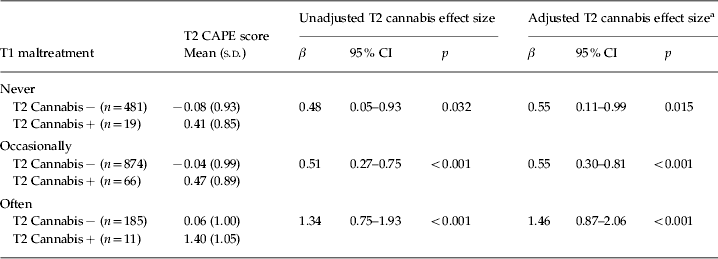
There was a significant adjusted interaction between T1 three-level continuous childhood maltreatment and T2 dichotomous cannabis use in the model of T2 psychosis [test for interaction: F(2, 1627)=4.18, p=0.016]. An extra-linear relationship was observed, the psychosis-inducing effects of cannabis being elevated only in those with the highest level of physical punishment (‘often’) in childhood (Table 1). For these individuals, the adjusted effect of cannabis on psychosis outcome was much stronger (B=1.46, 95% CI 0.87–2.06, p<0.001), compared to those with physical punishment rated ‘occasionally’ (B=0.55, 95% CI 0.30–0.81, p<0.001) or ‘never’ (B=0.55, 95% CI 0.11–0.99, p=0.015). There was no evidence that T1 childhood maltreatment was associated with increased risk of T2 cannabis use (OR 1.21, 95% CI 0.85–1.74, p=0.29).
Mean T2 positive symptom scores (CAPE) by T1 childhood maltreatment and T2 cannabis use in the Greek National Perinatal Study

CAPE, Community Assessment of Psychic Experiences; CI, confidence interval; s.d., standard deviation.
a Adjusted effects sizes, a priori adjusted for sex, urbanicity and other drug use.
NEMESIS
The final sample consisted of subjects who (i) completed the CIDI at T1 and (ii) at T2 and (iii) completed the questions on childhood maltreatment at T0. This yielded a risk set of 4842 subjects (47% male). The mean age at T0 was 41.2 years (s.d.=11.9). Moderate to severe maltreatment was reported by 8.5% of the sample and 9.5% reported T1/T2 cannabis use.
Main effects of childhood maltreatment and cannabis use on psychosis
Exposure to T0 childhood maltreatment, after adjustment, was positively associated with T1/T2 psychosis outcome (OR linear trend over four levels 1.96, 95% CI 1.73–2.20, p=0.000), and this association remained statistically significant after further adjustment for cannabis use (OR 1.93, 95% CI 1.71–2.18, p=0.000). T0 cannabis use was associated, after adjustment, with T1/T2 psychosis (OR 1.73, 95% CI 1.24–2.42 p=0.001), and this association remained significant after further adjustment for T0 childhood maltreatment (OR 1.45, 95% CI 1.03–2.03, p=0.034). T0 childhood maltreatment was associated with a significantly increased risk of T1/T2 cannabis use (OR 1.57, 95% CI 1.33–1.86, p<0.001). There was no large or significant association between T0 psychotic symptoms and later cannabis use (T1: OR 1.22, 95% CI 0.84–1.78, p=0.31; T2: OR 1.27, 95% CI 0.84–1.93, p=0.25).
Cannabis×maltreatment interaction
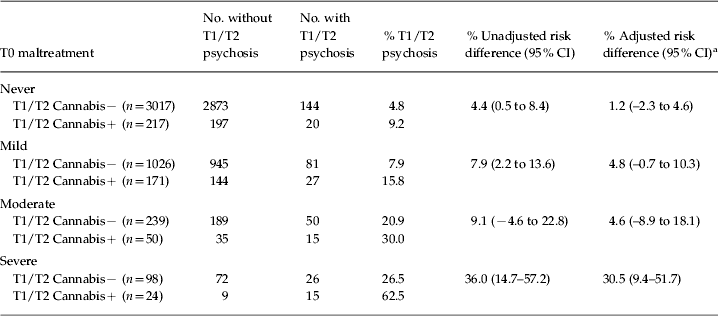
There was a significant interaction between childhood maltreatment and T1/T2 cannabis use in the model of T1/T2 psychosis [χ2(3)=8.08, p=0.04]. Again, an extra-linear relationship was observed (Table 2). Thus, the effect of cannabis in the group with severe maltreatment exposure was much higher [adjusted risk difference (RD) 30.5%, 95% CI 9.4–51.7, p=0.005] than those with moderate (adjusted RD 4.6%, 95% CI −8.9 to 18.1, p=0.50) or mild maltreatment exposure (adjusted RD 4.8%, 95% CI −0.7 to 10.3, p=0.09).
T1/T2 psychosis outcome by T0 childhood maltreatment and T1/T2 cannabis use in NEMESIS

NEMESIS, The Netherlands Mental Health Survey and Incidence Study; CI, confidence interval.
a Adjusted difference in risk, a priori adjusted for sex, urbanicity, other drug use, age, ethnicity, urbanicity, single marital status, discrimination and unemployment.
Discussion
This study, using two independent population-based samples, has shown that experience of childhood maltreatment moderates the association between cannabis and psychosis. Even maltreatment sometimes considered less severe, such as spanking, displayed main effects if it was ‘often’, and interacted with cannabis use. These findings are in accordance with two earlier studies (Houston et al. Reference Houston, Murphy, Adamson, Stringer and Shevlin2008; Harley et al. Reference Harley, Kelleher, Clarke, Lynch, Arseneault, Connor, Fitzpatrick and Cannon2010). The current study adds strength to these results because of its longitudinal design and because it has shown that maltreatment moderates the effects of cannabis in a dose-dependent, extra-linear fashion, more severe maltreatment being associated with the greatest effect of cannabis in later expression of psychosis. Furthermore, the findings indicate that self-medication (people using cannabis to self-medicate their psychotic symptoms or the traumatizing effects of early adversities) (Shevlin et al. Reference Shevlin, Murphy, Houston and Adamson2009) is unlikely to account for the interaction between childhood maltreatment and cannabis exposure because only in NEMESIS was an association between childhood maltreatment and later cannabis use present, and also in NEMESIS, psychosis at baseline did not predict future cannabis use.
Interaction between environmental factors
There is accumulating evidence that cannabis use and maltreatment in childhood or early adolescence play a role in the pathway to psychotic symptoms. The current results add credence to the suggestion that these environmental factors may act synergistically on the same final common pathway, as evidenced by the more-than-additive interaction. Interpretation of interaction of risk factors is difficult because correlation needs to be taken into account as well, as simulations show that environment–environment interaction (one environmental factor controlling sensitivity to the other) may be confounded by environment–environment correlation (one environmental factor controlling exposure to the other). The current results are inconsistent with respect to correlation between maltreatment and cannabis because only in NEMESIS, and not in the Greek survey, do early maltreatment predisposed individuals start using cannabis later in life. Because this association was only present in NEMESIS and was absent in the Greek survey, it suggests that there may be a small amount of gene–environment correlation in addition to gene–environment interaction. In the earlier study by Harley et al. (Reference Harley, Kelleher, Clarke, Lynch, Arseneault, Connor, Fitzpatrick and Cannon2010), the possible correlation between early cannabis use and childhood maltreatment was also calculated, showing that subjects who had experienced childhood maltreatment were five times more likely to use cannabis, confirming the hypothesis that environment–environment correlation cannot be ruled out. The occurrence of both interaction and correlation for the same risk factor at the same time was shown before in depression: the genetic liability for depression acts in part by increasing the sensitivity to stressful life events (Kendler et al. Reference Kendler, Kessler, Walters, MacLean, Neale, Heath and Eaves1995) but the same genes also influence the probability that individuals will experience stressful life events in the first place (Kendler & Karkowski-Shuman, Reference Kendler and Karkowski-Shuman1997). The same may hold for perinatal adversity and risk for schizophrenia: the genes predisposing for schizophrenia may not only render an individual more sensitive to the risk-increasing effect of perinatal adversity but also increase the risk for perinatal adversity itself (Marcelis et al. Reference Marcelis, van Os, Sham, Jones, Gilvarry, Cannon, McKenzie and Murray1998).
Cross-sensitization between maltreatment and cannabis
Exposure to cannabis increases risk for psychosis outcomes in a dose–response fashion (Henquet et al. Reference Henquet, Krabbendam, Spauwen, Kaplan, Lieb, Wittchen and van Os2005; Zammit et al. Reference Zammit, Spurlock, Williams, Norton, Williams, O'Donovan and Owen2007), suggesting an underlying process of sensitization. Evidence for this hypothesis comes from animal studies: rats that were pretreated with increasing doses of THC showed a greater behavioral response to a THC challenge after a 14-day washout period than did THC-naïve rats (Cadoni et al. Reference Cadoni, Pisanu, Solinas, Acquas and Di Chiara2001, Reference Cadoni, Valentini and Di Chiara2008). The current finding suggests that the psychosis-inducing effects of cannabis are moderated by early experience of maltreatment, suggesting cross-sensitization between stress and cannabis in shaping risk of psychotic outcomes. Sensitization involving dopaminergic signaling has been proposed as a possible mechanism by which environmental factors such as stress or cannabis use impact on psychosis risk (Collip et al. Reference Collip, Myin-Germeys and van Os2008). Animal studies have shown fairly consistently that both stress and THC lead to increased release of dopamine, particularly striatal regions (Abercrombie et al. Reference Abercrombie, Keefe, DiFrischia and Zigmond1989; Tidey & Miczek Reference Tidey and Miczek1996; French et al. Reference French, Dillon and Wu1997; Tanda et al. Reference Tanda, Pontieri and Di Chiara1997; Cheer et al. Reference Cheer, Wassum, Heien, Phillips and Wightman2004), although evidence for this in humans is less clear (Bossong et al. Reference Bossong, van Berckel, Boellaard, Zuurman, Schuit, Windhorst, van Gerven, Ramsey, Lammertsma and Kahn2009; Stokes et al. Reference Stokes, Mehta, Curran, Breen and Grasby2009; Kuepper et al. Reference Kuepper, Morrison, van Os, Murray, Kenis and Henquet2010). Few studies have examined possible cross-sensitization between THC and stress. Rats living under normal conditions (i.e. access to water and food), that were exposed to THC, showed only minor behavioral changes and no change in dopaminergic neurotransmission (MacLean & Littleton, Reference MacLean and Littleton1977). By contrast, under stressful housing conditions (i.e. isolation and food deprivation), THC administration had marked behavioral consequences. Furthermore, it also resulted in significantly increased dopamine uptake (MacLean & Littleton, Reference MacLean and Littleton1977). Similarly, Mokler et al. (Reference Mokler, Robinson, Johnson, Hong and Rosecrans1987) showed that, in rat pups, pretreatment with THC altered the stress-induced dopamine response in the hypothalamus and frontal cortex. Exposure to traumatic experiences during childhood similarly may occasion enduring neurobiological effects with over-reactivity of the hypothalamus and the hypothalamic–pituitary–adrenal (HPA) axis, abnormalities in neurotransmitter systems and structural brain changes (Read et al. Reference Read, Perry, Moskowitz and Connolly2001).
Limitations
Childhood maltreatment, cannabis use and psychosis outcome measures were assessed using different instruments across NEMESIS and the Greek study. Childhood maltreatment in NEMESIS was specified as any kind of emotional, physical, psychological or sexual abuse whereas in the Greek study, childhood maltreatment was limited to physical punishment. The question that arises is what degree of spanking may be considered a traumatic experience. Nevertheless, it has been shown that repeated slapping or spanking is associated with increased lifetime rates of psychiatric disorder (MacMillan et al. Reference MacMillan, Boyle, Wong, Duku, Fleming and Walsh1999). Similarly, a longitudinal birth cohort study in New Zealand showed that those exposed to ‘harsh or abusive’ treatment during childhood were at greater risk of later mental health problems (Fergusson & Lynskey, Reference Fergusson and Lynskey1997). In addition, several studies have shown that the same biological mechanism that is thought to underlie the association between trauma and psychosis may also be relevant for moderate levels of stress, as studies suggest that even small stressors occasion increases in dopamine levels in the brain (Davis et al. Reference Davis, Kahn, Ko and Davidson1991; Glenthoj, Reference Glenthoj1995; Laruelle, Reference Laruelle2000; Myin-Germeys et al. Reference Myin-Germeys, Delespaul and van Os2005). The current study is the first to demonstrate that even non-severe physical mistreatment can interact with cannabis on psychosis risk. No data on continuation of childhood maltreatment were available in the Greek study. However, there is little doubt that these smaller stressors occur more frequently during childhood than major traumatic experiences, and as such could impact on the aforementioned process of sensitization in a cumulative way.
Another limitation is that, in the Greek National Perinatal Study, the measure of childhood maltreatment relied on parental information, which may have resulted in under-reporting and underestimation of effect sizes. Nevertheless, the results were consistent across studies, and the Greek data are unique in that maltreatment was assessed prospectively. The measurement of childhood maltreatment relied on self-report. This type of assessment is acceptable, is associated with a high response rate and yields rates that are comparable to face-to-face interviews (Dill et al. Reference Dill, Chu, Grob and Eisen1991; Wurr & Partridge, Reference Wurr and Partridge1996; Read et al. Reference Read, Stern, Wolfe and Ouimette1997; Janssen et al. Reference Janssen, Krabbendam, Bak, Hanssen, Vollebergh, de Graaf and van Os2004).
In both studies, psychotic symptoms rather than psychotic illness were assessed in non-clinical samples. Psychotic symptoms are more prevalent in the general population than psychotic illness yet are associated with the same environmental risk factors as psychotic illness (van Os & Kapur Reference van Os and Kapur2009; Polanczyk et al. Reference Polanczyk, Moffitt, Arseneault, Cannon, Ambler, Keefe, Houts, Odgers and Caspi2010) and predict psychotic disorder over time (Poulton et al. Reference Poulton, Caspi, Moffitt, Cannon, Murray and Harrington2000; Hanssen et al. Reference Hanssen, Bak, Bijl, Vollebergh and van Os2005). The current results confirm earlier findings that both cannabis and adversity not only affect psychotic illness but also impact on the broader extended psychosis phenotype in the general population, which represents behavioral expression of liability to psychotic disorder. The results do not, however, provide information about to what degree the interaction between cannabis and maltreatment contributes to the onset of new psychotic symptoms or to the persistence of existing symptoms (Dominguez et al. Reference Dominguez, Wichers, Lieb, Wittchen and van Os2010). A further limitation of the current study is that self-reported cannabis use was not confirmed by urinalysis. Lifetime prevalence of cannabis use in the Greek National Perinatal Study was low (6%) compared to other that in European countries (20–31%) (Wone et al. Reference Wone, Dia, Ndiaye, Fall and Sarr2004; Kokkevi et al. Reference Kokkevi, Nic Gabhainn and Spyropoulou2006). However, in other Greek studies, comparable prevalence rates of 4–8.6% have been reported (Kokkevi et al. Reference Kokkevi, Fotiou and Richardson2007; Menti et al. Reference Menti, Lekka, Assimakopoulos, Varvarigou, Beratis and Beratis2007). NEMESIS was conducted in The Netherlands, where cannabis is sold and consumed legally in coffee shops, which makes under-reporting unlikely. In addition, false negatives would probably have contributed to a more, rather than a less, conservative result. Cannabis use in the current study was dichotomously defined; however, frequency and duration of use, and also the potency of cannabis consumed, were not specified. Given recent findings that different types of cannabis affect mental health differentially (Di Forti et al. Reference Di Forti, Morgan, Dazzan, Pariante, Mondelli, Marques, Handley, Luzi, Russo, Paparelli, Butt, Stilo, Wiffen, Powell and Murray2009; Morgan et al. Reference Morgan, Schafer, Freeman and Curran2010), future research should take into account differences in potency of cannabis in addition to duration of exposure (Henquet et al. Reference Henquet, van Os, Kueper, Delespaul, Smits, Campo and Myin-Germeys2010). The samples included in this study were not sufficiently genetically sensitive to allow examination of underlying gene–environment interaction or gene–environment correlation. It is unlikely, however, that the reported interactions between cannabis and childhood adversities are reducible to gene–environment interplay. If genes predisposing to schizophrenia also contribute to exposure to both adversity and cannabis use, an interaction between these two factors would not be expected.
Appendix
NEMESIS trauma questionnaire

Acknowledgements
C. Henquet received support from the Dutch Medical Research Council (VENI grant). The research leading to these results has received funding from the European Community's Seventh Framework Program under grant agreement HEALTH-F2-2009-241909 (Project EU-GEI).
Declaration of Interest
J. van Os is a speaker or grant holder with Lilly, BMS, Lundbeck, Organon, Janssen-Cilag, GSK, Otsuka and Astra-Zeneca.