Introduction
As the world’s population ages, dementia, a neurodegenerative disorder, is increasingly becoming a concern of the global health system. Despite considerable efforts, no successful preventive treatment for dementia has been developed. Consequently, multimodal interventions aimed at modifying multiple risk factors have been suggested (O’Brien et al., Reference O’Brien2017). This also necessitates early identification of prodromal dementia, such as mild cognitive impairment (MCI) (Knopman and Petersen, Reference Knopman and Petersen2014).
Mild behavioral impairment (MBI) refers to the development of persistent neuropsychiatric symptoms (NPS) that emerge in later life before the onset of prominent cognitive decline (Taragano et al., Reference Taragano2009). Although MBI was originally proposed for predicting incipient frontotemporal dementia, it can be an early manifestation of other dementias (Ismail et al., Reference Ismail2016). MBI appears to be a transitional state between normal aging and dementia, which may occur before or with MCI (Brodaty et al., Reference Brodaty2012; Ismail et al., Reference Ismail2017). NPS, once thought to be a feature of dementia, is now recognized to be common in the prodromal phase or even earlier stages of dementia (Lyketsos et al., Reference Lyketsos2011; Stella et al., Reference Stella, Radanovic, Balthazar, Canineu, de Souza and Forlenza2014). For instance, in the PROTECT study that enrolled 9931 older adults without MCI or dementia, the participants received evaluation for their cognitive functions and MBI symptoms at baseline and 1 year later (Creese et al., Reference Creese2019). Those with MBI exhibited a faster decline in attention and working memory at the 1-year follow-up. In the Cardiovascular Health Study, 3608 individuals were followed up for 10 years (Lyketsos et al., Reference Lyketsos, Lopez, Jones, Fitzpatrick, Breitner and DeKosky2002). In total, 682 participants later developed dementia or MCI, 80% and 50% of whom, respectively, presented at least one NPS from cognitive symptom onset. In addition, another longitudinal cohort study that recruited 1821 participants with MCI observed that participants presenting with NPS were associated with a significantly increased dementia and Alzheimer’s disease risk (Rosenberg et al., Reference Rosenberg, Mielke, Appleby, Oh, Geda and Lyketsos2013). These results indicated that MBI or NPS can be early marker of dementia, even before the presence of MCI or subjective cognitive decline.
Given the multifactorial nature of dementia, interventions that simultaneously target different risk factors in the prodromal or preclinical stage of dementia have become essential. Thus, we aimed to identify risk factors for MBI in older adults without dementia by using a population-based survey in Taiwan.
Methods
Data source
This population-based cross-sectional survey of the Taiwan Alzheimer Disease Association (TADA) Database included residents aged ≥65 years in Taiwan between December 2011 and March 2013. Computerized multistage random sampling was performed to achieve representative samples across Taiwan. At first, residents aged 65 and above in all 19 cities or counties were identified. Every official administrative district was then given a random number. In each city or county, districts were grouped by random order until the geriatric population aged 65 and above reached 2% of the total population in those districts. Among people from selected districts, approximately 60% were further sampled randomly to generate a list of potential participants. With the assistance of the Ministry of Health and Welfare of Taiwan and local city governments, our study team obtained the address needed, and our field interviewers then performed a door-to-door survey accordingly. In-person interviews were conducted to collect a brief history of cognitive and functional status, followed by a structured questionnaire of demographic data, personal habits, cognitive tests, economic burden, and quality of life. To achieve quality control, the interrater reliability of the global Clinical Dementia Rating (CDR) was evaluated (kappa: 0.67). Logic checks for inconsistency and auditing by experienced supervisors were also performed. Detailed sampling and home visit procedures are described elsewhere (Chen et al., Reference Chen2017; Cheng et al., Reference Cheng2018; Sun et al., Reference Sun2014). The study was approved by the Ethics Committee of the National Taiwan University Hospital, and informed consent was obtained from all study participants or their proxies.
Collection of medical history, measurement of cognitive and functional status
Data on participant demographics, lifestyle, and habits and medical history were recorded during the interviews, with information collected either from the recruited participants or from their principal caregiver (≥10 h/week of direct care). The participants’ cognitive functions were assessed using the Taiwanese Mini–Mental State Examination (TMSE) and CDR (Morris, Reference Morris1993; Shyu and Yip, Reference Shyu and Yip2001). Normal limits for TMSE scores were defined as >24 and >13 for literate and illiterate older adults, respectively. Functional status was assessed using the Instrumental Activities of Daily Living (IADL) Scale and the Activities of Daily Living (ADL) Scale. Insidious changes in behavior or personality and any mental decline from previous levels of functioning were also probed during history taking.
Identification of participants with MBI and exclusion criteria
MBI was retrospectively diagnosed under consensus by a group of board-certified physicians of the Taiwanese Society of Geriatric Psychiatry, according to the International Society to Advance Alzheimer’s Research and Treatment (ISTAART) diagnostic criteria (Ismail et al., Reference Ismail2016). As MBI is expected to develop before dementia onset, participants with dementia were excluded from our analysis. To diagnose all-cause dementia and MCI, the core clinical criteria recommended by the National Institute on Aging–Alzheimer’s Association (NIA-AA) were used (Albert et al., Reference Albert2011; McKhann et al., Reference McKhann2011). An individual was considered cognitively normal if that person did not fulfill any conditions listed in the NIA-AA core clinical criteria for all-cause dementia, the adjusted TMSE was within the normal range, and the CDR score was 0. Participants with mental disorders, delirium, or other serious physical illnesses that could lead to cognitive or functional impairment were excluded. The participants who were difficult to diagnose were reexamined by a consultant panel consisting of four neurologists and one clinical psychologist specializing in dementia diagnosis and management. If the diagnosis of a participant remained unclear after discussion, they would be categorized in the unclassified group and excluded from analysis. Participants with incomplete data or possibly erroneous data were excluded as well. To be noted, dementia participants in the TADA cohort were not included in this analysis.
Identification of risk factors for MBI
Demographic data of the study participants were collected during the interviews, which included educational level, body mass index (BMI), family history of dementia, personal lifestyle and habits, and medical comorbidities. TMSE scores and cognitive status of the participants were also recorded. These variables were analyzed to identify if any of them were predictive of MBI.
Statistical analysis
To check if the recruited participants in this study were representative of the whole population, we compared the general data and found no significant difference between the respondents and nonrespondents. To further confirm the representativeness of participants of individual city or county, intraclass correlation coefficient (ICC) was calculated as a ratio of the between-group variance to the total data variance by SAS (version 9.3, SAS Institute Inc., Cary, NC). The ICC was 0.0058, indicating a low between-city variance. The Chi-square and independent t-tests were used to compare categorical and continuous variables, respectively, between the MBI and non-MBI groups. Univariate logistic regression analysis was used to assess the association between all aforementioned variables and MBI. Odds ratio (OR) and its 95% confidence interval (95% CI) were assessed. All factors with p-value < 0.1 in univariate regression analyses then entered the multivariate analyses. Multivariate logistic regression Model 1 was adjusted for age, sex, educational level, BMI, history of head trauma, lifestyle and habits, and medical comorbidities. In Model 2, the cognitive status of the participants (i.e. presence or absence of MCI) was adjusted in addition to the factors listed in Model 1. All statistical analyses were performed on SPSS for Windows (version 21.0, IBM, Armonk, New York). All tests were two-tailed, and p-value < 0.05 was considered statistically significant.
Results
In total, 10,571 individuals were interviewed, of whom 4375 were excluded after applying the exclusion criteria. Of the 6196 included participants, 1049 (16.9%) had MCI and 5147 (83.1%) were cognitively normal. Regardless of cognition, 409 participants (6.6%) were included in the MBI group (Table 1).
Demographic data of study participants with or without mild behavioral impairment (MBI)

BMI: Body Mass Index; FDR: First-degree Relative; IADL: Instrumental Activities of Daily Living Scale; MBI: Mild Behavioral Impairment; MCI: Mild Cognitive Impairment; SD: Standard Deviation; TMSE: Taiwanese Mental State Examination
Compared with the non-MBI group (Table 1), the MBI group had significantly more women and lower education level. They also had significantly more medical comorbidities, including hypertension, hyperlipidemia, and cancer. Meanwhile, a much higher proportion of non-MBI participants reported having good sleep. No significant differences were observed in the TMSE score, cognitive status (MCI), and IADL score between the two groups.
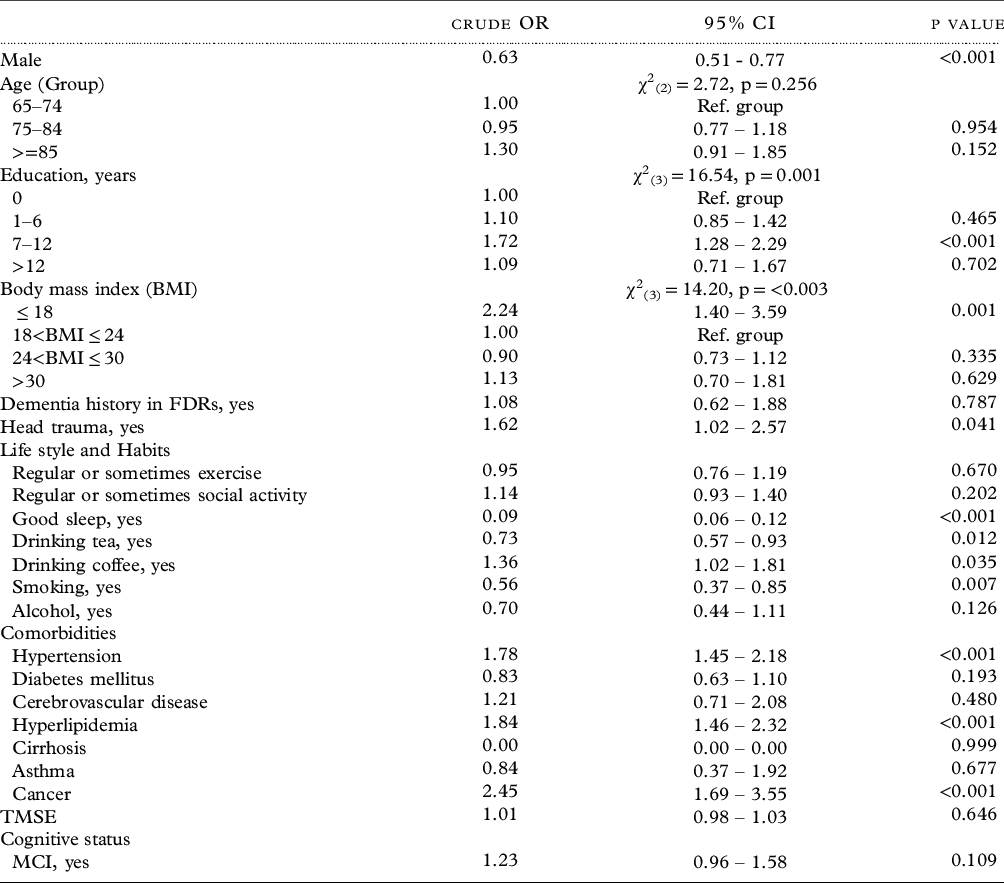
The association between different risk factors and MBI using univariate logistic regression analyses had been demonstrated (Table 2). Factors associated with significantly increased odds for MBI were medium education level (OR 1.72, 95% CI 1.28–2.29, χ2 (3) = 16.54, p = 0.001), low body weight (OR 2.24, 95% CI 1.40-3.59, χ2 (3) = 14.20, p = <0.003), medical comorbidities of hypertension (OR 1.78, 95% CI 1.45–2.18), hyperlipidemia (OR 1.84, 95% CI 1.46–2.32), and cancer (OR 2.45, 95% CI 1.69–3.55). Certain lifestyle markers were associated with lower MBI risk, which included good sleep (OR 0.09, 95% CI 0.06–0.12), tea drinking (OR 0.73, 95% CI 0.57–0.93), and smoking (OR 0.56, 95% CI 0.37–0.85), whereas a slight increase in MBI risk was found among those who had a habit of coffee drinking (OR 1.36, 95% CI 1.02–1.81). However, only good sleep remained significantly associated with lower MBI risk during multivariable regression analysis (Table 3). Moreover, neither TMSE scores (OR 1.01, 95% CI 0.98–1.03) nor MCI status caused a significant change in MBI risk between the two groups (OR 1.23, 95% CI 0.96–1.58, p = 0.109).
Predictive factors for mild behavioral impairment (MBI) in univariate logistic regression analysis

BMI: Body Mass Index; 95% CI: 95% Confidence Interval; FDR: First-degree Relative; MBI: Mild Behavioral Impairment; MCI: Mild Cognitive Impairment; OR: Odds Ratio; Ref. group: Reference group; TMSE: Taiwanese Mental State Examination
Predictive factors for mild behavioral impairment (MBI) in multivariable logistic regression analyses

BMI: Body Mass Index; 95% CI: 95% Confidence Interval; MBI: Mild Behavioral Impairment; MCI: Mild Cognitive Impairment; OR: Odds Ratio; Ref. group: Reference group
As shown in the multivariable regression analysis (Table 3), after adjustment for demographic data, medical comorbidities, lifestyle, and habits (Model 1) and cognitive status (Model 2), low-to-medium education (OR 1.40, 95% CI 1.06–1.85; OR 2.32, 95% CI 1.67–3.21, χ2 (3) = 25.34, p = <0.001), low body weight (OR 2.01, 95% CI 1.21-3.33, χ2 (3) = 9.29, p = 0.026), medical comorbidities of hypertension (OR 1.56, 95% CI 1.25–1.95), hyperlipidemia (OR 1.29, 95% CI 1.00–1.67), and cancer (OR 2.05, 95% CI 1.37–3.06) were still significantly associated with increased MBI risk. As mentioned, good sleep (OR 0.09, 95% CI 0.07–0.12) was associated with lower MBI risk. Again, the presence of MCI was independent of MBI risk (OR 1.00, 95% CI 0.76–1.32).
Discussion
The current large population-based cross-sectional study demonstrated several risk factors associated with MBI. Remarkably lower risk of MBI was found among participants with good sleep; in other words, participants without good sleep had 11-fold of higher MBI risk. Besides, underweight was associated with twofold higher risk of MBI. Other risk factors established in our study, such as low-to-medium education (OR 1.40; OR 2.32), cancer (OR 2.05), hypertension (OR 1.56), and hyperlipidemia (OR 1.29), confirmed the results of previous publications (Bjelland et al., Reference Bjelland, Krokstad, Mykletun, Dahl, Tell and Tambs2008; Apostolova et al., Reference Apostolova2014; Chiaie et al., Reference Chiaie2011; Mahendran et al., Reference Mahendran, Lim, Tan, Kua and Griva2016; Pan et al., Reference Pan2012; Yi and Syrjala, Reference Yi and Syrjala2017).
Sleep disturbance is prevalent and predictive of MCI and dementia (da Silva, Reference da Silva2015; Jee et al., Reference Jee, Shin, Jung, Kim, Lee and Jung2020), but evidence on the association between sleep and MBI has been limited. In a meta-analysis of population-based prospective studies, de Almondes et al. reported a significantly increased risk of all-cause dementia among people with insomnia (risk ratio: 1.53, 95% CI: 1.07–2.18) (de Almondes et al., Reference de Almondes, Costa, Malloy-Diniz and Diniz2016). Another meta-analysis that included 246,786 individuals at baseline, of whom 25,847 developed dementia after longitudinal follow-up of 9.5 years, also revealed a higher risk of all-cause dementia, Alzheimer’s disease, and vascular dementia among individuals with insomnia than those without (Shi et al., Reference Shi2018). In a prospective cohort study that recruited 1245 elderly women without dementia, those in the lowest quartile of average sleep efficiency had 1.5-fold higher odds of developing MCI or dementia after a follow-up of 4.9 years compared with participants in the highest quartile (Diem et al., Reference Diem2016).
The overall prevalence of MBI was reported to be 34.1% in a population-based epidemiological study that examined NPS in subclinical populations across the spectrum from normal aging to MCI (Mortby et al., Reference Mortby, Ismail and Anstey2018). Using the MBI-checklist (MBI-C) to explore the profile of MBI, affective dysregulation was reported to be the most common item in a population-based cohort study that recruited 5742 participant–informant dyads (Creese et al., Reference Creese2020). However, sleep problems were not evaluated in the MBI-C. Indeed, the prevalence of insomnia complaints could range up to 30–60% in older adults (de Almondes et al., Reference de Almondes, Costa, Malloy-Diniz and Diniz2016; Manjavong et al., Reference Manjavong, Limpawattana, Mairiang and Anutrakulchai2016). NPS prevalence in dementia and MCI were also estimated in the Cardiovascular Health Study–Cognition Study (Lyketsos et al., Reference Lyketsos, Lopez, Jones, Fitzpatrick, Breitner and DeKosky2002). In this study, 3608 participants were longitudinally evaluated for >10 years, and the most frequent clinically significant symptom in the MCI group was sleep disturbance (8.8%). However, none of these studies assessed whether good sleep can reduce or predict MBI risk.
Apart from being a risk factor of dementia, sleep disorders can actually be early manifestations of dementia due to neurodegeneration of brain regions that regulate sleep and wakefulness (Malhotra, Reference Malhotra2018; Westwood et al., Reference Westwood2017). Moreover, rapid eye movement sleep behavior disorder is now included as a core clinical feature for the diagnosis of dementia with Lewy bodies, as it often begins many years before other symptoms (McKeith et al., Reference McKeith2017). As the conversion risk to dementia was high in people with MBI, there is also possibility that our study results actually reflected the early presentations (i.e. worse sleep) of neurodegeneration among MBI participants.
Several possible neurobiological mechanisms might link between sleep and the development of MBI. Loss of cholinergic function is well-known in dementia, while at the same time, it may cause disturbance to the sleep architecture (Pase et al., Reference Pase2017). Minger et al. conducted a longitudinal study that follows 46 patients with dementia and 32 normal controls every 4 months for their cognitive functions and behavioral syndromes until death (Minger et al., Reference Minger2000). Brain autopsies were then performed to examine underlying neuropathologic changes. The authors reported that disturbance of the cholinergic system may contribute to some noncognitive behavioral changes in dementia. Notably, none of these patients was receiving cholinomimetic drugs. Meanwhile, a recent positron emission tomography (PET) and magnetic resonance imaging study that included 96 cognitively normal elderly individuals revealed a positive correlation between MBI and β-amyloid deposition (Lussier et al., Reference Lussier2020), further implying an association between MBI and an increased risk of progression to dementia. Furthermore, sleep deprivation can increase the overnight β-amyloid burden (Lucey et al., Reference Lucey2018; Shokri-Kojori et al., Reference Shokri-Kojori2018). Carvalho et al. recruited 283 community-dwelling elderly participants without dementia from the Mayo Clinic Study of Aging (MCSA) and reported that baseline excessive daytime sleepiness was associated with increased longitudinal β-amyloid accumulation on Pittsburgh compound B PET scans (Carvalho et al., Reference Carvalho2018). More studies are required to examine if other dysfunctional mechanisms of sleep regulation could play any role in MBI development.
Underweight was associated with significant risk of MBI in our study. In a prospective, 2-year follow-up study of 102 MCI subjects, those who had low initial BMI and higher weight loss were found to have greater risk of dementia conversion (Sobow et al., Reference Sobow, Fendler and Magierski2014). In another prospective, population-based cohort that randomly selected participants from the Cardiovascular risk factors, Aging and Dementia (CAIDE) study, the association of midlife and late-life BMI with late-life dementia had been investigated (Tolppanen et al., Reference Tolppanen2014). Steeper decrease of BMI and low late-life BMI were associated with higher risk of dementia (HR 1.14, 95% CI 1.03–1.25). In the MCSA, analysis was done to assess the rate of change in weight and BMI with the associated risk of incident MCI (Alhurani et al., Reference Alhurani2016). In total, 1895 cognitively normal participants with mean age of 78.5 years were followed up for 4.4 years, and 524 of them developed incident MCI. Those having greater weight loss (HR 1.04, 95% CI 1.02–1.06) and BMI decline (HR 1.08, 95% CI 1.03–1.13) demonstrated increased risk of MCI. Collectively, these studies indicated the higher MCI and dementia risk when an older adult had greater weight loss and lower BMI in late-life. Yet, discussions about MBI risk and low BMI in late-life were scarce. Our findings provided valuable data that MBI risk could increase up to twofold in underweight elderly. Whether these participants had poor nutritional intake under behavioral disturbance or if low body weight itself contributes to development of MBI requires further study.
Other risk factors for MBI established in the present study are consistent with previous results. For instance, lower education level is significantly associated with depression and anxiety (Bjelland et al., Reference Bjelland, Krokstad, Mykletun, Dahl, Tell and Tambs2008). A study analyzing the Neuropsychiatric Inventory Questionnaire (NPI-Q) data of 3456 participants with MCI and 2641 participants with mild Alzheimer’s disease reported that lower education level was particularly associated with irritable and agitated behaviors (Apostolova et al., Reference Apostolova2014). Our results indicated that education level of ≤12 years also increased the MBI risk. Moreover, subsyndromal NPS were common among patients with medical comorbidities, such as cancer, hypertension, and hyperlipidemia (Chiaie et al., Reference Chiaie2011; Mahendran et al., Reference Mahendran, Lim, Tan, Kua and Griva2016; Pan et al., Reference Pan2012; Yi and Syrjala, Reference Yi and Syrjala2017). Similarly, our findings demonstrated the elevated MBI risk among patients with these underlying medical illnesses.
Taragano et al. followed up a consecutive series of 358 patients for up to 5 years and found that >70% of patients with MBI, but only 34% of those with MCI, developed dementia (Taragano et al., Reference Taragano2009). Their findings suggested that MBI can be the first indicator of impending dementia. In another 5-year prospective, longitudinal cohort study also conducted by Taragano et al., the conversion risk to dementia was even higher in the MBI group (71.5%) than in the MBI-MCI overlap group (59.6%) or the MCI group (37.8%) (Taragano et al., Reference Taragano2018). A retrospective chart review of 2853 outpatients aged ≥ 50 years demonstrated that those who developed dementia were most likely to meet the diagnostic criteria of MBI at the time of their first visit, followed by MCI without MBI (Matsuoka et al., Reference Matsuoka, Ismail and Narumoto2019). Our results were supported by previous evidence that MBI risk is independent from MCI. Since both IADL deficits and behavioral changes could be present in individuals with MCI (Jekel et al., Reference Jekel2015), there is possibility that subtle IADL decline would also be detected in the MBI group. However, there was no statistically significant association found between IADL and MBI risk, even with or without exclusion of MCI participants (p = 0.425).
This study has several limitations. First, the cross-sectional design precluded the determination of causality between MBI and the identified risk factors. Nevertheless, our findings imply that patients presenting with multiple predictive factors should be evaluated for MBI and lifestyle modification may be recommended. Second, mistaken reports by the informant or erroneous recordings during interviews could not be excluded completely, although this was minimized through logic checks for inconsistency and auditing by experienced supervisors. Moreover, our study population only represent part of the community-dwelling older adults. Future studies should include populations living in institutes for a better understanding of MBI among them. Finally, in order to achieve more reliable MBI diagnosis, the inclusion rate of our study became relatively low since participants with dementia, unclear diagnosis, incomplete data, or possible erroneous data were all excluded.
In conclusion, MBI can precede dementia development and can occur independent of MCI. Risk factors for MBI identified in the current study, namely underweight, lower education levels, and medical comorbidities of hypertension, hyperlipidemia, are modifiable and should be adjusted actively. Moreover, sleep hygiene should be promoted since it is associated with lower MBI risk.
Conflict of interest
None.
Description of author(s)’ roles
YL Chan (first author) designed the study, wrote the protocol, analyzed the data, and wrote the paper. CM Cheng analyzed the data and assisted with the preparation of the manuscript. MH Huang analyzed the data and assisted with the preparation of the manuscript. HJ Lee supervised the data collection and assisted with the preparation of the manuscript. LY Tang supervised the data collection and assisted with the preparation of the manuscript. CF Tsai (corresponding author) designed the study, wrote the protocol, provided advices on statistical analysis, and proofread the manuscript.
Acknowledgments
The authors would like to thank all the subjects, the staff of TADA, and the interviewers who participated in this study.