

Psychological pressure refers to the perceiver's belief that the situation has high stakes for performance (Baumeister, Reference Baumeister1984; Gucciardi et al., Reference Gucciardi, Longbottom, Jackson and Dimmock2010). Cognitive ability is of known importance to skill development (e.g., Frydman & Lynn, Reference Frydman and Lynn1992); however, when the learning situation becomes pressured, the individual's capacity to manage such pressure is likely to become critical to skill acquisition. Previous research has demonstrated a negative relationship between anxiety and a range of learning outcomes including skill acquisition (Colquitt et al., Reference Colquitt, LePine and Noe2000). Yet, inter-individual differences in the way people respond to psychological pressure and situational demands have made it difficult to determine how anxiety and stress impact performance (Vine et al., Reference Vine, Uiga, Lavric, Moore, Tsaneva-Atanasova and Wilson2014). The ability to manage the experience of pressure during training is likely to be of importance to the acquisition rate of new skills. This research examines the role of psychological resources (i.e., general self-efficacy (GSE) and resilience) in moderating the relationship between psychological pressure and skill acquisition. Specifically, we anticipated that GSE and resilience will facilitate the rate of skill acquisition under psychological pressure suggesting a ‘buffering’ role for psychological resources in the relationship between psychological pressure and skill acquisition.
How Psychological Resources may ‘Buffer’ the Effects of Psychological Pressure to Enahnce Skill Acquistion
According to the transactional model of stress and coping (Lazarus & Folkman, Reference Lazarus and Folkman1984), how an individual responds to a stressful situation is determined by their evaluation of the resources available to meet demands. The transactional model of stress and coping (Lazarus & Folkman, Reference Lazarus and Folkman1984) is a key framework for understanding how situational demands convert to stress and anxiety. The fundamental tenet of the transactional model of stress and coping is that situational demands interact bi-directionally with individual factors to determine emotional and coping outcomes (Lazarus & Folkman, Reference Lazarus and Folkman1984). An important individual-level process that determines whether a stressor will be perceived as stressful is the degree that one's resources are thought to be overtaxed in addressing the situational demands (Folkman et al., Reference Folkman, Lazarus, Gruen and DeLongis1986). Thus, resource availability is critical to perceived distress (e.g., anxiety).
Resources can come in many forms, the resources examined in the present study are internal psychological resources that are understood to be adaptive belief systems. In the time-limited skill acquisition scenario used in this study, we specifically examine beliefs that relate to the ability to achieve good outcomes (GSE) or cope well under pressure (resilience). Other resources may relate to external factors such as social or financial resources and at times, these can also support the individual in weathering a stressful situation. The perceived availability of resources to address demands is considered to set the stage for one's cognitive appraisal of the situation as either threatening or challenging and within one's ability to control. Where resources are considered to be overtaxed, an individual will be more likely to appraise the situation as beyond their control and threatening with the potential for loss or harm to one's self or significant others (Folkman et al., Reference Folkman, Lazarus, Gruen and DeLongis1986). The result is pressure converting to the experience of stress and even distress. In contrast, where resources are anticipated to meet or exceed demands, stressors are more likely to be perceived as controllable challenges that yield lower stress and goal-directed coping efforts. Recent neurological research does offer some support for the suggested relationship between resources and appraisal demonstrating that optimism beliefs (psychological resource) enabled a downregulation in the perception of threat and a more adaptive threat response lowering the experience of stress (Taylor et al., Reference Taylor, Burklund, Eisenberger, Lehman, Hilmert and Lieberman2008). Thus, psychological resources appeared to be linked to a reduction in stress via the appraisal process.
A significant body of research has emerged suggesting that challenge appraisals predict better performance in several different domains (e.g., Seery et al., Reference Seery, Weisbuch, Hetenyi and Blascovich2010; Vine et al., Reference Vine, Freeman, Moore, Chandra-Ramanan and Wilson2013; Vine et al., Reference Vine, Uiga, Lavric, Moore, Tsaneva-Atanasova and Wilson2014). Vine et al. (Reference Vine, Uiga, Lavric, Moore, Tsaneva-Atanasova and Wilson2014) found that pilots who reported that they had the personal resources to cope with the demands of a stressful simulated aviation scenario (challenge appraisal) outperformed those pilots who reported having insufficient resources to cope with the same demands (threat appraisal). However, the role of psychological resource availability in moderating the impact of demands on skill acquisition has rarely been examined. The greater availability of internal psychological resources may reduce the experience of distress in a learning task therefore allowing a greater rate of skill acquisition. The reason that adaptive psychological resources and their associated appraisals may impact performance and skill acquisition is complex. The Attention Control Theory (Eysenck et al., Reference Eysenck, Derakshan, Santos and Calvo2007) suggests that distress creates a cognitive distraction that means available cognitive resources are moved from the task to their anxiety or other task-unrelated stimuli. Moreover, distressing emotions like anxiety have been shown to impair cognitive functions like working memory capacity (Eysenck, Reference Eysenck1992). This is an idea supported by several studies (e.g., Allsop & Gray, Reference Allsop and Gray2014, Eysenck et al., Reference Eysenck, Derakshan, Santos and Calvo2007). The negative impact of distress on important cognitive functions, like attention and memory, are likely to impair skill acquisition.
A further factor that may relate to skill acquisition in a demanding learning scenario is how the physiological experience of anxiety-related emotions is interpreted by the individual. Research suggests that where anxiety is reappraised as excitement, positive impacts on performance may emerge (Brooks, Reference Brooks2013). Anxiety and excitement are related to distinct effects on performance, anxiety reducing performance outcomes, whereas excited can enhance performance (Cropanzano et al., Reference Cropanzano, James and Konovsky1993). The experience of these emotions at a physiological level is very similar, both characterised by high emotional arousal (e.g., increased heart rate), and at a psychological level by anticipation. It is conceivable that psychological resources may also play a role in altering the appraisal of anticipatory emotions thus influencing the impacts on skill acquisition.
Which Psychological Resources are Likely to be Most Important?
Psychological resources that promote self-referent thoughts about one's ability to successfully undertake a task and cope effectively are considered to be the most effective in facilitating skill acquisition under pressure. GSE and perceived psychological resilience are two psychological resources considered to provide individuals with important information about how they will cope with situational demands. GSE is understood to be an individual trait that captures the perception that one is capable of addressing task demands across diverse situations (Chen et al., Reference Chen, Gully and Eden2004). In contrast, task self-efficacy is a more malleable task-specific belief about competency or the particular situation at hand (Bandura, Reference Bandura1977; Gist & Mitchell, Reference Gist and Mitchell1992). Akin to task self-efficacy, GSE is thought to promote the belief of control over emergent threats leading to fewer apprehensive thoughts and feelings (Jerusalem & Schwarzer, Reference Jerusalem, Schwarzer and Schwarzer1992). Higher GSE has been shown to result in lower threat appraisal even after failure. In contrast, lower GSE participants demonstrated an increase in threat appraisal after the occurrence of failure (Jerusalem & Schwarzer, Reference Jerusalem, Schwarzer and Schwarzer1992).
GSE is considered both a resource in the stress appraisal process (Jerusalem & Schwarzer, Reference Jerusalem, Schwarzer and Schwarzer1992), but also important to the motivational system (Chen et al., Reference Chen, Gully and Eden2004). GSE is a resource studied intensively in the context of the learning and training setting (e.g., Chen et al., Reference Chen, Gully, Whiteman and Kilcullen2000). However, although GSE has been positively correlated with other metrics (e.g., motivation), the links with objective task performance measures is limited. In this study, GSE was measured for two reasons. First, the task was novel to participants and therefore specific self-efficacy was likely to be low for most participants. In contrast, GSE is likely to vary to a greater degree between participants. Thus, baseline GSE is perhaps important to the learning of novel tasks, given that task self-efficacy has not yet been established. Therefore, GSE may have important implications for initial novel task performance and skill acquisition rate. Second, GSE may facilitate the development of task self-efficacy because of a general tendency to feel efficacious, which is considered to spill over to more specific domains (Shelton, Reference Shelton1990). Although the idea that people who generally feel efficacious will perform better is almost indisputable, the role of GSE in skill acquisition using objective measures has not been investigated. Moreover, we are interested in the interaction between psychological pressure and the level of GSE on skill outcomes. Specifically, GSE may play a particularly important role in enhancing skill acquisition rate under stressful conditions because of its importance to reducing felt distress. However, it is conceivable that under conditions of high demand, those with higher self-efficacy may feel even more concern about a task that threatens their sense of general prowess.
Definitions of resilience similarly reflect a personal capacity to bounce back or adapt to stress and adversity with little decrement in functioning (Bonnano, Reference Bonnano2005; Smith et al., Reference Smith, Dalen, Wiggins, Tooley, Christopher and Bernard2008). Resilient individuals report lower levels of perceived stress (Smith et al., Reference Smith, Dalen, Wiggins, Tooley, Christopher and Bernard2008); higher levels of adaptive coping strategies (e.g., planning, positive reframing) (Smith et al., Reference Smith, Dalen, Wiggins, Tooley, Christopher and Bernard2008); and demonstrate faster physiological and emotional recovery from stress (Tugade et al., Reference Tugade, Fredrickson and Barrett2004). Fletcher and Sarkar (Reference Fletcher and Sarkar2012) point out that resilience has often been explored in the context of uncontrollable events imposed on the individual (e.g., potentially traumatic events). In contrast, resilience is rarely explored in those wilfully exposing themselves to adversity for the purpose of achieving performance gains, which is often the situation when undergoing training.
Overall, research examining the relationship between resilience and performance suggests that resilience is an important resource that promotes performance in demanding situations (Fletcher & Sarkar, Reference Fletcher and Sarkar2012; Jackson et al., Reference Jackson, Firtko and Edenborough2007; Reis et al., Reference Reis, Colbert and Hebert2004). Yet, the role of resilience in skill acquisition is limited. There is little understanding of the role resilience plays in facilitating the acquisition of skill and whether the benefits of resilience occur irrespective of the context in which learning is taking place (e.g., under high or low psychological pressure). Resilience is proposed to facilitate the learning of a novel task when there is high pressure because resilience is a resource that is likely to manifest in self-referent thoughts about one's capacity to cope under pressure. Sarkar and Fletcher (Reference Sarkar and Fletcher2014) found that experience with adversity and learning from those experiences is an important feature of thriving under pressure. Learning from past adversity is likely to promote a greater perceived capacity to cope with future adversity. Those reporting high perceived past resilience acknowledge their past coping and have evaluated their capacity to overcome obstacles as high. Thus, perceived resilience is anticipated to play an important role in both increasing personal perceptions of coping capacity and enabling individuals to mitigate the effects of pressure during skill acquisition (Richardson, Reference Richardson2002).
A Direct Effects Versus Buffering Role for Psychological Resources
To this point, we have argued that psychological resources have a ‘buffering’ effect on the relationship between psychological pressure and skill acquisition, and therefore such resources will be most beneficial when situational demands are high. The term ‘buffering’ is borrowed from the social support literature (Cohen & Wills, Reference Cohen and Wills1985) and proposes that the detrimental effects of stressors should be lessened when people possess high levels of personal resources compared with low resources. An alternative to the buffering role proposed is the direct-effects hypothesis that suggests psychological resources will facilitate beneficial outcomes on the skill acquisition of all individuals regardless of whether situational demands are low or high. Previous research has demonstrated a direct role for self-efficacy in predicting learning motivation and learning outcomes (Colquitt et al., Reference Colquitt, LePine and Noe2000), suggesting a similar effect may occur for GSE. However, we anticipate that the effects of GSE will be even greater under high pressure because of the ability of GSE to buffer the negative psychological effects of pressure on skill acquisition. Similarly, the beneficial effect of resilience on skill acquisition is suggested to occur only when skill acquisition occurs under high pressure. Resilience is unlikely to have a direct impact on skill acquisition, but rather reduces the experience of anxiety and stress that can disrupt learning in high-pressure situations.
The Present Study
The role of GSE and resilience in moderating the effect of psychological pressure on the acquisition of a complex sensorimotor skill (i.e., learning to fly a flight simulator) was examined. Complex sensorimotor tasks are often used in studies examining skill acquisition or performance in situations where perceived pressure or situational demands are heightened (e.g., Mesagno et al., Reference Mesagno, Harvey and Janelle2011). In this study, participants attempted to fly and land a flight simulator over six trials after being randomly allocated to either a high or low psychological pressure condition.
A three-way interaction between learning trial, pressure condition and the focal psychological resource was predicted. In the low pressure condition, it is anticipated that skill acquisition would improve over the course of the six learning trials and the rate of learning would not be impacted by the reported level of psychological resources. In the high-pressure condition, skill acquisition rate would be weaker for those reporting relatively lower psychological resources, and greater for those individuals with higher levels of resources.
Method
Participants and Design
Eighty-one participants (M age = 22.93; SD = 7.53) from a large Australian university participated in this study (50.6% female). Participants had not previously operated a flight simulator and did not hold a pilot's licence or have prior flight experience. Participants were to be excluded if they indicated previous actual or simulator flight experience; however, no participants indicated such experiences. The study was a pseud-experimental design. Psychological pressure (low versus high) was manipulated between-subjects. The performance outcome measure was how steadily participants were able to control the aircraft. Aircraft roll variation (i.e., variation in the angular roll of the aircraft) was the indicator of aircraft control and was collected within-subjects across a series of six trials in a flight simulator. Written consent was obtained from participants and the study methodology was approved by the University Human Research Ethics Committee. Participants were given course credit for participating in the study.
Materials
The equipment used in the study included a GoPro Hero 3 video camera attached in the back right corner of a Redbird FMX flight simulator. The simulator used a modified version of Microsoft Flight Simulator × software and a motion-hardware platform to emulate the experience of flying. Microsoft Flight Simulator Recorder software was used to record aircraft roll.
Measures
Demographics
Information regarding age, gender and flight experience were collected from all participants. Hours spent playing videogames and PC-based flight games per week, and years driving a motor vehicle were measured as potential covariates.
State anxiety
The six-item short from of the Spielberger State-Trait Anxiety Inventory (Marteau & Bekker, Reference Marteau and Bekker1992) was used to check the manipulation of psychological pressure. This scale is intended to determine the presence or absence of anxiety within the present moment. Participants are instructed to respond to statements (e.g., ‘I am tense’, ‘I feel calm’) on a four-point scale from 1 (not at all) to 4 (very much). The Cronbach's alpha for this scale was satisfactory (α = 0.81).
GSE
GSE was measured using the eight-item GSE Scale (Chen et al., Reference Chen, Gully and Eden2001). Participants were asked to indicate their agreement with a series of statements (e.g., ‘I am confident that I can perform effectively on many different tasks’, ‘When facing difficult tasks, I am certain that I will accomplish them’) on a five-point scale from 1 (strongly disagree) to 5 (strongly agree). The Cronbach's alpha for this scale was satisfactory (α = 0.81).
Perceived resilience
The Brief Resilience Scale (BRS; Smith et al., Reference Smith, Dalen, Wiggins, Tooley, Christopher and Bernard2008) measures a person's perceived capacity to bounce back from hardship. The scale consists of six items and participants are asked to indicate the extent to which the statements (e.g., ‘I tend to bounce back quickly after hard times’, ‘I have a hard time making it through stressful events’) reflect their self-perceptions using a five-point rating scale from 1 (strongly disagree) to 5 (strongly agree). The Cronbach's alpha for this scale was satisfactory (α = 0.87).
Initial skill acquisition rate
Variation in the angular roll of the aircraft was used to measure if the participant was acquiring the necessary skill to fly the aircraft. If an aircraft is flying level, its roll will be closer to zero. If a participant is making many control adjustments and has difficulty maintaining directional control of the aircraft, the roll will demonstrate greater variability. For each trial, aircraft roll was recorded every 250 ms. To simplify nomenclature, the term aircraft roll will always refer to the variance of aircraft roll.
Procedure
Participants first completed an on-line survey that included demographic questions and the two measures of psychological resources: GSE scale and BRS. The participants were then randomly assigned to a low (n = 40) or a high-pressure condition (n = 41). High perceived pressure was manipulated using procedures validated for use in experimental settings (Mesagno et al., Reference Mesagno, Harvey and Janelle2011). To simulate the experience of evaluation that might occur in the training environment, participants in the high-pressure condition were advised that their performance was being filmed using a visible video camera located in the flight simulator, and that their performance would be assessed by experts. In the low-pressure condition, there was no camera present and participants were not told that they were being filmed or evaluated, rather they were just asked to do their best to fly the aircraft to the runway. Participants were seated in the cockpit of the flight simulator and given information about the instruments, controls and the learning task. Participants were given one-on-one instruction on how to operate the aircraft using only the control column, which controls aircraft roll and pitch. Participants completed six trials, each of which was limited to 5 min and were given a 2-min rest period between each trial. The flight scenario was a clear day at 13:00 and began nine nautical miles from the runway where the aircraft was already in flight. The task involved lining the aircraft up with the runway, descending to the correct altitude, reducing the aircraft to a safe landing speed and landing the aircraft on the runway. Flight simulators have previously been shown to be valid and reliable tools for learning tasks (Dahlstrom et al., Reference Dahlstrom, Dekker, van Winsen and Nyce2009). After the flight instructions were given, state anxiety was then measured using the Spielberger State-Trait Anxiety Inventory.
Statistical Analyses
These data were analysed using multi-level modelling in IBM SPSS 22. The alpha-level was set at 0.05 and variables were centred using grand mean centring to assist in the interpretation of interaction effects (Enders & Tofighi, Reference Enders and Tofighi2007). The trial variable was designated values between 0 (initial trial) and 5 (final trial). Dummy coding was used for the categorical variables of gender (0 = male, 1 = female) and pressure condition (0 = low pressure, 1 = high pressure).
Results
Preliminary Analyses
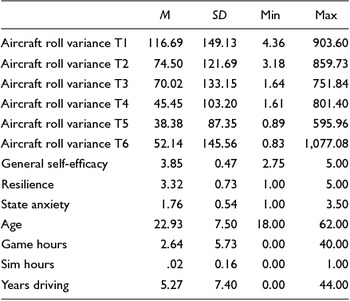
Missing data represented 0.21% of the survey data. Little's MCAR analysis revealed that cases were missing completely at random, χ2 (300) = 323.63, p = .17. Missing survey data were replaced using the expectation maximisation procedure. Descriptive statistics for the study variables are depicted in Table 1. Aircraft roll was positively skewed for each of the six learning trials. Therefore, a logarithmic 10 transformation was applied to the roll variance measure for each of the six trials to correct for positive skewness.
Descriptive Statistics for Measured Variables

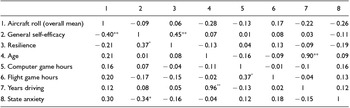
The bivariate correlations among the measured variables in the low- and high-pressure conditions are presented in Table 2. In the low-pressure condition, none of the psychological resources were significantly correlated with average aircraft roll. In contrast, for the high-pressure condition, GSE was significantly negatively related to aircraft roll. Resilience had a similar negative relationship with aircraft roll; however, it did not achieve significance. Resilience and GSE demonstrated a moderate positive relationship in both the high- and low-pressure condition. Interestingly, state anxiety demonstrated a weak negative relationship with perceived resilience in both the high- and low-pressure conditions, but these relationships were not statistically significant. State anxiety demonstrated a significant weak relationship to GSE, but only in the high-pressure condition.
Bivariate Correlations for Low (Shaded Area) and High-Pressure Condition

*p < .05; **p < .01.
In both conditions, the demographic and baseline skill variables (age, video gaming hours, simulator hours and years driving) demonstrated non-significant correlations with our performance outcome measure (i.e., variance in aircraft roll). Thus, these variables were not included as covariates in further analyses.
To demonstrate the baseline equivalence of the psychological resources across our experimental groups, independent samples t-tests were conducted. The t-tests revealed non-significant differences in GSE and resilience between the high- and low-pressure conditions. The manipulation check revealed a non-significant difference in state anxiety for high (M = 1.79, SD = 0.55) and low pressure (M = 1.72, SD = 0.54) (95% CI −0.31 to 0.17; p = .57).
Overview of Multi-Level Analyses
A restricted maximum likelihood method was selected for all multi-level analyses. This method has been shown to be robust for small sample sizes and corrects negatively biased estimates that are associated with the maximum likelihood approach (Bryk & Raudenbush, Reference Bryk and Raudenbush1992). An empty model with random intercepts demonstrated an intra-class correlation of 0.47, indicating that 47% of the total variability in aircraft roll was due to differences between participants, whereas 53% of the variability was within participants. Thus, these data were sufficiently nested and warranted analysis within a multi-level framework.
The unconditional model, performed on the whole sample, demonstrated a significant linear learning trajectory, t (80) = −11.13, p < .001. On average, aircraft roll decreased by 0.12 to 0.16 degrees over each trial. Covariance parameters indicated significant variability in intercepts between participants (Z = 3.96, p < .001), supporting the use of a random intercepts model. Significant variability in participant learning trajectories were also found (Z = 3.14, p = .004), suggesting that the use of random slopes was also appropriate.
Each model included the non-focal psychological resource as a covariate to account for the moderate shared variance among these resources. Main effects for trial, experimental condition and the focal psychological resource were included in the model. All two-way and three-way interactions between trial, condition and the resource were included. The −2 Restricted Log-likelihood (−2LL) and the Akaike's Information Criterion were consistently greater for models using an Autoregressive and Compound Symmetry covariance structure, compared to the Unstructured (UN) covariance structure. Therefore, the UN covariance structure was used.
Conditional Linear Growth Model with GSE
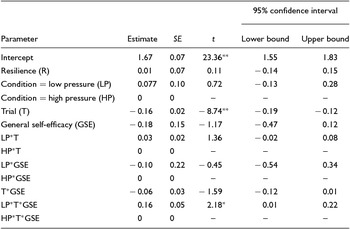
A significant main effect for learning trial emerged, indicating a significant decrease in aircraft roll over the six trials (B =−0.15; t (77) = −8.74, p < .001; 95% CI −0.19 to −0.12). There were no other significant main effects or two-way interactions. As anticipated, there was a significant three-way interaction between trial, condition and GSE (B = 12, t (77) = 2.18, p = .033; 95% CI 0.01 to 0.22). The final GSE model is shown in Table 3 and the three-way interaction is illustrated in Figure 1.
Parameter Estimates of Fixed Effects for the General Self-Efficacy Model Predicting Change in Aircraft Roll Over Six Learning Trials

*p < .05; **p < .01; High-pressure condition was the reference group.
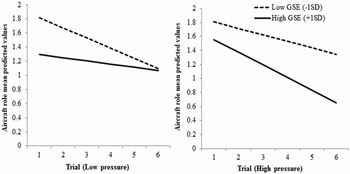
The three-way interaction between self-efficacy, trial and pressure condition (low vs. high) in the prediction of aircraft roll variance mean predicted values.

In the low-pressure condition, rate of initial skill acquisition, operationalised as the change in aircraft roll, over the trials was similar, regardless of the level of GSE. In the low-pressure condition, there was no statistically significant difference in Trial 6 aircraft roll variance for high versus low GSE (M Diff = 0.03, df = 12, p = .94). The difference in performance occurred in the initial trial (M Diff = 0.60, df = 12, p = .04). Those lower in GSE tended to initially perform worse than those high in GSE in the low-pressure condition. In the high-pressure condition, participants who were relatively higher in GSE (+1SD) experienced a faster rate of skill acquisition, compared to those with lower reported GSE (−1SD). In the high-pressure condition, by Trial 6, the difference in aircraft roll between participants who were lower in GSE and participants who were higher in GSE was statistically significant (M Diff = 0.69, df = 12, p = .002).
Conditional Linear Growth Model with Resilience
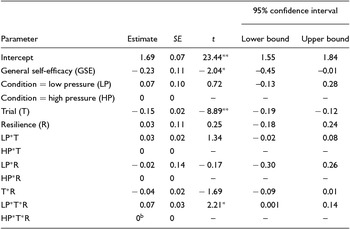
As before, there was a significant main effect for trial (B = −0.15, t(77) = −8.89, p < .001; 95% CI −0.19 to −0.12). There was also a statistically significant main effect for GSE in this model (B = −0.22, t(76) = −2.04 p = .05; 95% CI −0.45 to −0.01). Participants reporting greater GSE tended to perform better (lower aircraft roll) across learning trials. There were no other significant main effects or two-way interactions. The anticipated three-way interaction between condition, trial and resilience significantly predicted aircraft roll (B = 0.07, t(77) = 2.21, p = .03; 95% CI 0.001 to 0.14). The final model is shown in Table 4 and the three-way interaction is represented in Figure 2.
Parameter Estimates of Fixed Effects for the Final Resilience Model Predicting Change in Aircraft Roll Over Six Learning Trials

*p < .05; **p < .01; *p < .05; **p < .01; High-pressure condition was the reference group.
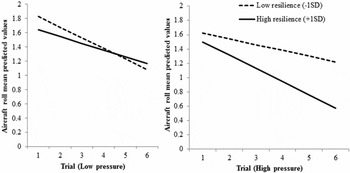
The three-way interaction between resilience, trial and pressure condition (low vs. high) in the prediction of aircraft roll variance mean predicted values.

In the low-pressure condition, Trial 6 demonstrated no significant difference in aircraft roll predicted values between participants lower or higher in resilience (M Diff = −0.08, df = 9, p = .82). In the high-pressure condition, those reporting higher resilience had a steady decrease in aircraft roll over the six trials, whereas the initial skill acquisition slope was attenuated for those participants reporting lower resilience. In the high-pressure condition, by Trial 6, there was a significant difference in aircraft roll between participants higher and lower in resilience (M Diff = 0.65, df = 11, p = .004).
Discussion
This study explored the direct and moderating roles of psychological resources in the relationship between psychological pressure and initial skill acquisition rate. As predicted, GSE and perceived resilience moderated the influence of psychological pressure on skill acquisition rate. The three-way interaction including GSE, demonstrated that when learning was taking place in a high-pressure situation, high GSE improved the rate of skill acquisition when compared to those participants with low GSE. In the low-pressure scenario, participants with low GSE appeared to start with worse performance than those with high GSE. However, the skill of controlling aircraft roll at Trial 6 was not statistically different for those with relatively high or low levels of GSE. This indicates that although low GSE participants were initially slow starters, under low pressure, by Trial 6, they demonstrated the same level of skill acquisition as their high GSE counterparts. A similar three-way interaction emerged when resilience was the moderator. In the high-pressure condition, the skill acquisition trajectory was attenuated for those with low resilience, whereas for those with high resilience, the trajectory indicated more rapid skill acquisition. However, in the low-pressure condition, skill acquisition trajectories were very similar across the six trials irrespective of resilience level.
These interactions demonstrated that psychological resources had little influence on skill acquisition under low pressure. However, when the training situation was pressured, those with low resources demonstrated deterioration in skill acquisition rate, whereas those with high resources improved in their rate of skill acquisition. The latter suggests that those with high resources actually may benefit from a high-pressure training situation.
Why Psychological Resources Buffer the Effects of High Psychological Pressure
The present study was able to demonstrate the role of psychological resources in facilitating skill acquisition in a complex novel sensory-motor task. The mechanisms that allow psychological resources to facilitate the acquisition of skill in the high-pressure context is a fruitful area for future research; and at present, we can only speculate why some resources may buffer the effect of high pressure on skill acquisition. According to the stress buffering hypothesis, a resource is able to buffer the causal link between a potentially stressful event and distress at two points (Cohen & Wills, Reference Cohen and Wills1985). The first is by preventing stress appraisals from occurring. Thus, limiting the experience of felt stress or distress. This is largely akin to the argument presented in the introduction. Consistent with the transactional model of stress and coping (Lazarus & Folkman, Reference Lazarus and Folkman1984), people with greater resources may appraise stressor situations as challenges, rather than threats. Previous work has demonstrated that challenge appraisals are associated with better performance under pressure (e.g., Moore et al., Reference Moore, Vine, Wilson and Freeman2012; Vine et al., Reference Vine, Uiga, Lavric, Moore, Tsaneva-Atanasova and Wilson2014). Alternatively, psychological resources may facilitate more adaptive interpretations of certain arousal experiences. Further, in the introduction, we suggested that these resources would be beneficial because of their role in the promotion of self-referent thoughts about one's ability to cope effectively with situational demands. Such positive coping thoughts may promote appraisals of greater control both over the situation, but also over distracting thoughts, feelings and behaviours (Sarkar & Fletcher, Reference Sarkar and Fletcher2014) leading to good performance outcomes.
The second point at which psychological resources may buffer the pressure–skill acquisition relationship is by assisting the individual to manage the felt experience of stress. Consistent with this suggestion, previous research has shown that people with greater resilience still experience the same levels of negative emotion, but also experience positive emotions such as happiness and interest (Tugade & Fredrickson, Reference Tugade and Fredrickson2004). Positive affective states promote faster physiological recovery and recovery from negative emotional experiences (Tugade & Fredrickson, Reference Tugade and Fredrickson2004). Alternatively, individuals with high GSE and resilience may manage the felt experience of psychological pressure more effectively resulting in behavioural adaptation.
Importantly, it appeared that in the high-pressure condition resilience and GSE not only allowed the individual to adapt to the experience of pressure, but also promoted improvement. This suggests that these resources may also exert their positive effects by impacting the motivational system. Individuals with high levels of resources may be more likely to engage in goal-directed efforts to meet the challenges presented by the stressor.
Both adaptation and motivational processes may be occurring simultaneously to benefit skill acquisition under pressure, or different psychological resources may function via different processes to create similar performance outcomes. Although the present research cannot disentangle why psychological resources buffer the impacts of psychological pressure, the research does highlight the potential for psychological resources to warrant further investigation within the domain of human skill acquisition.
Implications of Findings
Previous work has identified that aspects of an individual's cognitive ability are likely to contribute to learning; however, research on the contribution of other aspects has been limited in comparison. This paper demonstrates that perceived resilience and GSE play an important role in enhancing the initial skill acquisition rate of participants when learning is occurring under high pressure. These findings possess important implications for the training environment. Training to acquire and develop skills requires large investments of time and money, and there are performance and safety implications of improper skill acquisition (Aguinis & Kraiger, Reference Aguinis and Kraiger2009). This study suggests that when skill acquisition is occurring under high psychological pressure, there is value in assessing for, or developing, the necessary psychological resources. For example, assessing for GSE and resilience could be achieved as part of assessment centres prior to training entry for elite sports training programs, elite military training (e.g., fast jet pilots). Such assessments are likely to be most appropriate when high levels of skills need to be developed in short periods of time. In terms of the development of these resources, the work of Crane and Searle (Reference Crane and Searle2016) suggests that perceived resilience can be developed in relatively short timeframes through engagement with challenge stressors that also provide opportunities for performance development. Moreover, the encouragement of self-reflective practices has been shown to allow learning from setbacks as they arise developing greater efficacy (Ellis et al., Reference Ellis, Carette, Anseel and Lievens2014).
Limitations and Future Research Directions
The findings outlined above need to be considered alongside the study limitations. A principle limitation of the present study is the failure of the manipulation check which demonstrated no initial differences in state anxiety between our pressure conditions. The failure of our manipulation check may represent two possible causes. First, the pressure manipulation was unsuccessful. Second, the anxiety measure was not effective in measuring the differences in psychological pressure between conditions. The first issue brings into question the conclusions that can be made regarding skill acquisition under pressure, when we cannot confirm that pressure was effectively induced. For example, perhaps the ascribed ‘low pressure’ condition actually did create a sense of anxiety because failure on the task can less readily be attributed to task difficulty and may be more likely attributed to personal limitations. Having noted this, we argue that the second problem is most likely for several reasons. First, the pressure manipulation was based on the procedures used by Mesagno et al. (Reference Mesagno, Harvey and Janelle2011) who used this protocol to successfully manipulate perceived pressure in experienced field hockey players. Second, the state anxiety measure was typically not correlated with other measures that would be expected. For example, state anxiety was not related to resilience in either the high- or low-pressure conditions. Moreover, state anxiety was only negatively significantly related to GSE in the high-pressure condition, but not the low-pressure condition. Third, the ratings of state anxiety were very low with little variation. Given the novelty of the task for these students and the unfamiliar experimental situation, it is probably unlikely that even in the low-pressure condition students were experiencing very little apprehension. Perhaps, the state anxiety measure was inadequate for specifically capturing the nature of the psychological pressure felt (e.g., performance anxiety, self-presentational concerns). In Mesagno et al's (Reference Mesagno, Harvey and Janelle2011), study the Revised Competitive State Anxiety Inventory-2 (Cox et al., Reference Cox, Martens and Russell2003) that measures somatic anxiety, cognitive anxiety and self-confidence. In contrast, the measure used in this study only measured somatic anxiety. Future studies, should seek to confirm the present findings and consider alternative measures of psychological pressure perhaps measuring the perceived importance of the learning task or self-presentational concerns, rather than somatic anxiety.
A second limitation of the present study is the lack of an assessment of cognitive ability. Given the random assignment of participants to conditions, it is likely that the average cognitive ability was equivalent between experimental groups. However, individuals with greater cognitive ability may also possess greater psychological resources. Having noted this, if cognitive ability was completely responsible for the relationship between psychological resources and learning rate than it is likely that the impact of psychological resources would have been observed in both conditions. Nevertheless, a direction for future research is to determine the role of psychological resources in skill acquisition over and above that of cognitive ability.
A third limitation relates to the possible ceiling effects in the low-pressure condition for GSE. In the low-pressure condition, participants with high GSE demonstrated low aircraft roll (good performance) at Trial 1. Therefore, improvement may have been difficult suggesting a possible ceiling effect. Having noted this, comparing across the high- and low-pressure conditions, those in the high-pressure condition were able to improve in their performance beyond that of those in the low-pressure condition, suggesting improvement was possible, but not attained.
Fourth, the association between personal resources and skill acquisition may potentially be ascribed to the reverse direction of causality. That is, individual who are generally faster learners or perform well under pressure tend to have higher self-efficacy and resilience as a consequence.
Finally, a cautionary note about the generalisability of the findings should be made. These data were collected outside a real training context and this is important for two reasons. First, typically skill acquisition occurs over many more trials. This study only captured the initial six learning trials and therefore we cannot generalise the findings to the entire training process. It is unknown whether the rate of skill acquisition changes beyond these initial trials. For example, those with low resources in the high-pressure condition may eventually demonstrate a similar rate of learning to those with high resources. Future research could examine these hypotheses over more learning trials. Second, the training was unlikely to be of importance to participants as the quality of learning had no real-life implications. It would be interesting to investigate whether the found effects are robust in a training situation that had greater implications to the participants.
Future research should also aim to examine the mechanisms by which these psychological resources are able to facilitate skill acquisition under pressure. One possible mechanism is the way the individual evaluates the task as a challenge or threat. Indeed, those individuals with greater GSE and psychological resilience evaluated that they had the personal resources to cope with the demands of the pressurised sensorimotor task (i.e., a challenge state). Conversely, those with low perceived resources appraised the task as exceeding their resources and therefore as a threat state. At present, it is unclear whether psychological resources such as GSE and resilience enable individuals to ignore the effects of pressure or act to support strategies to better manage stress and anxiety therefore allowing them to compensate for it.
Conclusion
The present study demonstrated that when the training situation becomes pressured, those with low resources demonstrated deterioration in skill-acquisition rate, whereas those with high resources improved in their rate of skill acquisition. Although future research is invited to disentangle why psychological resources buffer the impacts of psychological pressure, the present research does highlight the potential for psychological resources to be a new frontier for the investigation of human skill acquisition.