Introduction
More than 500,000 earthquakes occur yearly with the majority too small or too remotely located to be felt by humans. 1 Approximately 3,000 earthquakes are perceptible, of which seven to 11 result in a significant loss of life. 1 In the past 25 years, >530,000 deaths due to earthquakes have been reported. 1
In the early morning of October 8, 2005, an earthquake measuring 7.6 on the Richter scale affected the Azad Jammu and Kashmirand northern areas of Pakistan. In the immediate phase of the earthquake, 75,000 persons were killed and more than 150,000 injured. In addition, 85% of the physical infrastructure was destroyed.
Relief and rescue operations organized abroad and by Doctors Pakistan reached the affected areas within 1-2 days. Dow University of Health Sciences Karachi sent a team of three orthopedic surgeons, two residents, one anesthetist, and two operating theater technicians to Battagram during the second week after the initial earthquake. The team remained there for one week. Battagram was one of the most affected areas in the North West Frontier Province located on the Karakorum Highway. According to the 1998 Pakistan census, the population of the district of Battagram was 307,278 with 158,563 being male and 148,715 female. A total of 147,197 were <14 years of age, 149,618 were between 15 to 64 years of age, and 10,463 were ≥65 years of age.
The objectives of this report were to describe (1) the type, pattern, and severity of musculoskeletal injuries and (2) the type of simple orthopedic surgical procedures that were performed at the disaster site.
Methods
This was a cross-sectional study conducted at the site of the earthquake. Patients reported upon in this report were those cared for by the Doctors Pakistan relief and rescue team. This team arrived on scene in Battagram two weeks after initial earthquake activity and provided orthopedic services through the third week (week 2-3) of the event.
The study patients were those selected from those who presented to the local district government-established tent hospital that was set up on a Battagram school playground. Patients admitted to the tent hospital ward who required orthopedic surgical interventions and patients who needed closed manipulation and plaster of paris casts were included in the study. De-identified data for this report was obtained in an ongoing manner from the study team records.
Results
During the second week after the earthquake, acute emergencies already were managed by orthopedic surgeons who had reached the affected area. The district headquarters hospital was destroyed by the earthquake and the local district government established a tent hospital. Before the study team was on-site, the Estonia Disaster Team and Doctors Without Borders, with the help of local physicians, established two tent operating theaters. One operating theater was used for closed manipulation and plaster of paris casting, and the other operating theater was used for internal fixation. A mobile X-ray unit was present in the hospital. For each patient with suspected bone injuries, an X-ray was taken and plans made accordingly. The Estonian team helped sterilize instruments. Patients who were not manageable with the resources available on-site, such as those with proximal or distal femur fractures or those with neurological deficits, were transferred to other city hospitals.
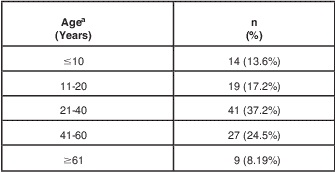
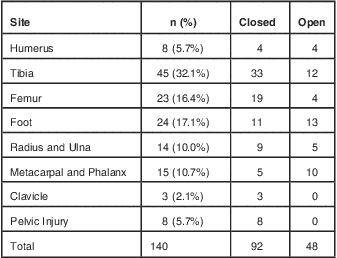
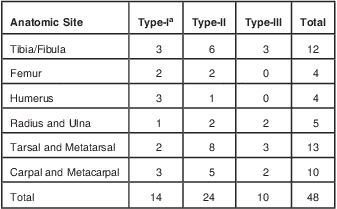
Of 110 patients, 55.5% were female, and 44.5% were male. One hundred forty orthopedic injuries were involved. Young patients were primarily affected, with 30.8% of patients <20 years of age and 37.2% between 21 and 40 years of age (Table 1). Forty-eight (34.3%) cases involved open fractures and 92 (65.7%) cases were closed. The bones involved in the different types of fractures are listed in Table 2. Open tibia fractures were noted in 12 (25%) cases, the humerus was involved in four (8.3%), the femur in four (8.3%), the radius and ulna in five (10.4%), the tarsal/metatarsal in 13 (27.1%), and the carpal/metacarpal in 10 (20.6%) cases (Table 3). In addition to 140 orthopedic extremity injuries, 40 patients also sustained other injuries. Thirteen patients sustained vertebral column injuries, seven thoracic, and six lumbar vertebral fractures. Five patients were paralyzed and were referred to another city. Eight patients sustained head injuries without neurological deficit and were managed on-site by a neurosurgeon. Six patients sustained rib fractures without pulmonary complications and were treated conservatively. Three patients experienced blunt injuries to the abdomen and were treated conservatively by a general surgeon. Ten patients experienced significant soft tissue injuries without bone involvement.
Age of Patients

aMinimum, 6 mo; maximum, 80 y.
Anatomic Fracture Sites

Types of Open Fractures

aGustilo-Anderson classification.
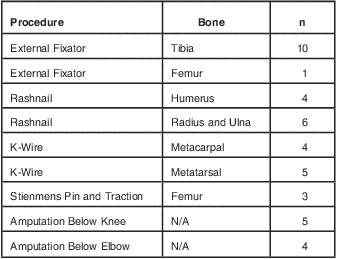
Surgical Procedures
Instruments and implants were sterilized in the sterilization unit of the Estonian team and later in the operating theater of Doctors Without Borders. An anesthetist attended surgical procedures. Wound debridement was performed in 35 patients. For 10 cases of open tibia fractures, an external fixator was applied. Two cases of Type-I open humerus fractures and three cases of Type-I and Type-II open fractures of the radius and ulna were fixed with the Rashnail method; and nine patients with open carpal, metacarpal, and metatarsal bone fractures were fixed with K-wire. With a small incision, three cases of closed fracture of the radius and ulna and two cases of fractured humerus were fixed using the Rashnail method. Three closed femur fractures were repaired with Stienmens pins passed through the distal end of the femur and set in traction. Five patients with crush injuries of the leg and foot arrived late from remote areas and had developed gangrene. For these patients with gangrene, below-the-knee amputations were performed. In four cases of severe crush injuries of the hand and wrist, below-the-elbow amputations were performed (Table 4). Under spinal or general anesthesia, closed manipulation and reduction was done in 25 cases. General anesthesia was used for 25 patients; in 32 cases spinal anesthesia was used; and Ketamine anesthesia injection was used for 17 cases.
Orthopedic Operative Procedure Performed

For open fractures, thorough wound debridement was performed and, if indicated, repeated after 24 hours. For open fractures, intravenous antibiotics were administered, which usually included a first generation cephalosporin in combination with an amino glycoside and injectable metronidazole for anaerobic coverage. Once a wound was found to be healthy, the fracture was fixed. After repeated debridement, Type-III open tibia fractures were stabilized with an external fixator. After debridement, open metacarpal and metatarsal fractures were fixed with K-wire. Post-operative antibiotics were continued in all cases. Tetanus toxoid injections were administered in all cases.
Discussion
The majority of the study population was female. This corresponds with results found in other studies.Reference Ramirez and Peek-Asa 2 - Reference Emami, Tavakoli, Alemzadh, Abdinejad, Shahcheraghi, Erfani, Mozafarian, Solooki, Rezazadeh, Ensafdaran, Nouraie, Jaberi and Sharifian 6 EmamiReference Emami, Tavakoli, Alemzadh, Abdinejad, Shahcheraghi, Erfani, Mozafarian, Solooki, Rezazadeh, Ensafdaran, Nouraie, Jaberi and Sharifian 6 noted a male:female ratio of 1:2.4 after the 1998 Armenian earthquakes.Reference Emami, Tavakoli, Alemzadh, Abdinejad, Shahcheraghi, Erfani, Mozafarian, Solooki, Rezazadeh, Ensafdaran, Nouraie, Jaberi and Sharifian 6
In the current study, 67.5% of patients were <40 years of age, which also corresponds with previous study data.Reference Ramirez and Peek-Asa 2 - Reference Emami, Tavakoli, Alemzadh, Abdinejad, Shahcheraghi, Erfani, Mozafarian, Solooki, Rezazadeh, Ensafdaran, Nouraie, Jaberi and Sharifian 6 Sarisozen et alReference Sarisozen and Durak 7 noted that 20.5% of patients after the Marmora earthquake were <16 years of age.
The data for this report showed the tibia was involved in 42.7% of cases, the femur in 18.1%, and the pelvis in 5.7%. This varies from Emami who noted that extremities were involved in 19% of cases, and axial skeletal fractures were found in 4% of cases.Reference Emami, Tavakoli, Alemzadh, Abdinejad, Shahcheraghi, Erfani, Mozafarian, Solooki, Rezazadeh, Ensafdaran, Nouraie, Jaberi and Sharifian 6 SarisozenReference Sarisozen and Durak 7 and HanelyReference Hanley 8 both noted that extremity injuries were more common in their studies.
For this study report, there were no presentations of compartment or squeeze syndrome, whereas TahmasebiReference Tahmasebi, Kiani, Mazlouman, Taheri, Kamrani, Panjave and Harandi 9 recorded these complications after the Bam and Armenian earthquakes. IskitReference Iskit, Alpay and Tugtep 10 and DönmezReference Dönmez, Meral, Yavuz and Durmaz 11 reported crush injuries and crush syndrome in pediatric patients in after the Marmara earthquake, and SarisözenReference Sarisözen and Dural 12 reported acute renal failure in pediatric patients suffering from crush injuries. SabzehchianReference Sabzehchian, Abolghasemi and Radfar 13 believes that on-site fixation decreases the need for fasciotomy. In the current study a different type of internal fixation was performed on-site, but little literature is available to assess the results of on-site surgical procedures. RoyReference Roy, Shah, Patel and Coughline 14 noted an increased incidence of post-operative infections and increased morbidity in patients in whom different implants were used after the 2001 Gujrat, India earthquake. Although different orthopedic surgical procedures using simple implants were performed, there was no follow up, so it is unknown how many patients developed non-union, delayed union, or infection.
Conclusions
The data for this disaster following an earthquake showed that young people, especially females, are prone to sustained orthopedic injury that more commonly affects the extremities.
For on-site surgical interventions, further experience is needed to better delineate the balance between early on-site surgical interventions versus less timely casualty evacuation to a more advanced hospital.
Abbreviations
- none