Implications
The fact that we found that a reduction in the amount of daily grazing hours increases the risk for hair and skin damages of dairy cows points to an impairment in animal welfare in cows’ present housing conditions where access to (summer) grazing is decreasing. This welfare impairment contradicts a public interest to manage livestock in a welfare-beneficial way. Severe disorders may further lead to economical loss when treatments become necessary or cows show changes in behaviour, followed by decreased production. The questions arise as to whether barn conditions need to and can be optimized and whether grazing is essential to meet the public interest.
Introduction
Structural changes in farming have led to increased herd sizes, with a subsequent reduction in pasture use as larger herds are less likely to be sent to pasture at all. However, grazing of cows during summer is considered as a good animal welfare practice and thereby wished by the public in the United Kingdom (Ellis et al., Reference Ellis, Billington, McNeil and McKeegan2009). Knowledge on how grazing affects animal welfare in large high-producing herds is scarce.
Time at pasture represents one basic aspect of grazing management, indicating how long cows have been exposed to its condition. One measure of animal welfare that depends on the physical environmental impact is the prevalence of integument alterations, commonly included in welfare assessment protocols for its likely effect of pain – especially of lesions and swellings – in the animal.
Hock joint integument has been found to be associated with the bedding surface in the barn (e.g. Norring et al., Reference Norring, Manninen, de Passilé, Rushen, Munksgaard and Saloniemi2008; Rutherford et al., Reference Rutherford, Langford, Jack, Sherwood, Lawrence and Haskell2008; Lombard et al., Reference Lombard, Tucker, von Keyserlingk, Kopral and Weary2010). Outdoor exercise (not necessarily on grassland) was found to reduce hock lesions in tie-stalled dairy cows in small farms (average 26 cows/herd) in Switzerland. Highly frequent but short exercises led to an increase in hock lesions (Keil et al., Reference Keil, Wiederkehr, Friedli and Wechsler2006). However, the condition of management of larger herds (with cubicle loose housing) is different from that for small (tie-stalled) herds. More land is needed close to the barn to send large herds outside, especially for long periods. A greater proportion of cows with hock swellings have been found in large compared with small herds in the United Kingdom (Rutherford et al., Reference Rutherford, Langford, Jack, Sherwood, Lawrence and Haskell2008). For British free-stall and straw-pen herds, with more than 50 cows, it has been described that hock damage (including hair loss and lesions) and swellings decrease with increasing number of months with summer grazing (Rutherford et al., Reference Rutherford, Langford, Jack, Sherwood, Lawrence and Haskell2008). Further, in the United Kingdom, free-stall herds with an average of 162 cows, hair loss and to some extent ulcerations at the hock joint increased with increasing number of days of indoor winter housing (Potterton et al., Reference Potterton, Green, Harris, Millar, Whay and Huxley2011). No study has as yet tested the impact of daily grazing hours for such herds.
The objective of this study was to investigate the effect of daily grazing time on alterations in the hock joint integument in Danish dairy herds. We hypothesized that a higher number of daily grazing hours reduces the probability of hock joint alterations in dairy cows.
Material and methods
Target population
The target population was dairy cows in Danish herds with sizes of more than 100 cows, housed in barns with cubicle loose housing systems and, in case of summer grazing, being on pasture above a minimum level during the summer season. This minimum level of summer grazing was defined as offering the herd access to pasture during 120 days/year and 5 h/day and offering estimated 3 feeding units (defined as a netto-energy value in 1 kg barley with 85% dry matter)/day and 0.1 hectare/cow in the reference month August.
Study population
The selection of herds was based on responses from a questionnaire survey on grazing procedures on Danish dairy farms in 2009 sent to a random sample (by the NEWID system function of a MICROSOFT SQL server) of 812 of a total of 2349 Danish dairy herds with more than 100 cows.
The questionnaire (a copy is accessible from the corresponding author) included 58 questions on management, housing and grazing practices in 2008, as well as the farmer's attitude towards and future plans for grazing. A total of 401 farmers answered the questionnaire (response rate 49.4%). According to the farmer's statements, 96 of the farms were classified as having cubicle loose housing systems and potentially using grazing in 2010. Telephone interviews with the 96 farmers were carried out in February 2010 to determine whether they would actually use grazing on at least the minimum specified level in 2010. A total of 36 of the 96 contacted farms fulfilled the inclusion criteria: herd size still larger than 100 cows, cubicle loose housing system with a homogeneous cubicle surface, being reachable by car within a distance of 250 km from the research centre Foulum located in Jutland, farmer interested in participating in the study, no large system changes (such as e.g. herd/barn expansion), using an automatic milking system or two times daily parlour/carrousel-milking, grazing lactating and grazing dry cows until at least 2 weeks before calving, offering complete questionnaire information. In addition, 20 of the 401 responding farms were recruited as zero-grazing herds, using no grazing at all and otherwise fulfilling the same selection criteria as for the grazing herds.
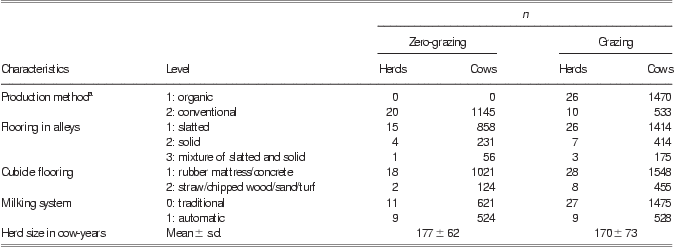
The descriptive characteristics of the 36 grazing and 20 zero-grazing herds studied are presented in Table 1. The mean herd size was 173 (s.d. = 69) cows among all herds. With regard to the grazing herds, 25 herds followed the Danish rules of organic farming, which require providing cows access to pasture for a minimum of 6 h during daylight from 15th April to 1st November. In three non-organic herds, a production concept of the dairy Arla was followed, labelled ‘Lærkevang’, requiring a minimum of 6 h on pasture from 1st May to 30th September. Also, one-third of the herds, half of the organic herds, used automatic milking systems. The most common flooring system was a slatted floor and the most common flooring in the cubicles was rubber mattresses or concrete (Table 1).
Descriptive characteristics of the studied 36 grazing and 20 zero-grazing herds and the distribution of the herds and their 3148 lactating cows among the characteristics at the herd visit day in 2010
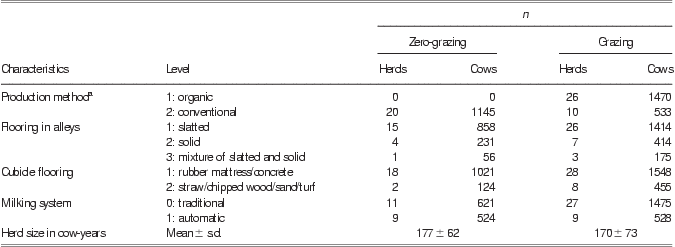
aOriginated from updated registrations at the Ministry of Food, Agriculture and Fisheries in 2010.
The selection of cows within the herds was done by random sampling before each farm visit, using sampling intervals (Dohoo et al., Reference Dohoo, Wayne and Stryhn2009, p. 38) on updated herd records obtained from a public database from the Ministry of Food, Agriculture and Fisheries. The sample size (S) per herd was based on an estimate of the prevalence of lameness of 0.5, a precision of 10% and a 95% confidence interval, calculated using the formula S = (96/(95/n + 1)Footnote 1 according to Cochran (Reference Cochran1977). S included a herd representative proportion of lactating as well as dry cows. In total, 3148 lactating and 386 dry cows were studied.
Clinical examinations of hock joint integument and cleanliness were carried out on only one of the body sides per cow. The side per cow was randomly selected by alternation on the S-list before the farm visit. Of the lactating cows, 1609 cows were assessed on the left side and 1539 cows on the right side.
Outcome variable alterations in hock integument
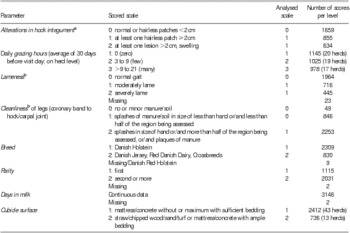
The condition of integument at the hock joint was assessed modified after Welfare Quality® (2009). Scores on an ordinal scale were assigned as 0 for normal or hairless patch(es) (criteria for hairless patch: hair loss, skin not damaged, extensive thinning of the coat due to parasites, hyperkeratosis possible) of <2 cm in diameter, 1 for one or more hairless areas ⩾2 cm, 2 for one or more lesions (criterion for lesion: damaged skin either in the form of a scab or a wound) ⩾2 cm and/or visible swelling(s) (Table 2). In contrast to Welfare Quality® (2009), only the presence but not the quantity of alterations per cow was noted. In the case of hairless patch(es) and lesion(s)/swelling(s) on the hock joint of the same cow, lesion(s)/swelling with the most severe alteration was noted.
Outcome variable alterations in hock joint and the potential risk factors in the study of probability of alteration in the hock integument in 56 Danish dairy herds with zero, few (3 to 9) or many (>9 to 21) hours of daily grazing in 2010 (n = 3148 cows scored for hock integument)

(Management) factors assessed
Grazing hours
The amount of daily grazing hours was recorded at the herd level in the 36 grazing herds by each herd manager for the 30 days before the farm visit. In farms with an open door between the barn and the pasture, the daily grazing hours were defined as the period in which cows had free access between the barn and the pasture. The average of daily grazing hours was calculated for each herd among the 30 days. The distribution of grazing hours, grouped to three levels of hours in the studied 56 herds, is presented in Table 2.
Lameness
Lameness was evaluated using the methods described in Welfare Quality® (2009), where the assessment is based on observation of rhythm and weight bearing in the cow's movement of its four legs while being walked in a straight line on the hard, level surface of the barn floors. The lameness score was based on an ordinal scale. A cow was scored 0 for normal gait; 1 for moderate lameness; and 2 for severe lameness. To assess cows with any stage of lameness in the analysis, the scores for moderate and severe lameness were aggregated to one category (lame) and compared with the category of normal gait (Table 2).
Cleanliness
Cleanliness of legs in the area from the coronary band to the carpal/hock joint was evaluated and scored either as 0 for no or minor manure/soil, 1 for splashes of manure/soil in the size of less than half of the assessed region or, imaginary summarized, of less than the size of a hand or, 2 for splashes of a size of more than half of the region being assessed, or plaques of manure or, imaginary summarized, of at least the size of a hand (modified after Welfare Quality®, 2009; Table 2). The scores for 0 and 1 were aggregated in the analysis because of the few numbers of scorings for 0, so that the variable cleanliness was dichotomous with the levels 0/1 v. 2.
Breed, parity and days in milk
The information on breed and parity per cow was obtained from registration lists of the Ministry of Food, Agriculture and Fisheries. The categories 1: Danish Holstein and 2: other than Danish Holstein were considered in the analyses (Table 2). For parity, the categories first or higher were chosen as most relevant. Days in milk (mean = 206, s.d. = 139 in grazing and mean = 180, s.d. = 120 in zero-grazing herds) was analysed as a continuous variable at the cow level.
Cubicle surface
The cubicle surface in each herd was assessed by categorization as follows: (a) flooring in cubicle by a hard rubber mat, soft rubber mat, straw/manure mattress, cow comfort mattress, concrete, wood, sand and soil, (b) bedding by straw, shredded straw, sawdust, wood shavings, peat, no bedding and (c) amount of bedding minimal, sufficient or ample. Information on (a), (b) and (c) was combined to the variable cubicle surface described in Table 2.
Observer
The observations in all 56 herds were carried out by three observers. Each herd was visited once by one of the observers. The observers were trained and calibrated in the assessment of alterations of hock integument, lameness and cleanliness by three on-farm training sessions, pictures and videos. After the data collection, inter-observer agreement was assessed using pictures and videos, with the prevalence-adjusted, bias-adjusted κ ranging from 0.6 to 0.9 for the three clinical signs.
Time period of clinical examination
The 20 zero-grazing herds were visited during the entire study period lasting from 17th June 2010 to 21st January 2011. The 36 grazing herds were visited during the grazing season, in July to September 2010, and the cows had been grazing for a minimum of 50 and a maximum of 132, median 102, days before they were visited (herds of 3 to 9 daily grazing hours during the last 30 days had been outside from 50 to 132 days, median 95 days, and herds of >9 daily hours from 85 to 129 days, median 115 days). The order of herd visits was decided based on (a) visiting ∼4 to 6 herds in one geographical direction during consecutive days (in one driving trip) and (b) visiting herds that on average have many grazing hours at the middle or the end of their period of most grazing hours.
The observations were made while the cows were in the barn around milking and/or feeding (morning or evening).
Statistical analyses
The risk factors for alterations in hock integument (outcome) of cows with different categories of daily grazing hours at the herd level (Table 2) were evaluated. Two separate analyses were carried out for each of the two cut-off-possibilities in the categories of alterations of hock integument to model the probability of hair loss/lesion/swelling v. normal and of lesion/swelling v. normal/hair loss using a logistic analysis (GLIMMIX procedure in SAS version 9.2). The data were multi-level and had a hierarchical structure and were modelled as such in the analysis.
At first, the association between single risk factors and the outcome variable was screened by univariable analyses. Only variables with P < 0.2 were considered in the initial model. Specification of the initial model:
 $$ {{\rm{logit(}}P{\rm{)}}\,{\rm{ = }}\,a\,{\rm{ + }}\,{\rm{GrazHour}}{{{\rm{s}}}_i}\,{\rm{ + }}\,{\rm{Lam}}{{{\rm{e}}}_j}\,{\rm{ + }}\,{\rm{Clea}}{{{\rm{n}}}_k}\,{\rm{ + }}\,{\rm{Bree}}{{{\rm{d}}}_l}\,\cr {\rm{ + }}\,{\rm{Cubicl}}{{{\rm{e}}}_m}\,{\rm{ + }}\,{{\beta }_{\rm{1}}}{\rm{DIM}}\,{\rm{ + }}\,{\rm{her}}{{{\rm{d}}}_l}\,{\rm{ + }}\,{\rm{observe}}{{{\rm{r}}}_m}$$
where logit(P) is the logit transformation of the probability P for alterations in hock integument of the cow, a is the overall intercept, GrazHoursi is the fixed effect of the ith level of grazing hours (i = 1: many, 2: few or 3: zero hours), Lamej is the jth level of lameness (j = lame or normal gait), Cleank is the kth level of cleanliness (k = 1: manure/soil or 2: no or minor manure/soil), Breedl is the lth level of breed (l = Danish Holstein or other breed), Cubiclem is the mth level of cubicle surface (m = 1: mattress/concrete or 2: straw/chipped wood/sand/turf or mattress/concrete with ample bedding or mixture), DIM is the linear effect of days in milk with slope β 1, herdl is the random effect of the lth herd (l = 1 to 56) and observerm is the mth observer (m = 1 to 3). Lame, Clean, Breed and DIM were included at the cow level, GrazHours and Cubicle were included at the herd level and herd was included at the observer level.
The model was reduced using stepwise backward elimination (P < 0.05 as the threshold) for fixed effects. The fit of the model was evaluated by the dispersion parameter generalized χ 2/d.f. (0.8 to 1.2 as threshold area). The resulting model was expanded by all combinations of possible two-way interactions (large model), reduced by stepwise backward elimination (P < 0.05 as the threshold) and checked for confounding (20% threshold for change in the estimates of the variable of interest). The final model was the one with fixed factors of P < 0.05 in tests of fixed effects and a dispersion parameter generalized χ 2/d.f. closest to 1 among those models derived from the large model.
Results
Of the studied 3148 dairy cows, 47.3% either showed hair loss, lesions or swellings at the hock integument and 20.1% had lesions or swellings.
All the studied risk factors listed in Table 2, except parity, showed an association with both cut-off variables of alterations in hock integument in univariate analyses by P < 0.2 and were all, except for parity, considered in the subsequent analyses.
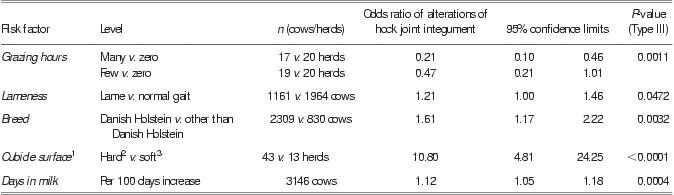
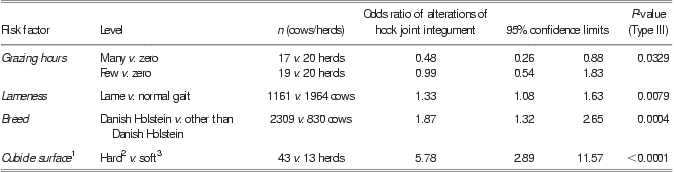
The risk factors with significant effects (P < 0.05) in the final model of the analysis are shown in Tables 3 and 4, related to the outcome variable with the threshold between normal and hair loss/lesion/swelling as well as normal/hair loss and lesion/swelling. In both analyses, no two-way interaction effect was found; cubicle surface was confounded with grazing hours.
Risk factors with a significant effect (P < 0.05) on hairless patches, swellings or lesions in the hock joint integument of dairy cows in 36 grazing and 20 zero-grazing herds in Denmark in 2010 (n = 3116, deviations from 3148 total observations due to missing values)
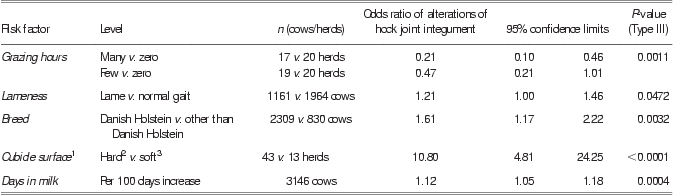
1Showed a confounding effect (change of coefficients of grazing hours with >20%).
2Mattress/concrete without or maximum with sufficient bedding.
3Straw/chipped wood/sand/turf or mattress/concrete with ample bedding.
Risk factors with a significant effect (P < 0.05) on swellings or lesions in the hock joint integument of dairy cows in 36 grazing and 20 zero-grazing herds in Denmark in 2010 (n = 3116, deviations from 3148 total observations due to missing values)
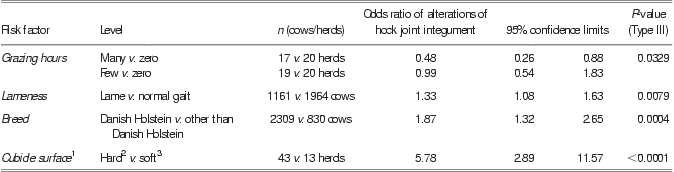
1Showed a confounding effect (change in coefficients of grazing hours with >20%).
2Mattress/concrete without or maximal with sufficient bedding.
3Straw/chipped wood/sand/turf or mattress/concrete with ample bedding.
The final models on the probability of hair loss/lesion/swelling and on lesion/swelling had dispersion parameters generalized χ 2/d.f. of 0.95 and 0.92, the estimated total variation was 4.22 and 3.75, of which herd explained 24.1% and 14.1% and observer 3.6% and 2.9%. The odds ratios of hair loss/lesion/swelling and lesion/swelling among the levels of each significant risk factor are presented in Tables 3 and 4.
Discussion
A high percentage of cows observed showed alterations in hock integument (47.3%), of which 20% were severe. Potterton et al. (Reference Potterton, Green, Harris, Millar, Whay and Huxley2011) found similarly high numbers for comparable management systems in the United Kingdom.
Increasing the number of daily grazing hours had a significantly positive effect on hock integument. The probability of alterations in hock integument decreased with an increase in hours that the cows spent grazing. This result indicates a benefit from the grazing time also for large (n = 173 cows) free-stalled herds and not just small (n = 26 cows) tie-stalled herds as Keil et al. (Reference Keil, Wiederkehr, Friedli and Wechsler2006) found for outdoor exercise or pasture use in Switzerland. Since alterations in the integument may lead to pain in the animal similar to that found for locomotion disorders (Rushen et al., Reference Rushen, Pobourcq and de Passille2007) – especially lesions and swellings – the reduction in alterations for cows with increased daily grazing hours may be seen as a benefit in the welfare of dairy cows.
Our results on improvement in hock integument by increased daily grazing hours are similar to the findings on improvement of hock integument by increased months of grazing (Rutherford et al., Reference Rutherford, Langford, Jack, Sherwood, Lawrence and Haskell2008). They found that an increased number of summer grazing months was associated with a decrease in damage (hair loss, lesions) and swellings in the hock integument. In addition, Corrazin et al. (Reference Corrazin, Piasentier, Dovier and Bovolenta2010) detected a decreased prevalence of injuries on cows’ whole body side after 3 months of full-day mountain grazing and in comparison with zero-grazing herds. On comparing grazing with zero-grazing herds, Haskell et al. (Reference Haskell, Rennie, Bowell, Bell and Lawrence2006) found a reduction in alterations in the carpal integument but not in the hock joint. In addition to the former findings on the effect of months of grazing, we also found that daily grazing hours are an important factor that affects the integument during the grazing season after winter barn housing.
A high number of daily grazing hours showed a beneficial effect on both the risk of any hock alteration and the risk of severe alterations. However, offering dairy cows 3 to 9 daily grazing hours, neither any nor the severe alterations could significantly be improved, but the odds of any alterations were 2.2 times lower than for zero-grazing. Winckler et al. (Reference Winckler, Brinkmann and Glatz2007) studied hock integument repeatedly in eight German dairy herds – of which four were offered 2 to 6 daily grazing hours in summer, from January to October, and did not find a difference in the prevalence of integument alterations (hair loss/injury). Based on this finding, they concluded that up to 6 h of daily pasture access in the grazing herds would be too short to lead to improvements in alterations resulting from the effects of being indoor. After our findings, 3 to 9 daily grazing hours led to improvements in a wide spectrum of integument alterations; however, a higher number of daily hours are necessary to induce improvements in severe integument alterations.
Hard cubicle surface was the strongest risk factor for both hair loss/lesion/swelling and lesion/swelling, with the odds being 10.8 and 5.8 times higher than that with a soft surface. The adverse effect of cubicle surface has, in addition to the present study, also been reported by Norring et al. (Reference Norring, Manninen, de Passilé, Rushen, Munksgaard and Saloniemi2008), Lombard et al. (Reference Lombard, Tucker, von Keyserlingk, Kopral and Weary2010) and Potterton et al. (Reference Potterton, Green, Harris, Millar, Whay and Huxley2011). In regions where cows are housed during winter and also remain inside the barn for at least some hours for milking and feed supplementation during summer, the cubicle surface has most influence on hock integument being the main lying surface. Cubicle surface was confounded with grazing hours. Thus, part of the association between grazing hours and alterations of hock integument may be due to the fact that more hours on grass also lead to fewer hours on the cubicle surface. Ketelaar-de Lauwere et al. (Reference Ketelaar-de Lauwere, Ipema, van Ouwerkerk, Hendriks, Metz, Noordhuizen and Schouten1999) found that cows preferred spending 80% to 99.6% of time lying outside on the grass while also having access to cubicles inside a barn. In 77% of the presently studied dairy cow housings, the impairing effect of lying surface indicates an essential drawback in housing conditions even if mattresses and some bedding material were provided.
The effect of lameness on the probability of hock joint alterations has also been found by Kielland et al. (Reference Kielland, Ruud, Zanella and Osteras2009) and Potterton et al. (Reference Potterton, Green, Harris, Millar, Whay and Huxley2011). Lame cows spend more time lying (Chapinal et al., Reference Chapinal, de Passillé and Rushen2010) and are therefore exposed to the lying surface for a longer time, which is, for grazing cows, during at least part of the day on the cubicle surface.
The higher risk of Holsteins compared with non-Holsteins, and by increased days in milk for any kind of hock alteration, was mainly in agreement with Potterton et al. (Reference Potterton, Green, Harris, Millar, Whay and Huxley2011) finding effect of breed on hair loss and of days in milk on swellings.
Conclusion
Increased amount of daily grazing hours reduced the probability of hair loss, lesions and swellings in the hock joint integument in Danish grazing herds.
Acknowledgements
The study is part of the project Afgræsning- også en del af fremtidens kvægbrug and was supported by funds from Aarhus University, Stiftelsen Hofmansgave and Mælkeafgiftsfonden. The authors wish to thank the Knowledge Centre for Agriculture/Cattle for providing access to data from the Danish Cattle Database and Troels Kristensen for providing the questionnaire data. The authors also wish to thank Søren Saxmose Nielsen and Nils Toft, Department of Large Animal Sciences/Population Biology, Copenhagen University, for advice on the statistical analysis.