Introduction
In many countries restraints are commonly used in the residential care of people with dementia (Hamers and Huizing, Reference Hamers and Huizing2005). The use of physical restraints, like safety belts and bedrails, can have serious negative side effects and, in some cases, has led to declining health and even death (Evans et al., Reference Evans, Wood and Lambert2003; Engberg et al., Reference Engberg, Castle and McCaffrey2008). Furthermore, nurses using restraints report moral distress, which can lead to decreased self-esteem and the loss of the ability to give good patient care (Jameton, Reference Jameton1984; Corley et al., Reference Corley, Elswick, Gorman and Clor2001; Austin et al., Reference Austin, Lemermeyer, Goldberg, Bergum and Johnson2005). In recent years many attempts have been made to decrease the use of physical restraints and a search has started for acceptable alternatives, such as surveillance technology (Niemeijer et al., Reference Niemeijer, Frederiks, Riphagen, Legemaate, Eefsting and Hertogh2010). When trying to diminish restraint use, it is important to know how those people who are involved in the nursing home care of people with dementia define the concept of “restraint”.
In most developed countries the rights of people who are restrained are laid down in legal rules based on, among other things, guidelines of the United Nations and the World Health Organization (United Nations, 1991; World Health Organization, 2005). Although these guidelines offer a minimum standard, the content of the law in different countries varies (Legemaate et al., Reference Legemaate, Frederiks and Roode2007). Also, the concepts “restriction of freedom” and “restraint”, as captured in legislation, appear to be ambiguous. Hantikainen and Kappeli (Reference Hantikainen and Kappeli2000), for instance, found differences in how nurses interpreted the term restraint and the conditions for justification of restraint use. Other researchers found differences between nurses in three different countries regarding the extent to which they considered various interventions to be restrictive (Hamers et al., Reference Hamers, Meyer, Kopke, Lindenmann, Groven and Huizing2008).
In the Netherlands, health care law does not define the concepts of freedom restriction or restraint but it does indicate which interventions are to be considered as restraints. Under the umbrella term “fixation”, the application of belts or another device to tie someone down, as well as the use of chairs with a tabletop, geriatric chairs and bedrails are all interventions that ought to be considered restraints.
In practice the implementation of laws on restraints rests predominantly on the shoulders of nurses and nurse assistants, who are generally ill-informed about the law on restraint use and do not have adequate knowledge about alternatives for restraints (Hertogh et al., Reference Hertogh, The and Eefsting2004a; Suen et al., Reference Suen2006; Moore and Haralambous, Reference Moore and Haralambous2007). Research shows that nurses have different opinions on the restrictive qualities of certain interventions they use (de Veer et al., Reference de Veer, Francke, Buijse and Friele2009). Furthermore, research by Hertogh et al. (Reference Hertogh, The and Eefsting2004a) demonstrated a discrepancy between the current legislation regarding restraint use in the Netherlands and the “local logic” of care practice. According to this study, nurses are mainly inspired by moral motives such as providing good care and ensuring safety. In their daily routine, they do not focus on whether they are acting in accordance with the law or not. In addition, a national committee created to evaluate the current health care law on restriction of freedom concluded that its practical implementation in residential care for people with dementia had been a resounding failure. More specifically, this committee stated that legal regulation that is alien to the experiences and moral beliefs of care professionals is likely to fail (Pool et al., Reference Pool, Hendriks and Hertogh2002). Currently, a new law is being developed; in order to design it more in line with daily care practice, it is important to examine the views of those involved in the care of nursing home residents with dementia.
We therefore explored the perspectives of nurses, nurse assistants, nursing home staff and relatives of residents on the use of physical restraints and surveillance technology. We opted to include surveillance technology in the study because, although this might be an alternative to restraint use, the restrictive qualities of the devices themselves are still under discussion. Furthermore, surveillance technology will probably be integrated in the forthcoming revised legislation on restraints in the Netherlands, as is already the case in some other European countries, such as Austria and Scotland. Elaborating on the findings in the research by de Veer et al. (Reference de Veer, Francke, Buijse and Friele2009) and Hertogh et al. (Reference Hertogh, The and Eefsting2004a; Reference Hertogh, The, Miesen and Eefsting2004b) regarding the discrepancy between legislation and actual practice, this study attempted to explore how the concept of restraint is experienced and defined by relevant actors in the field of nursing home care of people with dementia
Methods
Design
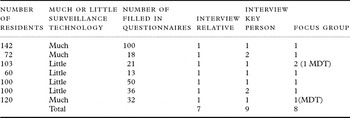
We used a mixed-method design. A questionnaire was administered to nurses and nurse assistants; semi-structured interviews were conducted with key persons and family members of residents; and focus group discussions were held with nurses and multidisciplinary teams (for a detailed description of residents, questionnaires interviews and focus groups in each nursing home, see Table 1).
Information about the number of residents, the use of surveillance technology, the number of completed questionnaires and the number of held interviews and focus groups per nursing home

MDT= Focus group was held with the multidisciplinary team. All other focus groups were held with nurses.
Selection of nursing homes
We interviewed nursing home staff (nurses, nurse assistants and key persons) from seven nursing homes. Because we suspected that the perspective on restraints might differ depending on whether or not surveillance technology use is common in a nursing home, we deliberately selected three nursing homes that used a lot of surveillance technology and four nursing homes that rarely used it. Whether nursing homes used relatively a lot or little surveillance technology was established on the basis of a previous national survey study by our research group on ethics and technology in residential care. In the nursing homes that used a lot of surveillance technology residents lived in group living care and the number of residents ranged from 72 to 120. Two of the nursing homes that used a little surveillance were group living care and two had a traditional setup. The number of residents in the nursing homes that did not use much surveillance technology ranged from 60 to 78.
Questionnaire
A questionnaire was distributed to all nurses and nurse assistants who worked more than 16 hours a week. A total of 271 professional caregivers (30 nurses, 224 nurse assistants and 16 other professional caregivers) participated, resulting in a response rate of 48%. We will refer to this group as “nurses”.
In the questionnaire we examined the nurses' definition of and experience with the concept of restraint in practice. The definition of restraint was examined by presenting them with nine pre-structured, multiple-choice items about several physical and technological interventions. The respondents could indicate which interventions they considered to be a restraint. The items were derived from the questionnaire of de Veer et al. (Reference de Veer, Francke, de Kruif and Bolle2007; Reference de Veer, Francke, Buijse and Friele2009), which was found to be valid in earlier research.
We also examined how nurses experience the use of physical restraints and surveillance technology by presenting them with eight items about moral distress. These items were derived from the moral distress scale, which was found to be valid and reliable (Corley et al., Reference Corley, Elswick, Gorman and Clor2001). The nurses could rate the distress they experienced when using several forms of physical restraint or surveillance technology from 1 (I do not feel distressed) to 5 (I feel very distressed).
Interviews
Individual semi-structured interviews were held with relatives of nursing home residents (n = 7) and key persons of the nursing homes (n = 9). Key persons were defined as the professionals (e.g. managers, nursing home physicians) within the nursing home who take the lead in the development and implementation of policy regarding the use of restraints and alternatives for restraints, such as the use of surveillance technology. We asked the management in each nursing home to introduce the interviewer to the person who fitted this description. In most nursing homes, one person could be described as the key person in developing and implementing policy on restraint use. However, in two nursing homes it was necessary to interview two key persons to get a complete picture.
To recruit relatives we asked to be introduced to a relative of a resident who had recently been restrained or who had recently been placed under technological surveillance. In some nursing homes no such interventions had been started recently. In those cases we asked to be introduced to a member of the client board. We interviewed one family member in each nursing home.
The interviews were conducted by the first author. Each interview took approximately 40 minutes. The interviews with relatives focused on the decision-making process regarding physical restraint and surveillance technology, and on their definition of restraints. The interviews with the key persons focused on the policy with respect to physical restraint and surveillance technology and on the decision-making process regarding these interventions.
Focus group discussions
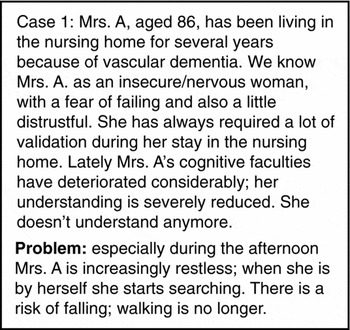
We conducted eight focus group discussions: six with nurses and two with members of multidisciplinary teams, consisting of physicians, psychologists, team managers, occupational therapists and senior nurses. The focus groups were held in the participating nursing homes. The first author conducted all focus groups and was assisted by one of the other researchers. The number of participants in the nurses' focus groups ranged from four to eight. We attempted to promote heterogeneity so as to achieve a mix of nurses with different educational levels, work experience and shifts. To structure and stimulate the discussion we used vignettes (Figure 1) that described real cases from the nursing home where the focus group was held. After introducing the vignettes, open questions were asked to start the discussion about experiences with and the definition of the concept of restraint in practice. Each focus group discussion took approximately 1 hour.
An example of the vignette used in the focus group discussion.

Analysis
The questionnaire was digitized using the data collection interface Blaise. The data were analyzed by means of descriptive statistics and the SPSS 15.0 program. All interviews and focus groups were recorded and transcribed verbatim. The transcripts were coded starting with open coding, which means that codes were directly derived from the texts of the interviews and focus groups. The coding process was supported by Atlas Ti and the open coding stage generated about 200 codes. From these 200 codes, themes were derived that were applicable to our research questions – for example, perception of residents and intention of staff. Based on these themes, more selective coding of the data took place. In this stage texts were also examined for consistency and variance on the themes. Examples that appeared to contrast with the developed themes were examined closely. Two researchers independently coded the data. The codes were compared and discussed until consensus was reached. During the entire process of analysis there was feedback from and discussion with four of the researchers.
Ethical approval
All data were anonymized. Informed consent was asked from all participants. The study protocol was approved by the Medical Ethics Review Committee of the VU University Medical Center.
Results
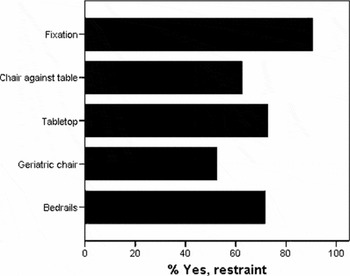
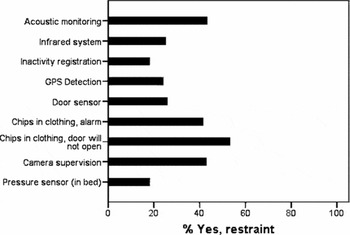
In the questionnaire, more than 80% of the respondents considered “fixation”, e.g. using a safety belt or restraining blanket, to be a restraint. Other physical interventions such as geriatric chairs and bedrails were regarded as restraints by 50 to 70% of the respondents (see Figure 2) Overall, more than half of the respondents did not regard the surveillance technology devices as restraints (for specification of surveillance technology type, see Figure 3).
Proportion of nurses who regarded physical interventions as a restraint.

Proportion of nurses who regarded surveillance technology as a restraint.

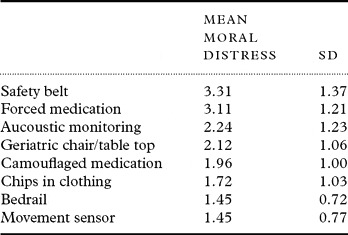
The highest moral distress (Table 2) was experienced when using fixation such as safety belts. The use of a geriatric chair or a tabletop also generated some distress. In the case of surveillance technology, the use of an acoustic monitoring system was experienced as most distressing.
Mean score and standard deviation on each moral distress item. Range: 1 (I do not feel distressed) to 5 (I feel very much distressed)

In the analysis of the responses of subgroups no differences were found with regard to gender or junior vs. senior nurses. Nurses with more than two years of working experience in dementia care tended to consider physical interventions as a restraint more often than nurses with less working experience (p < 0.05). No between-group differences were found for surveillance technology or moral distress.
The interviews and focus group discussions showed that the respondents use several criteria to define an intervention as a restraint. The criteria that were used can be divided into three categories: the perception of the resident, the intention of the care professional, and invasion of privacy.
The perception of the resident
The resident's perception of the intervention, as the respondents saw it, was an important criterion in defining an intervention as a restraint. First, respondents argued that if a resident does not notice an intervention, it cannot be regarded as a restraint. This argument was applied to physical restraints as well as to surveillance technology use. Examples of opinions regarding the perception of the residents are shown below:
Key person about bedrails: You put someone in a bed, in a bedstead so to speak. From the same safety consideration that he won't fall out if he should roll over, and then we call it a restraint. When there are some people who, well, are completely bedridden, they don't experience it like that.
Relative about sensors: Well, look, they aren't aware of it anymore of course. And in that case I think it's a good aid.
A second consideration with regard to resident perception is that a resident may notice the intervention, but does not experience any inconvenience because of it. Some respondents feel such interventions should also not be regarded as restraints. Others stated that the degree of inconvenience experienced by the resident does not affect the restrictive quality of the intervention, but it facilitates the decision to use and continue the use of the intervention. The degree of inconvenience a resident experiences is important in defining restraint, as is illustrated by the following quotation:
Key person about bedrails: Yes, when people are really far gone in their dementia and just slide to the edge of their bed to get out . . . and then are in danger of falling out, then it barely bothers them. In that case it isn't really a restraint for those people.
A third issue the respondents addressed was that some interventions can be pleasant for the resident. For example, in their view a restraining blanket can be comforting and bedrails can provide them with a sense of security. When an intervention is assumed to be pleasant for a resident, most respondents do not regard the intervention as a restraint and do not have serious reservations about using it.
Psychologist: I feel there is a difference between something not inconveniencing you or experiencing something as pleasant. [. . .]If someone experiences it as pleasant it is not a restraint anyway in my opinion.
However, communication and interpretation of utterances and behavior becomes progressively difficult in advanced dementia. As shown in the quotations below, respondents stated that advancing dementia complicated the interpretation of the experiences of residents and this can become problematical when the resident's perception is used to define the restraining qualities of interventions.
Professional caregiver about how to decide an intervention is pleasant for the resident: If they are able communicate that, the doctor said, but I think that's a bit, well, these aren't really the kind of people who can indicate that.
Nursing home physician about deciding if an intervention generates discomfort for a resident: Well, with these people it is harder to figure out, so it's correct that you should be able to tell from restlessness, that kind of thing. So I think it's possible we could be missing something there. You know, when people are no longer able to express that.
The intention of the care professionals
The most frequently mentioned reason for using an intervention concerns the safety of the resident. For example, this can refer to prevention of falling or prevention of exhaustion of residents who do not stop walking by using a physical restraint. Respondents differed with respect to whether or not such safety interventions should be called restraints. They argued that the intention of such interventions is not to restrict the resident, but to protect them from harm or give them the help they need. In their opinion, these interventions should therefore not be labeled as restraints because this would imply an intention to limit the freedom of residents. This argument was also expressed many times when discussing the use of surveillance technology. Nurses and key persons were keen to establish that their intention in using surveillance technology was not to restrain residents but to offer them help when needed. For example, they stated that a bed-exit alarm was not installed to get people back into bed as soon as an alarm goes off, but rather to be able to see if the person needs help. The following quotation illustrates the considerations regarding the intention of interventions:
Key person: It depends on how you use it. Look, if you use surveillance technology, and at the moment the signal goes off you push a person back into bed, yes well then it is basically a restraint. But if the bell rings and you help someone to the toilet, well that's something else in my opinion . . .
Privacy
In defining surveillance technology as a restraint, an additional criterion was used that was not applied to other types of restraints. Some of the nurses and key persons expressed concerns about privacy in defining surveillance technology as a restraint. Relatives in this study did not regard monitoring devices as restraints. On the contrary, they were sometimes surprised that others do.
Key person: Yes, that is rather difficult. “Big Brother is watching you”, is so easy. But although you cannot see or hear it, you are still restricting a resident. That is why I think it is important to describe the measure and to call it a restraint. Because that means that it should only be used when absolutely necessary, i.e. when there is a reason to use it.
Relative about acoustic monitoring: So I think it's fine that such a system exists and that it works, so when they hear stumbling, they can go there. No I don't consider it a restraint at all, I think it's wonderful that it is available.
Differences between respondents
Although the respondents defined restraints on the basis of the same considerations, they often differed in their interpretation of the criteria and their objections to using restraints. Nurses and relatives felt that in some situations there was no choice but to use a restraint.
However, the key persons, who were mostly nursing home physicians, did not always feel that restraints should be used in those situations. Often, nurses and relatives did not understand the physicians' reluctance about using interventions like safety belts or bedrails, and they did not necessarily feel the need to search for alternatives. Key persons, however, tended to keep the negative effects of restraints in mind. The following quotations illustrate the differences in opinion and the mutual lack of understanding between key figures and other respondents:
Daughter of a resident about the use of a belt in bed: She briefly started to sit up . . . but she did not protest and actually lay down again, it apparently didn't bother her, or else she would have, especially in view of her utterances about other things, let us know. But the doctor wouldn't have it, the guidelines didn't allow it, these were all restraints, she did not support that at all.
Nursing home physician: But there are a lot of people who lie in bed without moving a muscle. Then you wonder why the bedrails are still up, that is what I ask myself too. When I suggest putting the bedrails down, I encounter the resistance of the family member in particular.
Discussion
The main goal of this study was to gain insight into how the concept of restraint is experienced and defined in the field of nursing home care for people with dementia. We used both quantitative and qualitative methods in nursing homes that frequently used surveillance technology and nursing homes that rarely used it. We found similar results for both types of nursing homes, but there were differences between the results of the quantitative and qualitative measurements and also in the qualitative data obtained from key figures on the one hand and relatives and nurses on the other.
The quantitative data showed that most nurse respondents regard fixation (e.g. use of belts), putting a chair against the table, a tabletop on a chair, geriatric chairs and bedrails as restraints. They also reported that these interventions were a cause of moral distress, in particular the use of safety belts; but moral distress was also experienced with regard to other physical restraints and surveillance technology.
While these quantitative results seem fairly straightforward, the qualitative data present a more differentiated picture that is only partially in line with the quantitative findings. To determine whether an intervention is a restraint, the respondents used three criteria: the presumed perception of the resident, the intention of the care professional and the degree of invasion of privacy.
First of all, when a resident does not notice an intervention or is not disturbed by it, the decision to use or continue the use of the intervention is more easily made. Some even argue that the term “restraint” does not apply in such cases. However, this criterion depends very much on how staff interpret the residents' behavior and supposed perception, which becomes progressively difficult with advancing dementia. This complicates the application and the reliability of this criterion, as the respondents also argued. What is more, a resident might not express displeasure, but that does not mean that being restrained will not have harmful consequences to the physical and mental health of a resident.
The second criterion used to define a restraint is the intention with which an intervention is carried out. If the purpose of an intervention is to protect or help a resident rather than to restrict him or her, nurses have a problem with the term restraint. The intention criterion is also used to describe the restrictive qualities of surveillance technology. In general, the action that was supposed to follow an alarm determined whether or not the respondents regarded the device as a restraint. To monitor residents without the intention of restricting their actions was not seen as a form of restraint by nurses.
The third criterion that was named was the degree of impingement on privacy. This criterion was only mentioned with regard to surveillance technology and was mainly raised by the key persons. Some key persons feel that they do not need to know everything a resident is doing and that the invasion of privacy can be interpreted as a form of restraint, an argument that is in line with Article 8.1 of the European Convention of Human Rights (everyone has the right to respect for his privacy and family life). Relatives were surprised about this perspective on surveillance technology and did not use this criterion to define interventions as restraining. Nurses were, as described above, predominantly concerned with the intention of the intervention rather than with violation of privacy.
It appears that based on the first and the second criterion named by the respondents, interventions are regarded as a restraint in only a few situations, for example situations in which the intervention clearly causes the resident discomfort. Furthermore, with regard to the intention criterion, it is difficult to think of a situation in which the sole purpose of an intervention is to restrict a resident. However, in the questionnaire, more than half of the nurses stated that they regard several physical interventions as restraints.
A possible explanation for the discrepancy between the quantitative and the qualitative findings is that the nurses apparently know that the named physical interventions are considered restraints within the legal framework. The questionnaire therefore may have measured their general knowledge rather than the considerations and qualifications they use in actual practice. Moreover, in the survey the nurses reported feelings of moral distress with regard to several interventions. This could imply that there are situations in which they do feel as if they are restricting the freedom of a resident, despite their statements to the contrary in the focus groups. Thus, the discrepancy between quantitative and qualitative findings may also indicate the negative and possibly even accusatory implications that are linked to the term restraint. In the interviews and focus group discussions, some respondents seemed hesitant to mark any intervention they use as a restraint, as if the use of restraints is always the opposite of good care. However, the criteria named in this study illustrate that the act of using restraints cannot simply be valued as either good or bad, because each situation in which a restraint might be used is different with regard to the intention of nurses and the burden to the resident. Good care may sometimes require the use of interventions that scholars and legal rules classify as “restraint” or “restriction of freedom”.
Recently, various attempts have been made to diminish the use of restraint. When designing and implementing policy to reduce restraint, several aspects have to be born in mind. First, although nurses in Dutch nursing homes are not authorized to make decisions about the use of restraints (this being the responsibility of the physician), the practical execution of the decision is up to them. It therefore seems important that nurses support the policy. Accordingly, it is important that their feelings and considerations are taken seriously. It is likely that any policy to remove an intervention that is not experienced as a restraint will encounter resistance. We did indeed find that the reluctance of physicians regarding the use of interventions that are not viewed as restraints by nurses and relatives is met with incomprehension. Furthermore, even physicians do not always feel the need to discard all interventions that could be described as restraining.
Secondly, it is important to be aware of the “local logic” of care practice and to take into account that for staff and relatives, an intervention is only regarded as a restraint when it impacts negatively on a resident or when an intervention is used for the sole purpose of restriction of freedom and/or when interventions invade the privacy of a resident. Keeping these considerations in mind might facilitate the discussion and education regarding restraints, although it should be noted that these criteria do not cover all possible arguments in the debate on restraints. For example, a balance must also be found between the risks of putting up a bedrail (e.g. injury caused by climbing over or getting strangled) and leaving them down (e.g. falling out of bed).
Thirdly, when trying to diminish restraint use, it is important to find satisfactory alternatives. Relatives and nursing home staff in this study were predominantly concerned with the intention and the effect of an intervention: Making sure a resident is safe is one of the hallmarks of “good care” for most relatives and nursing home staff. If an alternative is available that is experienced as a safe option, people are likely to be more open to attempts to reduce the use of restraints. For example, monitoring devices can give nurses piece of mind about the safety of a resident. Also, it might be useful to educate care professionals and relatives about the negative consequences associated with restraint use (Neufeld et al., Reference Neufeld, Libow, Foley, Dunbar, Cohen and Breuer1999; Mion et al., Reference Mion2001 Evans et al., Reference Evans, Wood and Lambert2003; Engberg et al., Reference Engberg, Castle and McCaffrey2008).
Fourthly, regular evaluation of the restraints that are being used and discussion about alternatives to those restraints might also be helpful in eliminating the accusatory implications nurses feel when discussing restraint use. An open discussion about improvement of care is probably facilitated if no one feels they have to defend themselves. Nurses feel assaulted when all forms of restraints use are condemned, because this implies they are not always trying to give “good care”. It might be useful to move the focus of the discussion from (implicit) negative judgment of restraint use to a more constructive search for alternatives.
Finally, it would be relevant to gain more insight into the experiences of people with dementia themselves regarding restraint use. Research exploring their perspective is scarce and notoriously difficult due to communication difficulties that increase with advancing dementia. However, as it has been shown possible to elicit their views on quality of end-of-life-care, the possibility to engage people with advanced dementia in research on restraint use cannot completely be discarded (Godin and Waters, Reference Godin and Waters2009). This is a challenge for future research on this topic.
Conflict of interest
None.
Description of authors' roles
CH and AF designed the study. SA collected the data, CH and AN assisted in collecting the data. SA, CH, AN and AF analyzed the data. MD, CH and AF contributed to writing the paper. SA wrote the paper.
Acknowledgment
The study was funded by the Netherlands Organization for Health Research and Development (ZonMw).