INTRODUCTION
Faunistic and ecological works on the macrobenthic communities of the Iberian and Galician coasts have been carried out by several authors in recent years. The particular kind of estuarine systems called ‘rías’ have been especially studied due to their great economic and social importance, linked to fisheries, bivalve culture on rafts and shellfish resources. Particularly, these works have focused on their benthic communities, because they have been considered as good indicators of the conditions of marine bottoms (Warwick, Reference Warwick1988; Grall & Glémarec, Reference Grall and Glémarec1997).
Despite the profusion of scientific studies in Ensenada de San Simón (Nombela et al., Reference Nombela, Vilas, Evans, Flemming and Bartholoma1995; Fernández Rodríguez et al., Reference Fernández Rodríguez, Iglesias Portas, Pazos López, González and Cabaleiro Amil1997; Álvarez-Iglesias et al., Reference Álvarez-Iglesias, Rubio and Vilas2003), few researchers have analysed patterns of benthic fauna spatial distribution, neither have they quantified the population structures. This fauna was studied in the soft bottoms of other rías (López-Jamar, Reference López-Jamar1978, Reference López-Jamar1981; Mora, Reference Mora1982; López-Jamar & Mejuto, Reference López-Jamar and Mejuto1985; Mazé et al., Reference Mazé, Laborda and Luis1990; Currás & Mora, Reference Currás and Mora1991; Junoy, Reference Junoy1996; Olabarría et al., 1998; Troncoso et al., Reference Troncoso, Moreira and Urgorri2005). The Ensenada de San Simón was only sampled by Rolán (Reference Rolán1983) and Rolán et al. (Reference Rolán, Otero-Schmitt and Rolán-Álvarez1989), whereas in the Ría de Vigo several exhaustive studies have been carried out (Hidalgo, Reference Hidalgo1917; Margalef, Reference Margalef1958; Viéitez, Reference Viéitez1976, Reference Viéitez1981; Anadón, Reference Anadón1980; Viéitez & López-Cotelo, Reference Viéitez and López-Cotelo1982; López-Jamar & Cal, Reference López-Jamar and Cal1990; Moreira et al., Reference Moreira, Domínguez and Troncoso2004, Reference Moreira, Quintas and Troncoso2005).
Consequently, there was a need for improving the scientific knowledge to manage correctly and take control measures along the area, particularly since it has been included in the Nature 2000 Network like a Special Conservation Zone. Therefore, to supply this need, the aim of the present study was to describe and quantify the macrofaunistic communities and associations inhabiting intertidal and subtidal soft substrata throughout the Ensenada de San Simón. Characteristic and dominant species were discriminated, and we discuss how they relate to the measured environmental variables.
MATERIALS AND METHODS
Study area
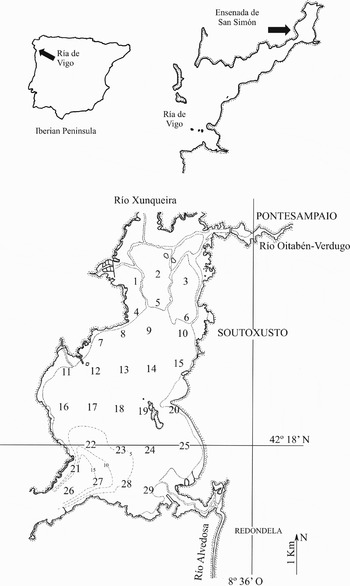
The Ensenada de San Simón is located in the inner part of the Ría de Vigo, between 42º17′ and 42º21′ N and 8º37′ and 8º39′ W (Figure 1). Soft-bottoms of this inlet are mainly muddy with high organic matter content (Vilas et al., Reference Vilas, Nombela, García-Gil, García-Gil, Alejo, Rubio, Pazos and de Galicia1995). Intertidal and shallow subtidal areas have meadows of the sea grasses Zostera noltii Hornem. 1832 and Zostera marina L. Culture of mussels on rafts is a common practice in large areas of the mouth of the inlet (Abella et al., Reference Abella, Parada and Mora1996). Large freshwater input occurs in the innermost part of the inlet which translates into fluctuations of salinity on both a tidal and seasonal basis (Nombela & Vilas, Reference Nombela and Vilas1991).
Location of the Ensenada de San Simón (Ría de Vigo) and position of the 29 sampling sites.

Sampling strategy and sediment analysis
Samples were collected during November and December 1999 from 29 sites (Figure 1). Five replicate samples were taken at each site, by means of a Van Veen grab (0.056 m2). Samples were sieved through 0.5 mm mesh and the retained material was fixed in 10% buffered formalin. Fauna was sorted from the sediment and preserved in 70% ethanol. Temperature, pH, Eh and salinity were measured in situ from water and/or sedimentary samples taken from each site. An additional sedimentary sample was taken at each site for grain-size analyses and to determine content of calcium carbonate and total organic matter. Granulometric fractions were determined according to Guitián & Carballas (Reference Guitián and Carballas1976) and sedimentary types according to Rodrigues & Quintino (Reference Rodrigues and Quintino1985) and Junoy (Reference Junoy1996). Median size grain (Q50, mm) and sorting coefficient (So) (Trask, Reference Trask1932) were also determined for each sample. Content of calcium carbonate (%) was estimated by treatment of a sample with hydrochloric acid, and content of total organic matter (%) was estimated from the weight loss after placing samples in a furnace for 4 h at 450ºC. Kurtosis (Kg) and skewness (Sk) coefficients were calculated according to Folk & Ward (Reference Folk and Ward1957).
Data analysis
Abundance data of each species were organized in matrices. Total abundance (N), number of species (S), Shannon–Wiener diversity index (H′, log2) and Pielou evenness index (J) were determined for each site. Fauna assemblages or groups were determined through non-parametric multivariate techniques using the Plymouth Routines in Multivariate Ecological Research software package (PRIMER; Clarke & Warwick, Reference Clarke and Warwick1994). A similarity matrix was prepared using the Bray–Curtis coefficient (Bray & Curtis, Reference Bray and Curtis1957) after applying the fourth-root transformation to species abundance. From the similarity matrix, classification and ordination of the sites was performed by cluster analysis through the algorithm UPGMA and non-metrical multidimensional scaling (MDS), respectively. Rare species, such as those appearing in one site or in small numbers (1–2 individuals) were included in the final analyses because preliminary trials showed that their suppression did not make a different classification or ordination of sites. The SIMPER program was used to identify species that contributed to dissimilarity among groups of sites determined by classification and ordination analyses.
Species were classified according to the constancy and fidelity indices (Dajoz, Reference Dajoz1971) and according to the fidelity–dominance product (Glémarec, Reference Glémarec1964). Relationships between abundance of invertebrates and environmental variables were investigated by means of the BIOENV procedure (PRIMER package) and canonical correspondence analysis (CANOCO package; ter Braak & Prentice, Reference Ter Braak and Prentice1988). Environmental variables expressed in percentages were previously transformed by log (x + 1) and then all of them were normalized.
RESULTS
Sedimentary characterization
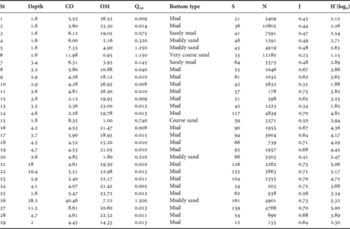
The soft bottoms of the Ensenada de San Simón were characterized by a predominance of muddy sediments with high content of total organic matter and by being low in calcium carbonate (Table 1). Sandy sediments were present in tidal channels in the inner inlet where low content of total organic matter was also found. Areas around the outer part of the inlet had muddy sands with a large gravel fraction comprising shells of mussels which are cultured there.
Depth of the water column during the sampling (metres), characteristics of sediments and faunistic parameters (in 0.28 m2) at each sampled site (St).

St, station; CO, percentage of carbonate; OM, percentage of organic matter; Q50, median particle size (mm); S, number of species; N, abundance; J, Pielou evenness; H′, Shannon–Wiener diversity index.
Macrobenthic fauna
Sampling yielded 95, 680 individuals belonging to 362 taxa, of which 123 species were polychaetes, 97 crustaceans, 34 gastropods and 30 bivalves. Polychaetes, nematodes and gastropods were the most abundant groups (73% of total abundance); oligochaetes (10.18%), ostracods, (3.60%) and bivalves (2.82%) were found in smaller numbers.
The largest numbers of fauna were recorded at the sandy intertidal sites 6, 2 and 3, and in the muddy 22, 10 and 20 (Table 1). The intertidal zone was colonized by large numbers of Hydrobia ulvae (Pennant, 1777). This hydrobiid showed densities up to 34,946 individuals per m−2 (ind m−2) in sandy bottoms of tidal channels and of 14,800 ind m−2 in sediments colonized by Zostera marina and Z. noltii in the innermost part of the inlet. Other dominant organisms were Pseudopolydora paucibranchiata (Okuda, 1937) and Rissoa labiosa (Montagu, 1803), mainly in muddy and shallow bottoms.
Lowest densities were recorded at sites 29 and 11 (574–635 ind m−2), and other poor sites were 24, 12 and 28 (724–2470 ind m−2).
Sites 26, 22 and 27 in the mouth of the inlet showed the largest number of species (139–161). Only 12 and 34 species were found in each of sites 29 and 24, which are located in the mouth of the Alvedosa River. The Shannon–Wiener diversity index fluctuated between 1.15 (site 6) and 5.32 (site 26), and evenness ranged from 0.23 (site 6) to 0.73 (sites 11, 21 and 26). Greatest values of H′ were recorded in sites in the mouth of the inlet while the lowest values were found in sites with large numbers of H. ulvae.
Spearman's correlation coefficient showed that depth was positively correlated with the number of species, diversity and evenness (P < 0.01). The diversity index and number of species showed positive correlations with temperature of bottom water (P < 0.01), while only diversity was positively correlated (P < 0.05) with temperature of sediment and sort coefficient.
Multivariate analysis
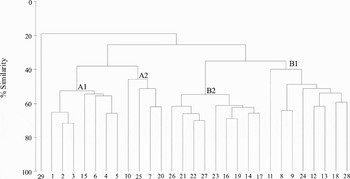
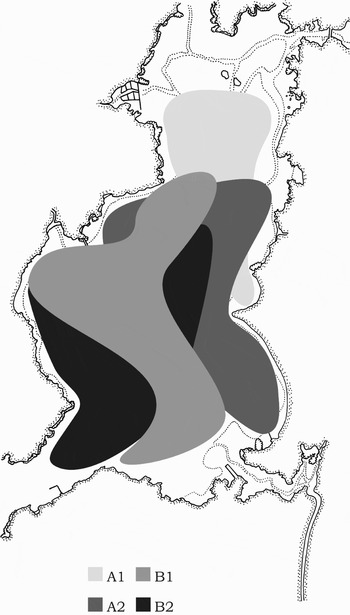
A dendrogram obtained through cluster analysis based on abundance data showed four main groups: A1, A2, B1 and B2 (Figure 2). Group A1 (sites 1, 2, 3, 4, 5, 6 and 15) had a varied sedimentology (from mud to very coarse sand); Group A2 (sites 7, 10, 20 and 25) was composed of muddy and sandy–muddy bottoms; Group B1 (sites 8, 9, 11, 12, 13, 18, 24 and 28) comprised muddy sediments and Group B2 (sites 14, 16, 17, 19, 21, 22, 23, 26 and 27) had sites of mud and muddy–sand bottoms. Ordination of sites through non-metrical multidimensional analysis confirmed the results of the dendrogram.
Dendrogram using Bray–Curtis similarity coefficient.

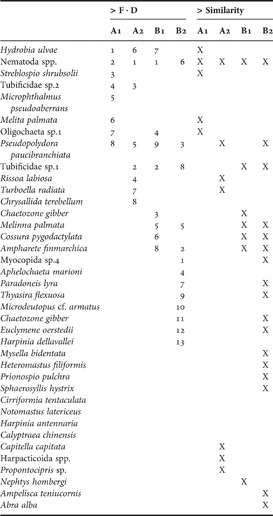
SIMPER analysis showed that the mollusc Hydrobia ulvae (Pennant, 1777), annelids Streblospio shrubsolii (Buchanan, 1890) and Oligochaeta sp.1, nematodes and the crustacean Melita palmata (Montagu, 1804) were the taxa with a greater contribution to similarity (up to a cumulative 40%) for Group A1. Group A2 was mainly defined by Turboella radiata (Philippi, 1836), Rissoa labiosa (Montagu, 1803), Capitella cf. capitata (Fabricius, 1780), P. paucibranchiata, nematodes and harpacticoid copepods. Group B1 was determined by nematodes, the oligochaete Tubificidae sp. 1 and Chaetozone gibber Woodham & Chambers, 1994, Ampharete finmarchica (Sars, 1866), Cossura pygodactylata Jones, 1956, Nephtys hombergi Savigny, 1818, and Melinna palmata Grube, 1870. Nematodes, annelids A. finmarchica, P. paucibranchiata, Melinna palmata, Paradoneis lyra (Southern, 1914), C. gibber, Euclymene oerstedii (Claparède, 1863), C. pygodactylata, Sphaerosyllis hystrix Claparède, 1863, Prionospio pulchra Imajima, 1990, Heteromastus filiformis (Claparède, 1864) and Tubificidae sp.1, crustaceans Myocopida sp. 4 and Ampelisca tenuicornis Liljeborg, 1855 and molluscs Thyasira flexuosa (Montagu, 1803), Mysella bidentata (Montagu, 1803) and Abra alba (Wood, 1802) defined Group B2. Most of these species were also responsible for dissimilarities among dendrogram groups.
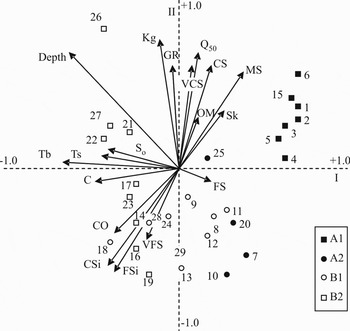
The BIOENV procedure showed that depth was the variable with the highest correlation with faunistic data (Spearman's rank correlation p w: 0.374), followed by the combination of depth and median grain size (p w: 0.259) and that of temperature of bottom water, very fine sand, fine silt and depth (p w: 0.256). Canonical correspondence analysis showed that the first two axes accounted for 39.3% of the total variance of species–environment relation, and 30.2% of the species variance. Bottom water and sediment temperature, depth and calcium carbonate showed the highest correlations with axis I, the correlations with other axes being less significant. Forward selection in this analysis selected depth, fine silt, temperature of bottom water and carbonates content as the variables explaining most of the variance in the species data (P < 0.01) as well as very fine sand and kurtosis coefficient (P < 0.05). The graphic representation showed an ordination of sites following a gradient in depth, bottom water temperature and grain size gradient (Figure 3). Sites from Group A were distributed along positive quadrants of axes I and II, in intertidal or shallow waters with coarse sediments and those from Group B were deeper with greater content of finer sedimentary fractions.
Canonical correspondence analysis ordination of environmental variables and sampled sites relative to the axes I and II for the Ensenada de San Simón. Ts, temperature of sediment; Tb, temperature of bottom water; So, sorting coefficient; Kg, kurtosis; Sk, skewness; GR, gravel; VCS, very coarse sand; CS, coarse sand; MS, medium sand; FS, fine sand; VFS, very fine sand; CSi, coarse silt; FSi, fine silt; C, clay; CO, carbonate; OM, organic matter; Q50, median particle size.

Description of assemblages
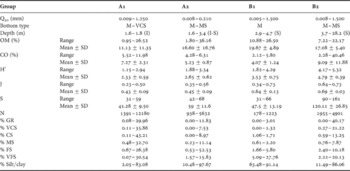
Multivariate analyses differentiated four different assemblages or faunistic aggregations, corresponding with the four groups from the dendrogram (Tables 2 & 3; Figure 4).
Spatial distribution of assemblages determined in Ensenada de San Simón as determined through cluster classification analysis.

Summary of characteristics for each association. I. Ecological features of the macrofaunistic assemblages determined in the Ensenada de San Simón, indicating range values of biotic and physical characteristics.

Q50, median grain size; OM, organic matter; CO, carbonate; S, number of species; N, abundance (ind 0.28 m−2); J, Pielou evenness; H′, Shannon–Wiener diversity index; GR, gravel; VCS, very coarse sand; CS, coarse sand; MS, medium sand; FS, fine sand; VFS, very fine sand; M, mud; I, intertidal; S, subtidal.
Group A1 (1, 2, 3, 4, 5, 6, 15) was located in the innermost part of the inlet, in intertidal sediments subjected to strong variations of salinity close to the mouth of the Rivers Oitabén-Verdugo and Xunqueira. Sites showed granulometric differences, with sedimentary types ranging from mud to very coarse sand. The most abundant species was H. ulvae, mainly in bottoms colonized by Z. noltii, followed by nematodes and P. paucibranchiata. These bottoms showed the lowest number of species: 102 taxa (from 31 to 59 by site). The sea grasses Z. marina and Z. noltii were spread across most of these bottoms. The most characteristic species according to values of the fidelity–dominance product (F · D, Table 3), were H. ulvae, nematodes, S. shrubsolii, Tubificidae sp. 2, Microphthalmus pseudoaberrans Campoy & Viéitez, 1982 and Melita palmata (all of them constant). This area had the smallest mean diversity value (2.33 ± 0.59) due to the high dominance of nematodes and H. ulvae. This gastropod is the most important contributor to the high densities existing in this group (21768.37 ind m−2 ± 15008.97). According to the number of species, crustaceans present the greater percentage (30.39%), followed by polychaetes and molluscs. A total of 10 taxa surpass 1% of average dominance in this group. Group A2 (sites 7, 10, 20 and 25) was located in the intertidal muddy and sandy bottoms. Sites 10 and 20 had Z. marina meadows. A total of 115 taxa were found, being the most characteristic nematodes P. paucibranchiata, H. ulvae (constant, occasional), Tubificidae sp.1 and Chrysallida terebellum (Philippi, 1844) (constant, accessory), Tubificidae sp. 2 (common, occasional), R. labiosa and T. radiata (constant, preferential) and Microdeutopus gryllotalpa A. Costa, 1853 (very common, accessory). Diversity was a little higher than in the previous group, including interval 1.88–3.34 (2.65 ± 0.62). Polychaetes and crustaceans presented the highest percentages according to the number of species (>30%). Among the 13 most dominant taxa (average dominance >1%) add a total average dominance of almost 89%. Group B1 (8, 9, 11, 12, 13, 18, 24 and 28) was present in shallow subtidal water with muddy bottoms. The number of species increased from sites in inner areas towards the mouth. Diversity oscillated between 1.82 and 4.29. The polychaetes were estimated to be 26% of all the individuals, due to the high densities showed by Melinna palmata, C. pygodactylata and C. gibber. Crustaceans and polychaetes presented the highest percentages according to the number of species (32.5 and 36.5% respectively). Fourteen taxa exceeded an average dominance of 1%, all of them being constant or very common. The most characteristic species, according to F · D and dominance values, were nematodes (constant, occasional), Tubificidae sp.1 and C. gibber (constant, accessory), Oligochaeta sp.1 (very common, occasional), Melinna palmata, C. pygodactylata and A. finmarchica (constant, accessory) and H. ulvae (very common, occasional). Group B2 (14, 16, 17, 19, 21, 22, 23, 26 and 27) was situated in subtidal bottoms of the external part of the inlet (3.7–28.2 m). These bottoms showed the highest mean value of diversity (4.79 ± 0.39). A total of 289 species was found, many of them showing great values of fidelity. Among the species with highest values of product F · D were Myocopida sp. 4 (preferent), polychaetes A. finmarchica (accessory), P. paucibranchiata (occasional), Aphelochaeta marioni (Saint-Joseph, 1894) (elective), Melinna palmata (accessory), Paradoneis lyra (accessory), Chaetozone gibber (accessory) and Euclymene oerstedii (accessory), nematodes (occasional) and Tubificidae sp.1 (occasional), the bivalve Thyasira flexuosa (accessory) and the crustacean Microdeutopus cf. armatus Chevreux, 1887 (accessory), all of them constant.
Summary of characteristics for each association. II. They are indicated species with highest values of the fidelity–dominance (F · D) product (decreasing order: 1, 2, 3…); dominant species for each group are highlighted in the shaded areas (until 75% accumulate mean dominance); X marks species with most important values to similarity in each group.

DISCUSSION AND CONCLUSIONS
In Ensenada de San Simón, the distribution of the macrobenthic fauna seemed to be primarily determined by depth and grain-size. These local environmental variables, mud content, salinity and bed level height, explained the largest part of the variation in macrobenthic fauna distributions of the estuarine, intertidal soft-sediment environment studied by Ysebaert & Herman (Reference Ysebaert and Herman2002). The lack of strong currents in most parts of the Ensenada de San Simón is responsible for a gradient in grain-size. Intertidal and shallow sediments in inner channels are mostly sandy and then becoming increasingly muddy towards the deeper bottoms in the centre and mouth of the inlet. Number of species, diversity and evenness were greater on subtidal bottoms than on intertidal areas. The intertidal sediments in Ensenada de San Simón are likely to be subjected to changes in salinity due to the freshwater input from several rivers (Vilas et al., Reference Vilas, Nombela, García-Gil, García-Gil, Alejo, Rubio, Pazos and de Galicia1995). The fluctuations in salinity may greatly influence the number and types of species that can survive there (Kikuchi, Reference Kikuchi1987) and dominate the community (Planas & Mora, Reference Planas and Mora1987), such as the gastropod H. ulvae which has a high dominance in these sediments. Large densities of H. ulvae are common in inner areas of other Galician rías (Currás & Mora, Reference Currás and Mora1990; Junoy, Reference Junoy1996; Olabarría et al., Reference Olabarría, Urgorri and Troncoso1998), and adults of this species were homogeneously distributed over the intertidal mudflat studied by Haubois et al. (Reference Haubois, Guarini, Richard, Hemon, Arotcharen and Blanchard2004). Hydrobia ulvae has a broad range of food sources, acting as a detritivore feeding on organic remains and faecal pellets (Jacobs et al., Reference Jacobs, Hegger and Ras-Willems1983) or grazing microalgae (Muus, Reference Muus1967) which may explain the large numbers in these sediments.
Diversity, number of species and evenness showed positive correlations with depth. Thus, deeper sediments have a greater diversity than sediments located in intertidal areas and unstable conditions (Kikuchi, Reference Kikuchi1987).
Intertidal sediments colonized by Zostera noltii and Z. marina showed low diversities. Sea grass meadows are known to provide a complex habitat that may be colonized by many species (Orth, Reference Orth and Coull1977; Peterson et al., Reference Peterson, Summerson and Duncan1984; Somersfield et al., 2002). In Ensenada de San Simón, however, these meadows are located in areas subjected to changes in salinity which is a major limiting factor for many species (Kikuchi, Reference Kikuchi1987; Planas & Mora, Reference Planas and Mora1987; Junoy, Reference Junoy1996). In fact, Planas & Mora (Reference Planas and Mora1987) indicated the dominance of eurihaline species in estuarine communities, which are submitted to great changes in physical conditions. The highest values of diversity and number of species were found in the mouth of the inlet. These subtidal sediments showed more stable conditions in terms of salinity and currents (Nombela et al., Reference Nombela, Vilas, Rodríguez and Ares1987). The sites with the smallest number of species and individual densities were muddy bottoms close to the mouth of freshwater channels and the main harbour in the inlet. Thus, it may be suspected that fluctuations in salinity coupled with effects of human activities, such as organic enrichment and disposal sewage, may be responsible for the scarce macrobenthic fauna. In general, diversity values observed in Ensenada de San Simón were high (3.47 ± 1.15) in comparison to other Galician rías with a predominance of sandy bottoms (Ría de Ares-Betanzos (Troncoso & Urgorri, Reference Troncoso and Urgorri1991) or Ensenada de Baiona (Moreira et al., Reference Moreira, Domínguez and Troncoso2004)).
Two major assemblages structured in facies (subdivision in the community that does not affect its qualitative composition) have been determined in Ensenada de San Simón: in the intertidal zone the reduced Macoma community (Thorson, Reference Thorson1957) was present, while subtidal bottoms were characterized by a Syndosmya (=Abra) alba community (Petersen, Reference Petersen1918).
The species belonging to the reduced Macoma community have been cited at several parts of the Atlantic and Cantabric–Iberian litoral (López-Cotelo et al., Reference López-Cotelo, Viéitez and Diaz-Pineda1982; Mora, Reference Mora1982; Penas & González, Reference Penas and González1983; Calvário, Reference Calvário1984; Quintino et al., Reference Quintino, Rodrigues, Gentil and Peneda1987; Carvalho et al., Reference Carvalho2005). Two facies were distinguished within this assemblage: the first one, corresponding to subgroup A1, was located in northern intertidal inner areas and was characterized by the presence of H. ulvae, S. shrubsolii, M. pseudoaberrans and Melita palmata. The polychaete S. shrubsolii was a characteristic species in the intertidal area of Estuario del Guadalquivir (Baldó et al., Reference Baldó, Arias and Drake2001), while Melita palmata appeared with important densities in the intertidal community in Ría de Foz (Junoy, Reference Junoy1996). This facies was associated in Ensenada San Simón with meadows of the sea grasses Z. noltii and Z. marina. These meadows are a refuge for the fauna, stabilize the sediment and retain detritus and concentrate high percentages of organic matter (e.g. site 10). Sea grass meadows generate an important source of food to numerous species (Peterson et al., Reference Peterson, Summerson and Duncan1984; Somerfield et al., Reference Somerfield, Yodnarasri and Aryuthaka2002). Nevertheless, the variation of salinity in the area (Saiz et al., Reference Saiz, López-Benito and Anadón1961) is an important factor controlling the biota and favouring eurihaline fauna. And so, although Currás & Mora (Reference Currás and Mora1991) and Moreira et al. (Reference Moreira, Quintas and Troncoso2005) found the highest diversity values in meadows of Z. marina of Ría del Eo and Ensenada de Baiona, in Ensenada San Simón these sites are among the poorest. The second facies (subgroup A2), with marginal distribution, was characterized by large numbers of nematodes as well as of H. ulvae, R. labiosa and T. radiata. Both facies are variations of a reduced Macoma community (Thorson, Reference Thorson1957). Similar faunal assemblages have been reported from other intertidal and shallow bottoms in the Galician rías (Anadón, Reference Anadón1980; Viéitez, Reference Viéitez1981; Mora, Reference Mora1982; Troncoso & Urgorri, Reference Troncoso and Urgorri1991; Mazé et al., Reference Mazé, Lastra and Mora1993). In estuarine bottoms with high organic content, the assemblage tends to be dominated by H. ulvae (Junoy, Reference Junoy1996; Olabarría et al., Reference Olabarría, Urgorri and Troncoso1998).
The assemblage corresponding to Group B (Syndosmia (=Abra) alba community) was also structured in two facies. The first one, B1, presented fauna of transition between that of the reduced Macoma community (e.g. H. ulvae) and that typical of the A. alba community (e.g. Melinna palmata or C. gibber). Characteristic species of the A. alba community tend to be more abundant in muddier sediments, such as the bivalves A. nitida, M. bidentata and T. flexuosa. The facies in deeper bottoms, B2, was characterized by the greater dominance of P. paucibranchiata and A. finmarchica.
Similar assemblages, showing faunas of transition between typical ‘communities’ (as in Thorson, Reference Thorson1957) both in composition of species and numbers of any given species according to gradients in depth and granulometry, have been reported by Olabarría et al. (Reference Olabarría, Urgorri and Troncoso1998), Sánchez-Mata & Mora (Reference Sánchez-Mata and Mora1999), Moreira et al. (Reference Moreira, Quintas and Troncoso2005) and Lourido et al. (Reference Lourido, Gestoso and Troncoso2006) in a variety of muddy bottoms of Galicia.
ACKNOWLEDGEMENT
We thank the Adaptations of Marine Animals laboratory staff for their invaluable help with sample collection and comprehension of statistical methods.