Introduction
The European honey bee (Apis mellifera) is a key organism in the balance of ecosystems and very important in the global production of food. Hence the massive disappearance of their colonies, observed in various countries in recent years (van Engelsdorp et al., Reference van Engelsdorp, Evans, Saegerman, Mullin, Haubruge, Nguyen, Frazier, Frazier, Cox-Foster, Chen, Underwood, Tarpy and Pettis2009; Potts et al., Reference Potts, Roberts, Dean, Marris, Brown, Jones, Neumann and Settele2010), has taken a growing public interest in the entire world. A relevant role in this process has been attributed to the ectoparasitic mite Varroa destructor and to honeybee viruses (de Miranda and Genersch, Reference de Miranda and Genersch2010; Martin et al., Reference Martin, Highfield, Brettell, Villalobos, Budge, Powell, Nikaido and Schroeder2012; Maggi et al., Reference Maggi, Antúnez, Invernizzi, Aldea, Vargas, Negri, Brasesco, De Jong, Message, Weinstein Teixeira, Principal, Barrios, Ruffinengo, Rodríguez Da Silva and Eguaras2016). More than 24 virus species, mainly positive-sense, single-stranded RNA viruses (+ssRNA) of the Dicistroviridae and Iflaviridae families, have been identified to date in A. mellifera, eight of which have been found to be associated with V. destructor-vectored transmission (Genersch and Aubert, Reference Genersch and Aubert2010; de Miranda et al., Reference de Miranda, Bailey, Ball, Blanchard, Budge, Chejanovsky, Chen, Gauthier, Genersch, de Graaf, Ribière, Ryabov, De Smet and van der Steen2013). Among the most studied viruses are Acute bee paralysis virus (ABPV; family: Dicistroviridae) and Deformed wing virus (DWV; family: Iflaviridae), which have been associated with Varroa mites and colony death around the world (Ellis and Munn, Reference Ellis and Munn2005; Gauthier et al., Reference Gauthier, Tentcheva, Tournaire, Dainat, Cousserans, Colin and Bergoin2007; Martin et al., Reference Martin, Highfield, Brettell, Villalobos, Budge, Powell, Nikaido and Schroeder2012; Wilfert et al., Reference Wilfert, Long, Leggett, Schmid-Hempel, Butlin, Martin and Boots2016).
Argentina is positioned as one of the major producers of honey in the world. There are around 3 million bee colonies managed by approximately 25,000 beekeepers in the country (Maggi et al., Reference Maggi, Antúnez, Invernizzi, Aldea, Vargas, Negri, Brasesco, De Jong, Message, Weinstein Teixeira, Principal, Barrios, Ruffinengo, Rodríguez Da Silva and Eguaras2016), which are mainly located in Buenos Aires Province (Reynaldi et al., Reference Reynaldi, Sguazza, Tizzano, Fuentealba, Galosi and Pecoraro2011). Nevertheless, the average number and strength of these colonies decrease each year. Our research group reported in previous studies that 30% of colony loses in Argentina occur in areas with temperate climates; as is the case of Buenos Aires and Santa Fé Provinces, the main honey-producing Provinces of the country (Maggi et al., Reference Maggi, Antúnez, Invernizzi, Aldea, Vargas, Negri, Brasesco, De Jong, Message, Weinstein Teixeira, Principal, Barrios, Ruffinengo, Rodríguez Da Silva and Eguaras2016). This scenario is alarming and the result of synergistic effects generated by Varroa and its ability to vector viruses in tandem with agricultural intensification (Maggi et al., Reference Maggi, Ruffinengo, Negri, Brasesco, Medici, Quintana, Eguaras and Molley2013, Reference Maggi, Antúnez, Invernizzi, Aldea, Vargas, Negri, Brasesco, De Jong, Message, Weinstein Teixeira, Principal, Barrios, Ruffinengo, Rodríguez Da Silva and Eguaras2016). The current beekeeping situation of the country suggests the increasing necessity of more intensive mite control and care of honeybee colonies in the area.
In Argentina, the information about bee viruses is scarce and fragmented. However in 2010, Reynaldi et al. reported the molecular identification of Chronic bee paralysis virus (CBPV), ABPV, and Sacbrood virus (SBV) in Buenos Aires (Reynaldi et al., Reference Reynaldi, Sguazza, Pecoraro, Tizzano and Galosi2010). In their study, a lower rate of infection and some cases of co-infection with more than one virus were found when compared to other countries of South America (Antúnez et al., Reference Antúnez, D'Alessandro, Corbella, Ramallo and Zunino2006). In 2011, the same authors reported by RT-PCR the presence of Israeli acute paralysis virus (IAPV) in samples taken from several Provinces. These data indicated a high frequency of IAPV in asymptomatic hives in Argentina (Reynaldi et al., Reference Reynaldi, Sguazza, Tizzano, Fuentealba, Galosi and Pecoraro2011).
In this concern, our research group collaborated and investigated the distribution of SBV, DWV, IAPV, and ABPV in colonies of the South-eastern region of Buenos Aires Province during 2013. Viruses were detected in 33.3% of all samples tested. SBV was identified in pupae, IAPV and DWV were identified in adult bees and in V. destructor mites. ABPV was not detected in any of the samples analyzed (Brasesco et al., Reference Brasesco, Quintana, Negri, Medici, Ruffinengo, Eguaras and Maggi2013). High loads of DWV in bees with deformed wings and lower viral loads in bees with normal wing appearance were observed, as previously reported (Yang and Cox-Foster, Reference Yang and Cox-Foster2005; Martin et al., Reference Martin, Highfield, Brettell, Villalobos, Budge, Powell, Nikaido and Schroeder2012). This was also corroborated later on by our research group in a recently published article; differences in DWV loads between deformed wings bees and normal bees were analyzed in relation with changes in the expression levels of immune genes of A. mellifera (Quintana et al., Reference Quintana, Brasesco, Negri, Marin, Pagnuco, Szawarski, Reynaldi, Larsen, Eguaras and Maggi2019).
Given that DWV is now considered as a quasi-species complex, described as a range of variants, genetically linked through mutation and organized around a master sequence or variant (Mordecai et al., Reference Mordecai, Wilfert, Martin, Jones and Schroeder2016; Kevill et al., Reference Kevill, Highfield, Mordecai, Martin and Schroeder2017; Ryabov et al., Reference Ryabov, Childers, Lopez, Grubbs, Posada-Florez, Weaver, Girten, van Engelsdorp, Chen and Evans2019); nothing is known about the prevalent types of the DWV variants and their distribution in Argentina. Moreover, no other variant of this virus quasi-species has yet been identified in the country other than the well-known DWV type A (DWV-A) master variant.
DWV-A and DWV-B (previously designated as Varroa destructor virus-1, VDV-1) belong to the same viral cloud or complex (de Miranda and Genersch, Reference de Miranda and Genersch2010; Martin et al., Reference Martin, Highfield, Brettell, Villalobos, Budge, Powell, Nikaido and Schroeder2012; Mordecai et al., Reference Mordecai, Wilfert, Martin, Jones and Schroeder2016; Kevill et al., Reference Kevill, Highfield, Mordecai, Martin and Schroeder2017; McMenamin and Flenniken, Reference McMenamin and Flenniken2018); family: Iflaviridae. Both viruses cause wing deformities and bloated abdomens in developing honeybees, and reduce the lifespan of infected adult bees (de Miranda and Genersch, Reference de Miranda and Genersch2010; Benaets et al., Reference Benaets, Van Geystelen, Cardoen, De Smet, de Graaf, Schoofs, Larmuseau, Brettell, Martin and Wenseleers2017; Brettell et al., Reference Brettell, Mordecai, Schroeder, Jones, da Silva, Vicente-Rubiano and Martin2017). Clinical signs are worsened by V. destructor infestation as it vectors them facilitating the transmission of specific DWV sequence variants (Martin et al., Reference Martin, Highfield, Brettell, Villalobos, Budge, Powell, Nikaido and Schroeder2012); increasing their prevalence and virulence in bee colonies (Zioni et al., Reference Zioni, Soroker and Chejanovsky2011; Martin et al., Reference Martin, Highfield, Brettell, Villalobos, Budge, Powell, Nikaido and Schroeder2012). However, both variants have been detected in honey bees in the absence of Varroa (Yue and Genersch, Reference Yue and Genersch2005; Zioni et al., Reference Zioni, Soroker and Chejanovsky2011; Martin et al., Reference Martin, Highfield, Brettell, Villalobos, Budge, Powell, Nikaido and Schroeder2012). It has been determined that both types of viruses are closely related as they share 84% of identity in their nucleic acid sequence and 95% amino acid identity (Ongus et al., Reference Ongus, Peters, Bonmatin, Bengsch, Vlak and van Oers2004), which makes the recombination events between them something very common (Moore et al., Reference Moore, Jironkin, Chandler, Burroughs, Evans and Ryabov2011; Zioni et al., Reference Zioni, Soroker and Chejanovsky2011; Ryabov et al., Reference Ryabov, Wood, Fannon, Moore, Bull, Chandler, Mead, Burroughs and Evans2014; Dalmon et al., Reference Dalmon, Desbiez, Coulon, Thomasson, Le Conte, Alaux, Vallon and Moury2017). Nevertheless, they can be distinguished by simple RT-qPCR tests with specific primers; hence both variants and their recombinants can co-exist in mites and honeybees at the same time (Ongus et al., Reference Ongus, Peters, Bonmatin, Bengsch, Vlak and van Oers2004; Zioni et al., Reference Zioni, Soroker and Chejanovsky2011). The major difference, at sequence level, between DWV-A and DWV-B is located in the 5′untranslated region and (at amino acid level especially) in the Leader protein (Lp) region (Lanzi et al., Reference Lanzi, De Miranda, Boniotti, Cameron, Lavazza, Capucci, Camazine and Rossi2006; Dalmon et al., Reference Dalmon, Desbiez, Coulon, Thomasson, Le Conte, Alaux, Vallon and Moury2017) of the viral genome, though there are also several other nucleotide differences between the coding regions of these viruses which result in amino acid changes in other proteins as well (Zioni et al., Reference Zioni, Soroker and Chejanovsky2011; Dalmon et al., Reference Dalmon, Desbiez, Coulon, Thomasson, Le Conte, Alaux, Vallon and Moury2017; Ryabov et al., Reference Ryabov, Childers, Lopez, Grubbs, Posada-Florez, Weaver, Girten, van Engelsdorp, Chen and Evans2019).
The advantage of recombination has been widely debated. Recombinants are generally believed to be less suitable than their main master variants, on average, and this has been demonstrated in several RNA viruses (Garcia-Arenal et al., Reference Garcia-Arenal, Fraile and Malpica2003; Desbiez et al., Reference Desbiez, Joannon, Wipf-Scheibel, Chandeysson and Lecoq2011). The fact that recombination hotspots have been observed near the borders of the three proposed modules of the DWV genome (Dalmon et al., Reference Dalmon, Desbiez, Coulon, Thomasson, Le Conte, Alaux, Vallon and Moury2017) suggests that these hotspots may be the result of selective pressure favoring these recombinants because they globally preserve the three functional modules that are essential for the survival and spread of the virus (Lefeuvre et al., Reference Lefeuvre, Lett, Varsani and Martin2009). Furthermore, virus diversity may be influenced by host RNA interfering (RNAi) response during infection. In this way, some recombinants might be more susceptible than others to the RNAi antiviral defense of bees because they exhibit sequences that are targeted by virus-derived small interfering RNAs (vsiRNA). Such a reduction in virus load was shown for DWV when feeding double-stranded viral RNA to induce the production of vsiRNAs (Desai et al., Reference Desai, Eu, Whyard and Currie2012). Therefore, if recombination breakpoints occur in the targeted sequences, recombinants might escape RNAi targeting parental sequences, thereby enhancing fitness.
In order to expand the information about the DWV quasi-species complex and the prevalent types of its variants and their distribution in managed honeybee colonies of the main beekeeping Provinces of Argentina (Buenos Aires, Santa Fe, Córdoba, Santiago del Estero, Río Negro, and Mendoza), we studied through RT-qPCR technique the presence of DWV-A and B, two master variants of the complex, in adult bees from apiaries from around the country.
Material and methods
Biological material
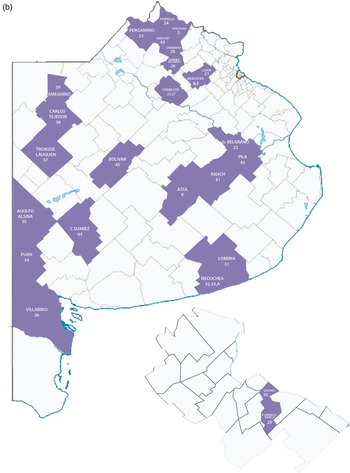
Forty-five samples (each one consisting of a pool of 50–100 adult worker honeybees) were collected from two to three colonies of different Argentine apiaries taken from the main honey-producing regions (Province of Buenos Aires, Córdoba, Santa Fe Santiago del Estero, Río Negro, and Mendoza) (fig. 1a). The Provinces of Buenos Aires (Bs As) and Santa Fé were intensively sampled, since they are the Provinces with the highest apicultural production in the country; especially the Province of Bs As where the sampling covered a large number of localities of the same (fig. 1b). The samples were taken from the field directly into dry ice, in a single sampling instance in each case, by the different beekeepers of each apiary and sent to our laboratory to be stored at −80°C until being processed.
(a) Map of Argentina, Provinces where samples were collected are highlighted with the number of samples per province. (b) Map of Buenos Aires Province with the names (numbers and letters) of the samples collected from each locality.

Figure 1.

In turn, since DWV infection is closely related to the degree of Varroa infestation in bee colonies, each sample came with a percentage of phoretic Varroa (table 1). As the sampling of the year 2018 was carried out in apicultural cabins, producers of biological material, these apiaries all presented 0% of infestation by the mite; this served as a control of the behavior of the virus complex in Varroa-free apiaries of Argentina.
Location, sample name, sampling year, percentage of phoretic Varroa, and detection of DWV-A and B in the samples. Ct values of β-actin and of DWV-A and B amplicons are given, as is the respective ΔCt value relative to the β-actin Ct value, in each case

nd, not detected.
a Products that were sequenced.
RNA extraction, DNAse treatment and reverse transcription
Total RNA was extracted from pools of ten adult bees, randomly selected from each sample, according to Reynaldi et al. (Reference Reynaldi, Sguazza, Pecoraro, Tizzano and Galosi2010) with modifications. The bees were crushed with a glass rod and homogenized with 3 ml of PBS. One milliliter of the homogenate was centrifuged for 15 min at 15,000 rpm. The total RNA of the samples was extracted using 500 μl of Trizol® Reagent (Invitrogen, Carlsbad, CA, USA) mixed with 500 μl of the PBS supernatant extract. The mixture was extracted with 220 μl of cold chloroform. After centrifugation at 12,000 × g for 15 min, the RNA contained in the aqueous solution was precipitated by adding 750 μl of isopropanol. The precipitated RNA was collected by centrifugation at 12,000 × g for 15 min, washed by 70% ethanol and dissolved in 50 μl of RNase-free water.
DNase I Amplification Grade (Invitrogen, Carlsbad, CA, USA) was used to eliminate any genomic DNA carried over in the RNA extraction by digestion at 37°C for 30 min. The quantity of the resulting RNA was determined in a Rotor Gene 6000 cycler (Qiagen, Frederick, MD, USA) using a Quant-iT™ RiboGreen® RNA Assay Kit (Invitrogen, Carlsbad, California, USA). Complementary DNA (cDNA) was synthesized using a reaction mixture containing 1 μg of total RNA, random hexamers (12 ng μl−1), and Moloney murine leukemia virus reverse transcriptase (Invitrogen, Carlsbad, California, USA) according to the procedures suggested by the manufacturer. Negative controls, omitting the RNA or the reverse transcriptase, were undertaken.
RNA extraction control RT-qPCR
To verify the success of RNA extraction from the samples and lack of inhibition in the PCR reactions, amplifications of A. mellifera β actin gene were performed (Yang and Cox-Foster, Reference Yang and Cox-Foster2005). The specific primers for the amplification were β-actin-Fw (5′-ATGCCAACACTGTCCTTTCTGG-3′) and β-actin-Rv (5′-GACCCACCAATCCATACGGA-3′) (Yang and Cox-Foster, Reference Yang and Cox-Foster2005). The cycling program consisted of an initial denaturation of 2 min at 95°C, and 45 cycles of 10 s at 95°C, 15 s at 60°C, and 15 s at 72°C. After amplification, a melting curve analysis was performed, which resulted in a single product-specific melting curve.
DWV-A and B RT-qPCRs
The primers used in the RT-qPCRs of this study, their specific annealing temperature and melting temperature are summarized in Supplementary table 1.
The cycling programs for the detection of the DWV consisted of an initial denaturation of 2 min at 95°C, and 50 cycles of 10 s at 95°C, 15 s at specific annealing temperature, and 15 s at 72°C. During the validation process, the PCR products were run on agarose gels to check the size of the amplicons. All real-time PCR reactions were carried out in a Rotor Gene thermocycler (Qiagen, Hilden, Germany) in a final volume of 20 μl using EvaGreen as an intercalating fluorescent dye (KAPA FAST, Biosystems, Woburn, MA, USA).
The sensitivity of the technique was studied analyzing 1:10 serial dilutions of cDNA from a positive sample of DWV-B (Supplementary fig. 2).
Assay specificity
As both virus types are closely related, sharing 84% identity in their nucleic acid sequence (Ongus et al., Reference Ongus, Peters, Bonmatin, Bengsch, Vlak and van Oers2004), we used specific primers for the detection of both variants separately. For the detection of DWV-A, the primers designed by Kukielka et al. (Reference Kukielka, Esperón, Higes and Sánchez-Vizcaíno2008), for the amplification of the conserved region of the RNA-dependent RNA polymerase (RdRp) gene, were used. This primer pair has been used in previous studies with good results (Negri et al., Reference Negri, Maggi, Ramirez, De Feudis, Szwarski, Quintana, Eguaras and Lamattina2015; Quintana et al., Reference Quintana, Brasesco, Negri, Marin, Pagnuco, Szawarski, Reynaldi, Larsen, Eguaras and Maggi2019). For the amplifications of fragments of the DWV-B, we used two primer pairs designed by Zioni et al. (Reference Zioni, Soroker and Chejanovsky2011), which can detect specific sequences of DWV-B. Also, the primer pair that amplifies a fragment of approximately 204 bp of DWV-B's Lp sequence allows for a sequence specificity analysis using High Resolution Melting (HRM) (Supplementary fig. 1). Nevertheless, in order to corroborate the size and specificity of the amplicons, PCR products were run on agarose gels and then purified using Accuprep Gel Purification Kit (Bioneer, Daejeon, South Korea). One DWV-B Lp fragment, six DWV-B Helicase amplicons, and four DWV-A RdRp products were sequenced using BigDye Terminator v1.1 Cycle Sequencing Kit (Applied Biosystems, Foster City, CA, USA) with the ABI Prism 310 Genetic Analyzer (Applied Biosystems, Foster City, CA, USA). The sequences obtained were analyzed using Blast software online (Altschul et al., Reference Altschul, Gish, Miller, Myers and Lipman1990) to find related sequences from previous reports; then aligned and compared with reference sequences obtained from the GenBank by use of MEGA X: The Molecular Evolutionary Genetics Analysis software (Kumar et al., Reference Kumar, Stecher, Li, Knyaz and Tamura2018) (figs 2 and 3).
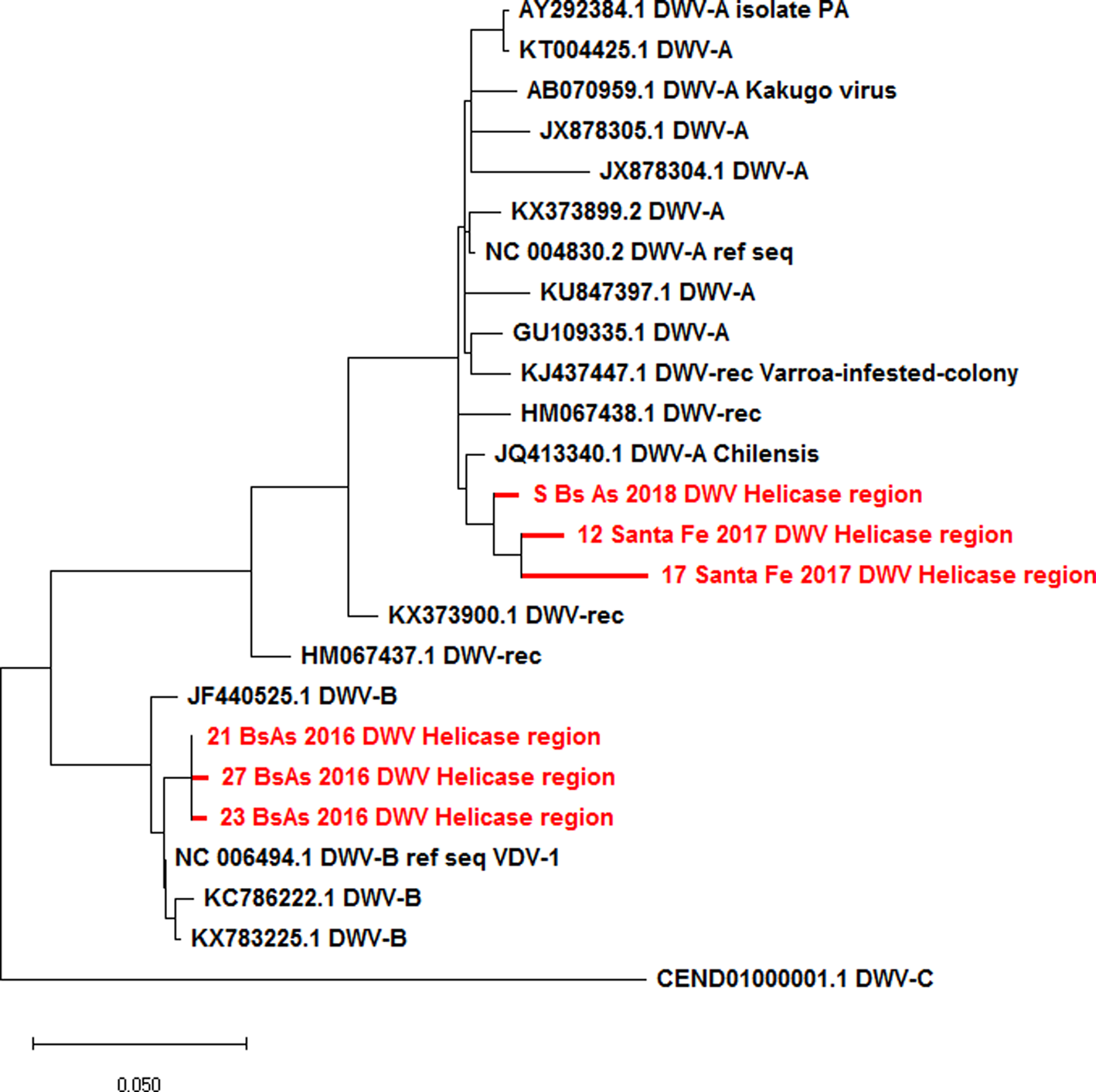
Phylogenetic tree created using MEGA X software (Kumar et al., Reference Kumar, Stecher, Li, Knyaz and Tamura2018) to visualize the clusters of the sequences obtained for the Helicase region of the DWV (21, 23, 27, 12, 17, and S) with related sequences from the GenBank.

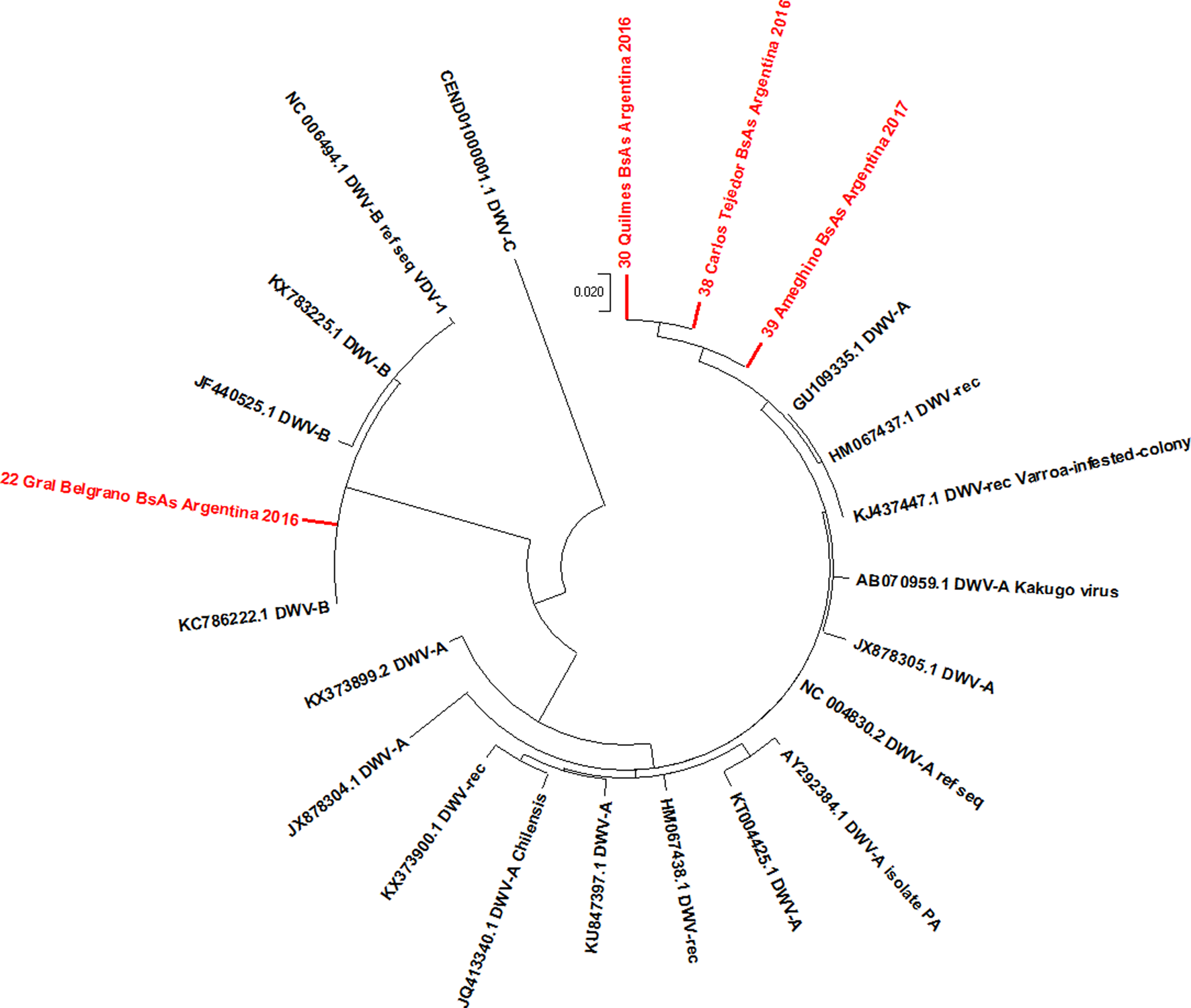
Phylogenetic circular tree created using MEGA X software (Kumar et al., Reference Kumar, Stecher, Li, Knyaz and Tamura2018) to visualize the clusters of the sequences obtained for the RdRp region of the DWV (22, 30, 38, and 39) with related sequences from the GenBank.

The nucleotide sequences obtained from the sequenced PCR products were deposited in GenBank under accession numbers (MN032108, MN055986, MN055987, MN055988, MN055989, MN055990, MN055991) using Bankit software (http://www.ncbi.nlm.nih.gov/BankIt/index.html).
Results
Study of the presence of DWV-A and B in adult bees from colonies of Argentinian apiaries
qPCR was applied to analyze the presence of DWV variants in cDNA obtained from the RNA extracted of each processed sample. Amplification with the Lp pair of primers of DWV-B was found in 20 of the 45 samples analyzed, 44% of the total samples (table 1). Further analyses were run on the 45 samples, using the Helicase pair of primers for the DWV-B and the primers for the RdRp of DWV-A (see Supplementary table 1). The DWV-B Helicase qPCR detected positive for the presence of DWV-B in seven more samples (table 1), and compared to the national level, DWV-B infection was found restricted mainly to Buenos Aires Province coincidentally with the highest percentages observed of phoretic Varroa (samples 21 and 38, table 1). In these, sense 11 samples (24% of the total samples) showed different results in the Lp qPCR and in the Helicase qPCR of DWV-B detection which could be putative recombinants. Amplification of the RdRp fragment of the DWV-A was positive in 41 samples, 91% of the total samples (table 1), and 15 samples (33%) of the total could be putative mixed (DWV-A + DWV-B) infections.
Blast software analysis of the Lp and the Helicase sequences of the DWV-B obtained for the samples from 2016 of Bs As Province (Lp seq: 22 Gral. Belgrano. Bs As. GenBank accession: MN032108; Helicase seq: 21 Lujan. Bs As., 23 Pergamino. Bs As., 27 Chivilcoy. Bs As. GenBank accession: MN055986, MN055987, MN055988) revealed the most significant alignments with the reported and reference sequence of the complete genome of DWV-B detected in mites in the Netherlands, sharing 99% of identity (GenBank accession: NC_006494.1). Also in the case of samples 21, 23, and 27, the alignments were significant with DWV-B isolates from the United Kingdom (UK), Belgium, and Israel (GenBank accession: KC786222.1, KX783225.1, and JF440525, respectively). Further analyses run with two Helicase sequences obtained from 2017-Santa Fé Province (12 Malabrigo and 17 Gral. Obligado, GenBank accession: MN055989 and MN055990) and one Helicase sequence obtained from 2018 of Bs As Province (S San Pedro. Bs As., GenBank accession: MN055991) revealed more significant alignments with a reported sequence of DWV-A from Chile (GenBank accession: JQ413340.1) and with a recombinant strain from the UK (GenBank accession: HM067438.1).
Additional sequence analyses were carried out with the sequences of the RdRp obtained by the specific primers for the detection of DWV-A (GenBank accession: MN025279, MN025280, MN025281, MN025282). In this case, the sequence obtained from sample 22 (2016-Gral. Belgrano. Bs As.) for this fragment of the virus genome aligned with the reference sequence of the DWV-B (GenBank accession: NC_006494.1), and with DWV-B isolates from the UK, Belgium, and Israel (GenBank accession: KC786222.1, KX783225.1, and JF440525, respectively). The other three sequences obtained for the RdRp fragment, also from 2016-Buenos Aires Province (30 Quilmes. Bs As., 38 Carlos Tejedor. Bs As. and 39 Ameghino. Bs As.) made the most significant alignments with three different DWV-A isolates of strains reported from the UK (GenBank accession: GU109335.1, HM067437.1, and KJ437447.1, respectively).
Using MEGA X (Kumar et al., Reference Kumar, Stecher, Li, Knyaz and Tamura2018), phylogenetic trees were created by the method of Maximum Likelihood to visualize the clusters of the sequences obtained in this study with reference sequences from previous reports in the GenBank (figs 2 and 3).
Of the 45 samples analyzed, over 90% appeared to be infected with DWV-A (table 1), being this virus ubiquitous in the main honey-producing regions (Province of Buenos Aires, Córdoba, Santa Fe Santiago del Estero, Río Negro, and Mendoza) (fig. 1a) of Argentina. Sixteen (36%) of the 45 samples were positive for DWV-B with both the Lp and the Helicase primer pairs, all of which were from 2016-Bs As Province. Co-infection with both types of the virus may be occurring in the majority of cases where DWV-B was detected, except for the case of sample 42 (Pila. Bs As.), where only the presence of the DWV-B genome was detected by the Helicase primer pair (table 1). This may probably mean a false negative in the Lp region because no recombinants in the 3′ region of the DWV-B genome have been described.
This is the first detection report of DWV-B master variant and of DWV recombinants in Argentina; where it is observed that they are found in higher prevalence in colonies of A. mellifera of the Buenos Aires Province when compared to the national level (table 1).
As of the assay sensitivity, it was determined that the technique used in this study shows 99% of the efficiency of reaction (Supplementary fig. 2).
Discussion
In this study, we sought to detect through RT-qPCR tests the presence of DWV-B in adult bees from different colonies of Argentina. The DWV-B (Mordecai et al., Reference Mordecai, Wilfert, Martin, Jones and Schroeder2016; Kevill et al., Reference Kevill, Highfield, Mordecai, Martin and Schroeder2017; McMenamin and Flenniken, Reference McMenamin and Flenniken2018) is closely related to DWV-A, allowing recombination events between both types of viruses producing recombinant variants (Moore et al., Reference Moore, Jironkin, Chandler, Burroughs, Evans and Ryabov2011; Zioni et al., Reference Zioni, Soroker and Chejanovsky2011; Ryabov et al., Reference Ryabov, Wood, Fannon, Moore, Bull, Chandler, Mead, Burroughs and Evans2014, Reference Ryabov, Childers, Chen, Madella, Nessa and Evans2017; Mordecai et al., Reference Mordecai, Wilfert, Martin, Jones and Schroeder2016; Dalmon et al., Reference Dalmon, Desbiez, Coulon, Thomasson, Le Conte, Alaux, Vallon and Moury2017). Some authors have suggested that this may be a mechanism of advantage by these viruses in its transmission from Varroa to bees (Moore et al., Reference Moore, Jironkin, Chandler, Burroughs, Evans and Ryabov2011; Mordecai et al., Reference Mordecai, Wilfert, Martin, Jones and Schroeder2016). This is why it has been proposed to consider DWV-B as a genetic ‘master variant’ of DWV (Mordecai et al., Reference Mordecai, Wilfert, Martin, Jones and Schroeder2016; McMenamin and Flenniken, Reference McMenamin and Flenniken2018).
Due to the already described similarities between both types of the viruses and its recombinants, to ensure the detection of the presence of both variants in the samples, we worked with three different types of primer pairs, in order to obtain sequences of DWV-A and DWV-B (Kukielka et al., Reference Kukielka, Esperón, Higes and Sánchez-Vizcaíno2008; Zioni et al., Reference Zioni, Soroker and Chejanovsky2011). Of the 45 samples analyzed using these sets of primers, over 90% were found to be infected with DWV (table 1), being this virus ubiquitous in the main honey-producing regions (Province of Buenos Aires, Córdoba, Santa Fe Santiago del Estero, Río Negro, and Mendoza) of Argentina (fig. 1a). Meanwhile, 16 (36%) of the 45 samples were positive for DWV-B with both the Lp and the Helicase primer pairs, all of which were from 2016-Buenos Aires Province.
Amplification with the Lp pair of primers of DWV-B was found in 20 (44%) of the 45 samples analyzed; the Helicase qPCR detected positive for the presence of DWV-B in 23 (51%) samples, seven of which had been negative in the Lp qPCR; and four that were positive in the Lp qPCR were negative in the Helicase qPCR (table 1). In these, sense 11 samples (24%) showed different results in the Lp and Helicase amplification reactions which could be putative recombinants. DWV-A detection, done with the RdRp amplification primers, was positive in 41 samples, 91% (table 1); and 15 samples (33%) of the total could be putative mixed (DWV-A + DWV-B) infections, except for the case of sample 42 (Pila. Bs As.), where only the presence of the DWV-B genome was detected by the Helicase pair of primers (table 1). This may probably mean a false negative in the Lp region because no recombinants in the 3′ region of the DWV-B genome have been described to date.
To our concern, these results make this the first detection report of DWV-B master variant and of DWV recombinants in Argentina; where it is observed that it was found in high prevalence in colonies of A. mellifera from 2016 of the Buenos Aires Province, coincidentally with the highest percentages observed of phoretic Varroa (samples 21 and 38, table 1), when compared to the national level. This is not surprising since high levels of DWV variants are usually found in colonies with high Varroa mite infestation rates (Wilfert et al., Reference Wilfert, Long, Leggett, Schmid-Hempel, Butlin, Martin and Boots2016).
DWV-B detection was performed amplifying a 204 bp fragment of the viral genome, corresponding to the region of the Lp of the structural polyprotein gene of the virus sequence, reported by Zioni et al. as a conserved sequence region of the viral genome (Zioni et al., Reference Zioni, Soroker and Chejanovsky2011). With the use of this pair of primers, the presumed presence of a 204 bp fragment of the virus was detected in 20 of the 45 samples processed, all of which were from 2016-Buenos Aires Province. As noted in the study conducted by Dalmon et al., the Lp fragment of the viral genome is also located in a recombination hot spot (min 73. 9% identity) making it a region where recombination events could occur with DWV-A and with recombinant strains (Dalmon et al., Reference Dalmon, Desbiez, Coulon, Thomasson, Le Conte, Alaux, Vallon and Moury2017). In this case, the sequence specificity analysis using HRM of the amplicons of the Lp fragment produced showed a single product-specific melting curve for the positive samples (Supplementary fig. 1).
Further analysis of the Lp sequence obtained from the PCR product of sample 22 Gral. Belgrano. Bs As. (GenBank accession: MN032108) using the Blast software online showed over 98% of identity with the reported sequence of the complete genome of DWV-B detected in mites in the Netherlands (GenBank accession: NC_006494.1).
Even so, we worked with a second pair of specific primers, also reported by Zioni et al. (Reference Zioni, Soroker and Chejanovsky2011) which generate an amplicon of ~660 bp corresponding to a region of the gene sequence of the Helicase protein of the DWV-B (Zioni et al., Reference Zioni, Soroker and Chejanovsky2011). This protein is the first in the region of the virus sequence of non-structural proteins. Through the use of this pair of primers, the presumed presence of DWV-B genome was detected in 23 (51%) samples (table 1).
The fact that in the Helicase PCR, four samples were negative when in the Lp PCR gave positive results may be due in one part because of the presence of recombinants in the Lp region of the viruses sequence (Dalmon et al., Reference Dalmon, Desbiez, Coulon, Thomasson, Le Conte, Alaux, Vallon and Moury2017), and in the other part due to the capacity of degradation and lability of the RNA material. Several of the positive Helicase PCR products were sequenced (21, 23, 27, 12, 17, and S), analyzed through Blast software, aligned, and compared with related sequences from the GenBank by use of MEGA X software (Kumar et al., Reference Kumar, Stecher, Li, Knyaz and Tamura2018) (fig. 2). In the case of samples 21, 23, and 27, the three of them collected in Bs As Province in 2016, it was revealed a close relation, sharing 98% of identity, with the reference sequence of the DWV-B from the Netherlands, isolates of DWV-B from UK, Belgium, and Israel (GenBank accession: NC_006494.1, KC786222.1, KX783225.1, and JF440525, respectively). The other three sequences, 12 and 17 sampled in 2017 from Santa Fé Province, and S sampled in 2018 from Bs As Province, were more related with a reported sequence of DWV-A from Chile (GenBank accession: JQ413340.1) and with a recombinant strain from the UK (GenBank accession: HM067438.1) (fig. 2). In this way, the detection of DWV-B is restricted to samples from 2016 of the Province of Buenos Aires, and the presence of recombinants is evident in the subsequent years of sampling.
For the sequences obtained from the amplification of the RdRp gene fragment of the DWV-A, we could observe, illustrated in the circular phylogenetic tree created with MEGA X software (Kumar et al., Reference Kumar, Stecher, Li, Knyaz and Tamura2018) (fig. 3), how the sequence obtained for sample 22 for this region of the genome clustered with all the DWV-B reference sequences used in this analysis. This same sample was positive for the DWV-B Lp PCR and its Lp sequence analysis also revealed significant alignments with DWV-B reference sequences. It can be said then that only DWV-B was detected in this sample, since it was positive in both DWV-B PCRs and the sequence obtained for the RdRp significantly aligned with the reported DWV-B sequences. The other three sequences obtained for the RdRp fragment, also from 2016-Buenos Aires Province (30 Quilmes. Bs As., 38 Carlos Tejedor. Bs As., and 39 Ameghino. Bs As.) made the most significant alignments with three different DWV-A isolates of strains reported from the UK (GenBank accession: GU109335.1, HM067437.1, and KJ437447.1, respectively). These three samples were also positive for the DWV-B Lp PCR, but their products were not sequenced. In any case, from the HRM analysis of the Lp qPCR, it can be corroborated that all positive samples showed the same melting profile (Supplementary fig. 1).
These results could be evidencing the presence of co-infections with both types of the virus, or the presence of recombinant variants in the province of Buenos Aires during 2016; agreeing with what has been observed in this concern in previous findings, where it is reported that most recombination points between DWV-A and B are located in the Lp region and in the central, Helicase-coding region of the virus genome (Moore et al., Reference Moore, Jironkin, Chandler, Burroughs, Evans and Ryabov2011; Zioni et al., Reference Zioni, Soroker and Chejanovsky2011; Ryabov et al., Reference Ryabov, Wood, Fannon, Moore, Bull, Chandler, Mead, Burroughs and Evans2014, Reference Ryabov, Childers, Chen, Madella, Nessa and Evans2017; Dalmon et al., Reference Dalmon, Desbiez, Coulon, Thomasson, Le Conte, Alaux, Vallon and Moury2017).
More studies of this style, and following a chronological order of sampling among the same apiaries, are necessary to better understand the dynamics of this virus cloud and to keep supplying the databases with sequences of both virus types and with the different recombinant strains detected from different parts of the world.
In this work, two types of sequences obtained from specific primer pairs for DWV-B were analyzed (GenBank accession: MN032108, MN055986, MN055987, MN055988, MN055989, MN055990, MN055991). The analysis of both types of sequences produced significant alignments with the reported sequence of DWV-B complete genome detected in mites in the Netherlands (GenBank accession: NC_006494.1). These results suggest that bees in the Province of Buenos Aires, in particular, are predominantly infected by strains of the DWV complex, given that 94% of the analyzed samples of this Province tested positive for DWV-A and 68% for DWV-B. On the other hand, at the national level, it can be observed how the DWV-A is still the most prevalent variant of the virus infecting the bees of various apiaries of the country.
In recent years, the presence of the ABPV, the CBPV, the SBV, and the IAPV in colonies of the country has been reported (Reynaldi et al., Reference Reynaldi, Sguazza, Pecoraro, Tizzano and Galosi2010, Reference Reynaldi, Sguazza, Tizzano, Fuentealba, Galosi and Pecoraro2011). Also the presence of the DWV-A and of the Black queen cell virus was confirmed in 2013 in different Argentine apiaries (Buenos Aires, Córdoba, Santa Fe and Entre Rios) by Sguazza et al. (Reference Sguazza, Reynaldi, Galosi and Pecoraro2013). Since then infections by the DWV-A in colonies of the South-eastern region of Buenos Aires Province have been detected from our research group (Brasesco et al., Reference Brasesco, Quintana, Negri, Medici, Ruffinengo, Eguaras and Maggi2013; Negri et al., Reference Negri, Maggi, Ramirez, De Feudis, Szwarski, Quintana, Eguaras and Lamattina2015; Quintana et al., Reference Quintana, Brasesco, Negri, Marin, Pagnuco, Szawarski, Reynaldi, Larsen, Eguaras and Maggi2019). Even so, the information is still scarce and fragmented, and the presence of DWV-B in colonies of bees of Argentina has not been reported so far. Due to this, and to the already known problems caused by these viral strains in bees, a nationally updated report on the type and distribution of the two most important master variants of the DWV complex present in the country is needed. In this way, future in-depth studies of the complete sequences of the viruses variants detected are necessary to determine the conformation and degree of recombination between these types of the virus in recombinant strains, and thus determine the true impact of DWV-B and its recombinants on the populations of honeybees in the country.
Supplementary material
The supplementary material for this article can be found at https://doi.org/10.1017/S000748532000036X.
Acknowledgements
The authors would like to thank the Institute of Analysis Fares Taie, CONICET, and the UNMdP for financial support. Also a special thanks to the Visual Communication Designer Antonela Guerra who participated in the editing of the maps.