For several years, historians of mathematics have been interested in analyzing diverse collective phenomena. To describe such past dynamics of knowledge, they have borrowed, discussed, and sometimes refined concepts coming from the history of science, history, or sociology. Taking into account both intellectual and social factors, their studies have helped us understand how ideas are created, developed, and circulated within groups of mathematicians. Different categories such as disciplines, research fields, research schools, networks, clusters, or practices have thus been dealt with, each of them covering specific situations and having their own peculiarities.Footnote 1
My own research led me to confront these categories while I was studying a precise historical question: the introduction of equation theory and substitution theory into geometry during the second half of the nineteenth century. To be more specific, this research brought to light the importance of “geometrical equations,” objects which have proved absolutely crucial for the understanding of encounters between those three mathematical domains around 1870 (Lê Reference Lê2015a; Lê Reference Lê2015b). A special feature of “geometrical equations” is that they gave rise to precise technical activities shared by a few mathematicians over a quite short period of time, although they were not well-defined mathematical objects. Though such a situation may be quite usual in the nineteenth century, none of the above-mentioned categories was appropriate to account for it. For instance, the activities linked to “geometrical equations” never became systematized and vanished quickly, making the label “discipline” unfit to characterize them. Besides, they formed a complex system glued together by epistemic preferences, which encouraged me to search for a larger descriptive type than that of “practices.” This situation brought me to explore the notion of “culture” to characterize the configuration of the mathematical knowledge at stake. The present paper aims at reporting this investigation; as we will see, I eventually ended up with the more restricted phrase “cultural system” to describe the organization of the knowledge connected to “geometrical equations.”
First, a few words of caution about the notion of “culture” should be expressed here. Throughout this paper, by “culture” will be meant neither some general process of intellectual, spiritual, and aesthetic development, nor the sum of the artistic production of a society, but rather the way of living and acting of a given social group.Footnote 2 This preliminary clarification being made, one has still to be as accurate as possible when defining “culture.” Trying to do so, an issue arises at once, for no definition of “culture” has achieved absolute consensus in the social sciences: in their famous book published in 1952, the anthropologists Alfred L. Kroeber and Clyde Kluckhohn counted more than 160 definitions of “culture” in the anthropological and sociological literature, (Kroeber and Kluckhohn Reference Kroeber and Kluckhohn1952).
Reflecting the multiplicity of the definitions of the notion of “culture,” recent studies in the history of mathematics have explored this notion in diverse contexts and in different ways.Footnote 3 From a case of ancient Chinese mathematics, Karine Chemla thus defined a notion of mathematical culture to understand long-lasting ways of acting that were shared within groups of people and sustained by institutional structures over centuries (Chemla Reference Chemla, Bartocci and Odifreddi2009). Frédéric Brechenmacher, for his part, tackled the question of a culture associated with a network of texts (that concerning the so-called “secular equation”), appealing to a notion of culture presenting interactions between individuals or groups of individuals as its elementary components (Brechenmacher Reference Brechenmacher2013).
My perspective here is different in scope: I was in search of a word or an expression defined by concrete criteria that can be applied to a definite corpus of related texts, where the definition does not only rely on explicit interactions among them or their authors (contrary to Brechenmacher's case for instance).Footnote 4 As we shall see, the concreteness of the criteria helped me analyze more closely these texts. However, my objective is not a new theory of scientific development, nor adherence to an already existing one. I have thus borrowed my (operational) definition of “culture” from a working sociologist, Guy Rocher:Footnote 5
Culture [is] an intricate system of more or less formalized ways of thinking, feeling, and acting, which, being learned and shared by a plurality of people, serves both objectively and symbolically to constitute these people as a particular and distinct group.Footnote 6 (Rocher Reference Rocher1968, 111)
Let us note that this definition contains characteristics that can be found in most definitions of culture: it refers to a set of traits that are shared among a certain number of people, are acquired by learning, and constitute a complex system.Footnote 7 In the rest of this paper, each of these points will be thoroughly detailed using the case of “geometrical equations” in light of Rocher's own explanations. Let us note that a problem will occur with the last point of the definition, namely the constitutive function for a group of persons. As already explained, I am aiming at an account of a corpus of texts involving the so-called “geometrical equations” and my criteria will serve to constitute such a group of texts. However, texts and persons are not the same and we will see that the authors of the texts are not defined as a group through my study.Footnote 8 Actually, it is the only point which will not fit our specific case, and this is why the label “cultural system” will be eventually adopted rather than that of “culture.”
As Rocher explains, the expression “ways of thinking, feeling, and acting” is borrowed from Émile Durkheim. It “has the advantage of emphasizing that the patterns, values, and symbols composing culture include knowledge, ideas, thought, [and] that culture is action, that it is first and foremost lived by people; one can infer the existence of culture and trace its outline from the observation of this action.”Footnote 9 Among the notions entering into the definition of culture, that of “pattern” is an important one and covers two main aspects. On the one hand, when individuals belong to a group with a specific culture, their action, behavior, and ideas are guided by preexisting patterns; on the other hand, because they conform to patterns, individuals take part in the strengthening of the culture. Hence, to detect behavioral conformity to patterns allows the observer to guess the existence of a culture in which such behaviors are valued as normal behaviors. It is thus about observing a particular organization of recurring ways of acting and thinking of a certain social group, and about characterizing it as a culture.
Now the question arises of where and how to carry out observation in order to handle cases in the history of mathematics. It is indeed impossible for us to observe action in situ, like an ethnologist. Research has be to done from material traces of action that have survived over time – texts (published or not), drawings, instruments of measurement or calculation, etc. – and that inform us in one way or another about the ways of acting, the sources, the influences, and the values of past mathematicians. Thus, recognizing patterns from such traces is the first step in inferring the existence of a culture.
To do so in the case of “geometrical equations,” I will begin by describing how a corpus of investigation can be built up and what issues arise when one does this. The scientific, personal, and institutional links existing between the authors of the corpus will then be presented. Afterwards, I will analyze components of the technical activities surrounding “geometrical equations” and show why Rocher's definition of “culture” helps me account for them. I will finally offer suggestions aimed at putting my analysis of “geometrical equations” into a broader historical perspective.
Spotting Geometrical Equations
My starting point in understanding “geometrical equations” is the Encyklopädie der mathematischen Wissenschaften mit Einschluß ihrer Anwendungen, a collective project launched at the end of the nineteenth century by Felix Klein, who wanted to give an account of the mathematical knowledge of the century.Footnote 10 The Encyklopädie is split into different volumes, devoted to domains like algebra, geometry, analysis, or mechanics, and in turn, each of these volumes is divided into chapters dealing with more specific subjects. The algebra volume contains for example a chapter called “Galois'sche Theorie mit Anwendungen,” of which Otto Hölder completed the writing in 1899 (Hölder Reference Hölder1899). The final section of this chapter is entitled “Geometrische Gleichungen,” which refers to the objects we are interested in. Like the other parts of the Encyklopädie, this section contains a mathematical description of its subject, as well as references to research papers and books on the topic.
Quite surprisingly, the label “geometrical equations” is not defined in Hölder's text, unlike the equations that are dealt with in the other sections of the chapter. For instance, “Abel's equations,” which appear in a preceding paragraph, are defined by a property of their roots:
Theorem: Let all the roots of an equation be rationally expressible as functions of one of them, x 1, and let any two roots be represented by θ(x 1) and θ1(x 1). If one always has θ1(θ(x 1)) = θ(θ1(x 1)), then the equation is solvable. . . .The equations [of this] theorem are called “Abel's equations”Footnote 11 (ibid., 506).
So, the appellation “Abel's equation” is unambiguously defined and designates every equation whose roots satisfy the described condition. Let us also look at the example of the so-called “cyclotomic equations”:
Let p be a prime number. The pth roots of unity satisfy the equation xp − 1 = 0. If one factors out the rational factor x − 1 from the left-hand side, then there remains the equation x p − 1 + x p − 2 + ⋅⋅⋅ + x 2 + x + 1 = 0. . . . Since the pth roots of unity are geometrically represented by p equidistant points of a circle, the division of the circle in p equal parts depends on these equations; that is why they are called cyclotomic equations.Footnote 12 (Ibid., 508)
There, the name “cyclotomic equations” refers to equations that are explicitly written as polynomials developed and equated to 0 (which is not the case for Abel's equations), and is doubled by an etymological explanation – the passage from singular to plural in the quotation indicates the existence of one cyclotomic equation per prime number p.
In opposition to Abel's or cyclotomic equations, those designated by the phrase “geometrical equations” are not defined in the Encyklopädie, neither by some property nor by expressing them as a polynomial equated to zero. Rather, this phrase seems to be a sort of vague label pointing to a certain number of specific examples. Indeed, Hölder's text on “geometrical equations” begins as follows:
The general curve of the third order contains nine inflection points; on each line joining two inflection points, there is always a third inflection point. The determination of the inflection points depends on an equation f(λ) = 0 of degree 9, where λ is chosen so that it can be rationally expressed with the two coordinates of an inflection point, and so that reciprocally, both of these coordinates can be expressed with λ. To the nine inflection points correspond the nine roots λ1, λ2, λ3, . . ., λ9.Footnote 13 (Ibid., 518–519)
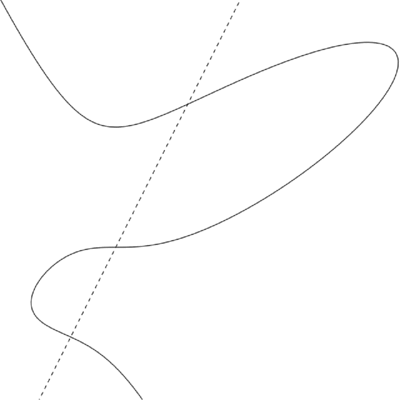
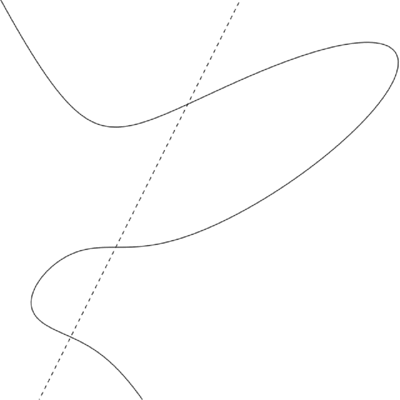
The first sentence of this extract refers to the inflection points of cubic curves, a geometrical situation that had already been studied at the beginning of the eighteenth century.Footnote 14 Indeed, in his Enumeratio linearum tertii ordinis (1704), Isaac Newton had investigated curves of the third order (also called cubic curves), that is, plane curves defined by a polynomial equation of degree 3, like x 3 + y 3 − 2x 2 y + xy 2 − xy − y = 0, and had considered inflection points of such curves, i.e. points where the curvature changes sign. In the same period, Jean-Paul de Gua de Malves and Colin Maclaurin both showed that any line joining two inflection points of a cubic curve intersects the curve in a third inflection point (see fig. 1). Later, in 1835, Julius Plücker proved that every cubic curve contains exactly 9 such points – he also demonstrated that there are exactly 12 lines containing three by three, the 9 inflection points.Footnote 15
The solid curve is part of the cubic curve having x 3 + y 3 − 2x 2 y + xy 2 − xy − y = 0 for equation. Three of its inflection points are represented as its intersection with the dashed line. This line is thus one of the 12 joining the inflection points three by three.
In Hölder's extract quoted above, the equation f(λ) = 0, which he calls “the equation on which the inflection points depend”Footnote 16 later in his text, is a first example of a “geometrical equation,” associated to the configuration of the 9 inflection points. Let us note, though, that Hölder did not precisely explain what are supposed to be its roots, for several choices can be made to express λ as a rational function of the inflection-point coordinates.
Next, Hölder mentions “other geometrical equations,” among which are “the equation of the 28 double tangents to a plane curve of the fourth order, the equation of the 27 lines of a surface of the third order, the 16 lines of a surface of the fourth order containing a double conic section, the equation of the 16 nodes of the Kummer surface.”Footnote 17 These equations are associated with special geometrical configurations that were quite well known in the second half of the nineteenth century. For instance, a surface of the third order, also called a cubic surface, is a surface defined by a polynomial equation of degree 3, e.g. x 3 + y 3 + z 3 + 1 = (x + y + z + 1)3. In 1849, Arthur Cayley and George Salmon had proved that every cubic surface contains exactly 27 straight lines (Cayley Reference Cayley1849; Salmon Reference Salmon1849).
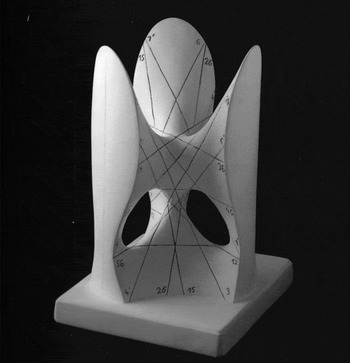
Just as in the case of the 9 inflection points, special incidence relations exist among the 27 lines: each of them intersects 10 of the others, which in turn intersect two by two. It is thus possible to define triangles formed from the 27 lines; in 1849, Cayley demonstrated that there are exactly 45 such triangles (see fig. 2).
Plaster model of a cubic surface with some of the 27 lines drawn upon it. Source: (Fischer Reference Fischer1986).

Let us remark that these 45 triangles can be seen as the analogues of the 12 lines formed from the 9 inflection points. The 45 triangles and the 12 lines are examples of objects that played an essential role in the amalgamation of equation theory, substitution theory, and geometry in the second half of the nineteenth century – their importance for some mathematicians of the time will be central for our discussion of “culture.”
The other geometrical configurations mentioned by Hölder are in the same vein. They consist of a certain number of objects (points or straight lines) associated with particular curves or surfaces. These objects are linked by incidence relations, typically alignment or coplanarity, as in the case of the 9 inflection points of cubic curves and of the 27 lines of cubic surfaces, and these relations can be expressed by means of other geometrical objects (like the 12 lines or the 45 triangles). But contrary to the case of the equation associated with the 9 inflection points, Hölder did not define those linked to the other geometrical configurations.
To sum up, the label “geometrical equations” is not defined in the Encyklopädie although it is the title of a section, and it seems to refer to a number of examples (like “the equation on which the 9 inflection points depend” or “the 27-lines equation”), which have no precise definition as well.
Actually, the same remarks can be made about the references given in this section of the Encyklopädie. The expression “geometrical equations” itself appears in only one of these references, more precisely in the title of a note of Camille Jordan called “Sur les équations de la géométrie” (Jordan Reference Jordan1869c). However, “geometrical equations” are not defined in this note, and just as in the Encyklopädie, one can find “the 27-lines equation,” “the 28-double-tangents equation,” and other similar names of equations associated with diverse geometrical situations.Footnote 18
Jordan's note is one of the short publications which contained results of, and had announced, his forthcoming Traité des substitutions et des équations algébriques (Jordan Reference Jordan1870b). The book was the synthesis of the dozen years of research that Jordan had done on substitutions and algebraic equations since his thesis of 1861, putting groups of substitutions at the center of questions related to the solution of algebraic equations. Jordan's Traité is now celebrated by historians of mathematics as “a major turning point in the development of the notion of group and of Galois theory, marking the completion of the clarification process of Galois' ideas on equation solution.”Footnote 19 The note “Sur les équations de la géométrie” corresponds to the chapter of the Traité called “Applications géométriques.”Footnote 20 This chapter involves different geometrical situations including the ones we mentioned above, like the 9 inflection points and the 27 lines. There again, the phrase “geometrical equations” is not to be found; however, the chapter begins with the following words:
One of the most frequent problems of analytic geometry is to determine which are the points, or the lines or surfaces of a given species, which satisfy some conditions. When the number of the solutions is limited, the coordinates of the sought point (or the parameters appearing in the equation of the lines or surfaces sought) are determined by a system of algebraic equations A, B, . . . in the same number as the number of unknowns x, y, . . . Eliminate all the unknowns but one, x: we know that the degree of the final equation X will indicate the number of solutions of the problem: and if the roots of this equation are distinct, let x 0 be one of them: we will have the corresponding values of y 0, . . . expressed as a rational function of x 0 when substituting x 0instead of x in the equations A, B, . . . and looking for the system of common solutions to these equations.
The sought-for points, lines, or surfaces are thus determined when one has solved the equation X, and they respectively correspond to its different roots x 0, x 1, . . . (Jordan Reference Jordan1870b, 310)
Since it appears at the very beginning of the chapter on geometrical applications, this general procedure (i.e. a procedure independent of the geometrical situation) could be interpreted as a definition of a “geometrical equation”: such an equation would then be an algebraic equation (in one unknown) associated to a given geometrical situation, of degree equal to the number of objects of the situation, and of which the roots can be rationally expressed as functions of parameters of these objects, and reciprocally – this list matches the characteristics of the 9 inflection points equation given in the Encyklopädie.
Yet, if these explanations can help us understand what geometrical equations might be, they are still ineffective as a spotting tool. Indeed, even in the texts that we already discussed (Hölder Reference Hölder1899; Jordan Reference Jordan1869c; Jordan Reference Jordan1870b), there are expressions like “the 27-lines equation” that are connected neither with a procedure of formation, nor with details about the parameters supposed to define the associated geometrical objects. Moreover, in the texts referenced in the Encyklopädie, equations associated with geometrical situations are never written as expanded or factorized polynomials. When studying these texts, however, I often met algebraic equations with one unknown, related to the determination of a geometrical situation or even linked to it just in the syntax of their designation, like in the phrase “the 27-lines equation.” Such equations I understand to be “geometrical equations.”
To form the corpus, I thus selected the texts referenced in the Encyklopädie that contain at least one of these equations. Then I repeated this process with these texts, i.e. I explored the references that were cited in them and picked the ones where I could find at least one of the previously described equations.Footnote 21
I was eventually confronted with a small corpus composed of 19 texts of 10 different mathematicians, dated between 1847 and 1896 with a concentration during the period 1868–1872. More precisely, this corpus includes an article of Otto Hesse (Hesse Reference Hesse1847), two papers of Ernst Eduard Kummer (Kummer Reference Kummer1863; Kummer Reference Kummer1864), two of Alfred Clebsch (Clebsch Reference Clebsch1868; Clebsch Reference Clebsch1871), five short notes due to Camille Jordan and his Traité des substitutions et des équations algébriques (Jordan Reference Jordan1869a; Jordan Reference Jordan1869b; Jordan Reference Jordan1869c; Jordan Reference Jordan1869d; Jordan Reference Jordan1870a; Jordan Reference Jordan1870b), three articles written by Felix Klein (Klein Reference Klein1870; Klein Reference Klein1871; Klein Reference Klein1888), one of Sophus Lie (Lie Reference Lie1872), one of Max Noether (Noether Reference Noether1879), a passage from Eugen Netto's book Substitutionentheorie und ihre Anwendungen auf die Algebra (Netto Reference Netto1882), a paper of Heinrich Maschke (Maschke Reference Maschke1889), and finally a chapter of Heinrich Weber's Lehrbuch der Algebra (Weber Reference Weber1896).
All the texts of the corpus are research publications, but relate to different domains and topics. Some can be qualified as belonging mainly to geometry,Footnote 22 like Clebsch's paper of 1868, which is an investigation of a certain kind of surface, namely quartic surfaces containing a double conic section. Some are mainly connected with algebraic matters (and especially substitution theory) like Jordan's Traité, as well as the books of Netto and Weber. Some other texts explicitly seek to establish bridges between geometry and algebra, as illustrated by Klein's article of 1871 about “a geometrical representation of resolvents of algebraic equations.”Footnote 23 In any case, it is important to emphasize that each of the texts of the corpus imply in one way or another at least one of the geometrical configurations mentioned above, like the 9 inflection points, the 27 lines, and the 28 double tangents.Footnote 24 As previously explained, they also contain at least one occurrence of the equations that I tracked. In the whole corpus there are about a hundred such occurrences; a vast majority of them appear in the texts by Jordan, Clebsch, Klein, and Noether, making them the main contributors to the subject of geometrical equations.
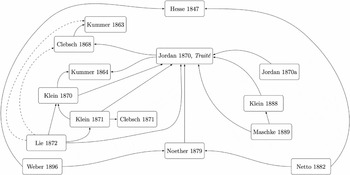
Let us note that the texts I started with in the process of formation of the corpus cite each other a great deal: only the two papers (Kummer Reference Kummer1863) and (Clebsch Reference Clebsch1871) were identified by the extension step of the process. Further, the references cited in these latter texts do not mention any geometrical equation, which explains why I stopped the process after one iteration. These remarks thus suggest a certain coherence of the obtained corpus.Footnote 25 The situation can be visualized with the help of the graph (fig. 3), which represents all the citations existing among the texts.
Citations between the texts of the corpus. For the sake of clarity, Jordan's Traité and the short notes that had announced it are gathered in a single box. Moreover, one reference cited in Lie Reference Lie1872 is obviously erroneous. The correct one being probably either Kummer Reference Kummer1863 or Clebsch Reference Clebsch1868, dashed arrows have been correspondingly drawn.

The relative density of the graph also pleads in favor of an actual circulation of knowledge within the corpus, in the sense that pieces of knowledge pass from text to text, from author to author. More specifically, the citations have diverse status, which reflects different kinds of links among the texts: citations of attribution of first works on a subject that are given without any mathematical transfer, but also citations concerning results or methods that are taken as bases for new research, as well as a few citations associated with results that were found by different methods than those employed in the text they are cited from. Furthermore, we will see that precise technical features repeatedly occur within the corpus without being accompanied by any explicit citation.
All these points confirm the possibility of grasping the notion of culture in the situation of geometrical equations, even if it involves only a few people. Indeed, sociologists readily consider cultures associated with small groups of people (like families), understood as mostly describing particular ways of acting of the members of each group: “A few persons can be enough to constitute the culture of a limited group . . . . The notion of culture is not just employed for a global society. Sociologists willingly talk about the culture of a social class, of a region, of an industry, of a ‘gang’.”Footnote 26 What is important for the notion of culture is that the cultural traits be shared among the members of the (small) plurality, so that they appear as collective patterns to the observer. What has been described in the preceding paragraphs weighs in favor of such a collective dimension and is thus a clue for the consistency of dealing with the notion of culture in the small-scale case of geometrical equations.
I will now proceed further, at first addressing the question of the social links existing among the mathematicians of the corpus. From now on, additional sources like obituaries, letters, and secondary biographical literature will be used to throw light on the texts of the corpus and their authors. As such, these sources constitute a set of texts that will help us explain some of the features of the texts of corpus and of their authors.
Social Links among the Authors of the Corpus
The authors of the corpus (especially Hesse, Clebsch, Jordan, Klein, and Noether) are connected by strong mathematical, institutional, or personal relations. Indeed, Hesse had been a docent and then an extraordinary professor at the university in his hometown of Königsberg from 1840 to 1855. Afterwards, he spent a year in Halle, and was then appointed ordinary professor in Heidelberg. During these years, Hesse taught analytic geometry to Clebsch (in Königsberg from 1850 to 1854) and to Weber and Noether (in Heidelberg, in 1860 and 1867–1868 respectively).Footnote 27 Furthermore, Noether and Klein both wrote an obituary of Hesse in 1875 (Klein Reference Klein1875; Noether Reference Noether1875). Later, Noether took part in the edition of Hesse's Gesammelte Werke (published in 1897) along with Walther von Dyck, Sigmund Gundelfinger, and Jacob Lüroth.
Gundelfinger, Lüroth, and Noether had met in the 1860s in Giessen. Clebsch had been a professor there since 1863 and with Paul Gordan, he had started to gather mathematicians around him:
[In Giessen,] a circle of young mathematicians who had been keenly intellectually stimulated by their tight personal relations with Clebsch and Gordan during lectures, seminars, walks, and around coffee, had gathered around these two friendly and witty docents. Apart from the very first students, Güssfeld and Brill, of Clebsch in Giessen, Lüroth, Gundelfinger, Korndörfer, and Noether from 1868 on, belonged to this circle of changing composition.Footnote 28 (Brill Reference Brill1923, 213)
In 1868, Clebsch was appointed to the chair in Göttingen left vacant after Riemann's death, and was followed there by some of his students from Giessen.
The same year, Klein defended the thesis he had prepared under Julius Plücker's supervision.Footnote 29 Plücker died shortly afterwards and Klein embarked on a posthumous edition of one of his books; this project led him to meet Clebsch in Göttingen in 1869. Many years later, Klein remembered how much he had liked the inspiring atmosphere that existed around Clebsch; Clebsch was equally enthusiastic when Klein came back to Göttingen a year later, as he wrote to Jordan: « Dr. Klein, who is now here fulltime [in Göttingen], told me much about the nice time he spent in Paris. As usual, he is very active . . .; I am happy to have gained such an active and charming colleague.”Footnote 30 When Clebsch suddenly died in 1872, Brill, Gordan, Klein, Lüroth, and Noether, along with Adolph Mayer and Karl von der Mühll, wrote a long obituary in his honor – in this text, they present themselves as Clebsch's “friends and former students” (Brill et al. Reference Brill, Gordan, Klein, Lüroth, Mayer, Noether and von der Mühll1873).
So we have a group of mathematicians (including Klein and Noether) who had progressively gathered around Clebsch and who later took care of matters relative to the deaths of Hesse and Clebsch. In the obituaries of these two, their mathematical affiliation is highlighted several times and is complemented by indications of deep friendship:
Hesse had had auditors like Kirchhoff, Aronhold, and Durège since 1843/44, Lipschitz, C. Neumann, Schroeter since 1849/50, and since the summer of 1850, his intellectual successor, Alfred Clebsch, who always claimed himself to be really a student of Hesse. Hesse not only stayed a faithful friend of Clebsch until the death of the latter, but he also willingly and proudly recognized his great value.Footnote 31 (Hesse Reference Hesse1897, 716)
Furthermore, the authors of the obituary of Clebsch specifically named Hesse when they mentioned Clebsch's interest in the links between equation theory and geometry; they also explicitly associated Jordan and his Traité des substitutions et des équations algébriques with the topic of geometrical equations:
The general theory of algebraic equations . . . interested Clebsch a great deal. . . . It really was Hesse's as well as Abel's research that sharply attracted Clebsch's attention to the algebraic side of geometrical problems; later, the multiple relations he had with Jordan brought his attention back to everything linked to the remarkable groupings of the roots of an equation. Reciprocally, it is mainly thanks to him that Jordan was able to devote a special chapter of his great work to “geometrical equations.”Footnote 32 (Brill et al. Reference Brill, Gordan, Klein, Lüroth, Mayer, Noether and von der Mühll1873, 46)
In the introduction of the Traité des substitutions et des équations algébriques, Jordan wrote: “It is thanks to the generous communications of Mr. Clebsch that we have been able to tackle the geometrical problems of Livre III, Chapitre III.”Footnote 33
Moreover, the relationship between Clebsch and Jordan is presented as friendly by Carl Neumann:
Clebsch did not lack recognition . . . , especially abroad. He was a corresponding member of the academies of Berlin and Munich, of Milan and Bologna, as well as that of Cambridge; he was one of the rare members of the London Mathematical Society. But he did not confine himself to superficial salutations with his honorary colleagues; a genuine friendship linked him to them. So one should call the relations he had developed for instance (aside from a great number of Germans) with Cremona in Milan, with Camille Jordan in Paris, and with Cayley in Cambridge.Footnote 34 (Neumann Reference Neumann1872, 559)
Further, Jordan's Traité also plays a role in the story of his first encounter with Klein and Lie. Indeed, these two had traveled to Paris at the beginning of the year 1870 and had met (among others) the author of the new Traité. In 1921, Klein recalled: “Camille Jordan made a great impression on me; his Traité des substitutions et des équations algébriques, which had just been published, appeared to us to be a book with seven seals” (Klein Reference Klein, Fricke and Ostrowski1921, 51). Klein and Lie had for their part met in Berlin shortly before and had struck up a friendship, in particular because they shared an aversion to the overly-formal atmosphere in Kummer's and Weiererstrass' lectures and seminars – according to (Rowe Reference Rowe2013, 2), “Clebsch had long ago burned his bridges to the leading mathematicians in Berlin.” In fact, five days before his encounter with Klein, Lie had sent two mathematical memoirs to Clebsch. The latter confessed he was not sufficiently qualified to evaluate them but encouraged Lie to contact Klein, (Stubhaug Reference Stubhaug2002).
The mathematicians of the corpus are thus linked by numerous relations, among which mathematical lineages are sometimes accompanied by friendship, reinforced by common oppositions (to ways of doing mathematics), or incarnated in the writing of obituaries of some by others. Either embraced by the authors themselves or claimed by their fellows, these redundant links contribute to the construction of a tight network.
In passing, let us note that geometrical equations do not seem to be the vector of socialization here: people like Hesse and Clebsch, or Jordan and Clebsch, knew each other before they began work on these equations. In other words, it seems that geometrical equations are not objects that gathered disconnected mathematicians; rather, the situation is that the diffusion of problems and ways of acting were favored by preexisting relations.
What is more important for the question of culture is how such ways of acting are acquired by the members of the group. “The acquisition of culture is the result of diverse modes and mechanisms of learning . . . . Cultural traits are not shared by a plurality of persons in the same way that physical traits may be,” says Rocher.Footnote 35 In the case of geometrical equations, we identified a mathematical lineage in which Hesse and Clebsch played an important role: as we saw, Clebsch had become interested in geometrical equations through Hesse, and then transmitted this interest to Jordan so that the latter included a special chapter in the Traité des substitutions et des équations algébriques. This book then played an important role, especially in Klein's learning substitution theory via geometrical equations.Footnote 36
Let us finally come to the characteristic of Rocher's definition of culture stipulating that the individuals engaged in a culture should constitute “a particular and distinct plurality.” According to Rocher, a culture has the social function to subjectively gather together a plurality of people, as would a geographical proximity or a blood relationship, so that “these people . . . feel, each individually and all collectively, like members of a single entity going beyond them.”Footnote 37 Now, in the case of geometrical equations, there is no clue that would suggest that the authors who were engaged in the corresponding activities felt as if they were part of a common entity, a subjective “us” they would define themselves. For instance, these authors did not name themselves as a group, they did not establish criteria of membership; they did not create, from the subject of geometrical equations, boundaries between themselves and other mathematicians.Footnote 38 This does not mean that they did not know with whom they could talk about geometrical equations or what texts they should read on this topic. Nonetheless, there was no deliberate constitution of an assumed identity of the plurality around geometrical equations.Footnote 39
To sum up, filiation and friendships among the authors of the corpus support the transmission of knowledge concerning geometrical equations. Since there is no subjective constitution of a collective group, to respect Rocher's definition, I will exclude the label “culture” as such to describe the organization of the dynamics linked to geometrical equations. Nevertheless, we will see that every other point of his definition applies to this case. For that purpose, let us now turn to the technical components that one finds recurring throughout the corpus.
Practices Linked to Geometrical Equations as Cultural Traits
To analyze the mathematical activities that involved geometrical equations, I drew upon the list of the hundred occurrences of these equations in the corpus. The study brought out several characteristics of the practices associated with geometrical equations. I grouped them into two sets. The first relates to the issue of recognition of the objects “geometrical equations” themselves. It encompasses what bears upon designations of the equations, their roots, the corresponding geometrical objects, and the (non-) formation of equations on the one hand, and upon identifications of equations on the other hand. The second set of characteristics concerns the diverse processes of solving geometrical equations, which gathers ways of acting that imply special algebraic functions, tables, or what I called “derived objects.”
We will see that these characteristics display more or less personal variations that did not obstruct their circulation within the corpus. In other words, they present similarities and analogies rather than strict, systematic identity from one author to the other (or even from one text to the other), but such variations did not hamper communication. For these reasons, and because these characteristics are shared among the authors of the corpus and appear repeatedly, they can be considered as cultural traits. Indeed, the “ways of thinking, feeling, and acting” which are the elementary constituents of a culture in Rocher's sense do not need to obey any rule of absolute regularity. On the contrary, they can (and even must) be charged with a “personal part of interpretation and adaptation” (Rocher Reference Rocher1968, 112). Thus the notion of culture allows one to identify sets of traits that are globally homogeneous but which present idiosyncratic variations. I will now detail each characteristic of geometrical equations and illustrate it with examples from the corpus.
Let us begin with the numerous variations of appellations of geometrical equations that can be found throughout the corpus – for the sake of brevity, only the most abundant will be set out here. Some of these designations involve the verbs “to determine,” “to depend,” or “to split,” or derived nouns, like “the equation of degree six by which the six tangents are determined,” “the equation of the 4th degree for the determination of the groups of 6 associated triangles,” “the equation of the sixteenth degree on which the sixteen lines of the surface depend,” and “the equation of the 6th degree . . . by which the 6 double tangents . . . are split off from one another.”Footnote 40 Other designations syntactically link equations and geometrical objects, as in “the 27-lines equation” or “the double-tangents equation.”Footnote 41 In other examples, roots of equations are directly tied to geometrical objects, as in “the reduced equation of the fortieth degree which has our enneahedrons as its roots.”Footnote 42
As varied as all these designations may be, no one in the corpus actually specified their meaning – this echoes the lack of definition of the label “geometrical equations” pointed out earlier. The only passage which could be interpreted as a definition of the verb “to determine” is Jordan's introduction of his chapter “Applications géométriques” in the Traité des substitutions et des équations algébriques (which has been quoted above), where one reads that “the sought-for points, lines, or surfaces are determined when one solves the equation X, and they respectively correspond to its diverse roots” (Jordan Reference Jordan1870b, 301). To “determine” geometrical objects would therefore mean to solve the corresponding geometrical equation and so to find its roots.
However, we mentioned earlier that the issue of forming geometrical equations is not discussed in the corpus: neither the parameters supposed to represent the different geometrical objects, nor the equations from which one should eliminate variables, nor the elimination process itself are features that the mathematicians of the corpus were willing to make explicit or even to mention.Footnote 43 From this vantage point, Jordan's description of a general procedure for the creation of geometrical equations seems to be a remark he placed in the chapter on geometrical applications to make it look complete, knowing it was not supposed to be actually applied in each particular case.
Furthermore, among the diverse geometrical equations of the corpus, only a few have clearly identified roots, whether in their very designation or in the text in which they appear. For instance, this is the case for the equation of which the roots are the abscissas or the ordinates of the 9 inflection points of a cubic curve. In such examples, the roots are scalar numbers that are parameters of the corresponding geometrical objects. But there also exist other examples having (according to their designation) geometrical objects for their roots, like in “the reduced equation of the fortieth degree which has our forty enneahedrons as its roots.” This direct incarnation of geometrical objects by roots seems to have allowed mathematicians to avoid being explicit about the choice of the scalars supposed to parameterize them. Now, these objects are of all sorts: special points, curves, surfaces, systems of points, of curves or of surfaces.Footnote 44 Therefore the silence on their parameters shows that the focus was not put on any particular realization of the roots of geometrical equations as scalars; the roots are the triangles, the enneahedrons, and so on.
These points suggest that using verbs like “to determine” or “to depend” relates to equations that could be formed even if no one does it because the focus lies on the geometrical objects themselves. Accordingly, it does not matter what the designations really mean: they allow reference to equations that are neither explicitly defined nor written as polynomials. Nevertheless, their mathematical vagueness did not hinder communication among the mathematicians of the corpus – for example, they did not lead to arguments or misunderstandings. On the contrary, the authors seem to know precisely what they are dealing with, as is shown by the common use of definite articles in designations such as “the equation of degree 6 which determines the 6 tangents,” “the 27 equation,” etc.
The diversity of objects associated with geometrical equations and their direct link to the roots (without explicit parameters), the use of definite articles conjointly with mathematically vague verbs to designate the equations, the absence of questions about how to realize them: all of this pleads for a shared, tacit understanding of geometrical equations. To be more precise, these clues suggest “relational tacit knowledge” in the sense of Harry Collins, that is to say, knowledge that could be made explicit but which is not because of a particular way of communication within a group of people.Footnote 45
Let us now continue the analysis and turn to identifications of geometrical equations. What is meant here by “identifications” is processes in which authors of the corpus consider as identical two geometrical equations associated with distinct geometrical objects. I illustrate this point with one specific example.
In one of the texts belonging to our corpus (Kummer Reference Kummer1864), Kummer proved the existence of particular surfaces containing exactly 16 singular points – such surfaces would later be called “Kummer surfaces.” Furthermore, he demonstrated that the 16 singular points belong six by six to planes, qualified as “singular,” and that there are 16 such singular planes. Finally, he showed that the 16 singular planes intersect six by six in each of the 16 singular points. Kummer did not study any corresponding geometrical equation in this text, though; a few years later, Jordan published on this subject in two notes (Jordan Reference Jordan1869c; Jordan Reference Jordan1869d) and in the Traité (Jordan Reference Jordan1870b). In each of these texts, Jordan recalled the incidence properties of the 16 singular points and 16 singular planes, but the geometrical equation he studied was specific to each paper: he dealt with “the sixteen-singular-points equation” in (Jordan Reference Jordan1869c) whereas he talked about “the equation of the sixteenth degree on which depend the sixteen singular planes” in (Jordan Reference Jordan1869d; Jordan Reference Jordan1870b). Yet, Jordan's results about each of these equations are the same: both can be solved with the help of a general equation of degree 6 and supplementary quadratic equations. As for the proofs, they are the same up to a switch of the words “points” and “planes.” Moreover, the section of (Jordan Reference Jordan1870b) where Jordan tackled the 16-planes equation is actually entitled “Singular Points of Kummer's Surface.”
This amalgamation between the 16 points and the 16 planes does not seem to be an editorial mistake. Rather, it shows that Jordan conceived as identical the 16-points equation and the 16-planes equation. The identification was neither explained, nor even made explicit; but looking into each of Jordan's proofs indicates that the identification came from the exact correspondence between the incidence relations existing between the 16 points on one hand and the 16 planes on the other hand: just like the 16 points belong six by six to one plane, the 16 planes intersect six by six in one point. Other examples of identifications exist in the corpus, all based on the identity of the incidence relations linking the objects associated with geometrical equations. They prove that the mathematicians in the corpus conceived the identity of a geometrical equation as arising from the number of corresponding objects and the incidence relations linking them – as the above example illustrates, both objects and incidence relations could differ between two equations that were seen as identical.
The second set of characteristics of practices linked to geometrical equations relate to their solution. It should be underlined here that in the nineteenth century, solving an equation would not necessarily mean explicitly expressing its solutions (e.g., with the help of radicals).Footnote 46 An equation being given, a typical problem was to find equations of lower degree such that its roots allowed the expression of all the roots of the given equation; the equation of lower degree was then called a “reduced” equation of the former. If additionally the roots of the second equation could all be expressed by means of the roots of the given one, the two equations were said to be “equivalent.” Such questions occurred in the case of geometrical equations, accompanied by very specific ways of answering them.
For instance, in his Traité des substitutions et des équations algébriques, Jordan devoted one section to the 27-lines equation. Most of his work is based on an intensive use of the theory of substitutions he developed above in his book, corresponding to his will to develop Galois' approach of algebraic equations. But he also presented a few arguments like the following:
For instance, let us take the plane of the triangle formed by three intersecting lines as the unknown of the question: these triangles being forty-five in number, one will have an equation of degree 45, which will be equivalent to the [27 lines] equation.Footnote 47 (Jordan Reference Jordan1870b, 319)
Jordan's argumentation reduces to this quotation: he did not explain what is the equation of degree 45 in hand, or why this equation is equivalent to the 27 lines equation. So the existence of an equivalent equation of degree 45 seems to result directly from the very existence of the 45 triangles formed by the 27 lines – the 45 triangles are examples of what I call “derived objects,” that is, geometrical objects that are constituted on the basis of incidence relations existing among those objects associated with a given equation. Jordan gave two other equivalent equations based on derived objects. For instance, he wrote:
One can determine, in (27.16)/2 different ways, a pair of non-intersecting lines. Moreover, one can group these couples six by six (Schläfli's double-sixes) so that the lines of one couple meet one line of the other pair of the double-six. Thus the double-sixes depend on an equation of degree (27.16)/(2.6) = 36, which will be equivalent to the given one.Footnote 48 (Ibid.)
Here, the derived objects are the 36 “double-sixes,” which are sets of 12 lines having prescribed incidence relations; they give rise straightaway to an equivalent equation of degree 36. Similar ways of solving geometrical equations are to be found throughout the corpus, and do not seem to be have been questioned by any author. Yet, the reader should note that these solutions were not mathematically justified in the corpus. Just as in the case of the numerous designations, we are here confronted with practices that seemed to make perfect sense to the mathematicians of the time even if they were not unambiguously explained.Footnote 49
Other kinds of solving processes found in the corpus involve particular functions or tables. I will not develop these approaches, but I want to emphasize that in every case, incidence relations existing between the objects ruled by geometrical equations are at the core, just like in the case of derived objects.Footnote 50 The particularity of derived objects is that they can be seen as a sort of geometrical incarnation of incidence relations.
As stated above, all the technical characteristics that have been described in this section can be interpreted as cultural traits. These allow the observer to infer the existence of patterns through the recurrence of their appearances. By their very existence, they show the adhesion of the authors of the corpus to underlying values that sanction good conduct: “patterns can be considered as symbolic forms of values; and the orientation of action in accordance with some patterns testifies also, in a symbolic manner, to the adhesion of the subject to given values.”Footnote 51 For instance, according to these values, the good ways to label geometrical equations are the designations we have studied, and exhibiting derived objects is an appropriate manner to solve a geometrical equation. When employing these ways of acting, the authors show conformity of their action to the existing patterns and prove their acceptance of what is considered as normal behavior.
An important feature is that almost none of the technical practices we have encountered were rigorously justified by the authors of the corpus. So at this point of the analysis we have only detected recurrent behaviors, most still difficult to explain.Footnote 52 I will now present epistemic values that mathematicians of the corpus attached to derived objects. These values will constitute all the practices we have met as a coherent whole and help us to understand them.
Epistemic Preferences Attached to Derived Objects
In his paper (Hesse Reference Hesse1847), Hesse proved that the 9-inflection-points equation is solvable by radicals. The demonstration splits into two distinct steps. The first one is to prove that some algebraic equations of degree 9 satisfying a certain property (which I note here by θ) are solvable by radicals. More specifically, Hesse showed that these equations can be solved with the help of an equation of degree 4 and two equations of degree 3 – since equations of degree less than 5 can be solved with radicals, so are the equations of degree 9 which are the subject of Hesse's article. At this point, none of these equations, nor any element of the demonstration, is geometrical. Geometry enters the picture at the second step, when Hesse proves that the 9-inflection-points equation satisfies the property θ and is thus of the type he has treated in the first step; the property θ comes from the fact that the 9 inflection points are aligned by threes into 12 lines.
A few years later, in his obituary of Hesse, Klein wrote:
Hesse seized the problem of the algebraic determination of the nine inflection points. Because it is possible to order the twelve lines on which the nine points can be disposed into four triangles, the solution of the given equation of degree nine depends on an equation of degree four.Footnote 53 (Klein Reference Klein1875, 48)
The triangles evoked by Klein have as their sides the 12 lines containing the inflection points by threes, so that these are included in each of the four triangles – as such, they are derived objects. Their existence had been proved by Hesse in 1844 (Hesse Reference Hesse1844), but the latter did not mention them in his 1847 paper dealing with the 9-inflection-points equation. Yet, as one can see in the previous quote, Klein saw in their existence the very reason for the existence of a reduced equation of degree 4: the solution of the 9-points equation depends on an equation of degree 4 because the 12 lines can be arranged into 4 triangles. This emphasis on the triangles thus illustrates a certain value that Klein put on derived objects as he depicted Hesse's own work.
Moreover, when Clebsch wrote an obituary of Plücker, he mentioned the latter's works on cubic curves and added:
The four triangles [in which the twelve lines joining the inflection points by threes] were still unknown to Plücker. By finding them (Hesse Reference Hesse1844), Hesse was able to reveal the true algebraic nature of the problem. Thus was revealed the marvel of this class of algebraically solvable equations of the 9th degree bearing Hesse's name, and whose first instance is given by the inflection points.Footnote 54 (Clebsch Reference Clebsch1872, 22)
Here Clebsch went further than Klein: the existence of the four triangles was the way to access the “true algebraic nature of the problem.” Noether wrote something similar in his obituary of Hesse:
With the research on the inflection points of curves of the third order, for which only the twelve lines containing them three by three were then known, the existence of the four triangles in which the twelve lines group gave an insight into the particular nature of the equation of the ninth degree which determines the nine points.Footnote 55 (Noether Reference Noether1875, 86)
Noether then placed the example of the 9-inflection-points equation into a broader picture where geometrical equations served as intuitive examples guiding the understanding of substitution theory:
A geometrical image of all the relations concerning groupings of roots has been obtained. Such particular and intuitive examples contributed in an essential way to an easier conception, as well as to the development of the very abstruse substitution theory, of which the bases had been elaborated by Galois soon after Abel's research, although first published after these works of Hesse.Footnote 56 (Ibid.)
This mention of intuition echoes another that can be found in one of Klein's texts in the corpus:
The general theory of algebraic equations is illustrated in the most beautiful way by a certain number of particular geometrical examples; I am just thinking (see Camille Jordan, Traité des substitutions, p. 301 etc.) of the problems of the inflection points of curves of the 3rd order, of the twenty-eight double-tangents of curves of the 4th order, of the twenty-seven lines on the surfaces of the 3rd order, etc. . . . The great advantage of these examples is that they intuitively present to the eye the extraordinarily abstract ideas of the theory of substitutions.Footnote 57 (Klein Reference Klein1871, 346)
The comments quoted in this section highlight a tension between an “abstruse” substitution theory and an “intuitive” approach allowed by geometry, a point of view shared at that time by Klein and Noether but also by Clebsch. For instance, when Jordan sent him the second half of his Traité (probably the Livre IV, devoted to the complete classification of solvable equations), Clebsch answered:
Unfortunately I must confess that for now, this deep and important research goes far beyond my competence. I confine myself to the first half, where geometry comes to my rescue and guides thought even into the abstract things.Footnote 58
All the previous quotations inform the historical point I presented in the introduction of the paper, namely the encounters between geometry, equation theory, and substitution theory. They show that people like Clebsch, Klein, and Noether used their own geometrical knowledge in order to understand substitution theory (as presented in Jordan's Traité). More precisely, they indicate that these mathematicians used derived objects to cope with questions concerning algebraic equations, and that these objects were valued as being the right answers because they were seen as intuitive.
If Clebsch, Klein, and Noether were mainly geometers, Jordan was definitely the one mathematician of the group who understood substitution theory very well. The following case shows how Jordan dealt with such considerations. One result that he proved in the Traité des substitutions et des équations algébriques links the equation of the 27 lines and an equation associated with particular functions called “hyperelliptic functions.”Footnote 59 Jordan mostly used techniques coming from the theory of substitutions and showed that the group of the 27 lines equation and the group of the so-called “trisection” of hyperelliptic functions are identical.Footnote 60 Geometry does not enter the picture, not even via derived objects. This result on the 27 lines and hyperelliptic functions did not go unnoticed, already when Jordan communicated it just before the publication of the Traité. For instance, when Jordan sent him a part of the forthcoming Traité, the mathematician Luigi Cremona wrote back:
There is one question that excites my curiosity in the highest degree: that of the connection between the search for the 27 lines of a cubic surface . . . and the trisection of hyperelliptic functions. Especially from the geometrical point of view, there is a true riddle to explain here.Footnote 61
Jordan then answered:
The definitive demonstration of a link between this question of the 27 lines and the division of Abelian functions seems to me to be very interesting but too difficult for me, knowing neither enough about geometric theories nor Abelian functions. However, the interest you appear to have for this problem made me take a first step in this direction by seeking the function of the 27 lines that satisfies an equation of degree 40 analogous to that of the equation of the trisection of Abelian functions.Footnote 62
Later in the letter, Jordan presented this “function of the 27 lines”: an enneahedron, i.e. a system of 9 of the planes containing the 27 lines by threes and satisfying specific incidence relations. In other words, Jordan's explanation for the “riddle” consisted in giving an adequate derived object.Footnote 63
The need for Jordan to give a “definitive demonstration” of a result he had already proved using substitution techniques may seem strange. According to the above, I think it can be interpreted as a communication problem: in order to be accepted and understood by his peers, the right answer had to be formulated in terms of derived objects, and not in terms of the “very abstruse” theory of substitutions. In other words, Jordan was aware of the difficulties of substitution theory and he accepted this and succeeded in finding a new answer that was satisfying to geometers.Footnote 64 This action shows that Jordan knew how to communicate with other mathematicians dealing with geometrical equations, and that he was willing to accommodate his approach to theirs.Footnote 65 From this vantage point, the case illustrates the feature of social constraint of cultural patterns. Indeed, Jordan's search for a “definitive demonstration” can be seen as an example of compliance with existing patterns – here, to answer a question of solving a geometrical equation by giving a derived object, rather than by proving an equality of groups using substitution techniques.
In this section we have seen how authors of the corpus explicitly attached values to derived objects, but only in some specific cases. However, it helps us understand why, more generally, derived objects were advocated in addressing geometrical equations: they were seen as the way to intuitively access the nature of these equations and to really understand the links between them.
An Intricate and Coherent System
We now come to an essential characteristic of Rocher's definition of culture, namely the one demanding that ways of thinking, feeling, and acting must form an intricate and coherent system: “the different elements composing a given culture are not merely juxtaposed one to another. Links join them together, coherence relations unite them.”Footnote 66 This point is important for the case of geometrical equations, for all the traits we have analyzed separately are in fact related and form a whole.
Indeed, sustained by values placing geometrical objects themselves at the core of the understanding of geometrical equations, the emphasis placed on incidence relations explains at once the different processes of resolution and of identification of these equations, the variety and vagueness of their designations, and the lack of explicit formulations. For instance, there was actually no need for Clebsch, Jordan, Klein, or Noether, to form (or even to know how to form) the 9-inflection-points equation and its reduced equations since their attention was mostly focused on the inflection points themselves and their geometrical groupings in lines or triangles. Hence the very designation “nine-points equation” can be seen as a symbol referring to a certain equation of degree 9 which might have been formulated, but which was actually considered from the angle of a geometrical incarnation of its roots and their groupings. All the vague terms and procedures we encountered concerning its designations did not make their use problematic; on the contrary, they allowed an efficient communication between the authors of the corpus, avoiding technical definitions that no one wanted to effectively carry out. A perfect example is Jordan's designation “the reduced equation . . . which has our enneahedrons as its roots,” which condenses in itself an uncertain parameterization of the enneahedrons, a direct geometrical incarnation of its roots, its equivalence with the 27-lines equation, and at the same time, a use of a definite article suggesting an unambiguous understanding.
Moreover, the entanglement of all these elements related to geometrical equations can be seen as a cause of the symptoms observed above: the lack of a precise mathematical definition of geometrical equations and of associated practices. By looking at the bigger picture, we do not know more on the mathematical level but from this vantage point, all the vague points then hold together and form a coherent whole. In other words, the characteristic traits of geometrical equations can be well understood only when put in conjunction, whereas isolating one of them could have led the observer to a seemingly senseless situation:
Values contribute to give a certain coherence to the set of rules or patterns in a given society. [Taken] separately, patterns are difficult to explain and . . . the links that unite them are not always apparent. It is in reference to underlying values . . . that patterns achieve a wider range and a deeper meaning, and that links connecting them are illuminated.Footnote 67 (Rocher Reference Rocher1968, 86)
Obtaining such a global vision required immersion in the whole corpus, a necessary condition to be able to forge an understanding of the situation and to account for it in return.Footnote 68
The characterization of the activities surrounding these objects labelled “geometrical equations” as a complex whole is thus the key to comprehend them, and this is one of the main reasons why I found the notion of culture well suited to the situation. To recall that there is no subjective constitution of a collective group of mathematicians, but also to insist on the importance of the idea of an intricate system of patterns, symbols, and values, I eventually suggest the phrase “cultural system” to describe the organization of the mathematical knowledge linked to geometrical equations.
A Conclusion in Two Questions
One might now wonder how this cultural system fits into a broader picture of the mathematical activities of the time: in particular, what were the conditions and the mechanisms that directed its appearance, and what happened afterwards? Both questions are actually up for discussion, but I would like to give hints of answers deserving, I think, some consideration.
As for the second question, I have pointed out that the greatest part of the activities bearing on geometrical equations were concentrated between 1868 and 1872. Nevertheless, one can still find some texts dealing with a few geometrical equations up to the turn of the twentieth century.Footnote 69 What is striking though, is that the very specific ways of acting that I described in the paper have disappeared: in these later texts, the focus is not on the geometrical equations themselves but on their Galois group, and the search for their reduced equations with the help of derived objects is replaced by the investigation of particular subgroups. Such an enfeeblement of the former specific activities around geometrical equations that we described above thus agrees with a general growth in the importance of the notion of group from the end of the nineteenth century.
My point however, and this will respond to my first question about the appearance of geometrical equations, is that these equations actually participated in the development of group theory. Indeed, we have seen that geometrical equations were the way through which some influential mathematicians intuitively understood substitution theory. These mathematicians, in particular Clebsch and Klein, were geometers above all and, through geometrical equations, they assimilated substitution theory thanks to the geometrical approaches with which they were familiar. Their focus on derived objects instead of reduced equations can be seen as a case of “reinterpretation” in Melville Herskovits' sense, i.e. a “process by which old meanings are ascribed to new elements or by which new values change the cultural significance of old forms” (Herskovits Reference Herskovits1948, 553). From this perspective, geometrical equations would fit into the dynamics of acculturation between geometry and substitution theory.Footnote 70 Using a term like “acculturation” would nonetheless raise, among other questions, the one of knowing if it is possible to talk about cultures of geometry and of substitution theory in the nineteenth century, a question I think too difficult to be answered here.Footnote 71
The aim of this paper was to explore the notion of culture as a mode of describing past collective, technical mathematical activities. Taking the opposite view from considering culture as a dusty, monolithic conception hiding difficulties rather than untangling them, I have tried, throughout my study, to make it an operative analytic category and to show how seriously the question should be taken. In particular, examining technical components in minute detail and articulating them with values and textual elements (like what might otherwise be read as simply innocent designations) appears to be a necessary condition to precisely understand processes of dynamics that were never systematized and to find an adequate framework to describe them. Such elements are essential traces of the mathematical activity of the past; dissecting them allows observing this activity in action and, starting from that, reconstituting its social organization.
Ackowledgments
I would like to warmly thank Catherine Goldstein for her useful remarks that helped me to elaborate this article. I am also indebted to Moritz Epple and the two anonymous reviewers who helped improve the paper with their comments. I finally thank Jemma Lorenat and Jim Ritter for their precious linguistic help.