Introduction and theoretical context
Many characteristics once considered unique to cultures organised as states (e.g. social inequality, residential sedentism, slavery, economic specialisation) are now known to have occurred among certain foraging groups; such foraging groups have been termed ‘complex’, ‘trans-egalitarian’ and ‘intermediate’ (Arnold Reference Arnold1996; Owens & Hayden Reference Owens and Hayden1997; Plourde Reference Plourde and Shennan2009; Estabrook Reference Estabrook2011), including large groups of sedentary, socially stratified hunter-gatherers (Kelly Reference Kelly1995; Fitzhugh Reference Fitzhugh2003). Since 1984, Portland State University's Wapato Valley archaeology project (Ames et al. Reference Ames, Raetz, Hamilton and McAfee1992, Reference Ames, Smith, Cornett and Sobel1999) has addressed the archaeology of such sedentary foragers living on the pre-Contact Pacific Northwest Coast of North America. This research has focused on the hierarchical organisation of domestic household labour as a defining factor in the evolution and maintenance of social complexity (Arnold Reference Arnold1993; Ames Reference Ames, Price and Feinman1995, 2003; Hendon Reference Hendon1996; Hayden Reference Hayden, Feinman and Price2001, Reference Hayden, Forsyth and Hoyt2011; Pluckhahn Reference Pluckhahn2010); it further considers how labour organisation structures the spatial arrangement of the household (Wilk & Rathje Reference Wilk and Rathje1982) and determines units of production and consumption (Ames Reference Ames, Price and Feinman1995; Sobel et al. Reference Sobel, Trieu and Ames2006). European contact with the Northwest Coast began in the last quarter of the eighteenth century AD; this paper explores the social organisation of labour in three contemporaneous late pre-Contact to early-Contact plank houses on the Pacific Northwest Coast (Figure 1); each represents a residential corporate group (Hayden & Cannon Reference Hayden and Cannon1982) or household of socially ranked, sedentary and complex foragers. Each plank house was the residence of multiple economic households, and may have been occupied by large groups from 80 to over 200 people at any given time. Specifically, I characterise the range and nature of domestic production carried out in these plank houses and comment on the nature of task specialisation as it reflects labour organisation and the nature of elite power.
Study area, showing aboriginal village sites along the Columbia River.

The Wapato Valley archaeological project and the archaeological sites
Pre-Contact Pacific Northwest Coast plank houses occur as early as 2500 BC (Ames Reference Ames2003; McLaren Reference McLaren2008; Martindale et al. 2010), and they were usually tens of metres long. From a European perspective, they resemble Linearbandkeramik houses (Ames et al. Reference Ames, Bouredeau and Smith2008; Bickle Reference Bickle, Hoffman and Smyth2013), being long and narrow; but whereas Linearbandkeramik houses are associated with farmers, Pacific Northwest Coast aboriginals were foragers and often sedentary. They included inhabitants of the Meier site (35CO5), a single 14 × 30m plank house (Ames et al. Reference Ames, Raetz, Hamilton and McAfee1992), and the Cathlapotle site (45CL1), representing a village of plank houses, mostly c. 9m wide and >20–30m long (Ames et al. Reference Ames, Smith, Cornett and Sobel1999). Located less than 8km apart on the banks of the Columbia River, these settlements are radiocarbon dated from AD 1400–1830, after which the local population suddenly declined (Boyd Reference Boyd1999).
Ethnographic and archaeological data from these sites (most thoroughly reported in Sobel Reference Sobel2004) strongly suggest that the long axes of such plank houses reflected social rank, with elites living at one end and people of lower rank occupying other areas or ‘compartments’ of a different size (Hajda Reference Hajda1984); this notion fits a global pattern of modern humans using domestic space to reinforce social rank (Durkheim & Mauss Reference Durkheim and Mauss1903; Hall Reference Hall1968; Lawrence & Low Reference Lawrence and Low1990; Locock Reference Locock and Locock1994). The distinction in rank can be seen archaeologically in statistically significant differences in quantities of highly valued decorative objects (e.g. stone anthropomorphic sculpture), expensive ground stone tools (expensive in terms of the amount of labour required to produce them) and trade items (e.g. gun parts) discovered within the plank houses. For the Wapato Valley archaeological project, the working hypothesis is that the highest-ranked plank house inhabitants occupied the north end of the Meier plank house and the south end of Cathlapotle house 1; the social arrangement in Cathlapotle house 4 remains unclear. Excavations sampled the long axes of the plank houses to identify the activities of all social ranks, including elites (ascribed-status titleholders), commoners (free, non-titleholders) and slaves (non-free, non-titleholders) (Donald Reference Donald1997; Ames 2003).
Excavations, site formation processes, depositional contexts and sampling
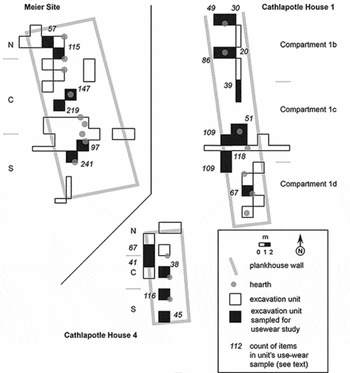
Excavations (undertaken from 1987–1996) used 2 × 2m and 1 × 4m units (see Figure 2), 6.3mm and 3.1mm screens, constant-volume nested wet screening, bulk sampling and the excavation of arbitrary, cultural and natural excavation levels (Ames et al. Reference Ames, Raetz, Hamilton and McAfee1992, Reference Ames, Smith, Cornett and Sobel1999). More than 150 000 artefacts, faunal and botanical remains were recovered, and publication is ongoing (e.g. Ames et al. Reference Ames, Bouredeau and Smith2008; Smith Reference Smith2008; Lyman Reference Lyman2008: 18–22; Ames & Sobel Reference Ames and Sobel2009; Butler & Martin Reference Butler, Martin, Boyd, Ames and Johnson2013).
Meier and Cathlapotle plank houses and excavations.

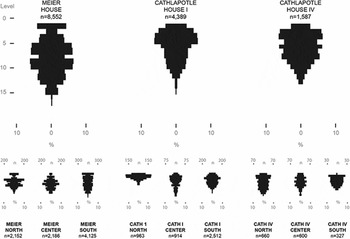
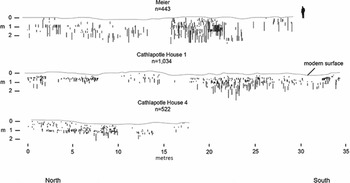
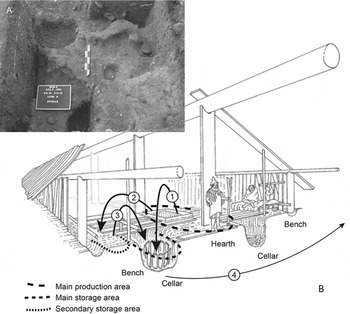
The sites are palimpsests, each representing several centuries of artefact deposition (mostly tools of domestic labour). Natural and cultural formation processes (reviewed in Smith Reference Smith, Ames, Sobel and Trieu2006, Reference Smith2008, Reference Smith2009) did not disturb artefacts significantly, and it was possible to reconstruct the social organisation of labour, as sampled by various analytical units. The artefacts (14 528 in total) are plotted by 0.1m excavation levels below site datum (Figure 3). The distribution suggests that the plank houses were continuously occupied with no significant gaps (sustained habitation breaks) in the data. Figure 4 shows the vertical depth of the 1999 structural features excavated in the plank houses. The standard architecture of plank houses is presented in Figure 5 (there are some differences between sites), which schematically represents the flow of artefact production, storage and discard reconstructed by analysis of over 80 000 lithic, bone and antler debitage items and 3251 shaped artefacts assigned to various stages of use-life in this study. Sampling for this study (Figure 2) focused on the representation of activities in different plank house areas that corresponded to sub-populations of different social ranks.
Indications of residential continuity in the plank houses.

Elevations of structural features; gaps indicate gaps in excavations; each vertical line indicates the depth range of a pit, post or plank feature.

Essential plank house architecture: a) excavation of pit features at the Meier site, scale is 50cm b) reconstruction of plank house 1) production of artefacts and debris in hearth area, immediate storage in cellar; 2) production in hearth area, storage in bench; 3) use/loss in bench area, discard/loss in cellar; 4) episodic cellar clean-out with matrix and artefacts moving to midden (not shown); note that at Cathlapotle cellars were directly beneath benches; cellars could be 2m deep (Ames et al. 2008); the same essential artefact flow occurred in both the Meier and Cathlapotle plank houses, and in each area (north, centre and south) of each plank house.

Use-wear analysis
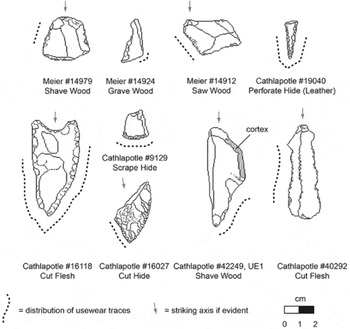
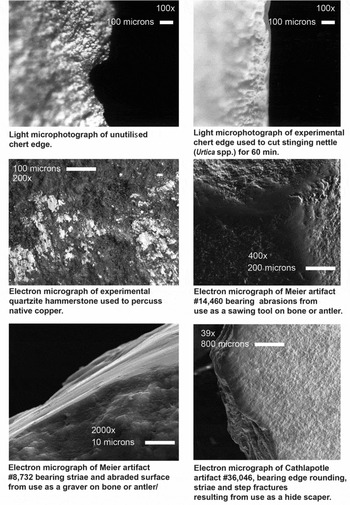
Use-wear analysis was employed to identify the production activities carried out with chipped lithic tools (representatives seen in Figure 6) at the sites (for a review of use-wear studies, see Hayden Reference Hayden1979; for modern methods, see Evans et al. Reference Evans, Lerner, Macdonald, Stemp and Anderson2014; for diverse modern applications, see Aoyama Reference Aoyama2007; Lerner et al. Reference Lerner, Du, Costopoulos and Ostoja-Starzewski2007; Stemp et al. Reference Stemp, Childs, Vionnet and Brown2009; Minchak Reference Minchak2013). Replicas of the excavated tools (1324 replicas in total) were manufactured and applied to the processing of a variety of raw materials native to the Wapato Valley, including meat, bone, antler and vegetation. Sample use-wear traces of this experiment are shown in Figure 7; the traces that were examined include edge rounding or blunting, striations, micro-flaking, polishing distribution and extent interior from margin, and face- and edge- (longitudinal), distribution of wear (Smith Reference Smith2008). Control tests were carried out to check my proficiency, revealing that on average I correctly identified whether or not an implement was used in 86% of the tests, recognised the work action in 72% of the tests and identified the worked material in 68% of the tests. These levels of accuracy are noticeably higher than in many comparable studies; this is because I limited my identification to very broad categories, discriminating only between wood or vegetation, bone or antler, and flesh. Overall, the blind test results verified that I was of comparable proficiency to other use-wear analysts.
Representative fine-grained chipped lithic artefacts.

Representative scanning electron and light microphotography of experimental and archaeological use-wear traces.

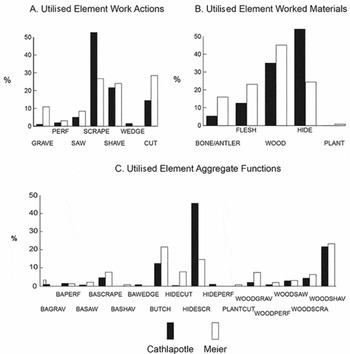
A sample of 2097 lithic items from the Meier and Cathlapotle assemblages (representing 29% and 13% respectively of the sites’ fine-grained, non-projectile point, non-core, crypto-crystalline silicate artefact assemblages; see Figure 6 for representative artefacts) was drawn from analytical units sampling the ends and centres of each plank house. The sampled excavation units and the number of non-projectile-point, fine-grained lithic items from each excavation unit are indicated in Figure 2. Light and scanning electron microscopy at magnifications from 1–400× (Figure 7) revealed that 623 items, or 29.7% of the sample, bore utilised elements; of these, 41% had evidence of scraping, 23% showed shaving evidence, 20% had been used for cutting, 6% for graving, 6% for sawing and 3% for perforation or wedging (<1%) (Figure 8). These work actions were expected considering the properties of the chert (c. 90%) and obsidian (<2%) (Hamilton Reference Hamilton1994). Where use-wear could be attributed to working a specific raw material, it was typically wood (37%), hide (35%), flesh (17%), bone/antler (11%) or plant material (<1%) (Figure 8); all of which were common raw materials of the region (Saleeby Reference Saleeby1983). The range of activities carried out with the sampled tools was wide and essentially the same at both sites (Smith Reference Smith, Ames, Sobel and Trieu2006).
Summary of use-wear analysis: GRAVE = graver, PERF = perforator, SAW = saw, SCRAPE = scrape, SHAVE = shave, WEDGE = wedge, CUT = cut, BONE/ANTLER = bone and/or antler, FLESH = yielding animal tissue, WOOD = wood, HIDE = hide, PLANT = vegetal tissue, BAGRAV = bone/antler graver, BAPERF = bone/antler perforator, BASAW = bone/antler saw, BASCRAPE = bone/antler scraper, BASHAV = bone/antler shaver, BAWEDGE = bone/antler wedge, BUTCH = butchery implement, HIDECUT = hide cutter, HIDESCR = hide scraper, HIDEPERF = hide perforator, PLANTCUT = plant cutter, WOODGRAV = wood graver, WOODSAW = wood saw, WOODSCRA = wood scraper, WOODSHAV = wood shaver.

Chaîne opératoire analysis
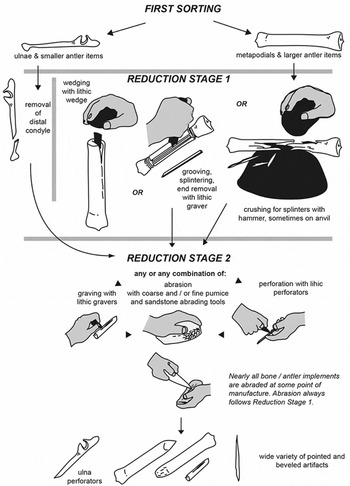
Chaîne opératoire analysis identifies material correlates of different stages of production (see Reide Reference Reide2006; Soressi & Geneste Reference Soressi and Geneste2011); it is here synonymous with production-stage analysis in that both study sequences of production, assisting in understanding the spatial organisation of production behaviour. Here, material correlates of various stages of production were studied in combination with spatial cell frequency analysis (Johnson Reference Johnson and Heitala1984). This allowed production activity to be tracked in both space and time, and made it possible to identify whether certain production stages were carried out universally or only by members of certain rank-specific areas of the plank houses. This study added the 623 utilised elements identified in the use-wear analysis to 5346 other stone, bone and antler artefacts—including lithic and bone/antler debitage—assigned to early, middle or late stages of production. Initially, production-stage analysis assigned each of the combined 5969 artefacts and utilised elements recovered from inside the plank houses to one of five main stages of production: 1) raw material gathering/storage; 2) early reduction; 3) later reduction; 4) use; and 5) exhaustion/end of use-life (Figures 9–11). The frequency of observed material correlates per production stage and per analytical unit was compared with expected frequencies that were calculated as a function of excavation volume. A battery of 82 chi-squared tests was carried out to identify frequency differences per analytical unit in each plank house (Smith Reference Smith2008: 83–114); the results are summarised below. In reading the following, recall working hypotheses regarding social rank arrangement in the plank houses: Meier high-ranked persons in the north, middle ranked in the centre and low ranked in the south; in Cathlapotle house 1 high ranked persons in house 1D, middle ranked in house 1C and lower ranked in house 1B; and in Cathlapotle house 4 higher-ranked persons in the south and lower-ranked persons in the north (see Figure 12, discussed later in this paper).
Chaîne opératoire of chipped lithic production.
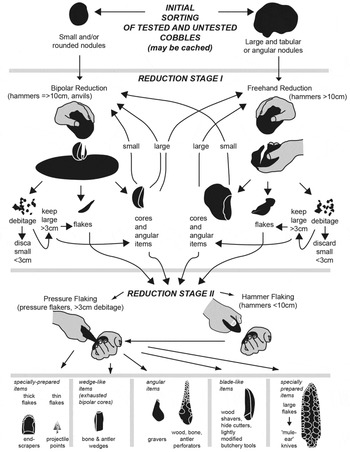
Chaîne opératoire of ground and heavy flaked lithics.

Chaîne opératoire of bone/antler tool production.

Summary of all labour organisation evaluations.

Chipped-stone reduction (4385 artefacts and utilised elements)
Residents of each plank house and each plank house zone executed all lithic reduction stages from storage to discard. All stages of chipped lithic working were found in significantly high densities in the middle-ranked centre of the Meier plank house, whereas at Cathlapotle high frequencies of chipped-stone production were associated with higher-ranked members of the plank houses.
Bone/antler reduction (469 artefacts and utilised elements)
Residents of each plank house and each plank house zone executed all bone/antler reduction stages from storage to discard. Significantly high quantities of all stages of reduction were observed in the lower-ranked north (compartment 1B) of Cathlapotle house 1 and the higher-ranked north of the Meier plank house.
Woodworking reduction (204 artefacts and utilised elements)
Inhabitants of each zone of each plank house were engaged in all stages of wood reduction. Significant exceptions are in the higher intensity of later-stage woodworking in the higher-ranked north end of the Meier plank house and the higher ranked south end of Cathlapotle house 4.
Hide-working reduction (911 artefacts and utilised elements)
People of all social ranks engaged in all stages of hide production, although it was concentrated in the lower ranked north (1B) and centre (1C) of Cathlapotle house 1.
These data indicate that household production was not organised spatially according to production stage.
Labour category analysis
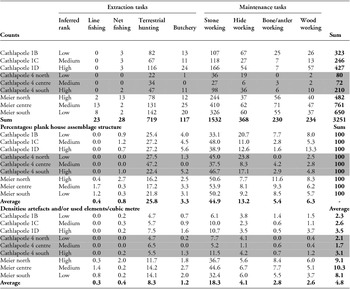
The possibility that labour was organised by broader categories, such as ‘extraction’ (the handling of calories) or ‘maintenance’ (the manipulation of artefacts) was evaluated by assigning to broad task categories the 623 utilised elements and 2628 other category-diagnostic artefacts, recovered from inside the plank houses (Table 1). The artefacts were assigned a category based on their design or use-wear traces. The observed frequencies were evaluated using the chi-squared method described above; the overall impressions are communicated in Figure 12 and discussed in detail below. In many cases (such as bone/antler artefacts), the labour category was identified not by use-wear analysis but by the assignment of artefacts to categories by their morphology, which was supported by multiple studies providing ethnographic frameworks for such assignments (e.g. Davis Reference Davis1998). The assignment of small (<4cm maximum dimension), pointed bifacial items to the class ‘lithic projectile point’ is based on a lack of other wear (e.g. cutting or graving) found in 98% of a spatially random sample of 106 items previously assigned to this class entirely on morphofunctional grounds. Note also that in engineering terms such items are of little other utility, being too small for cutting and too gracile for graving, shaving, splitting planks and so on. I am therefore confident in my assignment of these items, based largely on form alone, to ‘lithic projectile point’ with all of its implications. The assignment of artefact types to labour categories is relatively straightforward, based on artefact use-wear traces and engineering considerations of artefact design.
Counts, assemblage compositions and densities of task-specific artefacts and utilised elements per plank house.

A total of 3251 items were linked to extraction or maintenance activities, according to their use-wear or morpho-functional properties. The four extraction tasks were: line fishing (bone/antler points and bipoints); net fishing (net weights); terrestrial hunting (lithic projectile points); and butchery (butchery tools). The four maintenance tasks were: stone working (lithic cores, raw material, anvils and hammers); hide working (hide-working tools and bone/antler perforators); bone/antler working (bone/antler-working tools, including abraders); and woodworking (woodworking tools including bone and antler wedges and chisels).
Line fishing is represented only at Meier. The number of these items found in the common-ranked centre and low-ranked south areas (combined) was ten times higher than in the higher-ranked north area of the plank house. Close examination of the raw numbers generating this pattern reveal that it is genuine and not a statistical anomaly.
Net-fishing artefacts made up a significant proportion of the higher-ranked north assemblage at Meier and less in the lower-ranked centre and south assemblages. In Cathlapotle house 1, equal emphasis on net fishing is represented in each plank house zone. In Cathlapotle house 4 these artefacts are present only in the high-ranked south area of the plank house. This result is driven by only two artefacts, however, and I am not confident that this suggests strong activity differentiation.
Terrestrial hunting equipment was manufactured and stored throughout the Meier house but clearly concentrated in the low-ranked south assemblages. In Cathlapotle house 1 I found less differentiation, and, echoing line fishing, terrestrial hunting was engaged in by all Cathlapotle house 1 people in similar frequencies. In Cathlapotle house 4 terrestrial hunting items were rarer than in the other houses and were significantly less common at the north, lower-ranked end than elsewhere in terms of their density.
Butchery was practiced in roughly the same degree by all Meier and Cathlapotle house 1 people. Yet in the higher-ranked south area of Cathlapotle house 4, roughly five times the amount of butchery items were found than anywhere else; this is also where net-fishing implements were found in a particularly high density.
Stone working (all stages) was particularly important in the common-ranked centre of the Meier house. At Cathlapotle house 1 the mid-ranked centre (1C) and higher-ranked south (1D) revealed significantly more traces of stone working than in the lower-ranked north (1B). In Cathlapotle house 4 the middle-ranked centre was far less engaged in stone working than higher- or lower-ranked areas, where it was equally distributed, whether examined in raw counts, densities or as an assemblage composition component.
Hide working was carried out in roughly equal proportions by all Meier people. In Cathlapotle house 1 the situation is noticeably different, and roughly twice the amount of hide-working implements per cubic metre were found in the lower-ranked north (1B) than in the common-ranked centre (1C) or higher-ranked south (compartment 1D). In Cathlapotle house 4 hide working was carried out by all but on a significantly smaller scale in the mid-ranked centre of the plank house.
Bone/antler working was carried out in roughly equal proportions by all Meier people. In Cathlapotle house 1, although it was carried out by all, it was somewhat concentrated in the lower-ranked north (1B). In Cathlapotle house 4 bone/antler was worked occasionally and fairly equally, although low frequencies indicate that it was not a particularly important activity in any area (least of all the lower-ranked north).
Woodworking was uniformly carried out by all Meier ranks. In Cathlapotle house 1 all people carried out wood-reduction activities, but people of the mid-ranked centre (1C) did so somewhat less than their neighbours. In Cathlapotle house 4 all ranks were engaged in woodworking, but it was concentrated in the higher-ranked south assemblages.
Figure 12 summarises the distribution of material correlates of the eight extraction and maintenance activity classes. This summary graphic is a speculative distillation of what is indicated by the raw numbers, densities, percentage component scores and the chi-squared tests discussed above, data that cannot be used independently in any sensitive way but must be considered in sum for an overall impression.
At the Meier site most activity variation occurred in extractive tasks. Higher-ranked occupants of the north end of the plank house were concerned with net fishing more than any other area, and those of the lower-ranked south focused on land hunting. In maintenance tasks people of all areas carried out the same labour to the same degree with the exception of stone working, which was a particular concern in the centre populations, probably free commoners, neither slave nor elite. In Cathlapotle house 1 there is broad spatial (rank) homogeneity in extractive task engagement, but significant heterogeneity in maintenance task engagement. That is, higher-ranked peoples engaged in more stone working than others, and the working of hide, bone and antler was done most commonly by the lower-ranked people of the north. Middle-ranked people of the centre were less engaged in woodworking than anyone else. Cathlapotle house 4 yields evidence of heterogeneity in both maintenance and extractive tasks; most people, regardless of rank, were engaged in all tasks, although there is a convincing lack of hide-working material correlates in the centre and, perhaps, an emphasis on woodworking in the south. At this broader level, Figure 12 presents evidence that suggests that labour is organised by the degree of engagement in particular tasks across different social ranks, rather than by participation in particular types of activity.
Conclusions
Sedentary foragers of Meier and Cathlapotle were engaged in roughly the same variety of production activities. Each village population made and used its own set of tools for both maintenance and extraction tasks. The main distinction in productive labour between the sites is in the dominance of hide scraping at Cathlapotle, although it was also carried out at Meier, where bone/antler working and woodworking were somewhat more prevalent. The settlements were largely identical in terms of basic maintenance and production technologies and activities.
Within individual plank houses there is homogeneity in the variety of labour and in the organisation of that labour, indicated by the presence of artefacts from most production stages in all areas. Heterogeneity is seen, however, in the intensity of labour in different zones, as reflected by statistically significant concentrations or absences of artefacts specific to certain activities. This shows a significant degree of differential engagement in labour organised by social rank.
Such organisation is reflected in Figure 12, which distils the data discussed above into eight classes of production, broadly divided into extractive tasks related to the processing of food and maintenance classes related to the transformation of raw material into tools, or the use of tools for non-food production. In the Meier plank house, all stages of all activities were carried out in all areas, with an emphasis on net fishing in the high-status north, lithic production in the middle-status centre and terrestrial hunting in both the middle-ranked centre and the low-ranked south. Extraction tasks were more likely to have been organised by social rank than maintenance tasks.
In Cathlapotle house 1, stone was more commonly worked by the high-status occupants of the south (1D), woodworking was less emphasised in the middle-status centre (1C) and hide and bone/antler working were significantly more commonly engaged in by members of the low-status north (1B). Extraction tasks were carried out in all zones to roughly the same degree. Here, maintenance tasks were more likely to be organised by social rank than extraction tasks, a pattern that contrasts with that at Meier.
In Cathlapotle house 4, 68% of the statistical tests were invalidated due to low counts, but the remaining tests strongly suggest that maintenance and extraction tasks were generally carried out equally by all, though line fishing and butchery were more intensely carried out by higher-ranked people of the south and land hunting was more common among the middle-ranked people of the centre. Maintenance and extraction were generally carried out without being significantly differentiated by social rank.
At Meier extraction was somewhat organised by social rank whereas maintenance was not, a pattern largely opposite to that at Cathlapotle house 1. At Cathlapotle house 4 both maintenance and extraction tasks were organised differentially by social rank. There was, then, a single set of technical solutions to sedentary foraging in the proto-Contact Wapato Valley but more than one organisational solution.
Was labour organised strictly by social rank? No. At both sites, people of all social ranks engaged in most activities, although there are intensity differences probably attributable to social rank. Labour was rank organised by the intensity of engagement in a given task, rather than the presence or absence of engagement, and that labour was organised according to whether it involved maintenance or extraction.
These findings highlight the question of the nature of elite power among stratified foragers. Specifically, Ames (Reference Ames, Price and Feinman1995) has pointed out that models of elite power among such groups (e.g. Coupland Reference Coupland1988; Carlson Reference Carlson1995; Matson & Coupland Reference Matson and Coupland1995) typically ask whether elites were ‘managers’ (acting in the interest of the group at large) or ‘thugs’ (acting in their own interest). If elites controlled production (a prediction of many elite-emergence models) to gain material wealth for themselves, we might expect to find exclusive concentrations of highly valued end products or stockpiles of raw materials and tools in elite residences, and perhaps (though not necessarily) less-than-expected frequencies of production debris. None of the plank houses in this study illustrate this pattern. There was no evidence of elite control of the means or mode of production in, for example, stockpiles of mundane or exotic raw materials, special sets of tools or tool characteristics or caches of artefacts referable to very specific stages of artefact production and calorific extraction. Furthermore, architectural evidence reveals that all ranks were equipped with the same facilities for processing raw materials and calories with the same storage, drying, heating, disintegrating and other processes afforded by hearths, pits and drying racks. Such homogeneity is also suggested in the as yet unpublished faunal and botanical records.
Is there evidence of craft specialisation that can be used by elites to maintain and elevate their rank (as seen in other contexts, see Brumfiel & Earle Reference Brumfiel, Earle, Brumfiel and Earle1987)? Costin (Reference Costin and Schiffer1991) defined a spectrum of craft specialisation intensity; the Meier and Cathlapotle sites most closely resemble her ‘individual’ or ‘dispersed workshops’ characterised by low-intensity specialisation. Ames (1995) describes this as ‘embedded specialism’, wherein elites sponsor part-time artisans.
Present data support a more managerial than acquisitive, aggrandising or ‘thuggish’ role among Meier and Cathlapotle elites. Archaeological features, production techniques and activities appear to be largely similar between and within plank house areas that are believed to have been occupied by groups of different social rank. The elites who resided in the north of the Meier house and the south of Cathlapotle house 1 may have managed or organised manufacture of the most mundane artefacts used in daily production activities, but they do not seem to have owned the bulk of them or, indeed, ‘special’ sets of them. Whether elites were ‘thugs’ or ‘managers’ might be a false distinction; as Ames has hinted (1995, 2003), self-aggrandising elites of non-state cultures, lacking power over others (but capable of some influence), would have been effective managers, able to establish, maintain and increase their status and influence. According to the ethno-historic record, aside from the work of slaves—which could comprise up to 25% of the pre-Contact native population (Donald Reference Donald1997)—elites appear unable to have compelled anyone to do anything. This ethnographically based middle ground between managerial and thuggish elite roles is revealed by the apparent lack of polarity in terms of elite power, and it appears to be corroborated by the pre-Contact archaeological record at these sites, which indicate differences in the degree of engagement in activities by social rank, rather than differences in the type of activity undertaken.