





Impact statement
This work is relevant to the biodesign community as it reframes human hair, a familiar, human-grown and often discarded biomaterial, as both a sustainable material resource and an expressive interactive medium within electronic textiles. By combining hair’s triboelectric properties with hands-on textile interaction, the demo bridges biodesign technical outcomes with the aesthetic, sensorial and emotional potential of biomaterials, opening new directions for meaningful and sustainable soft interfaces.
Bio-based electronic textiles
Electronic textiles (eTextiles) are emerging soft interfaces for collecting, processing and responding to environmental and bodily data (Castano and Flatau Reference Castano and Flatau2014; Stoppa and Chiolerio Reference Stoppa and Chiolerio2014). As ubiquitous computing becomes increasingly present in everyday life, these textile-based interfaces offer new ways to engage with digital environments through soft, flexible and pliable materials, enabling more intimate and embodied forms of interaction. Technically, eTextiles combine textile constructions, such as weaving and knitting, with electrically functional components, including conductive yarns and energy-storage elements. Recent research has begun exploring bio-based alternatives derived from renewable sources, such as cellulose and mycelium, which can biodegrade and introduce new functional properties including shape-changing behaviours and thermal insulation (Guridi et al. Reference Guridi, Iannacchero and Pouta2024).
Triboelectricity
The underlying technology of this demo builds on the principles of triboelectricity combined with textile construction techniques. Triboelectricity refers to the charge produced when two different materials come into contact and then separate, leaving one positively charged and the other negatively charged (Lacks and Mohan Sankaran Reference Lacks and Mohan Sankaran2011). It is the mechanism behind common static electricity and is widely applied in triboelectric nanogenerators (TENGs) to harvest mechanical energy. This phenomenon has been explored in interaction design to create immersive textile-based experiences (Gowrishankar Reference Gowrishankar2020; Gowrishankar et al. Reference Gowrishankar, Leite, Mauranen and Xiao2025), as well as in self-powered sensing applications for wearables (Batra et al. Reference Batra, Pourjafarian, Chang, Tsai, Revelo and Hsin-Liu Kao2025).
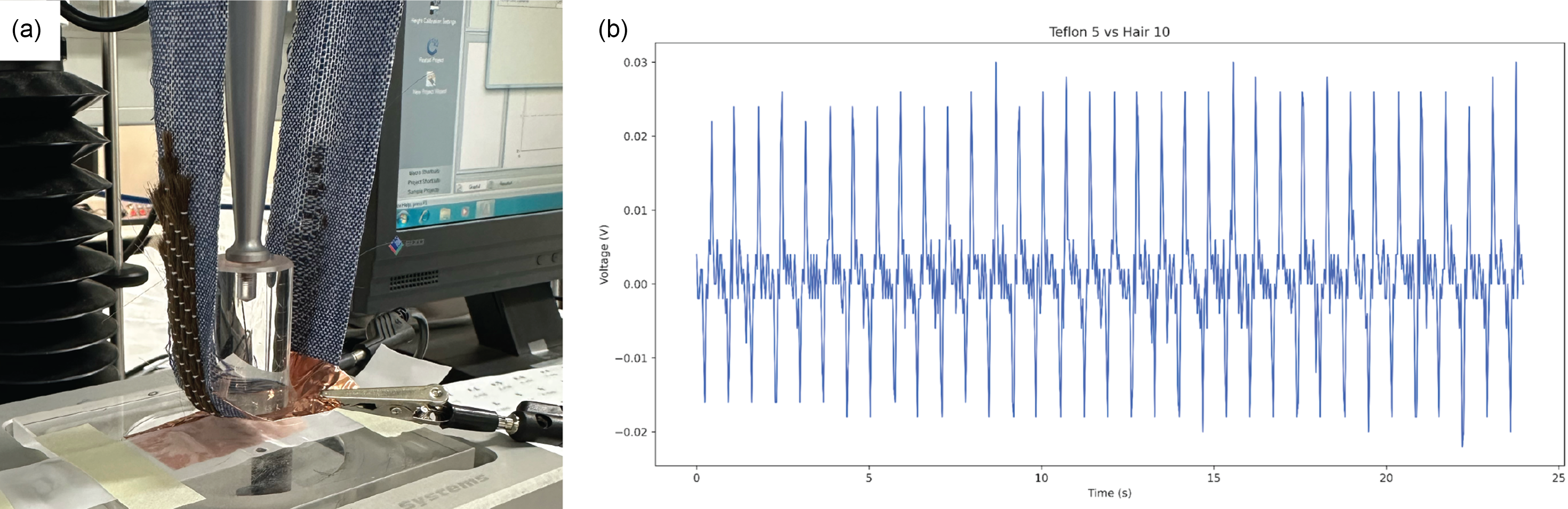
Human hair typically lies near the positive end of the triboelectric series (higher than wool or silk), tending to lose electrons and become positively charged when in contact with materials such as Teflon, polyvinyl chloride or acrylic, with magnitude and signal varying with humidity, cleanliness and surface condition (Diaz and Felix-Navarro Reference Diaz and Felix-Navarro2004). This demo builds on initial laboratory tests conducted by the authors. A hand-woven textile sample, combining human hair (warp) and wool (weft), was tapped against a Teflon film (Kumi ja Matto n.d.). Copper tape was attached to one side of each sample, and both were mounted on a texture analyser to control tapping frequency and force (Figure 1). The two copper tape contacts were then connected to an oscilloscope to record the resulting voltage signal. When the woven hair sample was tapped against the Teflon film using a tubular probe of 25 mm diameter, a root-mean-square (RMS) voltage of 16.45 mV was recorded (Figure 1).
(a) Laboratory evaluation of human hair and wool sample pressed against Teflon film (b) Resulting voltage signal.

Generated through contact and separation, this low-voltage output (16.45 mV) can be amplified and interpreted as input data, enabling gesture detection such as pressing or stroking. The material thus functions as a self-powered sensing interface, translating triboelectric charge transfer from hand manipulation into readable electrical signals.
Hair pillow and samples
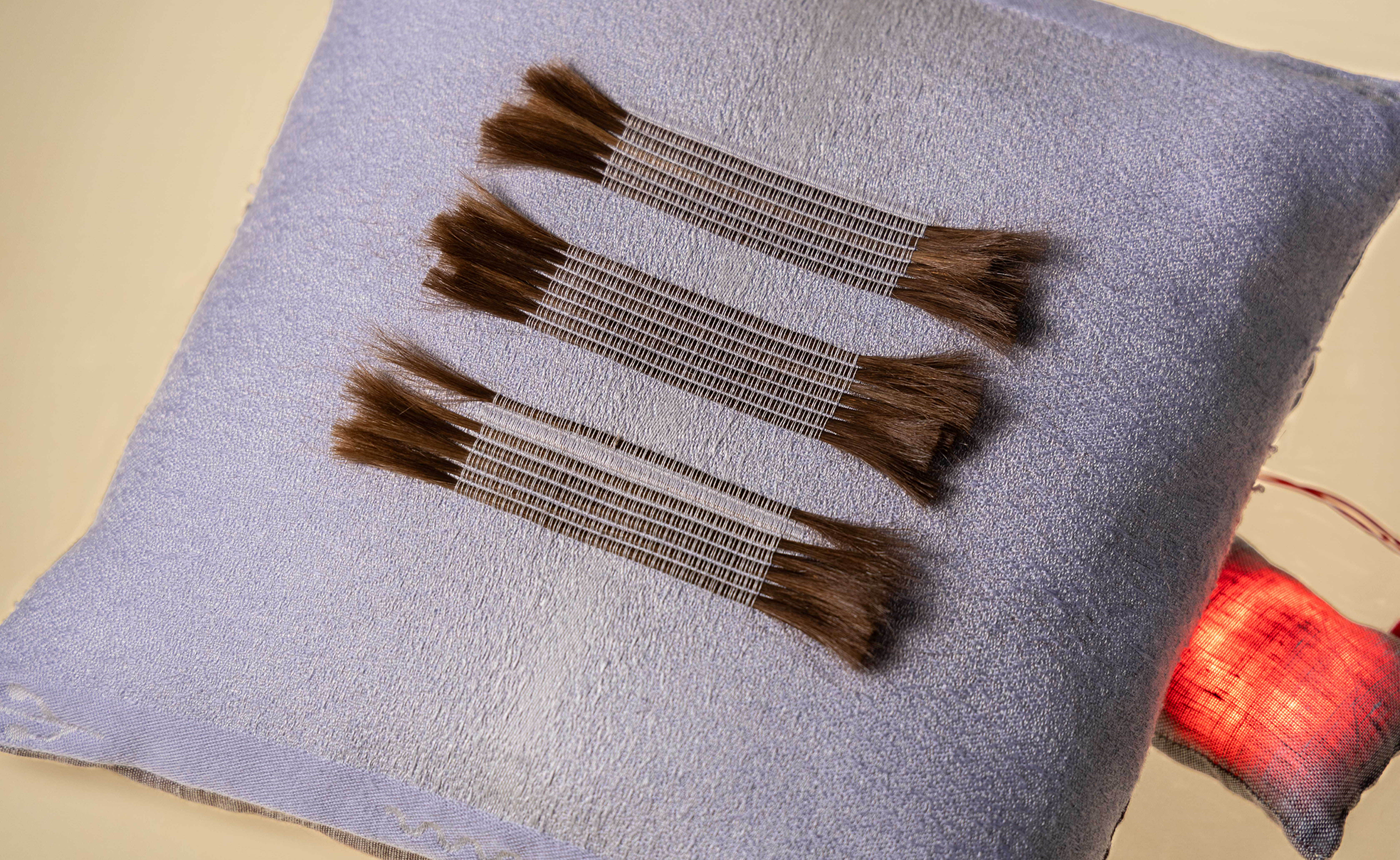
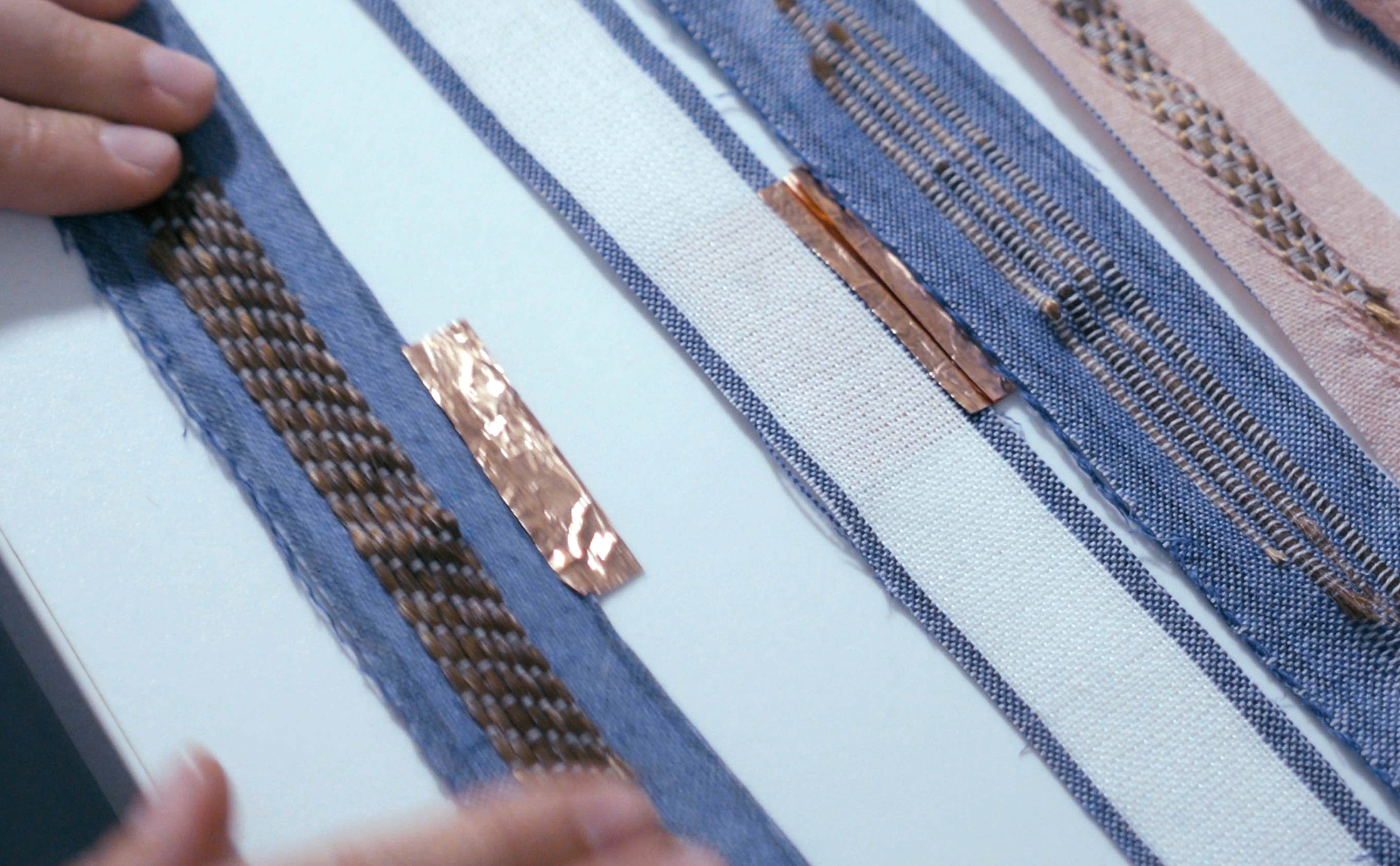
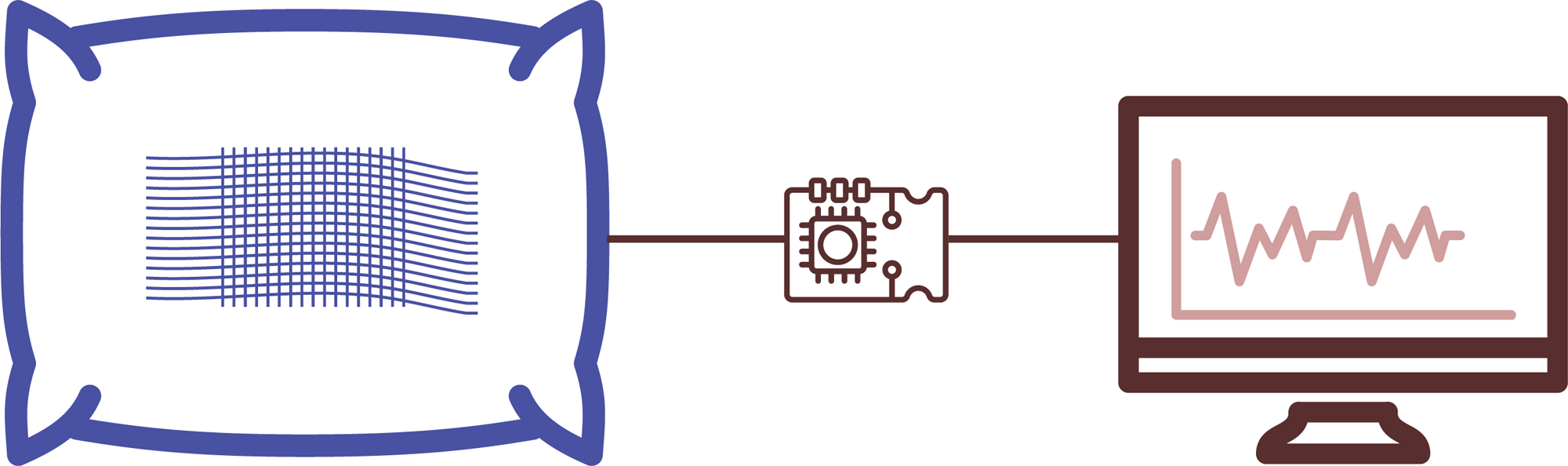
The pillow prototype to be presented at the demo (Figure 2) was constructed using the same layered method as the laboratory samples (hand-woven hair, wool and Teflon film layers). The textile was woven on a hand-operated TC2 Jacquard loom, with wool yarns in purple tones and the Teflon encased in an inner layer. The conductive traces from the pillow will be connected to a circuit board and a computer screen to visually display the voltage generated through direct interaction between the audience and the pillow (Figure 4). The demo will also include a collection of textile samples with different woven structures, made from various types of human hair (Figure 3). A visual diagram, supported by physical samples, will illustrate the layered “sandwich” structure of hair, yarns and Teflon, helping the audience understand the underlying physical phenomenon.
Hair pillow with light visual indicator.

Textile samples made from wool and cotton yarns, human hair and teflon yarns.

Set-up schematic of the pillow connected to an electrical circuit and screen.

Set-up, interactions and technical requirements
The demo requires a surface area of approximately
 $60 \times 60{\rm{\;cm}}$
, positioned about 70 cm above the floor and kept accessible to allow the audience to interact with the pillow through pressing, stroking and tapping. A power outlet will also be needed to connect the computer. The main author will take field notes without any personal data from the audience. A small sign will be added to the table stating that the researchers may take observational notes on interactions, that participation is voluntary and that all observations are anonymous.
Objectives
The objective of this demo is to showcase a novel approach to triboelectric sensing through direct interaction with a bio-based eTextile made from a human-grown biomaterial. By presenting a functional prototype in a real-life setting, the demo enables observation of how people intuitively engage with the textile and how their gestures translate into electrical signals. In parallel, it aims to gather impressions and reflections from the audience in order to enrich the experiential and interpretative understanding of interacting with this type of textile. Finally, the demo seeks to open a shared space for discussion to speculate on possible future scenarios for the use of human-grown materials in electronic textiles, interaction design and biodesign.
Data availability statement
Data availability is not applicable to this article as no new data were created or analysed in this study.
Author contributions
Sofía Guridi: Conceptualisation, Methodology, Investigation, Resources, Writing – Original Draft, Writing – Review & Editing, Visualisation, Project Administration. Matteo Iannacchero: Conceptualisation, Investigation, Resources, Writing – Review & Editing.
Financial support
This research received no specific grant from any funding agency, commercial or not-for-profit sectors.
Competing interests
No conflicts of interest.
Ethical standards
This study involves observational data to be collected during a public demo. No personal data will be collected from participants. Interaction with the prototype is entirely voluntary, and all observations will remain anonymous. Participants will be informed of the observational nature of the study through a visible sign displayed at the demo setup. No formal ethical approval is required for this type of observational, non-interventional public engagement activity. Human hair used in the fabrication of the textile samples has been collected as discarded material, with no personal identification retained.

 Open access

