Anxiety screening instruments have come a long way since their inception (Garcia-Lopez & Storch, Reference Garcia-Lopez and Storch2008). At first, anxiety screening questionnaires of child and adolescent anxiety focused on a more-than, lesser-than approach of the degree of anxiety severity as a global whole without considering specific DSM anxiety disorder symptoms (Garcia-Lopez, Olivares, & Vera-Villaroel, Reference Garcia-Lopez, Olivares and Vera-Villarroel2003; Hale, Raaijmakers, Muris, & Meeus, Reference Hale, Raaijmakers, Muris and Meeus2005). However, the advent of self-report questionnaires related to specific DSM-IV-TR (American Psychiatric Association, 2000) anxiety disorder symptoms helped to refine screenings instruments of specific child and adolescent anxiety disorder symptoms (Myers & Winters, Reference Myers and Winters2002). Instruments that allow for the measurement of specific DSM-IV-TR anxiety disorder symptoms are important to researchers and clinicians alike as they allow for the study of these symptoms in the general adolescent population (Garcia-Lopez, Reference Garcia-Lopez2013; Garcia-Lopez, Piqueras, Diaz-Castela, & Ingles, Reference Garcia-Lopez, Ingles and Garcia-Fernandez2008).
In addition to studying this population as a whole, examination should also be given to specific adolescent sex groups. For example, previous studies (e.g., Cohen et al., Reference Cohen, Cohen, Kasen, Velez, Hartmark, Johnson and Streuning1993) have demonstrated that adolescent girls run a higher risk of developing anxiety disorders than adolescent boys. Additionally, in a study by Hale et al. (Reference Hale, Raaijmakers, Muris and Meeus2005) it was found that adolescent girls had more severe Generalized Anxiety Disorder symptoms and Social Anxiety Disorder symptoms than adolescent boys. However, other studies have found that the effect size for adolescent boy and girl differences is small for Social Anxiety Disorder symptoms (Garcia-Lopez, Ingles, & Garcia-Fernandez, Reference Garcia-Lopez, Ingles and Garcia-Fernandez2008; Gren-Landell et al., Reference Gren-Landell, Tillfors, Furmark, Bohlin, Andersson and Svedin2009; Ingles et al., Reference Ingles, Piqueras, Garcia-Fernandez, Garcia-Lopez, Delgado and Ruiz-Esteban2010). With the knowledge of differences between boy and girl adolescent anxiety disorder symptoms, clinicians can become more sensitive as to the relative occurrence of these specific anxiety symptoms and could potentially help the clinician to come to a diagnosis in a more timely fashion.
One of the best studied of these DSM-IV-TR anxiety disorder screening instruments is the Screen for Child Anxiety Related Emotional Disorders (SCARED; Birmaher et al., Reference Birmaher, Khetarpal, Brent, Cully, Balach, Kaufman and McKenzie-Neer1997; Reference Birmaher, Brent, Chiappetta, Bridge, Monga and Baugher1999). In a review of the literature, Myers and Winters (Reference Myers and Winters2002) suggest that two of the better anxiety disorder screening instruments are the SCARED and the Multidimensional Anxiety Scale for Children (MASC). According to Myers and Winters (Reference Myers and Winters2002), the advantages that these two new questionnaires hold over previous questionnaires are that “both the MASC and SCARED tap clear constructs, [and] have adequate initial psychometric properties” (p. 652). Additionally, in studies by Muris and colleagues, it has been shown that the SCARED is strongly correlated with the MASC (Muris, Gadet, Moulaert, & Merckelbach, Reference Muris, Gadet, Moulaert and Merckelbach1998) and the anxiety disorders section of the Diagnostic Interview Schedule for Children (Muris, Merckelbach, Mayer, & Prins, Reference Muris, Merckelbach, Mayer and Prins2000).
The SCARED is a screening instrument that purports to measure five child and adolescent anxiety disorder symptom dimensions. Four of the five factors of the SCARED (Generalized Anxiety Disorder, Panic Disorder, Separation Anxiety Disorder, and Social Anxiety Disorder) are clearly related to DSM-IV-TR anxiety disorders. The fifth anxiety symptom dimension of the SCARED is School Anxiety (or: School Refusal), which is not a DSM-IV-TR anxiety disorder but is a serious problem in childhood and adolescence that negatively impacts the social and emotional development of the youth (Fremont, Reference Fremont2003, King & Bernstein, Reference King and Bernstein2001). As noted by King & Bernstein (Reference King and Bernstein2001) “Terms such as separation anxiety and school phobia are often used interchangeably with school refusal…” (p. 197). However, in a cross-cultural meta-analysis of the SCARED by Hale, Crocetti, Raaijmakers, and Meeus (Reference Hale, Crocetti, Raaijmakers and Meeus2011) it was found that while the School Anxiety scale of the SCARED had weaker psychometric properties than all the other SCARED scales, it still was found to be independent from Separation Anxiety Disorder.
In a recent cross-cultural meta-analysis of the psychometric properties, the five-factor structure of the SCARED was borne out (Hale et al., Reference Hale, Crocetti, Raaijmakers and Meeus2011). Furthermore, this same study demonstrated that the four SCARED scales related to the symptoms of DSM-IV-TR anxiety disorders have robust psychometric properties (Hale et al., Reference Hale, Crocetti, Raaijmakers and Meeus2011).
However, until recently, almost no studies have been conducted of the psychometric properties of the SCARED for the Spanish speaking population. It is estimated that approximately 250 million individuals speak Spanish as their native language (McArthur, Reference McArthur and McArthur2005), and the prevalence rates of anxiety disorders in Spanish adolescents are relatively high (Haro et al., Reference Haro, Palacín, Vilagut, Martínez, Bernal, Luque and Alonso2006), so it is curious that so little attention has been devoted to this issue. A notable exception to this is a recently published study by Vigil-Colet et al. (Reference Vigil-Colet, Canals, Cosí, Lorenzo-Seva, Ferrando, Hernández-Martínez and Doménech2009) that demonstrated good psychometric properties for the four SCARED scales related to the symptoms of DSM-IV-TR anxiety disorders in a community sample of children. However, no study has been conducted for the Spanish version of the SCARED in an adolescent population.
Additionally, it has not yet been determined whether the SCARED can significantly differentiate between Spanish adolescents diagnosed with an anxiety disorder and healthy adolescents. Since the SCARED purports to screen for anxiety disorder symptoms, it is essential to examine not only whether the psychometric properties of the SCARED for the general Spanish adolescent population are good, but also whether the SCARED can significantly differentiate between Spanish adolescents diagnosed with an anxiety disorder and healthy adolescents.
Method
Participants and Procedure
This study was part of a larger research project (Spanish Ministry of Higher Education; PSI2009-12448) at the Department of Psychology of the University of Jaén (Spain) that screened 2500 adolescents for anxiety symptoms. The sample in this study (conducted in 2008) was selected from among those participants who passed the cut-off score established by Olivares et al. (Reference Olivares, Garcia-Lopez, Hidalgo, LaGreca, Turner and Beidel2002) to detect socially anxious adolescents; namely a score of 70 or higher on the Social Phobia and Anxiety Inventory (Turner, Beidel, Dancu, & Stanley, Reference Turner, Beidel, Dancu and Stanley1989; Olivares et al., Reference Olivares, Garcia-Lopez, Hidalgo, LaGreca, Turner and Beidel2002) and a score of 53 or higher on the Social Anxiety Scale for Adolescents (La Greca & López, 1998; Olivares et al., Reference Olivares, Garcia-Lopez, Hidalgo, LaGreca, Turner and Beidel2002).
The 425 Spanish adolescents who participated in this study came from two private and six public (junior) high schools (grades 8 to 12) in the Andalucía region of Southern Spain. The adolescent population consisted of 200 (47%) boys and 225 (53%) girls. The students ranged from 12 to 19 years of age (M = 15.41, SD = 1.32).
Prior to the study, the adolescents and their parents were informed about the study and its goals. Active informed consent was obtained from the adolescents’ parents before the research was conducted. The adolescents provided assent before the study and could at any time simply decline to participate in the study. The research assistants explained the procedure and provided instructions before conducting the research and reiterated that participation in the study was on a volunteer basis only. During the homeroom study period, the adolescents filled in the SCARED. For the diagnosis of Social Anxiety Disorder, each adolescent was individually interviewed in a private room in the school.
The Anxiety Disorders Interview Schedule for DSM-IV Child Version (ADIS-IV-C; Silverman & Albano Reference Silverman and Albano1996) was conducted by trained Ph.D. students of clinical psychology to diagnose Social Anxiety Disorder. Based on the ADIS-C, 149 adolescents (35%) met the DSM-IV criteria for Social Anxiety Disorder. The Ph.D. students of clinical psychology were trained by the third author to administer the interview.
The interview was recorded for 25% of the cases. These recorded interviews were conducted in the school counselor’s office and the students were aware and informed of the recording. Two trained Ph.D. students of clinical psychology independently rated these recorded interviews to check for accuracy. Inter-rater reliability was calculated using the kappa coefficient method. The results, mean kappa coefficients of 0.82, indicated that good inter-rater reliability was achieved (Landis & Koch, Reference Landis and Koch1977).
Measures
The screening instrument for adolescent anxiety disorder symptoms employed in this study was the original 38-item SCARED (Birmaher et al., Reference Birmaher, Khetarpal, Brent, Cully, Balach, Kaufman and McKenzie-Neer1997; Reference Birmaher, Brent, Chiappetta, Bridge, Monga and Baugher1999). The SCARED is a self-report questionnaire that measures five anxiety disorder symptom dimensions in children and adolescents, namely Generalized Anxiety Disorder, Panic Disorder, School Anxiety (or: School Refusal), Separation Anxiety Disorder, and Social Anxiety Disorder. Apart from the School Anxiety dimension, the other four symptom dimensions are related to DSM-IV-TR anxiety disorders.
The adolescent rated each symptom on a 3-point scale: 0 (almost never), 1 (sometimes), 2 (often). The subscales of the questionnaire were: Generalized Anxiety Disorder (9 items; score range: 0–18; sample item: “I worry about the future.”), Panic Disorder (13 items; score range: 0–26; sample item: “I am afraid for no reason.”), School Anxiety (4 items; score range: 0–8; sample item: “I am afraid to go to school.”), Separation Anxiety Disorder (8 items; score range: 0–16; sample item: “I am afraid to be alone.”), and Social Anxiety Disorder (4 items; score range: 0–8; sample item: “I get nervous around strangers.”).
The SCARED was translated into Spanish using the back-translation method (Hambleton, Reference Hambleton1994; Hambleton & Kanjee, Reference Hambleton and Kanjee1995). First, the original 38-item version of the SCARED (Birmaher et al., Reference Birmaher, Khetarpal, Brent, Cully, Balach, Kaufman and McKenzie-Neer1997) was translated into Spanish by a native English speaker with a degree in translation, majoring in Spanish, and was also translated into Spanish by a Spanish lecturer of child psychology with knowledge of both cultures. Once completed, a native Spanish translator with a degree in English and knowledge of both cultures back-translated the two Spanish translations into English. The original version of Birmaher et al. (Reference Birmaher, Khetarpal, Brent, Cully, Balach, Kaufman and McKenzie-Neer1997) was then compared with the two back translations, and the translators made corrections to the final Spanish translations. An inter-translation agreement was reached of .95 in the first case and .96 in the second. The first and third authors supervised the entire process. No items were eliminated or significantly changed during the translation process.
Statistical analysis
To test the validity of the SCARED’s factor structure for measurement invariance between the socially anxious (as diagnosed by the ADIS-IV-C) and healthy Spanish adolescent groups, both a one factor model (which would indicate that all 38 items only measure one general anxiety factor) and a five correlated factors model (which would support the theoretic five anxiety disorder symptom dimensions of the SCARED) were tested in confirmatory factor analyses. For these analyses the structural equation modeling program AMOS (version 7) was used (Arbuckle, Reference Arbuckle2006). As the data did not justify the assumption of multivariate normality, the estimation method of Unweighted Least Squares (ULS) was employed. In this approach, the fit of the models was evaluated by means of three measures, proposed by Jöreskog and Sörbom (Reference Jöreskog and Sörbom1989): (a) Goodness of Fit Index (GFI; a value of .90 or greater represents an acceptable fit); (b) Adjusted Goodness of Fit Index (AGFI; a value of .90 or greater represents an acceptable fit); and (c) Root Mean Square Residual (RMR; a value of .05 or less represents an acceptable fit). After determining which model best represented the data of the total sample, a multiple group analysis was performed to test the measurement invariance of this model for both the socially anxious and healthy Spanish adolescent samples.
Additionally, Cronbach’s alphas were calculated to determine the reliabilities of the five SCARED scales. Finally we employed partial eta-square tests (η 2 ) to calculate the effect size of the differences between adolescent age, sex and socially anxious and healthy adolescent samples in both Multivariate and Univariate Analysis of Variance.
Results
Confirmatory Factor Analysis of the One Factor Model and the Five Correlated Factors Model
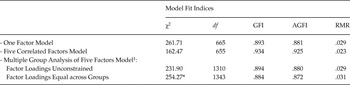
As can be seen from the results reported in Table 1, the five correlated factors model clearly outperformed the one factor model. Since the solution with five factors also relates to the theoretical assumptions of the SCARED, the fit of this model was further examined for measurement invariance for socially anxious and healthy Spanish adolescents. The results of this multigroup CFA, also reported in Table 1, revealed that constraining the factor loadings to be equal for both groups and did not significantly deteriorate the fit compared to the fit of a model in which these factor loadings were allowed to differ for both groups. This demonstration of measurement invariance allowed for further cross-group comparisons (Vanderberg & Lance, Reference Vanderberg and Lance2000).
Model fit indices for the One Factor Model and the Five Correlated Factors Model

Note:
* Compared to unconstrained model: Δχ2 (33) = 22.37, p > .500.
1 Groups: Socially anxious Spanish adolescents (N = 149) and healthy Spanish adolescents (N = 276).
GFI = goodness-of-fit index, AGFI = adjusted goodness-of-fit index, RMR = root mean square residual.
Homogeneity of the Five Scales of the SCARED
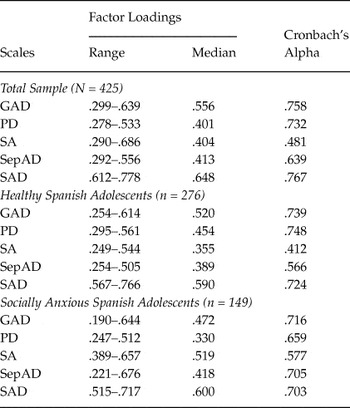
Table 2 reports the reliabilities (Cronbach’s α) of the five SCARED scales, both for the total adolescent population and for the socially anxious and healthy Spanish adolescent groups. In general, the reliabilities were acceptable, except for the School Anxiety Symptom Scale. Additionally, the Separation Anxiety Disorder Symptom Scale also performed rather poorly in the healthy Spanish adolescent group.
Reliability and Range and Median of Factor Loadings of the SCARED

Note:
GAD = Generalized Anxiety Disorder, PD = Panic Disorder, SA = School Anxiety, SepAD = Separation Anxiety Disorder, SAD = Social Anxiety Disorder.
According to the median of the standardized regression weights of the individual scale items (i.e., the factor loadings), the indicator items (i.e., the anxiety disorder symptoms) sufficiently contributed to the measurement of the five specific latent anxiety disorder symptom scales of the SCARED (Table 2).
Multivariate Analysis of Variance of the Differences between Adolescent Age, Sex and Socially Anxious and Healthy Adolescent Groups
In a Multivariate Analysis of Variance analysis, the effects of age, sex and belonging to either the socially anxious group or the healthy adolescent group were tested. Age was dichotomized to a group of young adolescents (12–15 years old; N = 230) and a group of older adolescents (15–19 years old; N = 195).
First, a full model was tested including two-way and three-way interactions. At the multivariate level (i.e., across the five subscales of the SCARED), all two-way and three-way interactions effects were statistically non-significant (p > .05), resulting in less than small effect sizes (i.e., η p 2 < .002).
Next, three specific full models containing only main effects were tested for each adolescent group (i.e., sex, age and the socially anxious and healthy adolescent groups). As expected, the model that tested for the multivariate differences for the socially anxious and healthy adolescent groups was highly significant and had a large effect size (p < .001, η p 2= .22). Additionally, the multivariate effect of the sex groups appeared to be highly significant and moderate in size (p < .001, η p 2 = .08). Finally, the multivariate effect of the age groups was found to be non-significant (p = .162, η p 2= .019). Therefore only univariate analyses were conducted for individual SCARED scales differences between the socially anxious and healthy adolescent groups and the sex groups.
Univariate Analysis of Variance of the Differences between the Socially Anxious and Healthy Adolescent Groups
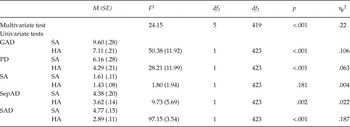
As noted in Table 3, the socially anxious Spanish adolescents consistently had higher mean symptom levels for the five subscales of the SCARED. However, the difference between the two groups in School Anxiety did not reach statistical significance and was of negligible size. As expected, the effect size of the difference in mean level of Social Anxiety Disorder was large and highly significant. Concerning the other anxiety disorder symptoms, the differences were of medium (i.e., Generalized Anxiety Disorder and Panic Disorder) or small effect sizes (i.e., Separation Anxiety Disorder).
Multivariate Analysis of Variance Results of Mean Differences in Sum Scores Between the Socially Anxious and Healthy Spanish Adolescents

Note:
SA = Socially anxious Spanish adolescents, HA = Healthy Spanish adolescents, GAD = Generalized Anxiety Disorder, PD = Panic Disorder, SA = School Anxiety, SepAD = Separation Anxiety Disorder, SAD = Social Anxiety Disorder.
1 Values enclosed in parentheses represent mean square errors. df 1 : hypothesis df; df 2 : error df.
Univariate Analysis of Variance of the Differences between Male and Female Adolescents
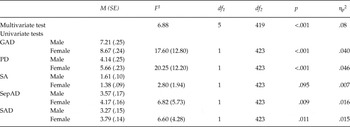
In Table 4, clear but small effect size differences in the Generalized Anxiety Disorder and Panic Disorder symptoms of the male and female adolescents can be observed, with females showing higher mean symptom levels. Less outspoken, but nevertheless significant, were the slightly higher mean symptom levels for the female adolescents’ Separation Anxiety Disorder and Social Anxiety Disorder symptoms. No significant differences between the male and female adolescents were found for the School Anxiety symptoms.
Multivariate Analysis of Variance Results of Mean Differences in Sum Scores Between Male and Female Spanish Adolescents

Note:
GAD = Generalized Anxiety Disorder, PD = Panic Disorder, SA = School Anxiety, SepAD = Separation Anxiety Disorder, SAD = Social Anxiety Disorder.
1 Values enclosed in parentheses represent mean square errors. df 1 : hypothesis df; df 2 : error df.
Discussion
The aim of this study was to examine if not only the psychometric properties of the Spanish translation of the SCARED were good for Spanish adolescents, but also if the SCARED could significantly differentiate between Spanish adolescents diagnosed with an anxiety disorder and healthy adolescents.
As can be seen in Table 1, Confirmatory Factor Analyses (CFA) demonstrated that the five correlated factors model clearly outperformed the one factor model. This finding is in agreement with the theoretical assumption that the SCARED measures specific DSM-IV-TR anxiety disorder symptom dimensions and is in agreement with a recent cross-cultural meta-analysis study of the SCARED (Hale et al., Reference Hale, Crocetti, Raaijmakers and Meeus2011).
When the SCARED was tested for measurement invariance between Spanish adolescents with a clinical diagnosis of Social Anxiety Disorder and healthy adolescents, CFA findings demonstrated that the SCARED is measured in the same way for both distinct populations.
Good psychometric properties were demonstrated by the acceptable reliabilities and the large multivariate effect size between socially anxious and healthy Spanish adolescent groups (η p 2 = .22) and the moderate multivariate effect size between the adolescent boys and girls (η p 2 = .08). Both these size effects demonstrate specificity of the instrument. Furthermore, the univariate findings of the individual SCARED scales differences between the adolescent boys and girls were in agreement with previous studies from various countries (e.g., Hale et al., Reference Hale, Crocetti, Raaijmakers and Meeus2011). These findings therefore support the claim that the SCARED is a psychometrically sound instrument in the screening of anxiety disorder symptoms for Spanish adolescents.
Some limitations of this study should be mentioned. The first of these is that this study was conducted with only cross-sectional data. Use of longitudinal data would have allowed the study of the stability of the differences between the adolescent age and sex groups. Hence, future studies of Spanish adolescents should employ longitudinal data to explore this possibility. Additionally, this study only examined Spanish adolescents diagnosed with Social Anxiety Disorder and healthy Spanish adolescents. Conceivably, inclusion of Spanish adolescents diagnosed with other DSM-IV-TR anxiety disorders may have increased the variation in the dataset, and could have strengthened or weakened the found effects sizes.
In summary, this study demonstrates that the SCARED can be utilized as a screening instrument for Spanish adolescents in the general population and that the SCARED can clearly differentiate between socially anxious and healthy Spanish adolescents.