Introduction
Stereotactic body radiotherapy (SBRT) facilitates the administration of large doses per fraction and a small number of fractions to tumours, with minimal exposure to the surrounding organs. This method, which offers increased stability and precision, has been widely used for lung cancer treatment over the past 20 years. Hypofractionated high-dose SBRT has emerged to treat early-stage non-small-cell lung cancer. Reference Mehta, King, Agazaryan, Steinberg, Hua and Lee1 However, the adverse effects of this treatment often include radiation pneumonitis (RP), which can be fatal. Therefore, in the treatment planning, the spread of low doses to normal lung tissue should be minimised. Several researchers have reported that the percentage of lung volume receiving an excess dose of 5 Gy, 10 Gy, 20 Gy and 25 Gy (V5, V10, V20 and V25) and the mean lung dose (MLD) are predictive factors for RP. Reference Baker, Han and Sarangkasiri2–Reference Nakamura, Nishimura and Nakayama5 To avoid RP or respiratory function decline, conventional planning or intensity-modulated radiation therapy (IMRT) Reference Bradley6–Reference Kong, Hayman and Griffith8 planning could be employed by considering the combination of the gantry angle. In this regard, the CyberKnife system (Accuray Incorporated, Sunnyvale, CA) is suitable for increasing dose concentration because of its beneficial characteristics. CyberKnife, a specialised medical device for stereotactic radiosurgery treatments, consists of a compact 6-MV linear accelerator (LINAC) mounted on a robotic arm; the LINAC irradiates the target with radiation from different directions. Reference Kilby, Dooley, Kuduvalli, Sayeh and Maurer9 Moreover, it delivers the radiation dose with real-time tumour tracking that corrects for tumour motion during respiration by repositioning the radiation beam to track the moving tumour. Reference Nakamura, Nishikawa and Mayahara10
In conventional planning or IMRT planning using the medical LINAC, irradiation can be rendered through any angle in any direction. However, the irradiation angle is limited in the CyberKnife system, as its rotation is limited to 100 degrees. In a non-coplanar setting, the available beam directions have been shown to affect plan quality. Reference Rossi, Breedveld, Heijmen, Voet, Lanconelli and Aluwini11 Thus, owing to the specific geometry of the CyberKnife layout, irradiation from the space under the treatment table is impossible.
CyberKnife can only irradiate from above to its device characteristics. When a patient is positioned on his/her back, the exposure of normal organs to low-dose radiation becomes a problem when the tumour is in the posterior region. For example, in the case of lung cancer, if the patient is in the supine position, many beams pass through normal lung tissue when the tumour is located on the patient’s posterior lung side. Consequently, a large volume of the normal lung tissue is undesirably irradiated which can cause radiation injury. Thus, it is necessary to consider patient positioning during CyberKnife treatment. In this study, the comparison between the prone set-up and the supine set-up was investigated to decrease normal lung dose to avoid adverse events.
Materials and Methods
Treatment planning
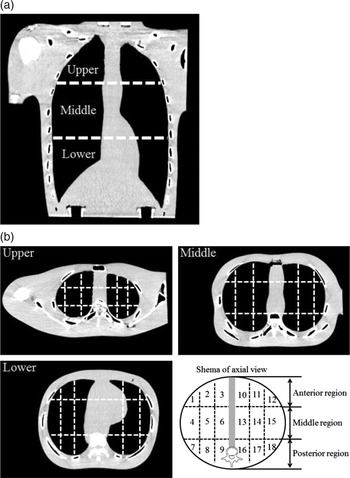
For a human phantom (Kyoto Kagaku Co., Ltd., Kyoto, Japan), simulation computed tomography (CT) scans were acquired in both supine and prone positions. The human phantom included the skin, lungs and bones. A virtual target was contoured in the supine dataset. For consistency, the same contours were copied onto the prone dataset after co-registering the prone and supine CT images. The tumour location was decided as follows. First, lungs were divided into three areas (Figure 1 (a)). Then, each area was further divided into nine cross-sectional regions (Figure 1 (b)). Finally, the virtual tumour was located in each area. Fifty-four regions were generated for the supine and prone set-ups, respectively (Figure 1 (b)). For simplicity, only one tumour was set in the lung for each plan. For all plans, the target volume was set to approximately 30 cm3 in accordance with Ueyama et al. Reference Ueyama, Arimura and Takumi4 In this study, target volume was considered as the same volume as planning target volume (PTV). Using the CyberKnife planning platform (Precision version 2.0.1.1; CyberKnife (VSI) version 9.6.0), 108 plans (54 for prone and 54 for supine) were generated. The plans were designed to deliver a dose of 60 Gy per eight fractions to 95% of the target volume. For a given target, the plans in the prone and supine positions were optimised using the VOLO method. Additionally, for all treatment planning, the Monte Carlo algorithm Reference Murali, Gopalakrishna Kurup and Bhuvaneswari12 was used for the dose calculation because of the lung electron density within and/or around the treatment volume. The plans were generated by a medical physicist specialised in CyberKnife treatment.
CT image of the phantom in this study. (a) Coronal view of the CT image of the phantom that is divided into three regions: upper, middle and lower. (b) Axial view of the CT image of the phantom according to each region, which is further divided into 18 slices (nos. 1 to 18).

Plan evaluation
The supine and prone plans were compared in terms of the following: the dosimetric characteristics (maximum PTV dose, percentage of the prescription dose covering 95% of the volume (D95), VS5, V5, V10, V20, V25 and MLD); delivery efficiency (number of beams, treatment time and total plan monitor units (MUs)) and plan efficiency (homogeneity index (HI), conformity index (CI) and new conformity index (nCI)). The HI is defined as follows Reference Cao, Zhu and Ju13 :
 $${\rm{HI}} = {{{D_{max}}} \over {{R_{xDose}}}},$$
where
 ${R_{xDose}}$
denotes the prescription dose. The CI is defined as follows
Reference Cao, Zhu and Ju13
:
 $${\rm{CI}} = {{prescription\;isodose\;volume\;\left( {c{m^3}} \right)} \over {tumor\;volume\;encompassed\;prescription\;isodose\;line\;\left( {c{m^3}} \right)}}$$
The nCI is calculated as follows Reference Cao, Zhu and Ju13 :
 $${\rm{nCI}} = C{I_{coverage}}$$
Here, coverage is defined as the ratio of the target volume covered with the prescription dose to the target volume.
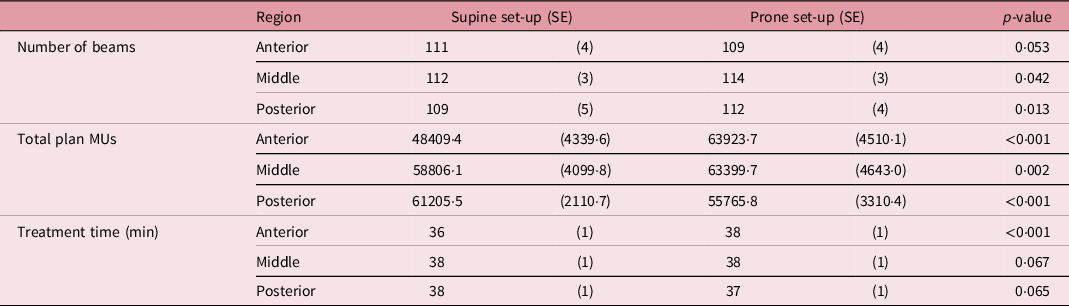
V5, V10, V20, V25 and MLD of the lung were reported as risk factors for RP after stereotactic radiation therapy for lung tumours. Reference Baker, Han and Sarangkasiri2–Reference Nakamura, Nishimura and Nakayama5 A dose–volume histogram (DVH) analysis was performed. For the supine and prone position plans, the mean DVHs of the target and critical organs were calculated and compared for each lung region, that is, posterior, middle and anterior region.
Statistical analysis
Data were presented as mean ± standard error. Differences between groups were evaluated using the Student’s t-test. Data were considered statistically significant for p < 0·001.
Results
Plan quality
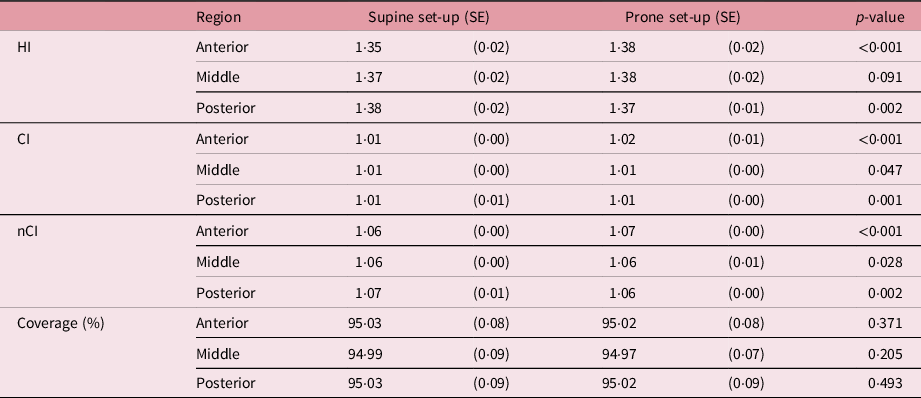
Table 1 shows the results obtained for the plan quality index. No statistically significant difference was observed in the dose coverage parameter among the each plan. The average HI values and the average CI values were calculated for each region, that is, posterior, middle and anterior region. There was a significant difference in HI, CI and nCI between the supine and prone set-up plans only when the target was seated in the anterior region.
Dosimetric parameter in supine and prone position

Dosimetric characteristics
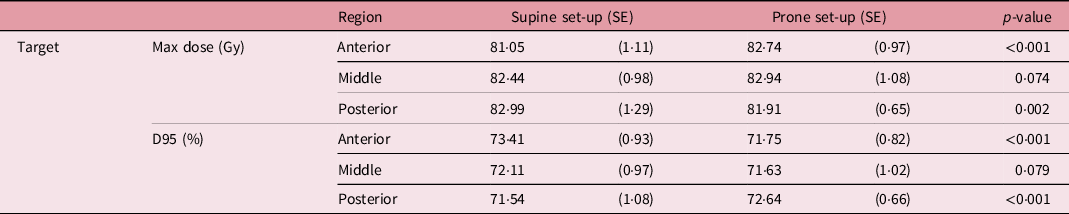
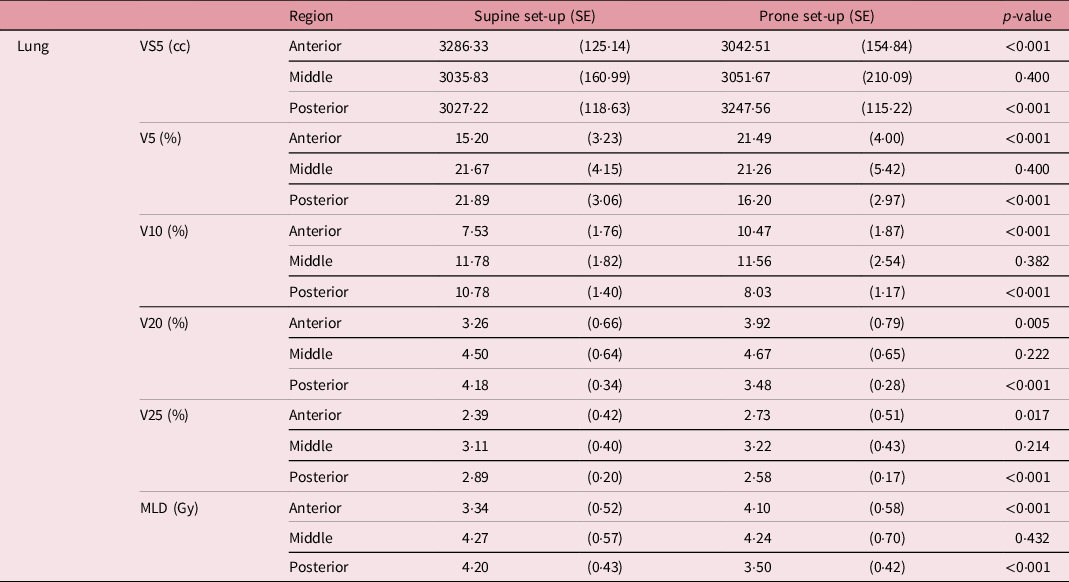
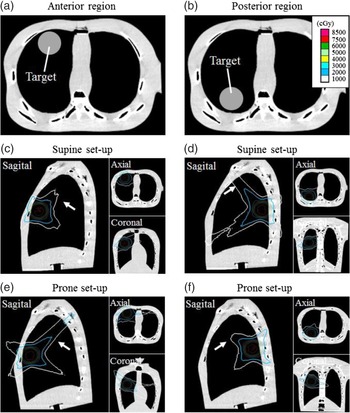
Table 2 shows the dosimetric characteristics of the target, and Table 3 shows the dosimetric characteristics of the lungs. The V10 of the lungs is 7·53% and 10·47% (p < 0·001) in the anterior region, 11·78% and 11·56% (p = 0·382) in the middle region, and 10·78% and 8·03% (p < 0·001) in the posterior region in the supine and prone set-up plans, respectively (Figure 2 (a)–(f)). There was a significant difference in the V5 and V10 to the lung between the supine set-up and prone set-up plans when the target was located in either the anterior or posterior region.
Maximum dose and D95 dose in supine and prone position

Dose volume metrics of the factors related to symptomatic RP

Dose distribution of the typical plans for different set-ups when (a, b) the target is located in the anterior or posterior region. (c, d) Dose distribution of the plans for the supine set-up when the target is located in the anterior or posterior region. (e, f) Dose distribution of the plans in prone set-up when the target is located in the anterior or posterior region.

Delivery efficiency
A comparable degree of complexity in the planning was observed for both the prone and supine plans. For a given target, plans in the prone and supine position required similar planning efforts and resulted in a similar number of beams. Table 4 shows that no significant difference exists between the supine and prone set-up plans with regard to the average number of beams for each side. However, there is a significant difference in the total planned MUs in the anterior and posterior regions between the supine and prone set-up plans. Lower total planned MUs translate into a faster treatment time.
Quality factors of each plan in supine and prone positions

DVH analysis
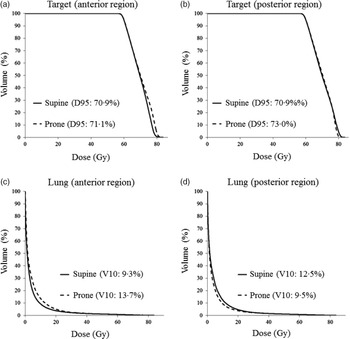
Figure 3 shows the DVH for the target and the lung. From the DVH characteristics, it appears that the target dose was not much different for each plan. However, the low dose to the lung was lower for plans developed for the supine set-up when the target was located in the anterior region; conversely, the low dose to the lung was lower for the plans developed in the prone set-up when the target was seated in the posterior region.
DVH curve of a typical plan for supine and prone set-ups, respectively. DVH curve of the target (a, b), and DVH curve of the lung (c, d) when the target is located in the anterior or posterior region. The solid line indicates the supine set-up plan; the dotted line indicates the prone set-up plan.

Discussion
RP is the most severe side effect after SBRT for lung tumours. Some researchers have reported that the incidence of symptomatic RP after SBRT ranges from 9% to 29%. Reference Yamashita, Nakagawa and Nakamura14–Reference Stauder, Macdonald and Olivier18 To reduce the incidence of symptomatic RP after SBRT, some studies have assessed the DVH of SBRT and strived to predict the rate of symptomatic RP. Ueyama et al. reported that the cut-off values of V20 and V10 were 4·3% and 9·7%, respectively, for symptomatic RP. Reference Ueyama, Arimura and Takumi4 Furthermore, Nakamura et al. reported that the cut-off values of V5, V10, V20, V25 and MLD to be 21·5%, 9·1%, 3·5%, 3·4% and 3·6 Gy, respectively, for symptomatic RP. Reference Nakamura, Nishimura and Nakayama5
We evaluated set-up position for lung cancer treatment using the CyberKnife system. It was obvious that the prone set-up was better when the target was located on the posterior, and the supine set-up was better when the target was located on the anterior. Ding et al. Reference Ding, Chang, Haslam, Timmerman and Solberg19 noted that CyberKnife SBRT may deliver a lower dose to healthy lung tissue than IMRT when treating tumours in the anterior region of the lung. However, the low-dose volume delivered via CyberKnife is significantly greater than that delivered via LINAC-based delivery when treating tumours in the posterior region of the lung. This is because CyberKnife SBRT plans use more MUs than conventional SBRT treatments. Reference Ding, Chang, Haslam, Timmerman and Solberg19 Mark K.H.Chan reported that the volumetric-modulated arc therapy plans resulted in higher dose around the gantry rotation path compared to the CyberKnife plans for when the tumour located in anterior lesion, whereas the CyberKnife plans were mostly associated with high doses anterior to the lesions due to the missing irradiation coming from underneath the patient when the tumour located in posterior lesions. Reference Chan, Kwong and Law20 Moreover, the CyberKnife system can be used only up to 100 degrees from the top, owing to the limited mobility of the arm. However, our results prove that changing the patient set-up could solve this problem. The prone set-up is highly beneficial in the case of spinal radiosurgery. Reference Descovich, Ma, Chuang, Larson and Barani21,Reference Fürweger, Drexler, Muacevic, Wowra, de Klerck and Hoogeman22 This study revealed that it is also beneficial for lung cancer patients with their tumour located in the posterior region to receive treatment in the prone position.
In the case of lung cancer, for a target that moves with the respiratory motion, CyberKnife SBRT can deliver radiation beams with continuous tumour tracking. Nakayama et al. analysed the synchrony log files of patients with lung tumours who were treated using the Xsight Lung Tracking (XLT) or 1-View tracking system. They reported that the tumour motion amplitude may be one of the factors that affect the model errors; therefore, the errors should be carefully analysed to determine the margins for tumours with large motion amplitudes as accurately as possible. Reference Nakayama, Nishimura and Mayahara23
This study had a limitation that real-time tumour motion tracking is not considered. However, in practice, the use of respiratory synchrony is imperative. Furthermore, the range of respiratory motion varies depending on the site of the lung tumour. When respiratory synchrony is used, there will always be motion errors. In future studies, it is thus necessary to evaluate the set-up position with consideration of respiratory synchrony.
Conclusions
This study compares the treatment planning between the prone set-up and the supine set-up for lung cancer in CyberKnife SBRT, which to the best of our knowledge, is the first such study. The comparison between the prone set-up and the supine set-up was investigated with regard to target coverage and dose to organs at risk. We expect that our findings will help radiation oncologists, radiation technologists, dosimetrists and medical physicists to decrease lung dose when CyberKnife lung SBRT will be performed and in designing optimal radiation therapy plans for patients. To extend our inferences based on a phantom study to real-life cases, we intend to conduct further investigations.
Acknowledgements
The authors thank Keisuke Okumura (Kobe University Hospital) for offering technical assistance.
Financial Support
This research received no specific grant from any funding agency, commercial or not-for-profit sectors.
Conflicts of Interest
None.