Acquired brain injury (ABI) is a severe stressor, with important consequences not only for the individual with ABI but also for the family system. The negative effects of ABI on the family have been well documented in the literature (e.g., Brooks, Reference Brooks1991; Carnes & Quinn, Reference Carnes and Quinn2005; Harris, Godfrey, Partridge & Knight, Reference Harris, Godfrey, Partridge and Knight2001; Kreutzer et al., Reference Kreutzer, Rapport, Marwitz, Harrison-Felix, Hart and Glenn2009; Wade, Taylor, Drotar, Stancin & Yeates, Reference Wade, Taylor, Drotar and Stancin1996). Family members often present symptoms of depression, anxiety and other difficulties (see, for review, Ennis, Rosenbloom, Canzian & Topolovec-Vranic, Reference Ennis, Rosenbloom, Canzian and Topolovec-Vranic2013). For instance, Calvete and López de Arroyabe (Reference Calvete and López de Arroyabe2012) recently observed that 28.5% of family members displayed severe depression and that grief was common among caregivers.
Caring for a person with a chronic illness creates a situation of chronic stress (Arango-Lasprilla & Kreutzer, Reference Arango-Lasprilla and Kreutzer2010; Montorio, Izal, López-López & Sánchez, Reference Montorio, Izal, López López and Sánchez Colodrón1998), which can be particularly negative for the family member who performs the role of caregiver for an extended period of time. Furthermore, the family often becomes a target for the frustration and anger of the person with ABI, and many family members report being verbally and physically abused by the person for whom they are caring (Lezak, Reference Lezak1978; Serio, Kreutzer & Gervasio, Reference Serio, Kreutzer and Gervasio1995). As a consequence, some studies have indicated that there is a positive correlation between the number of behavioural and emotional problems of the person with ABI and the levels of distress of his/her caregivers (Kreutzer, Gervasio & Camplair, Reference Kreutzer, Gervasio and Camplair1994; Marsh, Kersel, Havill & Sleight, Reference Marsh, Kersel, Havill and Sleigh1998a; Marsh, Kersel, Havill & Sleight, Reference Marsh, Kersel, Havill and Sleigh1998b). For instance, in a study of parents of children with ABI, parents who reported more than 12 problems scored at or above the 85th percentile on parental distress scales (Hawley, Ward, Magnay & Long, Reference Hawley, Ward, Magnay and Long2003).
Although there are some valid measures of behavioural and emotional problems associated with ABI (e.g., Godfrey et al., Reference Godfrey, Harnett, Knight, Marsh, Kesel and Partridge2003; Kreutzer, Marwitz, Seel & Serio, Reference Kreutzer, Marwitz, Seel and Serio1996; Sander et al., Reference Sander, Fuchs, High, Hall, Kreutzer and Rosenthal1999), the study of the effects of these problems on caregivers’ well-being has been limited by a relative lack of instruments to measure caregivers’ perceptions of these problems. This limitation is important because cognitive models of stress (Beck, Reference Beck1967; Hankin, Reference Hankin2008; Lazarus & Folkman, Reference Lazarus and Folkman1984) posit that the subjective appraisal of stressors is a better predictor of psychological maladjustment than the objective number of stressors. That is, it is not the stressor itself that causes distress but the manner in which the stressor is coded and interpreted by the individual. As a consequence, measures of problems caused by ABI should include the perspectives of caregivers. Godfrey et al. (Reference Godfrey, Harnett, Knight, Marsh, Kesel and Partridge2003) developed the Head Injury Behaviour Scale (HIBS), which assesses both the number of behavioural and emotional regulation problems of the individual with ABI and the distress experienced by the caregiver as a consequence of each problem. Their study, conducted in New Zealand using responses from 242 caregivers of people with traumatic brain injury, indicated that this scale was particularly useful in assessing whether the family required support or whether an intervention was effective. These outcomes suggest that the scale's adaptation to other languages and cultures would be beneficial.
As described above, although the association between psychological problems and caregiver distress is clear, recent studies have indicated that objective measurements of psychological problems in people with ABI have only made a modest contribution to explaining caregiver symptoms of distress (López de Arroyabe & Calvete, Reference López de Arroyabe and Calvete2013). This finding suggests that other factors are involved that moderate the effect of stressors on caregivers’ distress. Furthermore, not all family caregivers are ‘predestined to experience high levels of distress in performing their caregiving roles’ (Degeneffe, Reference Degeneffe2001, p. 264). Family caregivers have viable options to address the stresses and burdens of caregiving, using efficacious coping strategies and resources (Degeneffe, Reference Degeneffe2001). For example, coping responses, such as acceptance, cognitive restructuring and distraction, can ameliorate depression and feelings of grief among caregivers (Calvete & López de Arroyabe, Reference Calvete and López de Arroyabe2012; Minnes, Graffi, Nolte, Carlson & Harrick, Reference Minnes, Graffi, Nolte, Carlson and Harrick2000; Wade et al., Reference Wade, Borawski, Taylor, Drotar, Yeates and Stancin2001). Additionally, seeking social support has a direct effect on family functioning after ABI and is a powerful moderator of caregiver stress (Ergh, Rapport, Coleman & Hanks, Reference Ergh, Rapport, Coleman and Hanks2002; Verhaeghe, Defloor & Grypdonck, Reference Verhaeghe, Defloor and Grypdonck2005).
Recently, the search for the factors that can alleviate the distress of caregivers has focused on the positive aspects of care (PAC). This approach posits that caregiving can in itself become a source of satisfaction, suggesting that the PAC can reduce caregivers’ distress (Tarlow et al., Reference Tarlow, Wisniewski, Belle, Rubert, Ory and Gallagher-Thompson2004). The PAC have been described in terms such as ‘satisfaction’, ‘uplift’, ‘reward’ or ‘mastery’ (Noriko et al., Reference Noriko, Kazuko, Midori, Noriko, Kunihiko and Kiyomi2004), and they have included feelings of being appreciated, increased self-esteem, the development of more positive relationships with the person being cared for and feelings of personal growth (Beattie & Lebel, Reference Beattie and Lebel2011; Mackenzie & Greenwood, Reference Mackenzie and Greenwood2012). Thus, those caregivers with more positive caregiving feelings are less likely to develop depression, feelings of being burdened and other psychological problems. For instance, in a meta-analysis undertaken by Pinquart and Sörensen (Reference Pinquart and Sörensen2004), the PAC showed a moderate correlation in caregivers with subjective well-being, as well as a negative correlation with depression.
Most studies on the PAC have focused on the caregivers of people with dementia and of people in the final stages of their lives (Carbonneau, Caron & Desrosiers, Reference Carbonneau, Caron and Desrosiers2010; Gold et al., Reference Gold, Cohen, Shulman, Zucchero, Andres and Etezadi1995; López, López-Arrieta & Crespo, Reference López, López-Arrieta and Crespo2005; Peacock et al., Reference Peacock, Forbes, Markle-Reid, Hawranik, Morgan and Jansen2010; Roff et al., Reference Roff, Burgio, Gitlin, Nichols, Chaplin and Hardin2004). In contrast, the study of the PAC in family caregivers of people with ABI has been rare. Mackenzie and Greenwood (Reference Mackenzie and Greenwood2012) reviewed the few published quantitative and qualitative studies on the PAC in caregivers of people with stroke from 1999 to 2009. These few studies observed a range of positive experiences, including care recipients’ progress, strengthened relationships, feelings of being appreciated and increased self-esteem among caregivers.
The overall purpose of this study was to increase the knowledge of the negative effects of ABIs on primary caregivers (parent, sibling, spouse and son/daughter). In this study, we focused on several specific objectives. The first objective was to adapt the relative version of the HIBS (Godfrey et al., Reference Godfrey, Harnett, Knight, Marsh, Kesel and Partridge2003) for the Spanish population. Few instruments have been developed to assess the psychological problems of people with ABI while taking into account relatives’ perceptions, although relatives’ perspectives are particularly relevant for interventions. In this study, we assessed the psychometric properties of the Spanish version of the HIBS, including an examination of its factor structure and internal consistency. This study's second objective was to assess the role of the PAC as ameliorating factors in the effects of psychological problems on caregivers’ distress. We hypothesised that the association between these problems and the caregivers’ distress would be lower among caregivers who indicated a large number of PAC than among caregivers who indicated fewer PAC.
Methods
Sample
The participants in this study were 237 primary family caregivers of persons with ABI. The caregivers participating in this study were either members of the Federation of ABI Associations in Spain (FEDACE) or caregivers of people with ABI admitted to public day centres specialising in ABI (Bekoetxe & Lurgorri Centre, Bizkaia, Spain). To satisfy the main caregiver criteria, the family member taking part had to be a first-degree relative (parent, sibling or spouse) who had spent at least 12 months looking after the person with ABI and who had the following characteristics: 1) ‘is responsible for’ and makes decisions concerning the care of the ABI patient, regardless of whether he/she lives with the latter; and/or 2) spends the most time, daily or weekly, accompanying/looking after the person with ABI. The main caregiver might look after one or more dependent people. The following were considered exclusion criteria: the ABI occurred at or soon after birth or was caused by a neurodegenerative disease or the caregiver had difficulties in understanding or expressing language, as detected by members of the research team, which would prevent him/her from being able to collaborate.
The caregivers, 184 women (77.6%) and 50 men (21.1%), had a mean age of 55.61 years old (SD = 12.41). The sample comprised 67 parents, 112 spouses, 17 siblings and 35 sons/daughters. Most (81.85%) of the relatives were living with the person with ABI. The average total length of time devoted to caregiving (from the moment the brain injury occurred to the time of the study) was 9.63 years, with an average of 81.60 hours (SD = 52.39) per week spent looking after the person with ABI, including overnight care. Many caregivers (40.9%) received little or no support from other family members.
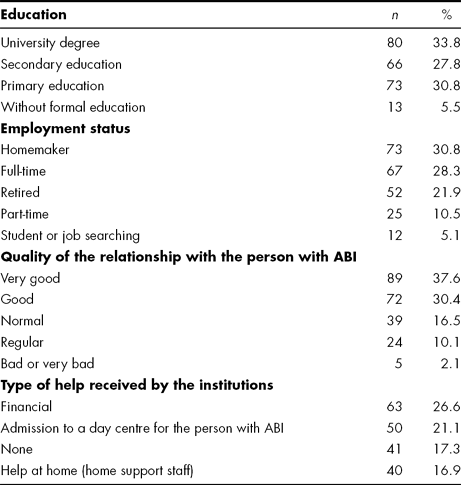
Regarding the demographics of the person with ABI, they were mostly men (67.9%) and had a mean age of 52.06 years old (SD = 15.78). Strokes caused 46.4% of the injuries, 32.8% were caused by traumatic brain injuries, 7.6% were caused by brain tumours, and 6.1% had other causes (e.g., cerebral anoxia and brain infection). According to the official evaluation by the Spanish government, the average degree of disability in the sample of people with ABI was 75.6% (SD = 17.86) on a range of 0 to 100, in which the greater the estimation was, the higher the degree of disability was. When the degree of disability is higher than 33%, the individual can access a range of services, such as financial help. The same assessment system determines the degree of disability for activities of daily living, using a five-category classification: no disability, mild, moderate, severe and very severe. In this study, 31.2% of persons with ABI had total dependence, 29.1% had severe dependence, 13.1% had moderate dependence, 5.5% had mild dependence, and 4.2% were independent. Table 1 lists the socio-demographic characteristics of the relatives, the quality of their relationship with the person with ABI and the type of help received by the institutions.
Characteristics of the caregiver, quality of the relationship with the person with ABI and type of help received from institutions

Measurements
The relative version of the HIBS (Godfrey et al., Reference Godfrey, Harnett, Knight, Marsh, Kesel and Partridge2003) was used to assess distress in caregivers of persons with ABI. The HIBS is a 20-item scale describing common psychological problems that occur following brain injury. For each of the items in the scale, the caregiver is asked, ‘Is the behaviour a problem?’ (yes/no) and ‘How much distress does this problem cause?’ Distress ratings are recorded for the identified items using a four-point scale: 1 (no distress); 2 (mild distress); 3 (moderate distress); and 4 (severe distress). The HIBS includes two subscales: Emotional Regulation and Behavioural Regulation. The Emotional Regulation subscale assesses behaviours reflecting impaired emotional control and occurring during interactions with caregivers (e.g., sudden/rapid mood changes, depression, despondency). The Behavioural Regulation subscale assesses problems that carry less emotional valence for caregivers (e.g., lack of control over behaviour, behaviour inappropriate for social situations, lack of motivation, or lack of interest in doing things). Godfrey et al. reported high alpha coefficients for both subscales: Emotional Regulation (α = .91) and Behavioural Regulation (α = .87). The HIBS provides reliable and valid measurement of caregiver distress.
In the present study, we included seven additional items, which were interspersed among the original HIBS items, after obtaining the permission of the authors of the HIBS. Four of the new items belonged to a Perceived Psychological Sequelae Inventory developed by López de Arroyabe and Calvete (Reference López de Arroyabe and Calvete2013) in a study of 223 family caregivers of persons with ABI (‘isolates him/herself from his/her surroundings,’ ‘barely enjoys free time and leisure,’ ‘has few friends or nearly none’ and ‘the psychological problems prevent him/her from having a job or keeping it’). In that study, these psychological problems, which are components of the psychosocial domain, were shown to be relevant to the family's psychological symptoms; they were therefore incorporated into the HIBS. Finally, two cognitive interviews with family members suggested the value of including three more items, the contents of which correspond to extreme behaviours: ‘manifests the intention of wanting to die or has attempted suicide at some point’ (included in Emotional Regulation), ‘abuses of coffee, smoking, gambling, alcohol, etc.’ and ‘exhibits unusual sexual behaviours’ (included in Behavioural Regulation). The inclusion of these items in the categories of Behavioural Regulation and Emotional Regulation was based on factor analyses (see the Results section).
The positive aspects of caregiving were evaluated using the Positive Aspects of Caregiving Scale (PACS; Tarlow et al. Reference Tarlow, Wisniewski, Belle, Rubert, Ory and Gallagher-Thompson2004). This scale has been used in studies of caregivers of persons with dementia and Alzheimer's disease (Alva & McCallum, Reference Alva and McCallum2011; Harris, Durkin, Allen, DeCoster & Burgio, Reference Harris, Durkin, Allen, DeCoster and Burgio2011; Hilgeman, Allen, DeCoster & Burgio, Reference Hilgeman, Allen, DeCoster and Burgio2007). Recently, the PAC were adapted to primary family caregivers of persons with ABI (Las Hayas, López de Arroyabe & Calvete, Reference López de Arroyabe and Calvete2013), exhibiting good psychometric properties. The PACS includes nine items reflecting the positive aspects that can occur during care. Each item begins with the stem ‘Providing help to (name) has. . .’ followed by specific items. The participants indicate how frequently each PAC occurs using a five-point Likert-type response option, ranging from 1 (never) to 5 (always). Factor analysis identified two components: Self-Affirmation (e.g., ‘Providing help to (name) has’ made me feel good about myself; made me feel strong and confident) and Outlook on Life (e.g., ‘Providing help to (name) has’ enabled me to appreciate life more, enabled me to develop a more positive attitude towards life). The strong correlation between the two factors justified combining the items to generate a single score (Tarlow et al., Reference Tarlow, Wisniewski, Belle, Rubert, Ory and Gallagher-Thompson2004). In the present study, the alpha coefficients of the Self-Affirmation and Outlook on Life factors were .81 and .74, respectively, and α = .82 for the complete scale.
Procedures
The items of the Head Injury Behaviour Scale were translated into Spanish using a back-translation method, after obtaining the permission of the authors for its use in this study. First, two bilingual psychologists translated the scale from English into Spanish. Then, another bilingual psychologist translated it from Spanish back into English and observed that the original version and the back-translated version were virtually identical. The results of the back translation were assessed by the research team. The back-translated version was compared with the original, and no significant differences were observed. Once translated, a number of cognitive interviews were conducted to determine the suitability of the question set. These interviews were conducted with two family members of persons with ABI, as well as with two researchers in the field from the University of Deusto who were not members of the research team. The findings from these interviews suggested the inclusion of the additional items mentioned above. Finally, the new version was formatted identically to the original questionnaire and was prepared for application in the sample of caregivers.
To respect the participants’ right to confidentiality, the collaborating associations sent a letter to all of their members with information regarding study, an informed consent form to be signed if they agreed to collaborate and a stamped and addressed envelope to send the signed form to the research team's centre. Therefore, the researchers only learned the identities and contact details of those members who had voluntarily agreed to participate. The associations sent out reminders to those members who had not responded to the first communication to increase the response rate. Once the invitation to collaborate had been accepted, the relative was given the choice of being interviewed over the telephone, answering the questionnaire in written form in the privacy of his or her own home or answering online. Eighty relatives completed the questionnaire by phone interview, 84 in writing and 73 online. The telephone interviews lasted approximately 45 minutes each and were conducted by research staff with PhDs in psychology. Each relative who participated in these telephone interviews received a gift voucher as a token of our gratitude. The study was approved by the University of Deusto Ethics Committee.
Results
Confirmatory Factor Analysis of the HIBS
The parameters for confirmatory factor analysis were estimated using the polychoric and asymptotic covariance matrices of the HIBS items. The models were tested via generally weighted least-squares estimation with LISREL software, version 8.8 (Jöreskog & Sörbom, Reference Jöreskog and Sörbom2006). Following the recommendations of Hu and Bentler (Reference Hu and Bentler1999), goodness of fit was assessed by the comparative fit index (CFI; values of .95 or greater indicate that the model adequately fits the data), the root mean squared error of approximation (RMSEA; values of .06 or less indicate that the model adequately fits the data), and the standardised root-mean-square residual (SRMR; values of .08 or less indicate that the model adequately fits the data). The scale of each construct was set using the effects-coding method, which implies constraining the set of indicator intercepts to add up to zero for each construct and for the set of loadings for a given construct to average 1.0 (Little, Slegers & Card, Reference Little, Slegers and Card2006). A series of preliminary analyses indicated that the seven added items loaded highly in the proposed factors. The fit indices were excellent for the model, consisting of three correlated factors: χ2(321, N = 237) = 259; RMSEA = .058 (90% CI: 0.051; 0.066); CFI = .93; and SRMR = .059.
The alpha coefficients were .94, .77, and .81, for Emotional Regulation, Behavioural Regulation and Psychosocial Problems, respectively. The alpha for the total scale was .83.
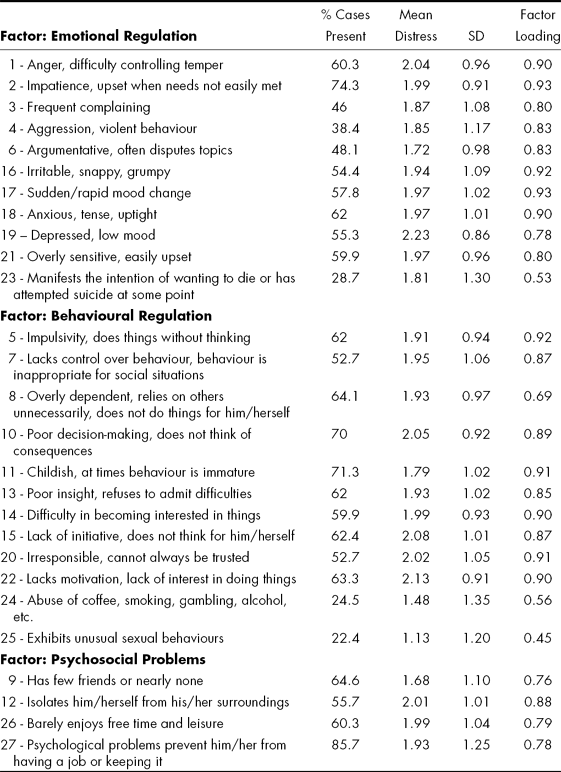
Table 2 shows the percentage of times that caregivers reported that each problem was present, as well as the means and standard deviations of distress reported by caregivers per problem item and factor loadings for each item in each factor.
Percentage of times caregivers reported that the problem was present. Mean and SD of distress reported by caregiver for each psychological problem and factor loadings for each item in each factor
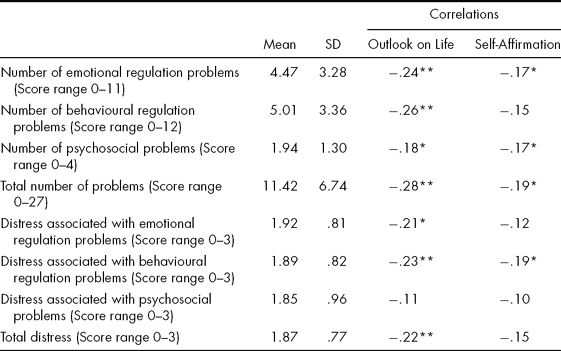
Among the problems of the Emotional Regulation subscale that caused the most suffering were symptoms of anger and depression, which were reported by more than 50% of caregivers. Within the Behavioural Regulation subscale, behaviours such as poor decision- making (mean distress score: 2.05; SD = .92), lack of initiative (mean distress score: 2.08; SD = 1.01) irresponsibility (mean distress score: 2.02; SD = 1.05) and lack of motivation (mean distress score: 2.13; SD = .91) were those that caused the most suffering in caregivers. Finally, the most damaging psychosocial problem was witnessing the person with ABI isolate him/herself from his/her surroundings (mean distress score: 2.01; SD = 1.01). This problem was present in nearly 56% of cases. Table 3 displays the descriptive statistics per factor, showing both the mean number of problems per factor and the mean distress score per factor. The differences among the mean distress scores associated with Emotional Regulation problems, behavioural regulation and psychosocial problems were not statistically significant.
Descriptive statistics for the HIBS scores and correlations with positive aspects of care
* p < .05; ** p < 001
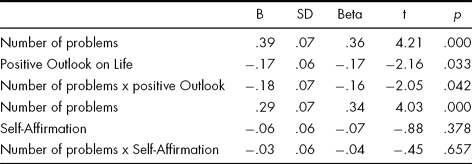
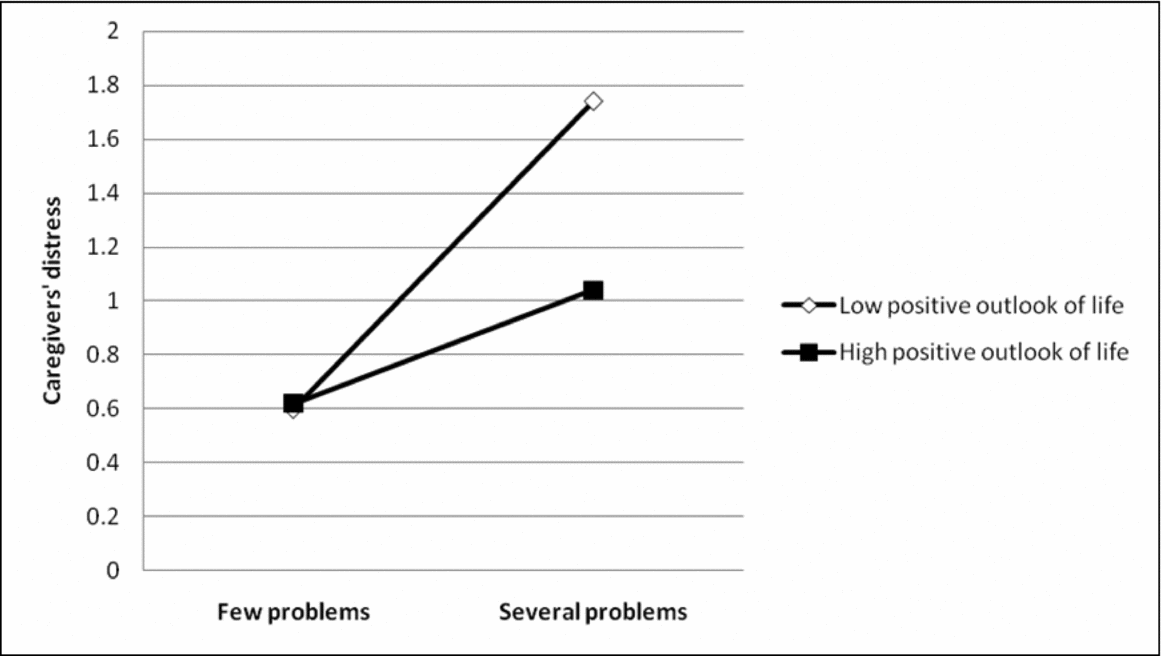
Positive Aspects of Caregiving as a Moderator of the Association Between the Number of Psychological Problems and Caregivers’ DistressA series of hierarchical multiple regression analyses were conducted to test the hypothesis that positive aspects could moderate the association between the number of problems and the distress experienced. A separate set of regression analyses was used for each of the positive aspects subscales (Outlook on Life and Self-Affirmation). In these models, in the first step, the number of problems and the positive aspects subscale were regressed on experienced distress. In the second step, we entered a multiplicative term representing the interaction between the number of problems and the positive aspect. Following standard procedure, predictors were centred to maximise interpretability and to minimise potential problems with multicollinearity (Frazier, Tix & Barron, Reference Frazier, Tix and Barron2004). The regression results are presented in Table 4. Both the number of psychological problems and a positive outlook on life were significant predictors of distress. Furthermore, the interaction term between the two variables served as a significant predictor of distress. The addition of the interaction term increased R2 significantly: ∆R2 = .024; F(1, 231) = 4; p = .042. We plotted the regression of distress on the number of problems at high (one standard deviation greater than the mean) and low (one standard deviation less than the mean) levels of positive Outlook on Life. As Figure 1 shows, the association between the number of problems and distress was higher among caregivers who scored low on positive Outlook on Life. In fact, the slope at the high level of this subscale was not different from zero (β = .07, ns). In contrast, the Self-Affirmation subscale was not associated with distress and did not moderate the association between the number of problems and distress.
Hierarchical regression models for problems x positive aspects interactions on caregivers’ distress
Effect of the interaction between number of psychological problems and positive Outlook on Life on caregivers’ distress.
Discussion
This study contributes to the identification of those behavioural, emotional and psychosocial problems in persons with ABI that more negatively affect the caregiver's well-being and that increase the caregiver's distress. Additionally, the results of this study suggest that caregivers of persons with ABI can experience positive appraisals of the caregiving task and that these positive experiences can moderate the negative association between psychological problems due to ABI and the caregiver's distress.
Using stress theory as a basis for our analysis, we assessed caregivers’ perceptions of the psychological problems of persons with ABI. For this purpose, the HIBS (Godfrey et al., Reference Godfrey, Harnett, Knight, Marsh, Kesel and Partridge2003) was translated into Spanish to assess the effects of the psychological problems of people with ABI on Spanish family caregivers. In addition to the original items, we added seven items. Four items constituted a new factor labelled Psychosocial Problems, and three items completed the original factors (one in Emotional Regulation and two in Behavioural Regulation). Thus, the resulting version consisted of 27 items grouped into three subscales: Emotional Regulation problems, Behavioural Regulation problems, and Psychosocial problems. Confirmatory factor analysis indicated that the correlated three-factor model displayed an excellent fit. The three subscales showed good internal consistency coefficients.
Among the problems of the Emotional Regulation subscale that caused the most suffering were symptoms of impatience, anger and depression, which were reported by more than half of the caregivers to be present. These data are consistent with those obtained by Godfrey et al. (Reference Godfrey, Harnett, Knight, Marsh, Kesel and Partridge2003), who observed that impatience, anger, difficulty controlling temper and depression were the problems with the highest scores in caregiver distress. Regarding the Behavioural Regulation subscale, the behaviours that imply the inability to make decisions, irresponsibility and lack of initiative or motivation were those that caused the most suffering in the caregiver. These problems often mean that the caregiver must take on the extra task of motivating the person with ABI to take responsibility for him/herself and pushing him/her to become involved in activities. This work can be exhausting over time and frustrating for the caregiver. Finally, the most damaging psychosocial problem for caregivers was witnessing the person with ABI isolating him/herself from his/her surroundings. This problem was present in nearly 56% of cases. This type of behaviour in people with ABI negatively affects the caregiver and also forces the caregiver to be a companion (in many cases, an exclusive companion) to the person with ABI. Therefore, the data obtained by means of the HIBS showed the importance of obtaining information from caregivers. The HIBS appears to be a useful tool, as shown by clinical studies of its application in family samples (e.g., Marsh & Kersel, Reference Marsh and Kersel2006) and by its use as an outcome measurement in a family support intervention (Smith & Godfrey, Reference Smith and Godfrey1995). Furthermore, the findings of the present study indicate that perceptions of the problems are similar in Spanish caregivers, which suggests a certain universality across cultures.
The present study joins a recent body of research identifying and evaluating positive aspects of caregiving in informal care. As mentioned, interest has increased because the PAC can moderate caregiver stress (Tarlow et al., Reference Tarlow, Wisniewski, Belle, Rubert, Ory and Gallagher-Thompson2004). Moreover, it has been suggested that caregivers who cannot identify a single positive aspect of care are at risk of suffering from depression or other health problems and that the care recipient is at greater risk of institutionalisation (Cohen et al. Reference Cohen, Gold, Schulman, Tracey, McDonald and Wargon1993; Cohen, Colantonio & Vernich, Reference Cohen, Colantonio and Vernich2002). Consistent with this approach, the findings of this study indicate that the association between the number of psychological problems and distress is lower among those caregivers who identify positive experiences from caregiving. Namely, a factor that moderated the association between the number of problems and distress was the Outlook on Life subscale, which included items such as ‘appreciate life more’ and ‘develop a more positive attitude toward life.’ In contrast, Self-Affirmation, which involves items such as ‘feeling valued’ and ‘feeling needed’ for helping others, was not associated with the distress level and did not moderate the effects of behavioural problems on distress. These data make sense because to cover the Self-Affirmation need by caring for one relative could indicate a gap in other important areas in the caregiver's life. The present study expands on previous results by showing that caregivers who have learned to value life in a more positive manner and have improved their relationships with other people could better handle the psychosocial problems of ABI. This finding is particularly important because care is a long-term process. In our sample, the average time since injury was 9.63 years. Suggesting that there might be a measurable return to a more positive state as new caregivers become veterans is also consistent with the adaptation hypothesis (Lawton et al., Reference Lawton, Kleban, Moss, Rovine and Glicksman1989).
These results have important implications for interventions with caregivers. Rehabilitation programmes should work within the family system and enhance the strategies to help caregivers have positive experiences with care. These interventions will not only result in a reduction in caregiver distress but also contribute to a better quality of care to the extent that the caregiver will feel better, actually improving his/her caregiving.
Thus, helping the family caregiver to understand that the negative aspects of care are concomitant with positive aspects favours more successful adaptation. Family members can understand that ‘it is possible to feel burdened but not necessarily depressed’ (Lawton, Moss, Hoffman & Perkinson, Reference Lawton, Moss, Hoffman and Perkinson2000, p. 446). In fact, Las Hayas et al. (Reference Las Hayas, López de Arroyabe and Calvete2013) observed a weak association between the PAC and variables traditionally considered negative and objective in nature (e.g., number of hours of care, years spent caring and the level of severity of the person with ABI), revealing the independence of both negative aspects of care and positive appraisals of care. Therefore, we should not assume that the presence of positive effects indirectly reveals the absence of negative effects or vice versa. One of the more clarifying studies in this regard was that of Perlesz, Kinsella and Crowe (Reference Perlesz, Kinsella and Crowe2000), who reported that 35% and 49% of primary caregivers displayed levels of psychological distress sufficiently high to warrant clinical intervention; however, 51% and 80% of them also reported being satisfied with their families.
This study had some limitations. The data were provided by primary caregivers, and it might have been more appropriate to study family functioning as a whole, as recommended by authors such as Schönberger, Ponsford, Olver and Ponsford (Reference Schönberger, Ponsford, Olver and Ponsford2010) and Perlesz et al. (Reference Perlesz, Kinsella and Crowe2000). Moreover, the majority (90.71%) of caregivers belonged to an association of relatives of persons with ABI, thus calling the generalisability of the results into question. It is also important to identify more peripheral family members who might experience a negative psychological adjustment after ABI but who have been generally neglected in research studies (Degeneffe & Olney, Reference Degeneffe and Olney2010). Furthermore, the results should be interpreted with caution because the cross-sectional nature of the study did not allow for the demonstrating of causality among the PAC, psychological problems and distress. Finally, the number of problems was also negatively associated with Outlook on Life, although this association was small, and the moderator variable should be relatively independent of the predictor variable. Thus, other alternative associations among the variables of the study might be involved, such as the negative effect of problems on positive Outlook on Life. Future research should examine this hypothesis using longitudinal studies.
The study also had several strengths. It was based on a large and heterogeneous sample, which increased its representativeness and statistical power. In addition, the results are not specific to a particular type of ABI because the sample included caregivers of persons with several modalities of ABI, especially trauma and stroke.
In summary, the present study adapted the HIBS to the Spanish language, which allowed for the identification of the psychological problems that cause the greatest suffering in caregivers. If the scale is applied at different points in the evolution of ABI, it could also provide information on the types of problems that are more prominent in different stages of the process and how the distress of the caregiver evolves over time. The HIBS could be a valuable tool for evaluating the effectiveness of intervention programmes because it is sensitive to changes in the distress caused by the problems of the person with ABI. In addition, this study provides data on the relevance of the positive aspects of care, which can buffer the negative effects of psychological problems on caregivers. Future research should extend the use of the HIBS and PAC in clinical settings (e.g., offering a family program regarding the nature of care and training in the identification and maintenance of the PAC) and in community interventions (e.g., promoting respite programmes).