Southwick Roman villa, occupied between the first and fourth centuries ad, is believed to offer the only examples of gold glass tesserae (in which the gold leaf is sandwiched between a base layer and a thin top layer, known as a cartellina) to have been discovered in a villa context in Roman Britain.Footnote 1 A small number of coloured glass tesserae in shades of blue and green were also recovered from excavations at the site. Although gold tesserae are certainly known from at least the first century ad in Nero's Golden House and from the Stadium of Domitian, they are not overly common on Roman sites before the fourth century ad. Indeed, Frank Sear's catalogue of 301 wall and vault mosaics from across the Roman Empire records gold tesserae in only twenty sites.Footnote 2 The presence of such tesserae at Southwick is even more surprising as gold glass tesserae tend to be associated with wall mosaics and with lavish buildings, rather than with floor mosaics in a villa setting. Does their presence imply the presence of costly wall mosaics at Southwick? Possibly not, given that the seven surviving gold glass tesserae said to be from Southwick have a complicated, perhaps dubious, provenance and that chemical analyses of the glass suggests that dating them to the Roman period is equally problematic. In this paper we lay out our reasons for concluding that these tesserae should be discounted from the record of mosaic tesserae from Roman Britain.
It is useful to begin by setting the Southwick gold and coloured glass tesserae in a wider context of gold and coloured glass tesserae finds in Roman Britain, as this highlights their anomalous status. Coloured glass tesserae are relatively scarce in Roman Britain compared both to other areas of the Empire and to tesserae of other materials in the country. Sear's catalogue of what he saw as wall and vault mosaics listed six examples, Southwick being the only site with examples of gold glass tesserae.Footnote 3 Neil Cookson, however, studying floor mosaics, detailed twenty-four separate instances of glass tesserae in Britain, of which gold glass tesserae were restricted to Capel St Mary and Southwick.Footnote 4 Other examples have since been added to this list,Footnote 5 but the overall number is not huge. Finds of loose glass tesserae are also known, such as the 1,268 loose tesserae excavated at Union Street, London, where one is of gold glass, and the large quantity found at the West Clacton Reservoir site, in Essex, dated to the first or second century ad, none of which were gold glass.Footnote 6
Other than Southwick, however, finds of gold glass tesserae in Roman Britain are very limited indeed. Two tesserae are recorded as being unearthed at Capel St Mary in Suffolk, though the archaeological context of these is not clear. It is plausible, though not certain, that they may be associated with some glass fragments and coloured glass tesserae from the nearby Romano-British site at Capel St Mary, now held in Ipswich Museum. The content and form of this collection of fragments suggest that they originated in a glass workshop. A short report from 1947 described a rescue excavation at Capel St Mary undertaken by a Mr B Brown (possibly Basil Brown, the excavator of Sutton Hoo), which found ‘glass cubes of various colours, and of the sticks from which they were cut, [which] may indicate the presence of a worker in glass mosaic’.Footnote 7 A later description summarised the finds in the following terms: ‘Kiln debris … was associated with cakes of glass, glass tesserae in blue or green covered with gold foil, and tesserae of Samian ware’.Footnote 8 This information was apparently provided by a curator at Ipswich Museum. One of the two gold glass tesserae disappeared before reaching the museum; the other was supposedly deposited in the museum but cannot now be found; nothing else survives to support their existence.
In addition to Cookson's catalogue of sites, at least two gold glass tesserae were found during excavations at the Flaxengate site in Lincoln.Footnote 9 From the coin and pottery finds associated with them, they were dated to the second or third century ad. The excavation report suggested that their presence implied that the building to which they belonged had been one of ‘unusual elegance and importance’. However, the report was less than precise about the exact number of glass tesserae uncovered, noting only that finds from this structure included ‘a small number of glass tesserae or mosaic cubes, one of which had a gilded surface’.Footnote 10 In contradiction, a later account recorded ‘two gold glass tesserae; the surface is covered in thin gold leaf’.Footnote 11 Whatever their number, these tesserae are now lost and were probably destroyed in a fire.
Two gold glass tesserae have been found in London. One, from Union Street, Southwark, was dated by its context to the first or second century ad. This was the only gold tessera amongst 1,268 predominantly dark blue, light blue, green and turquoise tesserae that seem to have constituted the debris of a glass workshop.Footnote 12 The second, from Shadwell, originated from a masonry building of the late third or fourth century ad. Both London tesserae are of gold leaf sandwiched between two layers of clear, colourless glass. Finally, a gold glass tessera was found at a seventh-century ad site at Dunadd, in Argyll.Footnote 13 Though undoubtedly of Roman origin, it is suggested that it originated in a piece of jewellery imported into Scotland from Scandinavia, and therefore will not be treated as germane to the present discussion.
Besides Southwick, therefore, only two additional gold glass tesserae survive from Romano-British milieux. Four more have been lost and one further example appears to have been an import from Scandinavia. In this context, the tesserae from Southwick constitute a major record of this medium in Roman Britain. However, the Southwick gold glass tesserae provide their own problems of provenance. For a start, it is unclear how many of them were excavated and how many of them survive now.
Southwick has never been systematically excavated, although there have been several separate campaigns on the site. The first was undertaken by the then landowner, Mr Nathaniel Hall, in the 1840s and ‘Ancient Roman Pottery, Mosaic, etc., belonging to Mr. N. Hall’ was exhibited at Shoreham and Chichester in meetings of the Sussex Archaeological Society in 1847.Footnote 14 Although it was widely believed that no plans or finds survived from Hall's work, and a later excavator, S E Winbolt, was assured by Hall's grandson that none were in existence, a plan bearing Hall's original notes in pencil has recently been found in the East Sussex Record Office.Footnote 15
The site was excavated a second time by S E Winbolt and C R Ward in 1931, after the land, which was at that time part of a market garden, had been sold for development. Winbolt's excavation confirmed and extended Hall's original plans and yielded more artefacts, including pottery, coins and jewellery, but was never published in full.Footnote 16 The record of the finds documents only those with ‘some degree of significance’ and does not describe them in any detail.Footnote 17 After this, limited excavations at Southwick before further building on the site took place were undertaken by R A Canham in 1965 and David Rudling in 1981.Footnote 18 Canham's was a rescue dig, before the erection of a Methodist chapel on the site, and was never written up formally, though some notes survive.Footnote 19 These notes were used by Rudling, whose report included an account of most of the work on the villa site after Winbolt's 1931 excavation, including Canham's excavation and also minor digs by the Ward brothers, who had assisted Winbolt. Rudling's excavation covered a small area before extending the chapel manse. He noted that the villa deposits showed no stratification, which was hardly surprising given that the villa area had been dug out at least three times before and then been backfilled, destroying any possibility of placing new-found artefacts within their context.
Both Winbolt and Canham uncovered gold glass tesserae on the site. Winbolt's various accounts give a confusing picture of the tesserae that he found. In a short preliminary statement, he claimed that he had found ‘nine greenish glass tesserae, measuring on the surface 3/5 inch square. On the top gold leaf had been laid, and this was protected with a very thin flash of green glass’.Footnote 20 He repeated this account almost verbatim in 1935.Footnote 21 However, in his 1932 report, which can perhaps be taken as the most definitive account of the excavations, he described only ‘eight exceptional glass tesserae (7 square and 1 triangular) probably used for a wall decoration in room 14. They are of yellow-green glass … Gold leaf was laid on the upper surface, and flashed with a very thin coat of glass’.Footnote 22 Eight tesserae, including a triangular example, were pictured in figure 6 in this report next to the description of the gold glass tesserae; it has always been assumed that these eight represent the eight gold glass examples. Later in the same report, under the heading ‘Miscellaneous’, Winbolt also mentioned ‘numerous’ stone tesserae throughout the site but especially in the south-east room of the north block where ‘most of the glass tesserae’ were found.Footnote 23 Whether these glass tesserae were in addition to the gold glass tesserae is unclear; the implication, given the explicit location of the gold glass tesserae to room 14, is perhaps that there were further coloured glass tesserae from the site.
In 2012, Giles Standing and Jeffrey Leigh obtained a photograph of the same set of tesserae published by Winbolt in 1932, probably from the same negative.Footnote 24 They suggest that this picture was taken at the time of the excavations, arguing that, from the scale on the photograph, the measurements of these tesserae are internally consistent with those given in Winbolt's 1932 account. As a result, they deem the 1932 report, with its more precise measurements of the gold glass tesserae, together with the corroborating photographs, to be the correct record.Footnote 25 Thus Winbolt's gold glass tesserae present an immediate problem of quantity: it is unclear how many there were, though eight seems the most likely number.
Rudling's report of Canham's 1965 excavations makes it clear that three more gold glass tesserae, two square and another triangular example, surfaced from the junction of Trenches IV and VI (close to Winbolt's room 14) and Trench II.Footnote 26 His account also includes a description by John Shepherd of thirteen coloured glass tesserae that were recorded as being from the Sussex Archaeological Society's collection and said to be those recovered in 1931.Footnote 27 These ranged in hue from opaque deep blue and opaque turquoise to dull olive green, and pale green glass. Shepherd described seven gold glass tesserae, the three from Canham's excavation and four more that he assumed had come from Winbolt.Footnote 28 Whether this meant that four of Winbolt's eight gold glass tesserae had already been lost cannot now be established. Suffice it to say that, depending on the interpretation of the reports on the villa excavations, in total eleven (or perhaps twelve) or seven (if Shepherd's figures are the correct ones) gold glass tesserae were found at Southwick; whether either excavator uncovered coloured glass tesserae remains unknown.Footnote 29
The subsequent history of the gold glass tesserae is equally obscure. Only seven gold glass tesserae now survive, and these have all had peripatetic existences. In his 1932 excavation report, Winbolt said that ‘A selection [of artefacts from the excavation] will be found in the Hove Museum’.Footnote 30 However, Hove Museum holds no artefacts from Southwick and has no record of ever having received any. Sussex Archaeological Society's Barbican House Museum, in Lewes, holds a list of artefacts deposited by Winbolt and Ward. The record there shows that some small finds were forwarded to the Sussex Archaeological Society from Hove Museum in 1958. At some point, several of these items were moved to be displayed more locally in the Marlipins Museum in Shoreham. Four gold leaf and thirteen coloured glass tesserae are held by the Marlipins. These have generally been taken as the tesserae excavated by Winbolt. However, as Standing and Leigh point out, coloured glass tesserae do not feature in any of the excavation reports.Footnote 31 They also suggest that the dimensions of the Marlipins tesserae, both gold and coloured glass, are smaller than those recorded by Winbolt.Footnote 32 This lack of correspondence between the excavation reports and the tesserae in the Marlipins Museum implies, in fact, that none of the tesserae in the Marlipins Museum derive from any of the excavations at Southwick. One tiny blue glass tessera in the collection was recorded in the Marlipins Museum catalogue in 1992 as having ‘PAESTUM’ written on one side,Footnote 33 though this lettering is not visible today, and with no record of the arrival of these tesserae in the Sussex Archaeological Society collections, this suggested provenance can only be speculative. So if the Marlipins tesserae are not from Southwick, are they Roman? And what happened to Winbolt's tesserae?
A similar story pertains to Canham's three gold glass tesserae. When the Methodist Church became the owner of the villa site and built over the remains, it also inherited the small finds from the 1965 and 1981 digs. At some point after 1985 these finds were donated to the Southwick Society and stored in the Society's museum at Manor Cottage, Southwick. They were carefully wrapped up, placed in a box in a cupboard and forgotten. When rediscovered in 2010, there were three gold glass tesserae, including a triangular one.Footnote 34 These then, according to Rudling's account, must be those found by Canham.Footnote 35
Given the unclear provenance of the gold glass tesserae in the Marlipins Museum and Manor Cottage collections and the rarity of gold glass tesserae in Roman Britain, it was decided to undertake chemical analysis of the glass of the tesserae to see what light might be shed on their origins. It also made sense, for comparative reasons, to analyse the coloured glass tesserae from Southwick at the same time. The chemical characteristics of Roman and early medieval glasses are remarkably consistent. Roman glass is a soda-lime-silica type with little variation in its major and minor element composition. It is believed that this is the result of large-scale primary production of glass in a limited number of glass-making factories from a mixture of mineral soda imported from Egypt and locally available silica and lime sources.Footnote 36 If the tesserae from Southwick are genuinely Roman, then their major element data should be broadly consistent with those of the identified Roman type and should also suggest a rough chronological attribution.
In the discussion that follows, the four gold glass tesserae and twelve coloured glass tesserae, which may be from Winbolt's excavation and are now in the Marlipins Museum, Shoreham, are referred to as the Marlipins tesserae, whilst Canham's three examples, now in Manor Cottage, Southwick, are referred to as the Manor Cottage tesserae.Footnote 37 The two London specimens are distinguished according to their finds sites as Union Street and Shadwell.
Description and analysis
It is worth noting that, to the naked eye, the tesserae look different. The Manor Cottage gold glass tesserae are larger, brighter and much more regular than the gold glass tesserae in the Marlipins. Their body glass is an olive green or yellow green, whereas the Marlipins tesserae are pale green. Optical investigations of the three samples by scanning electron microscope (SEM) confirmed the familiar sandwich structure expected of gold leaf tesserae. The sides of one of the Manor Cottage tesserae (#SF1) and others of the four Marlipins tesserae exhibit the marks of conchoidal fractures, traces consistent with the use of a cold chisel when cutting the tesserae into the required shapes and sizes. Interestingly, an underlying layer, presumably of a resinous material originally used to affix the gold leaf to the body glass, is clearly discernible in one of the Manor Cottage samples.Footnote 38 The thickness of the gold leaf can be only roughly estimated but it is certainly less than about 1μm (micrometer), and perhaps as little as 0.3μm.
Preliminary results of qualitative X-ray fluorescence (XRF) analyses of the Marlipins tesserae identified some unexpected chemical characteristics among the gold glass tesserae.Footnote 39 While Roman and post-Roman glass has typically low magnesium and low potassium oxide concentrations (<1.5%), some of the supposedly Roman gold glass tesserae from the Marlipins showed higher levels in both these oxides. If these were Roman in origin, such findings would undermine current understandings of the history of glass production.Footnote 40 For more conclusive evidence, semi-quantitative analyses were carried out with a JEOL 63-10 scanning electron microscope equipped with an energy dispersive spectrometer (SEM-EDS).Footnote 41
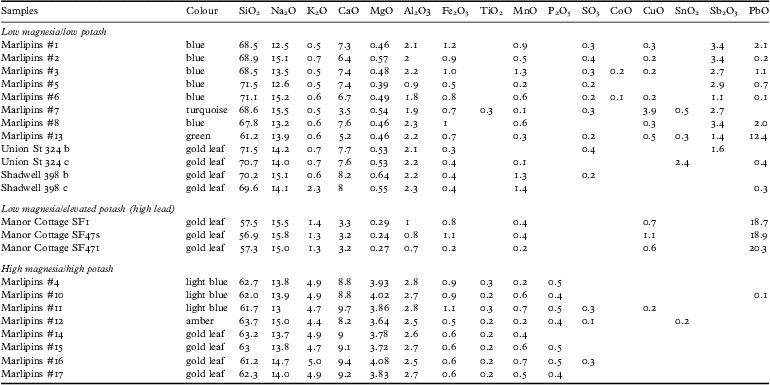
The results of the compositional analyses are presented in Table 1. They show that all the tesserae (with the exception of the three from Manor Cottage), both coloured glass and gold glass, are of a soda-lime-silica composition. For these samples, the soda content ranges from about 12.5% to 15%, the silica varies between 61% and 72% and the calcium oxide (lime) levels are generally between 5.2% and 9.5%. One example, the turquoise-coloured tessera Marlipins #7, has an exceptionally low lime content, at 3.5%. However, this might be the result of the precipitation of calcium antimonate missed when the sample was scanned or of the degradation of the tessera.Footnote 42 The three Manor Cottage samples are strikingly different. They have exceedingly high lead concentrations (18.5–20%), which is very unusual in non-coloured Roman glass, and they also differ significantly in their magnesia to potash ratio from all the other tesserae analysed in this study (Fig 1). Based on a comparison of the magnesia and potash concentrations of the samples, the assemblage can be divided into three chemically distinct groups: one with both magnesia and potash around 0.5%; one showing similarly low levels of magnesium oxide (0.3–0.5%) but increased values of potassium oxide (∼1.5%); and a third with magnesia around 4% and potash up to 5%. All the Marlipins gold glass tesserae fall into this latter group, while the Manor Cottage gold glass tesserae belong to the low magnesia/high potash group. The samples from Shadwell and Union Street in London fall into the low magnesia and low potash group. This grouping is further confirmed when comparing the alumina and lime concentrations of the samples (Fig 2).
Major and minor element composition of the tesserae (in weight per cent oxides (wt%)) obtained by SEM analysis and divided into the three subgroups identified and discussed; elements that are below the detection limits are left blank

Potassium and magnesium oxide contents (in wt%) of the tesserae distinguished between the three subgroups described in the text. The Shadwell cartellina is treated as an outlier of the low MgO/low K2O group. The asterisks indicate that the analytical data have been reduced to the base glass composition (SiO2, Na2O, MgO, Al2O3, CaO, K2O and Fe2O3) that are predominantly introduced with the sand and alkali source and normalised to 100% to enable comparison of the base glass
Calcium and aluminium oxide contents reflect the silica (sand) source used, and indicate that silica sources differ between groups and even within the same group. The asterisks indicate that the analytical data have been reduced to the base glass composition (SiO2, Na2O, MgO, Al2O3, CaO, K2O and Fe2O3) that are predominantly introduced with the sand and alkali source and normalised to 100% to enable comparison of the base glass
Low magnesia/low potash group
This group consists of all but three of the blue tesserae, one pale green and one turquoise piece, all from the Marlipins (Marlipins ##1, 2, 3, 5–8 and 13). It also includes the Union Street tesserae and at least the lower part of the Shadwell tesserae (Table 1). Judging from the low magnesia and low potash concentrations (Fig 1), it is most likely that these tesserae are of a natron-type glass, conforming to the usual pattern for Roman glass. If it is assumed that these glass samples were produced with the relatively pure form of mineral soda (so-called natron) from the Wadi Natrun in Egypt, as was the case for virtually all Roman and post-Roman glass in the Mediterranean, then it can be taken as read that all the other elements in the glass were introduced with the silica (sand) source used in the different locations.Footnote 43 Hence the lime and alumina levels present are diagnostic of the local sources of silica and lime that were used for the production of the glass. The fact that the low magnesia/low potash glass samples show a relatively wide spread for calcium and aluminium contents strongly implies that the glass was produced from silica that came from more than one source (Fig 2). The gold leaf samples from London, for example, cluster tightly in terms of their alumina and lime concentrations together with three of the six blue tesserae. Hence it can be said that these samples were produced from a similar, if not identical, silica source. The other samples of this group are more widely spread and samples Marlipins #5 (dark blue) and Marlipins #7 (turquoise) in particular have distinctive aluminium and calcium concentrations, indicating the presence of different raw materials.
The colours and the opacities of the glass tesserae can be attributed to the presence of specific metal ions and crystalline particles in the glass matrix.Footnote 44 In all the blue glass tesserae, cobalt was detected by hand-held XRF analyses at quantities that are mostly below the detection limit of the SEM. With one exception (Marlipins #5), the cobalt seems to be accompanied with slightly elevated levels of copper oxide (≥0.15%) and manganese oxide (≥0.5%). Lead is likewise higher in the blue samples, compared to the turquoise and colourless tesserae. Antimony oxide (1–3.4%) in the form of calcium antimonate presumably serves as the opacifier in the blue and turquoise samples. The opacity of the pale green sample, on the other hand, may be due to the precipitation of lead antimonate. The green and turquoise tesserae are furthermore distinguished by a detectable tin content, indicating that some kind of bronze may have been used as colouring agent. The turquoise tessera shows additionally a significant concentration in titanium oxide (0.25%), confirming once more that these tesserae are derived from a very different source than the rest of the low magnesia/low potash samples.
Low magnesia/elevated potash group
Based on the magnesia and potash concentrations, the second group consists of the three Manor Cottage tesserae and, at first sight, the cartellina of the Shadwell tessera (Fig 1). The Manor Cottage tesserae are conspicuous for their exceptionally high lead contents, unprecedented in non-coloured Roman glass. Whereas the Manor Cottage tesserae also show low alumina (<1%) and low lime (∼3.2%) concentrations, thus separating these three samples from all the other tesserae that have been analysed for this study, the lime and alumina contents of the Shadwell cartellina should actually be associated with the low magnesia/low potash group described above (Fig 2). The cartellina differs from the base of its tessera only in its higher potash content, and in somewhat lower sodium and slightly increased lead concentrations (Table 1). The difference in the potassium concentrations can plausibly be explained by prolonged heating and exposure to furnace fumes.Footnote 45
High magnesia/high potash group
The third group identified amongst the assemblage of tesserae includes the four Marlipins gold glass tesserae (##14–17), three blue samples (Marlipins ##4, 10 and 11) and a single dull amber-coloured tessera (Marlipins #12). These all have unexpectedly high levels of both magnesia and potash (Fig 1). This strongly suggests the use of a soda-rich plant ash as the fluxing agent instead of evaporitic minerals (mineral sodium carbonate, commonly called natron).Footnote 46 The use of plant ash is furthermore confirmed by the elevated phosphorous contents of these samples (≥0.4%). Yet for a plant ash glass the samples show relatively high levels of alumina (>2.5%) (Fig 2).Footnote 47 Also noteworthy is the presence of titanium (∼0.2%) and manganese oxides (0.2–0.7%), suggesting the use of impure sands rather than crushed quartz pebbles in the manufacture of these tesserae.Footnote 48 Cobalt seems to be the colourant in the three blue tesserae (Marlipins ##4, 10 and 11), in minute concentrations, which were nonetheless picked up by hand-held XRF analyses. The amber colour of Marlipins #12, as well as the greenish tinge of the gold glass tesserae, is probably the result of the presence of iron.
Discussion
The low magnesia/low potash group (Marlipins ##1, 2, 3, 5–8, 13 and the two gold glass tesserae from London) corresponds closely to Roman glass both in terms of the base glass composition and the use of colourants and opacifiers. The fact that these tesserae were opacified, using antimony in combination with either calcium or lead, strongly suggests a Roman origin. Compositional differences in the base glass indicate different silica sources for the tesserae, with a possible separation between colours, as there is a clear discrepancy between the blue tesserae and the green and turquoise pieces amongst this group. This in turn may indicate that the manufacture of tesserae was colour-specific, that workshops for the production of mosaic tesserae specialised in a specific colour and procured their raw glass from different sources. The number of samples, however, is too limited to make any conclusive statements. Consequently it seems likely that eight of the Marlipins tesserae (six blue tesserae, one pale green and one turquoise piece) are Roman, as are the two gold glass tesserae securely provenanced to London.
The second group, identified with low magnesia and elevated potash concentrations, consisting of the Manor Cottage three gold glass examples, said to have been excavated by Canham, is most certainly not Roman glass. These tesserae are just as different visually as they are chemically from other Roman glass tesserae and there simply is no precedent for Roman colourless glass with lead contents of up to 20%.
The levels of magnesium and potassium oxides in the final group, the high magnesia/high potash Marlipins samples of three blue tesserae, one amber-coloured tesserae and four gold glass tesserae, far exceed those typically encountered in Roman glass of these colours, even though some plant ash varieties have been identified among red and green glasses from Roman Britain. Both these colours incidentally contain copper compounds as colourants. No plant ash glass is known in the colours (amber, gold leaf, blue) of the Marlipins samples.Footnote 49
It is widely assumed that Roman and early medieval glass was manufactured until the ninth century ad using mineral natron imported from Egypt and a local sand source.Footnote 50 Only in the ninth century can a return to the use of plant ash in Mediterranean (Levantine as well as Egyptian) glass-making be detected, reflected in the increasing concentrations of magnesium and potassium oxides. Finding this third group among the Southwick Roman villa tesserae is very unexpected. It prompts the question of whether it is conceivable that the raw glass for these tesserae came ultimately from a Mesopotamian source, where plant ash was uninterruptedly used as the fluxing agent from the onset of glass production in the Late Bronze Age.Footnote 51 In this context, the clear differences between the London gold glass tesserae (low magnesium/low potassium) and the four Marlipins gold glass tesserae may be significant. If the tesserae were all contemporary, this would indicate the existence of at least two very different manufacturers of gold glass tesserae, each using a very different raw glass. Whether the presence of such tesserae in Roman Britain was the result of deliberate importation from these different manufacturers is another question; it is also possible that the gold glass tesserae from London or Southwick, or both, made their way to Roman Britain by accident rather than design. There is nothing to suggest an import trade in gold glass tesserae. However, the doubtful provenance of the Marlipins tesserae supports the view that the post-ninth-century dating suggested by the analysis is correct and that they do not derive from a Roman context at all.
Even though there might have been some small-scale primary glass production in Roman Britain and possibly in Germany, most of the glass during the Roman and early medieval period is assumed to have been manufactured on a very large scale in industrial-sized glass-making installations on the Levantine coast and northern Egypt.Footnote 52 Evidence for this comes from archaeological remains of primary glass-making centres in what is now Israel and northern Egypt, from shipwrecks that carried raw glass as their main cargo and, above all, from the general chemical homogeneity of Roman and post-Roman glass.Footnote 53 The chemical characteristics of the low magnesia/low potash group identified among the Marlipins tesserae seem to confirm that the raw glass stems from such large primary glass-making installations. Furthermore, the differences in the base glass composition between specific colours indicate a separate secondary working stage where the glass was coloured and worked into the final product – the tesserae. This may explain the different origins of the tesserae, for they clearly did not derive from the same silica source, and may furthermore imply that workshops specialised in producing tesserae of a specific colour. Given the small number of samples, however, no further conclusions can be drawn at this stage.
Conclusions
In summary, then, the coloured glass tesserae from the Marlipins Museum are a mixture of Roman glass and potentially post-ninth-century ad glass. The chemical evidence for both the Marlipins and the Manor Cottage gold glass tesserae strongly suggests that neither set is Roman.
The lead content of the Manor Cottage tesserae is problematic. The earliest examples of high lead glass known from Britain date to the tenth century ad.Footnote 54 Some thirteenth- and fourteenth-century yellowish lead-glass vessels have been recovered from sites in England, but these tend to have significantly higher lead concentrations, in the range of 60–80%.Footnote 55 The potash glass of the Marlipins examples may well place them in the ninth century or later.
This poses the question of how and why these tesserae became part of the archaeological record of Southwick Roman villa. It is possible that they were maliciously planted on the site. However, it is clear that tesserae were found in 1931 and 1965, which would imply either considerable contamination at several locations or more than one campaign of ‘seeding’. It may be that the tesserae in the Marlipins Museum and Manor Cottage are not those found by Winbolt and Canham, and that these have been lost. Both sets of tesserae have obscure post-excavation histories, with the Marlipins tesserae perhaps being among the small finds from Wimbolt's excavations moved to Shoreham in 1958 and with the Manor Cottage tesserae being rediscovered among a quantity of Roman small finds all supposedly given by the Southwick Methodist church to that museum. It is conceivable that when the Sussex Archaeological Society was asked in 1985 whether they had Winbolt's tesserae, they simply looked in the store, found some tesserae and concluded that what they found must be his. Though this may seem implausible, the ‘Paestum’ label noted in 1992 on a tessera from the Marlipins Museum means that it cannot be ruled out. Again, in the case of the Manor Cottage tesserae, a scenario in which stray tesserae were given a firmer context is not impossible. Both sets of tesserae may well come from contexts other than Southwick. Gifts of tesserae to museums are not unknown: Brighton Museum, for example, has thirteen gold tesserae given by Alderman Arthur Griffith in 1918 and said (by him, we assume) to have come from the Christian church at the Great Mosque at Damascus.Footnote 56 Brighton and Hove themselves have a couple of mosaics incorporating gold tesserae: F Hamilton Jackson's Arts and Crafts mosaics in St Bartholomew's church in Brighton and the facade of the Dubarry Perfume Factory in Hove, though late nineteenth- and early twentieth-century gold tesserae look very different from late Roman gold tesserae. Finally, our knowledge of Roman glass is by no means complete; the tesserae may yet turn out to be Roman and to be those excavated by Wimbolt and Canham.
Whichever explanation one prefers, the gold glass tesserae that are currently held in the Marlipins Museum and Manor Cottage cannot yet be seen as having come from a Roman or Romano-British context. The quantity of gold glass tesserae from Southwick has been seen up to now as unique in Roman Britain. In fact, if our current knowledge of Roman glass is comprehensive and correct, the Southwick villa gold glass tesserae should be deleted from the record of Roman glass tesserae in Britain.
Acknowledgements
Our thanks to David Rudling, FSA, Justine Bayley, FSA, J Greenaway (Curator of Archaeology, Reading Museum), Mike Helias (University of Brighton), D Heyworth (Curator of Archaeology, Lincoln Museum), C Macdonald (Curator of Archaeology, Ipswich and Colchester Museum), Sarah Paynter (English Heritage), Marco Verità and Roger Wilkes, FSA (English Heritage). We also thank the following organisations for their financial support, which enabled us to carry out the chemical analysis: the Association for the History of Glass, the Association for the Study and Preservation of Roman Mosaics, the Council for British Archaeology South-East, the Society of Antiquaries of London, the Southwick Society and the Sussex Archaeological Society (Margary Research Grant). The work would not have been possible without their generous help.