Introduction
Since the resumption of institutionalized negotiations between China and Taiwan in June 2008, 23 agreements had been reached up until December 2015. However, sovereignty and national security remain central to cross-strait political disputes (Lo and Lin, Reference Lo and Lin1995), of which sovereignty is the key concern (Bush, Reference Bush2005: 81–106). With the growing prosperity of China, Mearsheimer (Reference Mearsheimer2014) predicted that Taiwan will become an integral part of China. Under such circumstances, Taiwan has only three response strategies: nuclear deterrence, conventional deterrence, or the ‘Hong Kong strategy’. However, are these three strategies the only options available to Taiwan?
In this study, I assert that with the yearly increase in Mainland Chinese students studying in Taiwan (Wang, Reference Wang2013: 71), changing the political attitude of Chinese students is an effective method of protecting Taiwanese sovereignty. When Chinese students study in Taiwan, the interdependence theory views this phenomenon as an exchange between people (Keohane and Nye, Reference Keohane and Nye2001: 8–9), which facilitates the cultivation of cross-strait peace promoters (Barbieri and Schneider, Reference Barbieri and Schneider1999), affects public opinion (Chao, Reference Chao2003; Keng, Reference Keng2007), or leads to policy changes. For example, the ‘favor granting policies (huitai zhengce)’ adopted by Hu Jintao have decreased the enmity that Taiwanese citizens have against the Chinese government; this is conducive to Taiwan promoting Mainland China's policies (Keng and Schubert, Reference Keng and Schubert2010: 290–6; Gries and Su, Reference Gries and Su2013: 82–6; Chiang, Reference Chiang2011: 684–90). Similarly, if Taiwan could win the support of Chinese students studying in Taiwan, who are considered the future pillars of China, the sovereignty and safety of Taiwan could be secured.
The changes in the trust that Chinese students studying in Taiwan have in the Chinese government is a crucial topic because the degree of political trust among these students is inversely proportional to their acceptance toward Taiwanese sovereignty (Wang, Reference Wang2011). However, research on this topic is lacking. As Chinese students lose political trust in the Chinese government, the policies implemented by the Taiwanese government may stimulate the students to reflect on the appropriateness of Chinese policies and even advocate that China should emulate Taiwan (Cai, Reference Cai2012: 21–3; Chen, Reference Chen2010: 60–2). Through this transformation, Chinese students may become critical citizens (Wang, Reference Wang2010: 58–9) who could facilitate the political democratization of China (Catterberg and Moreno, Reference Catterberg and Moreno2005; Norris, Reference Norris and Norris1999: 269–70). Therefore, exploring how the political trust of Chinese students toward the Chinese government can be changed is critical. To fill this research gap, I used a panel study to explore the changes in Chinese students’ trust in the Chinese government and to explain such changes according to the political socialization approach.
Theory and research hypotheses
In this section, the theoretical implications and operational definition of political trust are explored. Subsequently, five hypotheses are proposed using the political socialization approach, as well as the theories of cognitive dissonance, assimilation, social contact, and social identity.
Political trust
Political trust comprises three orientations: cognitive, affective, and evaluative orientations (Mishler and Rose, Reference Mishler and Rose2001: 30–62). The political trust categorization method can be simplified by separating the assessment of political trust into measuring the subject and meaning of trust. The subjects of political trust include political community, regime principles, and regime institutions; among these, regime institution is the most common indicator of political trust (Tan and Tambyah, Reference Tan and Tambyah2011: 367–8; Wong et al., Reference Wong, Wan and Michael Hsiao2011: 268; Wang, Reference Wang2005: 158; Yang and Tang, Reference Yang and Tang2010: 417–19). Political trust refers to the policy formulation, integrity, and reliability of political actors (Li, Reference Li2013: 28–9; Shi, Reference Shi2001: 405–7; Catterberg and Moreno, Reference Catterberg and Moreno2005: 33; Sheng, Reference Sheng2003: 120).
Studies investigating the influence of political trust among Mainland Chinese students studying in Taiwan have typically employed the meaning of political trust as the method of assessment (Wang, Reference Wang2011: 79–80). Chinese students with high political trust are more satisfied with the governance of the Chinese government than are those with low political trust; therefore, they tend to support China's policy regarding Taiwan (Wang, Reference Wang2011: 79–88). In this study, I applied the same approach to generate informative results.
Factors influencing political trust
Factors that influence the political trust of Mainland Chinese citizens can be divided into four categories: (a) modernization, which emphasizes the role of critical citizens; (b) political mobilization, which stresses the influence of government-controlled political propaganda and education; (c) cultural values, including Confucianism and interpersonal trust; and (e) institutional performance, including evaluations of economic and political performance (Yang and Tang, Reference Yang and Tang2010: 422–4).
These four factors can be simplified into two broader categories: cultural and institutional (Wong et al., Reference Wong, Wan and Michael Hsiao2011: 264; Steinhardt, Reference Steinhardt2012: 436). Cultural theory hypothesizes that political trust is exogenous and a character trait learned early in life. Institutional theory posits that political trust is endogenous and is the rational reaction of an individual to regime performance. Therefore, regarding the origin of political trust, cultural theory emphasizes national culture and individual socialization; and institutional theory stresses government performance and individual evaluations of performance (Mishler and Rose, Reference Mishler and Rose2001: 31–4).
Both cultural and institutional theories value the influence of individual experiences. The difference is that the former emphasizes experiences gained early in life and the latter is concerned with experiences attained later in life (Mishler and Rose, Reference Mishler and Rose1997: 434). When Mainland Chinese students study in Taiwan for a short period or to obtain a degree, this can be viewed as a process of political socialization because school education is the primary tool of political socialization (Dawson and Prewitt, Reference Dawson and Prewitt1969: 147). This process helps individuals ascertain their political orientation and behavioral model (Easton and Dennis, Reference Easton and Dennis1969: 7) and transmits an overview of the political system and social values (Patrick, Reference Patrick and Renshon1977: 204–6). In addition, political trust encompasses three dimensions, namely, cognition, emotion, and evaluation (Mishler and Rose, Reference Mishler and Rose2001: 30–62). These dimensions are influenced by student experiences in Taiwan, which is precisely the effect of political socialization.
Changes in political trust among Mainland Chinese students studying in Taiwan can be regarded as a consequence of political learning. Political socialization can occur at the individual or aggregate level. The individual level emphasizes unique growth in an individual and encompasses all stages of life (Greenstein, Reference Greenstein and Sills1968: 551). The aggregate level involves the viewpoint of the social system, treating political socialization as the passing of political culture from one generation to the next (Langton, Reference Langton1969: 4). Chinese students who study in Taiwan are free to choose the courses they desire and arrange traveling plans. Therefore, the political socialization of Chinese students during their time in Taiwan is aimed at attaining personal political learning.
The political socialization approach to lifetime learning emphasizes that personal political attitudes can change throughout one's lifetime (Mishler and Rose, Reference Mishler and Rose2007: 822–34). However, the possibility of change does not necessarily mean that change will occur (Jennings and Niemi, Reference Jennings and Niemi1981: 20); such change hinges on whether one holds unexpected information or whether one experiences an unexpected event (Tyler and Schuller, Reference Tyler and Schuller1991: 689). This approach involves the individual experience emphasized by cultural and institutional theories. In addition, by integrating theories such as cognitive dissonance, assimilation, social contact, and social identity, the change in political trust among Mainland Chinese students studying in Taiwan can be explained.
The experience of studying in Taiwan enables Mainland Chinese students to perceive a different China from the perspectives of Taiwanese citizens. Through this interaction, the existing cognition of Chinese students may be influenced (Nishida, Reference Nishida1999: 756), leading to cognitive dissonance. Cognition is a standard or expectation (e.g., values, beliefs, attitudes, and knowledge) that can be used to detect dissonance (Awa and Nwuche, Reference Awa and Nwuche2010: 48). The theory of cognitive dissonance postulates that people tend to seek balance, and that cognitive dissonance results when incompatible relationships exist between cognitive factors (Festinger, Reference Festinger1957: 1–18). For example, Chinese students studying in Taiwan believe that China is the ‘great motherland’ and that Taiwan is a part of this great nation. However, studying in Taiwan made them realize that Taiwanese citizens not only disregard the fact that Taiwan is a part of China, but also evaluate China negatively (Sobel et al., Reference Sobel, Haynes and Zheng2010: 785–803). Therefore, in this study, the cognitive dissonance of Chinese students originates from the negative evaluations that Taiwanese citizens have of China.
Reducing cognitive dissonance can be accomplished in three ways: (a) changing one's behavior in such a way that it is consonant with the environment, (b) changing the environmental cognitive element (to accord with one's cognition), and (c) adding new cognitive elements (Festinger, Reference Festinger1957: 18–24).
The first method, changing behavior, refers to Chinese students lowering their trust in the Chinese government. The factors that affect trust stems from assimilation. Assimilation is defined as the gradual decline and eventual elimination of ethnic distinctions and cultural and social differences (Alba and Nee, Reference Alba and Nee1997: 863). The assimilation of immigrants has four dimensions: Cultural assimilation, which refers to the assimilation into the cultural patterns of society; structural assimilation, which refers to joining mainstream social groups or establishing close friendship with local people; marital assimilation, which refers to the intermarriage between immigrants and locals; and identificational assimilation, which refers to establishing a sense of peoplehood based on the host society (Gordon, Reference Gordon1964: 70–1). For Chinese students studying in Taiwan, assimilation is most likely to occur in the forms of cultural, structural, and identificational assimilation. Because their stays in Taiwan are brief and their objective is educational exchange, Chinese students are unlikely to experience marital assimilation.
In cultural assimilation, culture can be viewed as a set of values and customs that can create meaning for a society. Culture is generally divided into high culture and popular culture. Examples of high culture are literature and art, which typically attract societal elites. By contrast, popular culture refers to activities that please the masses (Nye, Reference Nye2004: 11). Typical items of culture assimilation included food, dress, knives and forks, language, sport, and automobiles (Gordon, Reference Gordon1964: 65). Taiwanese night markets, featuring various street food and fashion, can be categorized as popular culture, and were used as an indicator of culture assimilation among Mainland Chinese students in Taiwan.
Choosing to visit a night market indicates that the Chinese student is able to accept Taiwan's local specialties. It also meant that they could assimilate into Taiwanese society and become more accepting of Taiwanese information and viewpoints (Murphy and Anderson, Reference Murphy and Anderson2003: 112), which could cause them to lose trust in the Chinese government. This phenomenon exhibits individual socialization (Kennedy, Reference Kennedy2009: 520–1). Thus, I propose the following hypothesis:
H1: Chinese students studying in Taiwan who frequent night markets are more likely to lose political trust than those who seldom visit night markets.
Structural assimilation occurs when an individual befriends locals after social contact. The social contact theory hypothesizes that interpersonal interactions among different groups affect the attitudes and behaviors that the group members exhibit. This influence may result in the elimination or strengthening of existing prejudice. Developing true acquaintance is beneficial to eliminating prejudice because of mutual understanding and trust. Casual contacts lack such understanding and trust and thus can result in intensifying bias (Allport, Reference Allport1954: 263–8). Friends are the primary target of true acquaintances. People with friends of different ethnic groups have a low degree of racial prejudice (Hamberger and Hewstone, Reference Hamberger and Hewstone1997: 173). Similarly, Mainland Chinese students studying in Taiwan who frequently interact with Taiwanese friends are likely to develop interpersonal trust. Through this social capital, Chinese students tend to identify with their Taiwanese friends’ evaluations of the Chinese government, leading to a loss of trust in the Chinese government. This explanation can be classified as individual socialization (Yang and Tang, Reference Yang and Tang2010: 423). Thus, Hypothesis 2 is proposed as follows:
H2: Chinese students studying in Taiwan who often interact with Taiwanese friends are more likely to lose political trust than are those who seldom interact with Taiwanese friends.
The second method of reducing cognitive dissonance is changing the environmental cognitive element (by modifying the situation with which that element is associated). This refers to Chinese students attempting to persuade Taiwanese people that China is a trustworthy, respectful nation. Social identity is the primary factor influencing this behavior (Mummendey et al., Reference Mummendey, Klink and Brown2001: 159). Social identity theory posits that individuals tend to categorize, identify, and compare groups (Tajfel, Reference Tajfel1981: 254–9). Individuals who strongly identify with a group will attempt to improve the status of that group, leading to increased self-esteem (Turner, Reference Turner and Tajfel1982: 15–36). The operational definition of strong identification with a group can be high external political efficacy. External political efficacy refers to the cognition of the political systems, that is, the degree of belief that government official's value and will respond to the needs of people (Lane, Reference Lane1959: 149; Craig et al., Reference Craig, Niemi and Silver1990: 290). People with high external political efficacy tend to support the government (Catterberg and Moreno, Reference Catterberg and Moreno2005: 41–2). Chinese students with high external efficacy are unlikely to accept Taiwan's participation in international activities (Wang, Reference Wang2011: 88). If the external political efficacy of Chinese students in Taiwan increases, their expectations for their government's response increases, and then their level of political trust increases. This phenomenon can be regarded as individual evaluations of performance (Mishler and Rose, Reference Mishler and Rose2001: 36). Thus, Hypothesis 3 is proposed as follows:
H3: An increase in the external political efficacy of Chinese students studying in Taiwan prompts an increase in their level of political trust.
The third method of reducing cognitive dissonance is adding new cognitive elements. This refers to Mainland Chinese students holding political discussions with others. Political discussions can be regarded as a type of political learning through which one learns information related to political affairs (Klofstad et al., Reference Klofstad, Mcclurg and Rolfe2009: 462–3). As a result, the ability to understand political realities is increased (Finkel and Smith, Reference Finkel and Smith2011: 420). Political discussions among Chinese students can reduce the factors of cognitive dissonance, strengthen existing cognition, and gain social support that mitigates cognitive dissonance (Festinger, Reference Festinger1957: 21–2). Discussion partners are the key elements influencing political preference, and the selection of partners depends on the social environment (Huckfeldt and Sprague, Reference Huckfeldt and Sprague1991: 156). For Chinese students studying in Taiwan, their discussion partners are members of their peer groups, including both Chinese and Taiwanese students.
In Taiwan, Chinese students all live in dormitories and experience the same cognitive dissonance. Discussions of cross-strait issues facilitate the exchange of their experiences. Living in Taiwan exposes these students to negative information regarding the Chinese government or enables them to identify with Taiwanese culture; therefore, more than half of the Chinese students advocate that China should learn from Taiwan (Wang, Reference Wang2013: 80). Mainland Chinese students’ criticisms of the Chinese Government after arriving in Taiwan can be categorized into four aspects: in terms of the political party system, some students have started to reflect on the legitimacy of a one-party dictatorship; in terms of historical events, some students believe that the Chinese government should face the Tiananmen Square incident in the way that the Taiwanese Government recognized the 28 February incident; in terms of the role of media, some students are against the Chinese Government's control of the media and advocate for the media to be allowed to perform a watchdog function; in terms of basic human rights, some students have started to have doubts about totalitarianism and have recognized that human rights are not gifts from the government (Wang, Reference Wang2013: 81).
These students can be considered critical citizens who are inclined to criticize governmental performance and reject authority (Wang, Reference Wang2010: 58–9; Wang, Reference Wang2005: 161). Similar to the concept of true acquaintance, political discussions among Chinese students can easily lead to value shifts (Hamberger and Hewstone, Reference Hamberger and Hewstone1997: 173). When Chinese students seeking new cognition encounter the critical thinking of fellow Chinese students, they are disposed to criticizing their government based on democratic standards (Norris, Reference Norris and Norris1999: 27; Inglehart and Welzel, Reference Inglehart and Welzel2005: 151–2), which thereby reduces their level of trust in the Chinese government. This assertion is associated with individual socialization (Wong et al., Reference Wong, Wan and Michael Hsiao2011: 266–7). Thus, this study proposes the following Hypothesis 4–1:
H4-1: Chinese students studying in Taiwan who often discuss political issues with other Chinese students are more likely to lose political trust than students who do so less often.
The culture and democratization of China and Taiwan differ. In addition, Taiwanese students are dissatisfied with China's interference with Taiwan's participation in international activities. Therefore, Chinese students are likely to receive negative information regarding China when discussing cross-strait relations with Taiwanese students. Similar to the notion of casual contact (Allport, Reference Allport1954: 263–8), this type of political discussion can stimulate the self-esteem and patriotism of Chinese students (Turner, Reference Turner and Tajfel1982: 15–36; Druckman, Reference Druckman1994: 62–3), which enhances their trust in the Chinese government. One of the Chinese students who participated in a short-term research project in Taiwan from September 2013 to January 2014 experienced a change in thinking that is consistent with this theoretical description:
I overheard some Taiwanese classmates express extremely negative comments about China. On their way home from class, they loudly and heatedly said things like ‘I hate China’. This experience had a strong impact on me. From then on, my attitude began to change gradually. I became very sensitive about protecting my country. I would not allow my country to be hurt by others, or by my own actions . . . Everything that happened makes me want to protect my country even more. Therefore, in these types of questionnaires, I will not say anything negative about my homeland. I will always support my country.Footnote 1
This assertion can be classified as national culture (Shi, Reference Shi2001: 403). Thus, I formulate Hypothesis 4-2 as follows:
H4-2: Chinese students studying in Taiwan who often discuss political issues with Taiwanese students are less likely to lose political trust than students who do so less often.
Data, measurement and methods
The subjects of this study comprised of short-term research exchange students from China, who enrolled in one Taiwanese university between September 2010 and January 2011. The university was chosen primarily because the number and distribution of Chinese students was convenient for data collection: its 270 Chinese students originated from 33 distinct universities in China. Among them, 38.5% were from 12 ‘Project 985’ elite universities,Footnote 2 30.7% were from nine ‘Project 211’ universities,Footnote 3 and 30.7% were from 12 other universities.Footnote 4 Such a distribution of differences is thus conducive to exploring the commonality among subjects of this type.
The first questionnaire was distributed on 23 September 2010, during an orientation seminar in the first week of school. The self-administered questionnaire was distributed to 267 students, and 206 responses were received, yielding a response rate of 77%. The second questionnaire was distributed on 9 January 2011, 17 weeks after the beginning of the term. Because all the Chinese students lived in the same dormitory, the author asked an acquaintance to distribute the self-administered questionnaires at curfew. The questionnaires were later provided to certain students who were not available that night. The questionnaire was distributed to 267 students, and 233 responses were received, yielding a response rate of 87%. The second questionnaire was distributed after the Chinese students had studied in Taiwan for 16 weeks, two weeks before their scheduled return to China. This time period was assumed to be sufficient to show changes in attitudes toward Taiwanese international participation.
This study used the demographic data of the respondents for comparing the two surveys to identify samples that could be used in the panel study. E-mail addresses provided on the two surveys were examined initially, and a match ensured that two surveys were answered by the same respondent. However, some respondents did not provide an e-mail address or provided different ones. In that situation, the author examined responses to questions such as province in which their school is located, province of residence, sex, year of birth, years in school, and the school attended in Taiwan. Although the author collected 206 questionnaires from the first survey and 233 from the second survey, several surveys contained incomplete information, and, thus, only 115 questionnaires were valid for the panel study.
Amongst the 115 participants in the panel study, 96.4% were born between 1986 and 1991. Female and male students comprised 74.8% and 25.2%, respectively. A total of 98.3% were undergraduate students and 1.7% were postgraduate students. In terms of their household registration (or huji), 79.1% were from urban areas and 19.1% were from rural areas.
Dependent variables: political trust
The three dimensions typically used for assessing political trust in Taiwanese academia were used in this study (Sheng, Reference Sheng2003: 120). The items relating to policy formulation are as follows: Q1. The government lacks long-term policy planning and acts ad libitum. Q2. When the government considers critical policies, popular welfare is its first priority. The items relating to reliability are as follows: Q3. Most of the decisions made by the government are correct. Q4. Government officials typically waste a great deal of public tax money. The items relating to integrity are as follows: Q5. Government officials are typically honest and above corruption. Q6. I do not believe what government officials say on TV or in newspapers.
The responses to these items were strongly disagree, disagree, agree, or strongly agree, and they were assigned values of 1–4, of which 1 represented the lowest degree of trust and 4 represented the highest degree of trust. Q1, Q4, and Q6 were reversely worded items. The responses to these six items were averaged to obtain a numerical value for the degree of political trust in the Chinese government among the participants. A high score represented a high level of trust in the Chinese government. The Cronbach's α value of the six items was 0.85 after the first questionnaire and 0.82 after the second questionnaire. Subtracting the first value from the second value yields the change in the level of political trust in the Chinese government among the participants. A positive value represents an increase in the level of political trust in the Chinese government since the arrival of the participants in Taiwan. A value of 0 represents no change in political trust; a negative value represents a decrease in political trust.
To eliminate possible biases caused by different interpretations of the respective response scales, this study converted all responses into z-scores, then combined all six responses to obtain an average score to calculate the z-score for the political trust indicator. The difference between the z-scores from the two sets of data represented the z-score for changes in political trust.
Independent variables
The independent variables in this study were cultural assimilation, structural assimilation, identificational assimilation, social identity, and political discussions. The following describes the assessment of each variable:
-
Cultural assimilation The cultural assimilation indicator was experiences in visiting night markets, where frequency of visit of less than four represents seldom and five or more represents often. The seldom group was designated as the reference group.
-
Structural assimilation The item used for assessing structural assimilation was communication (one-on-one) with Taiwanese friends (including verbal, telephonic, written, or online communication). During analysis, responses of once every two days were rec as often, and once every three days or more were recoded as seldom. The seldom group comprised the reference group.
-
Social identity The indicator of social identity was the change in external political efficacy. The items assessing external political efficacy included ‘government officials do not care much about what people like me think’ and ‘people like me don't have any say about what the government does’. The responses to these items were strongly disagree, disagree, agree, or strongly agree, and they were assigned values of 1–4, of which 1 represented the lowest degree of external political efficacy and 4 represented the highest degree of external political efficacy. This study converted the responses to the two items into z-scores, then combined both scores to obtain an average score to calculate z-scores for external political efficacy. The difference between the z-scores from the two sets of data represented the z-score of change in external political efficacy. A value of 0 decrease in external political efficacy, and a small value represents a corresponding decrease. The Cronbach's α value of the two items was 0.86 after the first questionnaire and 0.83 after the second questionnaire.
-
Political discussions The items assessing political discussions related to how often Chinese students discussed cross-strait relations with their Chinese classmates or friends and how often they discussed cross-strait relations with their Taiwanese classmates or friends. The responses to these items included never, seldom, sometimes, and often. During the analysis, the responses never and seldom were recoded as a low frequency of discussion and the responses sometimes and often were recoded as a high frequency of discussion. Low frequency of discussion comprised the reference group.
Control variables
The control variables in this study were gender and permanent residence. Gender is the control variable most frequently used in demographic backgrounds. The male participants comprised the reference group. The item used for assessing permanent residence was permanent residence in a rural or urban area. During analysis, the urban group comprised the reference group. Compared with students from urban areas, students from rural areas typically receive information from fewer sources and frequently perceive perspectives concerning patriotism and loyalty, and I predict they will experience greater cognitive dissonance when they arrive in Taiwan. Thus, I assert that rural Chinese students studying in Taiwan are inclined to a decrease in political trust.
Data analysis and discussion
A contingency table and a bar graph were used to determine the changes in political trust among Mainland Chinese students studying in Taiwan. Regression analysis was used to verify the hypotheses and examine which factors influencing change in political trust.
Changes in political trust among Mainland Chinese students studying in Taiwan
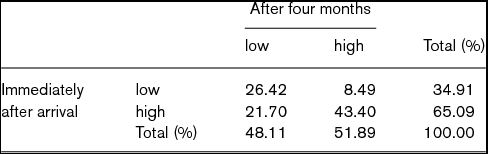
To determine whether a significant difference exists in the panel data using the contingency table, I recoded the political trust index for both sets of data. If the z-score of the index was smaller or equal to 0, it was recoded as ‘0’ and was taken to imply a lower level of trust towards the Chinese Government; if the z-score of the index was greater than 0, it was recoded as ‘1’ and was taken to imply a higher level of trust towards the Chinese Government. Table 1 presents the contingency table showing the students’ level of trust immediately after arrival and after four months.
Change in political trust in the Chinese government

Notes: χ2=17.297, d f= 1, p<0.001. Somers' d = 0.423, p<0.001. N=106.
The chi-squared test (p < 0.001) in Table 1 shows significant changes in political trust four months after the students arrived in Taiwan. The percentage of students with a high level of trust in the Chinese government dropped by 13.20%. Among all students, 69.82% did not change their opinion regarding the Chinese government; 26.42% had a low level of trust and 40.30% had a high level of trust. For the same population, 30.18% experienced a change in political trust, of which 21.70% trusted less in the Chinese government and 8.49% had an increased trust level.
Immediately after arrival, the Chinese students exhibited a mean political trust index of 2.66, with a standard deviation (SD) of 0.54. Four months later, the mean increased to 2.57, with a SD of 0.46. Performing a t test on the mean values of political trust four months after arrival indicated that the mean significantly decreased by 0.09 (p = 0.041).
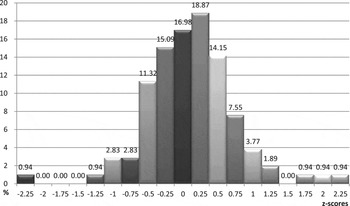
Subtracting the mean political trust index immediately after arrival from the mean index four months later revealed a change in the level of political trust. The theoretical values ranged from –3 to +3 and the actual values ranged from –1.67 to +1.33. A high value represented a high level of trust in the Chinese government after a student's arrival in Taiwan. Amongst the Mainland Chinese students in Taiwan who participated in this study, 16.98% showed no change in their level of trust towards the Chinese Government, 33.02% showed an increase, and the remaining 50% showed a decrease. However, when differences in political trust were expressed as z-scores, the highest value observed was 2.06, whereas the lowest value was –2.33, with a mean of 0.01 and a standard deviation of 0.63. The z-scores of the changes in the political trust amongst Mainland Chinese students were grouped and organized as in Figure 1; the inter-group interval was 0.25. Based on Figure 1, I can see that 50.94% of Mainland Chinese students surveyed exhibited a decrease in their level of trust towards the Chinese Government, whereas the remaining 49.06% showed an increased level of trust.
Changes in the political trust among Chinese students studying in Taiwan

Regression analysis of change in political trust among Mainland Chinese students studying in Taiwan
The descriptive statistics of the independent variables in this study are summarized as follows: 76.5% often visited night markets; 48.7% frequently interacted with their Taiwanese friends; 72.2% frequently discussed cross-strait relations with their Chinese classmates; and 46.1% often discussed cross-strait relations with their Taiwanese classmates. A mean of –0.18 was exhibited for the change in external political efficacy, with a SD of 0.63, signifying that the students’ expectations regarding the response of the Chinese government declined.
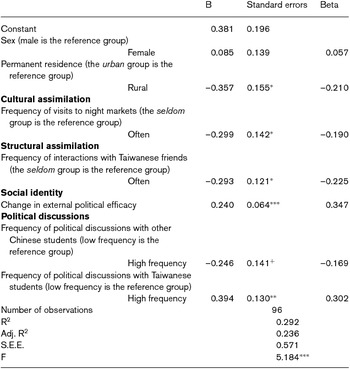
The dependent variable in this paper was the difference between the political index z-scores from the two waves of the survey. This is a continuous variable; therefore, the ordinary least squares method of the linear regression model was adopted to determine the effects of the independent variables on change in political trust. The results are shown in Table 2. The F-test statistic of this regression model was 5.2 (p < 0.001), indicating that the explanatory power of the model was statistically significant. The adjusted R2 value shows that the regression model developed in this study explains 23.6% of the variance in the changes in the political trust of Chinese students studying in Taiwan. Five hypotheses were empirically supported.
OLS regression model of the factors influencing of change in political trust

Notes: +: p < 0.1, *: p < 0.05, **: p < 0.01, ***: p < 0.001.
Regarding cultural assimilation, the change in political trust among Chinese students who frequent night markets was 0.19 SDs lower than that among students who seldom visit night markets. Thus, H1 was supported. Choosing to visit a night market indicates that Chinese students are able to accept Taiwan's local specialties and can easily assimilate into Taiwanese society, which exposes them to substantial amount of information and viewpoints pertaining to Taiwan. Therefore, their trust in the Chinese government decreases.
Regarding the structural assimilation hypothesis, the change in political trust among Chinese students who often interacted with their Taiwanese friends was 0.23 SDs lower than that of students who seldom interacted. Thus, H2 was supported. Chinese students who interact with their Taiwanese friends develop a mutual understanding and trust with these true acquaintances. They tend to identify with their friends’ negative evaluations of the Chinese government, and subsequently lose their trust in the Chinese government.
Concerning social identity, every 1.0 SD increase in external political efficacy corresponded to a 0.35 SD increase in political trust. Thus, H3 was supported. In Taiwan, Chinese students with increased external political efficacy strongly identify with the political system of China. They tend to support the ruling party of China because they believe that government officials value and will respond to the needs of the people. Therefore, their political trust in the Chinese government increased.
Regarding political discussion, the change in political trust of the Chinese students who frequently discuss politics with other Chinese students was 0.17 SDs lower than that of students who seldom engage in political discussions. Thus, H4-1 was supported. Living in Taiwan enabled the Mainland Chinese students to access negative information about the Chinese government or officials or to identify with Taiwanese culture. Thus, I expected that most students would lose political trust. Moreover, discussions of cross-strait relations between Mainland Chinese students who wish to seek new cognition and other Chinese students prompted a decrease in trust in the Chinese government.
The change in political trust among Chinese students who often engaged in political discussions with Taiwanese students was 0.30 SDs higher than that of the students who seldom did. Thus, H4-2 was supported. In Taiwan, several Mainland Chinese students discuss cross-strait issues with their Taiwanese classmates. This behavior can be regarded as their attempt to change the environmental cognitive element to one that matches their cognition. Therefore, these students are unlikely to lower their trust in the Chinese government. Furthermore, during such discussions, Chinese students perceive the negative aspects of China, which may stimulate their patriotism, leading to a strengthened trust in the Chinese government.
Conclusion
Currently, cross-strait political disputes center on sovereignty. The advancement of Taiwan's international position lies within the good faith of China, which, unfortunately, cannot be achieved immediately. Gaining the support of Mainland Chinese students studying in Taiwan may be one of the solutions to such problem. According to the interdependence theory, exchange between people facilitates the cultivation of cross-strait peace promoters, influences public opinion, and causes policy changes. A literature review revealed that a change in the political trust in the Chinese government among Chinese students studying in Taiwan is a crucial topic that has rarely been studied. Thus, our objective was to fill this research gap.
The results of this study showed that after four months of living and studying in Taiwan, the Chinese students experienced a mean decrease of 0.09 in trust in the Chinese government. When they first arrived in Taiwan, their mean value was 2.66, with a SD of 0.54. After four months, this mean value decreased to 2.57, with a SD of 0.46. Among all the participants, 17% experienced no change in trust, whereas 33% and 50% exhibited increase and decrease in trust, respectively. Overall, 16.98% more of the participants exhibited decreased political trust compared with those who experienced increased political trust. This means that living in Taiwan led most Chinese students to lose their trust in the Chinese government.
In this study, the political socialization approach, which was integrated with the concept of the cultural and institutional theories (i.e., the emphasis on individual experiences), emphasizes that the political learning resulting from unexpected information or experiences is the primary cause of change in political trust among Chinese students studying in Taiwan. I defined the sources and effects of unexpected experiences according to theories such as cognitive dissonance, assimilation, social contact, and social identity. I also formulated and tested five hypotheses. The independent and control variables of the regression model concurrently explained 23.6% of the variance in the changes in the political trust of Chinese students, and the five hypotheses were supported. Factors causing a decrease in the political trust among Chinese students included frequent visits to night markets, frequent interaction with Taiwanese students, decrease in external political efficacy, and frequent political discussions with fellow Chinese students. Factor prompting an increase in the political trust among Chinese students was frequent political discussions with Taiwanese students. Among these five factors, four factors are associated with the cultural theory, and one is related to institutional theory. Therefore, the explanatory power of the cultural theory for the change in political trust among Chinese students is higher than that of the institutional theory.
To improve the explanatory power of the regression model for the change in political trust in Taiwan, identificational assimilation within the scope of institutional theory can be considered in the future. Individuals exhibiting identificational assimilation develop a sense of peoplehood based on the host society; they regard the host country as their home or the primary target of their loyalty (Wilkie, Reference Wilkie1977: 88). Political identity is the most common indicator of identificational assimilation (Alba and Nee, Reference Alba and Nee1997: 831). Comparing the governance of the Taiwanese and Chinese governments is common among Mainland Chinese students. Based on the experiences of Chinese students, I found that Taiwan's literacy, freedom, and humanized policies have not only impressed and attracted Chinese students, but have also prompted them to reflect on the systems practiced in China. Furthermore, more than 50% of Chinese students yearn to live in Taiwan (Wang, Reference Wang2013: 75). Therefore, as Mainland Chinese students increasingly favor the performance of the Taiwanese government, to a point where they wish to become a citizen of this nation, their level of trust in the Chinese government decreases.
This study measured the identificational assimilation of Mainland Chinese students in Taiwan with the question ‘How do you feel about the Taiwanese government?’ However, the statistical results showed that this variable did not have a significant influence on changes in their political trust. A possible reason for this is that Chinese students view the Taiwanese government as a local government of China. Therefore, in future, questionnaires can include questions that probe participants’ views concerning Taiwan and China, such as ‘Do you agree with the statement that Chinese government should follow the policy behaviors of the Taiwanese government?’ to assess the identificational assimilation of Chinese students after their arrival in Taiwan.
About the author
Chia-chou Wang is a professor at Department of Public Policy and Management at I-Shou University. Professor Wang received his Ph.D. from Graduate Institute of East Asian Studies, National Chengchi University. His research interests include comparative politics, intergovernmental relation, cross-Strait relations. Recent publications in China: An International Journal, Journal of Contemporary China, Democratization, and Asian Survey.