Introduction
On 12 October 2002 members of the militant Islamic organization known as Jemaah Islamiah detonated three bombs within an hour of one another in Bali (Indonesia), killing 202 people. Of these 202 deaths, Australian citizens (88 deaths) were more than double that of any other nationality. The Balinese sustained the second greatest number of casualties (38 deaths). Anecdotal evidence suggests that communities in Bali were significantly affected by the economic and psychological consequences of the 2002 bombings. It is conceivable that these economic and psychological consequences were detrimental to the mental health of the Balinese population in the period after 2002, and that this might be an explanation of anecdotal increases in suicide and attempts reported in the province.
Previous studies have considered the effects of terrorist attacks on the World Trade Centre in New York City on subsequent suicidal behaviour in populations (Salib, Reference Salib2003; De Lange & Neeleman, Reference De Lange and Neeleman2004; Detsky et al. Reference Detsky, Sivilotti, Kopp, Austin and Juurlink2005); however, these studies found inconsistent associations and were not specific to the directly affected populations. By contrast, Bali is a discrete, insular Hindu population (within an overwhelmingly Muslim country) with an economy that is sustained largely through foreign tourism. The Balinese were directly affected by the October 2002 bombings, with the island being explicitly targeted due to its profound association with Western tourism. The previous three decades has seen a growing interdependence of Bali with the West, many viewing the perceived absorption of Western values into Balinese culture with alarm (Vickers, Reference Vickers1989; Picard, Reference Picard1996). This study examines suicide rates in Bali over the period 1994–2006 to assess the effects of the 2002 bombings upon these rates and to consider socio-economic, cultural and other factors associated with this phenomenon.
Method
Setting
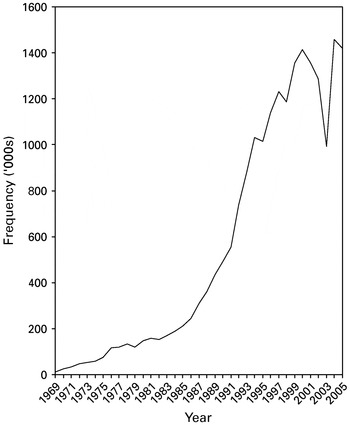
Bali is an island province of Indonesia approximately 5500 km2 in size with a population of approximately 3.1 million people, comprising nine administrative regencies. Unlike the predominantly Muslim composition of the wider Indonesian population, the majority of the Balinese population are Hindu (92%), followed by Muslims (6%), with the remaining religious population being Buddhists or Christians (Badan Pusat Statistik Propinsi Bali, 2000). Bali is considered to be one of the wealthier provinces of Indonesia, predominantly due to income from foreign tourism that has developed over the previous three decades (Fig. 1). The service sector, comprising trade, hotel, restaurant and other services, and the transport and communication sector represent 55% of Bali's gross domestic product (GDP) (Statistics Indonesia, 2007a). There is also a significant agricultural sector (22% of Bali's GDP) (Statistics Indonesia, 2007b).
Number of foreign tourist arrivals in Bali (1969–2005).

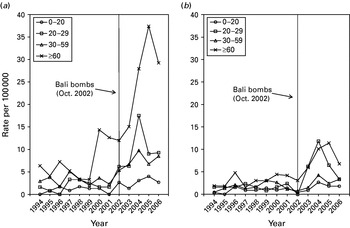
Suicides per 100 000 by age and sex, 1994–2006: (a) males (b) females. Regencies included in the analysis were Buleleng, Karang Asem and Tabanan.

Data
Cases of suicide were enumerated through local police departments in three of the nine regencies of Bali. The enumeration of mortality data in Bali is problematic because there is no centralized vital registration system based on formal diagnosis or definition of cause of death, nor is it routinely classified according to the International Classification of Disease (ICD) codes. Deaths are reported to regency authorities by the head of the local village (kepala desa), and centralized at the regency (Kabupaten) level. The enumeration of suicide in Bali is not as problematic as for other causes of death because all ‘suspicious’ deaths, including murder and suicide, are investigated and enumerated by local police departments and centralized for each regency. For this study resources and local agreements to access data could be obtained for three regencies: Buleleng (in the north), Karang Asem (in the northeast) and Tabanan (in the southwest). These three regencies represent approximately 44% of the total Balinese population. Only Buleleng contains a tourist area (that of Lovina) and none of the regencies incorporate the major tourist centres of southeast Bali (Kuta Beach, Jimbaran Bay) in which the bombings took place. Unit record data were obtained from regency police departments and aggregated by sex, age and year (1994–2006) for each area. Based on exploratory analyses of age-specific suicide rates, age groups were aggregated into the following broad age groups: 0–20, 20–29, 30–59 and ⩾60 years.
Corresponding population counts by sex, age group, year and area were obtained for 1994–2006 and were based on census data (for the years 1990 and 2000) and augmented for inter-censal years using population estimates derived from representative surveys published in statistical year books for all Bali (Badan Pusat Statistik Propinsi Bali, 2000; Badan Perencanaan Pembangunan Nasional, 2005).
Data on tourist arrivals for the study period were also obtained as a key social and economic indicator (Darma Putra & Hitchcock, Reference Darma Putra and Hitchcock2006; Dinas Pariwisata Bali, 2006), given the predominance of tourism as a source of income for Bali. Tourist numbers are collected routinely through immigration and airport arrival information. Numbers of tourists for Bali (and Indonesia as a comparison) for the period 1969–2006 were obtained and converted into a total per capita indicator by dividing the number of tourists by the total Balinese population.
Analysis
Suicide rates per 100 000 by age and sex were calculated for each year for the period 1994–2006 to examine secular trends in suicide in the period prior and subsequent to the 2002 Bali bombs. The time period selected for the analysis was based on the longest period available for which data were reliable, and to ensure a sufficient period of time to investigate secular trends in suicide (using time-series analysis) prior to the October 2002 bombings. Age-adjusted rates per 100 000 were also calculated using the direct method, using the 2000 population as the standard. It is important to note that there was a second series of bombs in October 2005. Two bombs were detonated outside two restaurants in the coastal resort of Jimbaran Bay, and a third bomb was detonated again in Kuta. This triplicate of bombs resulted in 23 fatalities, mostly Balinese. This second series of bombings is not considered directly in this analysis, given that the available time series of suicide data is to 2006 and thus does not provide a sufficient period of time in which to ascertain any longer-term effects on suicide rates in the study areas.
The effects of the Bali bombs were investigated in the first instance using Poisson regression models stratified by broad age group and sex to estimate the risk of suicide in the period after the first bomb (2003–2006) compared to the period prior to the first bomb (1994–2002) and to determine whether the average rate of suicide changed significantly over this period. Age-adjusted models and models adjusting for age and for tourist rates per capita were also conducted. The tourism rate per capita may be an intermediary variable between the effect of the Bali bombs and the suicide rate, and so tourism was included in models to investigate the extent to which the association between the 2002 Bali bombs and suicide is accounted for by the mediating socio-economic effects of tourism over time.
Additional analyses of the effect of the October 2002 bombs were also conducted using interrupted time-series regression analysis, with monthly suicide rates the unit of analysis. The October 2002 bombing was specified as a categorical pre-post variable (as above), variously adjusting for age, and for age and tourists per capita. Models adjusting for the effect of tourism relate to the period 2001–2005, which is the only period where published monthly tourist arrivals to Bali are available (Dinas Pariwisata Bali, 2006). Time series and Poisson regression modelling was carried out in SAS version 9.1 (SAS Institute, 2003).
Results
Male and female suicide rates increased significantly in the period after 2002. Age-adjusted suicide rates in the three regencies increased in males from an average of 2.84/100 000 in the period pre-2002 to 8.10/100 000 in the period post-2002, and for females from 1.51/100 000 to 3.68/100 000. The greatest increases in suicide in the post-2002 period were evident in the age groups 20–29 and ⩾60 years, for both males and females (Fig. 2). The highest rates of suicide were in 2004 for males aged 20–29 years (17.5/100 000) and in 2005 for males aged ⩾60 years (37.4/100 000), although suicide rates increased after 2002 for all ages >20 years in males and females (Fig. 2). Similar significant increases by sex and age in the post-2002 period were also evident in analyses of monthly suicide data using time-series analysis, although the average change in suicide was of a smaller magnitude than in aggregated analyses (Table 1).
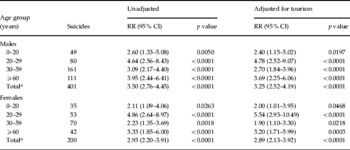
The relative risk (RR) of suicide adjusted for age for males in the post-2002 period was 3.50 [95% confidence interval (CI) 2.76–4.45, p<0.001] compared to the pre-2002 period (RR 1.00), and for females the RR was 2.93 (95% CI 2.20–3.91, p<0.001) (Table 1). Adjusting for tourism rates reduced RR estimates in comparisons between pre- and post-2002 periods in both Poisson regression and time-series regression analyses; however, differences remained statistically significant for males and females and across age groups (data not shown), suggesting that part of the increase in suicide post-2002 may be attributable to the socio-economic effects of declines in tourists to Bali in the period following the 2002 bombs. The greatest difference in suicide risk between the pre- and post-bomb period was evident for Buleleng Regency, followed by Karang Asem and Tabanan; however, these differences by regency were not statistically significant (data not shown).
Relative risk of suicide in three regencies of Bali in the period following the first Bali Bomb (post-2002) compared to previous periods (pre-2002), 1994–2006

RR, Relative risk; CI, confidence interval.
a Adjusted for age, and for age and tourism.
Discussion
This study investigated the effects of the bombings in Bali on subsequent suicide rates in three of the larger regencies of Bali by examining secular trends in suicide over the period 1994–2006 by sex and age. Suicide rates in males increased almost fourfold and in females increased threefold in the period after the first bombing in Bali (2002–2006), with greatest increases evident in young males aged 20–29 years and older males aged ⩾60 years. Adjusting for tourism rates reduced RR estimates in comparisons between pre- and post-2002 periods in both Poisson regression and time-series models, suggesting that some of the differential may have been attributable to the socio-economic effects of declines in tourism to Bali. However, RRs remained statistically significant for both males and females. Other factors are important in understanding the significant increase in suicide in the post-bomb period.
There are a number of methodological factors to consider in interpreting the findings of the present study. First, there is likely to be under-enumeration of suicide, given the lack of a formal, centralized vital registration system in Bali. However, suicide enumeration is probably substantially better than other causes of death, because local police are obligated to investigate all suspicious deaths, namely suicides and homicides, and it is likely that a near full enumeration of suicide cases is possible through these methods. It is not possible, however, to determine the extent to which suicide might be under-enumerated in the Balinese context. It is unclear how deaths reported as ‘suicide’ through the police correspond with the ICD definition. Concerning the reporting of suicide in Bali, it is also worth noting that the population is predominantly Hindu, a religion that views suicide negatively (Leenaars et al. Reference Leenaars, Cantor, Connolly, EchoHawk, Gailiene, Zhao, Kokorina, Lopatin, Lester, Rodriguez, Schlebusch, Takahashi, Vijayakumar, Hawton and van Heeringen2000). There is, however, no law against suicide in Indonesia. In any case, if under-reporting is non-differential over time, this would probably have little effect on the relative differences in suicide rates in the period prior and subsequent to the Bali bombs. Given the large magnitude of the differences observed in suicide between the pre- and post-bomb periods (RRs ranged from 2.11 to 4.86), it is unlikely that enumeration bias would wholly account for these observed differences. For changes in enumeration to be the main explanation for the rise in suicide, changes in coding practices would need to coincide with October 2002, and there have been no formal changes to coding practices of which the authors are aware during this period.
Second, not all regencies of Bali were included in the present study. Adequate data could only be extracted for three out of nine regencies (Buleleng, Karang Asem and Tabanan) for logistical reasons, and these areas (although accounting for almost half the Balinese population) may not necessarily be representative of the patterns of suicide in other areas of Bali. These areas do not include the most populated regency of Badung, comprising the capital Denpasar and the main tourist localities of Kuta, Legian, Seminyak, Sanur and Ubud. In this respect, the present study partially resembles previous studies of the (inconsistent) effects of the terrorist attacks on the World Trade Centre in 2001 on suicide and suicide attempts (Salib, Reference Salib2003; De Lange & Neeleman, Reference De Lange and Neeleman2004; Detsky et al. Reference Detsky, Sivilotti, Kopp, Austin and Juurlink2005). A study in England and Wales found a decrease in suicide in the immediate period after September 11, 2001 (Salib, Reference Salib2003), another study in Ontario (Canada) found a decrease in deliberate self-poisoning admissions to hospital in the days following September 11 (Detsky et al. Reference Detsky, Sivilotti, Kopp, Austin and Juurlink2005), whereas a study in The Netherlands found an increase in suicide and deliberate self-harm in the weeks following September 11 (De Lange & Neeleman, Reference De Lange and Neeleman2004). This may be because these studies were conducted in populations considerably removed from the terrorist attacks themselves (The Netherlands, the UK and Canada), and other contextual and intervening factors specific to the study context may have been more relevant in accounting for trends in suicide that coincided with the immediate period after the World Trade Centre attacks.
Although the regencies included in the present study do not correspond exactly to the areas involved in the October 2002 bombings, they are geographically proximate to the targeted areas (e.g. 1–2 hours drive away from Denpasar) and in practical terms service the tourist economies located in the areas where the bombings took place. It is likely that any effects of the bombs on suicide would be greater in these more populated tourist regions and hence the effects of the bombings on suicide would be underestimated in the areas included in the present study.
The implication of this study is that the sudden social and economic dislocation brought about by the 2002 bombings resulted in a significant increase in the incidence of suicide in Bali in the years after the bombings, from associated socio-economic effects of the decline in tourism in 2003. It is also probable that the September 11 terrorist attacks on the World Trade Centre had an indirect effect on tourism to Bali (as they had internationally) prior to October 2002. In the Australian context, campaigns to holiday domestically led to increases in domestic tourism in the post-September 11 period (Wilkinson, Reference Wilkinson2004; Athanasopoulos & Hyndman, Reference Athanasopoulos and Hyndman2008). The long-term effects of the second bombings on secular suicide trends in Bali are not clear, given that the present study is based on data up to 2006 (that is only one year past the 2005 bombings).
Just as the Western sociological literature has demonstrated that indicators of social integration and connectedness, such as socio-economic equality, urbanization and religiosity, are associated with lower suicide rates (Stack, Reference Stack2000a, Reference Stackb), social dislocation brought about by social and economic upheaval can also result in higher suicide rates and marked temporal increases in suicide (Pridemore & Spivak, Reference Pridemore and Spivak2003). This effect of social dislocation and suicide is also consistent with previous studies of the effects of population-level ‘disasters’ (and associated social upheaval) such as earthquakes and hurricanes (Yang et al. Reference Yang, Xirasagar, Chung, Huang and Lin2005; Kessler et al. Reference Kessler, Galea, Jones and Parker2006), although decreases in suicide have also been found subsequent to natural disasters (Shioiri et al. Reference Shioiri, Nishimura, Nushida, Tatsuno and Tang1999) and also for war (Stack, Reference Stack2000b). Collective responses to such events are likely to be context specific, and natural disasters and war differ in their origin, if not their effects, from terrorist bombings for which the explicit rationale is to instil fear in populations and disrupt factors associated with social cohesion.
In the context of Bali there are additional psychological, cultural and spiritual factors that are of importance (Suryani & Jensen, Reference Suryani and Jensen1993). The centrality of Hinduism in Balinese culture and the belief that social and personal misfortune is a consequence of ritual neglect (Hooykaas, Reference Hooykaas1974) are important dimensions in understanding the findings of the present study. Such neglect can include a failure to observe appropriate rituals or to carry out proper practices in accordance with the imputed wishes of a panoply of spiritual forces, including ancestors, demons and deities (Hooykaas, Reference Hooykaas1974). Widespread calamities and their social and health consequences have historically been interpreted in Bali as signalling a collective failure in this regard (Stuart-Fox, Reference Stuart-Fox1979; Lovric, Reference Lovric and Owen1987). It is likely that both the 2002 and 2005 bombings have likewise been interpreted as both a collective and an individual failure on the part of Balinese people to conduct themselves in accordance with the wishes of these unseen forces that govern the natural and cosmic universe (buana agung) (Muninjaya, Reference Muninjaya and Mitchell1982). In such circumstances, communal guilt may become manifest in unusual and distressing ways, compounding existing distress associated with material and economic factors and other more proximate antecedents associated with suicide (such as hopelessness, psychological distress and mental disorder).
Of particular note is that the largest increase in suicide occurred in those aged 20–29 years, particularly males. This age group is perhaps most vulnerable in the context of rapid social change and associated economic effects on, for example, employment. Previous studies of suicide in Western developed contexts have shown that socio-economic deprivation (Taylor et al. Reference Taylor, Page, Morrell, Harrison and Carter2005; Page et al. Reference Page, Morrell, Taylor, Carter and Dudley2006; Rehkopf & Buka, Reference Rehkopf and Buka2006), especially changes in employment status (Morrell et al. Reference Morrell, Taylor, Quine, Kerr and Western1999; Platt & Hawton, Reference Platt, Hawton, Hawton and and van Heeringen2000), can be associated with increased suicide in younger age groups. This may be applicable to the Balinese context, where most sectors are directly or indirectly affected by foreign income and tourism. Unemployment in Bali increased in the period after 2002, from approximately 2.8% in 2000–2002 to 6.0% in 2003, and then declined to approximately 4.6% in 2004–2005 (Statistics Indonesia, 2007b).
A large increase in suicide in the post-bomb period was also evident in those aged ⩾60 years, which followed upon an already increasing trend in males in this age group. The increase in the period from 1997 to 2002 coincides with the Asian economic crisis of 1997, the fall of the Soeharto regime, and the consequent economic dislocation experienced across the Indonesian archipelago. The socio-economic and cultural dimensions noted above for the younger age groups are also likely to be relevant in interpreting the increase in the ⩾60 years age group. For the younger age group, there are the direct material effects on socio-economic circumstances, in terms of employment and income, but for the older age group these socio-economic effects are more likely to be indirect. This age group is likely to be dependent on extended family in younger age groups, and increased suicide in older age groups may reflect increased social and economic strain on family and social networks.
It is conceivable that delayed economic effects of the Asian economic crisis led to rises in unemployment that subsequently resulted in the increases in suicide that coincided with the post-2002 period. To sustain this interpretation of the findings, the strong contemporaneous association between the October 2002 bombs would need to be ignored, as well as the lack of any change in the suicide rate (with the exception of ⩾60-year-old males) occurring in the 1997–1999 period, the peak of the crisis (Weisbrot, Reference Weisbrot and Muchhala2007). This is not consistent with the contemporaneous rises in suicide in all age groups most affected by the economic crisis for countries where data are available (Japan, Republic of Korea), which occurred during 1997–1999 (Australian Institute for Suicide Research and Prevention, 2003). Unemployment may be a key factor associated with the increase in suicide in Bali in the post-bomb period; however, it is logically unsustainable to suggest that the bombings were an intermediary between unemployment and suicide, rather it is more likely that patterns of unemployment were affected by the social and economic effects of the October 2002 bombs.
Conclusions
This study found that suicide in Bali increased almost fourfold in males and threefold in females in the period after the 2002 bombings, with the largest effects evident in the young adult age group (20–29 years) and the elderly (⩾60 years). Trends in tourism partially accounted for observed differences in the period pre- and post-bombs. Other factors such as indirect socio-economic effects and the centrality of Hinduism in Balinese culture, especially notions of collective guilt and anxieties relating to the neglect of ritual, are important in understanding the sharp rise in suicide in the post-2002 period. Although the suicide rate in Bali is fairly low compared with developed countries, such as Australia (Morrell et al. Reference Morrell, Page and Taylor2007), the sharp rise occurring contemporaneously with a catastrophic event that explicitly aimed to cause social and economic dislocation demonstrates the importance of contextual factors in understanding the aetiology of suicide, and also the need for local Balinese authorities to address the ongoing social, economic and psychological adjustment in post-bomb Bali.
Declaration of Interest
None