INTRODUCTION
South America is home to the largest diversity of silverside fish of the family Atherinopsidae (New World silversides; Dyer & Chernoff, Reference Dyer and Chernoff1996). Many forms occur in rivers and lakes, but the majority occupies inshore ecosystems. The Brazilian silverside, Atherinella brasiliensis (Quoy & Gaimard, 1825), is a small (maximum 160 mm standard length (SL)), short-lifespan (~1.5 years) species that is a conspicuous member of the south-western Atlantic ichthyofauna distributed along the coast of Brazil up to Venezuela (Sergipensis & Vieira, Reference Sergipensis and Vieira1999; Figueiredo & Menezes, Reference Figueiredo, Menezes, Menezes, Buckup, Figueiredo and Moura2003; Garcia et al., Reference Garcia, Vieira, Winemiller and Grimm2004; Allen et al., Reference Allen, Jiménez and Villafranca2006; Falcão et al., Reference Falcão, Sarpédonti, Spach, Otero, Queiroz and Santos2006; Neves et al., Reference Neves, Pereira, Costa and Araújo2006). It generally inhabits the shallow areas of bays and estuaries and may form large local populations. Although it has no commercial importance, this silverside may serve as a food fish for recreational anglers (Bervian & Fontoura, Reference Bervian and Fontoura2007) and local fishing communities, and is sometimes used as fish-bait in artisanal long-line fisheries (R. Contente, personal observation). Aspects of the reproductive biology, life history, growth, and population dynamics of A. brasiliensis have been well studied (Bemvenuti, Reference Bemvenuti1990; Fávaro et al., Reference Fávaro, Lopes and Spach2003; Bervian & Fontoura, Reference Bervian and Fontoura2007; Fávaro et al., Reference Fávaro, Oliveira and Verani2007; França et al., Reference França, SeveriI, Castro, Medeiros and El-Deir2007). However, comprehensive accounts on its feeding pattern are lacking. Carvalho (Reference Carvalho1953) and Bemvenuti (Reference Bemvenuti1990) have shown that its diet is based on zooplankton, plant detritus, and small bottom invertebrates. However, both studies were largely descriptive and did not provide a statistical evaluation of feeding habits.
Atherinella brasiliensis dominates the shallow-water resident fish assemblages in the large estuarine ecosystems of subtropical Brazil (Garcia et al., Reference Garcia, Vieira, Winemiller and Grimm2004; Fávaro et al., Reference Fávaro, Oliveira and Verani2007). Given its great abundance, this species may act as an important trophic component in the food chain of such sub-tropical systems. As part of a comprehensive study on the trophic ecology of fish in the Paranaguá Bay Estuarine Complex (Paranaguá BEC) (south-east Brazil) this paper describes the feeding ecology of A. brasiliensis. Our specific goals were to describe the dietary composition, feeding strategy, and trophic level of A. brasiliensis, evaluating how estuarine sector, season and body size affect the observed feeding pattern.
MATERIALS AND METHODS
Study area and sampling procedures
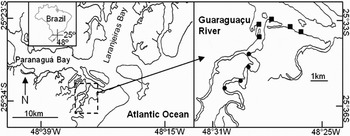
The Paranaguá BEC, located on the coastal plain of the State of Paraná, Brazil (Figure 1), is the southern part of the large, interconnected, subtropical estuarine system ‘Iguape–Cananéia–Paranaguá,’ which supports economically important sport and commercial fisheries (Lana et al., Reference Lana, Marone, Lopes, Machado, Seeliger, Lacerda and Kjerfve2001) and is located within the Atlantic Forest (Mata Atlântica) Biosphere Reserve (UNESCO 2008; http://www.unesco.org/mabdb/br). The Paranaguá BEC is a large (~460 km2), semi-enclosed body of water, bounded by mangroves and salt marshes. The region's climate is humid sub-tropical, with a mean annual rainfall of 2500 mm. The Paranaguá BEC exhibits a semi-diurnal tide regime, with maximum amplitudes of approximately 2 m. During the rainy season (spring–summer), temperature and freshwater runoff-rate to the coastal zone increases (23–30°C, 28 × 106 m3day−1) and salinity decreases (12–29), while during the dry season (autumn–winter), the opposite physical conditions occur (T = 18–25°C, salinity = 20–34, runoff = 7 × 10⁶ m3day−1) (Lana et al., Reference Lana, Marone, Lopes, Machado, Seeliger, Lacerda and Kjerfve2001). A further description of the environmental characteristics of the Paranaguá BEC is provided in Lana et al. (Reference Lana, Marone, Lopes, Machado, Seeliger, Lacerda and Kjerfve2001).
Map of the estuarine complex of Paranaguá Bay and its location on the southern Brazilian coast. The Guaraguaçu River Estuary and the capture stations are shown in detail. •, upstream sector; ■, downstream sector.

This study took place in the estuary of the Guaraguaçu River (Figure 1), a large tributary that opens to the southern sector of the Paranaguá BEC. The study area was divided into the upstream (the inner, oligohaline zone of the estuary with salinity generally <10) and the downstream (the lower, polihaline zone of the estuary with salinity 10–25) estuarine sector. Sampling was conducted monthly along an annual cycle (September 2005–August 2006) at four or five marginal stations within each habitat (Figure 1). Fish were caught using a 15 m × 2 m seine-net with a uniform mesh size of 5 mm (stretched). During each survey, one 20 m tow was performed parallel to the river's course at each station, fishing to a depth of approximately 1.5 m. When a tow yielded a large catch, 30 animals were randomly selected and retained. Catches < 5 fish were not retained. Other abundant fish species were also retained in order to study their trophic ecology. Sampling always took place during spring tide, at low water during the morning (7:00–12:00 h). Fish were stored and transported on ice to the laboratory.
Laboratory procedures
Individuals were measured (SL, nearest 1 mm) and their gut removed, preserved in 10% formalin and stored in 70% ethanol. Atherinella brasiliensis does not possess a discrete stomach, so only food contents from the first third of gut were used in analyses. For non-empty guts, gut fullness (GF) was estimated visually on a scale of 1 (10% full) to 10 (100% full) (Chuwen et al., Reference Chuwen, Platell and Potter2007). Dietary items were identified to the lowest taxonomic level, whenever possible, under a microscope. For each gut, the content was spread in a counting cell chamber with a uniform depth, and, then, the volumetric contribution of the dietary item i was obtained by calculating the proportional area of i in relation to total item area. The number of fish with empty guts was also obtained.
Statistical analyses
Friedman's test (non-parametric repeated measures comparisons) was used to assess variation in the number of fish in proportion to within size-classes among seasons and habitats (Sokal & Rohlf, Reference Sokal and Rohlf1995).
To evaluate the rate of feeding intensity, the monthly mean gut fullness (GFm) and monthly percentage of non-empty guts were computed. The adequacy of the sample size for describing the global diet was assessed by using a cumulative prey-type curve, based on 999 random orders of non-empty guts (Ferry & Caillet, Reference Ferry, Caillet, MacKinlay and Shearer1996). Frequency of occurrence (%F i, percentage of fish containing a given dietary item i) and percentage volume (%V i, the volume of a given dietary item i in relation to total volume) were the descriptive diet indices utilized (Tirasin & Jørgensen, Reference Tirasin and Jørgensen1999). To assess the uncertainty associated with these indices, non-parametric confidence intervals (CI95%) were calculated using the bootstrap method (based on re-sampling 5000 times), using each gut as a sampling unit (Tirasin & Jørgensen, Reference Tirasin and Jørgensen1999).
To look for general trends in feeding behaviour, prey-specific abundance (P i) was plotted against %F i (Amundsen et al., Reference Amundsen, Gabler and Staldvik1996; Garcia et al., Reference Garcia, Geraldi and Vieira2005; La Mesa et al., Reference La Mesa, La Mesa and Tomassetti2006; Contente et al., Reference Contente, Stefanoni and Spach2008). P i was calculated as the volume of dietary item i divided by the total volume of dietary items in the guts containing i, expressed as a percentage (Amundsen et al., Reference Amundsen, Gabler and Staldvik1996).
The ‘DISTLM (DISTance-based Linear Modeling) forward’ software (Anderson, Reference Anderson2003) was employed to verify the existence of a significant relation between the diet data matrix and the estuarine habitat, season, and fish size (McArdle & Anderson, Reference McArdle and Anderson2001; Campo et al., Reference Campo, Mostarda, Castriota, Scarabello and Andaloro2006). This program performs a multivariate multiple regression based on a given any distance measure and performs a forward selection of the predictor variables, either individually or in specified sets, with permutation tests. The results are a marginal test, fitting each variable individually and ignoring other variables, and a conditional test fitting each variable one at a time, conditional on the variables that are already included in the model (Anderson, Reference Anderson2001, Reference Anderson2003). Fish size was regarded as a continuous variable, and season and habitat, as categorical variables (with numerical levels corresponding to the seasons (winter = 1, spring = 2, summer = 3 and autumn = 4) and habitats (upstream zone = 1 and downstream zone = 2)). DISTLM software based on two data matrix files: ‘matrix 1’ file = %V of the dietary items of each non-empty guts × dietary items; ‘matrix 2’ file = either categorical or continuous values for each non-empty guts × explanatory variables of interest, i.e., fish size, season and habitat. DISTLM fits the individual variables of interest sequentially in the model, and, then, fits a sequential model of the set of such variables of interest (i.e. evaluation of the interaction among variables) (Anderson, Reference Anderson2003). To verify how such factors affect dietary composition in a higher taxonomic level, DISTLM was also performed using dietary categories (i.e. dietary items pooled into main food categories; see Figure 8) as variables. DISTLM was based on ln(x + 1)-transformed data, 999 permutations, and a dissimilarity matrix constructed with the Bray–Curtis coefficient (Campo et al., Reference Campo, Mostarda, Castriota, Scarabello and Andaloro2006).
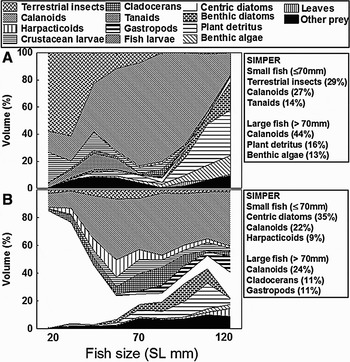
Similarity percentages (SIMPER) were applied to identify which food items were responsible for typifying the dietary composition within a fish group selected (Clarke & Warwick, Reference Clarke and Warwick2001). To illustrate between-habitat differences through its ontogeny, the total Brazilian silverside sample for each habitat was divided into small (≤70 mm) and large (>70 mm) groups and SIMPER was then used to characterize their diet composition.
For the following analyses, dietary samples (=gut data from matrix-1 averaged according to month and station of capture) were used. Feeding-niche breadth, evenness, and trophic level of each dietary sample were estimated by the Shannon–Wiener diversity index H′, Pielou's evenness index J (La Mesa et al., Reference La Mesa, La Mesa and Tomassetti2006), and TROPH index (Pauly et al., Reference Pauly, Trites, Capuli and Christensen1998), respectively. TROPH is an important quantity in the modelling of marine ecosystems, as it expresses the trophic position of a species within the food web; it is expressed formally by:
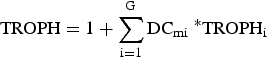
where DC mi is the fraction of dietary item i in the diet of consumer m, TROPH i is the trophic level of i, and G is the number of groups in the diet of m (Pauly et al., Reference Pauly, Trites, Capuli and Christensen1998). It takes any value between 2.0, for herbivorous and detritivorous organisms, and 5.0, for piscivorous and carnivorous organisms (Pauly et al., Reference Pauly, Trites, Capuli and Christensen1998). To search for habitat and seasonal differences in H′, J, and TROPH, a Kruskal–Wallis test was used (Sokal & Rohlf, Reference Sokal and Rohlf1995). Spatial–temporal changes in feeding habits were graphically assessed using correspondence analysis (CA) and dietary category. CA allows dietary samples to be organized in a multivariate space, so that those that are most similar in both food composition and relative abundance will appear close together, while samples that differ greatly in the relative importance of a similar set of food category or that possess quite different prey categories, will appear far apart (Legendre & Legendre, Reference Legendre and Legendre1998). Additionally, points along an axis (or dimension) fall along a dietary categories gradient.
RESULTS
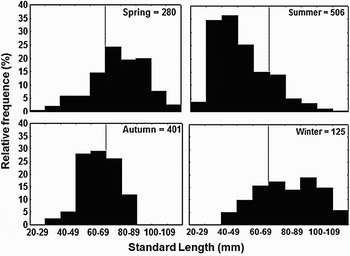
Altogether 1431 Atherinella brasiliensis, ranging from 21 to 120 mm SL, were caught for gut analyses. Fish size distribution among size-classes varied significantly across seasons (Friedman's test, P < 0.01), but not between habitats within each season (P > 0.05). Thus, a clear seasonal distribution pattern of fish size was detected. The larger fish (>70 mm SL) prevailed during winter and spring and the smaller ones (<50 mm SL) during summer (Figure 2). Individuals of intermediary sizes (50–70 mm) were more abundant in autumn.
Seasonal length–frequency plots of Atherinella brasiliensis captured between September 2005 and August 2006 in the Guaraguaçu River Estuary (southern Brazil coast). The total number of individuals caught throughout each season is given in the upper right of each plot. Dot line represents a division between the small (≤70 mm) and large (>70 mm) group of fish.

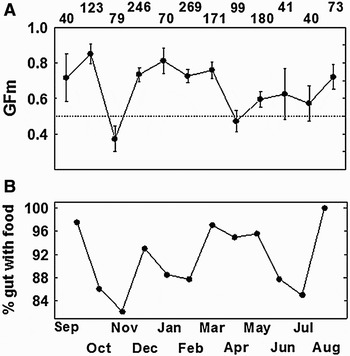
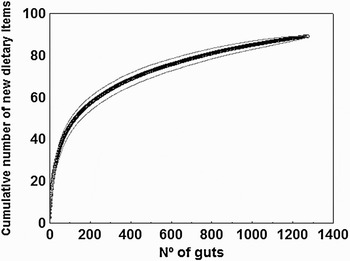
Atherinella brasiliensis showed a high rate of feeding intensity. Almost all individuals contained food in their gut (N = 1312, 91.6%), and the monthly mean gut fullness values and the monthly proportion of non-empty gut were frequently higher than 0.5 and 85%, respectively (Figure 3A & B). A suitable sample size for describing the diet diversity of A. brasiliensis was obtained, as the cumulative food types curve for the entire data set stabilized (Figure 4).
Monthly (A) mean foregut fullness (GFm) and (B) mean percentage of gut containing food in Atherinella brasiliensis captured between September 2005 and August 2006 in the Guaraguaçu River Estuary (southern Brazil coast). Monthly data from catch stations were averaged because they did not differ (ANOVA, P < 0.05). Bars = ±SE. Number of fish caught is given at the top of the figure. Dot line = GFm-value of 0.5.

Dietary item cumulative curve based on different 999 random orders of 1312 non-empty guts of Atherinella brasiliensis from the Guaraguaçu River Estuary (southern Brazil coast). The grey lines are standard deviations.

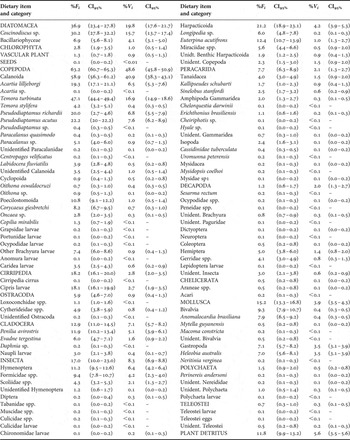
Atherinella brasiliensis consumed a large array of prey types. Gut analysis led to the identification of 89 dietary items belonging to eight major groups (Crustacea, Insecta, Chelicerata, Mollusca, Polychaeta, Teleostei, Diatomacea and Cholorophyta), as well as plant detritus, seeds, and leaves of vascular plant. Table 1 summarizes dietary items, categories and their descriptive indices. Calanoids were the main and more speciose (8 species) dietary category consumed. The exotic calanoid Temora turbinata was the most important prey species in the overall diet (V i = 17%, F i ~ 50%). Other main calanoids were Pseudodiaptomus acutus, P. richardii and Acartia lilljeborgi, each one accounting for about 7% in V i and occurring in a range of 19–22%. Centric diatoms (mainly Coscinodiscus spp.) ranked second in importance as dietary category (V i = 16%, F i = 30%). The next important foods were cladocerans, mainly Penilia avirostris, and adult hymenopterans. Plant detritus contributed 5% of the volume and occurred in 12% of guts. Though in low volume (V i < 2%), larvae of cirripedians (Cypris), early forms of the bivalve Anomalocardia brasiliana, and the copepods Corycaeus giesbrecht and Euterpina acutifrons, were relatively frequent in the diet (F i > 10%). Other consumed taxa appeared as accessory food for the overall diet.
Frequency of occurrence (%F i) and percentage contribution by volume (%V i) of dietary items and categories of overall diet of Atherinella brasiliensis from the Guaraguaçu River Estuary (southern Brazil coast). The uncertainty associated with both indices (±CI95% calculated by bootstrapping method) is given.

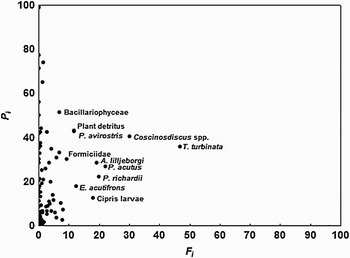
The feeding strategy graphical method (Figure 5) revealed that the majority of dietary items were located in the lower part of the graph, indicating a generalized feeding strategy in which a large number of prey types are usually consumed by a low percentage of predators. In terms of relative importance, the major items were after 9–10% F i and that T. turbinata was most important due to its further central position in the plot.
Graphical representation of the feeding pattern of Atherinella brasiliensis from the Guaraguaçu River Estuary (southern Brazil coast). P i = prey-specific abundance and F i = frequency of occurrence. Only names of the major dietary items are given.

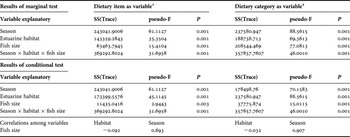
Based on both dietary items and categories, the DISTLM test revealed that the diet composition was highly significantly correlated with estuarine habitat, season, and fish size and their interaction term, evidence that such factors largely affect the diet of A. brasiliensis (Table 2). Fish-size effect was highly correlated with season (r dietary items > 0.6, r dietary categories > 0.9; Table 2), probably due to the marked seasonal size distribution pattern (Figure 2).
Marginal and conditional test results of the DISTLM forward routine for evaluating potential relationships among Atherinella brasiliensis diet and the estuarine habitat, season, and body size of a population from southern Brazil. Correlations among variable effects are also provided.
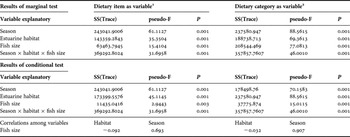
1Rare dietary items (V i < 1% of the total diet) were pooled into broader taxonomic groups to reduce excessive occurrence of 0-values. In this case, matrix-1 was 1312 guts × 44 dietary items. 2Matrix-1 was 1312 guts × 19 dietary categories.
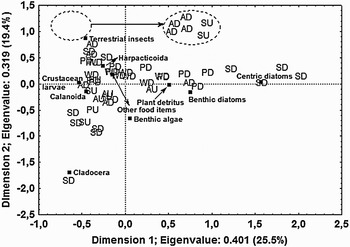
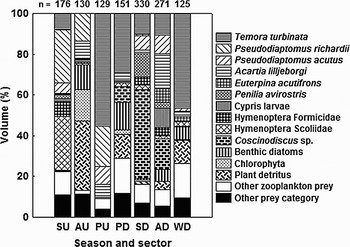
Correspondence analysis showed how the feeding habits of A. brasiliensis varied spatially and temporally through the ordination of dietary samples on prey gradients (Figure 6). One gradient, which lies entirely on axis-1, ranged from non-animal to animal prey and another, which follows the non-animal part of axis-1, ranged from benthonic to planktonic resources. CA axis 2 represents a prey gradient from zooplankton to terrestrial prey. The SIMPER test along with the CA, showed, at a low taxonomic level, dietary shifts with respect to season and habitat (Figure 7). At the upstream sector, A. brasiliensis shifted from hymenopterans (the highest second axis scores) and calanoids (mainly P. richardii) in the summer to a large reliance on benthic non-animal resources in autumn and on Temora turbinata and Pseudodiaptomus species in spring. At the downstream sector, A. brasiliensis shifted from a mixed T. turbinata and plant diet in the spring to a disproportional consumption of Coscinodiscus diatoms (the highest first axis scores) in summer. While a diversity of similar-volume planktonic components was consumed in autumn, T. turbinata dominated the diet in winter.
Spatial–temporal variability in feeding habits of Atherinella brasiliensis examined by correspondence analysis (CA). CA ordination of dietary samples overlaps the CA ordination of dietary category. Dietary samples are ordered according to their proportion of animal, non-animal, zooplankton and insect prey on prey gradients (see text). The explained variance and eigenvalues are indicated along their respective axes. The dashed lines intersect at the origin of ordination. See Figure 8 for dietary samples codes.

Percentage by volume of the main dietary items that characterize the Atherinella brasiliensis diet, according to SIMPER, during each season in each sector of the Guaraguaçu River Estuary (southern Brazil coast). Only groups of dietary items contributing higher than 50% similarity in diet characterization are given; the remainder were pooled in the ‘other prey category’ or ‘other zooplankton prey’. Codes: first character, season (S, summer; P, spring; A, autumn; W, winter), second character, estuarine habitat (U, upstream; D, downstream). Number of non-empty guts is given at the top of the figure. A non-sufficient sample size occurred in WU.

SIMPER tests and the histogram of prey volumetric contribution shown in Figure 8 reveal consistent between-habitat differences among size-classes, as well as no apparent change in prey size with increasing predator size in A. brasiliensis. Terrestrial insects and central diatoms ranked as primary prey for juveniles in the upstream and downstream sectors, respectively. Although calanoids were the preferred prey, adults consumed more benthic non-animal food items in the upper estuary, and a highly diverse group of prey, including central and benthic diatoms, cladocerans, and gastropods, in the lower estuary.
Percentage volume of the major dietary categories ingested by small and large individuals of Atherinella brasiliensis in the upstream (A) and downstream (B) sectors of the Guaraguaçu River Estuary (southern Brazil coast). Principal diagnostic dietary categories identified by SIMPER are given at the side of the histograms.

Season and estuarine habitat did not appear to have any significant effect on feeding diversity (H′, H 8,51 = 8.8, P > 0.05), evenness (J, H 8,51 = 6.3, P > 0.05), or trophic level (TROPH, H 8,51 = 7.9, P > 0.05), thus suggesting that: (I) A. brasiliensis fed on numerous (H′ = 2.26) and evenly (J = 0.58) distributed food items in both habitats through the seasons; and (II) omnivory is maintained, despite consistent diet variation. Atherinella brasiliensis on average was at a low trophic level (mean TROPH = 2.57).
DISCUSSION
Atherinella brasiliensis is a generalist and opportunistic feeder that displays a wide trophic niche, ranging from copepods to detritus. Zooplankton (mainly calanoids), diatoms, terrestrial insects, and plant detritus made up the bulk of its diet, accounting for 95% of the items found in the gut and 84% of the gut contents by volume.
Our findings support previous studies that have also reported highly diversified diets, based on both plant material and a variety of different small invertebrates. In the Patos Lagoon Estuary, Bemvenuti (Reference Bemvenuti1990) found A. brasiliensis to feed mostly on zooplankton, insects, polychaetes, gammarids, tanaids and diatoms; in the Cananéia Estuarine System, Carvalho (Reference Carvalho1953) reported that plant detritus, copepods, shrimp larvae and fish dominate its diet. Along the Venezuelan coast, according to Carreño (1975, in Allen et al., Reference Allen, Jiménez and Villafranca2006), A. brasiliensis is a copepod-eater, also feeding on cirripedians, insects, molluscs and algae. Diversified feeding habitats appear to be a conspicuous feature among atherinopsid fish (Ringuelet et al., Reference Ringuelet, Iriart and Escalante1980; Grosman, Reference Grosman1995; Barry et al., Reference Barry, Yoklavich, Cailliet, Ambrose and Antrim1996; Cassemiro et al., Reference Cassemiro, Hahn and Rangel2003). Many are unspecific predators and feed upon whatever is available and abundant (Ringuelet et al., Reference Ringuelet, Iriart and Escalante1980; Cassemiro et al., Reference Cassemiro, Hahn and Rangel2003). Such high dietary plasticity in A. brasiliensis may be one aspect of its spreading success across the eastern South American coast; further, this attribute may play an important role in supporting large local populations observed throughout its distribution range, especially in the sub-tropical estuaries in southern Brazil.
Since A. brasiliensis is a fast-growing, short-lived species, our year-round sampling likely captured its life history. Large-sized silversides are present in the Paranaguá BEC in large numbers in winter and, particularly, in spring when peak reproduction takes place; a resultant age-0 cohort appears and becomes abundant in middle summer (Fávaro et al., Reference Fávaro, Lopes and Spach2003, Reference Fávaro, Oliveira and Verani2007). Our data confirm this pattern and demonstrate the strong interdependence between fish-size and season on diet. However, between-habitat differences in diet were highly significant; further, comparing the diet of same-size individuals between habitats (Figure 8) reveals very distinct diets, thus suggesting that habitat had stronger effect on diet than size, which means that A. brasiliensis is a highly opportunist and generalized predator throughout its ontogeny.
Like in the Patos Lagoon Estuary (Bemvenuti, Reference Bemvenuti1990), differential spatial–temporal foraging on several plankton prey taxa, plant detritus, and insects may be, in part, attributed to spatial–temporal prey abundance–availability. The dominance of Pseudodiaptomus richardii in the diets of the upper estuary may be related to its dominance in such low salinity, estuarine reaches of the region (Lana et al., Reference Lana, Marone, Lopes, Machado, Seeliger, Lacerda and Kjerfve2001). Greater summer predation on Coscinodiscus might likely be linked to the conspicuous pulse of diatom summer production at lower reaches of the river (Brandini & Thann, Reference Brandini and Thamm1994; Lana et al., Reference Lana, Marone, Lopes, Machado, Seeliger, Lacerda and Kjerfve2001). Greater consumption of terrestrial insects is probably due to the huge availability of falling insects in the upper estuary habitat because of strong rains during the summer months (R. Contente, personal observation).
The lack of a consistent size-related dietary shift in the Brazilian silverside was also observed in other generalist atherinopsids, like Odonthestes bonariensis (Ringuelet et al., Reference Ringuelet, Iriart and Escalante1980; Grosman, Reference Grosman1995). Overall, this is typical among generalist fish (e.g. Weliange & Amarasinghe, Reference Weliange and Amarasinghe2003; Bergmann & Motta, Reference Bergmann and Motta2005). Switching to larger, energetically-profitable prey due to an increase in gape size with increasing body size is an almost universal pattern among fish; however, the size-independent prey selection of generalist fish throughout their ontogeny (Wootton, Reference Wootton1998) may supersede such a pattern. In fact, the larger individuals of A. brasiliensis, with a mouth large enough to take large prey, fed upon small food items just like the smaller individuals. It is interesting to note that, in contrast to our data, A. brasiliensis shifts from smaller (zooplankton and diatoms) to larger prey (polychaetes, isopods and tanaids) in the Patos Lagoon Estuary, a possible interplay between their large gape and great macrobenthic prey availability (Bemvenuti, Reference Bemvenuti1990). Such contrasting ontogenetic patterns therefore emphasize a species' capacity for sustaining metabolic investment for body maintenance by relying on a variety of food quality throughout its lifespan.
The observed dietary composition of A. brasiliensis is probably closely related to its particular feeding morphology, behaviour and body form. Atherinella brasiliensis is known to form large, inquisitively foraging groups whose individuals pick small invertebrates or tufts of filamentous algae from the water column or substrate (Sazima, Reference Sazima1986). Its small, upwardly-directed, protrusible mouth and bifurcated teeth are suitable for particulate-feeding, while its small, compressed, fusiform body with a forked caudal fin is ideal for manoeuvrability and mobility (Bemvenuti, Reference Bemvenuti1990; Motta et al., Reference Motta, Clifton, Hernandez and Eggold1995). Closely spaced and long, highly ornamented gill rackers in A. brasiliensis (authors' personal observation) may favour planktivory and retention of minute particles such as detritus (Ross et al., Reference Ross, Martínez-Palacios, Aguilar-Valdez, Beveridge and Chavez-Sanchez2006).
Regardless of season and estuarine zone, the high feeding intensity detected in A. brasiliensis, coupled with its dominance in the resident fish community of the Paranaguá BEC, presumably imply that it is an important low trophic level component in this system, displaying increased contribution to net energy export to higher trophic levels. The Brazilian silverside serves as a major forage fish for large predator, such as large commercial fish (like snooks; R. Contente, unpublished data), seabirds and dolphins (Zanelatto, Reference Zanelatto2001). Complementary studies on food consumption rate and production estimates of A. brasiliensis populations are needed to assess its role within the ecosystem energy flux.
Atherinella brasiliensis was found to rely upon the largest Paranaguá BEC's calanoid standing-stocks (T. turbinata, P. acutus, P. richardii and A. lilljeborgi; Lopes et al., Reference Lopes, Vale and Brandini1998). Of particular interest is the dominant role of T. turbinata in the A. brasiliensis diet. This, to our knowledge, is the first observation of this exotic copepod in a fish's diet in Brazilian waters. After its introduction in Brazilian waters (likely during the 1980s), T. turbinata has proven to be an effective invader. For instance, it has replaced its co-generic, the native Temora stylifera and has become an important secondary producer in Cananéia (Ara, Reference Ara2002). Currently, T. turbinata occupies various estuaries from Brazil (Lopes et al., Reference Lopes, Vale and Brandini1998; Ara, Reference Ara2002; Silva et al., Reference Silva, Neumann-Leitão, Schwamborn, Gusmão and Silva2004) and interacts trophically with an abundant nekton component, probably becoming established within the trophic structure of the Paranaguá BEC.
ACKNOWLEDGEMENTS
We would like to thank the CEM Fish Biology Laboratory staff, especially Helen Pichler and Guilherme Mac Laren for help in the laboratory and the field work. We are grateful to Virginia Uieda and June Dias for their contributions to this study, and Marti Anderson for advice on the statistical analysis. We also thank Verônica Maria de Oliveira, Rubens Lopes and Terue Kihara for their support in taxonomic identification of prey. Finally, we are grateful to IAP (Environmental Institute of Paraná) for the research license and CNPq (National Counsel of Technological and Scientific Development) for financial support through a master grant to R.F.C. and M.F.S., and a productivity scholarship to H.L.S.