


Land reform - the reallocation of property rights and the redistribution of land – is a process that almost all countries have undertaken, in some form or other, during their development (Federico Reference Federico2005). Indeed, land reform continues to be a central component in the World Bank's prescribed policies for developing countries.Footnote 1 Moreover, recent empirical and theoretical studies suggest that reductions in land inequality (i.e. land reform) lead to higher income growth, reductions in poverty and growth in human capital (Besley and Burgess Reference Besley and Burgess2000; Deininger and Squire Reference Deininger and Squire1998; Griffin, Khan and Ickowitz Reference Griffin, Khan and Ickowitz2002; Deininger, Jin and Nagarajan Reference Deininger, Jin and Nagarajan2009; Galor, Moav and Vollrath Reference Galor, Moav and Vollrath2009; Gersback and Siemers Reference Gersback and Siemers2010; Lipton Reference Lipton2009; Vollrath Reference Vollrath2007). However, regardless of the desired outcome, there is no broad consensus on the design for land reform policies.Footnote 2 The study of successful examples of land reform programmes can help answer modern economic and political questions, such as what policy design developing countries should adopt when implementing land reform and what features of the economy help to facilitate the implementation.Footnote 3 For example, Griffin et al. (2002, pp. 309, 321) argue that successful examples of land reform in South East Asia represented a transfer of land ownership title from landlords to cultivating tenants, not landless labourers, but that such examples require large-scale financial investment: in the case of Ireland we find evidence of both.
In this article, we contribute to the debate on the design of land reform by studying the policies adopted towards Ireland at the end of the nineteenth century.Footnote 4 We provide a comprehensive background to explain how state-funded land purchase came to be seen as a ‘final settlement’ to the long-running ‘land war’ and rural unrest in Ireland (Gailey Reference Gailey1987). In particular, we describe the policy features that made the implementation of Irish land reform successful in terms of achieving its goal of peasant-proprietorship.Footnote 5 In a series of policies adopted from 1891 to 1934, the governments of the day achieved the transfer of almost all land ownership from landlords to tenants. Moreover, the series of land reform policies were adopted and implemented with little social or political disruption, although it should be noted that this was a period of significant social and political upheaval.
Land reform was successful in Ireland primarily because the state created a source of credit to purchase land at ‘market’ prices, a feature of land reform that is difficult to replicate in other regions without adequate financial support mechanisms. Central to the success of Ireland's land reform was the use of specifically designed government-guaranteed financial instruments - land bonds. Through these bonds, successive Acts of parliaments (UK, Irish Free State and Northern Ireland) enabled tenant farmers to purchase land from landlords.Footnote 6 Although Ireland was one of the first countries to see government bonds used to implement land reform, bonds were subsequently used in various countries.Footnote 7 However, not all countries had equivalent degrees of success (e.g. King Reference King1977). Why, then, was their use in Ireland so successful?
To further our understanding of land bonds, we introduce a database of Irish land bond prices recorded daily on the Dublin Stock Exchange from 1892, when land bonds were first issued, to 1938, when the Anglo-Irish trade agreement was signed. Our database, presented in Appendix B, is the first systematic effort to collect land bond prices. It fills important lacunas in the understanding of the mechanics of Irish land reform and in the knowledge of long-run Irish interest rates.Footnote 8 More generally, it contributes to the wider literature on returns to government bonds in the early twentieth century (Siegal Reference Siegal1992; Dimon et al. Reference Dimon, Marsh and Staunton2000; Ilmanen Reference Ilmanen2003; Obstfeld and Taylor Reference Obstfeld and Taylor2004; Homer and Sylla Reference Homer and Sylla2005; Ferguson Reference Ferguson2006, Reference Ferguson2008).
We outline the origin of land bonds, their legal structure, where they were traded and who owned them. We argue that a key element to the Irish story is the presence of state banking, whereby the state actively provides financial assistance to a sector adversely affected by globalisation (Verdier Reference Verdier2000). We show that the largest holders of Irish land bonds were institutional state-owned investors, in particular the Post Office Savings Bank that, by 1913, held 44 per cent of land bonds issues. Furthermore, land bonds were a growing share of POSB assets, increasing from almost nothing to 20 per cent of assets between 1898 and 1913.
The rest of our article is structured as follows: Section i describes the development of land purchase schemes in Ireland; Section ii outlines data on land bonds derived from records of the Dublin Stock Exchange; the concept of state banking is discussed in Section iii. Section iv concludes.
I
Government land policy in Ireland evolved significantly during the late nineteenth century in an effort to address the problems associated with the land ownership structure, at that time a central issue in politics and political economy known as the ‘Irish Land Question’.Footnote 9 First, innovations to state land policy aimed to redistribute agricultural income from landlords to tenants. Under the 1881 Land Act the state became an arguably tenant-biased arbitrator in landlord–tenant contracts and universally reduced rents paid by tenants. Second, state land policy shifted to the provision of loans to tenants to purchase their holdings and, from 1870 onwards, the state played an active role as a mortgage provider to the agricultural sector of the Irish economy. To finance these loans, the government guaranteed land bonds that were tradeable in several markets.
The integration of international factor markets in the late nineteenth century is an important contextual element for understanding these policy innovations (O'Rourke and Williamson Reference O'Rourke and Williamson1999). Falling agricultural prices coupled with rising real wages eroded landlord economic and political power. Ireland, as part of the UK, adhered to free trade principles throughout this period and this, together with changing market conditions, made the sale of land increasingly attractive to landlords.Footnote 10
In this section, we provide details on the land purchase schemes, including their size, operation and the various obligations imposed on tenant purchasers. We also set out the contemporaneous private options for land purchase available to prospective Irish tenant farmers as important context to our explanation of the demand for state-sponsored land purchase schemes.
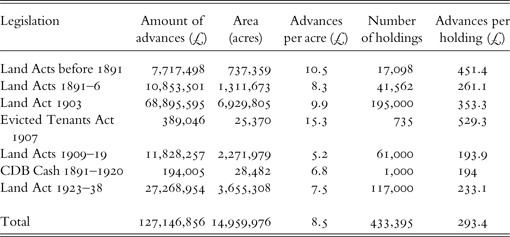
A number of Acts were passed between 1869 and 1934 which enabled tenants to purchase their holdings in Ireland.Footnote 11 In total, as shown in Table 1, these Acts led to advances worth over £127 million to purchase almost 15 million acres on 433,395 holdings in the South and North of Ireland.Footnote 12 However, the amounts advanced varied over the different schemes, and the advances per acre and per holding generally declined over the schemes. By far the largest scheme related to the Land Act of 1903, with over twice as much advanced as the next largest scheme. More generally, pre-partition Land Acts accounted for 77 per cent of the funds advanced on land purchases in Ireland. Of the pre-1920 Acts, the 1903 Act was the most significant with 74 per cent of total funds advanced.
Land purchase schemes 1869–1923: advances, acreage and holdings

Note: Excludes all vendor bonuses, advances made under the Labourers (Ireland) Acts, 1906–14, and the Irish Church Act, 1869. Also excludes land improvement investments made by the Land Commission and CDB.
Source: Commission of Inquiry into Banking, Currency and Credit 1938 and authors' calculations.
From 1881 onwards the state land purchase schemes were overseen by the Land Commission.Footnote 13 Initially all land purchase arrangements were negotiated freely between landlords and tenants, with state bodies providing the funds to prospective tenant purchasers. However, the 1903 Land Act introduced an element of compulsion by giving the state the power to force tenants to purchase land.Footnote 14 Subsequent legislation introduced in 1907 compulsory purchase powers for the agencies of state-funded land purchase whereby they had powers to compel landlords to sell their land: this was done for the explicit purpose of transferring land ownership. The introduction of compulsory purchase of land under the Labourers Act and the Evicted Tenants Act was extended to wider land purchase policy in 1909 by the Land Law Act (Kolbert and O’Brien Reference Kolbert and O'Brien1975).Footnote 15
For tenants, the obligations of the schemes varied considerably and are discussed in detail below. Figure 1 is a schema of how land purchase schemes functioned. First, a state body, the Land Commission, acted as an intermediary between tenant farmers and landlords. It sanctioned loans to tenants and paid vendors in either cash or bonds. If cash was paid, the Treasury/Commission for the Reduction of the National Debt issued bonds and raised money from their sale on the stock market. Likewise, if vendors received payment in bonds, they could either keep the bonds and receive dividends or sell them on the market. In general, tenant farmers repaid their loans with regular mortgage payment ‘annuities’ comprising interest and principal repayments to the administrative body responsible for collection (Land Commission).Footnote 16 These annuities were collected into a sinking fund that was used to pay dividends twice yearly and retire some of the outstanding bonds at the discretion of the government.Footnote 17 In the event of a default, a guarantee mechanism was activated whereby annuity payments were made by the guarantee fund, essentially local taxation, and this was intended to cover both interest and annuity cost.
Obligations and liabilities associated with land bonds
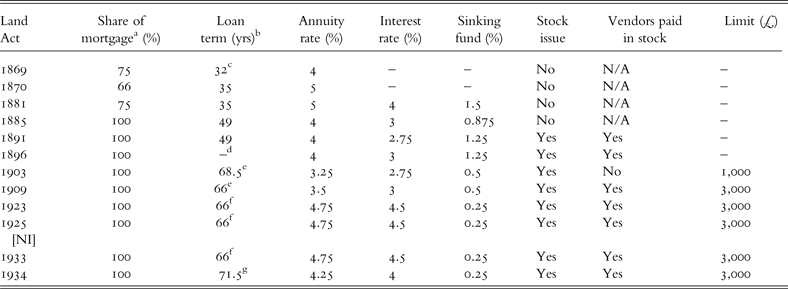
Table 2 summarizes the specific tenant obligations associated with each Land Act. Over the period 1870 to 1909, the state gradually increased the portion of the mortgage it was willing to lend from 66 to 100 per cent. Initially, under the 1869 to 1881 Acts, the state did not finance the entire purchase price, and it was the tenant's responsibility to raise the residual capital. However, the evidence suggests that only the wealthier tenants were able to take advantage of this facility. From 1885 onwards, government support of land purchase was more prominent, reflected by the increase in the percentage of the mortgage which the state advanced to tenants. Government bodies from 1885 onwards were issuing loans worth 100 per cent of the purchase price of a given holding. This is significant as it no longer excluded tenants who had insufficient capital, and the state became the primary mortgagee on the land.Footnote 18
Initial land purchase contracts for tenants, 1869–1933
a Refers to the percentage of the agreed purchase price which the state would advance under the Act.
b Loan terms (annuity repayment) estimated by contemporaries based on the expected performance of sinking funds.
c 64 half-yearly repayments.
d The 1896 Land Act introduced the concept of decadal reductions on the repayment of annuities.
e Estimated by BPP (1908b) as the time it takes a sinking fund to reach £100 stock.
f Estimated following the methodology outlined by BPP (1908b) as the time it takes a 5 shilling (£0.25) sinking fund, accumulating at rate of 4.50 per cent, to reach £100 stock.
g Estimated following the methodology outlined by BPP (1908b) as the time it takes a 5 shilling (£0.25) sinking fund, accumulating at rate of 4.00 per cent, to reach £100 stock.
Source: Various Land Acts, Irish Land Purchase Finance Report 1908 and authors' calculations.
The higher coverage of the purchase price by the state was coupled with longer loan terms. Initial mortgage loan terms were roughly half those under later Land Acts. The Land Acts from 1903 onwards did not specify a definite term for a loan but instead stated that ‘the purchase annuity shall be paid until the whole of the advance, in respect of which it is payable, is ascertained in manner prescribed by the Treasury to have been repaid’.Footnote 19 In the case of the Free State Acts the Minister for Finance decided ‘the manner and the times’ at which the loan would amortise. In all cases the amortisation of loans was based upon the performance of the sinking fund. The 1903 and 1909 Land Acts issued loans with terms of 68.5 and 66 years. Indeed, it is very likely that the loan term would have been greater than the borrower's life expectancy. Thus, the average tenant purchaser with a mortgage term of 66 or 68.5 years would have bequeathed both the land (farm) and the loan to the next generation.Footnote 20 The loans’ long duration allowed purchasers to amortise the significant principal (see below) through the return to land.
Crucially, the terms were also attractive to vendors (landlords). Loans were set in terms of the number of ‘years purchase’,Footnote 21 essentially the capitalised value of rents.Footnote 22 Under the 1903 Land Act this averaged 22.52 years (BPP 1921b). Thus, on average, landlords received lump sums totalling 22.5 years of rental income whilst farmers paid this sum over 68.5 years. Further incentives for landlords to sell came initially in the form of high bond prices in the late 1890s (see Appendix B) and, when bond prices fell, a £12 million ‘bonus’ distributed amongst all vendors was included in the 1903 Act. In addition, landlords could also avail themselves of the concessional loans on offer. A crucial factor from the vendors’ (landlords’) perspective was that their income had already been cut by rental reductions, thus making landlords more amenable to sell their land. With landlords willing to sell, the only willing purchasers were the existing tenants (Hooker Reference Hooker1938, pp. 50, 67).
As the intermediary between the tenant purchasers and financial markets, the government used its reputation to borrow capital on behalf of the tenant purchasers on favourable terms. The government could offer competitive rates to borrowers and still earn a spread on the cost of capital (the difference between columns 4 and 5 in Table 2). Between 1869 and 1896 land purchase annuities were around 4.5 per cent, competitive with the best available market rates. Some evidence on private mortgages in the early twentieth century suggests that rates charged for mortgages were between 4 and 10 per cent (BPP 1914, paragraph 823). Moreover, the differential between the rates paid and prevailing long-term interest rates decreased under the various Acts. As long-term interest rates increased during the war, the relatively low interest rates paid by those purchasing under the 1903 and 1909 Acts became even more attractive because their fixed rates were well-below market rates.
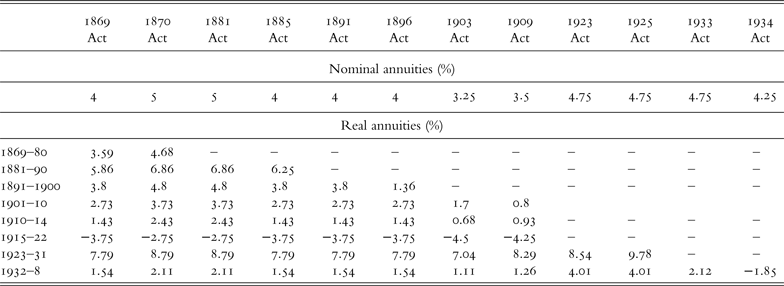
The loan contracts made no allowance for future price movements. However, as the land purchase contracts were designed, inflation was a boon to farmers whereas prolonged deflation was not. Moreover, the long loan terms created the possibility of embedded risk, as annuities were set without regard to future price trends, which could be risky to the scheme if it adversely affected farmers. Importantly, from the perspective of the governments presiding over the 1903/1909 Acts, these policies had an immediate benefit even if they may have led to future political difficulties. Table 3 attempts to address this by calculating decade average real annuities. Agricultural prices in Ireland were strongly influenced by international market conditions and this is reflected in the real annuity rates. A further difficulty, from the farmers' perspective, turned out to be the adherence to the gold standard during the era of deflation from 1870 to 1896. The abandonment of the gold standard during World War I coupled with increased demand led to greater inflation which significantly reduced annuity commitments. However, post-war deflation, worsened by Britain's resumption of gold at parity in 1925, exacerbated rural problems and real annuities were relatively high during the period 1923–31. The final row in Table 3 reflects the halving of the annuity payment in 1932, discussed below, rather than the slight increase in average prices over the same period.
Real and nominal annuities, decade averages
Note: post 1933 included halved annuities.
Sources: Table 2; Kennedy and Solar (Reference Kennedy and Solar2007); Nunan (Reference Nunan1987).
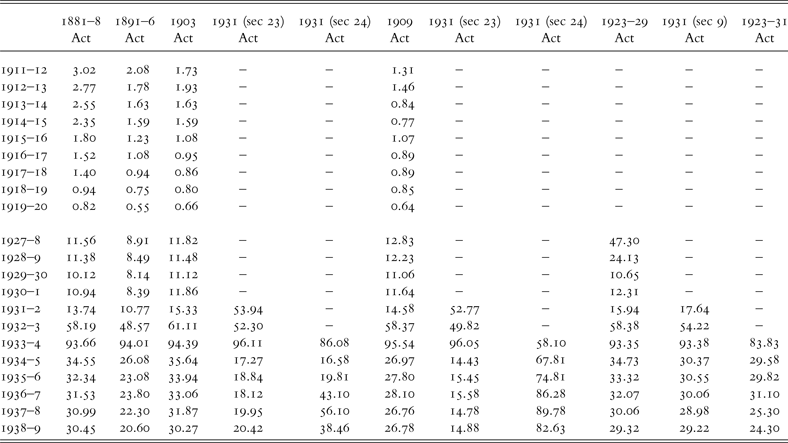
The 1903 Land Act stated that ‘every advance shall be repaid’ and repayment was supposed to be in accordance with the terms outlined in Table 2.Footnote 23 Published from 1911 onwards, Land Commission reports contain annual information on repayments and arrears of loans (see Table 4). For the nine years from 1911–12 to 1919–20, arrears were quite low. This is perhaps surprising, given the nationalist agitation in rural areas, but it lends support to the view that the 1910s were a boom time for Irish farmers due to high prices during World War I. Comparable information for the 1920s is available for a ten-year period from 1928–9 through to 1938–9. Arrears increased significantly, albeit from a very low base, averaging 11 per cent for the pre-independence Acts. However, tenant purchasers in the Irish Free State did not have to fully meet their debt obligations, as the terms of repayment were ‘fundamentally altered’ as a consequence of two events (IPP 1934). First, in 1932, Fianna Fáil carried out its electoral pledge to withhold annuity payments from the British government. Second, the 1933 Land Act permanently reduced all annuity payments by 50 per cent and cleared arrears of defaulting purchasers on the grounds that tenant purchasers were overburdened by their debt.Footnote 24 Despite the halving of annuities, arrears continued to be relatively higher in the 1930s than they had been previously, perhaps a reflection of the Anglo-Irish ‘economic war’ whereby the British government imposed tariffs on Irish produce, primarily livestock, in retaliation for the default on the annuity repayments.
Arrears as a share of instalments due (%)
Notes: 1912–12 to 1919–20 are figures for the island of Ireland, 1927–8 to 1938–9 are figures for the Irish Free State.
Sources: Land Commission reports (Irish Free State), 1910–20 and 1927–8 to 1938–9.
The economic effect of cutting annuity payments was to transfer the loan repayment from Irish landowners to the UK taxpayer. The evidence above suggests that the ex-post burden on Irish landowners from repaying the loans derived from the price at which the land was transacted. But this does not mean that the land was over-priced relative to the expected present discounted value of the returns at the time the land was purchased. It is possible that misperceptions of future returns contributed to an ex-post over-pricing of land during the reform. But, without better data on rental rates and the expectations of purchasers about the returns to agricultural productivity, it is not clear whether the land was over-priced contemporaneously.
Without state intervention there would have been no alternative means to purchase land on such a scale for the majority of borrowers. The lending models of contemporary financial institutions, namely Loan Fund Societies, Joint Stock Banks (JSBs) and Raiffeisen (agricultural credit) societies, were based on personal security, with only limited terms available to tenant farmers due to the illiquidity of landed security and the risk of death.Footnote 25 Private individuals who typically used solicitors as intermediaries did offer mortgages, but their availability was not widespread (BPP 1914, paragraph 883). Moreover, evidence from the 1914 report on agricultural credit suggests that only the wealthier farms had access to such mortgages. Curtis (Reference Curtis1980) acknowledges that landlords with large and wealthy estates could easily obtain lines of credit secured by land in the period before 1877, as land was deemed to have been the ‘soundest possible investments’.Footnote 26
As the majority of farms in Ireland were very small, they would not have been able to access private mortgage funding to purchase land. And if they were able to access private funding, the terms would not have been as generous as those of the state.Footnote 27 The 1914 report on agricultural credit compared the situation in Ireland with that on the Continent where mortgaging of smallholdings was more prevalent (BPP 1914, pp. 334–8). Moreover, cooperative building societies were not found in provincial towns in Ireland, although some building societies, most notably the Irish Civil Service Building Society, made loans throughout the island (McLaughlin Reference McLaughlin2013). Furthermore, savings banks did not issue loans and cooperative banks did not make long-term mortgages as they did on the Continent (Colvin and McLaughlin Reference Colvin and McLaughlin2014; McLaughlin Reference McLaughlin2014).
JSBs in Ireland were reluctant to make long-term loans on mortgage security. This was due to a number of complications, including the risk associated with long-term lending, illiquidity of landed assets, and the cost of determining property rights.Footnote 28 Illiquidity of loans backed by land was common at the time, since there was no ability to securitise such loans. This was a challenge to risk management, given the banks’ liability structure and the absence of a central bank with lender of last resort powers.Footnote 29 There was also the problem of sale of land in the event of default, and in Ireland this was a significant deterrent to the entry of the JSBs in the mortgage market. This became obvious in the 1926 banking commission as evidence was shown that the sale of foreclosed land was difficult due to social pressure on buyers (IPP 1926–7, pp. 21–2). Therefore, mortgage assets were practically worthless if a borrower defaulted on loan repayments.
State entry into the mortgage market was a novel approach to solving the lack of credit available to would-be tenant purchasers. Also, the fact that the state offered 100 per cent loan to value made the schemes accessible to all borrowers regardless of credit status.Footnote 30 State mortgage loans seem to have been based on a policy of social entitlement, disregarding the commercial considerations that caused private lenders to hesitate. Figure 2 illustrates the effectiveness of government intervention in the land market. In 1906 only a small share of farmers were owners of their land, but by 1917 a far larger share of Irish farmers were owner-occupiers. In the absence of private alternatives to the attractive terms and accessibility offered by the land purchase schemes, it is unsurprising that there was keen interest from prospective tenant purchasers. Indeed, it appears that the appetite for the generous terms on offer under 1903 Land Act was underestimated, with the Land Commission understaffed and unable to deal with the demand. Initially there were not enough funds available to purchase holdings, which in turn created a backlog of cases; £5 million was made available per annum but demand exceeded this amount (Cosgrove Reference Cosgrove2008, p. 148).
Landowners as a percentage of landholdings: 1906 and 1917
Nevertheless, despite their apparent appeal, some contemporary opinion seems to have been hesitant about borrowing funds from ‘London’, believing that a central government might not have been as easily influenced as a local landlord (Cosgrove Reference Cosgrove2008, pp. 162–3). However, it transpired that a democratically elected government could be influenced, as borrowers were also voters. Yet the extent of voter power determines the influence voters have on the elected bodies; the extent of influence of the Irish voters to revise their debt obligations and cancel arrears in a UK legislative assembly would not be the same as the case where the Irish electorate had their own assembly, dominated by Olsonian agrarian interest groups (Olson Reference Olson1982). The same cannot be said of landlords who would have been under no direct political pressure, vis-à-vis an electoral mandate, to reduce rents, although individual landlords may have been sympathetic to a tenant's plight and granted some respite. This is also a key distinction between a public and private lender; private lenders would not have any political obligations to alter loan repayments.Footnote 31 Loans could be renegotiated in order to minimise losses, but private lenders would not be as willing as the state to completely absolve debt obligations, especially on a grand scale.
II
Bonds issued under the Irish Land Acts were used specifically to finance land purchase in Ireland. They were distinct from other types of UK government debt, allowing scholars an insight into UK Treasury rationale regarding Ireland, the decision of landlords to sell, and also offer a perspective on the motives of traders and holders of these bonds.
The Irish land bonds distinct from Consols. For example, when the ‘Guaranteed £2:15s % stock’ was issued, the prospectus (3 January 1905) highlighted that the stock was ‘to be created under the Irish Land Act, 1903, 3 Edw VII, Ch. 37’.Footnote 32 Also clear from the prospectus was how these bonds were guaranteed: it was stated that the dividends were payable from the Irish Land Purchase Fund and, if that stream of income was insufficient, it would be paid out of the ‘Consolidated Fund of the United Kingdom’.
The fact that these bonds were so clearly identifiable with Ireland affected their performance. For example, a letter to the Postmaster General, written in 1904, suggested that although ‘it [Irish Land Stock] pays better than most of the Government securities. I am told by a Stock Broker that having the words ‘Irish Land’ causes a prejudice against it which must be strengthened by its being boycotted in the Postal Guide [1891 Land stock was not listed as an investment in the postal guide].’Footnote 33 A later broker also noted that ‘there always was a good deal of uncertainty in the mind of the public, and even on the Stock Exchange, as to the real value of the Irish land stocks, and no doubt the uncertainty is even greater in the case of Northern Ireland’.Footnote 34 The stock was even referred to derogatorily as ‘Bog Stock’ in Parliament.Footnote 35 By contrast, in evidence to the Free State banking commission in 1935, G. L. Kennedy, president of the Dublin Stock Exchange, stated that ‘the British Government guarantee of Land Bonds is always a big attraction’ (IPP 1938, evidence Q. 2995).
The following section discusses the technicalities of these bonds and introduce a new database of land bond prices derived from the Dublin Stock Exchange.
From 1891 to 1909, state purchases under the Land Acts were financed by the issue of government-guaranteed land bonds and were not financed out of UK Exchequer funds.Footnote 36 While the idea for transferring ownership, or creating leases-in-perpetuity, dates from Mill's (Reference Mill1848) discussion of the ‘means of abolishing Cottier tenancy’,Footnote 37 the practicalities of following this policy recommendation appeared later. John Edward Vernon, a governor of the Bank of Ireland, was one of the first people to suggest that the government raise money for land purchase through the issue of government-backed bonds. Vernon viewed the fact that there was a large amount of money held on deposit in the JSBs as evidence ‘that there is an element of wealth there which might be tapped and applied to the purposes of the Land Commission’. When Vernon was asked what he considered ‘the effect of bonds of that kind would be upon the general state of Ireland, if held by the people of that country?’ he suggested that it ‘would be very favourable to the stability of the government, and the peace and order of the country’. Vernon also suggested that the issuance of land bonds would restore order to the countryside as the bonds would ‘connect them with the primary security on which they would be charged, viz. the land itself, that is, the land sold to the occupiers’ (BPP 1882, Q. 4191–215).
The issue of guaranteed land bonds enabled funds to be raised to finance land purchase. The initial land bonds were issued with a coupon rate of 2¾ per cent,Footnote 38 increased to 3 per cent under the 1909 ActFootnote 39 and further increased to 4½ per cent under Land Acts in the Irish Free State and Northern Ireland in the 1920s and to 4 per cent under the 1934 Land Act in the Free State.Footnote 40 Under the 1891 and 1896 Acts, vendors (landlords) were paid only in government-guaranteed land stock.Footnote 41 Landlords could then sell these bonds in the market or retain the bonds and receive the bi-annual dividend on the stock,Footnote 42 whereas later Acts paid in cash and/or bonds.
The use of British credit to finance land reform in Ireland was not without reservations. The UK Treasury was reluctant to sanction the bond issues under the Irish Land Acts as they were extremely risky and because these terms, as set out in Table 2, ‘would never be dreamt of in dealings with any other loan body than the state’ (Gailey Reference Gailey1987, p. 84). Furthermore, the bonds issued to finance the 1903 Land Act came shortly after the floatation of the Transvaal loan following the Boer War and although the Treasury agreed to the principle of the 1903 Land Act they ‘did not wish to “scare” the City with the prospect of further borrowing by the state’ (Gailey Reference Gailey1987, p. 191, n. 191). The Treasury though was willing to underwrite the proposals because ‘if there is a really reasonable hope of peace, it will be worth some payment’ (Gailey Reference Gailey1987, pp. 191–2). However, the Treasury was later worried that the increased borrowing for the purposes of Irish land reform might in fact ‘undermine the credibility of the government in the City’ (Gailey Reference Gailey1987, p. 206).
This structure of financing land purchase by the issue of government-backed bonds was not self-sustaining in terms of tenant loan repayments alone. Consols traded below par after 1900, and each subsequent issue of land bonds was sold at a discount; the prospectus of the 1903 land bonds issued in 1905 stated that the minimum sale price was ‘£88:10s’.Footnote 43 Evidence from the Runciman report in 1908 suggests that there was a significant divergence between the prices of Consols and guaranteed land stock (BPP 1908b). This seems to have been caused by the amount of land stock issued between 1903 and 1908, and the fact that there were no new Consol issues after 1902 (BPP 1908c, p. 11). This meant that there was a shortfall in the finances which the Runciman report estimated would be around £20 million over the 68.5 years of the 1903 Act, on the assumption that the market prices were constant (BPP 1908c, p. 7). However, deficiencies in stock issues were to be met from the Irish development grant, probate duty grants and agricultural grants administered under the 1898 Local Government Act.Footnote 44 The fact that the programme was financially unsustainable effectively meant that the purchasers of land under the government land purchase schemes actually received their farms under concessional terms of state subsidy.
However, the lack of inherent sustainability in the programme should not have been a major concern for investors, since the nominal value of the land bonds was a small fraction of the British economy. Based on records from our dataset (discussed below), Figure 3 shows that the outstanding nominal value of British government guaranteed land bonds never rose above 4 per cent of UK GDP. By contrast, Figure 4 shows that at the time that Ireland gained independence, land bonds were worth about 40 per cent of estimated Irish GDP.Footnote 45 Moreover, the newly formed state continued to issue land bonds, with the outstanding nominal amount peaking almost 60 per cent of GDP in the early 1930s, a considerable burden for any developing economy.
Nominal value of land bonds as a share of GDP
Nominal value of all land bonds as a share of estimated Irish GDP
From the perspective of the government – UK and subsequently Irish Free State – the benefits of the land reform programmes were perceived to have been primarily political stability as they took place against the backdrop of ‘land war’ and revolution (Anglo-Irish war and subsequent civil war). The 1891–1909 Land Acts were seen as quelling rural agitation; in the case of the Free State the 1923 Land Act was seen as a way to restore order to the Irish countryside. In both instances, the state intervened out of necessity.
The source for our data is the daily records of the Dublin Stock Exchange.Footnote 46 We collected data from 1890 through to 1938, covering the first issuance of bonds under the 1891 Land Act through to the Anglo-Irish trade agreement. In particular, we obtained records of daily closing prices and amounts outstanding for all government-guaranteed debt traded on the Dublin Stock Exchange.Footnote 47 The exchange was open Monday–Friday (and Saturday in some years) excluding public holidays such as Easter and Christmas. The stock exchange was closed from August to December 1914, due to the war, and also briefly due to a financial crisis in 1931 (Thomas Reference Thomas1986, p. 68).Footnote 48
Although London was the pre-eminent financial trading centre of the time, we use Dublin Stock Exchange data because not all land bonds were traded in London (Thomas Reference Thomas1986, p. 170). That said, stock markets in London and Dublin were closely integrated during our period of study. The installation of a direct telegraph connection between Dublin and London in 1850 ensured information lagged at most one day, and the telephone was introduced in 1897.Footnote 49 Therefore, closing prices in Dublin should be reasonably close to those in London throughout our data.Footnote 50
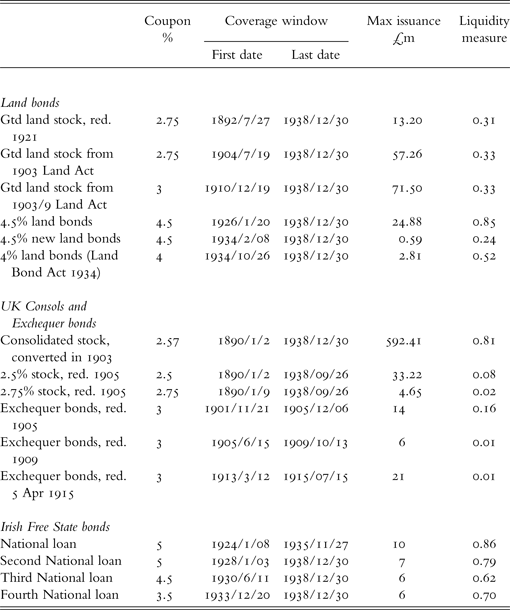
Table 5 lists the securities recorded in our database by order of issuance date. In all, there are six land bonds, six bonds that we term ‘benchmark’ UK sovereign debt and four Irish Free State bonds. The second column in the table reports the coupon associated with each issue, using the ‘average’ coupon for the consolidated stock converted in 1903 from 2.75 per cent to 2.5 per cent.Footnote 51 The first four land bonds, including bonds issued by the Free State in the 1920s, carried British government guarantees, while the last two were issued under the Land Bond Acts of 1933 and 1934 without such a guarantee (BPP 1924, 1924–5a, 1924–5b, 1929–30, 1930–1).Footnote 52 In addition, the land bonds issued under the 1933 and 1934 Acts were the first not to be expressed in sterling but were instead expressed in Free State currency (IPP 1938, paragraph 40, p. 14).Footnote 53
Dublin Stock Exchange: sovereign debt
Source: authors’ calculation.
The third and fourth columns in Table 5 report the time window in our database over which the bonds were priced on the Dublin Stock Exchange. The six land bonds remain in the daily record book until the end of 1938, implying coverage of the entire period. Similarly, the large issue of consolidated stock, the 2½ per cent stock, the 2¾ per cent stock and the four Irish Free State bonds cover most of our sample period, making the prices of these bonds useful as benchmark comparators for land bond price movements. The fifth column of the table reports the maximum recorded amount outstanding for each bond, illustrating the large size of the consolidated stock relative to all other bonds traded on the Dublin Stock Exchange. This column also shows how large the inherited burden of land bonds was relative to the size of new issuance for the Irish Free State.
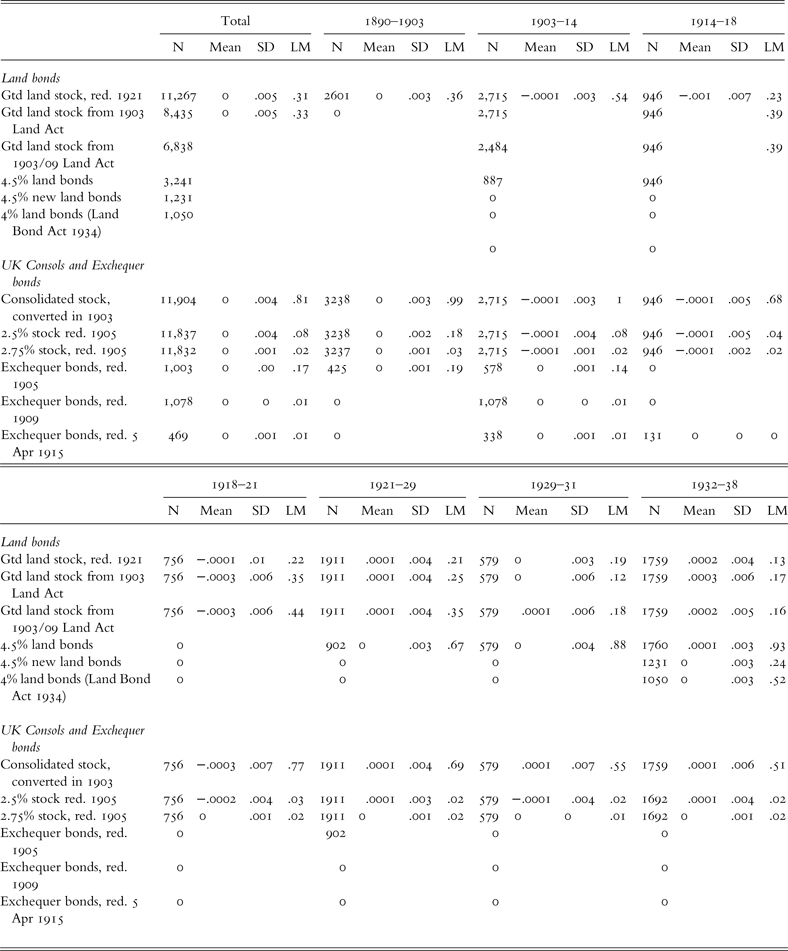
Unfortunately, neither bond trade volumes nor bid-ask spreads are reported in the stock market records. However, since we have relatively high-frequency data, we can create a proxy liquidity measure, reported in the sixth column of the table, by calculating the fraction of days on which trading occurred when the bond was priced in the market. Although this proxy may be computed over subsamples (see Table 6) it cannot be used to infer anything about the liquidity of an issue at a point in time. According to this proxy, land bond liquidity on the Dublin Stock Exchange compared favourably with the majority of Exchequer bonds. In particular, the liquidity of the final British-guaranteed land bond appears on a par with that of the consolidated stock, consistent with the assessment of Thomas (Reference Thomas1986, p. 170) that the sterling guarantee combined with quotation on the London Stock Exchange made this bond ‘always a big attraction’ in the interwar period. As Consols are the longest living and have the largest amount outstanding in our data, it is not surprising that they are found to be highly liquid in our dataset. By contrast, the 2½ per cent and 2¾ per cent stocks are quite illiquid, even relative to the land bonds.
Bond returns: summary statistics
Note: N is the number of observations, SD is the standard deviation and LM is the liquidity measure.
Source: authors’ calculations.
Figures 5 and 6 show on the same scale from 1890 until 1938 (i) the prices of land bonds and (ii) UK Consols and Exchequer bonds listed in Table 5. For clarification, these bond prices are shown on separate figures but aligned so that their general evolution can be compared.
Land bonds: last prices
Consols and Exchequer bonds: last prices
The broad movements in the prices of land bonds and UK Consols and Exchequer bonds are similar and are consistent with the major events of the time (Homer and Sylla Reference Homer and Sylla2005, pp. 438–50). Both series steadily decline from the middle of the final decade of the nineteenth century until the early 1920s, partly in response to the war, but mostly due to developments in fiscal and social policy. Prices remained low throughout the 1920s as the government strove to restore sterling's reputation as a strong currency. The sharp upward movement late in 1931 is also well known and attributable to the UK government's decision to abandon the gold standard and the conversion of the massive war loan in 1932 (Homer and Sylla Reference Homer and Sylla2005, p. 451).
Although the broad movements in the price series are similar, some of the more detailed activity in land bond prices is different from that of UK Consols and Exchequer bonds. First, there is more volatility in the land bond prices than in Consols and Exchequer bonds around the time of Irish partition and civil war (1921–3). Second, the movement in land bond prices appears more muted, in particular the large issues of 1903/9 land bonds and the 4.5 per cent land bonds. And, thirdly, while land bonds were at times viewed as unpopular, their prices towards the end of our data suggest that they had become more attractive even than Consols, despite the risk that the bonds might have been called for redemption (Thomas Reference Thomas1986, p. 170). To study this issue carefully, we need to account for individual bond characteristics, such as offered rate and duration, as well as market liquidity and volatility.
Summary statistics of bond returns, presented in Table 6, over the entire period and different subsamples help to clarify these observations.Footnote 54 For each bond, in addition to the number of observations and the average returns in each subsample, we report the standard deviation of returns as a measure of volatility during each period and our liquidity measure (the fraction of days on which trading took place). Average returns are consistently near-zero across bonds and subsamples, as is common in studies of daily returns (Brown and Warner Reference Brown and Warner1985).
During the early subsamples, Consols are by far the most liquid bond and the Exchequer bonds are traded only modestly. Land bonds were traded more frequently than Exchequer bonds and remained relatively liquid during World War I. Moreover, while the liquidity of Consols declined significantly after 1920, some land bonds were traded more frequently towards the end of the period. The analysis by sub-period confirms the overall finding that the 4.5 per cent land bonds were particularly popular during the interwar period. However, there was a decline in liquidity for the other three British government-guaranteed land bonds. This may in part reflect a migration of trading into markets that listed a full set of British securities and were more connected to London traders.Footnote 55
Although land bond returns and UK Consols and Exchequer bond returns display similar volatility over the entire sample, there is considerable variation across subsamples from World War I onwards. To explore this variation further, Figure 7 shows the standard deviation of the weighted average of these returns computed using a rolling window of three years (750 days) around each date on the horizontal axis.Footnote 56
Weighted average bond returns: volatility
According to Figure 7, land bonds and British government bonds experienced similar broad movements in return volatility throughout the sample. However, around the time of the outbreak of World War I, British government bonds became more volatile than land bonds. After appearing to converge during the early 1920s, the two series again diverged during the Great Depression and land bonds remained less volatile than British government bonds for the remainder the period. In addition, the volatility of land bonds remains elevated during the Irish war of independence while the volatility of British government bonds declines. These facts suggest that land bonds were reacting to Irish specific events, perhaps including developments in the value of collateral (Irish land) and the turbulent political events surrounding independence.
III
Verdier (Reference Verdier2000, p. 300), in his study of the rise and fall of state banking in OECD countries, finds that the supply of state banking, or the willingness of states to enter the market, is the result of ‘class politics’. The demand for state banking, he argues, came from groups that were displaced by international competition and felt they needed access to credit (Verdier Reference Verdier2000, p. 294). Verdier acknowledges the existence of state interference in savings markets and argues that there is a need to distinguish between deposit and credit banks because state savings banks, such as the UK Post Office Savings Bank, were established ‘to provide central treasuries with access to individual deposits and which are cheaper than bonds’. Instead, Verdier's definition of state banking is credit-focused, namely ‘banks that are specialized and were founded to meet a strongly felt need for credit by a category of borrowers whose relative borrowing power from the capital market was below their political power’. Verdier (Reference Verdier2000, p. 285) argues that UK savings banks did not constitute state banking as he defines it, namely the ‘allocation of credit by the central government through so-called state banks, which finance their needs by issuing state-guaranteed bonds’.
An important consideration for determining whether state banking took place in Ireland is where exactly the land bonds were held and by whom. Over the period 1860–1917, government securities held in Ireland remained relatively constant at approximately £40 million in 1860 and 1913, although there is some variation between these endpoints as the amount held decreased to a low of £24 million in June 1897.Footnote 57 Also, over this period government securities held in Ireland averaged 110 per cent of deposits held by Irish JSBs. Furthermore, as shown in Figure 8, land bonds made up a sizeable share of government debt held in Ireland, and by December 1913, 47 per cent of government debt held in Ireland was comprised of land bonds. Moreover, the land bonds held in Ireland in 1913 were 62.76 per cent of the market capitalisation of the equities traded on the Dublin stock exchange.Footnote 58 Almost the entire 1891/6 land bond issues were held in Ireland, but a smaller share of the 1903 and 1909 bond issues were held there. However, by 1913, 20 per cent of outstanding land bonds were held in Ireland, the remainder were held in Britain. Evidence from Bank of Ireland returns of the holders of government stock in the Irish Free State shows that the Irish held share was about 5 per cent in the 1920s and 1930s,Footnote 59 with an additional 3–4 per cent held in Northern Ireland.
Outstanding land bonds held in Ireland
Offer argues that the British government found it difficult to float land bonds and that savings banks and later national insurance funds were the main purchasers of land bonds. UK savings banks, unlike savings banks in Europe or the US, did not lend for commercial purposes but instead acted like money market mutual funds and invested in government securities (McLaughlin Reference McLaughlin2014). The responsibility for the investments was in the hands of the Chancellor of the Exchequer and the National Debt Commissioners. Offer (Reference Offer1983, pp. 133–4) states that in the Edwardian period government borrowing was ‘kept in reserve for a naval or political emergency’ with the notable exception of Irish land reform. There is strong evidence to suggest that these bonds were purchased by other state financial institutions, namely the Post Office Savings Bank and Trustee Savings Bank, as outlined in Figure 9.Footnote 60 Later records show that the POSB held a considerable share of land bonds in the 1920s and 1930s, with its holdings ranging from 44 to 50 per cent of outstanding land bonds.Footnote 61 Yet, not only were land bonds held by POSB a large share of total issues, but land bonds were also a growing share of POSB assets as indicated in Figure 10.
Outstanding land bonds held by institutional investors
Land bond share of POSB assets, 1898–1916 (%)
Given that Verdier describes state banking as the issue of state bonds, it is quite clear that state banking did take place in the UK (especially Ireland) because, as illustrated heretofore, UK land purchase schemes in Ireland were financed by the issue of guaranteed bonds and were managed by a state agency: the Land Commission. In addition, UK Savings Bank Funds were used to purchase land bonds because, as highlighted by the savings bank committee in 1858 (BPP 1857–8), government securities purchased by savings banks were not always Consols. The situation was clarified by the 1893 Savings Bank Act, when government stock was defined and importantly included ‘Guaranteed Land Stock’, and it is this guaranteed land stock that is central to this study.Footnote 62
Thus, from the discussion above, it is clear that Ireland was indeed a recipient of state banking but was this due to the ‘class politics’ motivation that Verdier suggested? State land purchase policies were direct responses to social agitation in the 1870s and 1880s that were pursued along class lines. Bad harvests in the late 1870s that coincided with the ‘grain invasion’, an increase in grain exports from granaries in the New World, and rising competition in traditional Irish export markets (Solow Reference Solow1971; Koning Reference Koning1994; O'Rourke 1997), effectively meant that Irish agricultural producers experienced a sustained reduction in farming income. Although it did not address the root causes of these problems, an umbrella coalition of interest groups called the Land League campaigned for rent reductions and promoted social agitation against landlords.Footnote 63 The Land League was attractive to those who viewed the payment of rent as the immediate cause of their problems as it promised a reduction in rents and aimed to achieve owner-occupancy of farms (Comerford Reference Comerford1985, p. 247).
Government reaction to Land League agitation was primarily to introduce new land law legislation.Footnote 64 The 1881 Land Act was essentially a rent control Act, with judicially determined lower rents and a Land Commission established by the Act to mediate in landlord–tenant contractual disputes. The aim of the Act was to grant the tenants a ‘fair rent’, but the policy seems to have been to reduce rents regardless of their level.Footnote 65
One of the most significant aspects of the 1881 Act was that it brought land purchase schemes to greater prominence than previously. The legislation made facilities available for tenants to buy land from landlords. However, land purchase schemes failed to attract much support in their initial phases, probably due to a view that judicial rent reductions may have been less costly to implement than expanded land purchase schemes. Future land purchases saw tenants purchase their holdings with the purchase price set in terms of judicially reduced rents.
As illustrated in Table 2, subsequent legislation was specifically designed to encourage greater transfer of ownership from landlords to their tenants. Most notably, the institution created under the 1881 Land Act to mediate rent disputes, the Land Commission, was transformed into an institution that supervised the sale of land.Footnote 66
Koning (Reference Koning1994, p. 32) argues that there were five possible options for agrarian groups (landlords and farmers) to respond to the deteriorated agricultural environment of the late nineteenth century: (i) curb the rise of farm wages; (ii) prevent the fall of domestic prices by introducing tariffs; (iii) shift into new export outlets where competitive advantages still remained; (iv) if tenants, shift the burden onto the owners of land by demanding rent reductions; and (v) if land owners, sell land to tenants at high prices despite the falling profitability of agriculture.
Tenant farmers in Ireland initially choose to pursue (iv) but, as has been shown heretofore, (v) became the option of choice at the behest of the government. At no point were options (i) to (iii) pursued.
IV
This article analyses a land reform programme that successful reached its policy goal of land ownership transfers. Irish land reform witnessed the widespread transfer of land ownership from landlords to sitting tenants and the land transfer programme was enabled by large-scale financial investment underwritten by the British government. Without the creation of a source of credit that enabled most sitting tenants to purchase land at ‘market’ prices from incumbent landlords the scheme would not have been as successful.
A key finding of this article is the importance of state banking in implementing land reform in Ireland. Without the issue of land bonds and the simultaneous purchase of these securities by the UK savings bank funds, land reform would have ground to a halt. This is an interesting facet of land reform policy in Ireland that could be extended to other countries wishing to undertake land reform. A key stumbling block in this regard is noted by Riedinger (Reference Riedinger1995) in the case of the Philippines in the 1990s, namely that the World Bank's Articles of Association do not enable it ‘to finance compensation payments for the transfer of existing assets’ and a general unwillingness by foreign donors to fund land purchases (Riedinger Reference Riedinger1995, pp. 122, 174, 280). In the case of the Philippines, international donors were reluctant to finance the programme because of concerns over the implementation of land reform and the credibility of government support for the programme (Riedinger Reference Riedinger1995, p. 204). This contrasts strongly with the Irish case, primarily because the ‘international donor’ did in fact design and implement the reform programme.
Could land ownership transfers in Ireland have been achieved without the provision of large-scale financial investment by the British state? A possible counterfactual can be observed in contemporary developments in the English land market. As with Ireland, land inequality in England was quite high in the nineteenth century, as evidence from the 1873 census of land ownership attests, and the land question remained a factor in contemporary political debate up until World War I (Sturmey Reference Sturmey1955; Thompson Reference Thompson1957, Reference Thompson1965 and Reference Thompson2007; Lindert Reference Lindert1987; Beckett and Turner Reference Beckett and Turner2007; Cragoe and Readman Reference Cragoe and Readman2010). The close connection between developments in Ireland and England is highlighted by Lindert, who states that ‘the Irish ferment in turn challenged the legitimacy of landed property in England itself’; however, the government-funded land reforms were not witnessed in England. Without direct state assistance in England and Wales, there was a ‘revolution in land ownership’ observable over the period 1890 to 1938, through the transfer of land from established landlord aristocrats to tenants and nouveau riche, most notably in the aftermath of World War I (Thompson Reference Thompson1957, 2007; Beckett and Turner Reference Beckett and Turner2007). Sturmey's account of the rise in owner-farming in England and Wales, shows that the share of owner-occupiers rose from 13 per cent to 36.6 per cent between 1909 and 1927 and that this ‘revolution’ that took place without government support. In fact, many tenants purchased their holdings either from their own savings or bought land on mortgage. The factors contributing to this revolution were similar to those in Ireland, changing market conditions affecting rents and changes in taxation in the 1910s and 1920s (Lindert Reference Lindert1987, p. 37). Therefore in the case of Ireland, could markets have been allowed to take their course or could landlords have been incentivised to sell through taxation schemes? First, as Sturmey (Reference Sturmey1955, p. 246) notes, ‘inducements’ to sell land had increased in England, but at the same time these inducements made it difficult to sell, dovetailing with the decline of the non-economic advantages of landownership and the fear, or anticipation, of hostile land legislation (Thompson Reference Thompson1957, pp. 305–6). Another major difficulty implementing this approach to achieve ownership transfers in Ireland is the market failures in the credit market outlined in Section i. As Sturmey (Reference Sturmey1955, p. 250) indicates, credit difficulties, especially in the early 1910s, acted as a brake on land purchases in England and, as Beckett and Turner (Reference Beckett and Turner2007, p. 279) note, there were calls for state assistance to help tenant farmers purchase their land. The same difficulties would have been evident in Ireland as it is uncertain who other than the state would offer mortgages to tenant farmers to purchase holdings. So perhaps if the land purchase schemes were not implemented in Ireland, there might have been half the number of peasant proprietors as under the land purchase scheme, i.e. 36 per cent instead of 75 per cent. A more in-depth study of counterfactuals may help illuminate the importance, or not, of land purchase schemes.
The study of land reform in Ireland suggests avenues for future research. A greater understanding of land reform in Ireland is desirable. Substantial amounts of capital were invested in Ireland for the purpose of asset redistribution from landlords to tenants. Although cross-national empirical research suggests a link between land inequality and economic growth, there is a stronger link between investment and growth: there are limits to asset redistribution and more benefit could be gained from creating new assets (Deininger and Squire Reference Deininger and Squire1998). It is not possible to address this question here and further work would be desirable in this direction: did land reform lead to increases in economic growth and could the money have been invested in other areas (à la Gerschenkron Reference Gerschenkron1962)? Also, given that asset redistribution resulted in greater landlord liquidity, how were these funds used? Were they consumed, redirected towards industry, such as in Taiwan and Korea, or exported?
Moreover, land reform was a common experience throughout Europe and the rest of the world. Further comparative work would help elucidate common themes and trends. Although the Irish land purchase schemes were not replicated within the United Kingdom, they bear remarkable resemblance to the financial underpinnings of serf emancipation in Russia and further measures of land reform in Russia. As in Ireland, Russian gentry were not expropriated when serfs were emancipated; instead serfs bought land from the gentry.Footnote 67 Contemporaries were aware of these similarities and there are some notable examples, such as Lenin (Reference Lenin1914, 1972) and Ely (Reference Ely1916), but this is an avenue that could be explored further.Footnote 68
Land reform, purchase and ownership are central issues to modern Irish history, yet despite this significance there has been little or no study of the economic or financial implications of the Land Acts in operation. Leading historians have accepted the 1903 Land Act as a ‘solution’ to the ‘land question’ despite the fact that land reform measures continued thereafter. However, debate amongst economic historians as to the short-, medium- and long-run efficiency of land reform is contested (Crotty Reference Crotty1966; Guinnane and Miller Reference Guinnane and Miller1997; Turner Reference Turner1996). Even though the land purchase schemes described in this article were one of the most important tools used to address the land question, the land bonds used to implement the schemes have heretofore been overlooked. The database presented in here is the first systematic effort to collect land bond prices and the data included in the Appendix fill an important lacuna in the understanding of land purchase schemes and also of long-run Irish interest rates. The prices of Irish land bonds presented in this article and in the Appendix are an important source for the greater understanding of developments in Irish history and Irish land reform in the early twentieth century. In particular, price levels of bonds indicate why the 1890 Land Act was initially so successful and why land sales fell as bond prices fell. The study of land bond prices and their relationship with price movements of agricultural commodities, particularly livestock and beef prices, would also be a useful venture. Moreover, while the major movements in these price series are consistent with broader fundamentals, we anticipate that higher-frequency movements offer a measurable interpretation of key developments in the early economic and political history of the Irish Free State.Footnote 69
APPENDIX A: THE 1870 LAND ACT
Precedents for state-funded land purchase were established by significant Acts passed in 1869 and 1870. The Irish Church Act of 1869, primarily an Act which disestablished the Church of Ireland as a state-sponsored church in Ireland, contained clauses enabling tenants on church lands to purchase their holdings with the aid of state-financed mortgages.Footnote 70 The 1870 Land Act also included land purchase clauses, whereby the state would advance money for the purchase of a tenant's holding.Footnote 71 However, neither of these Acts had a high uptake in terms of land purchase, and of the two the 1869 Act saw the greater number of tenant purchases (Lyons Reference Lyons1971, p. 146).
The primary aim of the 1870 Act was to reform the existing law governing landlord–tenant contracts. The 1870 Land Act was influenced by a perception that agricultural investment in Ireland was impeded by an inadequate definition of property rights. The case of the prosperity of farms in the northern counties of Ulster was used as an example of the benefits of reform, as it was believed that Ulster's prosperity was caused by what was known as the ‘Ulster custom’. The Ulster custom consisted of what were known as the ‘three F's’. As Kennedy and Solar (Reference Kennedy, Solar, Kennedy and Ollerenshaw2012, p. 174) note:
These extra-legal rights varied from estate to estate, but often carried the presumption that a sitting tenant could expect renewal of a lease, once it had expired; that rents would be ‘fair’, meaning essentially lower than the competitive or rack-rent; and that on vacating a holding he or she had the right to sell the value of the unexpired lease to the incoming tenant. The last could be valuable, amounting on some farms to ten times or more the annual rent paid to the landlord, suggesting that actual rents were well below the competitive rent level.
There was a common impression that the perceived prosperity of Ulster farming, small tillage farming, was based on the ‘Ulster custom’. Vaughan (Reference Vaughan1994, p. 82) has suggested that perhaps contemporaries were not able to distinguish between a flax boom, caused by market dislocations resulting from the American Civil War (the so-called ‘Cotton Famine’), and the customs prevailing in Ulster. Support for Vaughan's argument comes from the general report of the 1871 census where it was stated that ‘in that province [Ulster], however, throughout almost its entire extent, the cultivation of flax is connected with the one manufacture – that of linen – deserving to be called great’ (BPP 1876, p. 7).
The 1870 Land Act attempted to formalise informal traditional customs in Ulster. One of the main assumptions of the Acts was that the tenancy system in Ireland was an impediment to agricultural investment as tenants were unwilling to invest in agricultural improvements because of a fear that such investment would lead to either rent increases or arbitrary eviction. Solow (Reference Solow1971) and Vaughan (Reference Vaughan1994) have argued that this scenario did not exist, and that tenancies were relatively secure before the 1880s (McLaughlin Reference McLaughlin2009). The evidence on evictions also suggests that there was a low probability of eviction in post-famine Ireland. Thus, suggesting that the 1870 Land Act was misguided at best.
APPENDIX B: ANNUAL LAND BOND PRICES
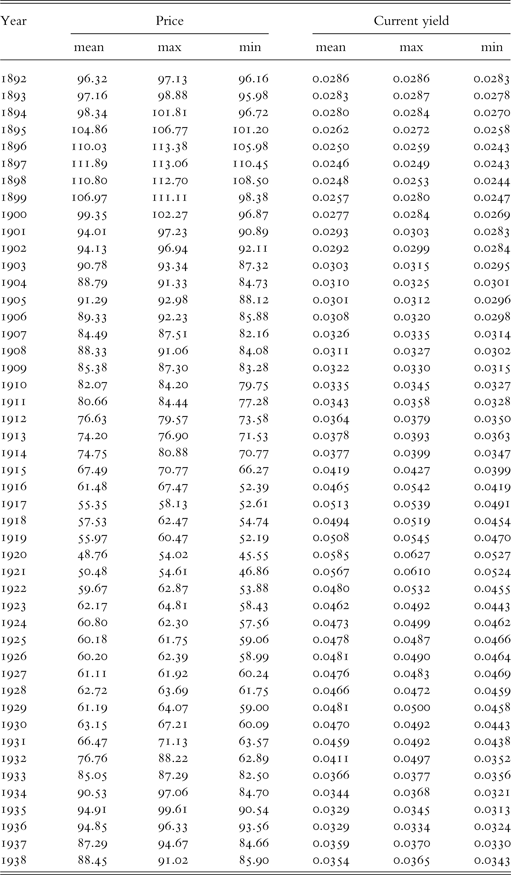
Land bonds: weighted average prices and current yields