





Introduction
Invertebrate populations are declining in many regions worldwide, with evidence implicating interacting drivers including climate warming (e.g. thermal stress), habitat degradation from land-use change and altered microclimatic conditions (Newbold et al. Reference Newbold, Hudson, Hill, Contu, Lysenko, Senior, Börger, Bennett, Choimes, Collen, Day, De Palma, Díaz, Echeverria-Londoño, Edgar, Feldman, Garon, Harrison, Alhusseini, Ingram, Itescu, Kattge, Kemp, Kirkpatrick, Kleyer, Correia, Martin, Meiri, Novosolov, Pan, Phillips, Purves, Robinson, Simpson, Tuck, Weiher, White, Ewers, Mace, Scharlemann and Purvis2015; Oliver et al. Reference Oliver, Roy, Hill, Brereton and Thomas2010; Sánchez-Bayo and Wyckhuys Reference Sánchez-Bayo and Wyckhuys2019; Sunday et al. Reference Sunday, Bates, Kearney, Colwell, Dulvy, Longino and Huey2014). These pressures disproportionately affect small-bodied, moisture-dependent decomposers, whose body temperatures and water balance are governed by fine-scale surface conditions rather than coarse atmospheric averages (Pincebourde and Woods Reference Pincebourde and Woods2020). Fine-scale microhabitats can generate thermal gradients of up to 30–40°C across short distances, with surface temperatures ranging from near freezing to >50–60°C within the same microhabitat (Pincebourde and Woods Reference Pincebourde and Woods2020), making small ectotherms highly sensitive to localised shading, moisture retention and substrate exposure. Heterogeneous landscapes provide a greater range of resources and microclimates that buffer populations against climatic variation and promote more stable dynamics (Oliver et al. Reference Oliver, Roy, Hill, Brereton and Thomas2010). Conversely, loss of microclimatic variation has been associated with insect population declines, including in dung beetles, leading to reduced species richness and community restructuring (Beiroz et al. Reference Beiroz, Slade, Barlow, Silveira, Louzada and Sayer2017; Oliver et al. Reference Oliver, Roy, Hill, Brereton and Thomas2010; Roslin et al. Reference Roslin, Avomaa, Leonard, Luoto and Ovaskainen2009).
Because belowground biodiversity contributes significantly to ecosystem functioning and is strongly structured by microscale soil heterogeneity in moisture, pH, and resource distribution (Bardgett and van der Putten Reference Bardgett and van der Putten2014), reductions in microclimatic buffering may have cascading implications for decomposition and soil processes such as springtails (Collembola), woodlice (Isopoda), enchytraeid worms and other detritivorous beetle larvae, which play critical roles in litter breakdown, nutrient cycling and soil structure. Yet, they are rarely incorporated into conservation priorities and applied design frameworks despite their documented ecological importance (Bardgett and van der Putten Reference Bardgett and van der Putten2014; Cardoso et al. Reference Cardoso, Erwin, Borges and New2011; Cardoso et al. Reference Cardoso, Barton, Birkhofer, Chichorro, Deacon, Fartmann, Fukushima, Gaigher, Habel, Hallmann, Hill, Hochkirch, Kwak, Mammola, Noriega, Orfinger, Pedraza, Pryke, Roque, Settele, Simaika, Stork, Suhling, Vorster, Samways and Borges2020; David Reference David2014; Hopkin Reference Hopkin1992; Warburg Reference Warburg1987; Zimmer Reference Zimmer2002). Artificial habitats such as insect hotels have proliferated as biodiversity-supporting interventions in urban landscapes; however, many are constructed from inert, durable materials such as hardwood, bamboo, brick or concrete, which prioritise structural longevity over material responsiveness (Fortel et al. Reference Fortel, Henry, Guilbaud, Mouret and Vaissière2016; MacIvor and Packer Reference MacIvor and Packer2015). Such structures have, in documented cases, been associated with overheating, rapid desiccation and the accumulation of parasites or mould (Roulston and Goodell Reference Roulston and Goodell2011). These materials may provide relatively limited microclimatic buffering and may be prone to elevated surface temperatures under sun exposure (Roulston and Goodell Reference Roulston and Goodell2011; Terlau et al. Reference Terlau, Brose, Eisenhauer, Amyntas, Boy, Dyer, Gebler, Hof, Liu, Scherber, Schlägel, Schmidt and Hirt2023). Moreover, the widespread use of regularised cylindrical cavities and uniform drilled holes of consistent diameter and depth, can create geometrically standardised nesting spaces with minimal internal variation in pore size, shading or humidity (MacIvor and Packer Reference MacIvor and Packer2015).
Such spatial repetition structurally favours cavity-nesting bees while offering comparatively little microclimatic variation for other invertebrate groups (Fortel et al. Reference Fortel, Henry, Guilbaud, Mouret and Vaissière2016; MacIvor and Packer Reference MacIvor and Packer2015). Although widely adopted, these designs therefore tend to support a relatively narrow subset of taxa, rather than accommodating the broader ecological requirements of soil-surface and litter-associated invertebrates (Potts et al. Reference Potts, Vulliamy, Dafni, Ne’eman, O’Toole, Roberts and Willmer2005). Rather than addressing the heterogeneous needs of these communities (Bardgett and van der Putten Reference Bardgett and van der Putten2014), such structures frequently privilege a limited range of iconic species, reinforcing simplified and taxonomically selective approaches to habitat support.
In response to these limitations, this paper explores an alternative design orientation grounded in sympoiesis (Haraway Reference Haraway2016), multispecies noticing (Tsing Reference Tsing2015) and material ecologies of care (Puig de la Bellacasa Reference Puig de la Bellacasa2017), which foreground interdependence, temporality and non-human agencies in design practice. Rather than proposing a technical solution, the project adopts a Research-through-Design approach in which a biodegradable habitat artefact functions as a field probe for exploring how porosity, material change and microclimatic variation might potentially afford diverse, non-iconic invertebrate life. The project deliberately avoids species-specific targeting, because species-targeted interventions can often reproduce an anthropocentric logic in which ecological value is defined through pre-selected organisms and measurable outcomes (Haraway Reference Haraway2016; Puig de la Bellacasa Reference Puig de la Bellacasa2017). Designing for a specific species typically requires stabilising narrow environmental parameters, simplifying complex habitat conditions into optimised performance criteria (Zhou et al. Reference Zhou, Barati, Giaccardi and Karana2022). Such approaches risk reinforcing control-oriented design biases, where variability is reduced in favour of predictability and ecological success is equated with intended occupancy. In contrast, a non-targeted orientation resists prescribing a singular environmental condition or ideal inhabitant. Rather than configuring the artefact around a defined biological user, the project sustains gradients of moisture, exposure and decay that remain open to contingent occupation. Gradients differ from prescription in that they enable multiple, shifting conditions to coexist over time, allowing inhabitation to emerge without predetermined ecological endpoints (Haraway Reference Haraway2016; Tsing Reference Tsing2015). In this sense, the project proposes designing ecological gradients rather than ecological outcomes. This orientation is not only methodological but also ethical. Species-targeted habitat interventions can inadvertently privilege organisms that are already culturally visible or functionally legible, reinforcing instrumental framings of ecological value. By contrast, a gradient-based and non-targeted approach sustains environmental multiplicity without prescribing a singular inhabitant, allowing material conditions and more-than-human agencies to participate in shaping potential relations over time.
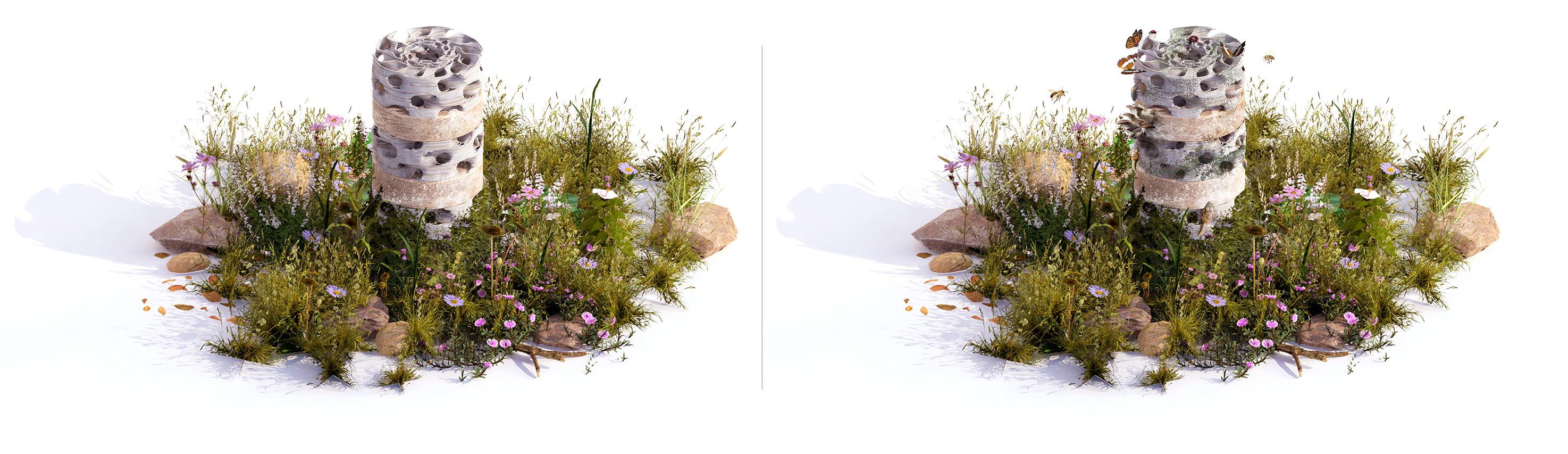
Instead, this project focuses on the creation of differentiated environmental conditions; such as shade, airflow and moisture gradients, that may be selectively occupied, modified or ignored by decomposer communities over time. To support this exploration, the prototype combines a gyroid-type triply periodic minimal surface (TPMS) geometry with an eggshell-based composite, selected for its high calcium carbonate content and porous hygroscopic properties associated with moisture adsorption and environmental humidity buffering in prior material studies (Babalola and Wilson Reference Babalola and Wilson2024; Nuntiya et al. Reference Nuntiya, Atong and Sricharoenchaikul2011) and a biodegradable mycelium material layer (Holt et al. Reference Holt, McIntyre, Flagg, Bayer, Wanjura and Pelletier2012), allowing the structure to erode and integrate with its environment over time (Figure 1).
Conceptual rendering of the proposed porous column, illustrating alternating eggshell and mycelium layers. Left: initial condition. Right: envisioned state following environmental exposure and natural biodegradation. Credit: Authors.

Figure 1. Long description
A side-by-side conceptual rendering illustrates the proposed porous column within a meadow-like setting. The cylindrical structure is composed of alternating porous eggshell and mycelium layers, surrounded by grasses, wildflowers, stones, and ground vegetation. The left panel depicts the column before deployment, with a clean, intact surface and clearly defined layered geometry. The right panel presents a conceptual visualisation of the column following environmental exposure and natural biodegradation, showing material ageing, weathering, and biological growth. Several invertebrates, including snails, woodlice, and small insects, are shown on the structure, while butterflies and bees fly around it, illustrating interactions between the habitat and its surrounding ecosystem. The rendering is intended to illustrate the intended ecological transformation of the design over time rather than document observed field results.
Insect hotels and more-than-human design
Conventional insect hotels utilise bamboo stems, drilled hardwood or reed bundles, creating uniform cavities that frequently overheat, desiccate or become parasite reservoirs (MacIvor and Packer Reference MacIvor and Packer2015; Roulston and Goodell Reference Roulston and Goodell2011). Studies further suggest that these structures disproportionately support cavity-nesting taxa while offering limited ecological benefit for broader invertebrate communities (MacIvor and Packer Reference MacIvor and Packer2015). By contrast, reviews of belowground biodiversity highlight the need for moist, heterogeneous, soil-connected habitats, with little evidence that artificial structures support moisture-dependent decomposer fauna (Bardgett and van der Putten Reference Bardgett and van der Putten2014).
These limitations reflect a broader tendency within ecological design to simplify complex ecological systems by reducing them to discrete habitat proxies that can be standardised, replicated and evaluated through occupancy metrics. In this framing, habitat becomes a product to be optimised and assessed for measurable ecological performance, aligning with sustainability paradigms that privilege quantification, scalability and visible ecological returns.
However, scholarship in ecological restoration and biodiversity design increasingly recognises that habitat quality cannot be reduced to structural provision alone. Microclimatic buffering, substrate chemistry, material porosity and soil connectivity are all critical to ecological viability, particularly for invertebrates and decomposer organisms operating at millimetre scales (Bardgett and van der Putten Reference Bardgett and van der Putten2014). Standardised cavity-based interventions may therefore inadequately address the environmental conditions required by many non-target and moisture-dependent taxa.
More-than-human design offers a counter-orientation, foregrounding relational, temporal and multispecies interdependencies (Giaccardi and Redström 2020; Haraway 2016; Puig de la Bellacasa Reference Puig de la Bellacasa2017; Tsing Reference Tsing2015). Haraway’s concept of sympoiesis rejects autonomous systems in favour of distributed, co-emergent ecological processes (Haraway Reference Haraway2016). Tsing emphasises the ecological significance of subtle and peripheral multispecies encounters that often evade dominant narratives of productivity and control (Tsing Reference Tsing2015). Puig de la Bellacasa frames care as a situated and material ecological entanglement rather than a detached ethic of stewardship (Puig de la Bellacasa Reference Puig de la Bellacasa2017). Within related design scholarship, materials, organisms and environments are understood not as passive recipients of design intent but as active participants in shaping ecological outcomes (Grosz Reference Grosz2008; Ingold Reference Ingold2011).
Research-through-Design methodologies support this approach by treating prototypes as exploratory and interpretive field apparatuses rather than controlled experimental instruments (Gaver Reference Gaver2012; Zimmerman et al. Reference Zimmerman, Forlizzi and Evenson2007). Yet despite these conceptual developments, relatively few design-led habitat experiments materially engage the microecological conditions they theorise. Many more-than-human design projects remain primarily discursive, while ecological engineering initiatives often prioritise technical optimisation without critically interrogating the ethical and epistemological implications of designing for multispecies worlds.
With Porous Ecologies, we contribute to this trajectory by examining how organic-waste-based materials can create porous, time-evolving microclimates. Following Grosz, material instability and decay are approached not as failures to be mitigated, but as productive conditions through which new ecological relations and territories can emerge (Grosz Reference Grosz2008). The project investigates habitat as an ongoing process of material negotiation shaped by microbial colonisation, moisture retention, decomposition and chemical differentiation through time.
Methodologically, the project differs from many more-than-human design approaches by operationalising ecological indeterminacy materially rather than representationally. Instead of using multispecies theory primarily as conceptual framing, the prototype was designed to sustain shifting gradients of moisture, porosity, decomposition and substrate chemistry without predefined occupancy targets or stable environmental optimisation.
Rather than symbolically representing ecological interdependence, the contribution lies in constructing material conditions through which contingent ecological relations may emerge. In this sense, the methodological approach operationalizes ecological indeterminacy by using multispecies theory not simply as a conceptual framework, but as a guide for designing a prototype capable of supporting evolving gradients of moisture, porosity, decomposition and substrate chemistry, without predefined occupancy targets or predetermined ecological optimization. We position this research between ecological engineering and more-than-human design discourse by enacting multispecies design principles through biodegradable materials, spatial gradients and time-based transformation.
This positioning reframes habitat-making not as the delivery of architectural certainty but as the careful orchestration of ecological indeterminacy. The intervention does not claim biodiversity enhancement or ecological remediation. Rather, it investigates how porous, degradable materials might expand the range of microconditions available within designed environments, allowing ecological relations to emerge without prescription.
Ecological gradients as design strategy
The Triply Periodic Minimal Surface (TPMS) geometry establishes continuous variations in porosity, forming a continuous sheet that divides space without producing discrete or isolated chambers (Rashid et al. Reference Rashid, Al Maimuri, Al-Obaidi, Eleiwi, Ameen, Ahmad, Chibani, Kezzar and Agyekum2025). Its repeating and interconnected morphology enables environmental gradients to emerge across scales rather than prescribing a singular or stable environmental condition. As a result, the geometry produces differentiated patterns of airflow, shading and moisture exposure throughout the structure.
The curvature of the gyroid surface introduces repeated expansions and constrictions in cross-section (Rashid et al. Reference Rashid, Al Maimuri, Al-Obaidi, Eleiwi, Ameen, Ahmad, Chibani, Kezzar and Agyekum2025), creating alternating zones of compression and openness that shape the movement of air and moisture through the column. Rather than directing flow linearly, this curvature may produce micro-variations in drying rates, shading intensity and moisture retention (Alteneiji et al. Reference Alteneiji, Alhajeri, Alqahtani, Al-Haddad and Al-Salem2022).
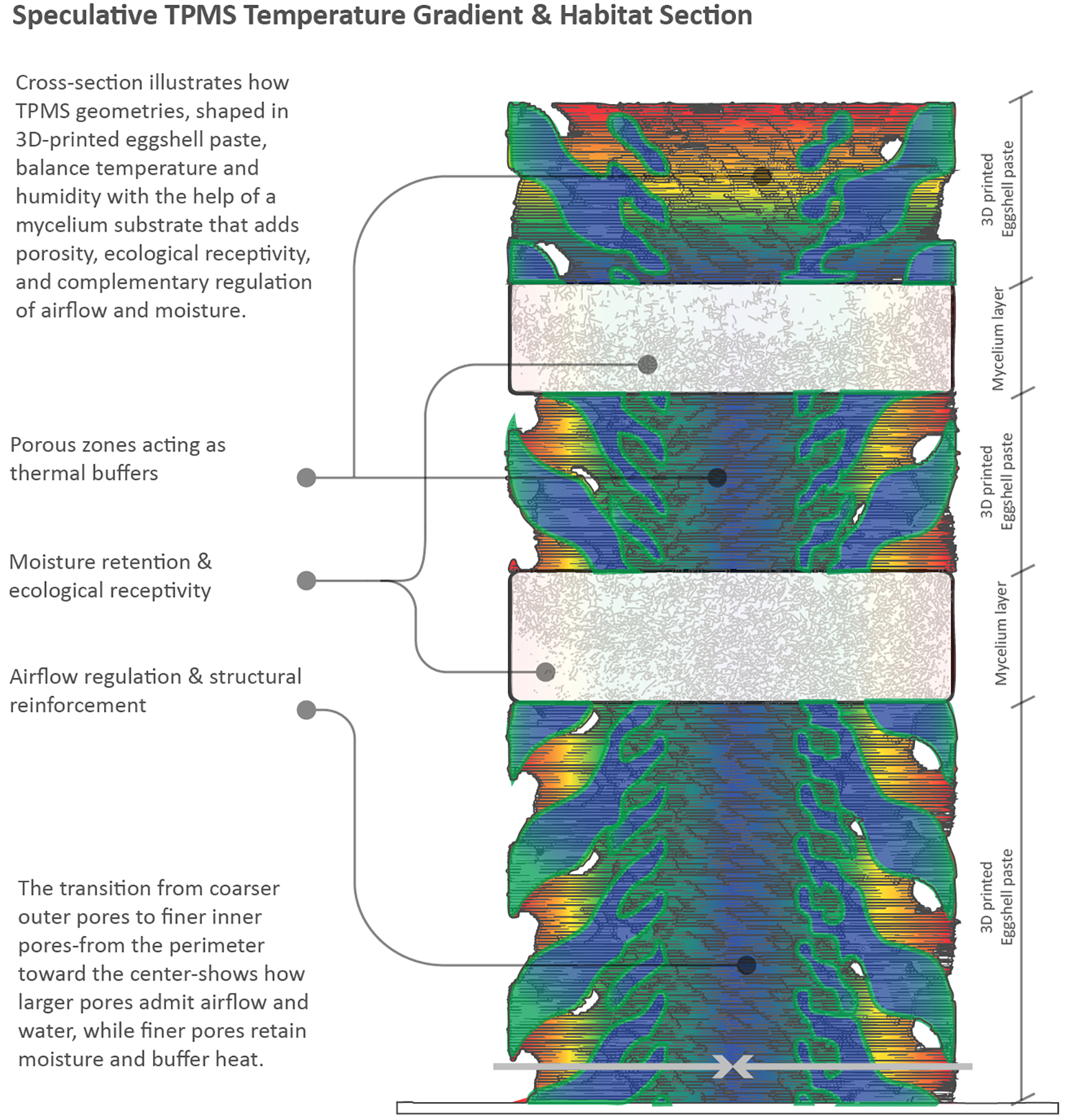
The geometry was selected not only for its capacity to influence airflow and moisture conditions, but also for its ability to sustain spatial multiplicity and environmental heterogeneity. Curvature creates zones of self-shadowing, while differential pore sizes are intended to modulate variations of drying rates and humidity pockets. These heterogeneities are conceptually informed by ecological theories of habitat heterogeneity and microhabitat differentiation, together with observations of leaf litter, peat and soil interfaces inhabited by decomposer organisms (Hopkin Reference Hopkin1992; Tews et al. Reference Tews, Brose, Grimm, Tielbörger, Wichmann, Schwager and Jeltsch2004; Warburg Reference Warburg1987; Zimmer Reference Zimmer2002) (Figure 2).
Cross-sectional illustration of the TPMS-based porosity gradient and proposed microclimatic zones within the porous column. Credit: Authors.

Figure 2. Long description
A labelled cross-sectional diagram illustrates the layered design of the proposed porous column and the intended environmental functions of its internal geometry. The structure consists of alternating 3D-printed eggshell paste and mycelium layers arranged vertically. A colour gradient applied to the TPMS geometry represents a speculative distribution of microclimatic conditions within the eggshell layers, while callouts explain airflow, moisture retention and pore-size gradients. The diagram presents a conceptual design hypothesis rather than measured environmental data.
Conventional ecological design strategies often seek to stabilise specific environmental parameters in order to support predefined target species or ecological functions. Such approaches may prioritise maximising humidity retention, maintaining thermal consistency or ensuring predictable shade coverage, thereby reducing environmental variability in favour of measurable performance outcomes. Similarly, many habitat interventions prescribe dimensional tolerances, nesting geometries or thermal conditions intended to optimise occupancy by selected taxa.
In contrast, this project does not prioritise a single dominant microclimatic state. Instead, multiplicity is treated as a design ethic. The structure is intended to sustain the coexistence of wetter and drier zones, shaded and exposed surfaces and slower and faster drying pockets within the same spatial volume. These potentially conflicting environmental states are not understood as flaws requiring resolution, but as conditions that may support shifting ecological relations over time. Different organisms, or the same organisms at different life stages, may therefore occupy transient and overlapping niches as moisture conditions, decomposition and microbial colonisation change.
By sustaining gradients rather than uniformity, the design foregrounds ecological contingency rather than environmental control. Within conventional ecological framing, environmental heterogeneity is often understood instrumentally as a strategy for increasing biodiversity through niche diversification. While this project acknowledges those ecological dynamics, the gradient-based approach proposed here extends beyond habitat optimization alone. From a sympoietic perspective, gradients are not simply environmental conditions engineered for ecological efficiency, but relational fields through which organisms, microbes, materials and climatic processes continually co-produce one another (Haraway Reference Haraway2016; Puig de la Bellacasa Reference Puig de la Bellacasa2017). Care, in this context, is expressed not through stabilising ideal habitat conditions, but through maintaining openness, variability and the possibility of unanticipated ecological relations. Gradients therefore operate not only as forms of spatial variation, but also as an ethical orientation toward sustaining environmental heterogeneity.
The column’s geometry enables a multiplicity of micro environmental states to coexist. From a more-than-human perspective, habitats emerge through relations between materials, moisture, microbes and invertebrates rather than through engineered stability (Grosz Reference Grosz2008; Haraway Reference Haraway2016; Ingold Reference Ingold2011; Puig de la Bellacasa Reference Puig de la Bellacasa2017).
Material logic of the porous column
The column comprises two principal materials that are responsive to humidity and selected so as to create differentiated substrates as per pH: eggshell composite and mycelium material.
The selection of eggshell waste was informed by principles of material circularity and waste valorisation, building upon previous research that developed eggshell waste as a regenerative biomaterial through locally situated fabrication processes (Valipour Goudarzi et al. Reference Valipour Goudarzi, Clifford and Ramkumar2026). In the present study, this material is repurposed as an ecological substrate within a porous habitat system, extending its application from regenerative material development to more-than-human habitat-making. As an abundant food by-product, discarded eggshells provide a calcium carbonate resource that can be reintroduced into ecological cycles rather than diverted to landfill (Owuamanam and Cree Reference Owuamanam and Cree2020). By grinding the shells into particulate form, the composite retains mineral availability, which may allow calcium-dependent invertebrates to access the substrate over time.
Calcium carbonate is a naturally occurring soil mineral present in many soil systems and contributes to pH buffering through its neutralisation of soil acidity, typically being associated with neutral to mildly alkaline conditions. Calcium carbonate can alter local soil pH, and both pH and calcium content have been shown to influence soil microbial community composition and distribution (Dai et al. Reference Dai, Su, Chen, Barberán, Zhao, Yu, Yu and Brookes2017; Florent et al. Reference Florent, Cauchie, Herold, Jacquet and Ogorzaly2022). Under humid conditions, the presence of water can facilitate surface-level interactions that may influence localised pH conditions (Rowley et al. Reference Rowley, Grand and Verrecchia2019). Within a porous structure, such mineral buffering capacity may contribute to the formation of differentiated microchemical conditions rather than uniform chemical stability, consistent with the spatial heterogeneity observed in soil systems (Bardgett and van der Putten Reference Bardgett and van der Putten2014).
Mycelium materials are generally made of a wood decay fungus cultivated on plant-based substrate (Rigobello and Ayres Reference Rigobello, Ayres, Satyanarayana and Deshmukh2023). The mycelium component was grown and subsequently dried prior to integration, functioning primarily as a biodegradable, bio-derived material substrate rather than as an actively cultivated organism during deployment. However, as with many mycelium-based materials, the dried structure retains the potential for renewed biological activity under favourable environmental conditions, situating the artefact between inert material and latent living system (Rigobello Reference Rigobello and Ozkan2026). To ensure this capacity with the presence of chlamydospores, and for its widest wood decay enzyme array facilitating substrate curation, we chose to work with a strain of Ganoderma lucidum, grown on beech wood particles (Fagus sylvatica). During the growth phase, enzymatic activity of the fungus leads to the development of an acidic material matrix through fermentation. This layer was incorporated as a moisture-responsive layer, instrumentalising the porosity and receptivity that mycelium materials exhibit thanks to their build up of plant particles and low density mycelial network which creates many cavities (Zhang et al. Reference Zhang, Xue, Zhang, Zhang, Peng, Wang and Cao2023). By positioning a mycelium material adjacent to the calcium carbonate matrix, we introduce pH variation, material microstructure difference and biochemical diversity across the prototypal artefact.
Mycelium materials are made of a diversity of compounds. Most notably and comparatively to the eggshell composite, they contain proteins and carbohydrate content (e.g., glucans, cellulosic compounds), but also lignin and other tougher polymers such as chitin. In association with the eggshell composite, they provide an essential nitrogen source for supporting coloniser nutrition, as well as prefermented lignocellulosic sources where lignin degradation by a white rot fungus makes cellulosic compounds, the main source of carbon, partially accessible.
During deployment, environmental exposure softened the eggshell composite, enabling adhesion between layers initially fabricated separately. Erosion formed pits and roughened surfaces, while fungal patches emerged on the surface of the form and within moisture-retentive pockets. These transformations are consistent with known decomposition processes wherein microbes and invertebrates modify substrate properties over time (Ulyshen Reference Ulyshen2016; Zimmer Reference Zimmer2002).
Methods: research-through-design and field prototyping
The TPMS geometry was parametrised to introduce gradients in pore size (c. 3–10 mm), intended to produce differentiated internal conditions of airflow, shading and moisture exposure across the structure.
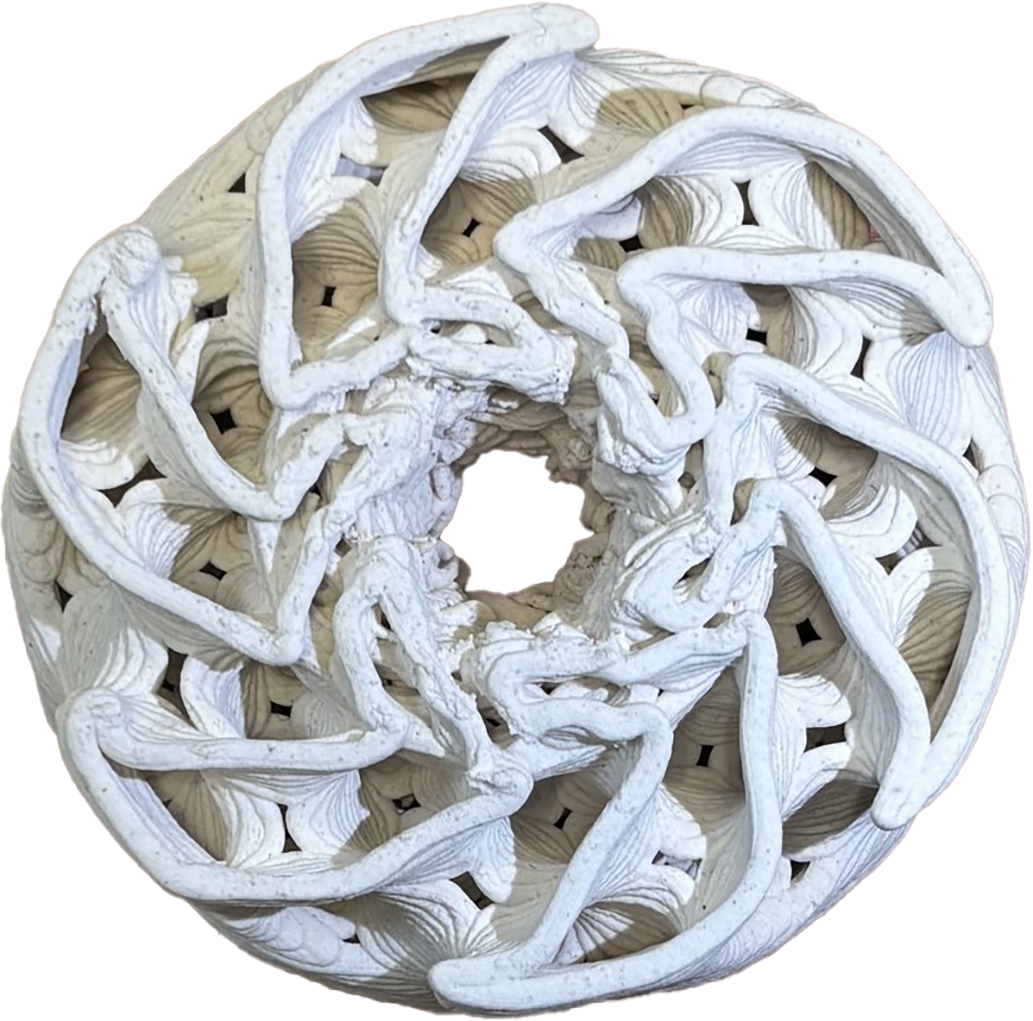
Fabrication was carried out in sequential layers. The eggshell composite was deposited through an additive manufacturing process using a biodegradable paste formulation. The mycelium material artefact was formed separately using a negative mould process and later integrated into the structure. Extensive preliminary testing was conducted to calibrate the rheological properties of the eggshell paste, balancing viscosity and flowability to ensure consistent extrusion while retaining dimensional stability after deposition. The formulation, comprising finely ground eggshell powder and water, was adjusted with biodegradable additives, including xanthan gum as a bio-based binder and glycerol as a plasticising agent, to enhance cohesion and interlayer adhesion. Print trials evaluated whether the material possessed sufficient green strength to maintain geometric fidelity during layer-by-layer fabrication. The TPMS geometry, being inherently self-supporting, does not theoretically require auxiliary supports; however, successful fabrication depended on the material’s capacity to sustain its form throughout deposition. The geometry was digitally generated using parametric modelling software, and toolpaths were computationally derived to guide controlled material deposition (Figure 3).
Top view of a fabricated eggshell-composite layer of the porous column with TPMS-derived geometry, showing heterogeneous porosity, curvature and internal cavities designed to support differentiated moisture retention and microclimatic conditions. Credit: Authors.

Figure 3. Long description
A top-view photograph shows one fabricated eggshell-composite layer of the porous column, produced with a TPMS-derived geometry. The circular structure features an open central cavity surrounded by an interconnected network of curved walls and pores of varying sizes. The variation in pore size and curvature reflects the designed heterogeneous architecture intended to provide diverse microhabitats and differentiated moisture conditions.
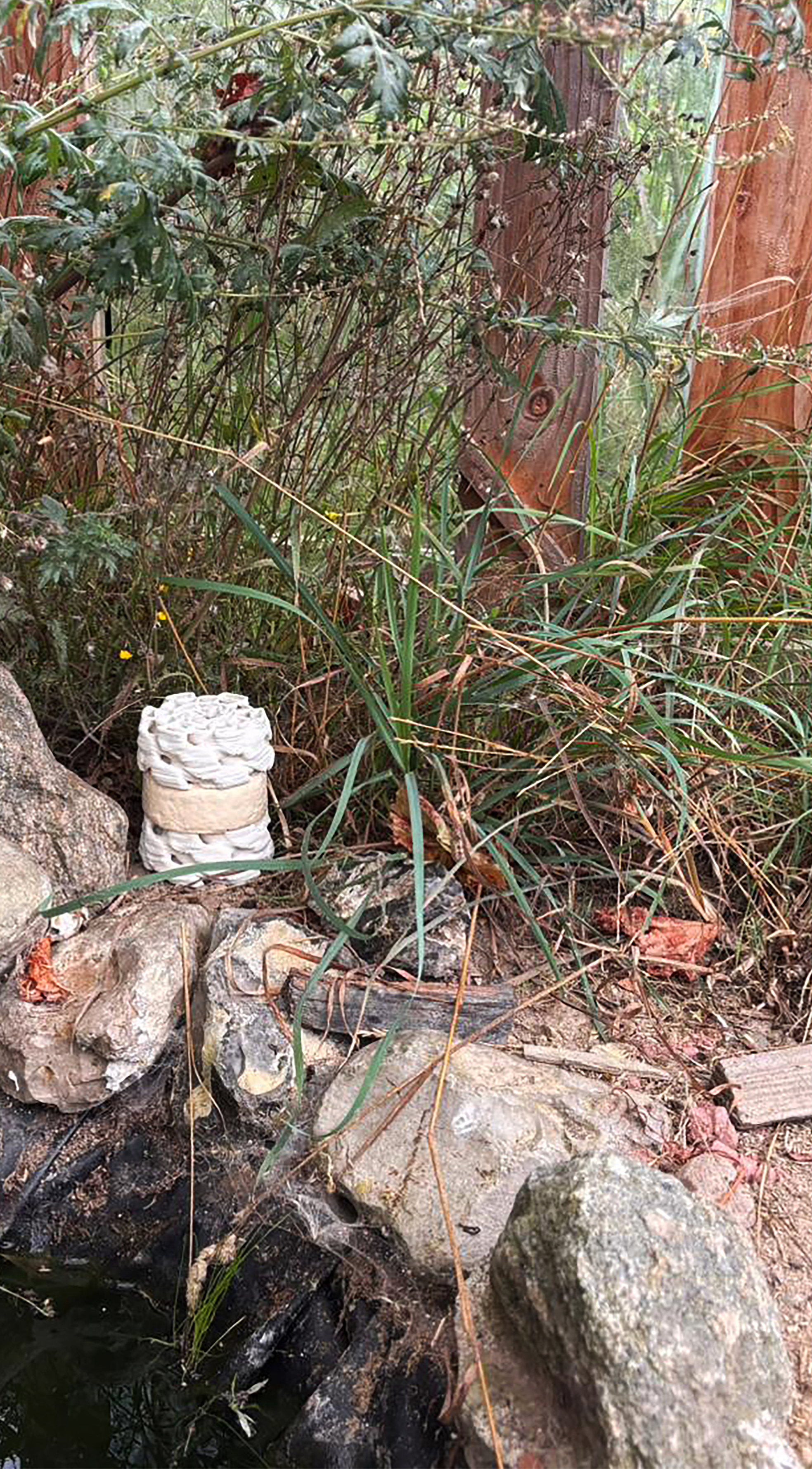
The installation was placed outdoors near Skjoldungernes Land National Park and remained in situ during an outdoor trial conducted from 19 September to 6 November 2025 (48 days). Site visits were conducted approximately four times during the deployment period and included visual inspection and close-range photography and film (Figure 4).
Photograph of the porous column installed in its field deployment environment. Credit: Authors.

Figure 4. Long description
A photograph shows the porous column installed in an outdoor field setting near Skjoldungernes Land National Park. The cylindrical structure stands upright among rocks, grasses and vegetation beside a small pond. The image documents the environmental context of the 48-day field deployment.
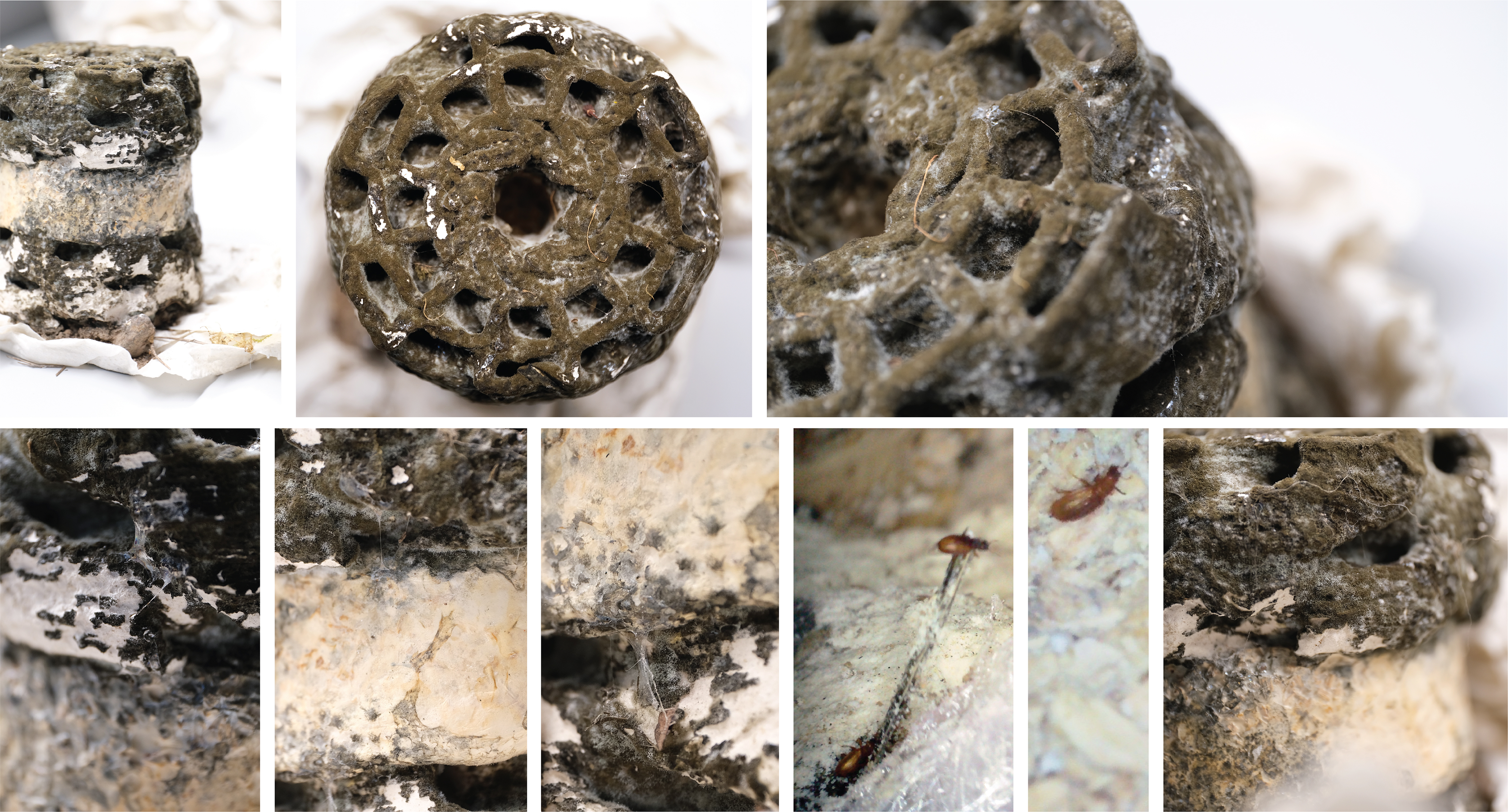
Macro photographic documentation was captured at the end of the deployment period, through which small beetles were observed within the structure and tentatively identified as belonging to the family Cryptophagidae (silken fungus beetles). No organisms were handled or removed. Temperature, humidity and precipitation records were later consulted descriptively to contextualise observed changes. No quantitative ecological measurements or formal species identifications were undertaken. This methodological decision aligns with more-than-human design approaches that privilege situated and relational engagement over optimisation or performance validation. Rather than treating organisms and environmental variables as controllable metrics, the artefact functioned as a field probe through which material and ecological interactions could unfold without being reduced to predefined evaluative criteria (Gaver Reference Gaver2012; Giaccardi and Redström Reference Giaccardi and Redström2020; Haraway Reference Haraway2016; Puig de la Bellacasa Reference Puig de la Bellacasa2017; Tsing Reference Tsing2015; Wakkary Reference Wakkary2021; Zimmerman et al. Reference Zimmerman, Forlizzi and Evenson2007). The approach also draws from Material-Driven Design, in which material behaviours and transformations are treated as generative inputs shaping design decisions rather than variables to be stabilised (Karana et al. Reference Karana, Barati, Rognoli and Zeeuw van der Laan2015). Within this Research-through-Design approach, the artefact functioned as a field probe rather than a test object, with emphasis placed on reading material inscriptions, softening, erosion, fungal blooms and abrasions, as signals of environmental interaction.
Results: material transformations
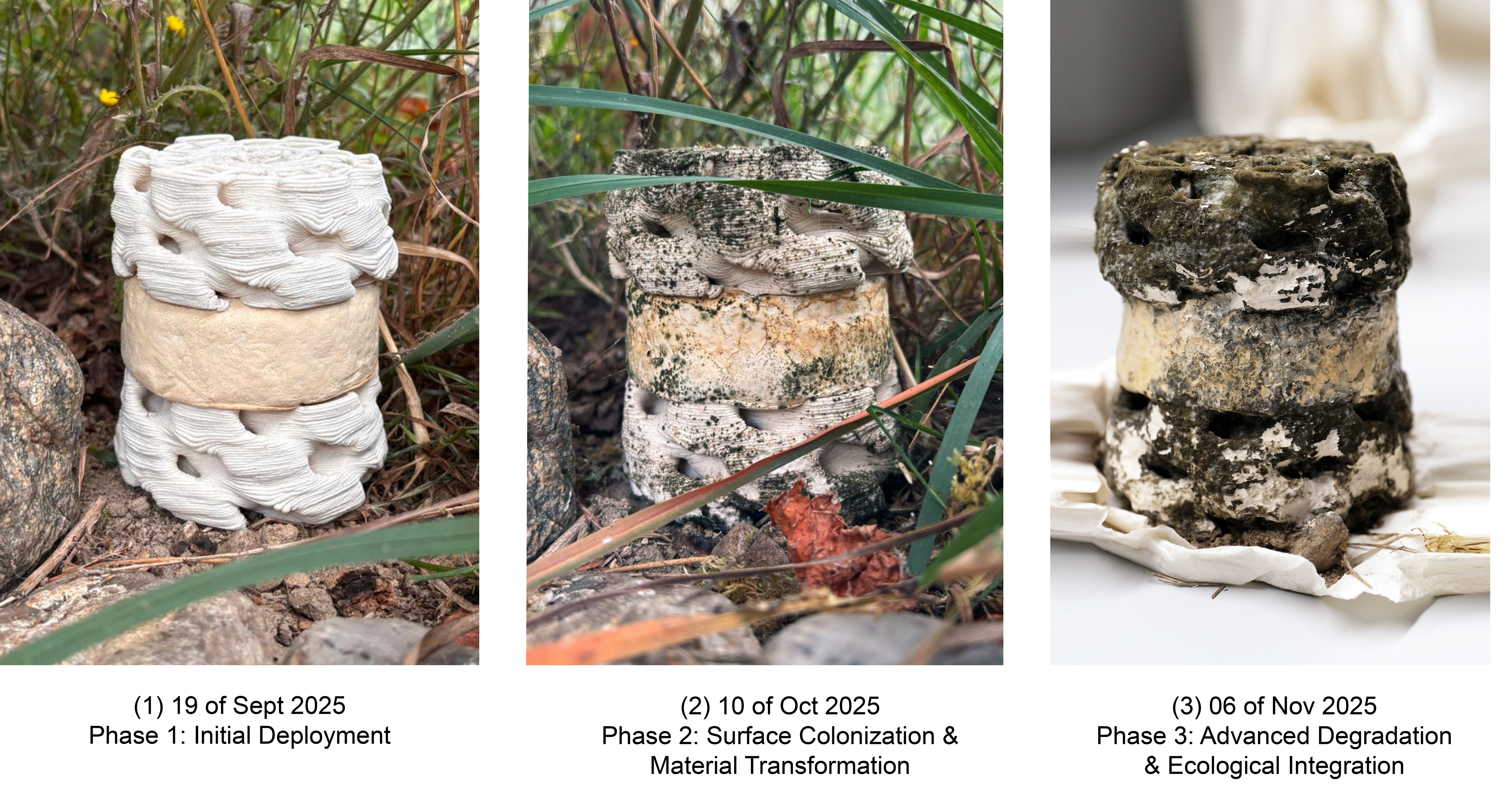
Across the outdoor trial period, the column accumulated: fungal patches in shaded, humid recesses; softened eggshell regions from prolonged exposure; adhesion between layers as materials integrated; surface erosion forming pits and rough textures; and faint scraping marks interpreted as consistent with exploratory contact by small organisms. To improve transparency of the field deployment, the 48-day exposure period was documented through three representative stages (Figure 5): (1) initial placement and intact morphology (19 September 2025), (2) intermediate colonization and surface transformation (10 October 2025) and (3) advanced degradation and ecological integration (06 November 2025). These stages illustrate the progressive interaction between the mycelium composite, moisture exposure, microbial growth and surrounding invertebrate activity over time.
Material transformations of the porous column during deployment, including softening, erosion, fungal growth and layer adhesion. Phase 1 shows the structure at initial deployment with intact geometry and dry surface conditions. Phase 2 documents early softening, fungal growth and surface erosion associated with environmental exposure. Phase 3 reveals advanced degradation characterized by darkening, increased layer adhesion, biological colonization and structural transformation. Credit: Authors.

Figure 5. Long description
A sequence of three photographs documents the progressive transformation of the porous column during a 48-day field trial, from initial installation through early weathering and fungal growth to advanced degradation, biological colonisation and changes in surface texture and layer adhesion.
Following Ingold’s understanding of materials as processual and continually forming through weathering and contact, these traces are read as material inscriptions emerging through environmental engagement rather than as signs of degradation or failure (Ingold Reference Ingold2011). The deployment period coincided with cool, humid autumn conditions with frequent rainfall and fog, reported here to contextualise environmental exposure rather than establish causal relationships. These inscriptions reflect the interplay between porous geometry, material responsiveness and environmental exposure rather than demonstrating ecological performance (Gaver Reference Gaver2012; Wakkary 2021; Zimmerman et al. Reference Zimmerman, Forlizzi and Evenson2007).
These transformations are consistent with known decomposition processes wherein microbes and invertebrates modify substrate properties over time (Ulyshen Reference Ulyshen2016; Zimmer Reference Zimmer2002). They were documented through periodic site visits, visual inspection and close-range photography. Observations remained qualitative and interpretive, focusing on material traces rather than quantified ecological indicators. Species identification was tentative and based solely on macro photography, without taxonomic verification. Temperature, humidity and precipitation data were consulted descriptively to contextualise environmental exposure, but no quantitative microclimatic measurements were conducted within the structure itself. As such, the deployment should be understood as exploratory and situated, registering early-stage ecological and material interactions rather than demonstrating ecological performance or habitat establishment (Figure 6).
Annotated close-up photographs documenting fungal patches, erosion patterns, abrasions, layer adhesion and small beetles observed on the porous column following deployment. Credit: Authors.

Figure 6. Long description
A collage of annotated close-up photographs documents surface features of the porous column following the 48-day field trial. Images show fungal patches, erosion, abrasions, adhesion between eggshell and mycelium layers, filamentous growth and two small beetles. Together they document material transformations and biological traces without implying long-term habitat establishment.
Limitations
The findings presented here are constrained by the short deployment duration and the absence of controlled environmental monitoring. The outdoor trial spanned approximately seven weeks during a single autumn period, limiting insight into seasonal variability and long-term material–ecological interactions. Observations were qualitative and interpretive in nature, and no quantitative measurements of internal humidity, temperature gradients or soil chemistry were conducted. Species identification was tentative and based on visual inspection rather than formal taxonomic analysis. Consequently, the project does not claim evidence of habitat establishment, biodiversity enhancement or ecological performance, but instead documents early-stage material–environment interactions within a Research-through-Design framework.
Discussion and conclusions
Following Ingold’s understanding of materials as processual and continually forming through weathering and contact, these traces are read as material inscriptions emerging through environmental engagement rather than as signs of degradation or failure (Ingold Reference Ingold2011). The deployment period coincided with cool, humid autumn conditions with frequent rainfall and fog, which are reported here to provide environmental context rather than to establish causal relationships. These inscriptions reflect the interplay between porous geometry, material responsiveness and environmental exposure rather than demonstrating ecological performance (Gaver Reference Gaver2012; Wakkary Reference Wakkary2021; Zimmerman et al. Reference Zimmerman, Forlizzi and Evenson2007).
The observed traces illustrate how material degradation, humidity retention, shading and curvature foster small-scale microhabitats that change over time (Oliver et al. Reference Oliver, Roy, Hill, Brereton and Thomas2010; Pincebourde and Woods Reference Pincebourde and Woods2020; Wakkary Reference Wakkary2021; Zimmerman et al. Reference Zimmerman, Forlizzi and Evenson2007). Moisture softened eggshell regions; fungal patches appeared in areas where shading retained dampness; erosion signalled progressive weathering; abrasions indicated potential transient invertebrate contact. Interpretation remains deliberately modest, focusing on what the material registers rather than inferring species presence or habitat occupation. At the same time, the emergence of fungal growth and other biological traces suggests that microbial and small-organism activity had begun to engage with the structure, indicating early-stage ecological processes without implying stable settlement or long-term habitation.
Beyond material traces, end-of-deployment macro photography revealed the presence of small beetles tentatively identified as belonging to the family Cryptophagidae (silken fungus beetles). This observation does not constitute evidence of habitat establishment or sustained occupation. Rather, it suggests that the evolving material and microclimatic conditions of the structure were at least permeable to fungi-associated invertebrates that are typically overlooked in design-led ecological interventions. Read within a Research-through-Design framework, such encounters are treated not as indicators of success but as signals of relational possibility, pointing to how biodegradable materials, porosity and decay may invite transient engagement without prescribing ecological outcomes.
This work advances several contributions to Research-through-Design, material ecologies and multispecies habitat-making. Building upon previous research that developed eggshell waste as a regenerative biomaterial through circular, locally situated fabrication processes (Valipour Goudarzi et al. Reference Valipour Goudarzi, Clifford and Ramkumar2026), this study shifts the focus from regenerative material development to investigating how such biomaterials can function as ecological substrates within porous, biodegradable habitat systems.
-
1. Porous Ecologies: advancing a conception of habitat-making based on the cultivation of shifting microconditions and maintained indeterminacy rather than the provision of fixed structures or prescribed ecological performance.
-
2. Organic-Waste-Based Material Strategy: exploring how eggshell–mycelium composite materials, derived from organic waste streams, are designed to transform, soften and decompose over time, gradually returning to the environment while reorganising microclimatic conditions through environmental exposure.
-
3. Field-Probe Methodology: positioning field-deployed prototypes as research instruments that generate knowledge through material decay, environmental traces and situated observation rather than through controlled ecological measurement. thereby foregrounding attentiveness over control in engagements with living systems.
-
4. Attention to Invisible Beings: reframing urban habitat-making away from iconic or target species toward decomposers and other subtle invertebrates whose lifeworlds unfold through processes of decay, moisture and material transformation, and which are typically overlooked in biodiversity infrastructures.
In this project we explored how porous geometries and organic-waste-based materials can support time-evolving microconditions and register subtle interactions through weathering, decay and fungal activity. Rather than aiming for ecological optimisation, the work foregrounds decomposition and porosity as design conditions that invite multispecies engagement. By shifting attention from target species toward the material and environmental conditions through which life becomes perceptible, the project advances an approach to urban habitat-making that attends to multispecies relations as they emerge over time. Rather than prescribing ecological performance, the project investigates how designed gradients of porosity, moisture, decomposition and material instability may sustain the conditions through which ecological relations emerge.
Situated within a broader ecological context in which insects and other invertebrates underpin processes such as decomposition and soil formation, this work argues for design practices that attend to these forms of life without claiming ecological remediation or performance. Future work may extend these explorations through longer outdoor deployments, varied organic-waste composites and expanded TPMS geometries.
Data availability statement
No datasets were generated or analysed during this study. All materials supporting the findings, including the design documentation and observational evidence, are contained within the article.
Acknowledgements
The authors sincerely thank Dr. Roland Mühlethaler for his careful reading of the manuscript and for insightful comments on the ecological roles of small and often-overlooked invertebrates, which strengthened the ecological framing of this work. The authors thank Suzi Pain for generously sharing her expertise and practical experience in clay extrusion printing. Her insights into paste-based additive manufacturing informed the early development of the printing methodology. The authors sincerely thank Dr. Svenja Keune for her assistance with positioning the porous column adjacent to her Tiny House, which is commonly used to host auto-ethnographic experiments and explore multispecies cohabitation, as well as her thoughtful feedback on its integration within the landscape. The authors acknowledge Hamid Peiro for his technical expertise and valuable discussions, which helped address challenges encountered during the development of the paste extrusion printing workflow. The authors gratefully acknowledge Natalie Mossin for her early encouragement and support in exploring eggshell as a research material. Her openness to this line of inquiry and the academic freedom she provided were instrumental in enabling the initial development of the eggshell-based paste formulation.
Author contributions
Hasti Valipour Goudarzi conceived the study, led and supervised the research, developed the methodology and eggshell-based paste formulation, designed and conducted the experiments, coordinated the field deployment, analysed the findings, prepared the scientific figures and wrote the original draft of the manuscript. Adrien Rigobello contributed to the development of the mycelium-based components of the study, oversaw the mycelium-related aspects of the research and reviewed the manuscript. Behnaz Khaksar contributed to the design of the pieces, figures and graphical elements of the manuscript. Vivien Roussel contributed to discussions on the research, provided feedback on the interpretation of the results and reviewed the manuscript. All authors reviewed and approved the final manuscript.
Financial support
This research received no specific grant from any funding agency, commercial or not-for-profit sectors.
Competing interests
The author declare no competing interests.
Ethical standards
This study did not involve human participants or regulated animal subjects and therefore did not require ethical approval. Observations of invertebrate activity occurred opportunistically during the field deployment without capture, handling or experimental manipulation.

 Open access

