Introduction
Northern Canadian communities have experienced considerable environmental, economic, social and political change over the last 30 years. Many of these changes have been shown to affect the health and wellbeing of residents (Furgal & Seguin, Reference Furgal and Seguin2006). In order to support informed decision making by residents it is critical that agencies and public health officials effectively communicate about risks and provide the most recent and relevant information.
Communicating about risks can be challenging, and numerous factors can hinder or promote effective risk communication. Trust in the information source is one of the most important components in effective risk communication (Slovic, Reference Slovic1993). If a communicator is not considered trustworthy, it is likely that a communication strategy will fail (Lundgren & McMakin, Reference Lundgren and McMakin2013). The concept of trust has been given varying definitions by researchers (see Earle et al., Reference Earle, Siegrist and Gutscher2010; Greenberg, Reference Greenberg2014). In the context of risk communication, Renn & Levine (Reference Renn and Levine1991, p. 179) describe trust as, “the generalised expectancy that a message received is true and reliable and that the communicator demonstrates competence and honesty by conveying accurate, objective, and complete information”.
We explored trust among Inuit residents in one region of the Canadian North in regards to information about environmental and health risks. The information generated can be used to determine who or what agencies should provide messages, and what communicators should do to engender trust. If communicators can better understand the components that influence good risk communication (for example, trust), it is argued that they can design more effective messaging strategies that will promote health and wellbeing among Arctic populations.
Background
Communicating about risks in the Arctic
Many organisations and programmes have acknowledged the need for better communication strategies about environmental and health hazards and their associated public health risks in the Arctic (AMAP, 2015). The International Polar Year (IPY) 2007−2008 is one such initiative that stressed the importance of education, outreach and communication in Arctic and Antarctic regions. A goal of the IPY was to provide the public with the resources and information needed to facilitate greater awareness about Arctic hazards (Parkinson, Reference Parkinson2013). Projects funded through the IPY targeted many audiences, including those from polar research areas. While 18% of IPY education, outreach and communication projects targeted residents of polar research areas (Provencher et al., Reference Provencher, Baesemann, Carlson, Badhe, Bellman, Hik and Zicus2011), few of these studies examined the factors that lead to effective communication. The findings from one IPY funded survey on Inuit health and contaminants in Nunavut reported that while methods of monitoring contaminants and their health impacts had improved, there was still a need for improved methods to communicate about the risks (Furgal et al., Reference Furgal, Boyd and Chan2014).
More recently, the Arctic Monitoring and Assessment Program (AMAP, 2015) reviewed the status of health risk communication in circumpolar countries. The report identifies the lack of evaluative information on health risk communication campaigns, and the need to increase our knowledge and understanding of trust in Arctic communications. This need persists despite the significant efforts being made in several circumpolar countries in providing this information to the public (AMAP, 2015). This information could lead to more effective message development and dissemination processes (Lundgren & McMakin, Reference Lundgren and McMakin2013). Therefore, the first research question (RQ1) this project sought to answer was: What individuals and organisations do Arctic residents trust to provide information about health and environmental risks?
The role of trust in risk communication and management
Trust in information sources is crucial to effective risk communication and management. This is especially true when a risk is unfamiliar or technically complex because the public must rely on expert assessments rather than personally evaluating the risk (Siegrist & Cvetkovich, Reference Siegrist and Cvetkovich2000). In particular, studies show that trust is an important component of risk communication practices in Northern Indigenous communities (Jardine et al., Reference Jardine, Banfield, Driedger and Furgal2013). Trust influences how people perceive risks and how they respond to risk management strategies (Peters et al., Reference Peters, Covello and McCallum1997). Implications for communicators is that “information alone, no matter how carefully packaged and presented, will not communicate risk effectively if trust and credibility are not established first” (Lundgren & McMakin, Reference Lundgren and McMakin2013, p. 20).
There are numerous factors that influence trust in individuals and organisations. An established model in the field of risk communication is the Trust, Confidence, and Cooperation model created by Earle & Siegrist (Reference Earle and Siegrist2008). This model has been used to better understand the role of trust in the formation of risk perceptions (Earle & Siegrist, Reference Earle and Siegrist2008). The model is premised on numerous, related factors that can influence trust and confidence. These factors include general trust, which is defined as a disposition where a person believes that most people, including complete strangers, are trustworthy (Earle et al., Reference Earle, Siegrist and Gutscher2010). General trust is built on social features such as relationship and shared values between individuals (Earle et al., Reference Earle, Siegrist and Gutscher2010). Relationship can be defined as connection between people, and value similarity refers to the perceived correspondence in values between the audience member and another person or entity (Earle & Siegrist, Reference Earle and Siegrist2008). Earle & Siegrist (Reference Earle and Siegrist2008) also argue that confidence is based on an individual’s previous experience with (that is, past performance of) an individual or organisation.
Others hypothesise that additional factors may influence trust. Many researchers have found that credibility is a factor in whether or not an individual or organisation is trusted (for example, Renn & Levine, Reference Renn and Levine1991; Peters et al., Reference Peters, Covello and McCallum1997). Credibility can be defined as the degree of technical expertise assigned to a message or source (Renn & Levine, Reference Renn and Levine1991). Additionally, some researchers advocate that transparency is an important factor in trust. Reasoned transparency refers to the openness or candidness of a decision or risk management process (Renn & Levine, Reference Renn and Levine1991). Transparency is often related to the “past performance” factor discussed previously (see Earle & Siegrist, Reference Earle and Siegrist2008).
Due to the importance of trust in risk communication, our second research question (RQ2) was: What are the factors that influence trust in individuals or organisations in Arctic environments? In this study, we examine if general trust, relationship and value similarity, previous experience and transparency, and credibility influence trust among northern audience members.
Case study and community
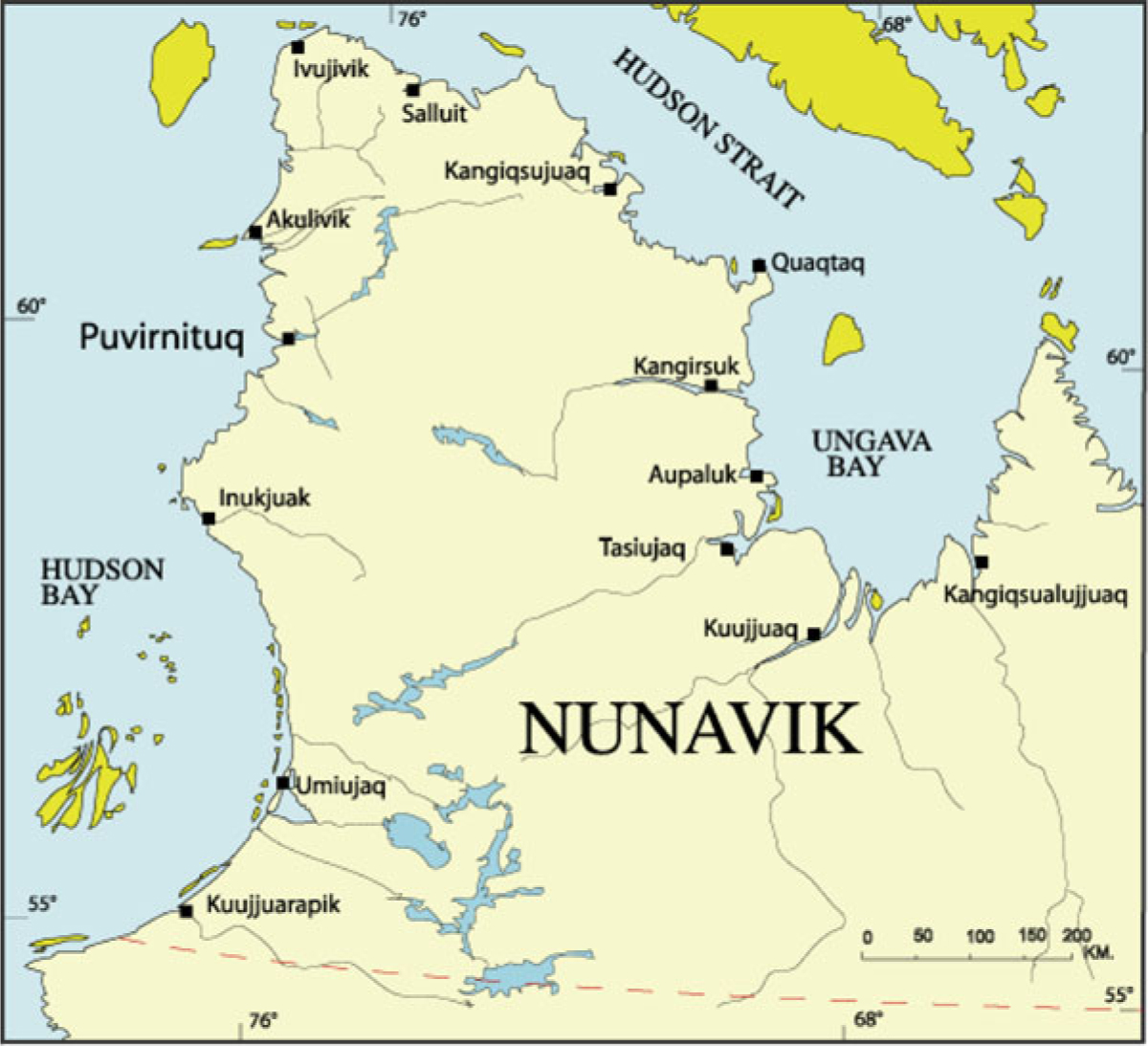
Nunavik encompasses the northern region of Quebec, Canada. The predominately Inuit population inhabits remote coastal communities along the Hudson Bay, Hudson Strait and Ungava Bay (Statistics Canada, 2013; Fig. 1). The 14 communities are only accessible by plane or by boat in the summer, with no roads connecting the region with southern Quebec. Inuttitut is the primary language spoken by the region’s 12,055 inhabitants (Statistics Canada, 2013). Kuujjuaq, the administrative capital of Nunavik, is located at the southern point of Ungava Bay. With a population of 2,754, Kuujjuaq is the largest village in the region (Statistics Canada, 2017). The vast majority of the population is of Inuit descent and 70% are under the age of 35 (Statistics Canada, 2017).
Map of Nunavik (Arctic Quebec) including location of regional centre, Kuujjuaq where interviews for this project took place (source: http://www.makivik.org/nunavik-maps/).

Methods
Interview process and questions
Interview protocol development, pre-testing and administration were completed with the aid of locally hired and trained research assistants. Questions to explore trust in communication sources were developed and then pre-tested with assistants to ensure clarity and comprehension. Convenience and snowballing sampling methods (Biernacki & Waldorf, Reference Biernacki and Waldorf1981) were used to select participants in Kuujjuaq for the study. To promote participation, information about the study was also disseminated to residents through community Facebook sites and local radio. Eligible participants were 18 years or older and self-identified as Inuit. Participants underwent a process of informed consent; those agreeing to participate were then interviewed in their choice of English or Inuttitut and interviews were audio recorded. Interview sessions averaged 34 minutes and were conducted between 19 July 2013 and 2 August 2013. This project received ethics review and approval from the Trent University Research Ethics Board.
A total of 112 Inuit residents from Kuujjuaq, Nunavik participated in interviews. The results presented and discussed in this paper are those pertaining to the topics of trust and communication. We examined who participants trusted (RQ1) by asking: “Who do you trust at an individual level?” and “Who do you trust at an organisational level?” We examined why they trusted the individual or organisation (RQ2) by asking both: “Why do you trust that individual?” and “Why do you trust that organisation?” Additional questions not relevant to the specific aims of this manuscript will be reported elsewhere.
Qualitative analysis
Qualitative data analysis was conducted using deductive and inductive approaches. The incorporation of both approaches for qualitative analysis is frequently used to identify and analyse emerging themes in interviews, particularly when studying issues where unidentified themes may emerge from the data (LeCompte & Schensul, Reference LeCompte and Schensul2010). A literature review of relevant studies on trust and risk communication provided the initial themes for deductive analysis (for example, Siegrist et al., Reference Siegrist, Cvetkovich and Roth2000). The inductive approach allowed for the inclusion of new themes as they emerged from the data (Creswell & Plano Clark, Reference Creswell and Plano Clark2007).
Responses to all open-ended questions were transcribed verbatim for analysis. Two analysts read all transcripts to identify initial themes. Approximately 10% (n = 11) of interview transcripts were then initially coded and reviewed by both analysts to confirm themes to be used (Suter, Reference Suter2012). Analysts then individually coded a subset of approximately 30% (n = 30) of randomly selected interviews to ensure inter-coder reliability. Agreement between coders was examined using Cohen’s kappa. Cohen’s kappa for the subset ranged between 0.82 and 1.0 for the variables. Throughout the process of analysis, researchers frequently met for debriefings and any potential issues with the data were discussed as they arose. The regular dialogue between researchers about the analysis supported the integrity of the process (Suter, Reference Suter2012).
Results
From our interviews with 112 Inuit residents, we present representative frequencies of common responses and quotes from participants pertaining to each of our main research questions. Frequencies of respondents are provided in addition to the qualitative descriptions of quantity to provide transparency in the reporting of results.
Trust in individuals and organisations
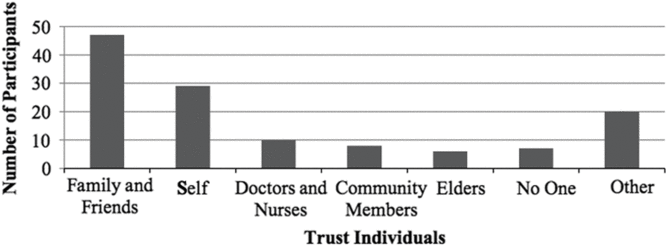
Participants were initially asked which individuals they trusted as sources of health risk communication messages. Several categories of individuals were identified including: friends and family members (n = 47; 42.0%), themselves (n = 29; 25.9%), doctors and nurses (n = 10; 8.9%), community members (n = 8; 7.1%), and elders (n = 6; 5.4%) (Fig. 2). An additional seven participants (6.3%) said they trusted no one. The ‘other’ types of individuals, those mentioned three times or less, included Inuit in general, the mayor, and biologists.
Individuals trusted by participants (frequency).

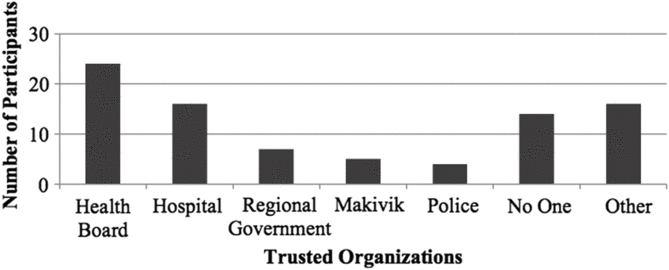
Participants were then asked what organisations they trusted. The organisations identified by participants included: the health board (n = 24; 21.4%), hospital (n = 16; 14.3%), the regional government (n = 7; 6.3%), Makivik (see below) (n = 5; 4.5%), and the police (n = 4; 3.6%) (Fig. 3). An additional 14 participants (12.5%) said there were no organisations that they trusted. The ‘other’ organisations mentioned by participants included the council office and schools (Fig. 3).
Organisation trusted by participants (frequency).

Makivik, mentioned by several participants in the study, is an organisation in Nunavik dedicated to protect the rights, interests and mandates from the 1975 James Bay and Northern Quebec Agreement. The Corporation’s mandate “ranges from owning and operating large profitable business enterprises and generating jobs; to social economic development, improved housing conditions, to protection of the Inuit language and culture, and the natural environment” (see http://www.makivik.org).
Factors influencing trust
The factors influencing trust were identified by asking participants why they trusted the individuals and organisations they previously identified. Six themes were identified through inductive and deductive approaches to this analysis. Themes included relationship, past performance, general trust, transparency, value similarity, and credibility. These themes were defined in the background section of the manuscript and are discussed further in the following section.
Relationship
When asked about why people trusted individuals or organisations, 44 participants discussed the importance of “relationship”. Many explained that their trust came from a connection with a family or friend. Participants commonly noted that this was influenced by length of relationship. One participant noted:
You have to trust your family. That’s the only way that we can look out for each other and rely on each other. You need a little bit of trust here and there, even if it’s just a plain old friend or close family.
Previous experience
Twenty-two participants stated that previous experience with the communicator or organisation was an important factor in their trust of others. Participants noted that if individuals and organisations acted in a trustworthy manner in the past, they would be more likely to trust them today. As one participant stated, “I have seen their capability to work … to implement the things that they want to. They inform the people right away and they do their job properly.”
General trust
Fifteen participants mentioned that they were generally trusting individuals or that people in general should be trusted. For example, one participant stated, “There’s always a few bad apples that we’ve seen over the years in big organisations, but in general I think they’re trustworthy.”
Transparency
Providing information and transparency was also identified as reason for trusting an individual or organisation. Eleven participants made statements about the need for transparency. For example, a participant noted, “the health board is doing a pretty good job letting people know about different health issues. If something epidemic happens, I’m sure they’re going to be all over it and let us know.”
Value similarity
Nine participants suggested that value similarity between themselves and the communicator influenced their trust. One participant remarked, “if they’re Inuit, they understand who we are. Whoever lives in the North knows what goes on here, so they know about the bad side and the good side.”
Credibility
Six participants stated that the credibility of an individual or organisation was important. One participant explained they trusted the hospital, “because there are doctors and nurses that work there.” Credibility was often described as professional status or perceived expertise.
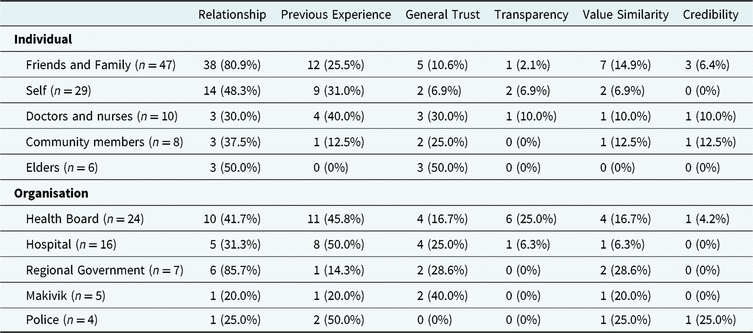
Table 1 provides a summary for the factors influencing why individuals and organisations are trusted.
Reasons for trust in individual and organisation (frequency and percentage), provided by Kuujjuaq residents* (n = 112)

*Participants could cite numerous reasons why they trusted individuals and organisations.
Discussion and conclusion
The results of this study show that there are numerous factors that influence trust. These factors are consistent with research with other populations (for example, Earle & Siegrist, Reference Earle and Siegrist2008). However, factors particularly important for Kuujjuaq residents were value similarity and relationship with the source. Numerous participants stated that they would trust those who had Inuit values or were from the region. This was a primary reason why people cited that they trusted those residing or working in the region (for example, health board, regional government) over others. This is consistent with the understanding that local cultural context will influence how the population trusts communicators (Slovic, Reference Slovic1993). This factor was related to the importance of the “relationship” with the individual or organisation. A relationship, often through family or friendship, created greater trust in the individual or organisation as communicator or information source.
A participant’s previous experiences with the individual or organisation was another theme consistently mentioned (Renn & Levine, Reference Renn and Levine1991). This finding is consistent with other research indicating that trust is more difficult to build than destroy, a notion described as the “asymmetry principle” (Slovic, Reference Slovic1993). Negative, trust-destroying events are often more apparent and have greater impact than positive, trust-building events and once trust has been broken, it is challenging and, in some cases, impossible to rebuild (Slovic, Reference Slovic1993). This factor may be related to transparency. Participants commonly mentioned that they would trust an individual or organisation if they were open and transparent in the past.
The ideal sources of health risk communication inferred through this study are established, trusted individuals and organisations within the region (for example, the regional health board and local hospital). These are sources that have already established trust among Inuit in the region and may be effective sources for messages about health or hazards in the North. For researchers new to the region, the results of this study may point to factors that will help establish trusted communication channels. There are some factors over which an individual or organisation has little control. For example, a person may not be of Inuit descent or able to develop a family relationship. However, factors such as transparency and past performance are things an individual or organisation can work to build. Additionally, credibility through experience or knowledge is a factor that may be controlled by the individual or organisation over time.
While this study provides insight into the factors that influence trust, there are some limitations to the study. We did not ask who people trusted for specific information (for example contaminant risk, chronic disease) despite the content of other questions in the survey. It is conceivable that people trust different sources in different situations or specific topics within the field of health. Future research could examine trust in individuals or organisations to communicate about different types of health risks. Additional studies should also be conducted in other communities to examine place specific differences in trust.
The Arctic Monitoring and Assessment Program (AMAP), International Polar Year and numerous studies recommend that additional research is needed to understand the most effective approaches to communicating about the risks that affect northern communities (AMAP, 2015). We further recommend that research is needed to measure the effectiveness of messages, evaluate message reception by the intended audience, and provide insight for future improvements. Trust will probably remain one of the most important factors in science and health communication. It is therefore critical that communicators work to engender trust, while reducing possible reasons for distrust. These efforts are likely to lead to more effective messaging, greater awareness of risks, and ultimately to more positive health outcomes and stronger communication relationships in the future.
Author ORCIDs
Amanda D. Boyd 0000-0002-6055-2128
Acknowledgements
We would like to thank the research assistants for their invaluable help: Mina Gordon, Darlene Kauke, Lizzie Epo, Kristeen McTavish and Nicole Bilodeau. Studies such as these could not be done without the participation of the people of Kuujjuaq, and we are grateful to them for sharing their time and perspectives.
Financial support
This research was funded by the Canadian Institutes of Health Research, Institute of Aboriginal Peoples’ Health grant (CIHR Operating Grant, 2010-2013, MOP 209456).
Conflict of interest
None.