Research on gender stereotypes has consistently shown that people tend to think that women and men differ from one another in basic traits such as being more or less sensible, emotional, caring or intelligent. It has been shown that those stereotypes vary along two dimensions named instrumentality and expressiveness (Bem, Reference Bem1974), or communion and agency (Eagly & Mladinic, Reference Eagly and Mladinic1989). In line with this classical literature on gender stereotypes, the stereotype content model assumes ambivalence in the attribution of competence and warmth traits to both genders: Female stereotypes include the ascription of high warmth and low competence traits to women (i.e., paternalistic), whereas male stereotypes imply low warmth and high competence (i.e., envious) (Fiske, Cuddy, Glick, & Xu, Reference Fiske, Cuddy, Glick and Xu2002). More recent research has shown that this traditional pattern of stereotypes is malleable and contingent on different contextual factors even at the implicit level (i.e., Blair, Reference Blair2002; de Lemus, Spears, Bukowski, Moya, & Lupiáñez, Reference de Lemus, Spears, Bukowski, Moya and Lupiáñez2013; Lenton, Sedikides, & Bruder, Reference Lenton, Sedikides and Bruder2009). In our research we examine how interdependence goals (i.e., cooperation or competition) influence the activation of gender stereotypical associations related to warmth and competence on an implicit level of measurement.
Research on the two fundamental dimensions of social judgment has provided extensive evidence of the existing link between social structure (status and competition) and specific cultural stereotypes and prejudices (e.g., Caprariello, Cuddy, & Fiske, Reference Caprariello, Cuddy and Fiske2009; Fiske et al., Reference Fiske, Cuddy, Glick and Xu2002; Eckes, Reference Eckes2002; Russell, & Fiske, Reference Russell and Fiske2008). Similarly, Wojciszke’s (Reference Wojciszke2005) oriented goal theory proposes that the goals that underlie behaviours (e.g., Does the actor have good or bad intentions? Can the actor carry out his/her intentions?) lead to the ascription of communion and agency in person perception, which in turn leads to liking and respect, respectively. Abele and Wojciszke (Reference Abele and Wojciszke2007) showed that the dimensions of morality or warmth and communion on the one hand, and competence and agency on the other, largely overlap. All of these lines of research emphasize the importance of interdependence goals in person and social perception.
Outcome dependency between individuals (i.e., interdependence) influences the predominance of category or individually based modes of processing in impression formation (Fiske & Neuberg, Reference Fiske, Neuberg and Zanna1990; Neuberg & Fiske, Reference Neuberg and Fiske1987). The categorical mode might be undermined for the sake of a more piecemeal processing when cooperation, affiliation and self-presentational goals specify the type of interaction (Fiske, Lin, & Neuberg, Reference Fiske, Lin, Neuberg, Chaiken and Trope1999). Interestingly, people tend to form a representation of the competitor that is more varied and based on inconsistent information when competition goals are active (Ruscher & Fiske, Reference Ruscher and Fiske1990). Some of these apparently contradictory findings suggest that the type of interdependence goal does not determine by itself the activation and use of stereotypes but rather it interacts with other contextual cues (e.g. an interpersonal or intergroup related context) and the content of a particular stereotype. An interesting and fairly underexplored question regards the impact of interdependence goals (cooperation and competition) on the activation of gender stereotypical associations on the two dimensions of social perception, i.e. warmth and competence.
Research that brings together interdependence motives and the stereotype content model has shown that warmth judgments vary more as a function of competition and competence ratings vary more as a function of status descriptions in an interpersonal context (Russell & Fiske, Reference Russell and Fiske2008) and in an intergroup context (Caprariello, et al., Reference Caprariello, Cuddy and Fiske2009). Furthermore, it has been shown that these two fundamental dimensions of social perception relate to each other in a compensatory manner (Judd, James-Hawkins, Yzerbyt, & Kashima, Reference Judd, James-Hawkins, Yzerbyt and Kashima2005). This more general compensation mechanism is leading the perceiver to an attribution of higher warmth, when competence disadvantage is made salient and vice versa. It has been proposed that gender stereotypes and ambivalent sexism are a good illustration of how compensation effects contribute to the formation and maintenance of stereotypes in intergroup relations (Kervyn, Yzerbyt, Judd, & Nunes, Reference Kervyn, Yzerbyt, Judd and Nunes2009).
In this paper, we focus on the moderating role of goals related to an interdependence relation structure (cooperation vs. competition), in the activation of implicit gender stereotypes related to warmth and competence. Previous research has examined the activation of implicit gender stereotypes using indirect measures (de Lemus, Moya, Bukowski, & Lupiáñez, Reference de Lemus, Moya, Bukowski and Lupiáñez2008; Wade & Brewer, Reference Wade and Brewer2006). For example, Wade and Brewer (2008) studied the content structure of female ambivalent stereotypes (subgroups) measuring the implicit associations between specific subgroup categories and warmth and competence related traits. The main aim of our research is to examine, whether competition and cooperation goals influence the activation of warmth related traits as proposed by the stereotype content model (Fiske et al., Reference Fiske, Cuddy, Glick and Xu2002), but also affect the activation of competence traits, consistently with the compensation hypothesis (Judd et al., Reference Judd, James-Hawkins, Yzerbyt and Kashima2005). Importantly, the interpersonal (cooperation) or intergroup (competition) context is assumed to critically influence the gender stereotype activation pattern.
Our main research hypothesis states that the activation of gender stereotypical traits will be contingent on the type of interdependence goals. To test this hypothesis we designed a study with two experimental conditions to manipulate interdependence goals (cooperation, or competition with a female student) and a control group, where no interdependence goals are activated. Our main dependent variable is the relative comparison of reaction times (RTs) to warmth and competence traits as a function of the primed gender in a subsequent priming task. We use a modified version of the evaluative priming paradigm (Fazio, Jackson, Dunton, & Williams, Reference Fazio, Jackson, Dunton and Williams1995), in which gender primes (women’s and men’s faces) are followed by warmth and competence related target-words. Participants’ task is to classify those words as positive or negative as fast as possible. This method is a valuable tool for investigating the accessibility of semantic and evaluative components of gender stereotypical associations simultaneously (de Lemus et al., Reference de Lemus, Spears, Bukowski, Moya and Lupiáñez2013). This previous research has shown that even during the operation of a processing objective of word evaluation, the meaning of the words was perceived and processed by the participants, resulting in stereotypical or counter-stereotypical patterns of trait activation depending on the salience of gender categories and stereotypical roles. This is consistent with the previous psycholinguistic research on word recognition which emphasizes that the meaning of a word, together with the contextual and sensory information can be processed in parallel (Seidenberg, Reference Seidenberg, Balota, Flores d’Arcais and Rayner1990).
Consistent with prior research using implicit methods (e.g., Rudman, Greenwald, & McGhee, Reference Rudman, Greenwald and McGhee2001) we expect to find a general ingroup bias effect such that female participants will favor their ingroup (women) over the outgroup (men), responding relatively faster to positive traits when primed with a member of the ingroup vs. outgroup (woman vs. man). The reversed pattern of activation is predicted for male participants. Regarding the activation of gender stereotypes, we predict that the activation of competence and warmth will be contingent on interdependence goals as described below.
In the control condition, where no interdependence goals are activated, we expect to find a traditional gender stereotype activation pattern that is, faster RTs to competence traits after male primes and faster RTs for warmth traits after female primes. In this and other effects related to the activation of gender stereotypical dimensions we did not expect to find differences between female and male participants, which means that more abstract, culturally shared knowledge about social category members would be active (Devine, Reference Devine1989). In a common interpersonal or intergroup interaction, traditional complementary gender stereotypes (men-competent; women-warm) are prone to be activated. However, would they also activate when the interaction is based on a competition goal? This is particularly an interesting question if we are competing against a woman, because the female stereotype itself contradicts the nature of the negative interdependence situation. Hence, we focus on a competitive simulated interaction with a woman, and we expect that in such conditions, the competitive nature of the interaction will significantly modify the traditional stereotype activation pattern.
In the competition goal condition we expected participants to reverse the stereotype activation. That is, because they are competing against a woman, we expect that female primes will activate less warmth (compared to male primes). Additionally we assume that this lower activation of warmth for women will be compensated by higher activation of competence, which is the status-defining dimension. These predictions are derived from the research on the stereotype content model that links competition with the warmth dimension and status with competence (Fiske et al., Reference Fiske, Cuddy, Glick and Xu2002). It is also consistent with the oriented goal theory, which proposes that communion leads to liking and agency to respect (Wojciszke, Reference Wojciszke2005; Wojciszke, Abele, & Baryła, Reference Wojciszke, Abele and Baryła2009). That is, we dislike our competitors, but we respect them.
Finally, what would happen when the interaction is based on a cooperation goal? We argue that a cooperative interaction is more likely to be the default setting in everyday life. Hence, one option is that the activation of gender stereotypes in the cooperative condition might not differ significantly from the control condition. Further, in this case, the positive interdependence is consistent with female stereotypes. In that sense, we expected an activation of warmth traits after female (vs. male) primes. However, in such an outcome–dependency setting, activating the low competence stereotype of women might be not instrumentally useful. For that reason, we expect that when positive interdependence with a woman is salient, negative competence stereotypes of women will be inhibited. That is, we predict a general ingroup bias effect to take place, which will manifest itself in the activation of warmth related traits after female primes and the reduction of the activation of competence after male compared to female primes.
Method
Participants & Design
A total of 100 Work Science students (70 women, 30 men) at the University of Granada voluntarily participated in this experiment in exchange for course credits. Data from 1 participant who consistently did not answer some of the trials in the primed categorization task was excluded from the analyses. The data from 99 participants (70 women, 29 men) were analysed.
The experimental design was 3 (Goal: cooperation vs. competition vs. control) x 2 (Gender of the prime: male vs. female) x 2 (Dimension: competence vs. warmth) x 2 (Valence: positive vs. negative), with the first factor manipulated between groups, and all the rest within participants. The variables Dimension and Valence refer to the nature of the target word. Each target word was presented 12 times, preceded by pictures of men and women; there were 24 observed data for each experimental condition. The dependent variable was the reaction times (RT) needed to classify the target words as positive or negative by the participants.
Materials
The stimuli used as targets were 8 competence traits, 4 positive (capable, intelligent, rational, demanding) and 4 negative (inefficient, fickle, unable, intransigent); 8 warmth traits, 4 positive (kind, nice, sensitive, sentimental) and 4 negative (gossipy, intolerant, hostile, superficial). The images used as primes were pictures of men’s and women’s faces with an emotionally neutral expression. All the stimuli were previously used and pretested by de Lemus et al (Reference de Lemus, Moya, Bukowski and Lupiáñez2008), who using the same priming task found that competence traits were activated after male (vs. female) primes, whereas warmth traits were activated after female (vs. male) primes. The target words had been pretested to distinguish between competence and warmth, and in valence (positive vs. negative).
Procedure
On their arrival to the laboratory, participants were greeted and placed individually in front of a computer. They were instructed to complete an analytical task (syllogisms, matrixes, completion of series, calculations, etc.). As a cover story, they were told that the test was a valid tool to predict the future career development in a variety of jobs that demand analytical reasoning. Participants in the control condition started completing the test straight after reading these instructions. Participants in the cooperation and competition condition were told that they had to perform the test separately, however they had been assigned a partner, and the points would be awarded based on the performance of them as a team. Their goal was to get as many points as possible in order to beat another team (of two people) who performed the task as well. After reading these instructions, participants were given five minutes to complete the analytical task. Once they had done the task, participants were told that before going on with the experiment they would get some information about one of the other participants. The information provided included the goal manipulation, participants being randomly assigned to the cooperation or competition condition. In the cooperation condition they were told that one of the persons that were participating with on the experiment was a female student from Psychology (named Ana or María), aged 22, and that she was a member of his/her team. In the competition condition they got exactly the same personal information, but in this case they were told that she was a member of the other team. Further on, they were told that before knowing the information about the rest of the participants they needed to do a word categorization task (into positive and negative words). In the control condition, participants completed the analytical task and were told that their points would be calculated individually, so no interdependence motivation was activated (no information about teams or other participants was provided).
As a cover story for the second task, all the participants were told that the research aim was to study the effects of cognitive tiredness produced by the first task on fast word-evaluation processes. Participants were asked to do a categorization task in which they had to categorize a target word as positive or negative as fast as possible while trying not to make any mistakes. These words were preceded by the image of either a man or a woman. At the beginning of each trial a fixation point (“+”) appeared on the middle of the screen for 1000 ms. The fixation point was followed by a prime (male or female face) presented in the same location during 28 ms. After a 70 ms inter-stimulus interval in which the screen was blank, the target word appeared. The target was presented at the centre of the screen until the participant gave a response, or until a maximum of 2000 ms.
Results
Trials with incorrect responses (7.41 %) or no response (.88 %) were eliminated from the analyses. In order to normalize the RT distribution we used cut-offs over maximal (1500 ms) and minimal (200 ms) values (Ratcliff, Reference Ratcliff1993), which were considered as lack of concentration and anticipations, respectively. This implied that a further .70 % of the trials were discarded.
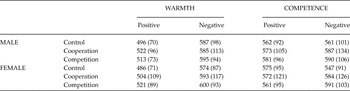
In order to check whether there were significant differences between male and female participants, we analyzed the data using a 2 (Gender) x 2 (Dimension) x 2 (Valence) x 3 (Goals) x 2 (Sex of participants) mixed ANOVA, with the first three factors as repeated measures and Goals and Sex as between groups factors. Mean RTs and standard deviations per condition are presented in Table 1.
Mean RTs and SDs (in brackets) for all the experimental conditions (independently of sex of the participant)

Results showed a main effect of the dimension on which targets were evaluated, F(1, 93) = 36.62, p < .0001, ηp 2 = .28, indicating faster RTs for warmth words (M = 556) than for competence words (M = 579). There was also a main effect of valence, F(1, 93) = 93.24, p < .0001, showing a positivity bias, that is, participants reacted faster to positive (M = 543) than negative (M = 591) traits. The valence effect could be explained as a consequence of a more systematic processing of negative traits, considering their larger informative value in impression formation (Skowronski & Carlston, Reference Skowronski and Carlston1989). Also, the primacy of the warmth dimension over the competence dimension is consistent with prior research on stereotype contents (Fiske, Cuddy, & Glick, Reference Fiske, Cuddy and Glick2007).
Regarding the sex of participants, there was a significant interaction between gender of the prime, valence, and sex of participants, F(1, 93) = 6.78, p = .01, which indicated the expected ingroup bias effect, that is, favouring the ingroup over the outgroup in the relative activation of positive and negative traits. In the case of women there was a significant interaction Gender x Valence, F(1, 93) = 4.42, p = .038, indicating faster RTs for positive traits when they were primed with female faces (M = 524) compared to male faces (M = 535), F(1, 93) = 8.05, p = .006. A similar pattern was found in the case of men, although the Gender x Valence interaction was marginal, F(1, 93) = 3.26, p = .07.
Most importantly, the significant interaction between Gender x Dimension x Valence x Goals, F(2, 93) = 3.31, p = .041, was not moderated by sex of participants, F < 1, ns. The analysis showed that the three-way interaction Gender x Dimension x Goals was significant for positive traits, F(1, 93) = 12.17, p < .001, but not for negative traits, F < 1, ns. This might be due to the salience of an interdependent context. For instance, when cooperating or competing with someone in a performance task, it might be more relevant to think in terms of whether that person is competent to achieve her goals, rather than detecting whether she is incompetent. Another possible explanation of this lack of effect for the negative traits is that only positive traits activate the whole dimensions of competence or warmth, whereas negative traits are more specific. Otherwise, the lack of effects for the negative traits might simply indicate that the negative words selected were not the most appropriate ones. Since the three-way interaction was non-significant for negative traits, these were not considered in further analyses.
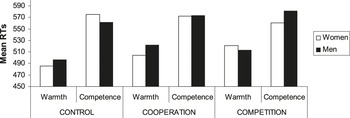
To disentangle the effects of cooperation and competition goals on the activation of gender stereotypes, we looked at the Gender x Dimension interaction for the positive traits in the three goal conditions (Figure 1).
Influence of goals on the activation of gender stereotypes with positive valence. The color of the bars indicates the prime gender.

In the control condition there was a significant interaction Gender x Dimension F(1, 93) = 6.97, p< .01, showing a classical stereotype activation pattern. Responses to competence traits were faster after a male prime than a female prime, F(1, 93) = 3.07, p = .08, whereas responses to warmth traits were faster after a female face was presented, F(1, 93) = 3.25, p = .07.
In the competition condition, there was an interaction Gender x Dimension, F(1, 93) = 9.21, p = .003, showing a reversal of the classical stereotype activation pattern found in the control condition. The analysis of the interaction showed faster RTs for positive warmth traits primed with a male face compared to a female face, F(1, 93) = 5.12, p = .026, and faster RTs for positive competence traits when they were primed with a female face compared to a male face , F(1, 93) = 3.48, p = .06.
In the cooperation condition, there was an interaction Gender x Dimension, F(1, 93) = 3.57, p = .06, indicating faster RTs for positive warmth traits when they were primed with a female face compared to a male face, F(1, 93)= 6.59, p = .01. There were no effects for the competence traits, F < 1, ns.
Discussion
The results of this research confirmed our main prediction that interdependence goals, such as interpersonal cooperation or competition, differently influence the accessibility of gender stereotypical associations. The study revealed that the content of two fundamental domains of person perception, warmth and competence, was activated as a function of the currently operating interdependence goal. In the competitive goal setting, competence traits were more strongly associated with female (vs. male) primes and warmth traits were less strongly associated with female (vs. male) primes. This result is consistent with Russell & Fiske’s (Reference Russell and Fiske2008) prediction about the influence of interdependence on warmth ratings. At the same time, it shows a compensatory pattern of activation for competence (Judd et al., Reference Judd, James-Hawkins, Yzerbyt and Kashima2005). It might be argued that anticipated competition makes the competence dimension of social perception also relevant for the perceiver (i.e., higher competence is needed in order to win the competition). Therefore, participants might activate competence as a preventive strategy before facing the opponent (i.e. not underestimating her). Thus, we could say that “we dislike our competitors, but we respect them” (Wojcziszke, Reference Wojciszke2005). In the cooperative setting the warmth traits were more strongly associated with female than male primes but there were no differences for competence traits. The activation of warmth in a cooperative setting is consistent with Russell & Fiske’s findings (2008). Further, the lack of activation of stereotypical associations on the competence dimension (i.e., women-low competence) goes in line with the contextually activated motive of performing well on the task with a cooperator. This might be due to the influence of ingroup protection and self-enhancement motives (Spencer, Fein, Wolfe, Fong, & Dunn, Reference Spencer, Fein, Wolfe, Fong and Dunn1998). Perceiving the cooperator (female student) as incompetent would simply not serve the goals of the participant. In line with this argument, our previous research has shown that when participants cooperate with a woman, who at the same time is a computer scientist, on an analytical abilities task then they strategically inhibit the stereotypically female, warmth related traits (Bukowski, Moya, de Lemus, & Szmajke, Reference Bukowski, Moya, de Lemus and Szmajke2009). In such settings it seems to be a logical strategy for the actor to “correct” the low competence stereotype of women.
Interestingly, these results show that both types of goals (cooperation and competition) influence to some extent the activation of the traditional gender stereotypes (as shown in the control condition) when a simulated interaction with a woman occurs. Whereas cooperation inhibited the women-low competence stereotype, competition completely reversed the traditional female stereotype on both competence and warmth. That is, in the competition condition, female primes activate a typically male pattern (as it would presumably occur if participants would be competing against a man). The interesting point here is that the activation of stereotypes is mainly driven by the interdependence context rather than by gender (of the cooperator/competitor). Our findings support the stereotype content model assumptions regarding the influence of interdependence goals on warmth and competence dimensions. That is, competition triggers faster responses to low warmth traits, whereas cooperation triggers faster responses to high warmth. Further, it is plausible that compensation processes are involved in the activation of competence traits, at least in the competition condition. However, they might be inhibited or controlled by other motivational factors (i.e., self-enhancement, ingroup protection) in the cooperation condition. These potential mediating processes can be considered in future research. It is also important to point out that warmth encompasses both sociability and morality related contents and previous research has shown that each component has different effects in social judgment (Brambilla, Rusconi, Sacchi, & Cherubini, Reference Brambilla, Rusconi, Sacchi and Cherubini2011). We have focused in our study only on the sociability component of warmth, given the greater relevance of those traits for gender stereotyping. However, future studies may address also the role of morality in the hypothesized pattern since it might be a very relevant dimension of social perception in a competitive context. Finally, it would be important to examine the interdependence and stereotype activation interaction using different implicit measures (e.g., semantic priming, IAT) that would provide some convergent evidence of the influence of interdependence goals on automatic activation of stereotypes and prejudice.
Summing up, we found that when competition and cooperation goals are active implicit gender stereotypical associations of warmth and competence traits can change. The content of culturally shared stereotypes seems to vary across interpersonal or intergroup contexts, which are evoked by cooperative or competitive goals. These findings provide new evidence for the malleability of stereotypical associations in line with the theoretical contributions that describe our cognitive representations of the social world as contextually situated (Blair, Reference Blair2002). It also might lead us to a better understanding of the impression formation process during a social interaction, in which stereotypical associations, perceiver’s goals and contextual information is integrated in parallel in order to build a cohesive representation of the person and situation perceived (Kunda & Thagard, Reference Kunda and Thagard1996). On a theoretical level, this leads us to a conclusion about the construction and nature of social perception, which largely relies on the type of social relations between individuals and group members. On an applied level it provides further evidence of the malleability and changeability of gender stereotypes.
This research was supported by Grants No. PSI2010-15139 from the Spanish Ministry of Science and Innovation and No. SEJ2010-6225 from the Andalusian Regional Government. The second author would like to thank the EASP for awarding a Seedcorn Grant that allowed to complete this research project.