Staphylococcus aureus is a major pathogen causing dairy cow mastitis. In control programmes, it is essential to promptly identify positive animals, to avoid the spread of infection. Bacterial identification is based on phenotypic criteria, but Staph. aureus isolates are often not consistent with the characteristic morphology described (Boerlin et al. Reference Boerlin, Kuhnert, Hüssy and Schaellibaum2003). Typically, the colonies of growth are pigmented, β-haemolytic and coagulase positive (Hogan et al. Reference Hogan, Gonzales, Harmon, Nickerson, Oliver, Pankey and Smith1999). Nevertheless, many isolates show week haemolysis and some do not express coagulase (Hogan et al. Reference Hogan, Gonzales, Harmon, Nickerson, Oliver, Pankey and Smith1999). In addition, coagulase-negative staphylococci (CNS) are often morphologically similar to Staph. aureus isolates, and display α-haemolysis (Boerlin et al. Reference Boerlin, Kuhnert, Hüssy and Schaellibaum2003).
As a consequence, further investigation of suspected colonies using molecular techniques is often needed. Several species-specific markers have been described, to confirm Staph. aureus isolates, including the coagulase gene (coa), the factor essential for expression of methicillin resistance gene (femA), the thermonuclease gene (nuc), and a chromosomal DNA insertion of 442 bp (Sa442). Both coa and femA show high polymorphism, and are unsuitable for diagnostic purposes (Schwarzkopf & Karch, Reference Schwarzkopf and Karch1994; Jayaratne & Rutherford, Reference Jayaratne and Rutherford1997). To the contrary, nuc is frequently used as a species-specific marker both in human (Costa et al. Reference Costa, Kay and Palladino2005) and veterinary isolates (Gao et al. Reference Gao, Ferreri, Liu, Chen, Su and Han2011), being highly conserved among Staph. aureus strains (Brakstad et al. Reference Brakstad, Aasbakk and Maeland1992). Nonetheless, some isolates have been reported as nuc negative by partial deletion or mutation of the nuc gene (Costa et al. Reference Costa, Kay and Palladino2005; Van Leeuwen et al. Reference Van Leeuwen, Roorda, Hendricks, Francois and Schrenzel2008). Recently, Sa442 targeting has been proposed as an alternative method to culture assays (Martineau et al. Reference Martineau, Picard, Roy, Ouellette and Bergeron1998) even though partial deletion is recognized in Sa442 among a few human strains (Klaassen et al. Reference Klaassen, Valk and Horrevorts2003; Heilman et al. Reference Heilman, Van der Zanden, Reubsaet and Wannet2004). As a consequence, the use of one gene as single marker may lead to misidentification, while incorporation of an additional species-specific marker could increase strain coverage and assay robustness (Van Leeuwen et al. Reference Van Leeuwen, Roorda, Hendricks, Francois and Schrenzel2008).
Therefore, the present study was aimed at the development of a species-specific duplex real-time PCR assay for rapid identification of Staph. aureus isolates, using both nuc and Sa442 as target genes.
Materials and Methods
Overall 140 strains, out of them 124 Staph. aureus and 16 CNS, from the culture collection of the Department, were tested. Bacterial isolates had been collected from quarter milk samples of dairy cow mastitis in 90 different herds, which were undergoing a control programme for contagious pathogens. Quarter milk (10 μl) had been plated on blood agar plate (5% bovine blood; Oxoid, Cambridge, UK) and incubated overnight at 37 °C. Colonies of growth had been isolated; the large and haemolytic ones, that were catalase and coagulase positive, were identified as Staph. aureus, as indicated elsewhere (Hogan et al. Reference Hogan, Gonzales, Harmon, Nickerson, Oliver, Pankey and Smith1999). The non-haemolytic and coagulase-positive isolates, as well as the coagulase-negative isolates morphologically resembling Staph. aureus, and all CNS were further identified by API ID32 Staph (Biomerieux, Marcy l'Etoile, France). Strains were maintained at −80 °C in Microbank Bacterial Preservation System (Thermo Fisher Scientific Inc., Waltham MA, USA) until needed. In addition, three ATCC strains were included: Staph. aureus ATCC 25923 and Staph. aureus ATCC 29213 as positive controls, Staphylococcus epidermidis ATCC 12228 as a negative control.
After thawing, strains were cultured on blood agar plates (Oxoid, Cambridge, UK); then one colony of growth was inoculated in brain heart infusion broth (Oxoid, Cambridge, UK) and grown overnight at 37 °C. DNA was extracted using Wizard Genomic DNA extraction kit (Promega Inc., Madison WI, USA) following the manufacturer's instructions, with the addition of lysostaphin (5 mg/ml; Sigma-Aldrich, St Louis MO, USA) for bacterial lysis. DNA amount and purity were tested with a ND-100 Spectrophotometer (NanoDrop Technologies Inc., Wilmington DE, USA).
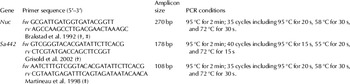
As a preliminary step, all samples were amplified in single-gene real-time PCR assay, to detect presence or absence of nuc or Sa442 genes. Real-time PCR was performed on an Opticon 2 (MJ Research, Bio-Rad, Carlsbad CA, USA), following conditions listed in Table 1. Each 20-μl reaction mixture consisted of 10 μl SsoFast EvaGreen Supermix (Bio-Rad), 0·075 μm of Sa442 primers or 0·1 μm of nuc primers, and 20 ng of genomic DNA. Specificity of the amplified PCR product was assessed by analysis of melting curves.
Primer sequence, amplicon size and PCR conditions used in single-gene real-time PCR (†) and duplex assay (‡)

Coagulase-negative Staph. aureus strains and the strains that were negative for one or both marker genes, were further characterized by sequencing a fragment of RNA polymerase (rpoB) gene, as described elsewhere (Drancourt & Raoult, Reference Drancourt and Raoult2002). Sequences were aligned using GenBank BLAST (http://blast.ncbi.nlm.nih.gov/Blast.cgi), and identification was assessed by >97% similarity with one of the database rpoB sequences.
The duplex PCR assay was performed using an Eco Real-time PCR System (Illumina Inc., San Diego CA, USA), and choosing a new primer pair for Sa442, in order to produce amplicons of sufficiently different melting temperatures. PCR conditions are listed in Table 1. Each 18-μl reaction mixture consisted of 9 μl Sso Fast EvaGreen Supermix (Bio-Rad), 0·4 μm of Sa442 primers, 0·1 μm of nuc primers and 20 ng of DNA template. Specificity of the amplified PCR product was assessed by performing high resolution melting curve analysis.
Thereafter, 40 quarter milk samples were randomly selected from 5 herds, to evaluate the possible application of the method to detect Staph. aureus directly in the milk. Half of the samples tested had been previously identified as positive for Staph. aureus by bacteriological procedures, as described above. All other samples were either bacteriologically negative, or positive for other micro-organisms. Bacterial DNA was extracted according to Cremonesi et al. (Reference Cremonesi, Castiglioni, Malferrari, Biunno, Vimercati, Moroni, Morandi and Luzzana2006), and duplex PCR assay was performed as described above.
Results
Overall, out of 124 Staph. aureus strains, 33 did not show the typical morphology or enzymic activity: 5 were coagulase-negative, 17 were weakly haemolytic and 11 were non-haemolytic. Out of 16 CNS isolates, 7 different species were identified: 3 isolates were classified as Staph. haemolyticus, 3 as Staph. chromogenes, 3 as Staph. xylosus, 2 as Staph. warneri, 2 as Staph. sciuri, 1 as Staph. epidermidis, 1 as Staph. lentus. Finally, 1 isolate was a Micrococcus sp.
Out of 124 Staph. aureus isolates, 118 isolates (95·2%) carried nuc, while 6 (4·8%) were negative. The amplicons revealed a peak at a melting temperature of 79·4 °C. Not one CNS harboured the nuc gene. When Sa442 was considered, 120 (96·8%) showed a peak in the melting temperature at 77·6 °C, while 4 strains (3·2%) gave negative results. No CNS carried the Sa442 gene.
Further characterization of coagulase-negative Staph. aureus strains and of the strains that were negative for one or both marker genes, was performed by sequencing a fragment of rpoB gene. All coagulase-negative Staph. aureus strains, and 2 strains carrying only Sa442, were confirmed as Staph. aureus. To the contrary, 4 isolates previously identified as Staph. aureus by phenotypic and biochemical characteristics, that were PCR-negative for both genes, presented 99–100% similarity with Staph. pseudintermedius (GenBank accession number CP002478·1), aligning within the rpoB gene sequence. Those strains were therefore reclassified as Staph. pseudintermedius.
According to single-gene PCR results, duplex PCR assay revealed two amplicons for 118 Staph. aureus strains, showing two peaks in the melting curve at 74·5 °C (Sa442) and 79·4 °C (nuc). In 2 strains, only the peak consistent with Sa442 was detected. Staph. pseudintermedius and CNS isolates showed weak to no amplification, with peaks in the melting curve outside the expected range of temperature, and were therefore considered negative for both genes.
Results of single-gene and duplex PCR assays are summarized in Table 2. Since all staphylococcal isolates tested in the study were correctly identified by duplex real-time PCR assay, calculated sensitivity and specificity were 100%.
Results of the identification of coagulase-positive or coagulase-negative strains tested in the study, by single-gene real-time PCR and duplex assay

When the assay was applied to quarter milk samples, 17 out of 20 samples previously diagnosed as bacteriologically positive for Staph. aureus, presented two melt-curve peaks, which were compatible with nuc and Sa442 genes; 3 samples revealed only the peak compatible with Sa442 gene. All the samples bacteriologically negative for Staph. aureus were lacking both genes. Out of such samples, 11 were sterile when tested by bacteriological analysis; CNS were detected in 3 samples; Prototheca sp. in 2 samples; Streptococcus sp. or Enterococcus faecalis in 2 samples and Serratia sp. in 1 sample; finally, 1 sample presented mixed bacterial growth and was considered as contaminated.
Discussion
It has been stated that the diagnosis of Staph. aureus based on the detection of a single species-specific gene could lead to misidentification, favouring the spread of atypical strains (Van Leeuwen et al. Reference Van Leeuwen, Roorda, Hendricks, Francois and Schrenzel2008). Furthermore, the occurrence of Staph. aureus strains lacking the nuc gene has been previously reported in milk samples collected in Northern Italy (Cremonesi et al. Reference Cremonesi, Luzzana, Brasca, Morandi, Lodi, Vimercate, Agnellini, Caramenti, Moroni and Castiglioni2005). The results of the present study showed that 2 Staph. aureus isolates would not have been identified as such, if tested by single-gene PCR for nuc. Interestingly, one of these atypical strains had been isolated in a herd during a control programme for contagious micro-organisms. In this herd, the strain detected at the beginning of the programme was a typical one, carrying both nuc and Sa442; thus, it was hypothesized that in the course of the programme a deletion of nuc gene occurred.
Even though all Staph. aureus tested in this study harboured Sa442, isolates lacking Sa442 have been reported in human clinical samples (Klaassen et al. Reference Klaassen, Valk and Horrevorts2003; Heilman et al. Reference Heilman, Van der Zanden, Reubsaet and Wannet2004); it is then presumable that such strains could also be causative agents of dairy cow mastitis.
We also reported the bacteriological misidentification of 4 Staph. pseudintermedius strains, which were morphologically and biochemically consistent with the species aureus, but tested negative for both nuc and Sa442. The consequence of such false-positive results in routine laboratory diagnosis could have been the segregation or even culling of the cows, if the herds were managing a strict control programme for contagious pathogens. Currently, no data are available in the literature regarding Staph. pseudintermedius prevalence in bovine milk. Nonetheless, the scarce data on Staph. intermedius indicate that bacteria from Staph. intermedius group are not important mastitis pathogens (Roberson et al. Reference Roberson, Fox, Hancock, Gay and Besser1996).
When applied to bacterial DNA extracted directly from milk samples, the assay correctly identified all the samples diagnosed as positive for Staph. aureus by bacteriological examination and duplex real-time PCR assay. To the contrary, no amplification curve was observed in bacteriologically negative milk or in the samples positive for a variety of other micro-organisms. As a result, the method showed 100% sensitivity and specificity also when applied to milk samples.
The use of high resolution melting analysis applied to real-time PCR with EvaGreen dye, allowed easy detection of unspecific amplifications. Therefore, this assay could be used in laboratory routine as a cost-effective and powerful tool for high-throughput identification of atypical Staph. aureus isolates causing dairy cow mastitis. Also, it could be directly applied to milk samples to detect Staph. aureus mammary infections, avoiding bacteriological analysis.